Give thanks unto the LORD, call upon his name, make known his deeds among the people. Sing unto him, sing psalms unto him, talk ye of all his wondrous works. (1 Chronicles 16:8-9 KJV)
O give thanks unto the LORD; for he is good; for his mercy endureth for ever. (1 Chronicles 16:34 KJV)
As we enter into the Thanksgiving Holiday week, with visits with family and friends, meals to prepare and eat, parades and games to watch, don’t forget to be thankful for our Creator of all this. He is Worthy of our Thanksgiving and Worship.
I am thankful for all the fantastic friends we have met through this blog (you, the readers). I am also thankful for those that contribute to the blog, like James J. S. Johnson (Dr. Jim) and Golden Eagle (Baron Brown) with which we recently went on a birdwatching adventure. Thankful for our other contributors as well.
Finally cleaned up the photos from that adventure and many are in the slideshow. Definitely thankful for all the birds the Lord gave us. He is “Worthy of Worship”
This slideshow requires JavaScript.
“Worthy of Worship” ~ Faith Baptist Orchestra
WORTHY OF WORSHIP
(York/Blankenship)
Worthy of Worship, worthy of praise,
Worthy of honor and glory,
Worthy of all the glad songs we can sing,
Worthy of all of the offerings we bring.
You are worthy, Father, Creator.
You are worthy, Savior, Sustainer.
You are worthy, worthy and wonderful;
Worthy of worship and praise.
Worthy of reverence, worthy of fear,
Worthy of love and devotion;
Worthy of bowing and bending of knees,
Worthy of all this, and added to these…
You are worthy, Father, Creator.
You are worthy, Savior, Sustainer.
You are worthy, worthy and wonderful;
Worthy of worship and praise.
Almighty Father, Master, and Lord,
King of all kings and Redeemer,
Wonderful Counselor, Comforter, Friend,
Savior and Source of our life without end.
You are worthy, Father, Creator.
You are worthy, Savior, Sustainer.
You are worthy, worthy and wonderful;
Worthy of worship and praise.
CHAPTER 5. Peter Learns Something He Hadn’t Guessed.
Running over to the Old Orchard very early in the morning for a little gossip with Jenny Wren and his other friends there had become a regular thing with Peter Rabbit. He was learning a great many things, and some of them were most surprising.
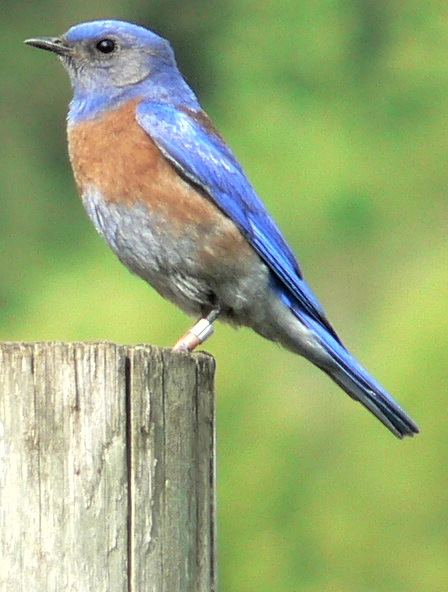
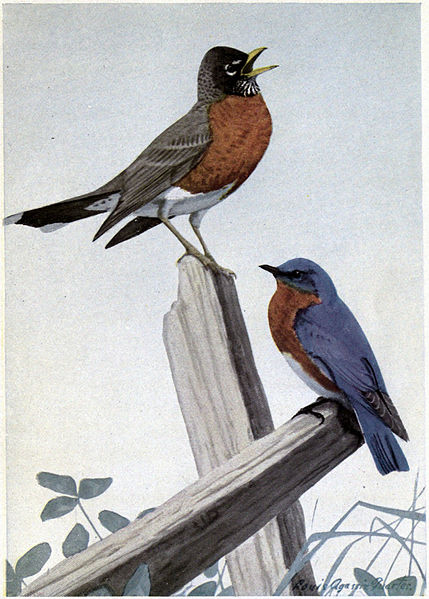
Now two of Peter’s oldest and best friends in the Old Orchard were Winsome Bluebird and Welcome Robin. Every spring they arrived pretty nearly together, though Winsome Bluebird usually was a few days ahead of Welcome Robin. This year Winsome had arrived while the snow still lingered in patches. He was, as he always is, the herald of sweet Mistress Spring. And when Peter had heard for the first time Winsome’s soft, sweet whistle, which seemed to come from nowhere in particular and from everywhere in general, he had kicked up his long hind legs from pure joy. Then, when a few days later he had heard Welcome Robin’s joyous message of “Cheer-up! Cheer-up! Cheer-up! Cheer-up! Cheer!” from the tiptop of a tall tree, he had known that Mistress Spring really had arrived.
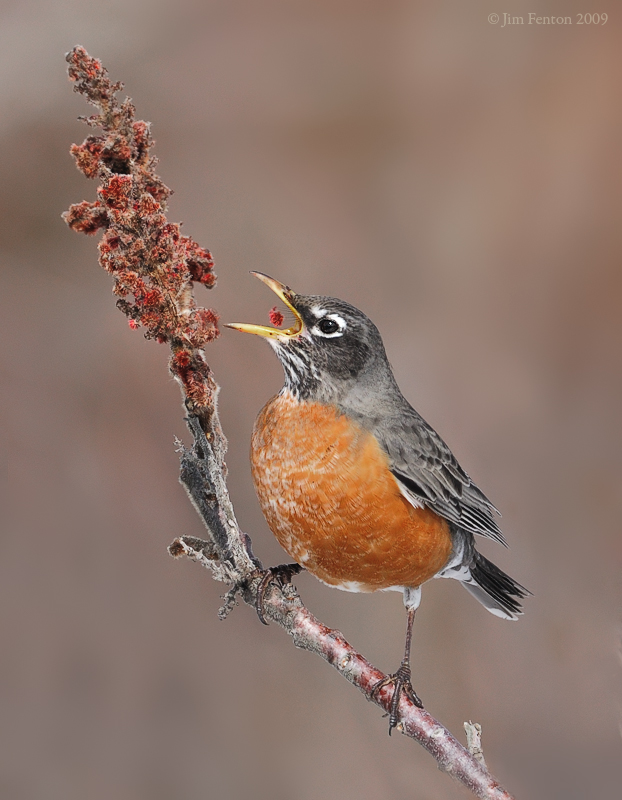
Robin Eating by Jim Fenton
Peter loves Winsome Bluebird and Welcome Robin, just as everybody else does, and he had known them so long and so well that he thought he knew all there was to know about them. He would have been very indignant had anybody told him he didn’t.
“Those cousins don’t look much alike, do they?” remarked Jenny Wren, as she poked her head out of her house to gossip with Peter.
“What cousins?” demanded Peter, staring very hard in the direction in which Jenny Wren was looking.
“Those two sitting on the fence over there. Where are your eyes, Peter?” replied Jenny rather sharply.
Peter stared harder than ever. On one post sat Winsome Bluebird, and on another post sat Welcome Robin. “I don’t see anybody but Winsome and Welcome, and they are not even related,” replied Peter with a little puzzled frown.
“Tut, tut, tut, tut, tut, Peter!” exclaimed Jenny Wren. “Tut, tut, tut, tut, tut! Who told you any such nonsense as that? Of course they are related. They are cousins. I thought everybody knew that. They belong to the same family that Melody the Thrush and all the other Thrushes belong to. That makes them all cousins.”
“What?” exclaimed Peter, looking as if he didn’t believe a word of what Jenny Wren had said. Jenny repeated, and still Peter looked doubtful.
Then Jenny lost her temper, a thing she does very easily. “If you don’t believe me, go ask one of them,” she snapped, and disappeared inside her house, where Peter could hear her scolding away to herself.
The more he thought of it, the more this struck Peter as good advice. So he hopped over to the foot of the fence post on which Winsome Bluebird was sitting. “Jenny Wren says that you and Welcome Robin are cousins. She doesn’t know what she is talking about, does she?” asked Peter.
Winsome chuckled. It was a soft, gentle chuckle. “Yes,” said he, nodding his head, “we are. You can trust that little busybody to know what she is talking about, every time. I sometimes think she knows more about other people’s affairs than about her own. Welcome and I may not look much alike, but we are cousins just the same. Don’t you think Welcome is looking unusually fine this spring?”
“Not a bit finer than you are yourself, Winsome,” replied Peter politely. “I just love that sky-blue coat of yours. What is the reason that Mrs. Bluebird doesn’t wear as bright a coat as you do?”
“Go ask Jenny Wren,” chuckled Winsome Bluebird, and before Peter could say another word he flew over to the roof of Farmer Brown’s house.
Back scampered Peter to tell Jenny Wren that he was sorry he had doubted her and that he never would again. Then he begged Jenny to tell him why it was that Mrs. Bluebird was not as brightly dressed as was Winsome.
“Mrs. Bluebird, like most mothers, is altogether too busy to spend much time taking care of her clothes; and fine clothes need a lot of care,” replied Jenny. “Besides, when Winsome is about he attracts all the attention and that gives her a chance to slip in and out of her nest without being noticed. I don’t believe you know, Peter Rabbit, where Winsome’s nest is.”
Peter had to admit that he didn’t, although he had tried his best to find out by watching Winsome. “I think it’s over in that little house put up by Farmer Brown’s boy,” he ventured. “I saw both Mr. and Mrs. Bluebird go in it when they first came, and I’ve seen Winsome around it a great deal since, so I guess it is there.”
“So you guess it is there!” mimicked Jenny Wren. “Well, your guess is quite wrong, Peter; quite wrong. As a matter of fact, it is in one of those old fence posts. But just which one I am not going to tell you. I will leave that for you to find out. Mrs. Bluebird certainly shows good sense. She knows a good house when she sees it. The hole in that post is one of the best holes anywhere around here. If I had arrived here early enough I would have taken it myself. But Mrs. Bluebird already had her nest built in it and four eggs there, so there was nothing for me to do but come here. Just between you and me, Peter, I think the Bluebirds show more sense in nest building than do their cousins the Robins. There is nothing like a house with stout walls and a doorway just big enough to get in and out of comfortably.”
Peter nodded quite as if he understood all about the advantages of a house with walls. “That reminds me,” said he. “The other day I saw Welcome Robin getting mud and carrying it away. Pretty soon he was joined by Mrs. Robin, and she did the same thing. They kept it up till I got tired of watching them. What were they doing with that mud?”
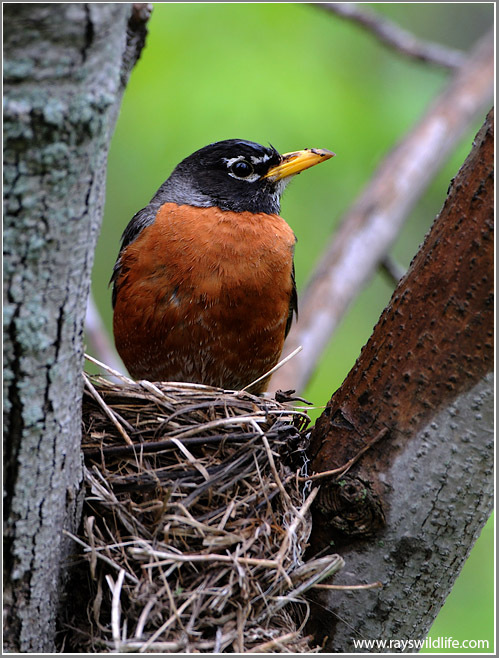
American Robin (Turdus migratorius) in nest by Ray
“Building their nest, of course, stupid,” retorted Jenny. “Welcome Robin, with that black head, beautiful russet breast, black and white throat and yellow bill, not to mention the proud way in which he carries himself, certainly is a handsome fellow, and Mrs. Robin is only a little less handsome. How they can be content to build the kind of home they do is more than I can understand. People think that Mr. Wren and I use a lot of trash in our nest. Perhaps we do, but I can tell you one thing, and that is it is clean trash. It is just sticks and clean straws, and before I lay my eggs I see to it that my nest is lined with feathers. More than this, there isn’t any cleaner housekeeper than I am, if I do say it.
“Welcome Robin is a fine looker and a fine singer, and everybody loves him. But when it comes to housekeeping, he and Mrs. Robin are just plain dirty. They make the foundation of their nest of mud,—plain, common, ordinary mud. They cover this with dead grass, and sometimes there is mighty little of this over the inside walls of mud. I know because I’ve seen the inside of their nest often. Anybody with any eyes at all can find their nest. More than once I’ve known them to have their nest washed away in a heavy rain, or have it blown down in a high wind. Nothing like that ever happens to Winsome Bluebird or to me.”
Jenny disappeared inside her house, and Peter waited for her to come out again. Welcome Robin flew down on the ground, ran a few steps, and then stood still with his head on one side as if listening. Then he reached down and tugged at something, and presently out of the ground came a long, wriggling angleworm. Welcome gulped it down and ran on a few steps, then once more paused to listen. This time he turned and ran three or four steps to the right, where he pulled another worm out of the ground.
“He acts as if he heard those worms in the ground,” said Peter, speaking aloud without thinking.
“He does,” said Jenny Wren, poking her head out of her doorway just as Peter spoke. “How do you suppose he would find them when they are in the ground if he didn’t hear them?”
“Can you hear them?” asked Peter.
“I’ve never tried, and I don’t intend to waste my time trying,” retorted Jenny. “Welcome Robin may enjoy eating them, but for my part I want something smaller and daintier, young grasshoppers, tender young beetles, small caterpillars, bugs and spiders.”
Peter had to turn his head aside to hide the wry face he just had to make at the mention of such things as food. “Is that all Welcome Robin eats?” he asked innocently.
“I should say not,” laughed Jenny. “He eats a lot of other kinds of worms, and he just dearly loves fruit like strawberries and cherries and all sorts of small berries. Well, I can’t stop here talking any longer. I’m going to tell you a secret, Peter, if you’ll promise not to tell.”
Of course Peter promised, and Jenny leaned so far down that Peter wondered how she could keep from falling as she whispered, “I’ve got seven eggs in my nest, so if you don’t see much of me for the next week or more, you’ll know why. I’ve just got to sit on those eggs and keep them warm.”
*
*
What bird family do the Bluebird and Robin belong to?
Why is it good that Mrs. Bluebird isn’t brightly dressed?
When the Robin runs and then stops, what is he doing? What might he find to eat?
What colors are the Robin’s head, breast, throat and bill?
What does the Robin’s song sound like?
Should we have an attitude like the Robin’s Song?
“Is anyone among you suffering? Then he must pray. Is anyone cheerful? He is to sing praises. (James 5:13 NASB)
“A joyful heart makes a cheerful face, But when the heart is sad, the spirit is broken. (Proverbs 15:13 NASB)
“Even the stork in the sky Knows her seasons; And the turtledove and the swift and the thrush Observe the time of their migration; But My people do not know The ordinance of the LORD. (Jeremiah 8:7 NASB)
There once was a turkey named Reginald who lived in the backwoods of Louisiana. Every year Reginald would band together with many other turkeys in a secret fortress underground to protect themselves from hunters hunting for turkeys to eat on Thanksgiving. Reginald and his friends had built the fortress a long time ago.
Reginald could tell it was Thanksgiving when one day he saw many hunters lurking in the backwoods searching for a turkey to eat on that special day. Reginald quickly went home to grab his Army helmet which he used as protection from gun shots, and called all his friends to their special underground fortress.
Many turkeys came prepared for the day. Most of them wore their Army helmets. Many other turkeys were there as well. They had brought food for Thanksgiving. Not just people celebrated Thanksgiving, turkeys did too, but without the turkey.
Soon there was a big party going on in the fortress. Not one hunter was aware that all the turkeys in the backwoods were in the underground fortress. The turkeys were joyously celebrating Thanksgiving. They were very thankful they were not “on the menu” that day.
Reginald was happy that the hunters could not find any turkeys. All the hunters eventually had to go to the grocery store to get a turkey, and every hunter from the backwoods hates to go to the grocery store and buy a turkey.
Soon Thanksgiving was over, and all the turkeys rejoiced. Even so, Reginald always made sure his Army helmet was where he needed it in case a hunter was nearby.
The End
Lee’s Addition:
“… But every man hath his proper gift of God, one after this manner, and another after that. (1 Corinthians 7:7b KJV)
“Now there are diversities of gifts, but the same Spirit. (1 Corinthians 12:4 KJV)
Emma has given us another great Bird Tale. I have been holding this for a while, waiting to get closer to Thanksgiving, but it is too adorable to hold any longer. So, it’s a little early, but ENJOY!
I keep encouraging her to write a tale for us, because she is developing into a gifted author. May we all encourage our young people to develop whatever talent the Lord has given them.
Maybe we can get a follow-up on Reginald and his friends.
Reginald – (Wild Turkey by Daves BirdingPix)
Reginald, Turkey Commander
By Emma Foster
There once was a turkey named Reginald who lived in the backwoods of Louisiana. Every year Reginald would band together with many other turkeys in a secret fortress underground to protect themselves from hunters hunting for turkeys to eat on Thanksgiving. Reginald and his friends had built the fortress a long time ago.
Reginald could tell it was Thanksgiving when one day he saw many hunters lurking in the backwoods searching for a turkey to eat on that special day. Reginald quickly went home to grab his Army helmet which he used as protection from gun shots, and called all his friends to their special underground fortress.
Many turkeys came prepared for the day. Most of them wore their Army helmets. Many other turkeys were there as well. They had brought food for Thanksgiving. Not just people celebrated Thanksgiving, turkeys did too, but without the turkey.
Soon there was a big party going on in the fortress. Not one hunter was aware that all the turkeys in the backwoods were in the underground fortress. The turkeys were joyously celebrating Thanksgiving. They were very thankful they were not “on the menu” that day.
Reginald was happy that the hunters could not find any turkeys. All the hunters eventually had to go to the grocery store to get a turkey, and every hunter from the backwoods hates to go to the grocery store and buy a turkey.
Soon Thanksgiving was over, and all the turkeys rejoiced. Even so, Reginald always made sure his Army helmet was where he needed it in case a hunter was nearby.
The End
Lee’s Addition:
“… But every man hath his proper gift of God, one after this manner, and another after that. (1 Corinthians 7:7b KJV)
“Now there are diversities of gifts, but the same Spirit. (1 Corinthians 12:4 KJV)
Emma has given us another great Bird Tale. I have been holding this for a while, waiting to get closer to Thanksgiving, but it is too adorable to hold any longer. So, it’s a little early, but ENJOY!
I keep encouraging her to write a tale for us, because she is developing into a gifted author. May we all encourage our young people to develop whatever talent the Lord has given them.
Maybe we can get a follow-up on Reginald and his friends.
“He taketh the wise in their own craftiness: and the counsel of the froward is carried headlong.” Job 5:13
Why do giraffes have long necks or kangaroos have pouches? Evolutionists answer that natural selection has favored the development of certain characteristics while discouraging and eliminating other features. But if this is what happened, we who believe in creation have a few questions.
Giraffe skeleton on exhibit at The Museum of Osteology, Oklahoma City, Oklahoma. (PD)
Giraffes have long necks, say evolutionists, because conditions favored the development of long-necked creatures that could feed on higher parts of the tree. But then many other grazing animals live side by side with giraffes and manage to get by. The horse, according to evolutionary explanations, has crowned teeth in order to survive in its environment. And yet the cow, with its uncrowned teeth, survives quite well in the same environment.
Some evolutionists say that plants developed berries so that their seeds, inside the berries, would be carried far and wide by hungry birds, thus ensuring the plants’ survival. Why then did some plants develop poisonous berries? And if the maternal instinct evolved to preserve the next generation, why do creatures like the stickleback fish, seahorse, and midwife toad, to name a few, leave total care of the young to the male?
The truth is that natural selection does not offer a clear and consistent explanation for the living world. The diversity of the created world does not bear witness to evolutionary principles, but to the artistry of our Creator God.
Prayer:
Dear Father, You confound those who are wise in their own hearts and give wisdom and clear vision to those Whom You have made pure through the blood of Christ. Let the wisdom and vision I seek be that which You provide. In Jesus’ Name. Amen.
Our Men’s Quartet added an extra voice last Sunday night and sung a very powerful song.
Before I say more about that, an interesting application can be made. The voices of a quartet, any singing group or a choir are made up of a variety of voices. Some sing base, tenor, alto, baritone, soprano, but those like me, “off-key”, don’t join them. But notice how they blend to make such beautiful music.
Likewise our birds the Creator gave us come in much variety, each with different looks, heights, purposes, habitat they dwell in, and voices. Yet, when you walk through a park, woods, or other place you go birdwatching, they seem to blend together to make music. Most times it is very pleasing, but there are times, some of those “off-key” birds sound off.
We all come in a variety of talents, voices, gifts, personalities, yet when we use them for the Lord’s service, they come together to make great “music” That all is true as long as we know the Lord as our Savior. Please listen to the words of the song, and I pray that you will not be “One Day Too Late.”
This slideshow requires JavaScript.
“Marvel not that I said unto thee, Ye must be born again.” (John 3:7 KJV)
“One Day Too Late.” – Men’s Quartet + 1 – Faith Baptist Church
“For God so loved the world, that he gave his only begotten Son, that whosoever believeth in him should not perish, but have everlasting life. For God sent not his Son into the world to condemn the world; but that the world through him might be saved.
He that believeth on him is not condemned: but he that believeth not is condemned already, because he hath not believed in the name of the only begotten Son of God.
And this is the condemnation, that light is come into the world, and men loved darkness rather than light, because their deeds were evil. For every one that doeth evil hateth the light, neither cometh to the light, lest his deeds should be reproved.
But he that doeth truth cometh to the light, that his deeds may be made manifest, that they are wrought in God.” (John 3:16-21 KJV)
And they sung a new song, saying, Thou art worthy to take the book, and to open the seals thereof: for thou wast slain, and hast redeemed us to God by thy blood out of every kindred, and tongue, and people, and nation; (Revelation 5:9 KJV)
For a while Jenny Wren was too busy to talk save to scold Mr. Wren for spending so much time singing instead of working. To Peter it seemed as if they were trying to fill that tree trunk with rubbish. “I should think they had enough stuff in there for half a dozen nests,” muttered Peter. “I do believe they are carrying it in for the fun of working.” Peter wasn’t far wrong in this thought, as he was to discover a little later in the season when he found Mr. Wren building another nest for which he had no use.
Finding that for the time being he could get nothing more from Jenny Wren, Peter hopped over to visit Johnny Chuck, whose home was between the roots of an old apple-tree in the far corner of the Old Orchard. Peter was still thinking of the Sparrow family; what a big family it was, yet how seldom any of them, excepting Bully the English Sparrow, were to be found in the Old Orchard.
“Hello, Johnny Chuck!” cried Peter, as he discovered Johnny sitting on his doorstep. “You’ve lived in the Old Orchard a long time, so you ought to be able to tell me something I want to know. Why is it that none of the Sparrow family excepting that noisy nuisance, Bully, build in the trees of the Old Orchard? Is it because Bully has driven all the rest out?”
Johnny Chuck shook his head. “Peter,” said he, “whatever is the matter with your ears? And whatever is the matter with your eyes?”
“Nothing,” replied Peter rather shortly. “They are as good as yours any day, Johnny Chuck.”
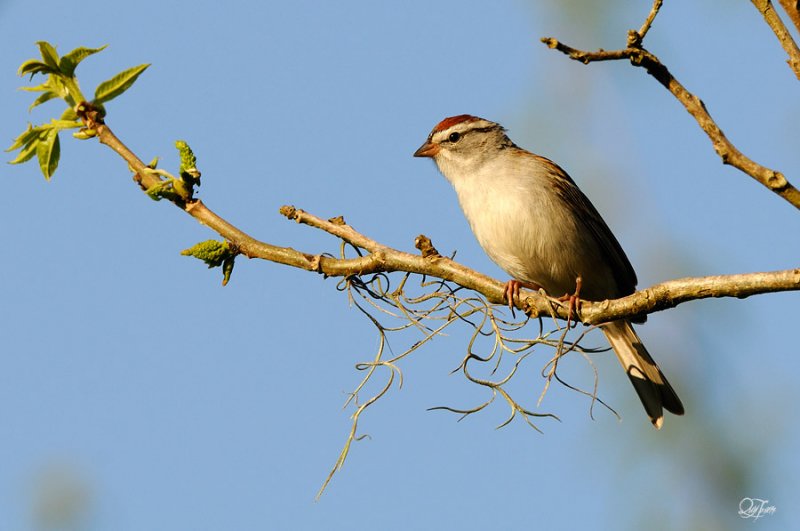
Johnny grinned. “Listen!” said Johnny. Peter listened. From a tree just a little way off came a clear “Chip, chip, chip, chip.” Peter didn’t need to be told to look. He knew without looking who was over there. He knew that voice for that of one of his oldest and best friends in the Old Orchard, a little fellow with a red-brown cap, brown back with feathers streaked with black, brownish wings and tail, a gray waistcoat and black bill, and a little white line over each eye—altogether as trim a little gentleman as Peter was acquainted with. It was Chippy, as everybody calls the Chipping Sparrow, the smallest of the family.
Chipping Sparrow (Spizella passerina) by Daves BirdingPix
Peter looked a little foolish. “I forgot all about Chippy,” said he. “Now I think of it, I have found Chippy here in the Old Orchard ever since I can remember. I never have seen his nest because I never happened to think about looking for it. Does he build a trashy nest like his cousin, Bully?”
Johnny Chuck laughed. “I should say not!” he exclaimed. “Twice Chippy and Mrs. Chippy have built their nest in this very old apple-tree. There is no trash in their nest, I can tell you! It is just as dainty as they are, and not a bit bigger than it has to be. It is made mostly of little fine, dry roots, and it is lined inside with horse-hair.”
“What’s that?” Peter’s voice sounded as it he suspected that Johnny Chuck was trying to fool him.
“It’s a fact,” said Johnny, nodding his head gravely. “Goodness knows where they find it these days, but find it they do. Here comes Chippy himself; ask him.”
Chippy and Mrs. Chippy came flitting from tree to tree until they were on a branch right over Peter and Johnny. “Hello!” cried Peter. “You folks seem very busy. Haven’t you finished building your nest yet?”
“Nearly,” replied Chippy. “It is all done but the horsehair. We are on our way up to Farmer Brown’s barnyard now to look for some. You haven’t seen any around anywhere, have you?”
Peter and Johnny shook their heads, and Peter confessed that he wouldn’t know horsehair if he saw it. He often had found hair from the coats of Reddy Fox and Old Man Coyote and Digger the Badger and Lightfoot the Deer, but hair from the coat of a horse was altogether another matter.
“It isn’t hair from the coat of a horse that we want,” cried Chippy, as he prepared to fly after Mrs. Chippy. “It is long hair from the tail or mane of a horse that we must have. It makes the very nicest kind of lining for a nest.”
Chippy and Mrs. Chippy were gone a long time, but when they did return each was carrying a long black hair. They had found what they wanted, and Mrs. Chippy was in high spirits because, as she took pains to explain to Peter, that little nest would not soon be ready for the four beautiful little blue eggs with black spots on one end she meant to lay in it.
“I just love Chippy and Mrs. Chippy,” said Peter, as they watched their two little feathered friends putting the finishing touches to the little nest far out on a branch of one of the apple-trees.
“Everybody does,” replied Johnny. “Everybody loves them as much as they hate Bully and his wife. Did you know that they are sometimes called Tree Sparrows? I suppose it is because they so often build their nests in trees?”
“No,” said Peter, “I didn’t. Chippy shouldn’t be called Tree Sparrow, because he has a cousin by that name.”
Johnny Chuck looked as if he doubted that, “I never heard of him,” he grunted.
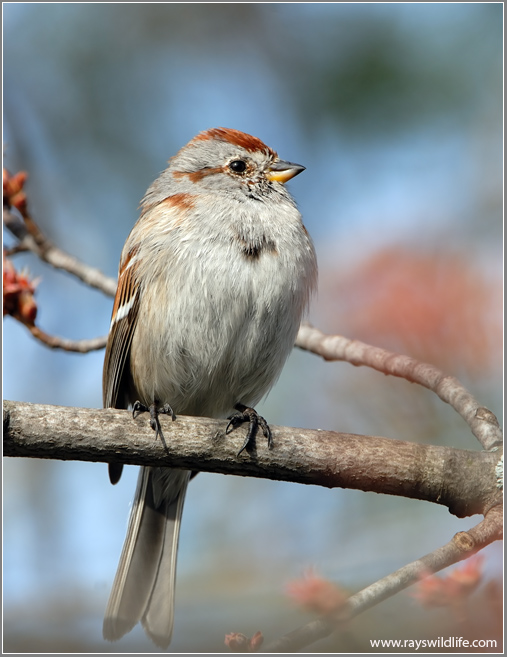
Peter grinned. Here was a chance to tell Johnny Chuck something, and Peter never is happier than when he can tell folks something they don’t know. “You’d know him if you didn’t sleep all winter,” said Peter. “Dotty the Tree Sparrow spends the winter here. He left for his home in the Far North about the time you took it into your head to wake up.”
“Why do you call him Dotty?” asked Johnny Chuck.
“Because he has a little round black dot right in the middle of his breast,” replied Peter. “I don’t know why they call him Tree Sparrow; he doesn’t spend his time in the trees the way Chippy does, but I see him much oftener in low bushes or on the ground. I think Chippy has much more right to the name of Tree Sparrow than Dotty has. Now I think of it, I’ve heard Dotty called the Winter Chippy.”
“Gracious, what a mix-up!” exclaimed Johnny Chuck. “With Chippy being called a Tree Sparrow and a Tree Sparrow called Chippy, I should think folks would get all tangled up.”
“Perhaps they would,” replied Peter, “if both were here at the same time, but Chippy comes just as Dotty goes, and Dotty comes as Chippy goes. That’s a pretty good arrangement, especially as they look very much alike, excepting that Dotty is quite a little bigger than Chippy and always has that black dot, which Chippy does not have. Goodness gracious, it is time I was back in the dear Old Briar-patch! Good-by, Johnny Chuck.”
American Tree Sparrow by Ray
Away went Peter Rabbit, lipperty-lipperty-lip, heading for the dear Old Briar-patch. Out of the grass just ahead of him flew a rather pale, streaked little brown bird, and as he spread his tail Peter saw two white feathers on the outer edges. Those two white feathers were all Peter needed to recognize another little friend of whom he is very fond. It was Sweetvoice the Vesper Sparrow, the only one of the Sparrow family with white feathers in his tail.
“Come over to the dear Old Briar-patch and sing to me,” cried Peter.
Sweetvoice dropped down into the grass again, and when Peter came up, was very busy getting a mouthful of dry grass. “Can’t,” mumbled Sweetvoice. “Can’t do it now, Peter Rabbit. I’m too busy. It is high time our nest was finished, and Mrs. Sweetvoice will lose her patience if I don’t get this grass over there pretty quick.”
“Where is your nest; in a tree?” asked Peter innocently.
“That’s telling,” declared Sweetvoice. “Not a living soul knows where that nest is, excepting Mrs. Sweetvoice and myself. This much I will tell you, Peter: it isn’t in a tree. And I’ll tell you this much more: it is in a hoofprint of Bossy the Cow.”
“In a WHAT?” cried Peter.
“In a hoofprint of Bossy the Cow,” repeated Sweetvoice, chuckling softly. “You know when the ground was wet and soft early this spring, Bossy left deep footprints wherever she went. One of these makes the nicest kind of place for a nest. I think we have picked out the very best one on all the Green Meadows. Now run along, Peter Rabbit, and don’t bother me any more. I’ve got too much to do to sit here talking. Perhaps I’ll come over to the edge of the dear Old Briar-patch and sing to you a while just after jolly, round, red Mr. Sun goes to bed behind the Purple Hills. I just love to sing then.”
“I’ll be watching for you,” replied Peter. “You don’t love to sing any better than I love to hear you. I think that is the best time of all the day in which to sing. I mean, I think it’s the best time to hear singing,” for of course Peter himself does not sing at all.
That night, sure enough, just as the Black Shadows came creeping out over the Green Meadows, Sweetvoice, perched on the top of a bramble-bush over Peter’s head, sang over and over again the sweetest little song and kept on singing even after it was quite dark. Peter didn’t know it, but it is this habit of singing in the evening which has given Sweetvoice his name of Vesper Sparrow.
“Serve the LORD with gladness: come before his presence with singing.” (Psalms 100:2 KJV)
*
Who was the first new Sparrow we meet?
What were they busy doing?
Their nest was being built with what material?
What was the one thing needed to finish their nest?
*
Who was the next Sparrow that showed up?
Why did it confuse Johnny Chuck?
Why did the name “Dotty” fit for that sparrow?
Was Dotty or Chippy larger?
*
Sweetvoice is what kind of Sparrow?
What were these Sparrows making their nest out of?
Where was their nest?
When does Sweetvoice like to sing?
*
Are you busy doing the things that need to done? Do you sing? Most thought better of Chippy than Bully. Are more like Chippy or Bully?
Speaking to yourselves in psalms and hymns and spiritual songs, singing and making melody in your heart to the Lord; Giving thanks always for all things unto God and the Father in the name of our Lord Jesus Christ;
(Ephesians 5:19-20 KJV)
A Psalm. A Song for the Sabbath Day. It is good to give thanks to the LORD, And to sing praises to Your name, O Most High; To declare Your lovingkindness in the morning, And Your faithfulness every night, (Psalms 92:1-2 NKJV)
Even though our vacation didn’t go according to “our” schedule, the Lord gave us some great blessings. He, the Lord, had a way of placing the right people in our path to help us. Only He could orchestrate those encounters. May we never forget to give the Lord credit for his blessings to us.
We were able to still see Patriots Point and Magnolia Plantation in Charleston, Merritt Island NWR, Brevard Zoo and the Viera Wetlands and the nearby Click Ponds. The slide show has some photos from those places.
** Some how I forgot to finish this Sunday Inspiration. We took our vacation several months ago. The song Sean is playing, “It Is Well With My Soul” seems to be even more appropriate today. I have been dealing with a walking and now pain issue. I start two days a week of physical therapy next week for almost two months. As I told the therapist Friday, “even though I am dealing with all this, I am trying to maintain a good attitude.” How can I do that? Because, It Is Well With My Soul.” I know the forgiveness for my sins because of the Lord Jesus Christ’s death on the cross for my sins and yours. Have you asked for His forgiveness? Please keep me in your prayers and Sean, also. He needs it more as he is dealing with Lymphoma.
“For God so loved the world, that he gave his only begotten Son, that whosoever believeth in him should not perish, but have everlasting life. For God sent not his Son into the world to condemn the world; but that the world through him might be saved.” (John 3:16-17 KJV)
CHAPTER 3. Jenny Has a Good Word for Some Sparrows.
The morning after the fight between Jenny and Mr. Wren and Bully the English Sparrow found Peter Rabbit in the Old Orchard again. He was so curious to know what Jenny Wren would do for a house that nothing but some very great danger could have kept him away from there. Truth to tell, Peter was afraid that not being able to have their old house, Jenny and Mr. Wren would decide to leave the Old Orchard altogether. So it was with a great deal of relief that as he hopped over a low place in the old stone wall he heard Mr. Wren singing with all his might.
The song was coming from quite the other side of the Old Orchard from where Bully and Mrs. Bully had set up housekeeping. Peter hurried over. He found Mr. Wren right away, but at first saw nothing of Jenny. He was just about to ask after her when he caught sight of her with a tiny stick in her bill. She snapped her sharp little eyes at him, but for once her tongue was still. You see, she couldn’t talk and carry that stick at the same time. Peter watched her and saw her disappear in a little hole in a big branch of one of the old apple-trees. Hardly had she popped in than she popped out again. This time her mouth was free, and so was her tongue.
“You’d better stop singing and help me,” she said to Mr. Wren sharply. Mr. Wren obediently stopped singing and began to hunt for a tiny little twig such as Jenny had taken into that hole.
“Well!” exclaimed Peter. “It didn’t take you long to find a new house, did it?”
“Certainly not,” snapped Jenny “We can’t afford to sit around wasting time like some folk I know.”
Peter grinned and looked a little foolish, but he didn’t resent it. You see he was quite used to that sort of thing. “Aren’t you afraid that Bully will try to drive you out of that house?” he ventured.
Jenny Wren’s sharp little eyes snapped more than ever. “I’d like to see him try!” said she. “That doorway’s too small for him to get more than his head in. And if he tries putting his head in while I’m inside, I’ll peck his eyes out! She said this so fiercely that Peter laughed right out.
“I really believe you would,” said he.
“I certainly would,” she retorted. “Now I can’t stop to talk to you, Peter Rabbit, because I’m too busy. Mr. Wren, you ought to know that that stick is too big.” Jenny snatched it out of Mr. Wren’s mouth and dropped it on the ground, while Mr. Wren meekly went to hunt for another. Jenny joined him, and as Peter watched them he understood why Jenny is so often spoken of as a feathered busybody.
For some time Peter Rabbit watched Jenny and Mr. Wren carry sticks and straws into that little hole until it seemed to him they were trying to fill the whole inside of the tree. Just watching them made Peter positively tired. Mr. Wren would stop every now and then to sing, but Jenny didn’t waste a minute. In spite of that she managed to talk just the same.
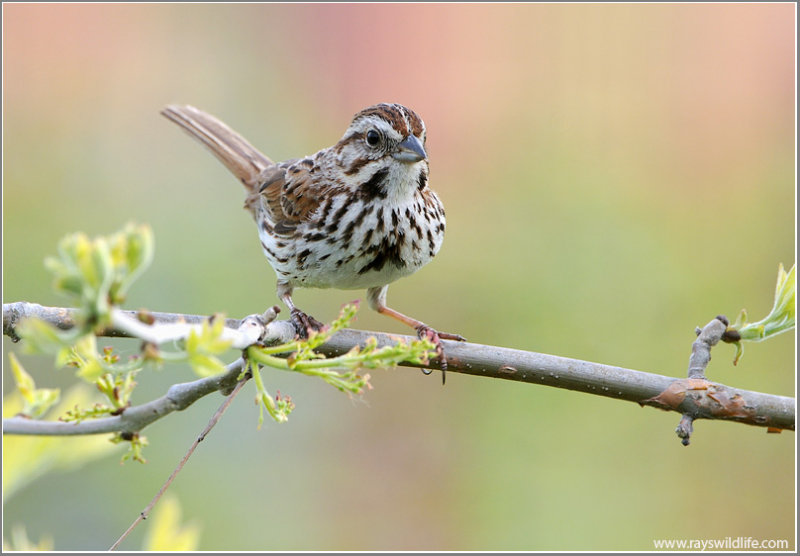
Song Sparrow by Ray
“I suppose Little Friend the Song Sparrow got here some time ago,” said she.
Peter nodded. “Yes,” said he. “I saw him only a day or two ago over by the Laughing Brook, and although he wouldn’t say so, I’m sure that he has a nest and eggs already.”
Jenny Wren jerked her tail and nodded her head vigorously. “I suppose so,” said she. “He doesn’t have to make as long a journey as we do, so he gets here sooner. Did you ever in your life see such a difference as there is betweenLittle Friend and his cousin, Bully? Everybody loves Little Friend.”
Once more Peter nodded. “That’s right,” said he. “Everybody does love Little Friend. It makes me feel sort of all glad inside just to hear him sing. I guess it makes everybody feel that way. I wonder why we so seldom see him up here in the Old Orchard.”
“Because he likes damp places with plenty of bushes better,” replied Jenny Wren. “It wouldn’t do for everybody to like the same kind of a place. He isn’t a tree bird, anyway. He likes to be on or near the ground. You will never find his nest much above the ground, not more than a foot or two. Quite often it is on the ground. Of course I prefer Mr. Wren’s song, but I must admit that Little Friend has one of the happiest songs of any one I know. Then, too, he is so modest, just like us Wrens.”
Peter turned his head aside to hide a smile, for if there is anybody who delights in being both seen and heard it is Jenny Wren, while Little Friend the Song Sparrow is shy and retiring, content to make all the world glad with his song, but preferring to keep out of sight as much as possible.
Jenny chattered on as she hunted for some more material for her nest. “I suppose you’ve noticed,” said she, “that he and his wife dress very much alike. They don’t go in for bright colors any more than we Wrens do. They show good taste. I like the little brown caps they wear, and the way their breasts and sides are streaked with brown. Then, too, they are such useful folks. It is a pity that that nuisance of a Bully doesn’t learn something from them. I suppose they stay rather later than we do in the fall.”
“Yes,” replied Peter. “They don’t go until Jack Frost makes them. I don’t know of any one that we miss more than we do them.”
“Speaking of the sparrow family, did you see anything of Whitethroat?” asked Jenny Wren, as she rested for a moment in the doorway of her new house and looked down at Peter Rabbit.
Peter’s face brightened. “I should say I did!” he exclaimed. “He stopped for a few days on his way north. I only wish he would stay here all the time. But he seems to think there is no place like the Great Woods of the North. I could listen all day to his song. Do you know what he always seems to be saying?”
Jenny nodded in her usual emphatic way. “I don’t know him as well as I do some of the others,” said she, “but when I have seen him down in the South he always has appeared to me to be a perfect gentleman. He is social, too; he likes to travel with others.”
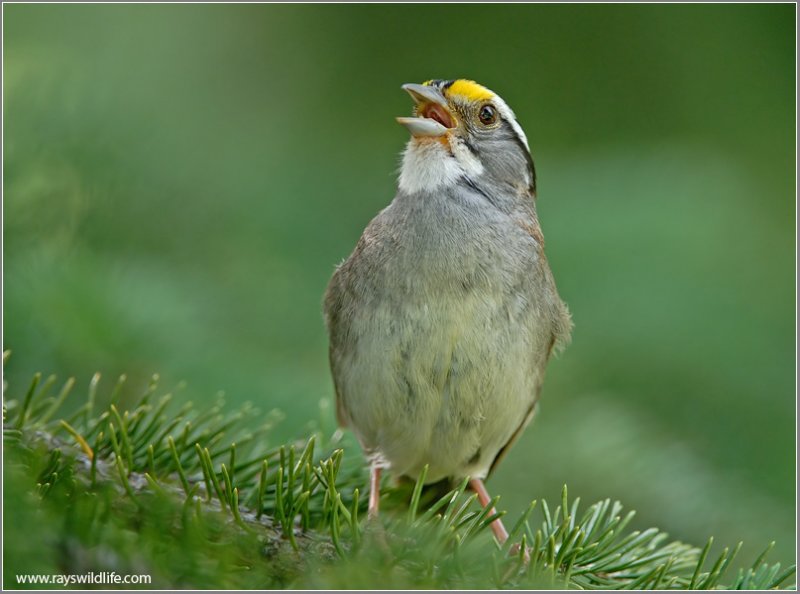
“I’ve noticed that,” said Peter. “He almost always has company when he passes through here. Some of those Sparrows are so much alike that it is hard for me to tell them apart, but I can always tell Whitethroat because he is one of the largest of the tribe and has such a lovely white throat. He really is handsome with his black and white cap and that bright yellow spot before each eye. I am told that he is very dearly loved up in the north where he makes his home. They say he sings all the time.”
Fox Sparrow (Passerella iliaca) by Ray
“I suppose Scratcher the Fox Sparrow has been along too,” said Jenny. “He also started sometime before we did.”
“Yes,” replied Peter. “He spent one night in the dear Old Briar-patch. He is fine looking too, the biggest of all the Sparrow tribe, and HOW he can sing. The only thing I’ve got against him is the color of his coat. It always reminds me of Reddy Fox, and I don’t like anything that reminds me of that fellow. When he visited us I discovered something about Scratcher which I don’t believe you know.”
“What?” demanded Jenny rather sharply.
“That when he scratches among the leaves he uses both feet at once,” cried Peter triumphantly. “It’s funny to watch him.”
“Pooh! I knew that,” retorted Jenny Wren. “What do you suppose my eyes are make for? I thought you were going to tell me something I didn’t know.”
Peter looked disappointed.
The heart of the wise instructs his mouth And adds persuasiveness to his lips. Pleasant words are a honeycomb, Sweet to the soul and healing to the bones. (Proverbs 16:23-24 NASB)
*
Jenny seems to be in a kinder mood in this chapter. She has kind words about three different Sparrows. Can you name them?
What kind of sparrow was Little Friend? What kind of songs does he sing? Where does he like to live? What color cap does he have?
Our second sparrow is pictured at the top. Where was Whitethroat headed? What color is his cap? What does his song sound like? (When people use word to descrbe a song, that is called – Mnemonics.
Who is the largest sparrow? What color is Scratcher’s coat? Why is he called “Scratcher”?
Jenny is using nice words about the sparrows this time. Don’t you like to have good words spoken about you? Do you use nice words when talking about someone?
Read the two verses and think about how the Lord wants your speech.
Let the words of my mouth and the meditation of my heart Be acceptable in Your sight, O LORD, my strength and my Redeemer. (Psalms 19:14 NKJV)
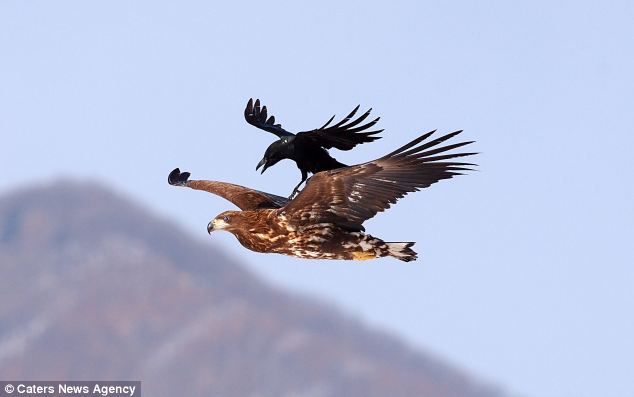
In the recent article, The Old Orchard Bully – Chapter 2, the whole group of birds united to chase off the Black Cat. That is called, “mobbing.”
Some ask why don’t the bigger birds fight back? Here are a few quotes from various sources:
“This behavior – like calling your family for help – is used by many bird species. The best time to observe mobbing is spring and early summer, when breeding birds are trying to protect their nests and young. Birds including swallows, blackbirds, and even these American Crows, seen here mobbing a Red-tailed Hawk, know that there is strength and power in numbers. And they’ve learned to join forces to protect themselves. Be sure to watch the video!”
Quote from Why Don’t Hawks Fight Back? :All agreed that if a red-tailed hawk reached out and grabbed a crow with its talons, that would be the end of the crow. Or as one of the professionals put it, in scientific terms, “the crow would be toast.” But although large raptors have the necessary weapons, the energy cost of pursuing or otherwise attempting to catch a crow is normally not worth it. Crows are agile creatures and would be very difficult to catch in flight. So a hawk typically ignores the crows or flies away.”
A Great Horned Owl being mobbed!
*
Just as the Lord helps His Created critters, the Lord gives us promises about seeking His help:
But the LORD your God you shall fear; and He will deliver you from the hand of all your enemies.” (2 Kings 17:39 NKJV)
Give us help from trouble, For the help of man is useless. Through God we will do valiantly, For it is He who shall tread down our enemies. (Psalms 60:11-12 NKJV)
I have pursued my enemies and overtaken them; Neither did I turn back again till they were destroyed. (Psalms 18:37 NKJV)
O my God, I trust in You; Let me not be ashamed; Let not my enemies triumph over me. (Psalms 25:2 NKJV)
My times are in Your hand; Deliver me from the hand of my enemies, And from those who persecute me. (Psalms 31:15 NKJV)
For I will not trust in my bow, Nor shall my sword save me. But You have saved us from our enemies, And have put to shame those who hated us. In God we boast all day long, And praise Your name forever. Selah (Psalms 44:6-8 NKJV)
There once was a stork named Norman. Every morning from a high spot in a tree he would watch the children from a nearby neighborhood walk down the street to the bus stop. The bus stop was right next to the zoo, which was where Norman lived.
His favorite part of the day, though, was when some of the kids came to the baseball field to practice. The field was right next to the zoo, and Norman enjoyed the game of baseball so much he decided to join the team.
The coaches were a little shocked at first to see that a stork was trying out for the team, but they decided to give Norman a chance. Norman was given his very own baseball bat, and he stepped up to the plate.
The first time Norman swung at the ball he missed, and a fifth grade boy yelled, “Strike one!” Norman hit the ball the second time, and flew to first base. It was then that Norman learned that you weren’t supposed to fly in baseball, and you had to make sure your baseball bat didn’t go flying as well.
Norman didn’t make it to first base anyway. One of the boys grabbed the ball off the ground and threw it to another boy at first base. The coach said that Norman was out, but Norman was still welcome on the team.
The first game was that Saturday. It was the last inning and Norman was up to bat. The bases were loaded.
The other team’s pitcher threw the ball, Norman swung the bat, and the ball sailed up into the sky. It was a home run! Norman and his team won the game, and Norman was allowed to stay on the baseball team.
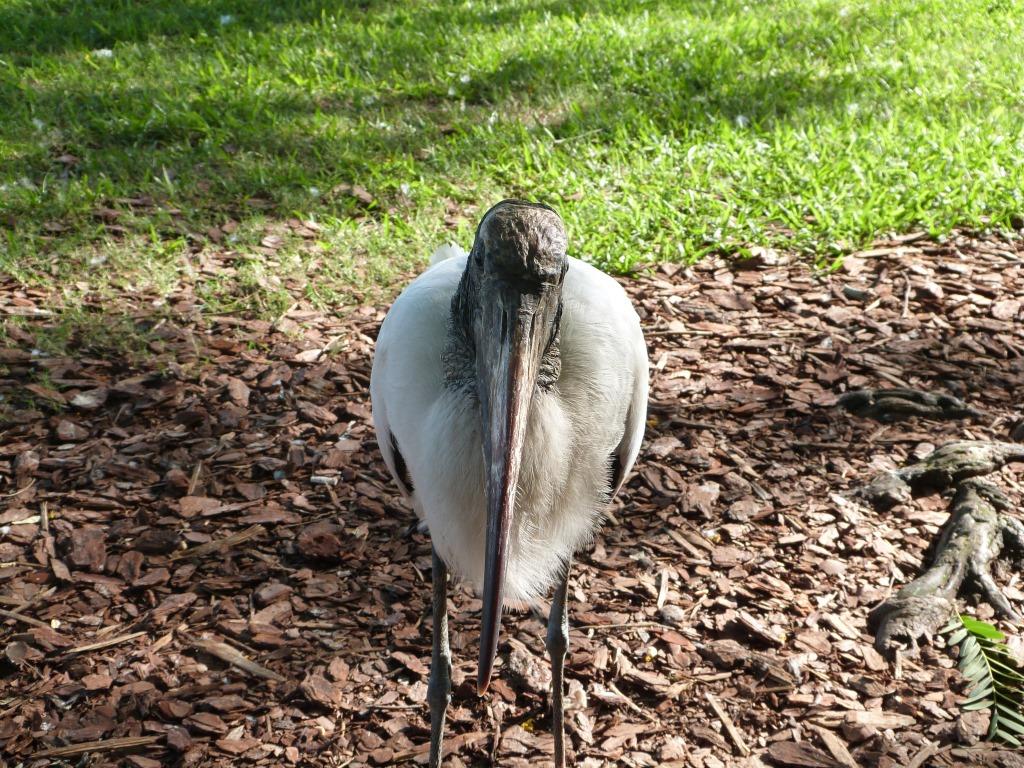
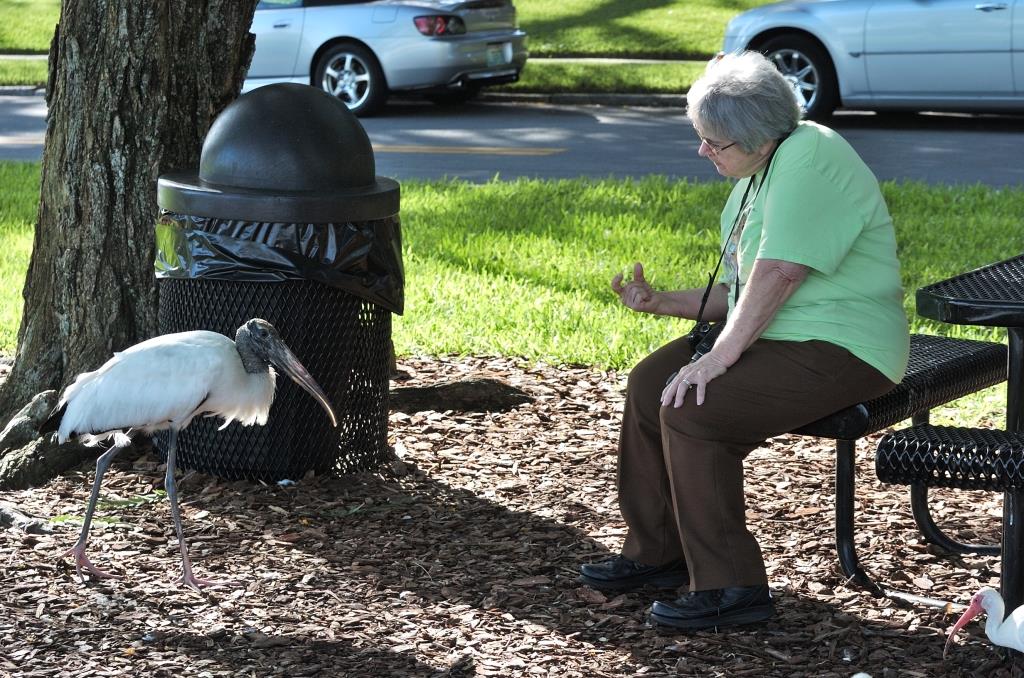
Woodstork & Lee by Dan at Lake Morton
Lee’s Addition:
Where the birds make their nests; The stork has her home in the fir trees. (Psalms 104:17 NKJV)
Thanks, Emma, for another delightful story, this time about Norman.
Emma is a teenager now, and I suggested she write us another story. This was her latest then. See her other ones in the Bird Tales section.
Norman might be that friendly Stork that hangs out at Lake Morton I encountered recently. Didn’t see a baseball cap though.
Emma Foster’s Previous Stories:
Peter Rabbit’s eyes twinkled when Jenny Wren said that she must look her old house over to see if it was fit to live in. “I can save you that trouble,” said he.
“What do you mean?” Jenny’s voice was very sharp.
“Only that our old house is already occupied,” replied Peter. “Bully the English Sparrow has been living in it for the last two months. In fact, he already has a good-sized family there.”
“What?” screamed Jenny and Mr. Wren together. Then without even saying good-by to Peter, they flew in a great rage to see if he had told them the truth. Presently he heard them scolding as fast as their tongues could go, and this is very fast indeed.
“Much good that will do them,” chuckled Peter. “They will have to find a new house this year. All the sharp tongues in the world couldn’t budge Bully the English sparrow. My, my, my, my, just hear that racket! I think I’ll go over and see what is going on.”
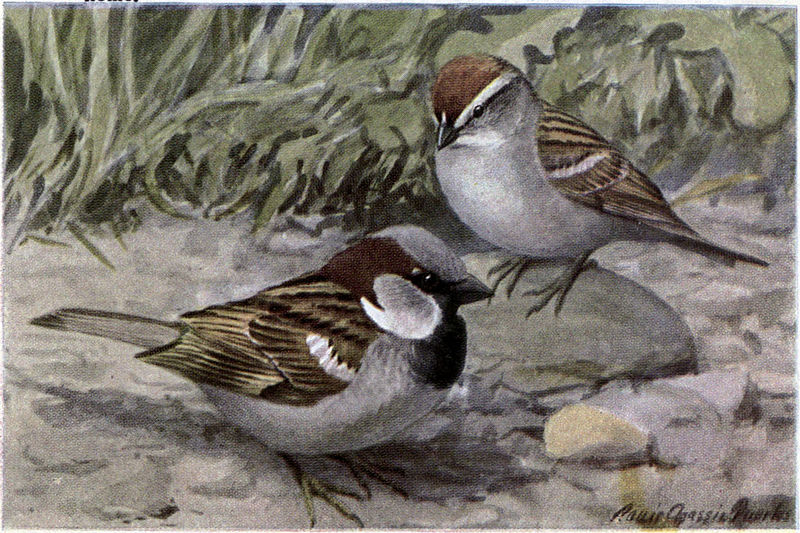
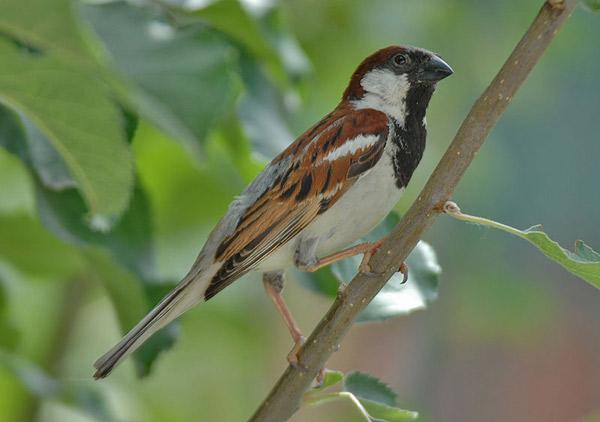
So Peter hopped to a place where he could get a good view of Jenny Wren’s old home and still not be too far from the safety of the old stone wall. Jenny Wren’s old home had been in a hole in one of the old apple-trees. Looking over to it, Peter could see Mrs. Bully sitting in the little round doorway and quite filling it. She was shrieking excitedly. Hopping and flitting from twig to twig close by were Jenny and Mr. Wren, their tails pointing almost straight up to the sky, and scolding as fast as they could make their tongues go. Flying savagely at one and then at the other, and almost drowning their voices with his own harsh cries, was Bully himself. He was perhaps one fourth larger than Mr. Wren, although he looked half again as big. But for the fact that his new spring suit was very dirty, due to his fondness for taking dust baths and the fact that he cares nothing about his personal appearance and takes no care of himself, he would have been a fairly good-looking fellow. His back was more or less of an ashy color with black and chestnut stripes. His wings were brown with a white bar on each. His throat and breast were black, and below that he was of a dirty white. The sides of his throat were white and the back of his neck chestnut.
By ruffling up his feathers and raising his wings slightly as he hopped about, he managed to make himself appear much bigger than he really was. He looked like a regular little fighting savage. The noise had brought all the other birds in the Old Orchard to see what was going on, and every one of them was screaming and urging Jenny and Mr. Wren to stand up for their rights. Not one of them had a good word for Bully and his wife. It certainly was a disgraceful neighborhood squabble.
Bully the English Sparrow is a born fighter. He never is happier than when he is in the midst of a fight or a fuss of some kind. The fact that all his neighbors were against him didn’t bother Bully in the least.
Jenny and Mr. Wren are no cowards, but the two together were no match for Bully. In fact, Bully did not hesitate to fly fiercely at any of the onlookers who came near enough, not even when they were twice his own size. They could have driven him from the Old Orchard had they set out to, but just by his boldness and appearance he made them afraid to try.
All the time Mrs. Bully sat in the little round doorway, encouraging him. She knew that as long as she sat there it would be impossible for either Jenny or Mr. Wren to get in. Truth to tell, she was enjoying it all, for she is as quarrelsome and as fond of fighting as is Bully himself.
“You’re a sneak! You’re a robber! That’s my house, and the sooner you get out of it the better!” shrieked Jenny Wren, jerking her tail with every word as she hopped about just out of reach of Bully.
“It may have been your house once, but it is mine now, you little snip-of-nothing!” cried Bully, rushing at her like a little fury. “Just try to put us out if you dare! You didn’t make this house in the first place, and you deserted it when you went south last fall. It’s mine now, and there isn’t anybody in the Old Orchard who can put me out.”
Peter Rabbit nodded. “He’s right there,” muttered Peter. “I don’t like him and never will, but it is true that he has a perfect right to that house. People who go off and leave things for half a year shouldn’t expect to find them just as they left them. My, my, my what a dreadful noise! Why don’t they all get together and drive Bully and Mrs. Bully out of the Old Orchard? If they don’t I’m afraid he will drive them out. No one likes to live with such quarrelsome neighbors. They don’t belong over in this country, anyway, and we would be a lot better off if they were not here. But I must say I do have to admire their spunk.”
All the time Bully was darting savagely at this one and that one and having a thoroughly good time, which is more than could be said of any one else, except Mrs. Bully.
“I’ll teach you folks to know that I am in the Old Orchard to stay!” shrieked Bully. “If you don’t like it, why don’t you fight? I am not afraid of any of you or all of you together.” This was boasting, plain boasting, but it was effective. He actually made the other birds believe it. Not one of them dared stand up to him and fight. They were content to call him a bully and all the bad names they could think of, but that did nothing to help Jenny and Mr. Wren recover their house. Calling another bad names never hurts him. Brave deeds and not brave words are what count.
How long that disgraceful squabble in the Old Orchard would have lasted had it not been for something which happened, no one knows. Right in the midst of it some one discovered Black Kitty, the cat who lives in Farmer Brown’s house, stealing up through the Old Orchard, her tail twitching and her yellow eyes glaring eagerly. She had heard that dreadful racket and suspected that in the midst of such excitement she might have a chance to catch one of the feathered folks. You can always trust Black Kitty to be on hand at a time like that.
No sooner was she discovered than everything else was forgotten. With Bully in the lead, and Jenny and Mr. Wren close behind him, all the birds turned their attention to Black Kitty. She was the enemy of all, and they straightway forgot their own quarrel. Only Mrs. Bully remained where she was, in the little round doorway of her house. She intended to take no chances, but she added her voice to the general racket. How those birds did shriek and scream! They darted down almost into the face of Black Kitty, and none went nearer than Bully the English Sparrow and Jenny Wren.
Now Black Kitty hates to be the center of so much attention. She knew that, now she had been discovered, there wasn’t a chance in the world for her to catch one of those Old Orchard folks. So, with tail still twitching angrily, she turned and, with such dignity as she could, left the Old Orchard. Clear to the edge of it the birds followed, shrieking, screaming, calling her bad names, and threatening to do all sorts of dreadful things to her, quite as if they really could.
When finally she disappeared towards Farmer Brown’s barn, those angry voices changed. It was such a funny change that Peter Rabbit laughed right out. Instead of anger there was triumph in every note as everybody returned to attend to his own affairs. Jenny and Mr. Wren seemed to have forgotten all about Bully and his wife in their old house. They flew to another part of the Old Orchard, there to talk it all over and rest and get their breath. Peter Rabbit waited to see if they would not come over near enough to him for a little more gossip. But they didn’t, and finally Peter started for his home in the dear Old Briar-patch. All the way there he chuckled as he thought of the spunky way in which Jenny and Mr. Wren had stood up for their rights.
A soft answer turns away wrath, But a harsh word stirs up anger. The tongue of the wise uses knowledge rightly, But the mouth of fools pours forth foolishness. The eyes of the LORD are in every place, Keeping watch on the evil and the good. A wholesome tongue is a tree of life, But perverseness in it breaks the spirit. (Proverbs 15:1-4 NKJV)
*
What caused all the fuss between the Sparrows and the Wrens?
Why did Bully have a right to the house?
Where had the Wrens gone?
When the cat came by, do you know what it is called when birds attack like that? It is called – Mobbing. (A simple definition of mobbing is an group of individuals around a potentially dangerous predator (the cat).
Are we suppose to get angry when things don’t go our way?
Sparrows are listed in the Bible several times and usually with a promise of God taking care of them.
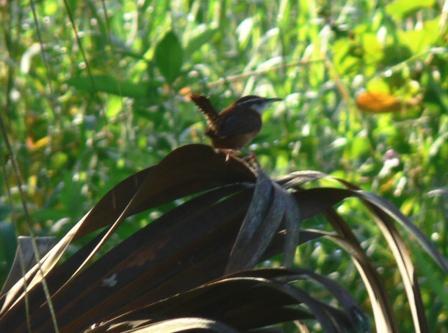
Wrens are really nice birds that sing often and do raise their tail frequently.
Carolina Wren by Lee at Circle B
“Are not five sparrows sold for two copper coins? And not one of them is forgotten before God. But the very hairs of your head are all numbered. Do not fear therefore; you are of more value than many sparrows. (Luke 12:6-7 NKJV)












 Lee's Birdwatching Adventures Plus