“Who provideth for the raven his food? when his young ones cry unto God, they wander for lack of meat.” (Job 38:41)
The shy bird called Clark’s nutcracker collects food during the growing season and stores it for the cold winter months. In one year, a bird will store between 22,000 and 33,000 seeds in as many as 2,500 locations, which can be more than ten miles apart. But does the little bird remember where he put all those seeds?
Biologists tracked the activity of Clark’s nutcrackers in the San Francisco Peaks in northern Arizona. A small army of researchers tracked the birds’ seed gathering and storing activities. One of the first things they discovered was that the birds quickly figured out that they were being observed. Some refused to store food when researchers were watching them. Others faked storing seeds when they were watched. Back in the lab, researchers studied the storing activity of Eurasian nutcrackers. After the birds stored seeds in a large sand floor, the birds were removed. Then the seeds they stored were dug up. When the birds were allowed to return, they quickly discovered that their seeds had been stolen, so they refused to store any more seeds. In the end, researchers concluded that the nutcrackers recover as many as two-thirds of their stored seeds within 13 months.
The remarkable memory of these little birds is their gift from God that enables them to be fed all year around.
Prayer:
Father, I thank You because You are gracious and generous, not just to the birds, but also to me. Amen.
Notes:
Science News, 2/14: 2004, pp. 103-105, Susan Milius, “Where’d I Put That?”
Lee’s Addition:
“Laying up in store for themselves a good foundation against the time to come, that they may lay hold on eternal life.” (1 Timothy 6:19 KJV)
Even though this was posted before, 6 years ago, it was still very interesting and worth reviewing. Interesting Things – Birds With a Memory to Envy. That is why Creation Moments. “Repetition aides learning,” or so they say. Here are some more articles along this same chain of thought.
“But if any provide not for his own, and specially for those of his own house, he hath denied the faith, and is worse than an infidel.
(1 Timothy 5:8 KJV)
Today we finish the Review of the Passeriformes Order of birds. These are the perching and songbird that are spread around the world for us to enjoy. You can check on the other two reviews with the links at the end of this article. This is the last of the 131 Families currently in this order.
And the lords of the Philistines passed in review by hundreds and by thousands, but David and his men passed in review at the rear with Achish. (1 Samuel 29:2 NKJV)
This verse in I Samuel 29:2 mentions the “lords of the Philistines passed in review by hundreds and by thousands,” That verse has nothing to do with our birds, but we have passed before your eyes for months a review of these beautifully created birds from our Lord. With over 6,000 in the Passerinformes order, they have gone by week after week adding up to hundreds and thousands. I trust you have learned to appreciate the variety and splendor of many of them. Yet, there were some, like the “common, plain” birds that are still there to be enjoyed.
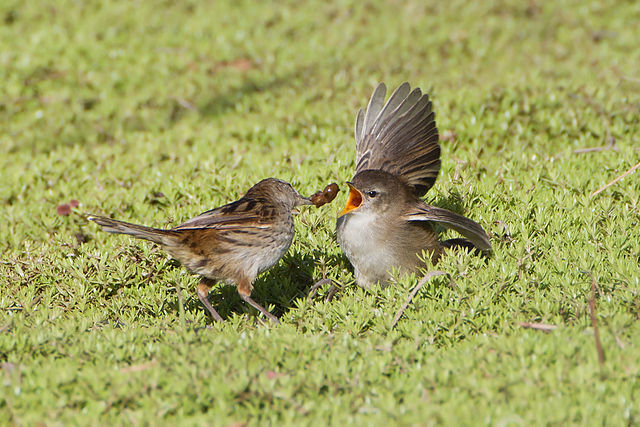
House Sparrow by Ray
Just as none of us are “plain” or “common”, God loves us all.
“Are not five sparrows sold for two copper coins? And not one of them is forgotten before God.” (Luke 12:6 NKJV)
Here is the last part of the families in this Order. They continue in the Taxonomic order.
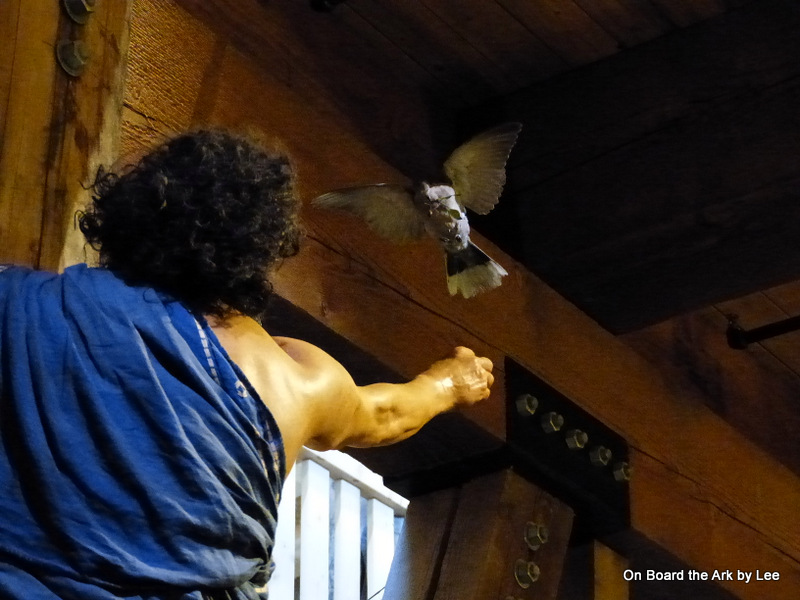
“But the dove found no rest for the sole of her foot, and she returned unto him into the ark, for the waters were on the face of the whole earth: then he put forth his hand, and took her, and pulled her in unto him into the ark.” (Genesis 8:9 KJV)
Noah taking the Dove Back on board the Ark Encounter by Lee
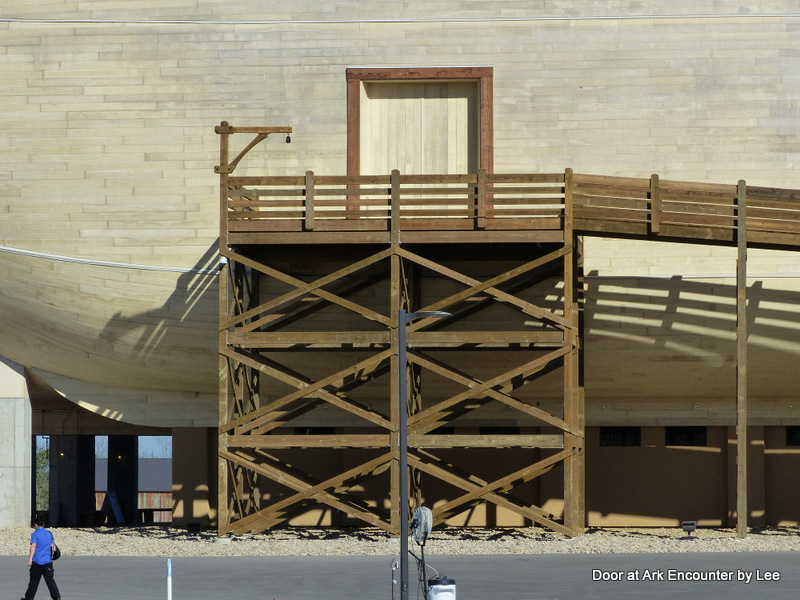
On Monday, September 12, 2016 we visited the Ark Encounter in Kentucky. One of my goals was to find as many birds as I could on the Ark. Dan and I were on vacation for almost two weeks and the highlight of our trip was a visit to the Ark. When you first see the size of the, it is overwhelming. The picture below is almost deceiving. The Ark spans ” 510 feet long, 85 feet wide, and 51 feet high.” (From the website)
Dan and I sitting way out front.
“And of every living thing of all flesh, two of every sort shalt thou bring into the ark, to keep them alive with thee; they shall be male and female. Of fowls after their kind, and of cattle after their kind, of every creeping thing of the earth after his kind, two of every sort shall come unto thee, to keep them alive. And take thou unto thee of all food that is eaten, and thou shalt gather it to thee; and it shall be for food for thee, and for them. Thus did Noah; according to all that God commanded him, so did he.” (Genesis 6:19-22 KJV)
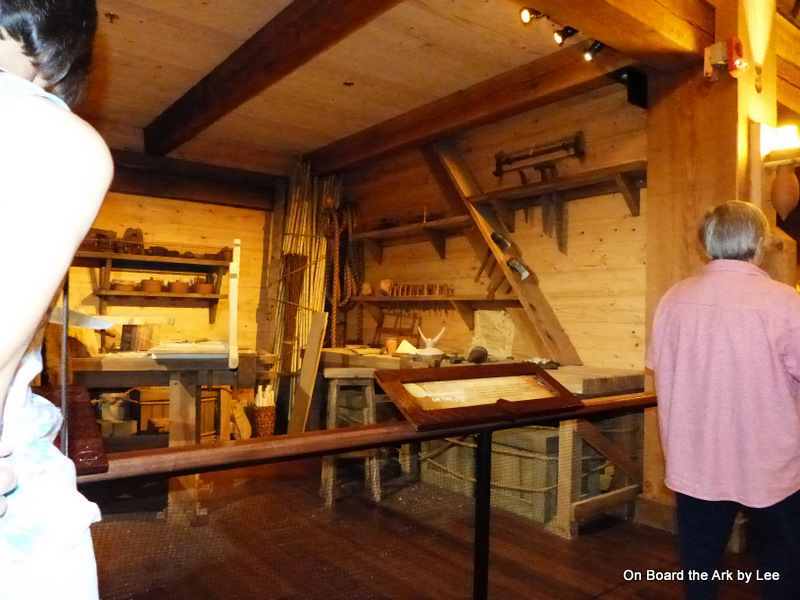
The first bird I observed was a carved bird in a workshop on board the Ark. It appears to be a dove, maybe.
Bird being carved in Workshop
The Workshop with the Dove
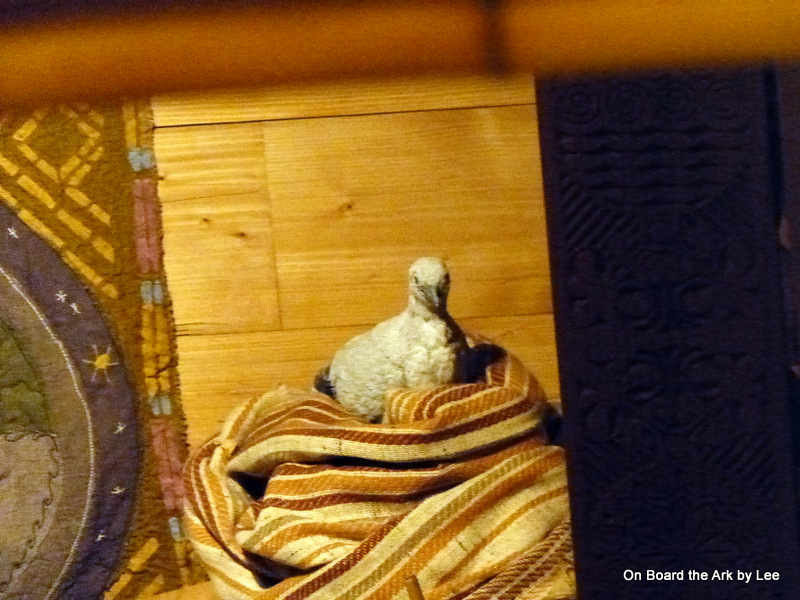
Then we saw a dove resting before its next venture out of the Ark.
Dove resting on board the Ark
“And the dove came in to him in the evening; and, lo, in her mouth was an olive leaf pluckt off: so Noah knew that the waters were abated from off the earth. And he stayed yet other seven days; and sent forth the dove; which returned not again unto him any more.” (Genesis 8:11-12 KJV)
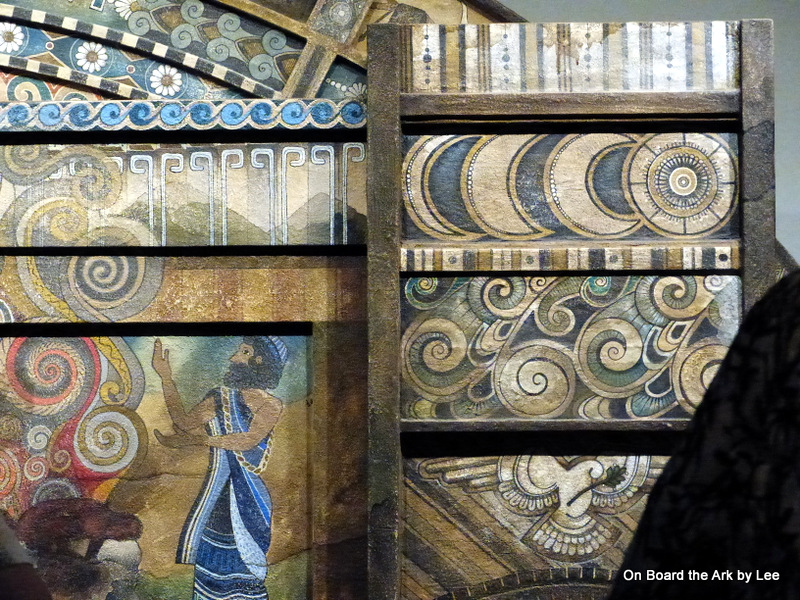
The next dove we saw was on a mural depicting various events in Genesis.
Mural Showing the Dove on the Ark
Mural on the Ark
Stay tuned as the other birds are revealed. We know from Scripture that there were seven pairs of every “kind” of birds/fowls on board the ark. I have more to show you.
“And the LORD said unto Noah, Come thou and all thy house into the ark; for thee have I seen righteous before me in this generation. Of every clean beast thou shalt take to thee by sevens, the male and his female: and of beasts that are not clean by two, the male and his female. Of fowls also of the air by sevens, the male and the female; to keep seed alive upon the face of all the earth.” (Genesis 7:1-3 KJV)
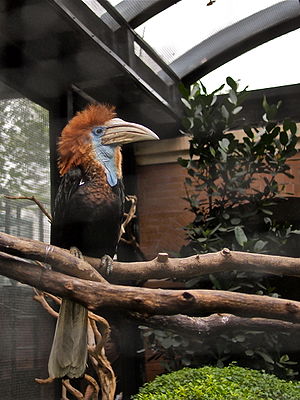
Hornbills That Understand Monkey by Creation Moments
“Whom we preach, warning every man, and teaching every man in all wisdom; that we may present every man perfect in Christ Jesus…” (Colossians 1:28)
With the exception of basic messages such as aggression, communication between two entirely different species has seldom been observed among animals in the wild. We know that many animals among the same species give each other specific warnings about an impending danger. However, scientists have never noted one species recognizing the specific warning given by a second species.
Diana monkeys on the Ivory Coast of Africa face two primary threats: leopards and crowned eagles. When one of these threats appears, the spotter gives a very specific bark-like call depending on the type of threat. Of course, the monkeys need to respond differently to each threat, whether it comes from the leopard below or the eagle above. So it helps them to know what they are facing. On the other hand, a bird named the yellow hornbill is threatened only by the crowned eagles. Researchers noted that these birds ignored the monkeys’ warning about the leopards. But when the monkeys signaled danger from the eagle, the yellow hornbill took defensive measures. Researchers confirmed their observations using tape-recorded monkey calls. The researchers were amazed that these birds understood the monkey warnings in an intelligent manner.
Such intelligence comes from the Creator, Who has given the gift of such intelligence to His creatures in a way that provides for their survival. This shows His loving care for His creation.
Prayer: Father, thank You for Your love, especially for Your forgiving love to me in Your Son, Jesus Christ. Amen.
FOSSIL INVENTORY: SURPRISES FOR SOME by Creation Moments
“And God said, Let the earth bring forth the living creature after his kind, cattle, and creeping thing, and beast of the earth after his kind: and it was so.” (Genesis 1:24)
Everyone will remember those school textbook diagrams showing the ever-upward progression of living organisms, including man. We recall the horse series, found in textbooks and the museum displays showing the evolution of the horse – the first stage as a small mammal and, after several transitions, the modern horse. The claim that fossils in the rock layers show a progression from simple life in the lowest layers to the most complex life at the top accompanies these diagrams.
Horse series diagram promoting evolution from I.C.R.
Recently, the journal Science, reported that paleobiologists who study these fossils reevaluated all the fossil-bearing rocks that have been found in the last 180 years. What was their reaction to the meaning of the fossil record after their new inventory? “We may have been misled for twenty years,” said one scientist. Another commented, “For the first time, a large group of people is saying paleobiology has been making a mistake.” Why are they reacting this way? They have had to conclude, on the basis of the fossil evidence, that there never was an ever-upward progression of complexity of life forms as they had expected. The species that are represented in the fossil record show no evidence of the classic evolutionary development traditionally found in school textbooks.
In short, the fossil record supports the biblical claim that all the kinds of animals appeared about the same time.
Prayer: I thank You, Lord, for the great diversity and beauty You have created in the living world. Amen.
“A window shalt thou make to the ark, and in a cubit shalt thou finish it above; and the door of the ark shalt thou set in the side thereof; with lower, second, and third stories shalt thou make it.” (Genesis 6:16 KJV)
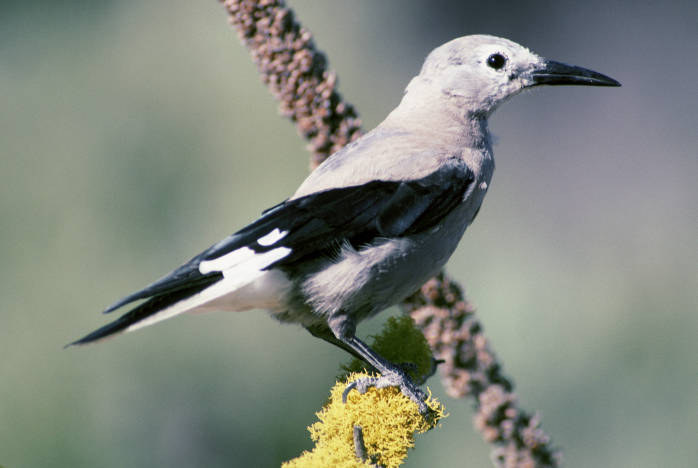
 The shy bird called Clark’s nutcracker collects food during the growing season and stores it for the cold winter months. In one year, a bird will store between 22,000 and 33,000 seeds in as many as 2,500 locations, which can be more than ten miles apart. But does the little bird remember where he put all those seeds?