Chippy, Sweetvoice, and Dotty – Chapter 4

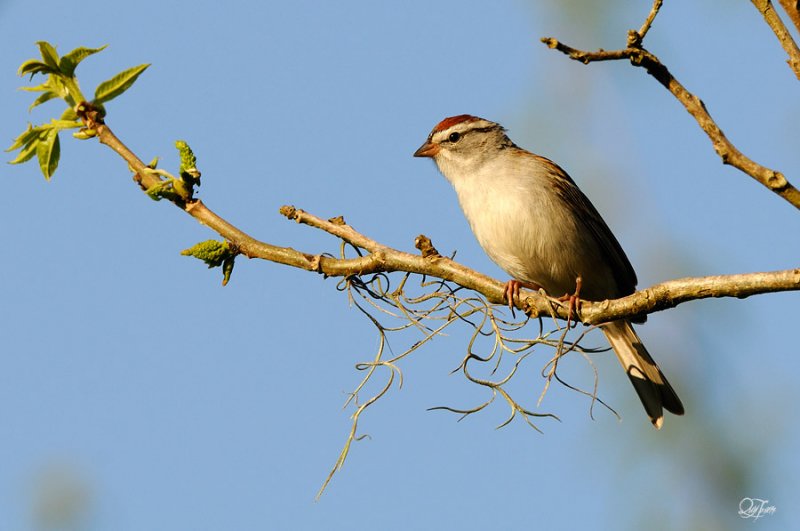
Chipping Sparrow (Spizella passerina) by Quy Tran

Chippy, Sweetvoice, and Dotty

The Chipping, Vesper and Tree Sparrows

The Burgess Bird Book For Children

*

Listen to the story read.

CHAPTER 4. Chippy, Sweetvoice, and Dotty.

For a while Jenny Wren was too busy to talk save to scold Mr. Wren for spending so much time singing instead of working. To Peter it seemed as if they were trying to fill that tree trunk with rubbish. “I should think they had enough stuff in there for half a dozen nests,” muttered Peter. “I do believe they are carrying it in for the fun of working.” Peter wasn’t far wrong in this thought, as he was to discover a little later in the season when he found Mr. Wren building another nest for which he had no use.

Finding that for the time being he could get nothing more from Jenny Wren, Peter hopped over to visit Johnny Chuck, whose home was between the roots of an old apple-tree in the far corner of the Old Orchard. Peter was still thinking of the Sparrow family; what a big family it was, yet how seldom any of them, excepting Bully the English Sparrow, were to be found in the Old Orchard.

“Hello, Johnny Chuck!” cried Peter, as he discovered Johnny sitting on his doorstep. “You’ve lived in the Old Orchard a long time, so you ought to be able to tell me something I want to know. Why is it that none of the Sparrow family excepting that noisy nuisance, Bully, build in the trees of the Old Orchard? Is it because Bully has driven all the rest out?”

Johnny Chuck shook his head. “Peter,” said he, “whatever is the matter with your ears? And whatever is the matter with your eyes?”

“Nothing,” replied Peter rather shortly. “They are as good as yours any day, Johnny Chuck.”

(Chipping Sparrow singing ©xeno-canto.org by Ian Cruickshank)

Johnny grinned. “Listen!” said Johnny. Peter listened. From a tree just a little way off came a clear “Chip, chip, chip, chip.” Peter didn’t need to be told to look. He knew without looking who was over there. He knew that voice for that of one of his oldest and best friends in the Old Orchard, a little fellow with a red-brown cap, brown back with feathers streaked with black, brownish wings and tail, a gray waistcoat and black bill, and a little white line over each eye—altogether as trim a little gentleman as Peter was acquainted with. It was Chippy, as everybody calls the Chipping Sparrow, the smallest of the family.

Chipping Sparrow (Spizella passerina) by Daves BirdingPix

Peter looked a little foolish. “I forgot all about Chippy,” said he. “Now I think of it, I have found Chippy here in the Old Orchard ever since I can remember. I never have seen his nest because I never happened to think about looking for it. Does he build a trashy nest like his cousin, Bully?”

Johnny Chuck laughed. “I should say not!” he exclaimed. “Twice Chippy and Mrs. Chippy have built their nest in this very old apple-tree. There is no trash in their nest, I can tell you! It is just as dainty as they are, and not a bit bigger than it has to be. It is made mostly of little fine, dry roots, and it is lined inside with horse-hair.”

“What’s that?” Peter’s voice sounded as it he suspected that Johnny Chuck was trying to fool him.

“It’s a fact,” said Johnny, nodding his head gravely. “Goodness knows where they find it these days, but find it they do. Here comes Chippy himself; ask him.”

Chippy and Mrs. Chippy came flitting from tree to tree until they were on a branch right over Peter and Johnny. “Hello!” cried Peter. “You folks seem very busy. Haven’t you finished building your nest yet?”

“Nearly,” replied Chippy. “It is all done but the horsehair. We are on our way up to Farmer Brown’s barnyard now to look for some. You haven’t seen any around anywhere, have you?”

Peter and Johnny shook their heads, and Peter confessed that he wouldn’t know horsehair if he saw it. He often had found hair from the coats of Reddy Fox and Old Man Coyote and Digger the Badger and Lightfoot the Deer, but hair from the coat of a horse was altogether another matter.

“It isn’t hair from the coat of a horse that we want,” cried Chippy, as he prepared to fly after Mrs. Chippy. “It is long hair from the tail or mane of a horse that we must have. It makes the very nicest kind of lining for a nest.”

Chippy and Mrs. Chippy were gone a long time, but when they did return each was carrying a long black hair. They had found what they wanted, and Mrs. Chippy was in high spirits because, as she took pains to explain to Peter, that little nest would not soon be ready for the four beautiful little blue eggs with black spots on one end she meant to lay in it.

“I just love Chippy and Mrs. Chippy,” said Peter, as they watched their two little feathered friends putting the finishing touches to the little nest far out on a branch of one of the apple-trees.
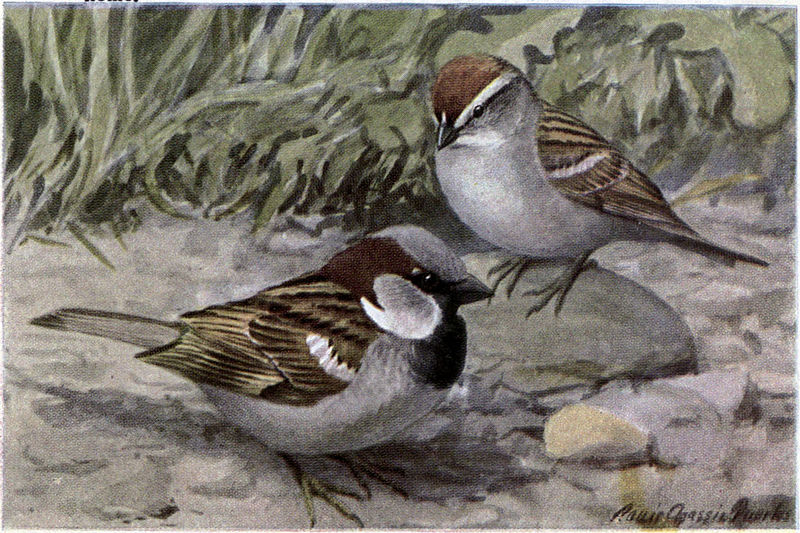
Bully the English Sparrow, Chippy the Chipping Sparrow - Burgess Bird Book ©©

Bully the English Sparrow, Chippy the Chipping Sparrow – Burgess Bird Book ©©

“Everybody does,” replied Johnny. “Everybody loves them as much as they hate Bully and his wife. Did you know that they are sometimes called Tree Sparrows? I suppose it is because they so often build their nests in trees?”

“No,” said Peter, “I didn’t. Chippy shouldn’t be called Tree Sparrow, because he has a cousin by that name.”

Johnny Chuck looked as if he doubted that, “I never heard of him,” he grunted.

Peter grinned. Here was a chance to tell Johnny Chuck something, and Peter never is happier than when he can tell folks something they don’t know. “You’d know him if you didn’t sleep all winter,” said Peter. “Dotty the Tree Sparrow spends the winter here. He left for his home in the Far North about the time you took it into your head to wake up.”

“Why do you call him Dotty?” asked Johnny Chuck.

“Because he has a little round black dot right in the middle of his breast,” replied Peter. “I don’t know why they call him Tree Sparrow; he doesn’t spend his time in the trees the way Chippy does, but I see him much oftener in low bushes or on the ground. I think Chippy has much more right to the name of Tree Sparrow than Dotty has. Now I think of it, I’ve heard Dotty called the Winter Chippy.”

“Gracious, what a mix-up!” exclaimed Johnny Chuck. “With Chippy being called a Tree Sparrow and a Tree Sparrow called Chippy, I should think folks would get all tangled up.”

“Perhaps they would,” replied Peter, “if both were here at the same time, but Chippy comes just as Dotty goes, and Dotty comes as Chippy goes. That’s a pretty good arrangement, especially as they look very much alike, excepting that Dotty is quite a little bigger than Chippy and always has that black dot, which Chippy does not have. Goodness gracious, it is time I was back in the dear Old Briar-patch! Good-by, Johnny Chuck.”
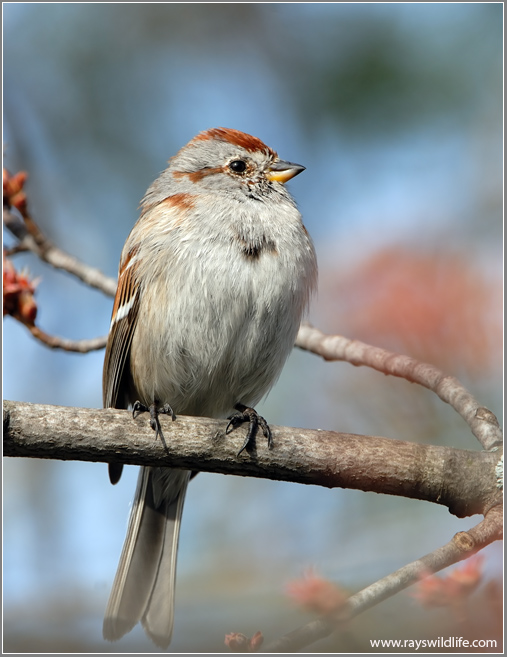
American Tree Sparrow by Ray

American Tree Sparrow by Ray

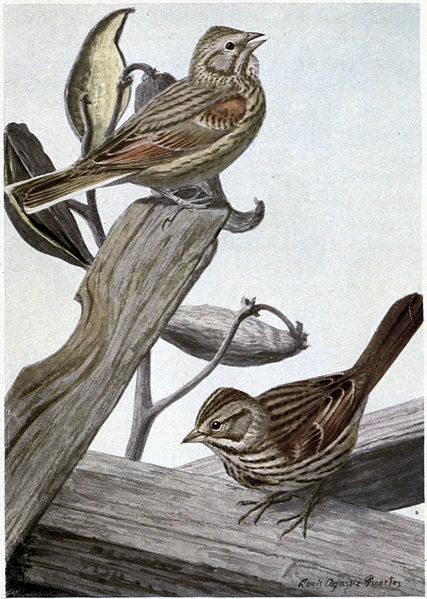
Away went Peter Rabbit, lipperty-lipperty-lip, heading for the dear Old Briar-patch. Out of the grass just ahead of him flew a rather pale, streaked little brown bird, and as he spread his tail Peter saw two white feathers on the outer edges. Those two white feathers were all Peter needed to recognize another little friend of whom he is very fond. It was Sweetvoice the Vesper Sparrow, the only one of the Sparrow family with white feathers in his tail.

“Come over to the dear Old Briar-patch and sing to me,” cried Peter.

Sweetvoice dropped down into the grass again, and when Peter came up, was very busy getting a mouthful of dry grass. “Can’t,” mumbled Sweetvoice. “Can’t do it now, Peter Rabbit. I’m too busy. It is high time our nest was finished, and Mrs. Sweetvoice will lose her patience if I don’t get this grass over there pretty quick.”

“Where is your nest; in a tree?” asked Peter innocently.

“That’s telling,” declared Sweetvoice. “Not a living soul knows where that nest is, excepting Mrs. Sweetvoice and myself. This much I will tell you, Peter: it isn’t in a tree. And I’ll tell you this much more: it is in a hoofprint of Bossy the Cow.”

“In a WHAT?” cried Peter.

“In a hoofprint of Bossy the Cow,” repeated Sweetvoice, chuckling softly. “You know when the ground was wet and soft early this spring, Bossy left deep footprints wherever she went. One of these makes the nicest kind of place for a nest. I think we have picked out the very best one on all the Green Meadows. Now run along, Peter Rabbit, and don’t bother me any more. I’ve got too much to do to sit here talking. Perhaps I’ll come over to the edge of the dear Old Briar-patch and sing to you a while just after jolly, round, red Mr. Sun goes to bed behind the Purple Hills. I just love to sing then.”

“I’ll be watching for you,” replied Peter. “You don’t love to sing any better than I love to hear you. I think that is the best time of all the day in which to sing. I mean, I think it’s the best time to hear singing,” for of course Peter himself does not sing at all.

(Vesper Sparrow singing ©xeno-canto.org by Chris Parrish)

That night, sure enough, just as the Black Shadows came creeping out over the Green Meadows, Sweetvoice, perched on the top of a bramble-bush over Peter’s head, sang over and over again the sweetest little song and kept on singing even after it was quite dark. Peter didn’t know it, but it is this habit of singing in the evening which has given Sweetvoice his name of Vesper Sparrow.

“Serve the LORD with gladness: come before his presence with singing.” (Psalms 100:2 KJV)

*

  • Who was the first new Sparrow we meet?
  • What were they busy doing?
  • Their nest was being built with what material?
  • What was the one thing needed to finish their nest?

*

  • Who was the next Sparrow that showed up?
  • Why did it confuse Johnny Chuck?
  • Why did the name “Dotty” fit for that sparrow?
  • Was Dotty or Chippy larger?

*

  • Sweetvoice is what kind of Sparrow?
  • What were these Sparrows making their nest out of?
  • Where was their nest?
  • When does Sweetvoice like to sing?

*

Are you busy doing the things that need to done? Do you sing? Most thought better of Chippy than Bully. Are more like Chippy or Bully?

Speaking to yourselves in psalms and hymns and spiritual songs, singing and making melody in your heart to the Lord; Giving thanks always for all things unto God and the Father in the name of our Lord Jesus Christ;
(Ephesians 5:19-20 KJV)

Links:

*

Links:

 Next Chapter –  Peter Learns Something He Hadn’t Guessed


Burgess-Bird-Book-for-Children


Burgess Bird Book For Children


 ABC’s of the Gospel


*

Burgess Bird Book For Children


*


Jenny Has a Good Word for Some Sparrows – Chapter 3

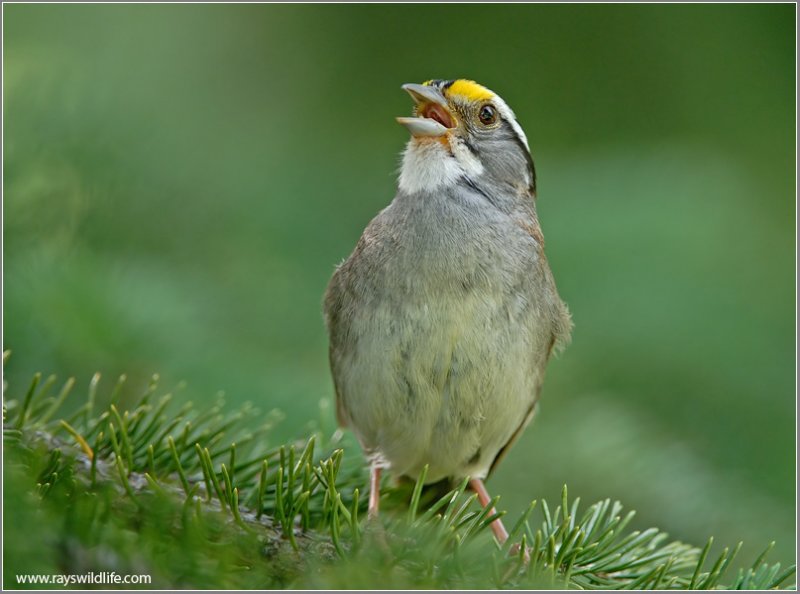
White-throated Sparrow by Ray

Jenny Has a Good Word for Some Sparrows

The Song, White-throated and Fox Sparrows.

The Burgess Bird Book For Children

*
Listen to the story read.

CHAPTER 3. Jenny Has a Good Word for Some Sparrows.

The morning after the fight between Jenny and Mr. Wren and Bully the English Sparrow found Peter Rabbit in the Old Orchard again. He was so curious to know what Jenny Wren would do for a house that nothing but some very great danger could have kept him away from there. Truth to tell, Peter was afraid that not being able to have their old house, Jenny and Mr. Wren would decide to leave the Old Orchard altogether. So it was with a great deal of relief that as he hopped over a low place in the old stone wall he heard Mr. Wren singing with all his might.

The song was coming from quite the other side of the Old Orchard from where Bully and Mrs. Bully had set up housekeeping. Peter hurried over. He found Mr. Wren right away, but at first saw nothing of Jenny. He was just about to ask after her when he caught sight of her with a tiny stick in her bill. She snapped her sharp little eyes at him, but for once her tongue was still. You see, she couldn’t talk and carry that stick at the same time. Peter watched her and saw her disappear in a little hole in a big branch of one of the old apple-trees. Hardly had she popped in than she popped out again. This time her mouth was free, and so was her tongue.

“You’d better stop singing and help me,” she said to Mr. Wren sharply. Mr. Wren obediently stopped singing and began to hunt for a tiny little twig such as Jenny had taken into that hole.

“Well!” exclaimed Peter. “It didn’t take you long to find a new house, did it?”

“Certainly not,” snapped Jenny “We can’t afford to sit around wasting time like some folk I know.”

Peter grinned and looked a little foolish, but he didn’t resent it. You see he was quite used to that sort of thing. “Aren’t you afraid that Bully will try to drive you out of that house?” he ventured.

Sweet Voice the Vesper Sparrow, Little Friend the Song Sparrow – Burgess Bird Book ©©

Jenny Wren’s sharp little eyes snapped more than ever. “I’d like to see him try!” said she. “That doorway’s too small for him to get more than his head in. And if he tries putting his head in while I’m inside, I’ll peck his eyes out! She said this so fiercely that Peter laughed right out.

“I really believe you would,” said he.

“I certainly would,” she retorted. “Now I can’t stop to talk to you, Peter Rabbit, because I’m too busy. Mr. Wren, you ought to know that that stick is too big.” Jenny snatched it out of Mr. Wren’s mouth and dropped it on the ground, while Mr. Wren meekly went to hunt for another. Jenny joined him, and as Peter watched them he understood why Jenny is so often spoken of as a feathered busybody.

For some time Peter Rabbit watched Jenny and Mr. Wren carry sticks and straws into that little hole until it seemed to him they were trying to fill the whole inside of the tree. Just watching them made Peter positively tired. Mr. Wren would stop every now and then to sing, but Jenny didn’t waste a minute. In spite of that she managed to talk just the same.

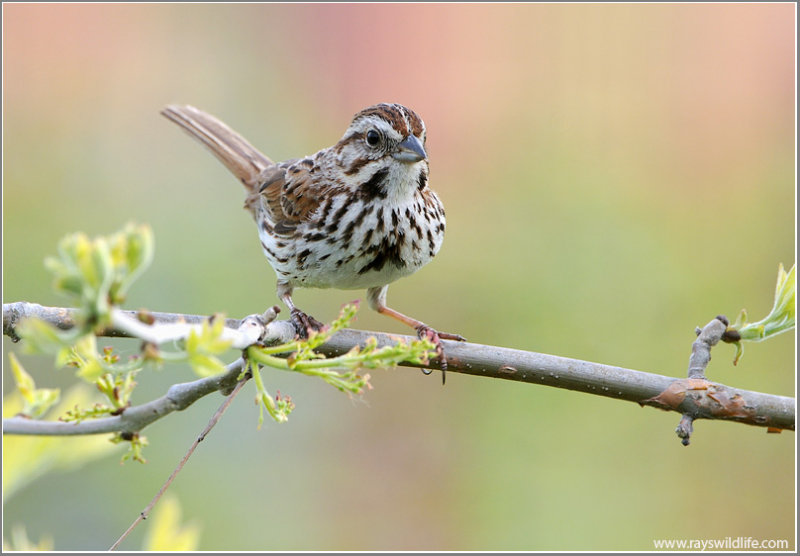
Song Sparrow by Ray

Song Sparrow by Ray

“I suppose Little Friend the Song Sparrow got here some time ago,” said she.

Peter nodded. “Yes,” said he. “I saw him only a day or two ago over by the Laughing Brook, and although he wouldn’t say so, I’m sure that he has a nest and eggs already.”

Jenny Wren jerked her tail and nodded her head vigorously. “I suppose so,” said she. “He doesn’t have to make as long a journey as we do, so he gets here sooner. Did you ever in your life see such a difference as there is between Little Friend and his cousin, Bully? Everybody loves Little Friend.”

Once more Peter nodded. “That’s right,” said he. “Everybody does love Little Friend. It makes me feel sort of all glad inside just to hear him sing. I guess it makes everybody feel that way. I wonder why we so seldom see him up here in the Old Orchard.”

“Because he likes damp places with plenty of bushes better,” replied Jenny Wren. “It wouldn’t do for everybody to like the same kind of a place. He isn’t a tree bird, anyway. He likes to be on or near the ground. You will never find his nest much above the ground, not more than a foot or two. Quite often it is on the ground. Of course I prefer Mr. Wren’s song, but I must admit that Little Friend has one of the happiest songs of any one I know. Then, too, he is so modest, just like us Wrens.”

Peter turned his head aside to hide a smile, for if there is anybody who delights in being both seen and heard it is Jenny Wren, while Little Friend the Song Sparrow is shy and retiring, content to make all the world glad with his song, but preferring to keep out of sight as much as possible.

Jenny chattered on as she hunted for some more material for her nest. “I suppose you’ve noticed,” said she, “that he and his wife dress very much alike. They don’t go in for bright colors any more than we Wrens do. They show good taste. I like the little brown caps they wear, and the way their breasts and sides are streaked with brown. Then, too, they are such useful folks. It is a pity that that nuisance of a Bully doesn’t learn something from them. I suppose they stay rather later than we do in the fall.”

“Yes,” replied Peter. “They don’t go until Jack Frost makes them. I don’t know of any one that we miss more than we do them.”

“Speaking of the sparrow family, did you see anything of Whitethroat?” asked Jenny Wren, as she rested for a moment in the doorway of her new house and looked down at Peter Rabbit.

Peter’s face brightened. “I should say I did!” he exclaimed. “He stopped for a few days on his way north. I only wish he would stay here all the time. But he seems to think there is no place like the Great Woods of the North. I could listen all day to his song. Do you know what he always seems to be saying?”

“What?” demanded Jenny.

I live happ-i-ly, happ-i-ly, happ-i-ly,” replied Peter. “I guess he must too, because he makes other people so happy.” (listen-©xeno-canto)

Jenny nodded in her usual emphatic way. “I don’t know him as well as I do some of the others,” said she, “but when I have seen him down in the South he always has appeared to me to be a perfect gentleman. He is social, too; he likes to travel with others.”

“I’ve noticed that,” said Peter. “He almost always has company when he passes through here. Some of those Sparrows are so much alike that it is hard for me to tell them apart, but I can always tell Whitethroat because he is one of the largest of the tribe and has such a lovely white throat. He really is handsome with his black and white cap and that bright yellow spot before each eye. I am told that he is very dearly loved up in the north where he makes his home. They say he sings all the time.”

Fox Sparrow (Passerella iliaca) by Ray

Fox Sparrow (Passerella iliaca) by Ray

“I suppose Scratcher the Fox Sparrow has been along too,” said Jenny. “He also started sometime before we did.”

“Yes,” replied Peter. “He spent one night in the dear Old Briar-patch. He is fine looking too, the biggest of all the Sparrow tribe, and HOW he can sing. The only thing I’ve got against him is the color of his coat. It always reminds me of Reddy Fox, and I don’t like anything that reminds me of that fellow. When he visited us I discovered something about Scratcher which I don’t believe you know.”

“What?” demanded Jenny rather sharply.

“That when he scratches among the leaves he uses both feet at once,” cried Peter triumphantly. “It’s funny to watch him.”

“Pooh! I knew that,” retorted Jenny Wren. “What do you suppose my eyes are make for? I thought you were going to tell me something I didn’t know.”

Peter looked disappointed.

The heart of the wise instructs his mouth And adds persuasiveness to his lips. Pleasant words are a honeycomb, Sweet to the soul and healing to the bones. (Proverbs 16:23-24 NASB)

*

Jenny seems to be in a kinder mood in this chapter. She has kind words about three different Sparrows. Can you name them?

What kind of sparrow was Little Friend? What kind of songs does he sing? Where does he like to live? What color cap does he have?

Our second sparrow is pictured at the top. Where was Whitethroat headed? What color is his cap? What does his song sound like? (When people use word to descrbe a song, that is called – Mnemonics.

Who is the largest sparrow? What color is Scratcher’s coat? Why is he called “Scratcher”?

Jenny is using nice words about the sparrows this time. Don’t you like to have good words spoken about you? Do you use nice words when talking about someone?

Read the two verses and think about how the Lord wants your speech.

Let the words of my mouth and the meditation of my heart Be acceptable in Your sight, O LORD, my strength and my Redeemer. (Psalms 19:14 NKJV)

Bonus – A Fox Sparrow Scratching

Links:

*

Links:

Bully the English Sparrow, Chippy the Chipping Sparrow - Burgess Bird Book ©©


  Next Chapter – Chippy, Sweetvoice, and Dotty.


Burgess-Bird-Book-for-Children


Burgess Bird Book For Children


Yellow-fronted Woodpecker (Melanerpes flavifrons) ©WikiC


*


Norman Joins The Baseball Team

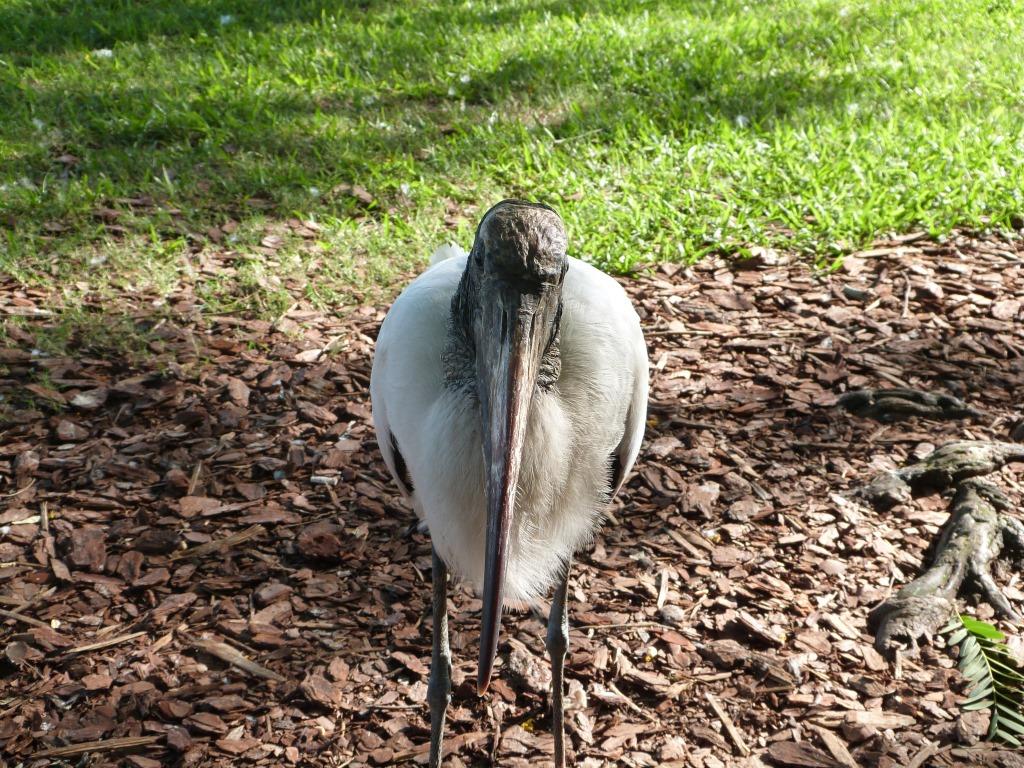
Wood Stork up close by Lee at Lake Morton

Wood Stork up close by Lee at Lake Morton

Norman Joins The Baseball Team

by Emma Foster


There once was a stork named Norman. Every morning from a high spot in a tree he would watch the children from a nearby neighborhood walk down the street to the bus stop. The bus stop was right next to the zoo, which was where Norman lived.

His favorite part of the day, though, was when some of the kids came to the baseball field to practice. The field was right next to the zoo, and Norman enjoyed the game of baseball so much he decided to join the team.

The coaches were a little shocked at first to see that a stork was trying out for the team, but they decided to give Norman a chance. Norman was given his very own baseball bat, and he stepped up to the plate.

The first time Norman swung at the ball he missed, and a fifth grade boy yelled, “Strike one!” Norman hit the ball the second time, and flew to first base. It was then that Norman learned that you weren’t supposed to fly in baseball, and you had to make sure your baseball bat didn’t go flying as well.

Norman didn’t make it to first base anyway. One of the boys grabbed the ball off the ground and threw it to another boy at first base. The coach said that Norman was out, but Norman was still welcome on the team.

The first game was that Saturday. It was the last inning and Norman was up to bat. The bases were loaded.

The other team’s pitcher threw the ball, Norman swung the bat, and the ball sailed up into the sky. It was a home run! Norman and his team won the game, and Norman was allowed to stay on the baseball team.


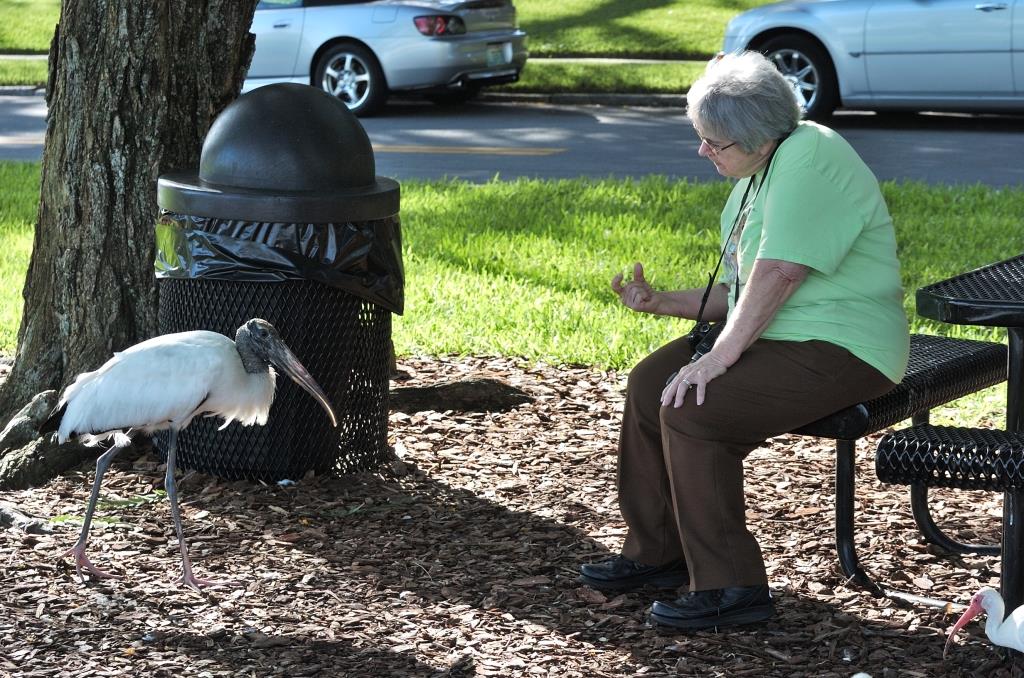
Woodstork & Lee by Dan at Lake Morton

Woodstork & Lee by Dan at Lake Morton

Lee’s Addition:

Where the birds make their nests; The stork has her home in the fir trees. (Psalms 104:17 NKJV)

Thanks, Emma, for another delightful story, this time about Norman.

Emma is a teenager now, and I suggested she write us another story. This was her latest then. See her other ones in the Bird Tales section.

Norman might be that friendly Stork that hangs out at Lake Morton I encountered recently. Didn’t see a baseball cap though.
Emma Foster’s Previous Stories:

Emma’s Stories

*
ABC's of the Gospel

  
  ABC’s of the Gospel
*

*


The Old Orchard Bully – Chapter 2

House Sparrow (Passer domesticus) by Nikhil

House Sparrow (Passer domesticus) by Nikhil

The Old Orchard Bully

The English or House Sparrow

The Burgess Bird Book For Children

*
Listen to the story read.

CHAPTER 2. The Old Orchard Bully.

Peter Rabbit’s eyes twinkled when Jenny Wren said that she must look her old house over to see if it was fit to live in. “I can save you that trouble,” said he.

“What do you mean?” Jenny’s voice was very sharp.

“Only that our old house is already occupied,” replied Peter. “Bully the English Sparrow has been living in it for the last two months. In fact, he already has a good-sized family there.”

“What?” screamed Jenny and Mr. Wren together. Then without even saying good-by to Peter, they flew in a great rage to see if he had told them the truth. Presently he heard them scolding as fast as their tongues could go, and this is very fast indeed.

“Much good that will do them,” chuckled Peter. “They will have to find a new house this year. All the sharp tongues in the world couldn’t budge Bully the English sparrow. My, my, my, my, just hear that racket! I think I’ll go over and see what is going on.”

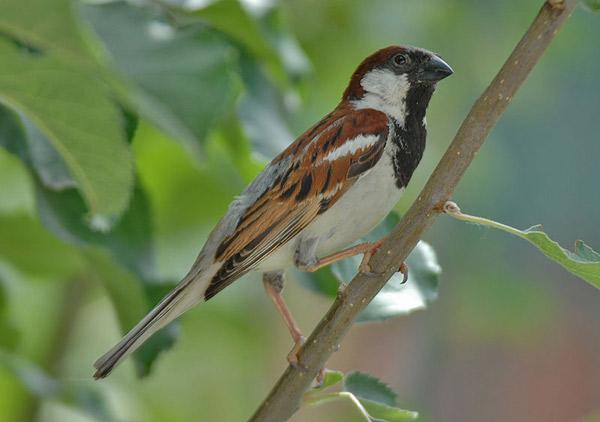
So Peter hopped to a place where he could get a good view of Jenny Wren’s old home and still not be too far from the safety of the old stone wall. Jenny Wren’s old home had been in a hole in one of the old apple-trees. Looking over to it, Peter could see Mrs. Bully sitting in the little round doorway and quite filling it. She was shrieking excitedly. Hopping and flitting from twig to twig close by were Jenny and Mr. Wren, their tails pointing almost straight up to the sky, and scolding as fast as they could make their tongues go. Flying savagely at one and then at the other, and almost drowning their voices with his own harsh cries, was Bully himself. He was perhaps one fourth larger than Mr. Wren, although he looked half again as big. But for the fact that his new spring suit was very dirty, due to his fondness for taking dust baths and the fact that he cares nothing about his personal appearance and takes no care of himself, he would have been a fairly good-looking fellow. His back was more or less of an ashy color with black and chestnut stripes. His wings were brown with a white bar on each. His throat and breast were black, and below that he was of a dirty white. The sides of his throat were white and the back of his neck chestnut.

By ruffling up his feathers and raising his wings slightly as he hopped about, he managed to make himself appear much bigger than he really was. He looked like a regular little fighting savage. The noise had brought all the other birds in the Old Orchard to see what was going on, and every one of them was screaming and urging Jenny and Mr. Wren to stand up for their rights. Not one of them had a good word for Bully and his wife. It certainly was a disgraceful neighborhood squabble.

Bully the English Sparrow, Chippy the Chipping Sparrow - Burgess Bird Book ©©

Bully the English Sparrow, Chippy the Chipping Sparrow – Burgess Bird Book ©©

Bully the English Sparrow is a born fighter. He never is happier than when he is in the midst of a fight or a fuss of some kind. The fact that all his neighbors were against him didn’t bother Bully in the least.

Jenny and Mr. Wren are no cowards, but the two together were no match for Bully. In fact, Bully did not hesitate to fly fiercely at any of the onlookers who came near enough, not even when they were twice his own size. They could have driven him from the Old Orchard had they set out to, but just by his boldness and appearance he made them afraid to try.

All the time Mrs. Bully sat in the little round doorway, encouraging him. She knew that as long as she sat there it would be impossible for either Jenny or Mr. Wren to get in. Truth to tell, she was enjoying it all, for she is as quarrelsome and as fond of fighting as is Bully himself.

“You’re a sneak! You’re a robber! That’s my house, and the sooner you get out of it the better!” shrieked Jenny Wren, jerking her tail with every word as she hopped about just out of reach of Bully.

“It may have been your house once, but it is mine now, you little snip-of-nothing!” cried Bully, rushing at her like a little fury. “Just try to put us out if you dare! You didn’t make this house in the first place, and you deserted it when you went south last fall. It’s mine now, and there isn’t anybody in the Old Orchard who can put me out.”

Peter Rabbit nodded. “He’s right there,” muttered Peter. “I don’t like him and never will, but it is true that he has a perfect right to that house. People who go off and leave things for half a year shouldn’t expect to find them just as they left them. My, my, my what a dreadful noise! Why don’t they all get together and drive Bully and Mrs. Bully out of the Old Orchard? If they don’t I’m afraid he will drive them out. No one likes to live with such quarrelsome neighbors. They don’t belong over in this country, anyway, and we would be a lot better off if they were not here. But I must say I do have to admire their spunk.”

All the time Bully was darting savagely at this one and that one and having a thoroughly good time, which is more than could be said of any one else, except Mrs. Bully.

“I’ll teach you folks to know that I am in the Old Orchard to stay!” shrieked Bully. “If you don’t like it, why don’t you fight? I am not afraid of any of you or all of you together.” This was boasting, plain boasting, but it was effective. He actually made the other birds believe it. Not one of them dared stand up to him and fight. They were content to call him a bully and all the bad names they could think of, but that did nothing to help Jenny and Mr. Wren recover their house. Calling another bad names never hurts him. Brave deeds and not brave words are what count.

Red-tailed Hawk (Buteo jamaicensis) Mobbed by Crows ©WikiC

Red-tailed Hawk (Buteo jamaicensis) Mobbed by Crows ©WikiC

How long that disgraceful squabble in the Old Orchard would have lasted had it not been for something which happened, no one knows. Right in the midst of it some one discovered Black Kitty, the cat who lives in Farmer Brown’s house, stealing up through the Old Orchard, her tail twitching and her yellow eyes glaring eagerly. She had heard that dreadful racket and suspected that in the midst of such excitement she might have a chance to catch one of the feathered folks. You can always trust Black Kitty to be on hand at a time like that.

No sooner was she discovered than everything else was forgotten. With Bully in the lead, and Jenny and Mr. Wren close behind him, all the birds turned their attention to Black Kitty. She was the enemy of all, and they straightway forgot their own quarrel. Only Mrs. Bully remained where she was, in the little round doorway of her house. She intended to take no chances, but she added her voice to the general racket. How those birds did shriek and scream! They darted down almost into the face of Black Kitty, and none went nearer than Bully the English Sparrow and Jenny Wren.

Now Black Kitty hates to be the center of so much attention. She knew that, now she had been discovered, there wasn’t a chance in the world for her to catch one of those Old Orchard folks. So, with tail still twitching angrily, she turned and, with such dignity as she could, left the Old Orchard. Clear to the edge of it the birds followed, shrieking, screaming, calling her bad names, and threatening to do all sorts of dreadful things to her, quite as if they really could.

When finally she disappeared towards Farmer Brown’s barn, those angry voices changed. It was such a funny change that Peter Rabbit laughed right out. Instead of anger there was triumph in every note as everybody returned to attend to his own affairs. Jenny and Mr. Wren seemed to have forgotten all about Bully and his wife in their old house. They flew to another part of the Old Orchard, there to talk it all over and rest and get their breath. Peter Rabbit waited to see if they would not come over near enough to him for a little more gossip. But they didn’t, and finally Peter started for his home in the dear Old Briar-patch. All the way there he chuckled as he thought of the spunky way in which Jenny and Mr. Wren had stood up for their rights.

A soft answer turns away wrath, But a harsh word stirs up anger. The tongue of the wise uses knowledge rightly, But the mouth of fools pours forth foolishness. The eyes of the LORD are in every place, Keeping watch on the evil and the good. A wholesome tongue is a tree of life, But perverseness in it breaks the spirit. (Proverbs 15:1-4 NKJV)


*

What caused all the fuss between the Sparrows and the Wrens?

Why did Bully have a right to the house?

Where had the Wrens gone?

When the cat came by, do you know what it is called when birds attack like that? It is called – Mobbing. (A simple definition of mobbing is an group of individuals around a potentially dangerous predator (the cat).

Are we suppose to get angry when things don’t go our way?

Sparrows are listed in the Bible several times and usually with a promise of God taking care of them.

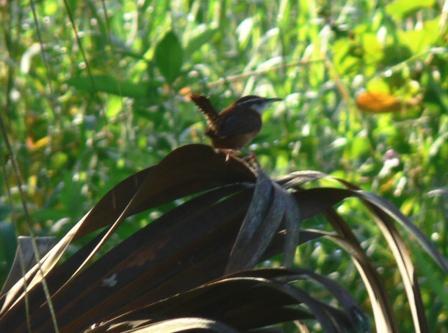
Wrens are really nice birds that sing often and do raise their tail frequently.

Carolina Wren by Lee at Circle B

Carolina Wren by Lee at Circle B

“Are not five sparrows sold for two copper coins? And not one of them is forgotten before God. But the very hairs of your head are all numbered. Do not fear therefore; you are of more value than many sparrows. (Luke 12:6-7 NKJV)

More:

Links:

Sweet Voice the Vesper Sparrow, Little Friend the Song Sparrow - Burgess Bird Book ©©


  Next Chapter (Jenny Has a Good Word for Some Sparrows.)


Burgess-Bird-Book-for-Children


Burgess Bird Book For Children


ABC's of the Gospel


  ABC’s of the Gospel


*

*


Jenny Wren Arrives – Chapter 1

House Wren (Troglodytes aedon) by Ray

House Wren (Troglodytes aedon) by Ray

Jenny Wren Arrives

Introducing the House Wren

The Burgess Bird Book For Children

*

CHAPTER I. Jenny Wren Arrives.

*

Listen to the story read.

Lipperty-lipperty-lip scampered Peter Rabbit behind the tumble-down stone wall along one side of the Old Orchard. It was early in the morning, very early in the morning. In fact, jolly, bright Mr. Sun had hardly begun his daily climb up in the blue, blue sky. It was nothing unusual for Peter to see jolly Mr. Sun get up in the morning. It would be more unusual for Peter not to see him, for you know Peter is a great hand to stay out all night and not go back to the dear Old Briar-patch, where his home is, until the hour when most folks are just getting out of bed.

Peter had been out all night this time, but he wasn’t sleepy, not the least teeny, weeny bit. You see, sweet Mistress Spring had arrived, and there was so much happening on every side, and Peter was so afraid he would miss something, that he wouldn’t have slept at all if he could have helped it. Peter had come over to the Old Orchard so early this morning to see if there had been any new arrivals the day before.

“Birds are funny creatures,” said Peter, as he hopped over a low place in the old stone wall and was fairly in the Old Orchard.

Jenny Wren - Burgess Bird Book ©©

Jenny Wren – Burgess Bird Book ©©

“Tut, tut, tut, tut, tut!” cried a rather sharp scolding voice. “Tut, tut, tut, tut, tut! You don’t know what you are talking about, Peter Rabbit. They are not funny creatures at all. They are the most sensible folks in all the wide world.”

Peter cut a long hop short right in the middle, to sit up with shining eyes. “Oh, Jenny Wren, I’m so glad to see you! When did you arrive?” he cried.

“Mr. Wren and I have just arrived, and thank goodness we are here at last,” replied Jenny Wren, fussing about, as only she can, in a branch above Peter. “I never was more thankful in my life to see a place than

I am right this minute to see the Old Orchard once more. It seems ages and ages since we left it.”

“Well, if you are so fond of it what did you leave it for?” demanded Peter. “It is just as I said before—you birds are funny creatures. You never stay put; at least a lot of you don’t. Sammy Jay and Tommy Tit the Chickadee and Drummer the Woodpecker and a few others have a little sense; they don’t go off on long, foolish journeys. But the rest of you—”

“Tut, tut, tut, tut, tut!” interrupted Jenny Wren. “You don’t know what you are talking about, and no one sounds so silly as one who tries to talk about something he knows nothing about.”

Peter chuckled. “That tongue of yours is just as sharp as ever,” said he. “But just the same it is good to hear it. We certainly would miss it. I was beginning to be a little worried for fear something might have happened to you so that you wouldn’t be back here this summer. You know me well enough, Jenny Wren, to know that you can’t hurt me with your tongue, sharp as it is, so you may as well save your breath to tell me a few things I want to know. Now if you are as fond of the Old Orchard as you pretend to be, why did you ever leave it?”

Jenny Wren’s bright eyes snapped. “Why do you eat?” she asked tartly.

“Because I’m hungry,” replied Peter promptly.

“What would you eat if there were nothing to eat?” snapped Jenny.

“That’s a silly question,” retorted Peter.

“No more silly than asking me why I leave the Old Orchard,” replied Jenny. “Do give us birds credit for a little common sense, Peter. We can’t live without eating any more than you can, and in winter there is no food at all here for most of us, so we go where there is food. Those who are lucky enough to eat the kinds of food that can be found here in winter stay here. They are lucky. That’s what they are—lucky. Still—” Jenny Wren paused.

“Still what?” prompted Peter.

“I wonder sometimes if you folks who are at home all the time know just what a blessed place home is,” replied Jenny. “It is only six months since we went south, but I said it seems ages, and it does. The best part of going away is coming home. I don’t care if that does sound rather mixed; it is true just the same. It isn’t home down there in the sunny South, even if we do spend as much time there as we do here. THIS is home, and there’s no place like it! What’s that, Mr. Wren? I haven’t seen all the Great World? Perhaps I haven’t, but I’ve seen enough of it, let me tell you that! Anyone who travels a thousand miles twice a year as we do has a right to express an opinion, especially if they have used their eyes as I have mine. There is no place like home, and you needn’t try to tease me by pretending that there is. My dear, I know you; you are just as tickled to be back here as I am.”

House Wren (Troglodytes aedon) by Ian

House Wren (Troglodytes aedon) by Ian

“He sings as if he were,” said Peter, for all the time Mr. Wren was singing with all his might.

Jenny Wren looked over at Mr. Wren fondly. “Isn’t he a dear to sing to me like that? And isn’t it a perfectly beautiful spring song?” said she. Then, without waiting for Peter to reply, her tongue rattled on. “I do wish he would be careful. Sometimes I am afraid he will overdo. Just look at him now! He is singing so hard that he is shaking all over. He always is that way. There is one thing true about us Wrens, and this is that when we do things we do them with all our might. When we work we work with all our might. When Mr. Wren sings he sings with all his might.”

“And, when you scold you scold with all your might,” interrupted Peter mischievously.

Jenny Wren opened her mouth for a sharp reply, but laughed instead. “I suppose I do scold a good deal,” said she, “but if I didn’t goodness knows who wouldn’t impose on us. I can’t bear to be imposed on.”

“Did you have a pleasant journey up from the sunny South?” asked Peter.

“Fairly pleasant,” replied Jenny. “We took it rather easily, Some birds hurry right through without stopping, but I should think they would be tired to death when they arrive. We rest whenever we are tired, and just follow along behind Mistress Spring, keeping far enough behind so that if she has to turn back we will not get caught by Jack Frost. It gives us time to get our new suits on the way. You know everybody expects you to have new things when you return home. How do you like my new suit, Peter?” Jenny bobbed and twisted and turned to show it off. It was plain to see that she was very proud of it.

“Very much,” replied Peter. “I am very fond of brown. Brown and gray are my favorite colors.” You know Peter’s own coat is brown and gray.

“That is one of the most sensible things I have heard you say,” chattered Jenny Wren. “The more I see of bright colors the better I like brown. It always is in good taste. It goes well with almost everything. It is neat and it is useful. If there is need of getting out of sight in a hurry you can do it if you wear brown. But if you wear bright colors it isn’t so easy. I never envy anybody who happens to have brighter clothes than mine. I’ve seen dreadful things happen all because of wearing bright colors.”

“What?” demanded Peter.

“I’d rather not talk about them,” declared Jenny in a very emphatic way. “‘Way down where we spent the winter some of the feathered folks who live there all the year round wear the brightest and most beautiful suits I’ve ever seen. They are simply gorgeous. But I’ve noticed that in times of danger these are the folks dreadful things happen to. You see they simply can’t get out of sight. For my part I would far rather be simply and neatly dressed and feel safe than to wear wonderful clothes and never know a minute’s peace. Why, there are some families I know of which, because of their beautiful suits, have been so hunted by men that hardly any are left. But gracious, Peter Rabbit, I can’t sit here all day talking to you! I must find out who else has arrived in the Old Orchard and must look my old house over to see if it is fit to live in.”

*

Why did Jenny and Peter Wren leave? Do you know what that is called?

How far did they travel?

What color are they and why does Jenny like it?

What kind of tongue did Jenny have? How is your tongue?

Even the stork in the sky Knows her seasons; And the turtledove and the swift and the thrush Observe the time of their migration; But My people do not know The ordinance of the LORD. (Jeremiah 8:7 NASB)

*

Links:
Bully the English Sparrow, Chippy the Chipping Sparrow - Burgess Bird Book ©©
  Next Chapter – The Old Orchard Bully
Burgess-Bird-Book-for-Children
  Burgess-Bird-Book-for-Children
Grasshopper Sparrow (Ammodramus savannarum) ©WikiC    Wordless Birds
*

The Burgess Bird Book For Children – Introduction

House Wren (Troglodytes aedon) by Ian

House Wren (Troglodytes aedon) by Ian

The Burgess Bird Book For Children

By Thornton W. Burgess

TO THE CHILDREN AND THE BIRDS OF AMERICA THAT THE BONDS OF LOVE AND FRIENDSHIP BETWEEN THEM MAY BE STRENGTHENED THIS BOOK IS DEDICATED


PREFACE

This book was written to supply a definite need. Its preparation was undertaken at the urgent request of booksellers and others who have felt the lack of a satisfactory medium of introduction to bird life for little children. As such, and in no sense whatever as a competitor with the many excellent books on this subject, but rather to supplement these, this volume has been written.

Its primary purpose is to interest the little child in, and to make him acquainted with, those feathered friends he is most likely to see. Because there is no method of approach to the child mind equal to the story, this method of conveying information has been adopted. So far as I am aware the book is unique in this respect. In its preparation an earnest effort has been made to present as far as possible the important facts regarding the appearance, habits and characteristics of our feathered neighbors. It is intended to be at once a story book and an authoritative handbook. While it is intended for little children, it is hoped that children of larger growth may find in it much of both interest and helpfulness.

Mr. Louis Agassiz Fuertes, artist and naturalist, has marvelously supplemented such value as may be in the text by his wonderful drawings in full color. They were made especially for this volume and are so accurate, so true to life, that study of them will enable any one to identify the species shown. I am greatly indebted to Mr. Fuertes for his cooperation in the endeavor to make this book of real assistance to the beginner in the study of our native birds.

It is offered to the reader without apologies of any sort. It was written as a labor of love—love for little children and love for the birds. If as a result of it even a few children are led to a keener interest in and better understanding of our feathered friends, its purpose will have been accomplished.

THORNTON W. BURGESS

CONTENTS

Introduction

  1. Jenny Wren Arrives.  – Introducing the House Wren
  2. The Old Orchard Bully. – The English or House Sparrow.
  3. Jenny Has a Good Word for Some Sparrows. – The Song, White-throated and Fox Sparrows.
  4. Chippy, Sweetvoice, and Dotty. – The Chipping, Vesper and Tree Sparrows.
  5. Peter Learns Something He Hadn’t Guessed. – The Bluebird and the Robin.
  6. An Old Friend In a New Home. – The Phoebe and the Least Flycatcher.
  7. The Watchman of the Old Orchard. – The Kingbird and the Great Crested Flycatcher.
  8. Old Clothes and Old Houses. – The Wood Peewee and Some Nesting Places.
  9. Longbill and Teeter. – The Woodcock and the Spotted Sandpiper.
  10. Redwing and Yellow Wing. – The Red-winged Blackbird and the Golden-winged Flicker.
  11. Drummers and Carpenters. – The Downy, Hairy and Red-headed Woodpeckers.
  12. Some Unlikely Relatives. – The Cowbird and the Baltimore Oriole.
  13. More of the Blackbird Family. – The Orchard Oriole and the Bobolink.
  14. Bob White and Carol the Meadow Lark. – The So-called Quail and the Meadow Lark.
  15. A Swallow and One Who Isn’t. The Tree Swallow and the Chimney Swift.
  16. A Robber in the Old Orchard. – The Purple Martin and the Barn Swallow.
  17. More Robbers. – The Crow and the Blue Jay.
  18. Some Homes in the Green Forest. – The Crow, the Oven Bird and the Red-tailed Hawk.
  19. A Maker of Thunder and a Friend in Black. – The Ruffed Grouse and the Crow Blackbird.
  20. A Fisherman Robbed. – The Osprey and the Bald-headed Eagle.
  21. A Fishing Party. – The Great Blue Heron and the Kingfisher.
  22. Some Feathered Diggers. – The Bank Swallow, the Kingfisher and the Sparrow Hawk.
  23. Some Big Mouths. – The Nighthawk, the Whip-poor-will and Chuck-wills-widow.
  24. The Warblers Arrive. – The Redstart and the Yellow Warbler.
  25. Three Cousins Quite Unlike. – The Black and White Warbler, the Maryland Yellow-Throat and the Yellow-breasted Chat.
  26. Peter Gets a Lame Neck. – The Parula, Myrtle and Magnolia Warblers.
  27. A New Friend and an Old One. – The Cardinal and the Catbird.
  28. Peter Sees Rosebreast and Finds Redcoat. – The Rose-breasted Grosbeak and the Scarlet Tanager.
  29. The Constant Singers. – The Red-eyed, Warbling and Yellow-throated Vireos.
  30. Jenny Wren’s Cousins. – The Brown Thrasher and the Mockingbird.
  31. Voices of the Dusk. – The Wood, Hermit and Wilson’s Thrushes.
  32. Peter Saves a Friend and Learns Something. – The Towhee and the Indigo Bunting.
  33. A Royal Dresser and a Late Nester. – The Purple Linnet and the Goldfinch.
  34. Mourner the Dove and Cuckoo. – The Mourning Dove and the Yellow-billed Cuckoo.
  35. A Butcher and a Hummer. – The Shrike and the Ruby-throated Hummingbird.
  36. A Stranger and a Dandy. – The English Starling and the Cedar Waxwing.
  37. Farewells and Welcomes. – The Chickadee.
  38. Honker and Dippy Arrive. – The Canada Goose and the Loon.
  39. Peter Discovers Two Old Friends. – The White-breasted Nuthatch and the Brown Creeper.
  40. Some Merry Seed-Eaters. – The Tree Sparrow and the Junco.
  41. More Friends Come With the Snow. – The Snow Bunting and the Horned Lark.
  42. Peter Learns Something About Spooky. – The Screech Owl.
  43. Queer Feet and a Queerer Bill. – The Ruffed Grouse and the Crossbills.
  44. More Folks in Red. – The Pine Grosbeak and the Redpoll.
  45. Peter Sees Two Terrible Feathered Hunters. – The Goshawk and the Great Horned Owl.

Lee’s Addition:

I think you will greatly enjoy this book. Birds and their behaviors are presented in a story, but many birdwatching truths are introduced. Look for questions and Christian principle at the end of the chapters. These are also a good way to read and teach your child or grandchild. Enjoy!

(P.S. – Just found a source for audio for these chapters. They will be attached.)

(The first chapter is being released today)


The Project Gutenberg EBook of The Burgess Bird Book for Children, by Thornton W. Burgess

This eBook is for the use of anyone anywhere at no cost and with almost no restrictions whatsoever. You may copy it, give it away or re-use it under the terms of the Project Gutenberg License included with this eBook or online at http://www.gutenberg.org

Burgess-Bird-Book-for-Children


 Burgess-Bird-Book-for-Children


Savannah Sparrow by Ray    Wordless Birds


George, The Hummingbird

George the Hummingbird by Emma Foster

I Think We Need To Practice A Little Bit More

George the Hummingbird

In a tropical rainforest by the shores of Chile, there lived two hummingbirds. One was named George and the other was named Frank. They both lived next door to each other in the rainforest and looked a lot alike. They both had pink, green, and blue feathers which were great camouflage. They were great friends.

Now George and Frank were hummingbirds so they were supposed to be able to fly backward. But George never could fly backward. Finally, one day, he was determined to learn how to fly that way. He flew over to Frank’s house, the next tree over, and knocked on the door with his long beak.

“I need your help,” he said. “I want to finally learn how to fly backward.”

“That will be easy,” said Frank. “I’ll show you.”

They found a big enough space to fly long distances and Frank demonstrated. He flew to a giant palm tree and back quite easily, flying backward. After several attempts, George wasn’t getting any better. The first three times, he fell; and, the fourth time, working his wings the wrong way, he flew into a tree and got his head stuck. Frank had to pull him out.

Then Frank had a solution. He grabbed a battery-powered fan and some rope. He tied the fan onto George’s stomach and turned it on. George was off! Sometimes he would fly so fast, he would run into a tree. A Toucan, living nearby, was so unhappy about this that he squawked angrily and chased them to another tree.

Eventually, George mastered flying backward with the fan, so Frank decided to try him once without it. George tried again and again, but it was always better with the fan. Frank helped him put it back on. George used the fan for flying backward from then on. That was just his way of doing it.

The End

(By Emma Foster a Kids Writer. She is 13.)

One who is righteous is a guide to his neighbor…. (Proverbs 12:26 ESV)

Everyone helps his neighbor and says to his brother, “Be strong!” (Isaiah 41:6 ESV)

*

Birds Vol 1 #6 – The Black-crowned Night Heron

Birds Illustrated by Color Photography – Revisited

Vol 1. June, 1897 No. 6

*

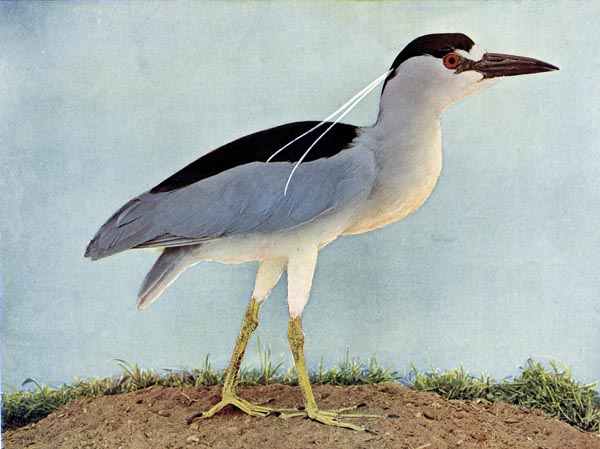
black-crowned night heronblack-crowned night heron.
From col. Chi. Acad. Sciences.

THE BLACK-CROWNED NIGHT HERON.

imgt

HAT a beautiful creature this is! A mounted specimen requires, like the Snowy Owl, the greatest care and a dust tight glass case to preserve its beauty. Dr. Coues’ account of it should be read by those who are interested in the science of ornithology. It is a common bird in the United States and British Provinces, being migratory and resident in the south. Heronries, sometimes of vast extent, to which they return year after year, are their breeding places. Each nest contains three or four eggs of a pale, sea-green color. Observe the peculiar plumes, sometimes two, in this case three, which spring from the back of the head. These usually lie close together in one bundle, but are often blown apart by the wind in the form of streamers. This Heron derives its name from its habits, as it is usually seen flying at night, or in the early evening, when it utters a sonorous cry of quaw or quawk. It is often called Quawk or Qua-Bird.

On the return of the Black-Crowned Night Heron in April, he promptly takes possession of his former home, which is likely to be the most solitary and deeply shaded part of a cedar swamp. Groves of swamp oak in retired and water covered places, are also sometimes chosen, and the males often select tall trees on the bank of the river to roost upon during the day. About the beginning of twilight they direct their flight toward the marshes, uttering in a hoarse and hollow tone, the sound qua. At this hour all the nurseries in the swamps are emptied of their occupants, who disperse about the marshes along the ditches and river shore in search of food. Some of these nesting places have been occupied every spring and summer for many years by nearly a hundred pair of Herons. In places where the cedars have been cut down and removed the Herons merely move to another part of the swamp, not seeming greatly disturbed thereby; but when attacked and plundered they have been known to remove from an ancient home in a body to some unknown place.

The Heron’s nest is plain enough, being built of sticks. On entering the swamp in the neighborhood of one of the heronries the noise of the old and young birds equals that made by a band of Indians in conflict. The instant an intruder is discovered, the entire flock silently rises in the air and removes to the tops of the trees in another part of the woods, while sentries of eight or ten birds make occasional circuits of inspection.

The young Herons climb to the tops of the highest trees, but do not attempt to fly. While it is probable these birds do not see well by day, they possess an exquisite facility of hearing, which renders it almost impossible to approach their nesting places without discovery. Hawks hover over the nests, making an occasional sweep among the young, and the Bald Eagle has been seen to cast a hungry eye upon them.

The male and female can hardly be distinguished. Both have the plumes, but there is a slight difference in size.

The food of the Night Heron, or Qua-Bird, is chiefly fish, and his two interesting traits are tireless watchfulness and great appetite. He digests his food with such rapidity that however much he may eat, he is always ready to eat again; hence he is little benefited by what he does eat, and is ever in appearance in the same half-starved state, whether food is abundant or scarce.


Black-crowned Night Heron at Lake Hollingsworth By Dan

Black-crowned Night Heron at Lake Hollingsworth By Dan

Lee’s Addition:

Black-crowned Night Heron (Nycticorax nycticorax nævius) Crown and back greenish black lower back, wings and tail ashy; head with two or three rounded white plumes, except just after breeding season. Young. Grayish brown streaked with white; below white streaked with blackish; outer webs of primaries, pale rufous. Notes. An explosive qûawk.

Range.—Western hemisphere; breeds in North America north to New Brunswick, Quebec, Manitoba, and Oregon; winters from California and Gulf States southward.

Frequently several nests will be found in the same tree, and I have counted as many as fifty nests in view at the same time. In large swamps in the south they generally nest at a low elevation, while in the marshes of Wisconsin and Minnesota, large colonies of them nest on the ground, making their nest of rushes. Like all Heronries, those of this species have a nauseating odor, from the remains of decayed fish, etc., which are strewn around the bases of the trees. Their eggs number from three to five and are of a pale bluish green color. Size 2.00 × 1.40. 4 eggs. Nest of sticks, about thirty feet up in a pine tree. Many other nests (From the Bird Book)

Adults are approximately 64 cm (25 in) long and weigh 800 g (28 oz). They have a black crown and back with the remainder of the body white or grey, red eyes, and short yellow legs. They have pale grey wings and white under parts. Two or three long white plumes, erected in greeting and courtship displays, extend from the back of the head. The sexes are similar in appearance although the males are slightly larger. Black-crowned Night Herons do not fit the typical body form of the heron family. They are relatively stocky and about 25 in tall (63 cm) with shorter bills, legs, and necks than their more familiar cousins the egrets and “day” herons. Their resting posture is normally somewhat hunched but when hunting they extend their necks and look more like other wading birds.

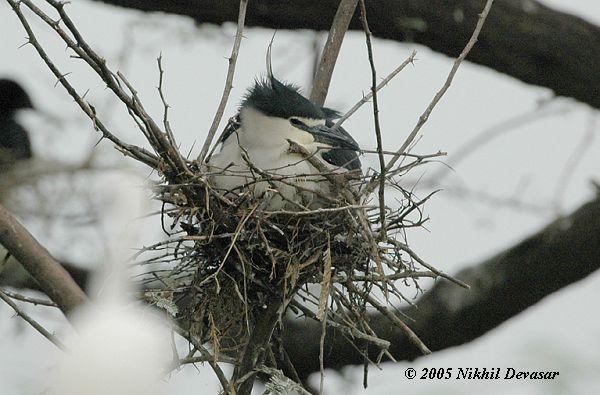
Black-crowned Night Heron (Nycticorax nycticorax) on nest by Nikhil Devasar

These birds stand still at the water’s edge and wait to ambush prey, mainly at night or early morning. They primarily eat small fish, crustaceans, frogs, aquatic insects, small mammals and small birds. During the day they rest in trees or bushes. N. n. hoactli is more gregarious outside the breeding season than the nominate race. (Wikipedia)

Black-crowned Night Heron (Nycticorax nycticorax) ©WikiC

Black-crowned Night Heron (Nycticorax nycticorax) ©WikiC

Now there is a case of almost biting off more than you can chew.

The Night Herons are in the Ardeidae – Herons, Bitterns Family of the Pelicaniformes Order. There are 72 species in the family.

*

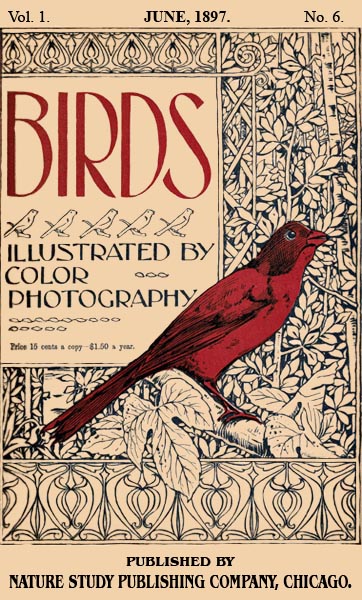
Birds Illustrated by Color Photograhy Vol 1 June, 1897 No 6 - Cover

Birds Illustrated by Color Photograhy Vol 1 June, 1897 No 6 – Cover

Birds Illustrated by Color Photography – Revisited – Introduction

The above article is the first article in the monthly serial that was started in January 1897 “designed to promote Knowledge of Bird-Live.” These include Color Photography, as they call them, today they are drawings. There are at least three Volumes that have been digitized by Project Gutenberg.

To see the whole series of – Birds Illustrated by Color Photography – Revisited

*

(Information from Wikipedia and other internet sources)

Next Article – The Ring-Billed Gull

Previous Article – The Mocking Bird


Wordless Birds – Toucan

Links:

Black-crowned Night Heron – Wikipedia

Black-crowned Night Heron All About Birds

Bible Birds – Herons

Birds of the Bible – Herons

Herons and Egrets  – by Dan

*

Birds Vol 1 #6 – The Mocking Bird

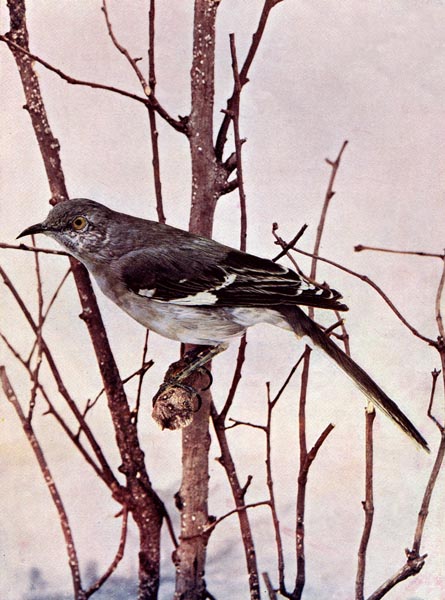
Mockingbird for Birds Illustrated by Color Photography, 1897

Mockingbird for Birds Illustrated by Color Photography, 1897, From col. F. M. Woodruff.

Birds Illustrated by Color Photography – Revisited

Vol 1. June, 1897 No. 6

*

THE MOCKING BIRD.

Some bright morning this month, you may hear a Robin’s song from a large tree near by. A Red Bird answers him and then the Oriole chimes in. I can see you looking around to find the birds that sing so sweetly. All this time a gay bird sits among the green leaves and laughs at you as you try to find three birds when only one is there.

It is the Mocking Bird or Mocker, and it is he who has been fooling you with his song. Nature has given him lots of music and gifted him with the power of imitating the songs of other birds and sounds of other animals.

He is certainly the sweetest of our song birds. The English Nightingale alone is his rival. I think, however, if our Mocker could hear the Nightingale’s song, he could learn it.

The Mocking Bird is another of our Thrushes. By this time you have surely made up your minds that the Thrushes are sweet singers.

The Mocker seems to take delight in fooling people. One gentleman while sitting on his porch heard what he thought to be a young bird in distress. He went in the direction of the sound and soon heard the same cry behind him. He turned and went back toward the porch, when he heard it in another direction. Soon he found out that Mr. Mocking Bird had been fooling him, and was flying about from shrub to shrub making that sound.

His nest is carelessly made of almost anything he can find. The small, bluish-green eggs are much like the Catbird’s eggs.

Little Mocking Birds look very much like the young of other Thrushes, and do not become Mockers like their parents, until they are full grown.

Which one of the other Thrushes that you have seen in Birds does the Mocking Bird resemble?

He is the only Thrush that sings while on the wing. All of the others sing only while perching.

THE MOCKING BIRD.

imgt

HE Mocking Bird is regarded as the chief of songsters, for in addition to his remarkable powers of imitation, he is without a rival in variety of notes. The Brown Thrasher is thought by many to have a sweeter song, and one equally vigorous, but there is a bold brilliancy in the performance of the Mocker that is peculiarly his own, and which has made him par excellence the forest extemporizer of vocal melody. About this of course there will always be a difference of opinion, as in the case of the human melodists.

So well known are the habits and characteristics of the Mocking Bird that nearly all that could be written about him would be but a repetition of what has been previously said. In Illinois, as in many other states, its distribution is very irregular, its absence from some localities which seem in every way suited being very difficult to account for. Thus, according to “Birds of Illinois,” while one or two pairs breed in the outskirts of Mount Carmel nearly every season, it is nowhere in that vicinity a common bird. A few miles further north, however, it has been found almost abundant. On one occasion, during a three mile drive from town, six males were seen and heard singing along the roadside. Mr. H. K. Coale says that he saw a mocking bird in Stark county, Indiana, sixty miles southeast of Chicago, January 1, 1884; that Mr. Green Smith had met with it at Kensington Station, Illinois, and that several have been observed in the parks and door-yards of Chicago. In the extreme southern portion of the state the species is abundant, and is resident through the year.

The Mocking Bird does not properly belong among the birds of the middle or eastern states, but as there are many records of its nesting in these latitudes it is thought to be safe to include it. Mrs. Osgood Wright states that individuals have often been seen in the city parks of the east, one having lived in Central Park, New York city, late into the winter, throughout a cold and extreme season. They have reared their young as far north as Arlington, near Boston, where they are noted, however, as rare summer residents. Dr. J. A. Allen, editor of The Auk, notes that they occasionally nest in the Connecticut Valley.

The Mocking Bird has a habit of singing and fluttering in the middle of the night, and in different individuals the song varies, as is noted of many birds, particularly canaries. The song is a natural love song, a rich dreamy melody. The mocking song is imitative of the notes of all the birds of field, forest, and garden, broken into fragments.

The Mocker’s nest is loosely made of leaves and grass, rags, feathers, etc., plain and comfortable. It is never far from the ground. The eggs are four to six, bluish green, spattered with shades of brown.

Wilson’s description of the Mocking Bird’s song will probably never be surpassed: “With expanded wings and tail glistening with white, and the bouyant gayety of his action arresting the eye, as his song does most irresistably the ear, he sweeps around with enthusiastic ecstasy, and mounts and descends as his song swells or dies away. And he often deceives the sportsman, and sends him in search of birds that are not perhaps within miles of him, but whose notes he exactly imitates.”

Very useful is he, eating large spiders and grasshoppers, and the destructive cottonworm.

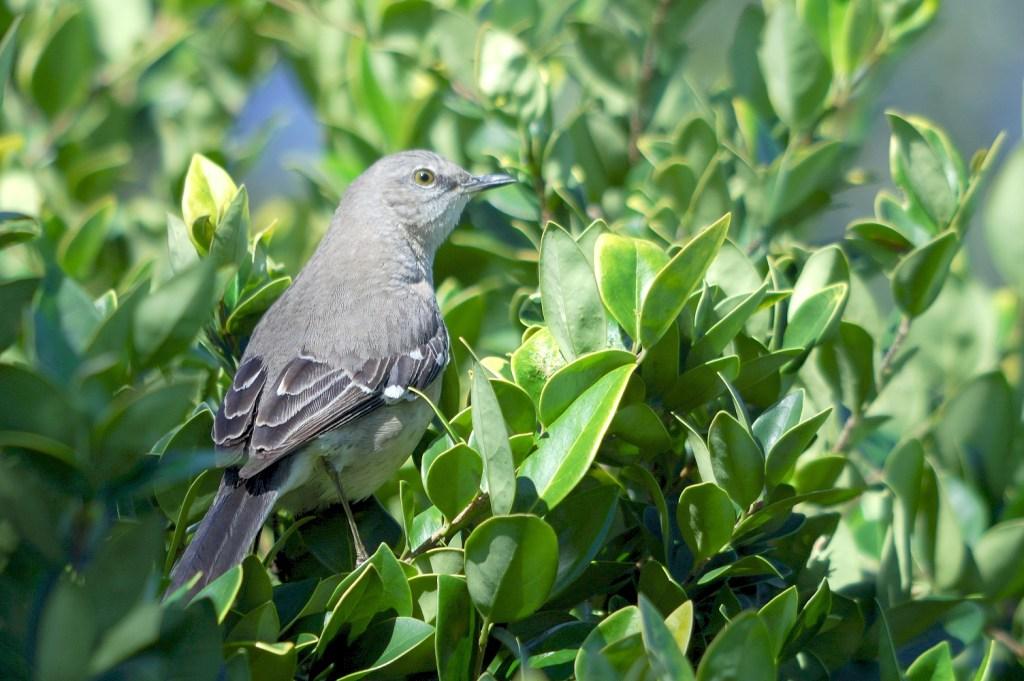
Northern Mockingbird (Mimus polyglottos) By Dan'sPix

Northern Mockingbird (Mimus polyglottos) By Dan’sPix


Lee’s Addition:

Even in your thoughts, do not curse the king, nor in your bedroom curse the rich, for a bird of the air will carry your voice, or some winged creature tell the matter. (Ecclesiastes 10:20 ESV)

Be not deceived; God is not mocked: for whatsoever a man soweth, that shall he also reap. (Galatians 6:7 KJV)

Mockingbirds belong to the Mimidae – Mockingbirds, Thrashers Family and are a passerine or perching bird. The name says alot about the bird because it is known to copy or mimic other birds and sounds.  Up to 200 songs have been learned by some. They can also drive you crazy when they sing outside your bedroom window at 3 AM. When they have young, they love to sing. At least the one outside our window did. It is our State Bird here in Florida. Other states, Arkansas, Mississippi, Tennessee and Texas also claim them as their State Bird.

Mockingbirds are medium sized and have “Mockingbirds have small heads, a long, thin bill with a hint of a downward curve, and long legs. Their wings are short, rounded, and broad, making the tail seem particularly long in flight.” (All About Birds)

Northern Mockingbird males establish a nesting territory in early February. If a female enters his territory, the male will pursue the female with initial aggressive calls and, if she becomes interested, with softer calls. Once the pair is established, their song becomes more gentle. Northern Mockingbirds tend to be monogamous, and the female may return to the same male from the previous season.

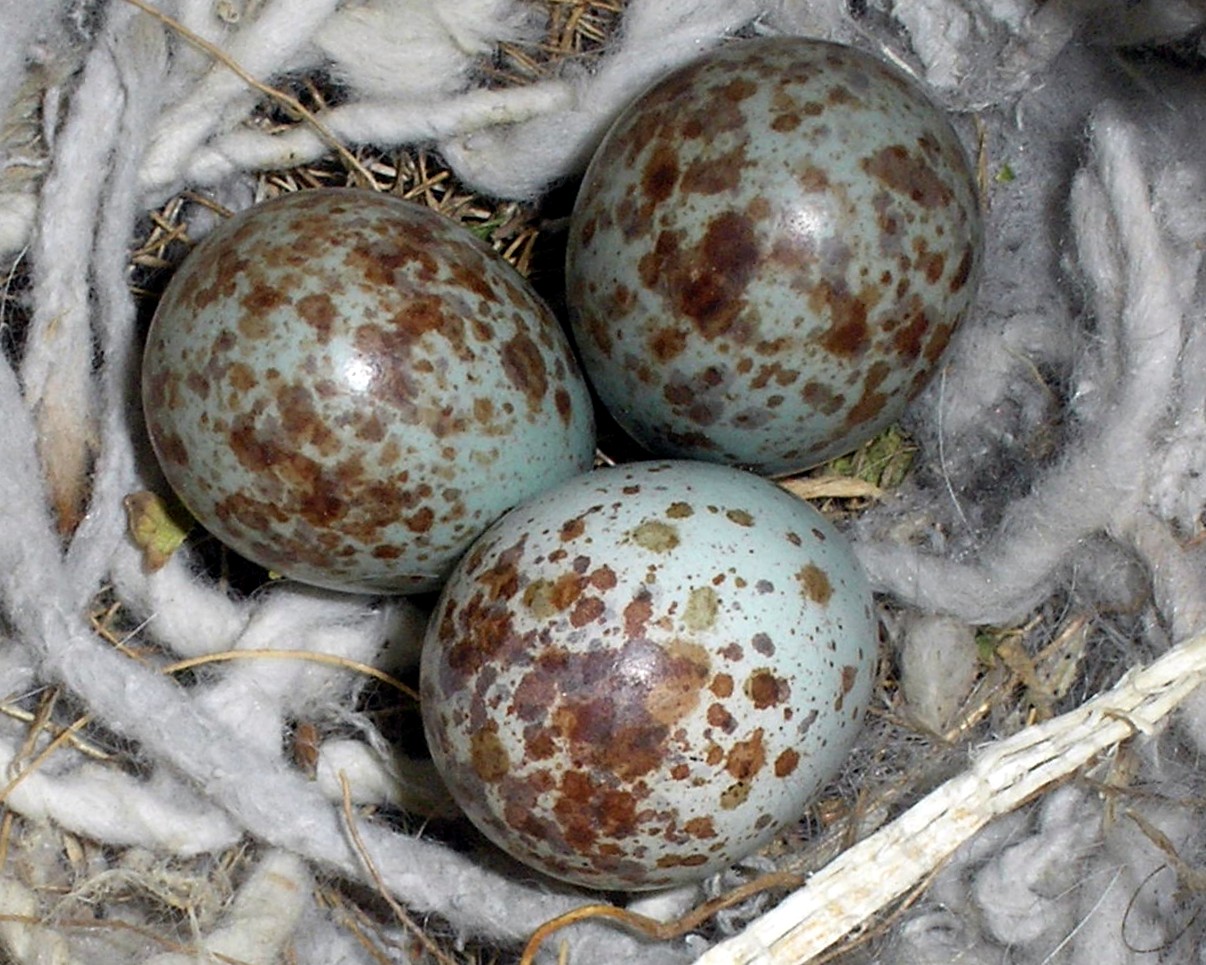
Northern Mockingbird (Mimus polyglottos) eggs ©WikiC

Northern Mockingbird (Mimus polyglottos) eggs ©WikiC

Both the male and female are involved in the nest building. The male does most of the work, while the female perches on the shrub or tree where the nest is being built to watch for predators. The nest is built approximately three to 10 feet above the ground. The outer part of the nest is composed of twigs, while the inner part is lined with grasses, dead leaves, moss or artificial fibers. The eggs are a light blue or greenish color and speckled with dots.] Three to five eggs are laid by the female, and she incubates them for nearly two weeks. Once the eggs are hatched, both the male and female feed the chicks.

Northern Mockingbird (Mimus polyglottos) Juvenile ©WikiC

Northern Mockingbird (Mimus polyglottos) Juvenile ©WikiC

The birds aggressively defend their nest and surrounding area against other birds and animals. When a predator is persistent, mockingbirds from neighboring territories, summoned by a distinct call, may join the attack. Other birds may gather to watch as the mockingbirds harass the intruder. In addition to harassing domestic cats and dogs they consider a threat, it is not unheard of for mockingbirds to target humans. They are absolutely unafraid and will attack much larger birds, even hawks. One famous incident in Tulsa, Oklahoma involving a postal carrier resulted in the distribution of a warning letter to residents.

Birds Illustrated by Color Photograhy Vol 1 June, 1897 No 6 - Cover

Birds Illustrated by Color Photograhy Vol 1 June, 1897 No 6 – Cover

Birds Illustrated by Color Photography – Revisited – Introduction

The above article is the first article in the monthly serial that was started in January 1897 “designed to promote Knowledge of Bird-Live.” These include Color Photography, as they call them, today they are drawings. There are at least three Volumes that have been digitized by Project Gutenberg.

To see the whole series of – Birds Illustrated by Color Photography – Revisited

*

(Information from Wikipedia and other internet sources)

Next Article – The Black-Crowned Night Heron

Previous Article – The Yellow-throated Vireo

ABC’s Of The Gospel

Links:

Mimidae – Mockingbirds, Thrashers Family

Northern Mockingbird – Wikipedia

Northern Mockingbird – All About Birds

*

Birds Vol 1 #6 – Bird Song 1

Northern Mockingbird (Mimus polyglottos) by Dan

Northern Mockingbird (Mimus polyglottos) by Dan

Birds Illustrated by Color Photography – Revisited

Vol 1. June, 1897 No. 6

*

BIRD SONG

“I cannot love the man who doth not love,
As men love light, the song of happy birds.”

imgi

T is indeed fitting that the great poets have ever been the best interpreters of the songs of birds. In many of the plays of Shakespeare, especially where the scene is laid in the primeval forest, his most delicious bits of fancy are inspired by the flitting throng. Wordsworth and Tennyson, and many of the minor English poets, are pervaded with bird notes, and Shelley’s masterpiece, The Skylark, will long survive his greater and more ambitious poems. Our own poet, Cranch, has left one immortal stanza, and Bryant, and Longfellow, and Lowell, and Whittier, and Emerson have written enough of poetic melody, the direct inspiration of the feathered inhabitants of the woods, to fill a good-sized volume. In prose, no one has said finer things than Thoreau, who probed nature with a deeper ken than any of his contemporaries. He is to be read, and read, and read.

But just what meaning should be attached to a bird’s notes—some of which are “the least disagreeable of noises”—will probably never be discovered. They do seem to express almost every feeling of which the human heart is capable. We wonder if the Mocking Bird understands what all these notes mean. He is so fine an imitator that it is hard to believe he is not doing more than mimicking the notes of other birds, but rather that he really does mock them with a sort of defiant sarcasm. He banters them less, perhaps, than the Cat Bird, but one would naturally expect all other birds to fly at him with vengeful purpose. But perhaps the birds are not so sensitive as their human brothers, who do not always look upon imitation as the highest flattery.

A gentleman who kept a note-book, describes one of the matinee performances of the Mocker, which he attended by creeping under a tent curtain. He sat at the foot of a tree on the top of which the bird was perched unconscious of his presence. The Mocker gave one of the notes of the Guinea-hen, a fine imitation of the Cardinal, or Red Bird, an exact reproduction of the note of the Phoebe, and some of the difficult notes of the Yellow-breasted Chat. “Now I hear a young chicken peeping. Now the Carolina Wren sings, ‘cheerily, cheerily, cheerily.’ Now a small bird is shrilling with a fine insect tone. A Flicker, a Wood-pewee, and a Phoebe follow in quick succession. Then a Tufted Titmouse squeals. To display his versatility, he gives a dull performance which couples the ‘go-back’ of the Guinea fowl with the plaint of the Wood-pewee, two widely diverse vocal sounds. With all the performance there is such perfect self-reliance and consciousness of superior ability that one feels that the singer has but to choose what bird he will imitate next.”

Nor does the plaintive, melancholy note of the Robin, that “pious” bird, altogether express his character. He has so many lovely traits, according to his biographers, that we accept him unhesitatingly as a truly good bird. Didn’t he once upon a time tenderly cover with leaves certain poor little wanderers? Isn’t he called “The Bird of the Morning?” And evening as well, for you can hear his sad voice long after the sun has himself retired.

The poet Coleridge claims the credit of first using the Owl’s cry in poetry, and his musical note Tu-whit, tu-who! has made him a favorite with the poets. Tennyson has fancifully played upon it in his little “Songs to the Owl,” the last stanza of which runs:

“I would mock thy chant anew;
But I cannot mimic it,
Not a whit of thy tuhoo,
Thee to woo to thy tuwhit,
Thee to woo to thy tuwhit.

With a lengthen’d loud halloo,
Tuwhoo, tuwhit, tuwhit, tuhoo-o-o.”

But Coleridge was not correct in his claim to precedence in the use of the Owl’s cry, for Shakespeare preceded him, and Tennyson’s “First Song to the Owl” is modeled after that at the end of “Love’s Labor Lost:”

“When roasted crabs hiss in the bowl,
Then nightly sings the staring Owl,
Tu-who;
Tu-whit, tu-who, a merry note.”

In references to birds, Tennyson is the most felicitous of all poets and the exquisite swallow-song in “The Princess” is especially recommended to the reader’s perusal.

Birds undoubtedly sing for the same reasons that inspire to utterance all the animated creatures in the universe. Insects sing and bees, crickets, locusts, and mosquitos. Frogs sing, and mice, monkeys, and woodchucks. We have recently heard even an English Sparrow do something better than chipper; some very pretty notes escaped him, perchance, because his heart was overflowing with love-thoughts, and he was very merry, knowing that his affection was reciprocated. The elevated railway stations, about whose eaves the ugly, hastily built nests protrude everywhere, furnish ample explanation of his reasons for singing.

Birds are more musical at certain times of the day as well as at certain seasons of the year. During the hour between dawn and sunrise occurs the grand concert of the feathered folk. There are no concerts during the day—only individual songs. After sunset there seems to be an effort to renew the chorus, but it cannot be compared to the morning concert when they are practically undisturbed by man.

Birds sing because they are happy. Bradford Torrey has given with much felicity his opinion on the subject, as follows:

“I recall a Cardinal Grosbeak, whom I heard several years ago, on the bank of the Potomac river. An old soldier had taken me to visit the Great Falls, and as we were clambering over the rocks this Grosbeak began to sing; and soon, without any hint from me, and without knowing who the invisible musician was, my companion remarked upon the uncommon beauty of the song. The Cardinal is always a great singer, having a voice which, as European writers say, is almost equal to the Nightingale’s; but in this case the more stirring, martial quality of the strain had given place to an exquisite mellowness, as if it were, what I have no doubt it was,

A Song of Love.”
—C. C. Marble.
[to be continued.]


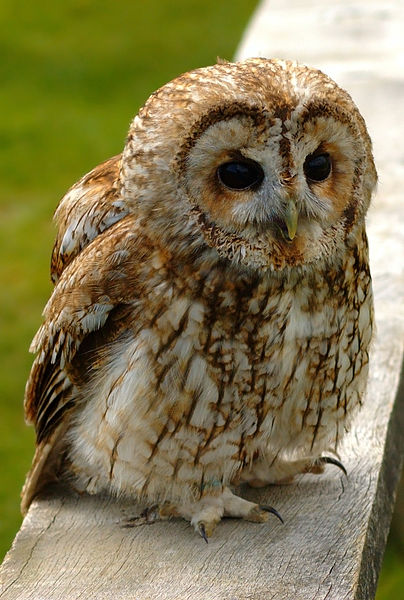
Tawny Owl (Strix aluco) ©WikiC

Tawny Owl (Strix aluco) ©WikiC

Lee’s Addition:

By them shall the fowls of the heaven have their habitation, which sing among the branches. (Psalms 104:12 KJV)

and the doors on the street are shut as the sound of the grinding mill is low, and one will arise at the sound of the bird, and all the daughters of song will sing softly. (Ecclesiastes 12:4 NASB)

What a delightful article about the birds singing. I suppose I can supplement  this by adding some sounds of these birds. I use xeno-canto.org because they are available and have many to choose from.

Northern Mockingbird ( imitating Ash-throated Flycatcher, Juniper Titmouse, Western Scrub-Jay, and probably more)

Grey Catbird (meaw)

difficult notes of the Yellow-breasted Chat (whistles, grunts and rattles)

Carolina Wren sings, ‘cheerily, cheerily, cheerily.’

A Flicker, (kleeeyer or wik-wik-wik)

a Wood-pewee, (pee-a-weee and pee-yer)

Eastern Phoebe follow in quick succession. (fee-beee (last syllable raspy)

Then a Tufted Titmouse squeals. (peter peter peter)

English Sparrow

Tawny Owl (Best I can find out who is the “Tu-whit, tu-who”)

*

Birds Illustrated by Color Photograhy Vol 1 June, 1897 No 6 - Cover

Birds Illustrated by Color Photograhy Vol 1 June, 1897 No 6 – Cover

Birds Illustrated by Color Photography – Revisited – Introduction

The above article is the first article in the monthly serial that was started in January 1897 “designed to promote Knowledge of Bird-Live.” These include Color Photography, as they call them, today they are drawings. There are at least three Volumes that have been digitized by Project Gutenberg.

To see the whole series of – Birds Illustrated by Color Photography – Revisited

*

(Information from Wikipedia and other internet sources)

Next Article – The Yellow-throated Vireo

Previous Article – The American Catbird

ABC’s Of The Gospel

Links:

Flights of Fancy – Tawny Owl

Mnemonic Bird Songs

*

Harriet Newell Cook – Scripture Alphabet of Animals

Scripture Alphabet of Animals

Harriet Newell Cook (1814-1843) – author of Scripture Alphabet of Animals

Baudet Donkey - Shaky and Brown

Baudet Donkey – Shaky and Brown

While looking for the quoted thoughts by G. D. Watson, “Others May, You Cannot,” I found the Christian Articles Website. It is loaded with articles by numerous pastors and preachers, but also other Christian writers. That is where I found Harriet N. Cook’s “Scripture Alphabet of Animals.” Her works and the others on that website are in the public domain and usable. I have decided to use her as a guest writer and produce the bird sections (finished) she wrote about. The other sections are being done also. They are listed below. Also, her books are available on Google Books and can be read on the computer or one of the eBook readers.

Oriental Turtle Dove (Streptopelia orientalis) by Nikhil

Oriental Turtle Dove (Streptopelia orientalis) by Nikhil

Harriet Newell Cook was born in 1814 and died in 1843. In her short 29 years of life she wrote several juvenile books and thought I would share parts of them here. “Her first volume for the young was one of Natural History, calculated to illustrate portions of the Bible, for the young, and entitled, “The Scripture Alphabet of Animals.” Nearly thirty thousand copies of the work have been printed in its English dress, and eight thousand of the German translation. The style of this work is eminently lucid…”

Her last very interesting work for the young —“The Trees, Flowers and Fruits of the Bible“– she was not permitted to finish, by reason of her death. It was completed by Miss F. M. Caulkins…” (From Memoir of Mrs. Harriet Newell Cook By Lydia Howard Sigourney, at Google Books)

Beasts, and all cattle; creeping things, and flying fowl: Kings of the earth, and all people; princes, and all judges of the earth: Both young men, and maidens; old men, and children: Let them praise the name of the LORD: for his name alone is excellent; his glory is above the earth and heaven. (Psalms 148:10-13 KJV)

It was difficult finding information about her personally. Also, I couldn’t find a picture of her. One thing was for certain, she appears to have loved the Lord greatly and wanted to serve Him through her writing.

See Also:

Scripture Alphabet of Animals: The Ant
Scripture Alphabet of Animals: The Ass (Donkey)
Scripture Alphabet of Animals: The Bear
Scripture Alphabet of Animals: The Bee
Scripture Alphabet of Animals: The Camel
Scripture Alphabet of Animals: The Dog
Scripture Alphabet of Animals: The Eagle
Scripture Alphabet of Animals: The Fox or Jackal
Scripture Alphabet of Animals: The Goat
Scripture Alphabet of Animals: The Hart and Hind
Scripture Alphabet of Animals: The Horse
Scripture Alphabet of Animals: The Ibex or the Wild Goat
Scripture Alphabet of Animals: The Jerboa or Mouse
Scripture Alphabet of Animals: The Kite
Scripture Alphabet of Animals: The Leopard
Scripture Alphabet of Animals: The Lion
Scripture Alphabet of Animals: The Locust
Scripture Alphabet of Animals: The Mole
Scripture Alphabet of Animals: The Night-Hawk
Scripture Alphabet of Animals: The Ostrich
Scripture Alphabet of Animals: The Peacock
Scripture Alphabet of Animals: The Quail
Scripture Alphabet of Animals: The Raven
Scripture Alphabet of Animals: The Roe or Gazelle
Scripture Alphabet of Animals: The Scorpion
Scripture Alphabet of Animals: The Sheep
Scripture Alphabet of Animals: The Stork
Scripture Alphabet of Animals: The Turtle-Dove
Scripture Alphabet of Animals: The Unicorn
Scripture Alphabet of Animals: The Vulture
Scripture Alphabet of Animals: The Whale
Scripture Alphabet of Animals: The Wolf

See:

Bible Birds

Birds of the Bible

Wordless Birds

*