Birds of the Bible – Bird-Nesting (Hastings)

American Robin (Turdus migratorius) with young in nest

American Robin (Turdus migratorius) with young in nest

If a bird’s nest should chance to be before you in the way, in any tree or on the ground, with young ones or eggs, and the mother bird is sitting on the young or on the eggs, you shall not take the mother bird with the young. You shall surely let the mother bird go, and take only the young, that it may be well with you and that you may prolong your days. (Deuteronomy 22:6-7 AMP)

Bird-Nesting

(Just found this interesting Commentary for Children – Children’s Great Texts of the Bible by James Hastings for my e-Sword.)

If a bird’s nest chance to be before thee in the way, in any tree or on the ground, with young ones or eggs, and the dam sitting upon the young, or upon the eggs, thou shalt not take the dam with the young: thou shalt in any wise let the dam go, but the young thou mayest take to thyself; that it may be well with thee, and that thou mayest prolong thy days.—Deu_22:6-7.

You think of the children of Israel, don’t you, as having lived far back in the dark ages? But here is one of the commandments which God gave to them—a little one about a bird’s nest—and the words of it make us feel that those wanderers were just big boys and girls with the same inclinations as we ourselves have today.

We learn from the words that the birds that flew about the Israelites as they journeyed were, in many cases, birds such as those we have now. The people must have been robbing their nests too, else we should not have had this verse at all. Naturally enough, in their wanderings they often came upon a nest by the wayside.

Northern Lapwing (Vanellus vanellus) by Nikhil Devasar

Northern Lapwing (Vanellus vanellus) by Nikhil Devasar

It may be that the Israelitish boys knew the little bird nests which are found in a hollow by the side of a marsh. Perhaps they thoughtlessly scattered the eggs, or perhaps Mr. Lapwing—artful little bird that he is!—lured them away from it with the wonderful antics with which he and his ancestors, generation after generation, have protected their nests. For Mr. Lapwing is the real defender of his nest. The mother bird is generally so frightened that she flies away. But when an enemy approaches the male lapwing practices the tricks his father taught him. Gradually moving farther and farther away from where the precious eggs are, he turns a number of somersaults, or he does other equally extraordinary things. The onlooker becomes so interested that the nest is forgotten.

Mourning Dove (Zenaida macroura) by Reinier Munguia

Mourning Dove (Zenaida macroura) by Reinier Munguia

You remember Noah’s clever scout bird, the dove? She, too, would be known to the Israelites. The dove has a very mournful note. No wonder! Her family has ancient legends of how large numbers of them used to be trapped and taken captive to Jerusalem and then killed. Sacrifice had no meaning to them. It was all a mystery, and they just mourned.

What made me think of the text this morning? Why, just the fact that it is May! And May is the great month for birds’ nests. It is the birds’ busy time.
In trees, in bushes, on house-tops, or on the ground, they have built their little homes. What wonderful architects many of them are. One bird has woven twigs together into a building like an old Gothic church; another has built his house in the shape of a bottle; while one we all love lives in a dear little house made of mud. They were very patient while they gathered their building materials; and when they selected a site for their nest, by some strange instinct they chose it as far out of the reach of boys and girls as possible. But in spite of all their wonderful wisdom, somehow—and I feel ashamed to say it—there are always boys ready to climb up and destroy the little houses on which so much thoughtful care has been bestowed.

Common Starling (Sturnus vulgaris) at Nest  by Anthony747

Common Starling (Sturnus vulgaris) at Nest by Anthony747

Now I am to give you three reasons why I want you not to disturb a bird’s nest while it’s being used.

1. Because it is cruel and cowardly.—What would you think if anyone were to break open the door of your home and run away with your bed? Think of your mother going out one day and coming home to find that someone had been there and stolen you away! Yet, how often does the poor mother bird come home to find all her children taken from her? If you rob a nest, it is a case of the strong taking advantage of the weak —a cowardly action under any circumstances—you know it is.

2. Because the birds have rights.—Any creature that suffers has rights. Theodore Parker, the great American preacher, when a lad, saw a turtle on a log, and, with stone in hand, he crept up and was about to throw it, when he heard a voice within which made him desist. He asked his mother about it. She told him that it was the protest of the doctrine of rights— the voice of God. Killing an animal for food or clothing is a part of life. But killing an animal for “fun” or “sport” is wrong.

3. Because we ought to love the birds, and love never willfully hurts what it loves. Love was Christ’s great commandment—love in little as well as in big things. God is great, yet He cares for the birds. “Are not two sparrows sold for a farthing? and one of them shall not fall on the ground without your Father.”
What has the song of birds’ not done for many a man and woman? It has cheered them, it has inspired them, it has given them new courage. It has even led them to God.

Savannah Sparrow Fifty Point-Canada by Ray Barlow

Savannah Sparrow Fifty Point-Canada by Ray Barlow

Here are some beautiful verses, by the poet George Macdonald, which tell what the song of a bird did for the heart of a man.

A brown bird sang on a blossomy tree,
Sang in the moonshine, merrily,
Three little songs, one, two, and three,
A song for his wife, for himself, and me.

He sang for his wife, sang low, sang high,
Filling the moonlight that filled the sky;
“Thee, thee, I love thee, heart alive!
Thee, thee, thee, and thy round eggs five!”

He sang to himself, “What shall I do
With this life that thrills me through and through!
Glad is so glad that it turns to ache!
Out with it, song, or my heart will break!”

He sang to me, “Man, do not fear
Though the moon goes down and the dark is near
Listen my song and rest thine eyes;
Let the moon go down that the sun may rise!”

I folded me up in the heart of his tune,
And fell asleep with the sinking moon;
I woke with the day’s first golden gleam,
And, lo, I had dreamed a precious dream!

*

By James Hastings’ Children’s Great Texts of the Bible

(I normally do a Birds of the Bible here and adapt it for the Birds of the Bible For Kids website. This time I am sharing one I posted on their site first.)

Birds of the Bible – Here

*
How The Woodpecker Makes A House – The Woodpeckers

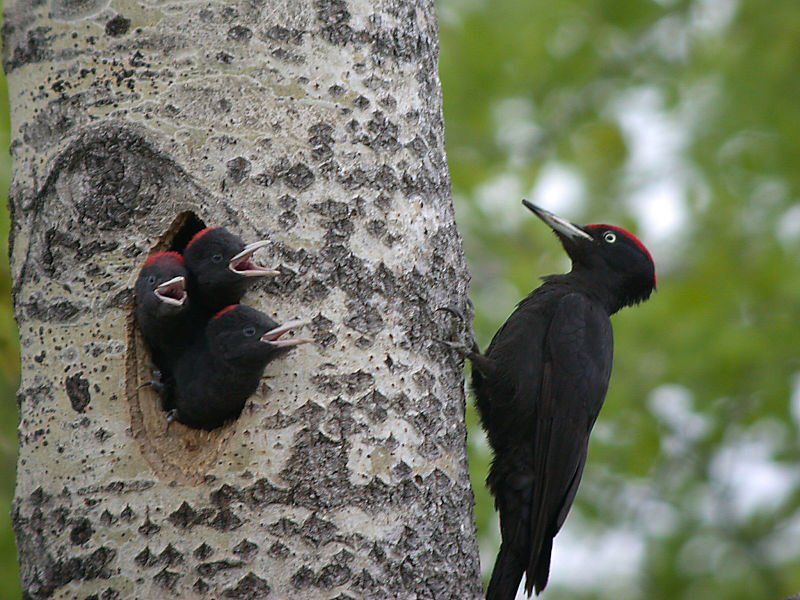
Black Woodpecker (Dryocopus martius) with Young ©WikiC

Black Woodpecker (Dryocopus martius) with Young ©WikiC

IV

HOW THE WOODPECKER MAKES A HOUSE

All woodpeckers make their houses in the wood of trees, either the trunk or one of the branches. Almost the only exceptions to this rule are those that live in the treeless countries of the West. In the torrid deserts of Arizona and the Southwest, some species are obliged to build in the thorny branches of giant cacti, which there grow to an enormous size. In the treeless plains to the northward, a few individuals, for lack of anything so suitable as the cactus, dig holes in clay banks, or even lay their eggs upon the surface of the prairie. In a country where chimney swallows nest in deserted houses, and sand martins burrow in the sides of wells, who wonders at the flicker’s thinking that the side of a haystack, the hollow of a wheel-hub, or the cavity under an old ploughshare, is an ideal home? But in wooded countries the woodpeckers habitually nest in trees. The only exceptions I know are a few flickers’ holes in old posts, and a few instances where flickers[21] have pecked through the weatherboarding of a house to nest in the space between the walls.

But because a bird nests in a hole in a tree, it is not necessarily a woodpecker. The sparrow-hawk, the house sparrow, the tree swallow, the bluebird, most species of wrens, and several of the smaller species of owls nest either in natural cavities in trees or in deserted woodpeckers’ holes. The chickadees, the crested titmice, and the nuthatches dig their own holes after the same pattern as the woodpecker’s. However, the large, round holes were all made by woodpeckers, and of those under two inches in diameter, our friend Downy made his full share. It is easy to tell who made the hole, for the different birds have different styles of housekeeping. The chickadees and nuthatches always build a soft little nest of grass, leaves, and feathers, while the woodpeckers lay their eggs on a bed of chips, and carry nothing in from outside.

Soon after they have mated in the spring, the woodpeckers begin to talk of housekeeping. First, a tree must be chosen. It may be sound or partly decayed, one of a clump or solitary; but it is usually dead or hollow-hearted, and at least partly surrounded by other trees. Sometimes a limb is chosen, sometimes an upright trunk, and the nest may be from two feet to one hundred feet from the ground, though most frequently it will be found not less than ten nor more than thirty feet up. However odd the location finally occupied, it is likely that it was not the first one selected. A woodpecker will dig half a dozen houses rather than occupy an undesirable tenement. It is very common to find their unfinished holes and the wider-mouthed, shallower pockets which they dig for winter quarters; for those that spend their winters in the cold North make a hole to live in nights and cold and stormy days.

Pileated Woodpecker (Dryocopus pileatus) by Raymond Barlow

Pileated Woodpecker (Dryocopus pileatus) by Raymond Barlow

The first step in building is to strike out a circle in the bark as large as the doorway is to be; that is, from an inch and a half to three or four inches in diameter according to the size of the woodpecker. It is nearly always a perfect circle. Try, if you please, to draw freehand a circle of dots as accurate as that which the woodpecker strikes out hurriedly with his bill, and see whether it is easy to do as well as he does.

If the size and shape of the doorway suit him, the woodpecker scales off the bark inside his circle of holes and begins his hard work. He seems to take off his coat and work in his shirtsleeves, so vigorously does he labor as he clings with his stout toes, braced in position by his pointed tail. The chips fly out past him, or if they lie in the hole, he sweeps them out with his bill and pelts again at the same place. The pair take turns at the work. Who knows how long they work before resting? Do they take turns of equal length? Does one work more than the other? A pair of flickers will dig about two inches in a day, the hole being nearly two and a half inches in diameter. A week or more is consumed in digging the nest, which, among the flickers, is commonly from ten to eighteen inches deep. The hole usually runs in horizontally for a few inches and then curves down, ending in a chamber large enough to make a comfortable nest for the mother and her babies.

What a good time the little ones have in their hole! Rain and frost cannot chill them; no enemy but the red squirrel is likely to disturb them. There they lie in their warm, dark chamber, looking up at the ray of light that comes in the doorway, until at last they hear the scratching of their mother’s feet as she alights on the outside of the tree and clambers up to feed them. What a piping and calling they raise inside the hole, and how they all scramble up the walls of their chamber and thrust out their beaks to be fed, till the old tree looks as if it were blossoming with little woodpeckers’ hungry mouths!

Lee’s Addition:

Pileated Woodpecker, female at nest hole

Pileated Woodpecker, female at nest hole

The trees of the Lord are watered abundantly and are filled with sap, the cedars of Lebanon which He has planted, Where the birds make their nests; as for the stork, the fir trees are her house. (Psalms 104:16-17 AMP)

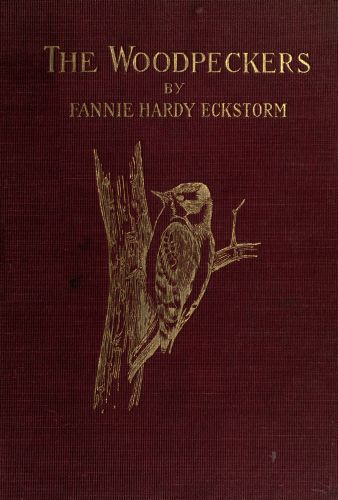
This is Chapter IV from The Woodpeckers book. Our writer, Fannie Hardy Eckstorm, wrote this in 1901. There are 16 chapters, plus the Forward, which are about the Woodpecker Family here in America. All the chapters can be found on The Woodpeckers page. I added photos to help enhance the article. In 1901, photography was not like today.

Woodpeckers belong to the Picidae – Woodpeckers Family.

If you have ever been in the woods and heard a Woodpecker or other member of their family working on their “house,” that sound helps locate them. The Pileated Woodpeckers especially sound like they are tearing the place apart. The Lord created this family to prefer having their home in the tree trunks and larger limbs. He has prepared them with beaks that can handle all the pounding they do and a cushioned forehead to protect their brains.  The video on the Woodpeckers page explains part of this.

See:

Picidae – Woodpeckers Family

The Woodpeckers by Fannie Hardy Eckstorm

Wordless Birds

*

Interesting link to a reader’s photos – Wonderful Woodpecker Family

*

Nuggets Plus – How is That?

How is That? ~ by ajmithra

Shark

Sharks would die
if they don’t swim continuously
when in water!
But how is that
most of us
are still alive in spite of
not swimming continuously
in the Living Water?

He that believeth on me, as the scripture hath said, out of his belly shall flow rivers of living water. (John 7:38)

Nuggets Plus

Nuggets Plus


Lee’s Addition:

interesting thought, aj, and a reminder to stay in the Word of God.

(A J’s nuggets always come at a time when they are needed. He writes them and I work them up. I have been struggling with bronchitis for the last week or so. Fever is staying down finally and am on the mend. Praise the Lord!)

See more of the articles and nuggets by ajmithra:

Nuggets Plus

a j mithra’s articles

*

Begging Pied-billed Grebe by MJSpringett

What an adorable photo that MJSpringett Wildlife Photography captured. Just had to share it, with permission.

Begging Pied-billed Grebe by MJSpringett Wildlife Photography

Begging Pied-billed Grebe by MJSpringett

Look at the birds of the air: they neither sow nor reap nor gather into barns, and yet your heavenly Father feeds them. Are you not of more value than they? (Matthew 6:26 ESV)

I alway enjoy seeing the Grebes swimming around and diving. Waiting for them to come up is always an adventure. You never know where to look. You watch an area and next thing you know, up they pop nowhere near where they dove.

As for a young one, like the photo, that is an site that has evaded us. It is “cute.”

The Pied-billed Grebe (Podilymbus podiceps) is a species of the grebe family of water birds. That is the Podicipedidae – Grebes FamilyThe Pied-billed Grebe is primarily found in ponds throughout the Americas. Other names of this grebe include American dabchick, dabchick, Carolina grebe, devil-diver, dive-dapper, dipper, pied-billed dabchick, thick-billed grebe, and other names.

Pied-billed Grebes are small, stocky, and short-necked. They are 12–15 in (31–38 centimeters) in length, with a wingspan of 18–24 in (45–62 cm) and weigh 8.9–20.0 oz (253–568 grams). They are mainly brown, with a darker crown and back. Their brown color serves as camouflage in the marshes they live in. They do not have white under their wings when flying, like other grebes. Their undertail is white and they have a short, blunt chicken-like bill that is a light grey color, which in summer is encircled by a broad black band (hence the name). In the summer, its throat is black. Juveniles have black and white stripes and look more like winter adults. This grebe does not have webbed feet. Its toes have lobes that come out of the side of each toe. These lobes allow for easy paddling. When flying, the feet appear behind the body due to the feet’s placement in the far back of the body.

Its call is unique, loud and sounds like a “whooping kuk-kuk-cow-cow-cow-cowp-cowp.” Its call is similar to the Yellow-billed Cuckoo.

Pied-billed Grebes rarely fly. They make a slow dive frequently, especially when in danger, diving to about 20 feet or less. They dive for about 30 seconds and may move to a more secluded area of the water, allowing only the head to be visible to watch the danger dissipate.

Pied-billed Grebes feed mainly on aquatic invertebrates, and also on small fish and amphibians (frogs, tadpoles). They dive to obtain food. Their bills allow them to crush crustaceans, like crawfish. They may also eat plants. They have been shown to eat their own feathers, like other grebes, to aid in digestion (prevent injury from small bones). They will also feed their feathers to their young. (Wikipedia with editing)

I have been young, and now am old, yet I have not seen the righteous forsaken or his children begging for bread. (Psalms 37:25 ESV)

This photo, even though the young one is not really begging, and the parent is only doing what it is supposed to do, reminds me of that promise.

See:

*

Birdwatching at Circle B Bar Reserve – 10/26/13

Little Blue Heron (Egretta caerulea) by Lee at Circle B

Little Blue Heron (Egretta caerulea)

Be thou exalted, LORD, in thine own strength: so will we sing and praise thy power. (Psalms 21:13 KJV)

Had a very productive hour and 40 minute trip to Circle B Bar Reserve Saturday afternoon enjoying the Lord’s creation. The birds are definitely heading back down. After a sparse summer, things are starting to get interesting once more.

Limpkin (Aramus guarauna) by Lee at Circle B

Limpkin (Aramus guarauna) by Lee at Circle B

We haven’t been out there for a while and was a little disappointed in the viewing. It rained considerably this summer and the plants have really grown up making it hard to see the water birds. Even with that, to see 34 species in just under 2 hours is not bad.

Alligator about 8 ft by Lee at Circle B

Alligator about 8 ft by Lee at Circle B

We were greeted with the sounds of the Blue Jays, Carolina Wrens and an Eastern Phoebe. Also, an Armadillo was walking right along the path to the marsh. Later, I spotted about an 8 foot alligator. Those and the normal squirrels were the only, non-birds I saw.

One of the highlights was seeing five Bald Eagles flying over. Two in one group and three in the other. We had just seen an Eagle on Friday down in Lake Wales. I love seeing Eagles.

American White Ibis (Eudocimus albus) by Lee at Circle B

American White Ibis (Eudocimus albus) by Lee at Circle B

In God we boast all the day long, and praise thy name for ever. Selah. (Psalms 44:8 KJV)

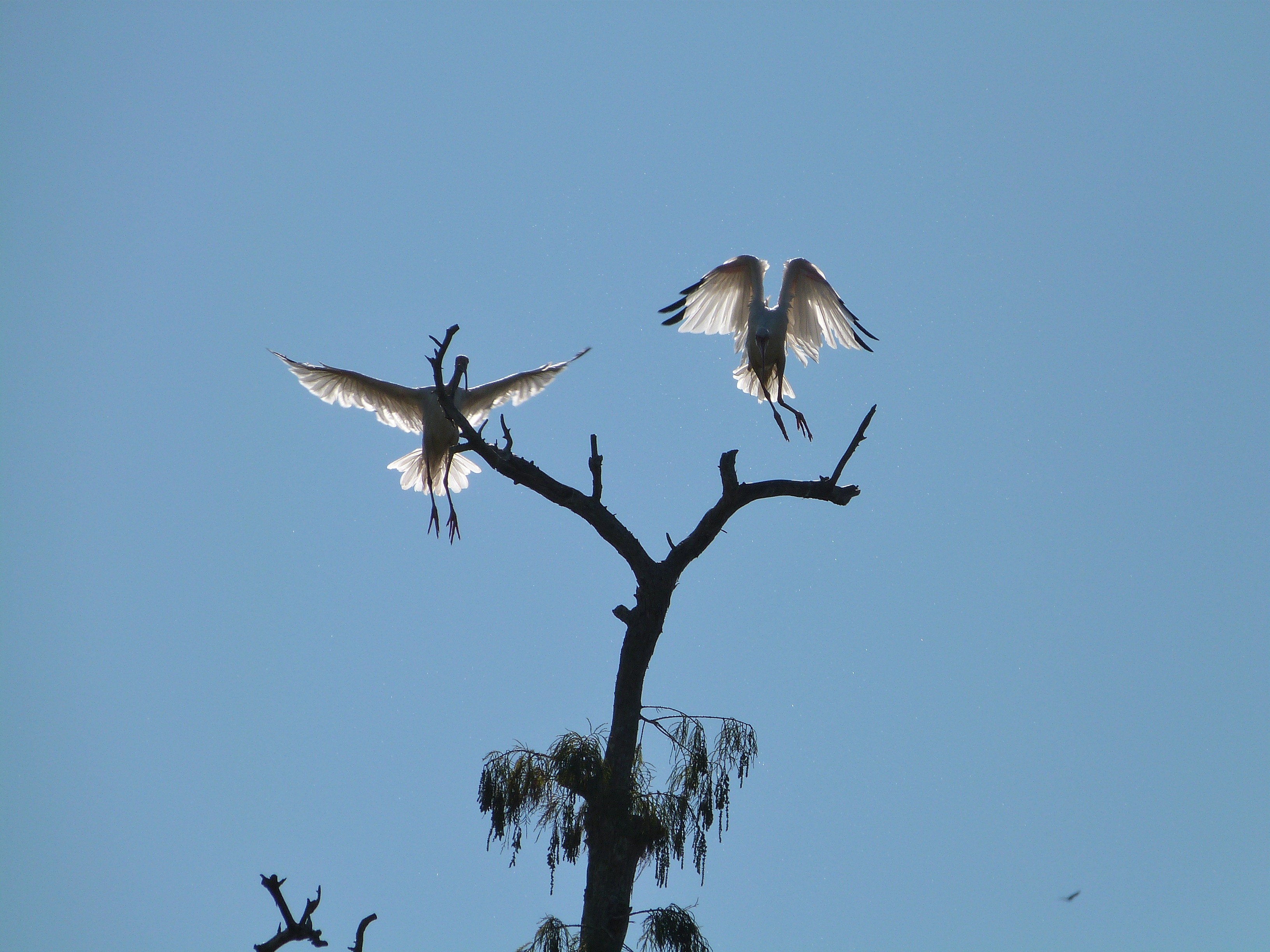
Two White Ibises landed in one of the trees when we first arrived. With the sun behind them, they remind you of Angel’s Wings. As you can see by the second photo the tree was being loaded up for the night when we passed it on the way out. That is one of the favorite “roosting” places at Circle B.

American White Ibis (Eudocimus albus) by Lee at Circle B

American White Ibis (Eudocimus albus) and friends

I am including a slideshow to give you an idea of how it was out there. The photography is not the best, but you can tell what the birds are at least. Dan doesn’t have his photos ready.

This slideshow requires JavaScript.

Here is a list of what I reported to e-Bird:

Circle B Bar Reserve, Polk, US-FL
Oct 26, 2013 3:45 PM – 5:25 PM
Traveling – 2.5 mile(s)
Clear 79 degrees
34 species
Black-bellied Whistling-Duck  15
Pied-billed Grebe  2
Wood Stork  17
Anhinga  5
Great Blue Heron  7
Great Egret  6
Snowy Egret  2
Little Blue Heron  1
Tricolored Heron  1
Cattle Egret  5
White Ibis  88
Glossy Ibis  2
Black Vulture  40
Turkey Vulture  37
Osprey  2
Bald Eagle  5
Purple Gallinule  4
Common Gallinule  6
Limpkin  4
Sandhill Crane  1
Belted Kingfisher  1
Red-bellied Woodpecker  1
Eastern Phoebe  2
Blue Jay  2
Fish Crow  5
House Wren  1
Carolina Wren  2
Blue-gray Gnatcatcher  1
Gray Catbird  1
Palm Warbler  3
Yellow-rumped Warbler  1
Northern Cardinal  1
Red-winged Blackbird  1
Boat-tailed Grackle  10
See:
*

Riddlers – The Woodpeckers

The Woodpeckers by Fannie Hardy Eckstorm - coverThe Woodpeckers, by Fannie Hardy Eckstorm

A Project Gutenberg EBook

*

THE WOODPECKERS

BY

FANNIE HARDY ECKSTORM

WITH ILLUSTRATIONS

The Woodpeckers by Fannie Hardy Eckstorm

BOSTON AND NEW YORK
HOUGHTON, MIFFLIN AND COMPANY
The Riverside Press, Cambridge
1901

Title: The Woodpeckers

Author: Fannie Hardy Eckstorm

Release Date: January 25, 2011 [EBook #35062]

*** START OF THIS PROJECT GUTENBERG EBOOK THE WOODPECKERS ***

(This eBook is for the use of anyone anywhere at no cost and with almost no restrictions whatsoever. You may copy it, give it away or re-use it under the terms of the Project Gutenberg License included with this eBook or online at www.gutenberg.org)

COPYRIGHT, 1900, BY FANNIE HARDY ECKSTORM

ALL RIGHTS RESERVED

To

MY FATHER
MR. MANLY HARDY
A Lifelong Naturalist


THE WOODPECKERS


FOREWORD: THE RIDDLERS


_
Long ago in Greece, the legend runs, a terrible monster called the Sphinx used to waylay travelers to ask them riddles: whoever could not answer these she killed, but the man who did answer them killed her and made an end of her riddling.

To-day there is no Sphinx to fear, yet the world is full of unguessed riddles. No thoughtful man can go far afield but some bird or flower or stone bars his way with a question demanding an answer; and though many men have been diligently spelling out the answers for many years, and we for the most part must study the answers they have proved, and must reply in their words, yet those shrewd old riddlers, the birds and flowers and bees, are always ready for a new victim, putting their heads together over some new enigma (mystery) to bar the road to knowledge till that, too, shall be answered; so that other men’s learning does not always suffice. So much of a man’s pleasure in life, so much of his power, depends on his ability to silence these persistent questioners, that this little book was written with the hope of making clearer the kind of questions Nature asks, and the way to get correct answers.

This is purposely a little book, dealing only with a single group of birds, treating particularly only some of the commoner species of that group, taking up only a few of the problems that present themselves to the naturalist for solution, and aiming rather to make the reader acquainted with the birds than learned about them.

The woodpeckers were selected in preference to any other family because they are patient under observation, easily identified, resident in all parts of the country both in summer and in winter, and because more than any other birds they leave behind them records of their work which may be studied after the birds have flown.

The book provides ample means for identifying every species and subspecies of woodpecker known in North America, though only five of the commonest and most interesting species have been selected for special study. At least three of these five should be found in almost every part of the country. The Californian woodpecker is never seen in the East, nor the red-headed in the far West, but the downy and the hairy are resident nearly everywhere, and some species of the flickers and sapsuckers, if not always the ones chosen for special notice, are visitors in most localities.

Look for the woodpeckers in orchards and along the edges of thickets, among tangles of wild grapes and in patches of low, wild berries, upon which they often feed, among dead trees and in the track of forest fires. Wherever there are boring larvæ, beetles, ants, grasshoppers, the fruit of poison-ivy, dogwood, june-berry, wild cherry or wild grapes, woodpeckers may be confidently looked for if there are any in the neighborhood.

Be patient, persistent, wide-awake, sure that you see what you think you see, careful to remember what you have seen, studious to compare your observations, and keen to hear the questions propounded you. If you do this seven years and a day, you will earn the name of Naturalist; and if you travel the road of the naturalist with curious patience, you may some day become as famous a riddle-reader as was that OEdipus, the king of Thebes, who slew the Sphinx.


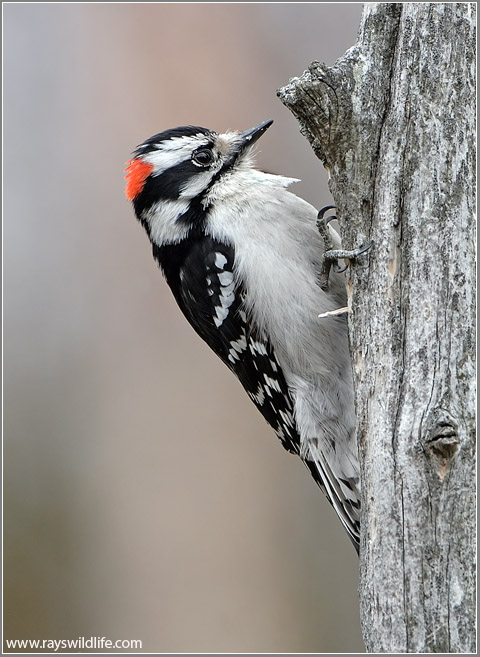
Downy Woodpecker (Picoides pubescens) by Raymond Barlow

Downy Woodpecker (Picoides pubescens) by Raymond Barlow

Lee’s Addition:

This is the beginning of a series from The Woodpeckers book. Our writer, Fannie Hardy Eckstorm, wrote this in 1901. There are 16 chapters, plus this Forward, which are about the Woodpecker Family here in America. All the chapters can be found on The Woodpeckers page.

Woodpeckers belong to the Picidae – Woodpeckers Family.

Here are the upcoming chapter titles:

CHAP. PAGE
 Foreword: the Riddlers  
I.  How to know a Woodpecker  
II.  How the Woodpecker catches a Grub  
III.  How the Woodpecker courts his Mate  
IV.  How the Woodpecker makes a House  
V.  How a Flicker feeds her Young  
VI.  Friend Downy  
VII.  Persona non Grata. (Yellow-bellied Sapsucker)  
VIII.  El Carpintero. (Californian Woodpecker)  
IX.  A Red-headed Cousin. (Red-headed Woodpecker)  
X.  A Study of Acquired Habits  
XI.  The Woodpecker’s Tools: His Bill  
XII.  The Woodpecker’s Tools: His Foot  
XIII.  The Woodpecker’s Tools: His Tail  
XIV.  The Woodpecker’s Tools: His Tongue  
XV.  How each Woodpecker is fitted for his own Kind of Life  
XVI.  The Argument from Design  

APPENDIX

A. Key to the Woodpeckers of North America

B. Descriptions of the Woodpeckers of North America

C. Explanation of Terms

*

I trust you will enjoy reading about these fantastic birds and how the Lord has created them to be able to carry out their task.

See:

The Woodpeckers by Fannie Hardy Eckstorm

Wordless Birds

*

Birdwatching Adventure – Florida Scrub Jay

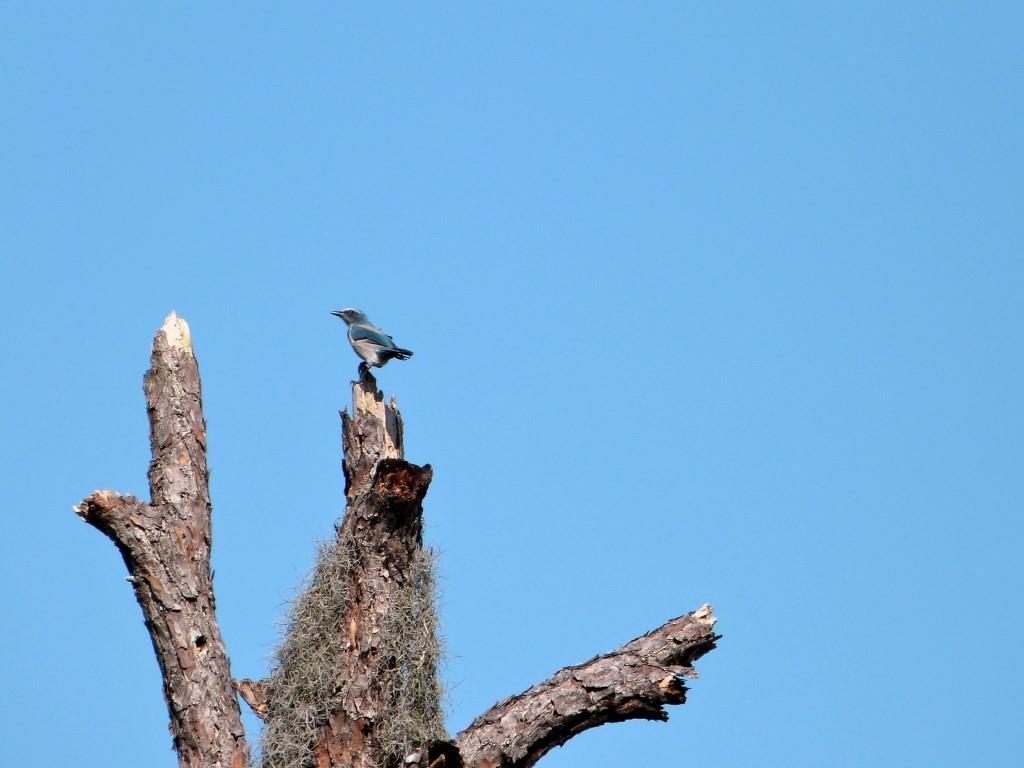
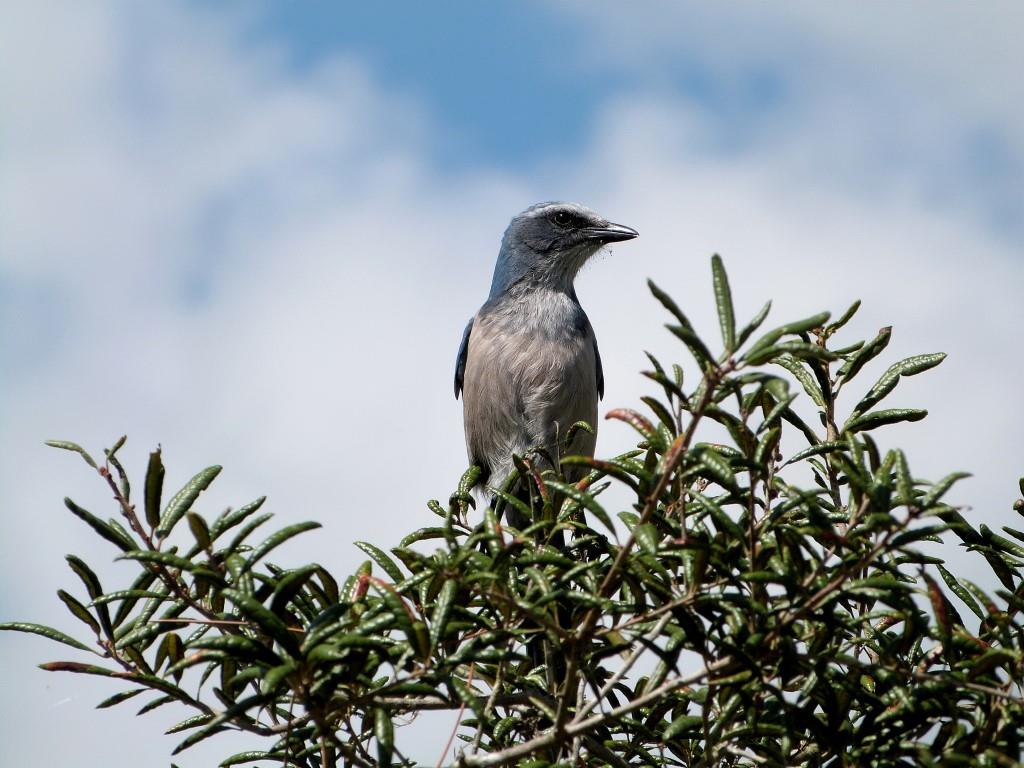
Florida Scrub Jay (Aphelocoma coerulescens) Highlands Hammock S Pk by Lee

Florida Scrub Jay (Aphelocoma coerulescens) Highlands Hammock S Pk

Look at the birds of the air, for they neither sow nor reap nor gather into barns; yet your heavenly Father feeds them. Are you not of more value than they? (Matthew 6:26 NKJV)

The main reason we went to Highlands Hammock State Park yesterday was to find some Florida Scrub Jays. The ranger told us where to find theirs and also where more could be found in another park.

Florida Scrub Jay (Aphelocoma coerulescens) Highlands Hammock S Pk by Lee

Florida Scrub Jay (Aphelocoma coerulescens) Highlands Hammock SPk 10-14-13

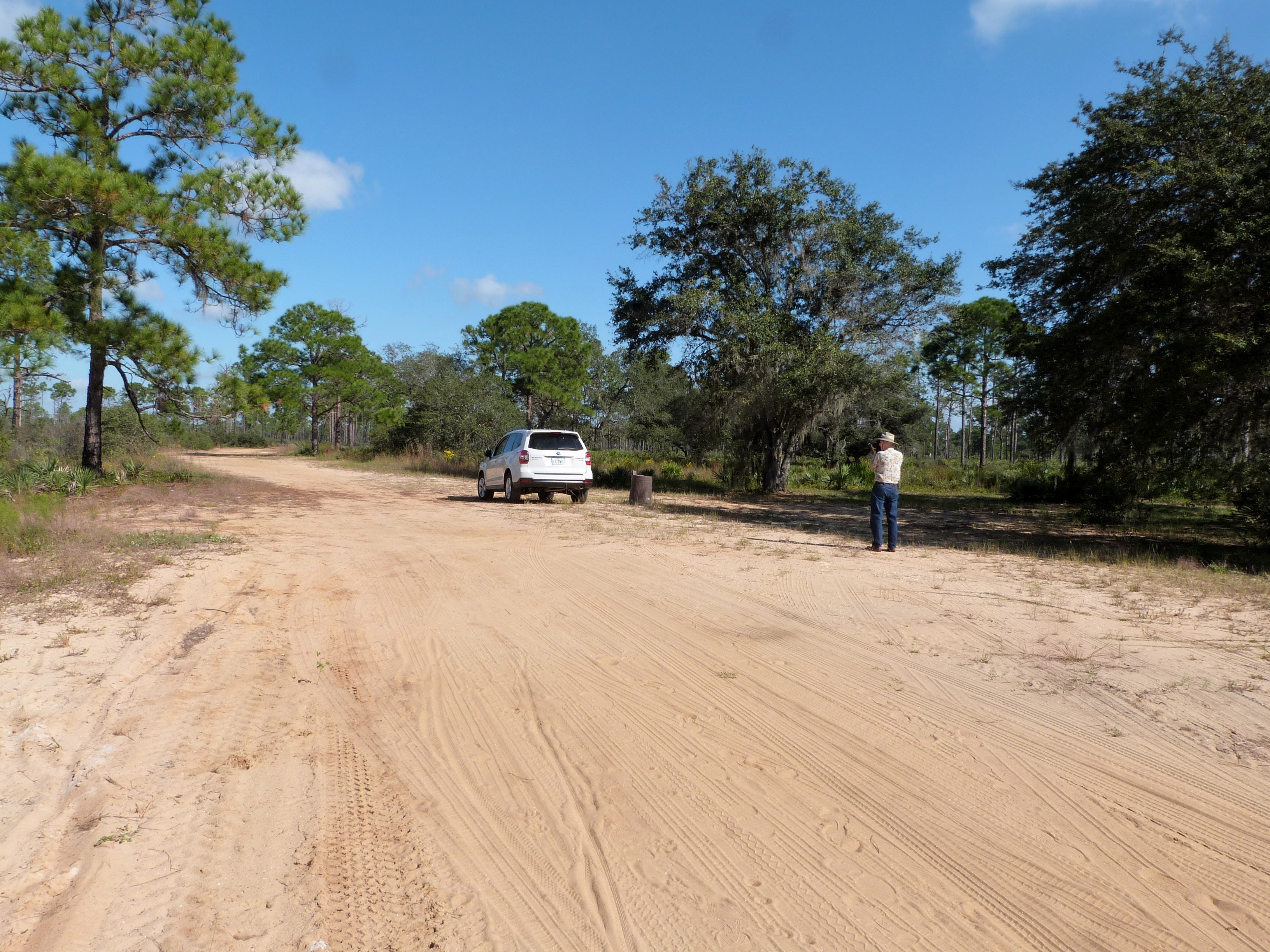
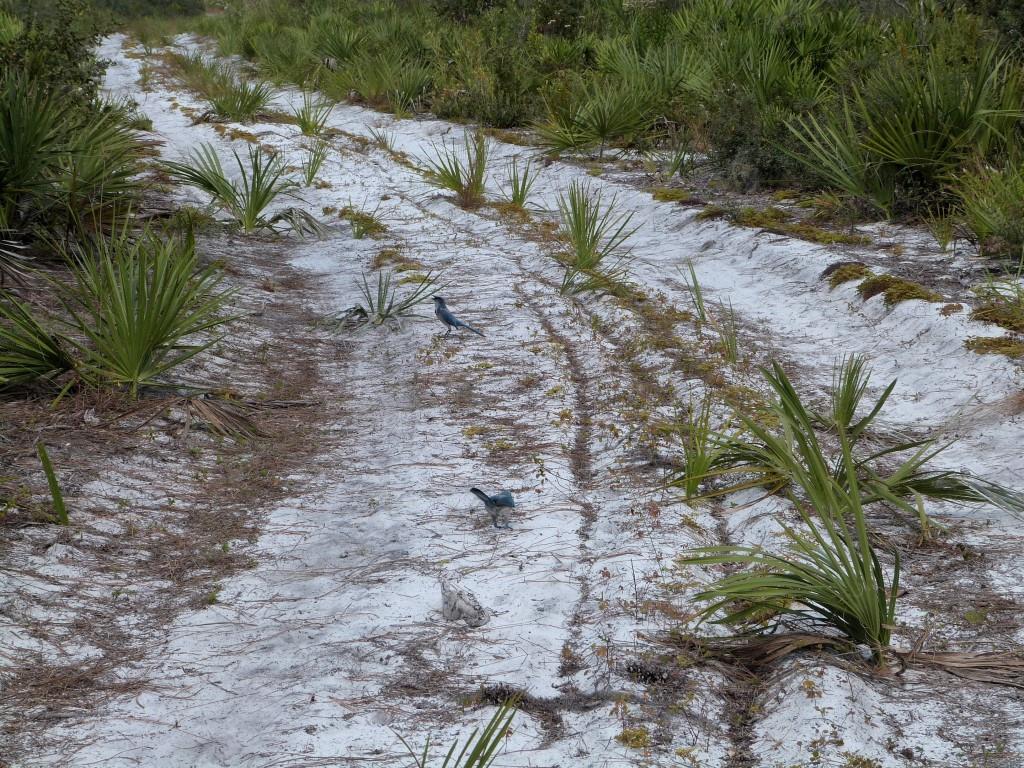
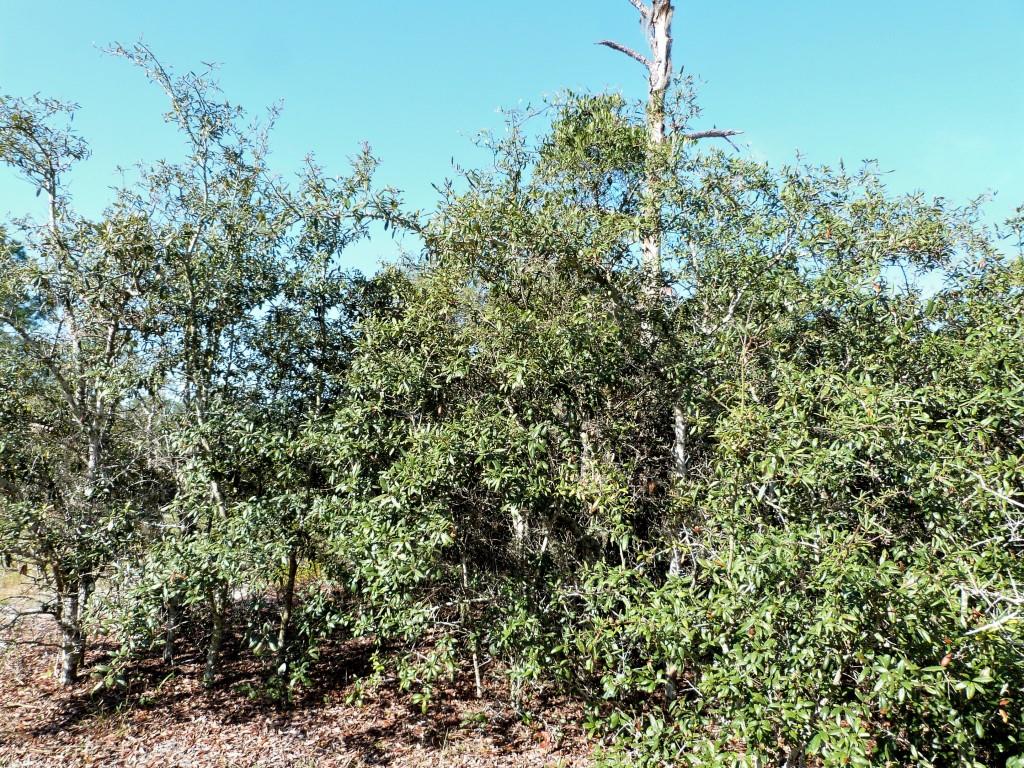
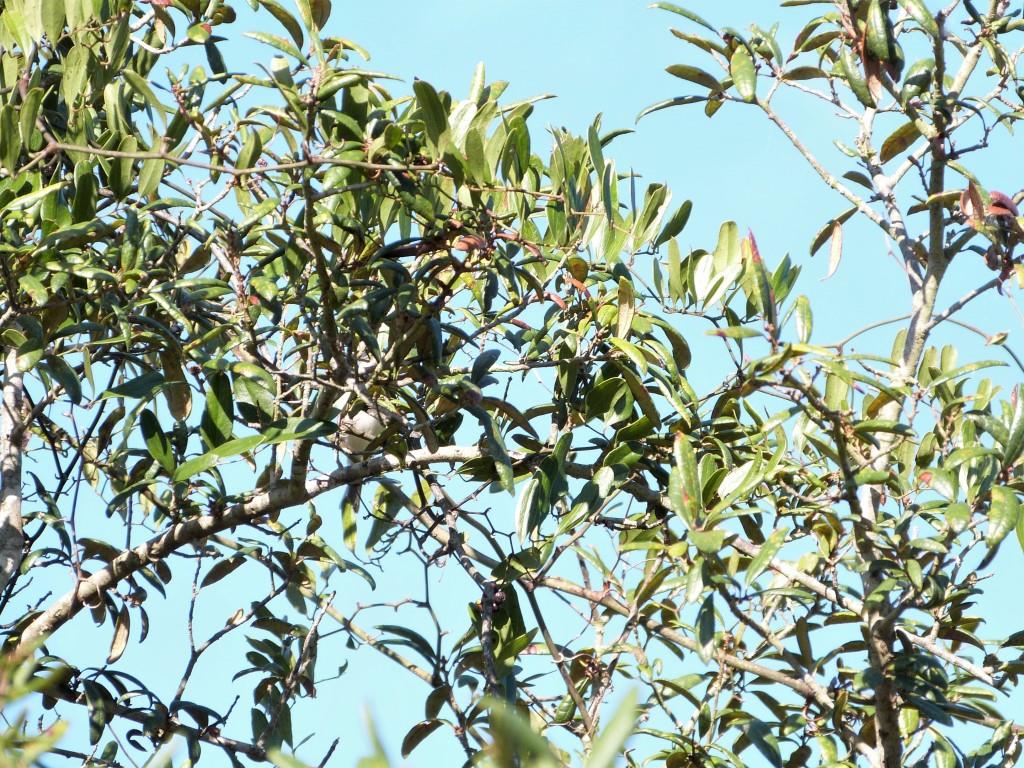
Went on the drive where the Wilderness Camping Area is located. Florida Scrub Jays prefer the scrub areas. The ranger told us that they had recently had a controlled burn and this family moved in right after that. From the pictures, you will see the kind of habitat they like.

Our new "Birding Mobile"

This is the area where we found the Scrub Jays at Highlands Hammock S P.

We found the Florida Scrub Jays, but they never got very close. We were also initiating our new “birding mobile”, as I have named it. Off the subject, but here is a photo of a Red-shouldered Hawk I shot through the “moonroof.” My first attempt at that. Next time, when we are not right under a hawk, it will be opened.

Red-shouldered Hawk (Buteo lineatus) Highlands Hammock SPk 10-14-13 Thru moonroof

Red-shouldered Hawk (Buteo lineatus) Highlands Hammock SPk 10-14-13

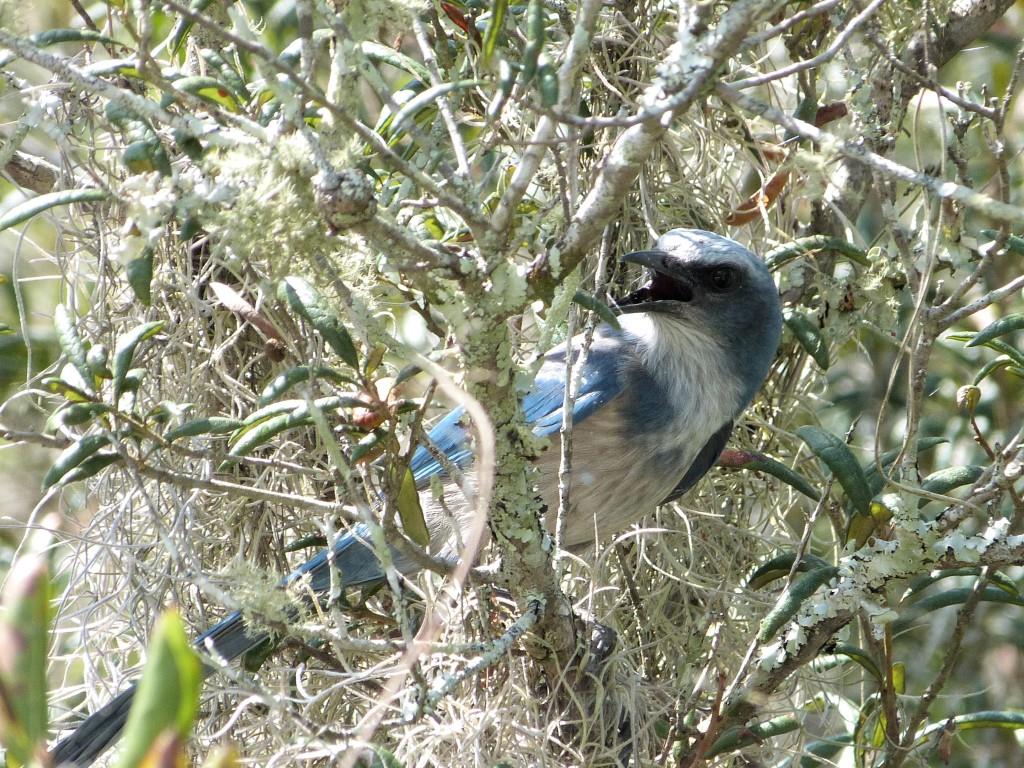
After driving through the rest of that park, we headed for the Lake June-in-Winter State Park. Never heard of it before. It is very tiny and we were the only ones there. Well, the birds of course were there, especially the Scrub Jays. We were able to get quite a few photos of them and they were quite friendly. There were also three Sandhill Cranes plus sounds of birds I do not recognize. The photos will be intermingled with some information about the jays from Wikipedia.

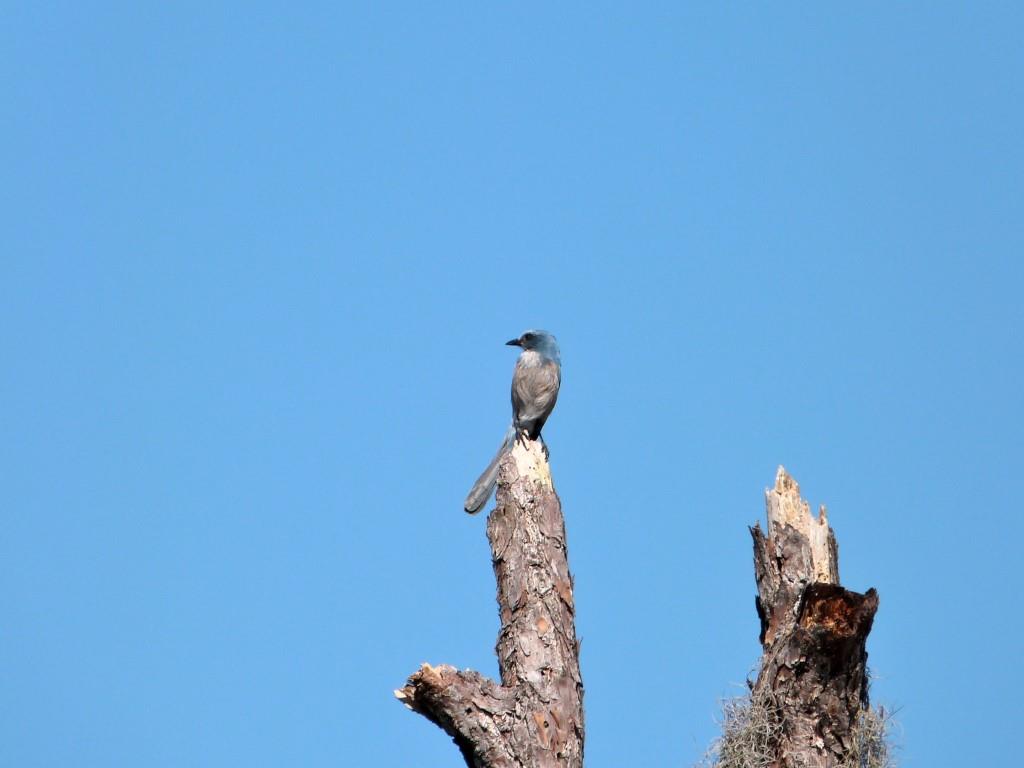
Florida Scrub Jay (Aphelocoma coerulescens) Lake June-in-Winter SPk

Florida Scrub Jay (Aphelocoma coerulescens) Lake June-in-Winter SPk

The Florida Scrub Jay (Aphelocoma coerulescens) is one of the species of scrub jay native to North America. It is the only species of bird endemic to the U.S. state of Florida and one of only 15 species endemic to the United States. Because of this, it is heavily sought by birders who travel from across the country to observe this unique species. It is possibly derived from the ancestors of Woodhouse’s Scrub Jay, the inland forms of the Western Scrub-jay. They belong to the Corvidae – Crows, Jays, Ravens Family.

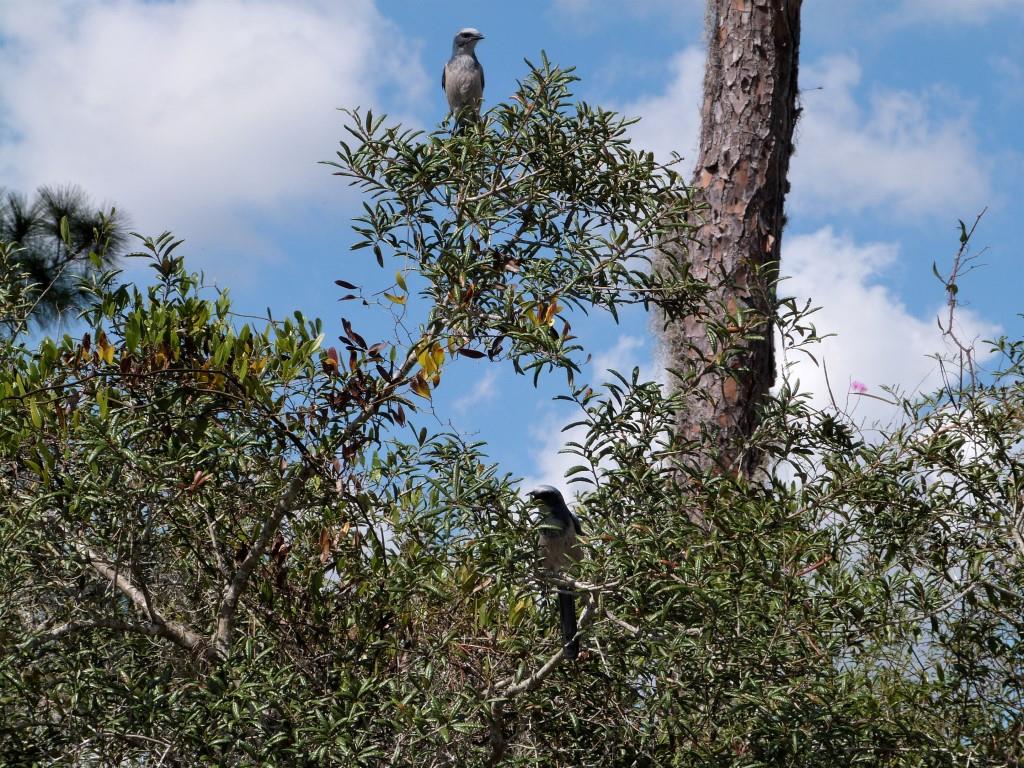
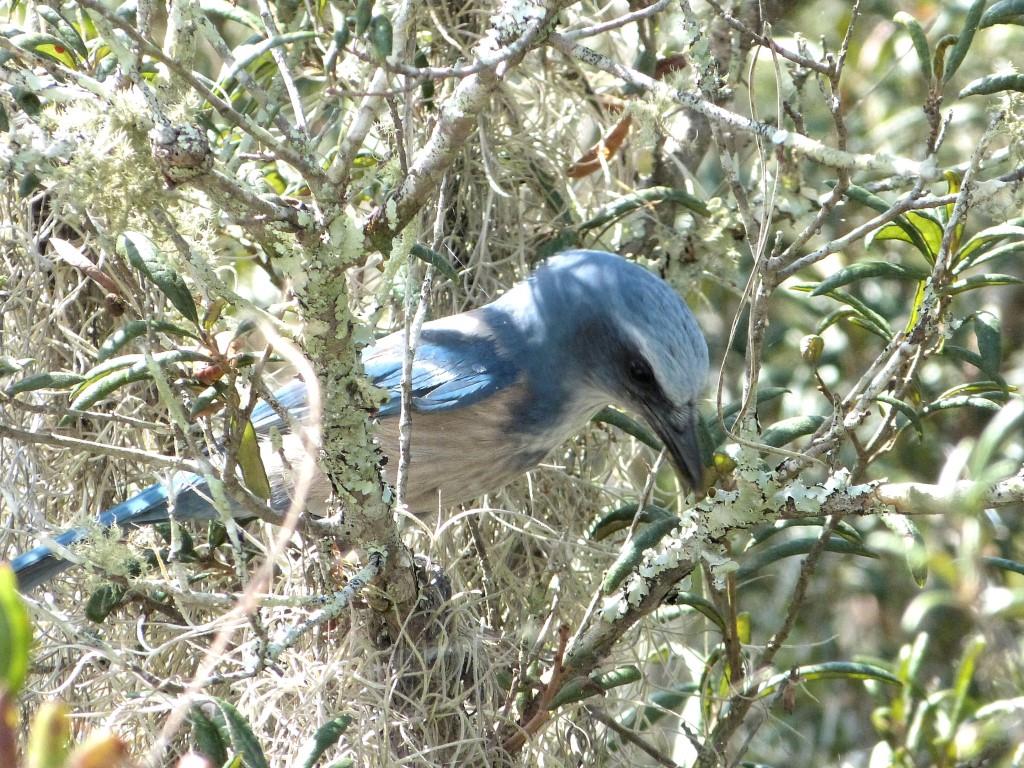
Florida Scrub Jay (Aphelocoma coerulescens) Lake June-in-Winter SPk

Florida Scrub Jay (Aphelocoma coerulescens) Lake June-in-Winter SPk

It measures 9.1 to 11 in (23 to 28 cm) in length, and weighs from 2.3 to 3.2 oz (66 to 92 g), with an average 2.83 oz (80.2 g). The wingspan of the jay is 13–14 in (33–36 cm). It has a strong black bill, blue head and nape without a crest, a whitish forehead and supercilium, blue bib, blue wings, grayish underparts, gray back, long blue tail, black legs and feet.

Florida Scrub Jay (Aphelocoma coerulescens) Lake June-in-Winter SPk

Florida Scrub Jay (Aphelocoma coerulescens) Lake June-in-Winter SPk

The Florida Scrub Jay is found only in Florida scrub habitat, an ecosystem that exists only in central Florida and is characterized by nutrient-poor soil, occasional drought, and frequent wildfires. Because of its somewhat harsh weather pattern, this habitat is host to a small assortment of very specific plants, including Sand Pine, Sand Live Oak, Myrtle Oak, Chapman’s Oak, Sandhill Oak, Florida Rosemary[11] and various other hardy plants such as Eastern prickly pear.

Florida Scrub Jay (Aphelocoma coerulescens) Lake June-in-Winter SPk

Florida Scrub Jay (Aphelocoma coerulescens) Lake June-in-Winter SPk

Florida Scrub Jays are omnivorous and eat a wide variety of acorns, seeds, peanuts, insects, tree frogs, turtles, snakes, lizards, and young mice. Florida Scrub Jays have also been occasionally observed to eat other birds’ eggs or nestlings, but this occurs rarely. They routinely cache thousands of acorns a year, burying them just beneath the surface. The acorns are typically buried in the fall and consumed during the winter and spring. Acorns that are forgotten or missed may germinate, making the Florida Scrub-Jay an effective agent for the dispersal of a variety of oak trees.

Florida Scrub Jay (Aphelocoma coerulescens) Lake June-in-Winter SPk

Florida Scrub Jay (Aphelocoma coerulescens) Lake June-in-Winter SPk

Scrub jays may also take silverware and other shiny objects in a manner similar to the American Crow.

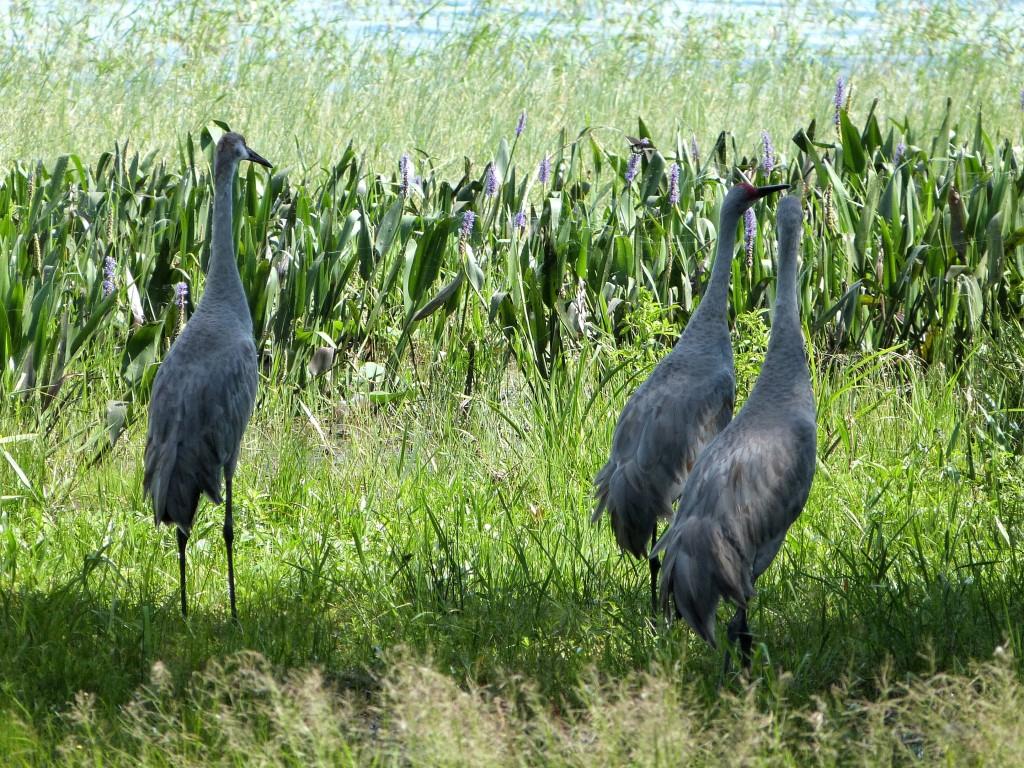
Sandhill Crane (Grus canadensis) Lake June-in-Winter SPk

Sandhill Crane (Grus canadensis) Lake June-in-Winter SPk

Here are some more of the photos from this “birdwatching adventure.”

This slideshow requires JavaScript.

See also:

Highlands Hammock State Park

Lake June-in-Winter State Park

Corvidae – Crows, Jays, Ravens Family

*

Birdwatching Adventure – Kingbird and Vireo

Western Kingbird (Tyrannus verticalis) Highlands Hammock SPk by Lee

Western Kingbird (Tyrannus verticalis) Highlands Hammock S Pk by Lee

I know all the birds of the mountains, And the wild beasts of the field are Mine. (Psalms 50:11 NKJV)

We have been off on several birdwatching adventures the last few days. We were out enjoying the Lord’s creation, especially His birds. Still sorting through the photos, but wanted to share two birds we saw today. They were at Highlands Hammock State Park in Sebring, FL. Both are birds that I have seen, but only when another birder pointed them out. That always gives a joy when you find and can figure out what a bird is.

The first one, I was only able to get one decent photo because it moved on quickly. Here is the bird cropped. (I trust this is the correct ID)

Western Kingbird (Tyrannus verticalis) Highlands Hammock SP by Lee (Cropped)

Western Kingbird (Tyrannus verticalis) Highlands Hammock SP by Lee

Kingbirds are members of the Tyrannidae – Tyrant Flycatchers Family. Adults are grey-olive on the upperparts with a grey head and a dark line through the eyes; the underparts are light becoming light orange-yellow on the lower breast and belly. They have a long black tail with white outer feathers. Western kingbirds also have a reddish crown that they only display during courtship and confrontations with other species.

These birds migrate in flocks to Florida and the Pacific coast of southern Mexico and Central America. (Lucky for us.)

They wait on an open perch and fly out to catch insects in flight, sometimes hovering and then dropping to catch food on the ground. They also eat berries.

The song is a squeaky chatter, sometimes compared to a dog’s squeaky toy. The call is a sharp loud whit. Occasionally sings before sunrise.

I have only seen this bird maybe three or four times before, so it was a nice find.

Highlands Hammock State Park

Highlands Hammock State Park

My next challenge started out in the trees and bushes above. This bird was all over the place and wouldn’t stay still as I tried to catch a photo of it. (Which is typical for those small birds.)

White-eyed Vireo (Vireo griseus) Highlands Hammock

White-eyed Vireo (Vireo griseus) Highlands Hammock

Here are some of my attempts to catch this bird. I do not use the “rule of thirds” because when I get home, finding the bird is easier if it’s centered. I figured out that it had a white breast by this photo. Let me zoom in.

White-eyed Vireo (Vireo griseus) Highlands Hammock SP cropped

White-eyed Vireo (Vireo griseus) Highlands Hammock SP cropped

Now the wings and its eye became more visible.

White-eyed Vireo (Vireo griseus) Highlands Hammock SPk 10-14-13

White-eyed Vireo (Vireo griseus) Highlands Hammock SPk 10-14-13

Then the bird finally popped out where I could get these next two photos.

White-eyed Vireo (Vireo griseus) Highlands Hammock SPk by Lee

White-eyed Vireo (Vireo griseus) Highlands Hammock SPk

That white eye is what nailed the ID on this bird. This is the first time that I’ve photographed one. When trying to figure these birds out, a good field guide and the internet sure come in handy.

My first ID in the field was wrong on both of these birds. I thought the Kingbird was some sort of Flycatcher and that this Vireo was a Warbler. Even though I only shoot in Program mode, and I do not claim to be a photographer, it does help to take proof or ID photos to help figure out what you really are seeing. It is more fun to just enjoy the birds while you are watching them and figure what it was later.

White-eyed Vireo (Vireo griseus) Highlands Hammock  SP by Lee

White-eyed Vireo (Vireo griseus) Highlands Hammock SP by Lee

They belong to the  Vireonidae – Vireos, Greenlets Family. The White-eyed Vireo (Vireo griseus) is a small songbird. It breeds in the southeastern USA from New Jersey west to northern Missouri and south to Texas and Florida, and also in eastern Mexico, northern Central America, Cuba and the Bahamas.

Populations on the US Gulf coast and further south are resident, but most North American birds migrate south in winter.The White-eyed Vireo (Vireo griseus) is a small songbird. It breeds in the southeastern USA from New Jersey west to northern Missouri and south to Texas and Florida, and also in eastern Mexico, northern Central America, Cuba and the Bahamas.

Populations on the US Gulf coast and further south are resident, but most North American birds migrate south in winter.

More of these trips will be shared. Saw lots of Wood Ducks and Florida Scrub Jays that I will “Show and Tell” later.

Thank all of you up North who have finally been sending your birds down for the coming winter. The birdwatching was getting a little boring.

See:

Tyrannidae – Tyrant Flycatchers Family

Vireonidae – Vireos, Greenlets Family

Some of our Birdwatching Trips

Highlands Hammock State Park

*


Birdwatching Reviews

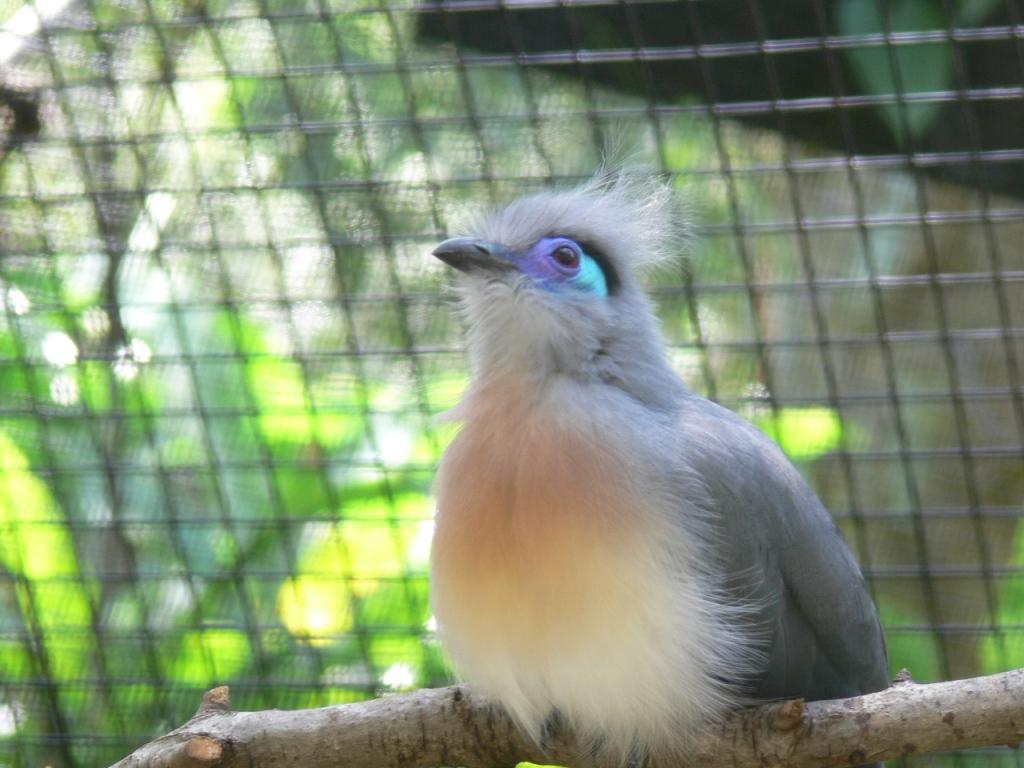
Crested Coua (Coua cristata) by Lee at LPZoo

Crested Coua (Coua cristata) by Lee at LPZoo

I remember the days of old; I meditate on all Your doings; I ponder the work of Your hands. (Psalms 143:5 AMP)

If you read yesterday’s post, Birds of the Bible Review II, you know I am in a “coasting mode” due to surgery on my neck. Today, I am encouraging you to look around the blog at some of the many Birdwatching articles that have been written over the last five years. Also, continue to pray that my cut heals and the infection clears up. It is better today.

Here are some of those many articles:

Joe Cool

(Black and White) Sumatran Laughingthrush (Garrulax bicolor) by Lee

Birdwatching

Beside them the birds of the heavens have their nests; they sing among the branches. [Matt. 13:32.] (Psalms 104:12 AMP)

Our Birdwatching Trips and other comments about birds and birding.

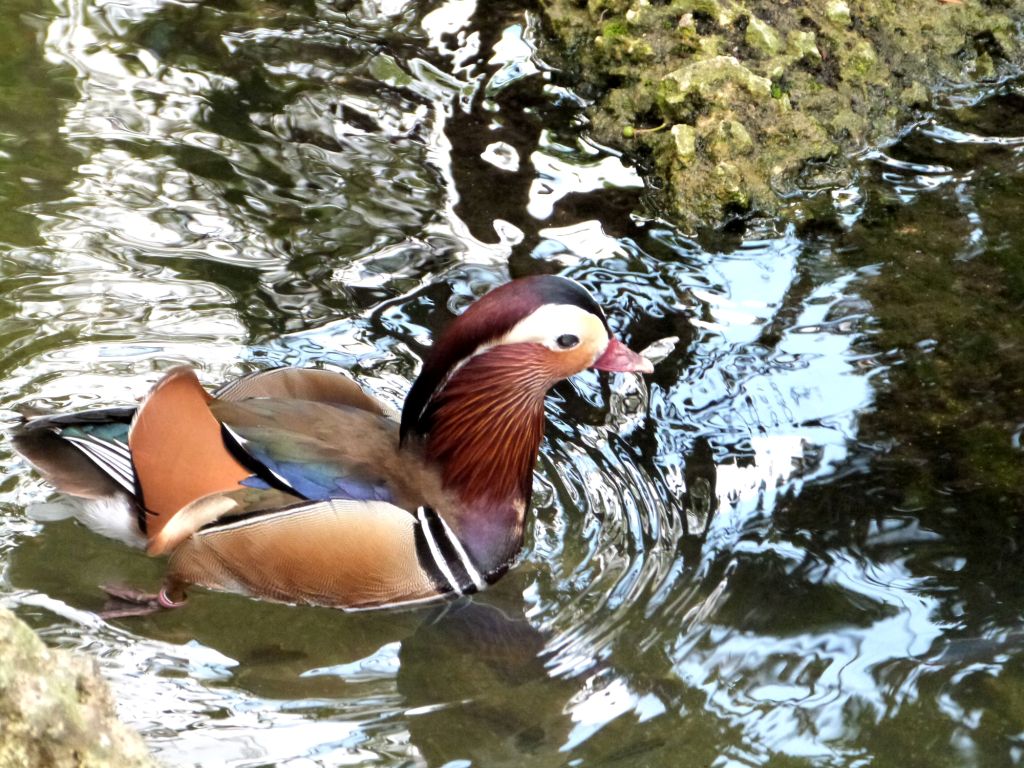
Mandarin Duck (Aix galericulata) Zoo Miami by Lee

Mandarin Duck (Aix galericulata) Zoo Miami by Lee

Formed By Him

Thou art worthy, O Lord, to receive glory and honour and power: for thou hast created all things, and for thy pleasure they are and were created (Revelation 4:11 KJV)

List of Articles:

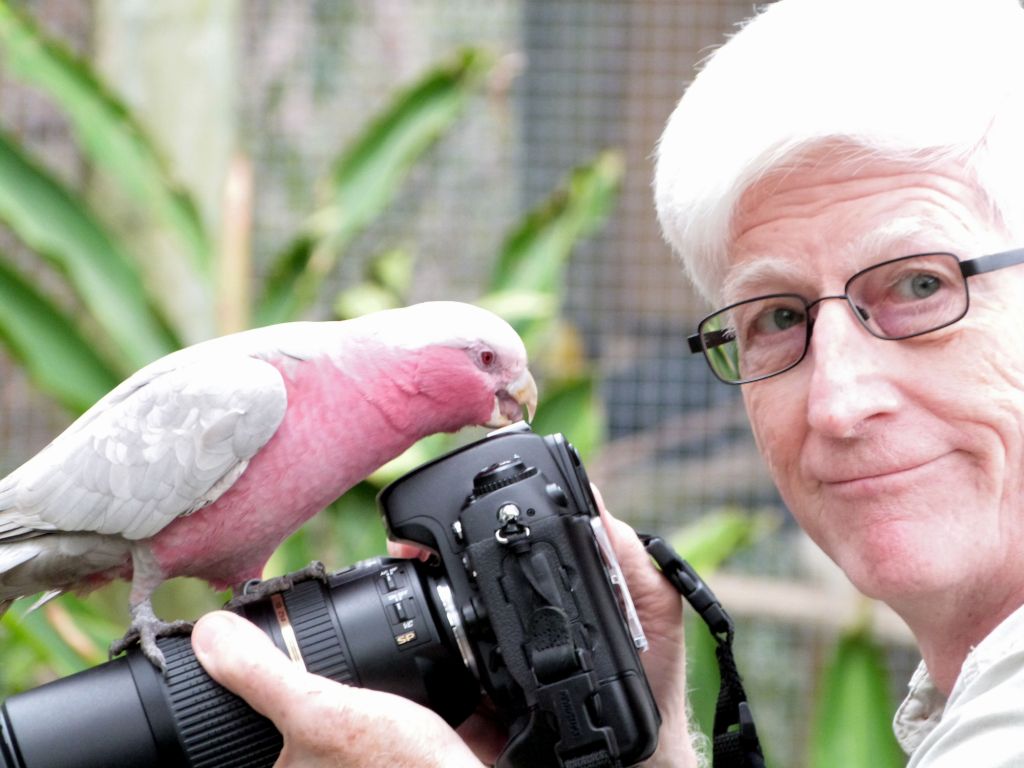
Galah (Eolophus roseicapilla) and Dan at Brevard Zoo

Galah (Eolophus roseicapilla) and Dan

Birds of the World

Are not five sparrows sold for two pennies? And [yet] not one of them is forgotten or uncared for in the presence of God. (Luke 12:6 AMP)

Birds of the World

*

Birdwatching Term – Nape

Blue-naped Mousebird (Urocolius macrourus) at Cincinnati Zoo)

Blue-naped Mousebird at Cincinnati Zoo)

Nape

My son, listen to your father’s discipline, and do not neglect your mother’s teachings, because discipline and teachings are a graceful garland on your head and a golden chain around your neck. (Proverbs 1:8-9 GW)

Nape – An easy definition is the back of the neck.

 Blue-naped Mousebird - Blue Nape (Back of Neck)

Blue-naped Mousebird – Blue Nape (Back of Neck)

Topography of a Bird - Bluebird - Color Key to NA Birds - Nape

Parts of Bird – Nape in Blue

Notice the Nape is between the Crown and the Back

There are quite a few birds that have colored napes that help identify them, such as Woodpeckers, Grebes, etc. Our Blue-naped Mousebird is one where the color of the “nape” is used in its name. While learning to bird watch, I kept saying (and still do) that the Lord should have placed little signs on them. That way when we look at them through binoculars, scopes, cameras, or our eyes, that we could just read the sign.

That is not the way it is, but there are many clues do that help us ID the birds. The variety of the birds with their colors and shapes keep us busy, but aren’t we thankful that He didn’t make them all alike. How boring that would be.

Here are the “-naped” birds of the world:

Chestnut-naped Francolin (Pternistis castaneicollis)
Red-naped Ibis (Pseudibis papillosa)
White-naped Crane (Grus vipio)
Black-naped Tern (Sterna sumatrana)
White-naped Pigeon (Columba albinucha)
Eastern Bronze-naped Pigeon (Columba delegorguei)
Western Bronze-naped Pigeon (Columba iriditorques)
Island Bronze-naped Pigeon (Columba malherbii)
Scaly-naped Pigeon (Patagioenas squamosa)
Red-naped Fruit Dove (Ptilinopus dohertyi)
Black-naped Fruit Dove (Ptilinopus melanospilus)
Purple-naped Lory (Lorius domicella)
White-naped Lory (Lorius albidinucha)
Blue-naped Parrot (Tanygnathus lucionensis)
Yellow-naped Amazon (Amazona auropalliata)
Scaly-naped Amazon (Amazona mercenarius)
White-naped Swift (Streptoprocne semicollaris)
Red-naped Trogon (Harpactes kasumba)
Golden-naped Barbet (Megalaima pulcherrima)
Golden-naped Woodpecker (Melanerpes chrysauchen)
Red-naped Sapsucker (Sphyrapicus nuchalis)
White-naped Woodpecker (Chrysocolaptes festivus)
Blue-naped Pitta (Hydrornis nipalensis)
Rusty-naped Pitta (Hydrornis oatesi)
Grey-naped Antpitta (Grallaria griseonucha)
Chestnut-naped Antpitta (Grallaria nuchalis)
Ochre-naped Ground Tyrant (Muscisaxicola flavinucha)
Rufous-naped Ground Tyrant (Muscisaxicola rufivertex)
White-naped Xenopsaris (Xenopsaris albinucha)
White-naped Honeyeater (Melithreptus lunatus)
Red-naped Bushshrike (Laniarius ruficeps)
Rufous-naped Whistler (Aleadryas rufinucha)
Rufous-naped Greenlet (Hylophilus semibrunneus)
Black-naped Oriole (Oriolus chinensis)
Black-naped Monarch (Hypothymis azurea)
White-naped Monarch (Carterornis pileatus)
Azure-naped Jay (Cyanocorax heilprini)
White-naped Jay (Cyanocorax cyanopogon)
Rufous-naped Tit (Periparus rufonuchalis)
White-naped Tit (Parus nuchalis)
Rufous-naped Lark (Mirafra africana)
White-naped Yuhina (Yuhina bakeri)
Rufous-naped Wren (Campylorhynchus rufinucha)
Chestnut-naped Forktail (Enicurus ruficapillus)
Purple-naped Sunbird (Hypogramma hypogrammicum)
Golden-naped Weaver (Ploceus aureonucha)
Golden-naped Finch (Pyrrhoplectes epauletta)
Blue-naped Chlorophonia (Chlorophonia cyanea)
White-naped Brush Finch (Atlapetes albinucha)
Pale-naped Brush Finch (Atlapetes pallidinucha)
Rufous-naped Brush Finch (Atlapetes latinuchus)
Golden-naped Tanager (Tangara ruficervix)
Green-naped Tanager (Tangara fucosa)
White-naped Seedeater (Dolospingus fringilloides)

*

This slideshow requires JavaScript.

*

You can see by the photos that the “nape” can be narrow or very broad. Other birds have napes that are different colors, but do not have the word “nape” in their names. Some of the Woodpeckers that have napes were include above.

Nape – All About Birds

More Birdwatching Terms

Wordless Birds

*

Birds of the Bible – The Bat Revisited

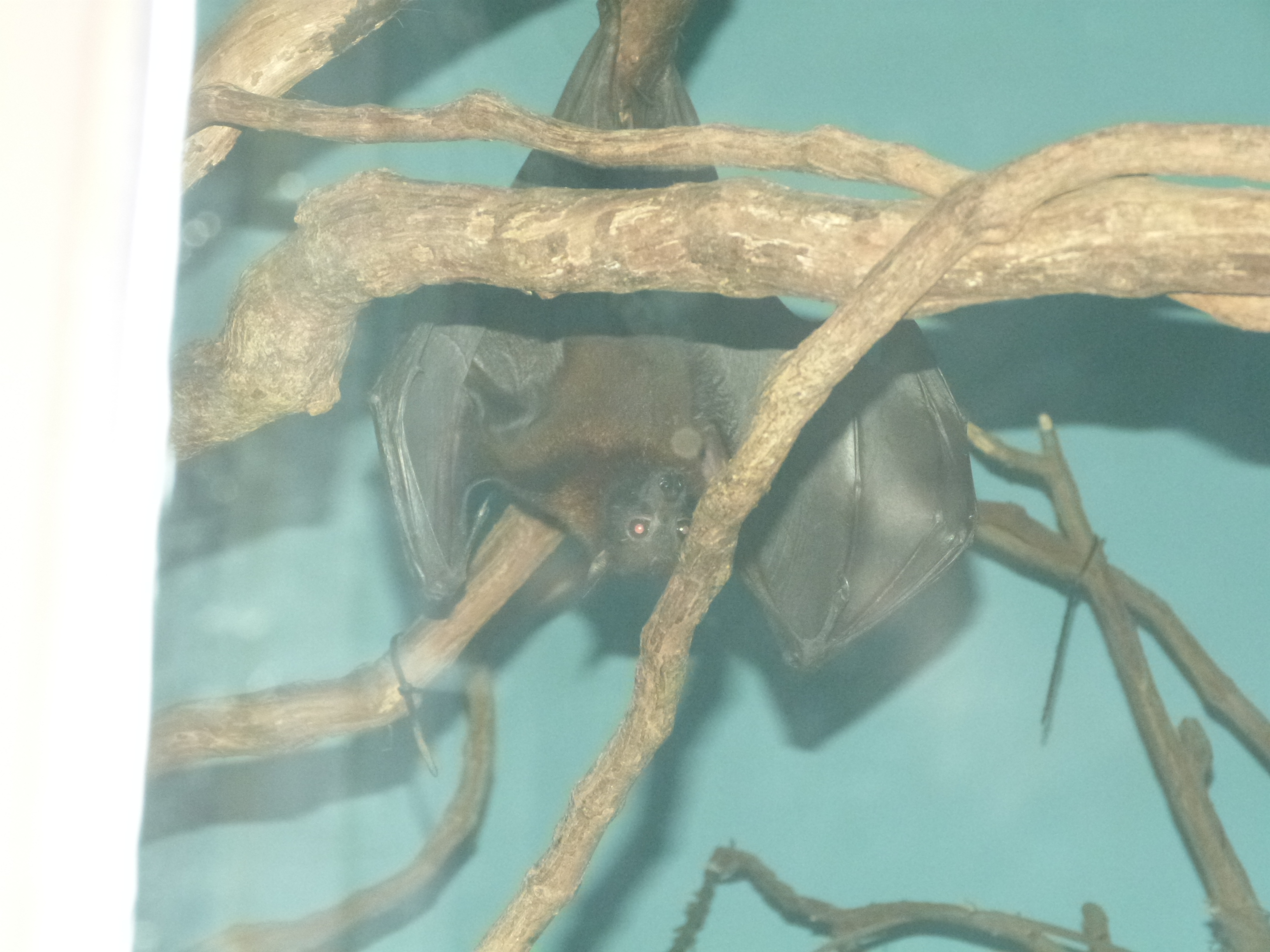
Giant Fruit Bat at Cincinnati Zoo 9-5-13 by Dan

Giant Fruit Bat at Cincinnati Zoo by Dan

And the stork, the heron after her kind, and the lapwing, and the bat. All fowls that creep, going upon all four, shall be an abomination unto you. Yet these may ye eat of every flying creeping thing that goeth upon all four, which have legs above their feet, to leap withal upon the earth; Even these of them ye may eat; the locust after his kind, and the bald locust after his kind, and the beetle after his kind, and the grasshopper after his kind. But all other flying creeping things, which have four feet, shall be an abomination unto you.
(Leviticus 11:19-23 KJV)

While we were at the Cincinnati Zoo, we were able to see and photograph several Bat species. They were really cool and I wanted to share them with you.

Giant Fruit Bat at Cincinnati Zoo 9-5-13 by Lee

Giant Fruit Bat at Cincinnati Zoo by Lee

Then I remembered that I had written about them in Birds of the Bible – The Bat?, in 2010. In that article, the controversy over whether a Bat is a Bird was mentioned, with several commentary comments. This time, I am mainly sharing the photos of the Bats that are there at the Zoo and comments about them. Just one personal observation about the above verses. The use of “fowl” in the King James Version and some of the others seems to refer to any creature that had wings and flies. I quoted the whole context because; 1) The verse and chapter separations were inserted later, 2) Birds, bats, and insects all seem to be referred to with the same collective term, “fowl.” I do not have a problem with the bat. It is not a bird.

The only other verses using “bat” or “bats” are:

And the stork, and the heron after her kind, and the lapwing, and the bat. (Deuteronomy 14:18 KJV)

In that day a man shall cast his idols of silver, and his idols of gold, which they made each one for himself to worship, to the moles and to the bats; (Isaiah 2:20 KJV)

The bats we saw at the Cincinnati Zoo were the Giant Fruit Bats and the Vampire Bats. They are amazing creatures of design and creation from their Creator, the Lord.

*

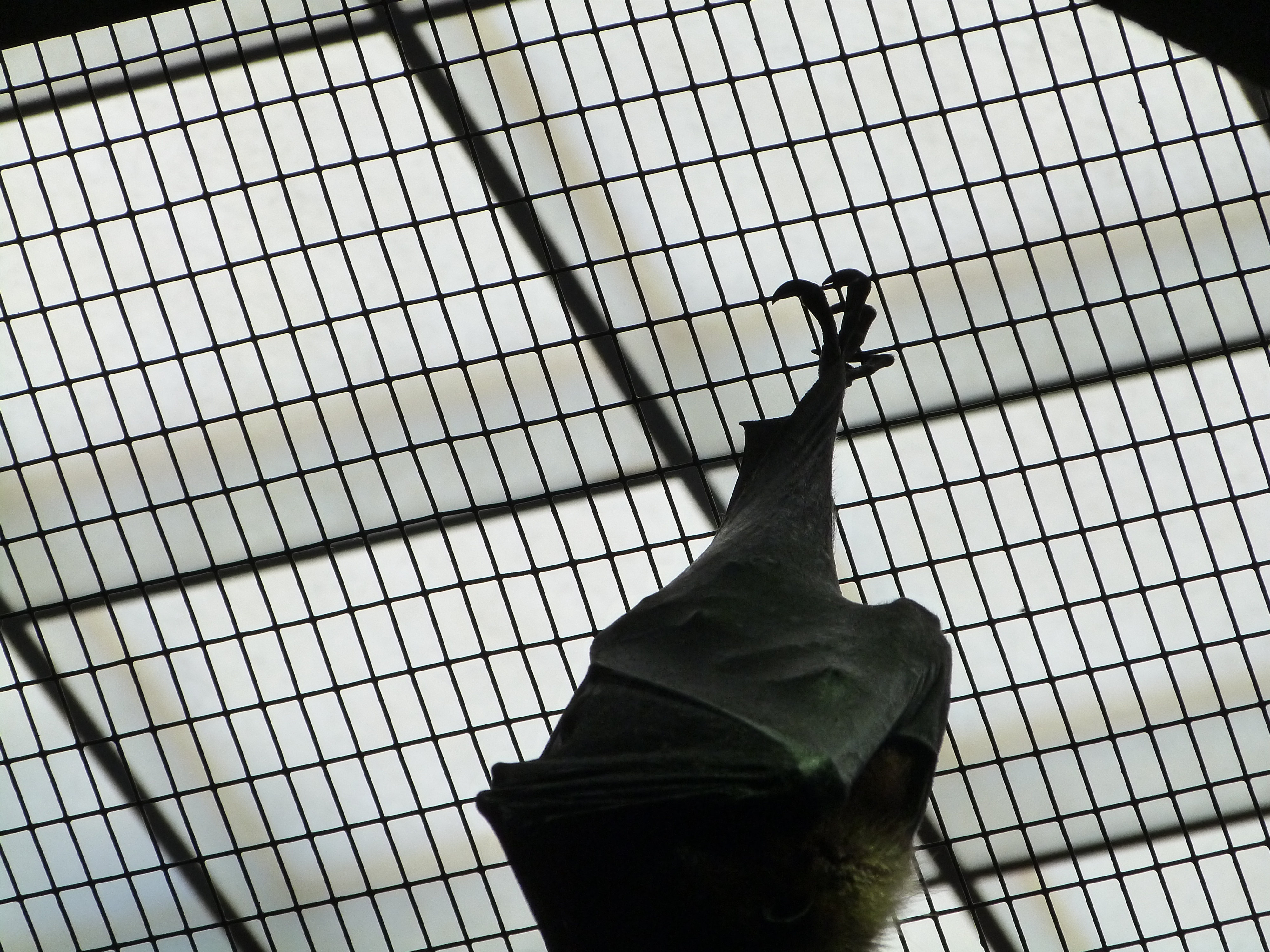
Giant Fruit Bat at Cincinnati Zoo 9-5-13 by Lee

Giant Fruit Bat’s Foot amazed me

Giant Fruit Bat (Pteropus giganteus) or Indian Flying Fox is found in Bangladesh, China, India, the Maldives, Nepal, Pakistan, and Sri Lanka. Also known as the greater Indian fruit bat, it lives in mainly forests. It is a very large bat with a wingspan between 3 ft 10 in and 4 ft 10 in (1.2 and 1.5 m). It is nocturnal and feeds mainly on ripe fruits, such as mangoes and bananas, and nectar. This bat is gregarious and lives in colonies which can number a few hundred. Their offspring have no specific name besides ‘young’. They have one to two young.

The Indian flying fox lives in tropical forests and swamps, where a large body of water is nearby.

The way they were hanging up there amazed me. I zoomed in and took a photo of its foot. Also, they almost looked like a large cocoon hanging up there with the wings wrapped around them. The first photo, Dan caught one of them stretching.

*

*

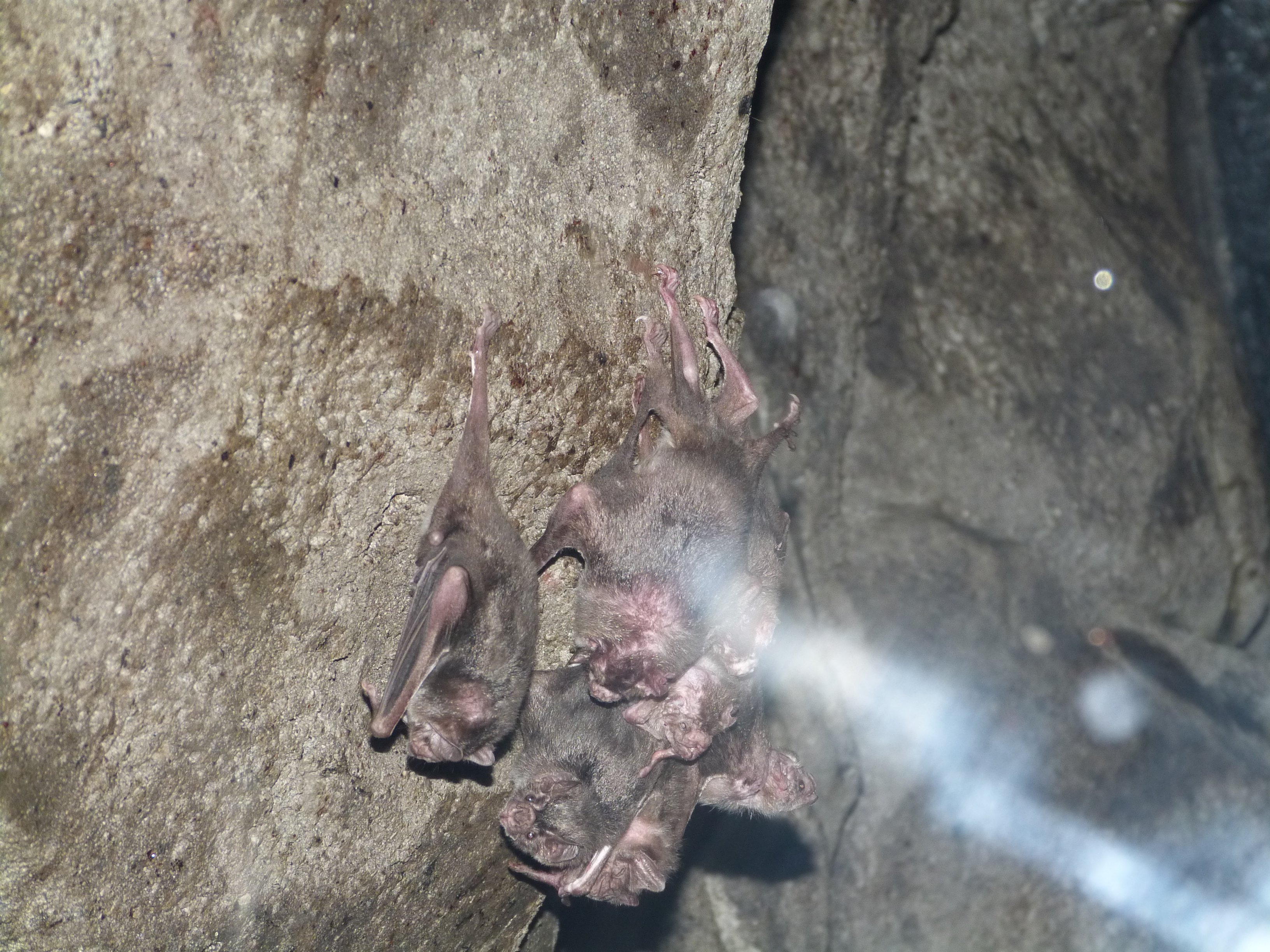
Common Vampire Bat (Desmodus rotundus) Cincinnati Zoo 9-5-13 by Lee

Common Vampire Bat Cincinnati Zoo by Lee (Shot through glass into a dark exhibit)

(Common) Vampire Bat (Desmodus rotundus) – The common vampire bat mainly feeds on the blood of livestock, approaching its prey at night while they are sleeping. It uses its razor-sharp teeth to cut open the skin of its hosts and laps up their blood with its long tongue. They are native to the New World, ranging from Mexico to Brazil, Chile, and Argentina.

The common vampire bat is short-haired, with silver-gray fur on its undersides, sharply demarcated from the darker fur on its back. It has small, somewhat rounded ears, a deeply grooved lower lip, and a flat, leaf-shaped nose. A well-developed, clawed thumb on each wing is used to climb onto prey and to assist the animal in take-off. The bat averages about 3.5 in (9 cm) long with a wingspan of 7 in (18 cm). It commonly weighs about 2 oz (57 grams), but its weight can double after a single feeding. The braincase is relatively large, but the snout is reduced to accommodate large incisors and canines. It has the fewest teeth among bats.

Common Vampire Bat - Cincinnati Zoo by Lee

Common Vampire Bat – Cincinnati Zoo by Lee

Common vampire bats have good eyesight. They are able to distinguish different optical patterns and may use vision for long-range orientation. These bats also have well-developed senses of smell and hearing: the cochlea is highly sensitive to low-frequency acoustics, and the nasal passages are relatively large. They emit echolocation signals orally, and thus fly with their mouths open for navigation.

Common Vampire Bat - Cincinnati Zoo by Lee

Common Vampire Bat – Cincinnati Zoo by Lee

*

(Wikipedia with editing)

*

*

Links:

Cincinnati Zoo

Giant Fruit Bats – Cincinnati Zoo

Indian Flying Fox – Wikipedia

Vampire Bats – Cincinnati Zoo

Common Vampire Bat – Wikipedia

Birds of the Bible – The Bat?

Birds of the Bible

*

Child’s Book of Water Birds ~ The Oyster Catcher

The Oyster Catcher

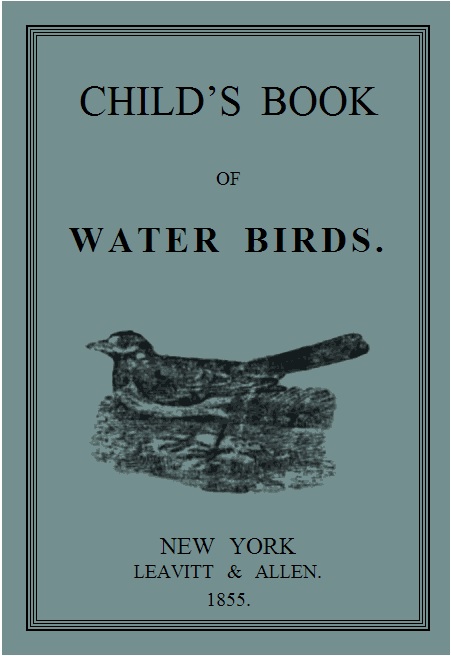
Child's Book of Water Birds - Book Cover

Child’s Book of Water Birds – Book Cover

***

Childs Bk of Water Birds titlebird

NEW YORK

LEAVITT & ALLEN.

1855.

***

Welcome to the Updated Child’s Book of Water Birds, by Anonymous. It was written in 1855 and this is 2013. That is 158 years ago.

*
*
Childs Bk of Water Birds oystercatcher

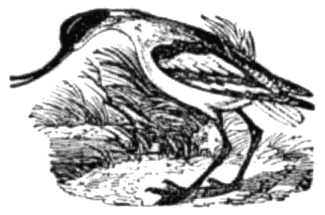
THE OYSTER CATCHER.

The Oyster Catcher feeds generally on shell-fish, oysters, limpets, &c. He detaches them from the rocks to which they are fastened, and opens them with his long, stout bill. The head, neck, and body are black. It lays two olive-brown eggs, spotted with black.

*

American Oystercatcher (Haematopus palliatus) by Robert Scanlon

American Oystercatcher (Haematopus palliatus) by Robert Scanlon

Update:

Just as day was breaking, Jesus stood on the shore; yet the disciples did not know that it was Jesus. (John 21:4 ESV)

American Oystercatchers are sometimes called the American Pied Oystercatcher. They are about 19 inches (42-52 cm) long. They were created with a large thick orange or red beak which helps them pry open their food, like oysters, clams, and mussels. They belong to the Oystercatcher Family which has twelve (12) species. They like the coastal areas and nest on the beaches. In winter, they are found in flocks along the coast from central New Jersey to the Gulf of Mexico (eastern) or along the Pacific coast from northwestern Baja California southward. (western).

Black Oystercatcher (Haematopus bachmani) Family by Beedie Savage

Black Oystercatcher (Haematopus bachmani) Family by Beedie Savage

***

See the other five Child’s Book of Water Birds:

The Swan

The Coot

The Dabchick

The Teal

The Goose

*

Oystercatcher Family

Oystercatcher – Wikipedia

Oystercatcher – All About Birds

Oystercatcher – ARKive


Bible Birds

Wordless Birds

*

Child's Book of Water Birds - Levit and Allen

Back Cover

*** PROJECT GUTENBERG EBOOK CHILD'S BOOK OF WATER BIRDS ***

*