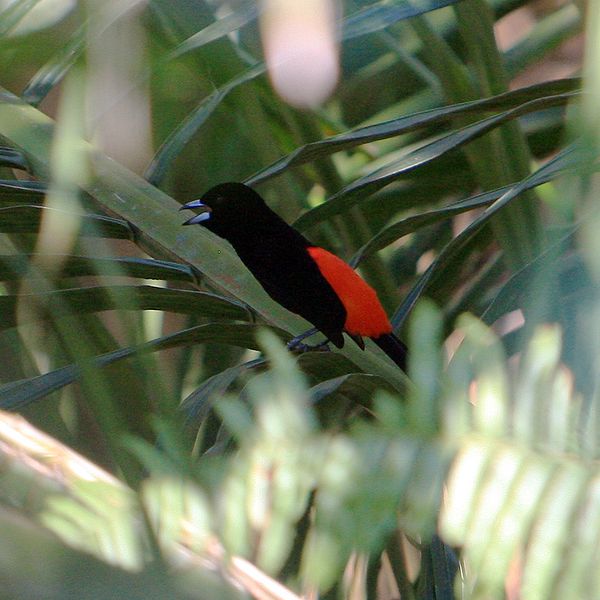
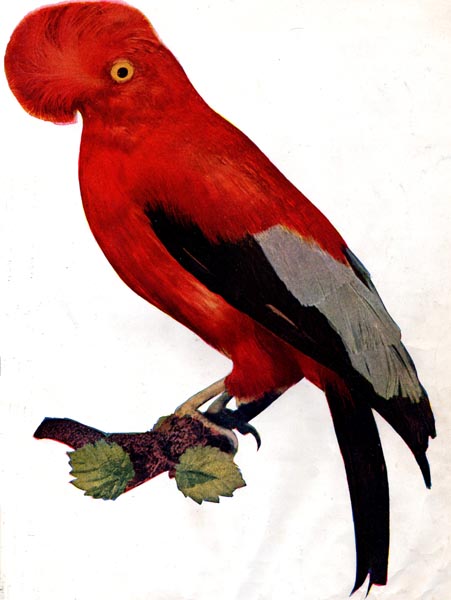
Birds Vol 1 #2 – The Red-Wing Black Bird

Red-winged Blackbird (Agelaius phoeniceus) - Birds Illustrated

Red-winged Blackbird (Agelaius phoeniceus) – Birds Illustrated

Birds Illustrated by Color Photography – Revisited

Vol 1. February, 1897 No. 2

*

THE RED WING BLACK BIRD – THE BIRD OF SOCIETY

THE BLACKBIRD.

“I could not think so plain a bird
Could sing so fine a song.”


One on another against the wall
Pile up the books—I am done with them all;
I shall be wise, if I ever am wise,
Out of my own ears, and of my own eyes.

One day of the woods and their balmy light—
One hour on the top of a breezy hill,
There in the sassafras all out of sight
The Blackbird is splitting his slender bill
For the ease of his heart:
Do you think if he said
“I will sing like this bird with the mud colored back
And the two little spots of gold over his eyes,
Or like to this shy little creature that flies
So low to the ground, with the amethyst rings
About her small throat—all alive when she sings
With a glitter of shivering green—for the rest,
Gray shading to gray, with the sheen of her breast
Half rose and half fawn—
Or like this one so proud,
That flutters so restless, and cries out so loud,
With stiff horny beak and a top-knotted head,
And a lining of scarlet laid under his wings—”
Do you think, if he said, “I’m ashamed to be black!”
That he could have shaken the sassafras-tree
As he does with the song he was born to? not he!
—Alice Cary.


“Do you ne’er think what wondrous beings these?
Do you ne’er think who made them—who taught
The dialect they speak, where melodies
Alone are the interpreters of thought?
Whose household words are songs in many keys,
Sweeter than instrument of man ere caught!
Whose habitation in the tree-tops even
Are half-way houses on the road to heaven!

* * * * * * *

“You call them thieves or pillagers; but know,
They are the winged wardens of your farms,
Who from the cornfields drive the insidious foe,
And from your harvest keep a hundred harms;
Even the blackest of them all, the crow,
Renders good service as your man-at-arms,
Crushing the beetle in his coat of mail,
And crying havoc on the slug and snail.”
—From “The Birds of Killingworth.”
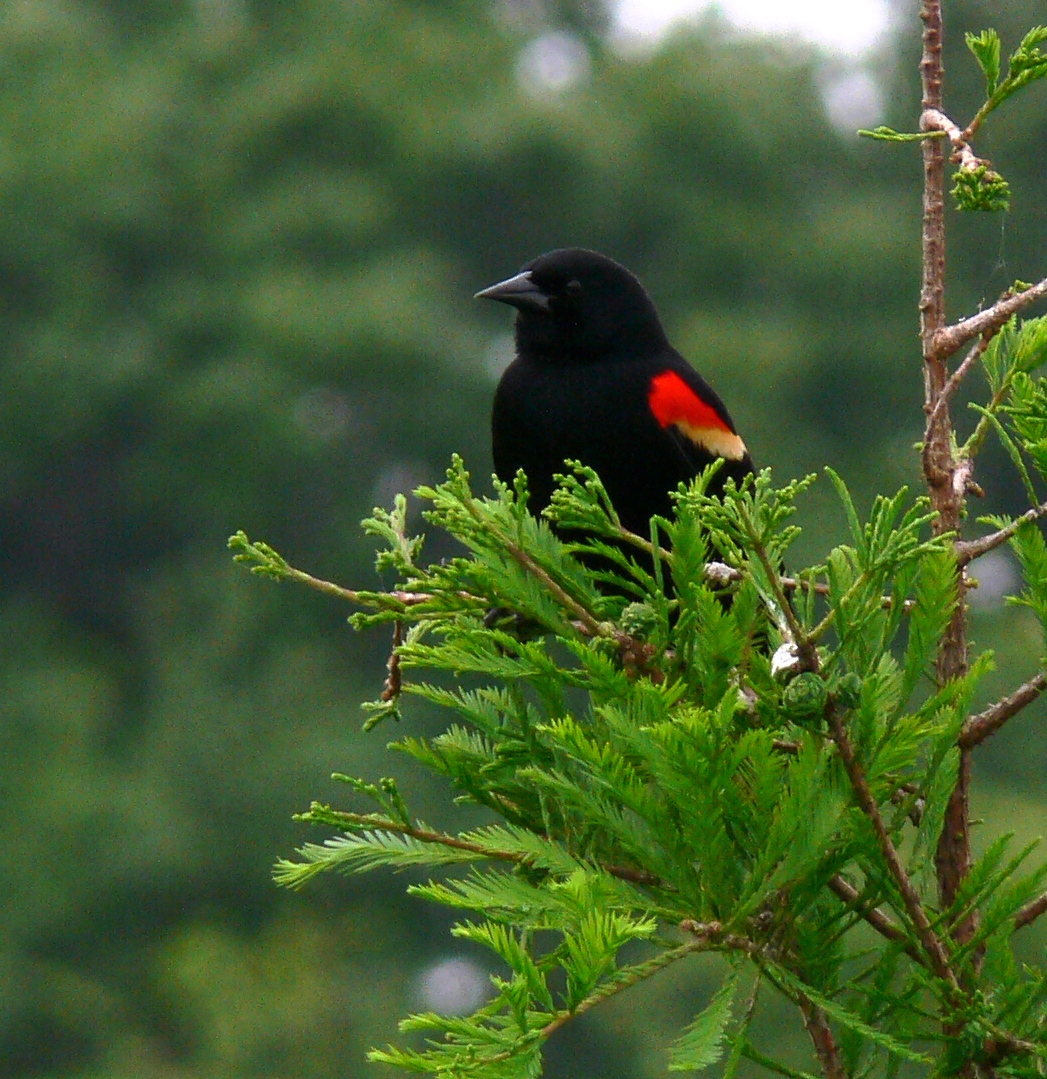

Red-winged Blackbird at S. Lake Howard Nature Pk. by Lee

Red-winged Blackbird at S. Lake Howard Nature Pk. by Lee

*

The blackbirds make the maples ring
With social cheer and jubilee;
The redwing flutes his o-ka-lee.—Emerson.

imgtHE much abused and persecuted Red Wing Black Bird is found throughout North America, from the Atlantic to the Pacific; and it breeds more or less abundantly wherever found. In New England it is generally migratory, though instances are on record where a few have been known to remain throughout the winter in Massachusetts. Passing, in January, through the lower counties of Virginia, one frequently witnesses the aerial evolutions of great numbers of these birds. Sometimes they appear as if driven about like an enormous black cloud carried before the wind, varying every moment in shape. Sometimes they rise suddenly from the fields with a noise like thunder, while the glittering of innumerable wings of the brightest vermillion, amid the black cloud, occasion a very striking effect. At times the whole congregated multitude will suddenly alight in some detached grove and commence one general concert, that can plainly be distinguished at the distance of more than two miles. With the Redwings the whole winter season seems one continued carnival. They find abundant food in the old fields of rice, buckwheat and grain, and much of their time is spent in aerial movements, or in grand vocal performances.

The Redwings, for their nest, always select either the borders of streams or low marshy situations, amongst thick bunches of reeds. One nest was found built on a slender sapling at the distance of fourteen feet from the ground. The nest was pensile, like that of the Baltimore Oriole.

They have from one to three or more broods in a season, according to locality.

In the grain growing states they gather in immense swarms and commit havoc, and although they are shot in great numbers, and though their ranks are thinned by the attacks of hawks, it seems to have but little effect upon the survivors.

On the other hand, these Black Birds more than compensate the farmer for their mischief by the benefit they confer in the destruction of grub worms, caterpillars, and various kinds of larvae, the secret and deadly enemies of vegetation. It has been estimated the number of insects destroyed by these birds in a single season, in the United States, to be twelve thousand millions.

The eggs average about an inch in length. They are oval in shape, have a light bluish ground, and are marbled, lined and blotched with markings of light and dark purple and black.


BLACKBIRD.

’Tis a woodland enchanted!
By no sadder spirit
Than blackbirds and thrushes,
That whistle to cheer it
All day in the bushes,
This woodland is haunted;
And in a small clearing,
Beyond sight or hearing
Of human annoyance,
The little fount gushes.—Lowell.


THE BIRD OF SOCIETY.

The blackbird loves to be one of a great flock. He talks, sings or scolds from morning until night. He cannot keep still. He will only stay alone with his family a few months in the summer. That is the reason he is called the “Bird of Society.” When he is merry, he gaily sings, “Conk-quer-ree.” When he is angry or frightened he screams, “Chock! Chock!” When he is flying or bathing he gives a sweet note which sounds like ee-u-u. He can chirp—chick, check, chuck, to his little ones as softly as any other bird. But only his best friends ever hear his sweetest tones, for the Blackbirds do not know how to be polite. They all talk at once. That is why most people think they only scream and chatter. Did you ever hear the blackbirds in the cornfields? If the farmers thought about it perhaps they would feel that part of every corn crop belongs to the Blackbirds. When the corn is young, the farmer cannot see the grubs which are eating the young plants. The Blackbirds can. They feed them to their babies—many thousands in a day. That is the way the crops are saved for the farmer. But he never thinks of that. Later when the Blackbirds come for their share of the corn the farmer says, “No, they shall not have my corn. I must stop that quickly.” Perhaps the Blackbirds said the same thing to the grubs in the spring. It is hard to have justice for everyone.

In April the Blackbird and his mate leave the noisy company. They seek a cosy home near the water where they can be quiet until August. They usually choose a swampy place among low shrubs and rushes. Here in the deep nest of coarse grass, moss and mud the mother bird lays her five eggs. They are very pretty—light blue with purple and black markings. Their friends say this is the best time to watch the blackbirds. In the flock they are all so much alike we cannot tell one from another. You would like to hear of some of the wise things Blackbirds do when they are tame.

One friend of the birds turned her home into a great open bird cage. Her chair was the favorite perch of her birds. She never kept them one minute longer than they wanted to stay. Yet her home was always full. This was Olive Thorne Miller. If you care to, you might ask mother to get “Bird Ways” and read you what she says about this “bird of society” and the other birds of this book.
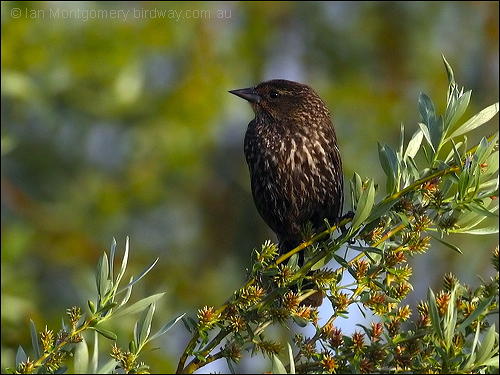

Red-winged Blackbird (Agelaius phoeniceus) female by Ian

Red-winged Blackbird (Agelaius phoeniceus) female by Ian

Lee’s Addition:

I combined the Blackbird and the Red Wing Blackbird together. The poems and some of the writing, combined them and only one photo was provided.

Today this bird is called the Red-winged Blackbird and they are in the Icteridae – Oropendolas, Orioles & Blackbirds Family, which has 108 species. We are fortunate here because we see Red-winged Blackbirds quite often and even have them stop by the feeders in our yard. I can always tell when they are near because of the male’s song. It is a loud, gurgling “conk-a-reeeee” or “o-ka-leeeee” sound.

And to every beast of the earth and to every bird of the heavens and to everything that creeps on the earth, everything that has the breath of life, I have given every green plant for food.” And it was so. And God saw everything that he had made, and behold, it was very good. And there was evening and there was morning, the sixth day. (Genesis 1:30-31 ESV)

*
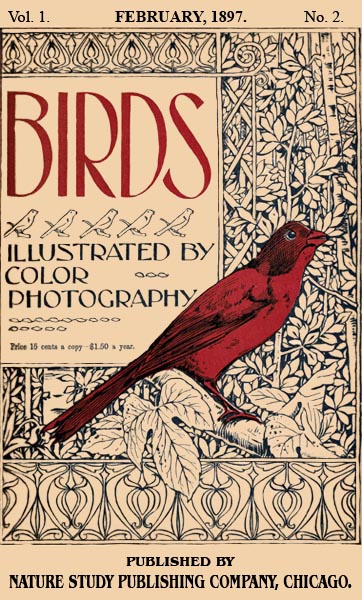
Birds Illustrated by Color Photograhy Vol 1 February 1897 No 2 - Cover

Birds Illustrated by Color Photograhy Vol 1 February 1897 No 2 – Cover

Birds Illustrated by Color Photography – Revisited – Introduction

The above article is the first article in the monthly serial for February 1897 “designed to promote Knowledge of Bird-Live.” These include Color Photography, as they call them, today they are drawings. There are at least three Volumes that have been digitized by Project Gutenberg.

To see the whole series of – Birds Illustrated by Color Photography – Revisited

*
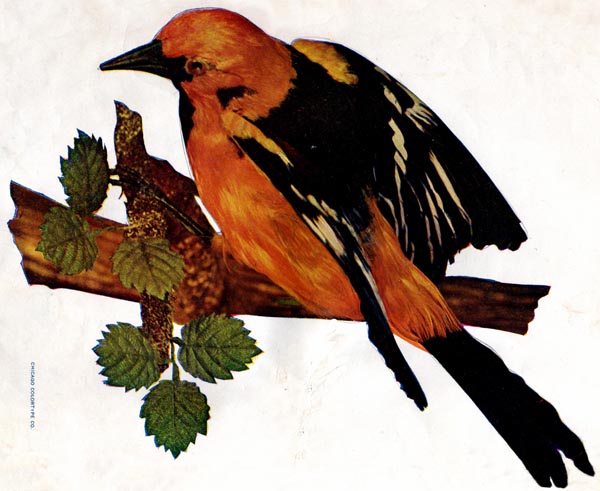
(Information from Wikipedia and other internet sources)

Next Article – Blue Mountain Lory

Previous Article –The Kingfisher – The Lone Fisherman

Wordless Birds

Links:

Red-winged Blackbirds

*

Birds Vol 1 #2 – The Kingfisher – The Lone Fisherman

Kingfisher – Birds Illustrated by Photography 1897

Birds Illustrated by Color Photography – Revisited

Vol 1. February, 1897 No. 2

*

THE KINGFISHER.

Dear Children:

I shall soon arrive from the south. I hear that all the birds are going to tell stories to the boys and girls.

I have never talked much with children myself for I never really cared for people. They used to say that the dead body of a Kingfisher kept them safe in war and they said also that it protected them in lightning.

Even now in some places in France they call us the moth birds, for they believe that our bodies will keep away moths from woolen cloth.

I wish that people would not believe such things about us. Perhaps you cannot understand me when I talk. You may think that you hear only a child’s rattle.

Listen again! It is I, the Kingfisher. That sound is my way of talking. I live in the deep woods. I own a beautiful stream and a clear, cool lake. Oh, the little fish in that lake are good enough for a king to eat! I know, for I am a king.

You may see me or some of my mates near the lake any pleasant day. People used to say that we always brought pleasant weather. That is a joke. It is the pleasant weather that always brings us from our homes. When it storms or rains we cannot see the fish in the lake. Then we may as well stay in our nests.

My home once belonged to a water rat. He dug the fine hall in the gravel bank in my stream. It is nearly six feet long. The end of it is just the kind of a place for a nest. It is warm, dry and dark. In June my wife and I will settle down in it. By that time we shall have the nest well lined with fish bones. We shall put in some dried grass too. The fish bones make a fine lining for a nest. You know we swallow the fish whole, but we save all the bones for our nest.

I shall help my wife hatch her five white eggs and shall try in every way to make my family safe.

Please tell the people not to believe those strange things about me and you will greatly oblige,
A neighbor,
The Kingfisher.


THE KINGFISHER.

The Lone Fisherman.

imgtHE American species belongs to the true group of Kingfishers. It occupies the whole continent of North America and although migrating in the north, he is a constant resident of our southern states. The belted Kingfisher is the only variety found along the inland streams of the United States. Audubon declares that “belted” should apply only to the female, however.

Like most birds of brilliant plumage, the Kingfisher prefers a quiet and secluded haunt. It loves the little trout streams, with wooded and precipitous banks, the still ponds and small lakes, ornamental waters in parks, where it is not molested, and the sides of sluggish rivers, drains and mill-ponds.

Here in such a haunt the bird often flits past like an indistinct gleam of bluish light. Fortune may sometimes favor the observer and the bird may alight on some twig over the stream, its weight causing it to sway gently to and fro. It eagerly scans the shoal of young trout sporting in the pool below, when suddenly it drops down into the water, and, almost before the observer is aware of the fact, is back again to its perch with a struggling fish in its beak. A few blows on the branch and its prey is ready for the dexterous movement of the bill, which places it in a position for swallowing. Sometimes the captured fish is adroitly jerked into the air and caught as it falls.

Fish is the principal food of the Kingfisher; but it also eats various kinds of insects, shrimps, and even small crabs. It rears its young in a hole, which is made in the banks of the stream it frequents. It is a slatternly bird, fouls its own nest and its peerless eggs. The nesting hole is bored rather slowly, and takes from one to two weeks to complete. Six or eight white glossy eggs are laid, sometimes on the bare soil, but often on the fish bones which, being indigestible, are thrown up by the bird in pellets.

The Kingfisher has a crest of feathers on the top of his head, which he raises and lowers, especially when trying to drive intruders away from his nest.

The plumage is compact and oily, making it almost impervious to water. The flesh is fishy and disagreeable to the taste, but the eggs are said to be good eating. The wings are long and pointed and the bill longer than the head. The voice is harsh and monotonous.

It is said that few birds are connected with more fables than the Kingfisher. The superstition that a dead Kingfisher when suspended by the throat, would turn its beak to that particular point of the compass from which the wind blew, is now dead. It was also supposed to possess many astonishing virtues, as that its dried body would avert thunderbolts, and if kept in a wardrobe would preserve from moths the woolen stuffs and the like contained in it.

Under the name of “halcyon,” it was fabled by the ancients to build its nest on the surface of the sea, and to have the power of calming the troubled waves during its period of incubation; hence the phrase “halcyon days.”

A pair of Kingfishers have had their residence in a bank at the south end of Washington Park, Chicago, for at least three seasons past. We have watched the Kingfisher from secluded spots on Long Island ponds and tidal streams, where his peculiar laughing note is the same as that which greets the ear of the fisherman on far inland streams on still summer days.

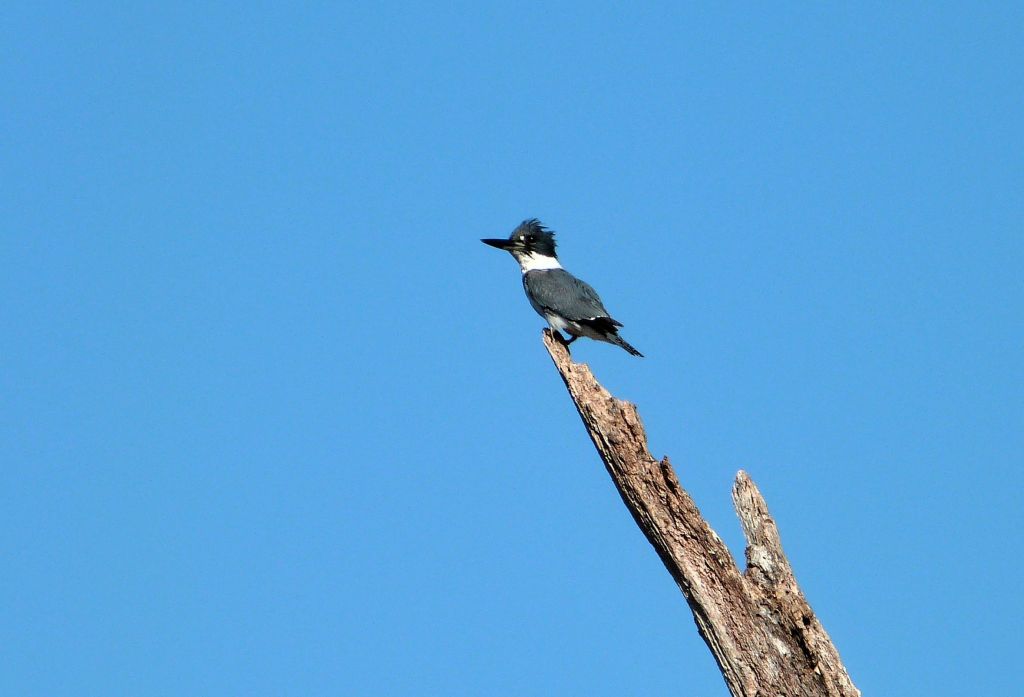
Belted Kingfisher (Megaceryle alcyon) by Daves BirdingPix


Lee’s Addition:

Another of my favorite birds. I think most of them are, but the Belted Kingfisher is a real challenge to photograph. They must sense that your camera is on. Dan says that many photographers call it the “Devil Bird” because it is so hard to photo. See http://jimt.zenfolio.com/p703966915 by James Thiel and another photographer at http://www.flickr.com/photos/johnklos/3049270990/.

I think of them as having a short squatty neck and a long beak. Actually the Laughing Kookaburra is in the Kingfisher family, the Kingfishers – Alcedinidae Family. The article mentioned that the Belted Kingfisher is the only one in the U. S., but there are actually two more; the Ringed and the Green Kingfishers that are found in south Texas. We have seen all three of them.

The Kingfisher – Alcedinidae family has a total of 95 members. Many of them are very colorful and again show the Lord’s Creative Hand at work. He has provided them with just the right kind of beak to snatch their meals with and even given them the ability to see their prey in the water. The distortion water gives is compensated for them.

And Jesus, walking by the sea of Galilee, saw two brethren, Simon called Peter, and Andrew his brother, casting a net into the sea: for they were fishers. And he saith unto them, Follow me, and I will make you fishers of men. (Matthew 4:18-19 KJV)

Belted Kingfisher (Megaceryle alcyon) by Lee Circle B

Belted Kingfisher (Megaceryle alcyon) by Lee Circle B

In January, I was able for the first time to get some photos of the Belted Kingfisher. Two of them were showing off and forgot someone was watching. They can hover over the water, keeping their head steady and watch for their prey. It is amazing to watch them do that. (Birdwatching Adventure – Circle B Bar Reserve – 1/16/12)

Birds Illustrated by Color Photograhy Vol 1 February 1897 No 2 - Cover

Birds Illustrated by Color Photograhy Vol 1 February 1897 No 2 – Cover

Birds Illustrated by Color Photography – Revisited – Introduction

The above article is the first article in the monthly serial for February 1897 “designed to promote Knowledge of Bird-Live.” These include Color Photography, as they call them, today they are drawings. There are at least three Volumes that have been digitized by Project Gutenberg.

To see the whole series of – Birds Illustrated by Color Photography – Revisited

*

(Information from Wikipedia and other internet sources)

Next Article – The Red Wing Black Bird – The Bird Of Society

Previous Article – The American Robin – The Bird Of The Morning

Wordless Birds

Links:


Birds Vol 1 #2 – The American Robin

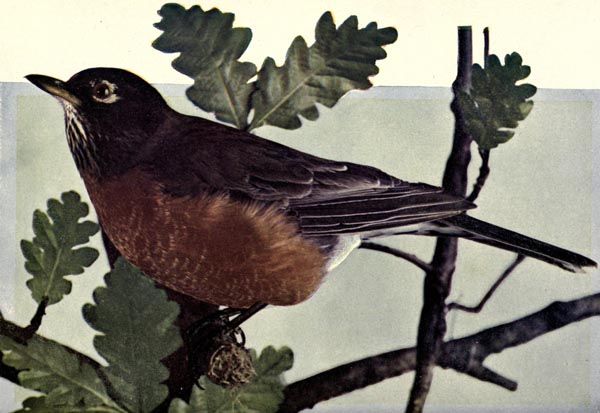
American Robin for Birds Illustrated by Color Photography

American Robin for Birds Illustrated by Color Photography

Birds Illustrated by Color Photography – Revisited

Vol 1. February, 1897 No. 2

*

THE AMERICAN ROBIN.

The Bird of the Morning.

Yes, my dear readers, I am the bird of the morning. Very few of you rise early enough to hear my first song. By the time you are awake our little ones have had their breakfast, Mrs. Robin and I have had our morning bath and we are all ready to greet you with our morning song.

I wonder if any of you have seen our nest and can tell the color of the eggs that Mrs. Robin lays. Some time I will let you peep into the nest and see them, but of course you will not touch them.

I wonder, too, if you know any of my cousins—the Mocking bird, the Cat-bird or the Brown Thrush—I think I shall ask them to have their pictures taken soon and talk to you about our happy times.

Did you ever see one of my cousins on the ground? I don’t believe you can tell how I move about. Some of you may say I run, and some of you may say I hop, and others of you may say I do both. Well, I’ll tell you how to find out. Just watch me and see. My little friends up north won’t be able to see me though until next month, as I do not dare leave the warm south until Jack Frost leaves the ground so I can find worms to eat.

I shall be about the first bird to visit you next month and I want you to watch for me. When I do come it will be to stay a long time, for I shall be the last to leave you. Just think, the first to come and last to leave. Don’t you think we ought to be great friends? Let us get better acquainted when next we meet. Your friend,
Robin.

American Robin (Turdus migratorius) Eggs and 1 hatchling ©©SenzEnina

American Robin (Turdus migratorius) Eggs and 1 hatchling ©©SenzEnina


How do the robins build their nest?
Robin Red Breast told me,
First a wisp of yellow hay
In a pretty round they lay;
Then some shreds of downy floss,
Feathers too, and bits of moss,
Woven with a sweet, sweet song,
This way, that way, and across:
That’s what Robin told me.

Where do the robins hide their nest?
Robin Red Breast told me,
Up among the leaves so deep,
Where the sunbeams rarely creep,
Long before the winds are cold,
Long before the leaves are gold
Bright-eyed stars will peep and see
Baby Robins—one, two, three:
That’s what Robin told me.

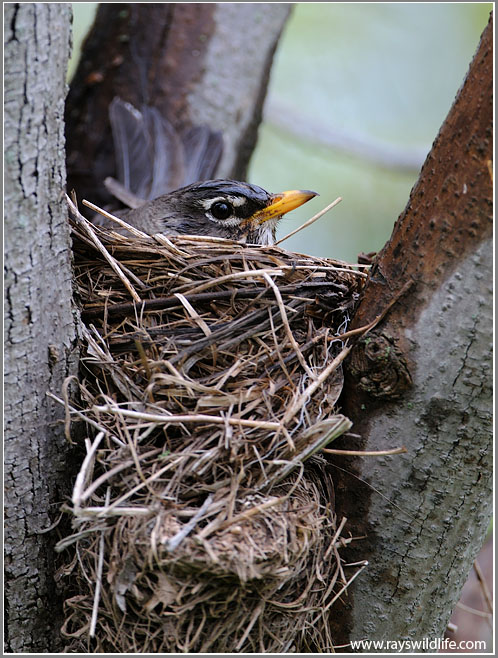
American Robin (Turdus migratorius) by Raymond Barlow

American Robin (Turdus migratorius) by Raymond Barlow


THE AMERICAN ROBIN.

“Come, sweetest of the feathered throng.”

imgo


UR American Robin must not be confounded with the English Robin Redbreast, although both bear the same name. It is the latter bird in whose praise so much has been written in fable and song. The American Robin belongs to the Thrush family; the Mocking bird, Cat-bird and Brown Thrush, or Thrasher, being other familiar children. In this family, bird organization reaches its highest development. This bird is larger than his English cousin the Redbreast and many think has a finer note than any other of the Thrush family.

The Robin courts the society of man, following close upon the plow and the spade and often becoming quite tame and domestic. It feeds for a month or two on strawberries and cherries, but generally on worms and insects picked out of the ground. It destroys the larvae of many insects in the soil and is a positive blessing to man, designed by the Creator for ornament and pleasure, and use in protecting vegetation. John Burroughs, the bird lover, says it is the most native and democratic of our birds.

It is widely diffused over the country, migrating to milder climates in the Winter. We have heard him in the early dawn on Nantucket Island welcoming the coming day, in the valleys of the Great and the little Miami, in the parks of Chicago, and on the plains of Kansas, his song ever cheering and friendly. It is one of the earliest heralds of Spring, coming as early as March or April, and is one of the latest birds to leave us in Autumn. Its song is a welcome prelude to the general concert of Summer.

“When Robin Redbreast sings,
We think on budding Springs.”

The Robin is not one of our most charming songsters, yet its carol is sweet, hearty and melodious. Its principal song is in the morning before sunrise, when it mounts the top of some tall tree, and with its wonderful power of song, announces the coming of day. When educated, it imitates the sounds of various birds, and even sings tunes. It must be amusing to hear it pipe out so solemn a strain as Old Hundred.

American Robin’s Song from xeno.canto by Mike Nelson

It has no remarkable habits. It shows considerable courage and anxiety for its young, and is a pattern of propriety when keeping house and concerned with the care of its offspring. Two broods are often reared out of the same nest. In the Fall these birds become restless and wandering, often congregating in large flocks, when, being quite fat, they are much esteemed as food.

The Robin’s nest is sometimes built in a corner of the porch, but oftener it is saddled on the horizontal limb of an orchard tree. It is so large and poorly concealed that any boy can find it, yet it is seldom molested. The Robin is not a skillful architect. The masonry of its nest is rough and the material coarse, being composed largely of leaves or old grass, cemented with mud. The eggs number four to six and are greenish blue in color.

An observer tells the following story of this domestic favorite:

“For the last three years a Robin has nested on a projecting pillar that supports the front piazza. In the Spring of the first year she built her nest on the top of the pillar—a rude affair—it was probably her first effort. The same season she made her second nest in the forks of an Oak, which took her only a few hours to complete.

“She reared three broods that season; for the third family she returned to the piazza, and repaired the first nest. The following Spring she came again to the piazza, but selected another pillar for the site of her domicile, the construction of which was a decided improvement upon the first. For the next nest she returned to the Oak and raised a second story on the old one of the previous year, but making it much more symmetrical than the one beneath. The present season her first dwelling was as before, erected on a pillar of the piazza—as fine a structure as I ever saw this species build. When this brood was fledged she again repaired to the Oak, and reared a third story on the old domicile, using the moss before mentioned, making a very elaborate affair, and finally finishing up by festooning it with long sprays of moss. This bird and her mate were quite tame. I fed them with whortleberries, which they seemed to relish, and they would come almost to my feet to get them.”

The amount of food which the young robin is capable of absorbing is enormous. A couple of vigorous, half-grown birds have been fed, and in twelve hours devoured ravenously, sixty-eight earth worms, weighing thirty-four pennyweight, or forty-one per cent more than their own weight. A man at this rate should eat about seventy pounds of flesh per day, and drink five or six gallons of water.

The following poem by the good Quaker poet Whittier is sweet because he wrote it, interesting because it recites an old legend which incidentally explains the color of the robin’s breast, and unique because it is one of the few poems about our American bird.


THE ROBIN.

My old Welsh neighbor over the way
Crept slowly out in the sun of spring,
Pushed from her ears the locks of gray,
And listened to hear the robin sing.

Her grandson, playing at marbles, stopped,
And—cruel in sport, as boys will be—
Tossed a stone at the bird, who hopped
From bough to bough in the apple tree.

“Nay!” said the grandmother; “have you not heard,
My poor, bad boy! of the fiery pit,
And how, drop by drop, this merciful bird
Carries the water that quenches it?

“He brings cool dew in his little bill,
And lets it fall on the souls of sin:
You can see the mark on his red breast still
Of fires that scorch as he drops it in.

“My poor Bron rhuddyn! my breast-burned bird,
Singing so sweetly from limb to limb,
Very dear to the heart of Our Lord
Is he who pities the lost like Him.”

“Amen!” I said to the beautiful myth;
“Sing, bird of God, in my heart as well:
Each good thought is a drop wherewith
To cool and lessen the fires of hell.

“Prayers of love like rain-drops fall,
Tears of pity are cooling dew,
And dear to the heart of Our Lord are all
Who suffer like Him in the good they do.”


Lee’s Addition:

Robins have always been special. I suppose it was one of the first birds that I knew by name. Not that I was a birdwatcher back in my youth. Wish I had started back then.

Like the article mentioned, the American Robin is actually in the Turdidae – Thrushes Family of Passerines which has 184 members. There is another family of Robins and they are in the Chats, Old World Flycatchers – Muscicapidae Family which has 297 species. Wikipedia has this to say about these Robins:

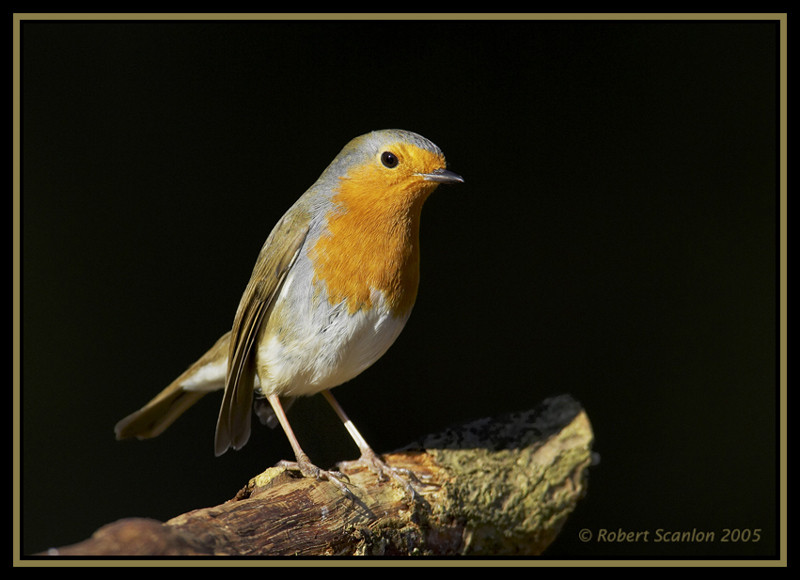
European Robin (Erithacus rubecula) by Robert Scanlon

European Robin (Erithacus rubecula) by Robert Scanlon

“The European Robin (Erithacus rubecula), most commonly known in Anglophone Europe simply as the Robin, is a small insectivorous passerine bird that was formerly classed as a member of the thrush family (Turdidae), but is now considered to be an Old World flycatcher (Muscicapidae). Around 12.5–14.0 cm (5.0–5.5 in) in length, the male and female are similar in colouration, with an orange breast and face lined with grey, brown upperparts and a whitish belly. It is found across Europe, east to Western Siberia and south to North Africa; it is sedentary in most of its range except the far north.

The term Robin is also applied to some birds in other families with red or orange breasts. These include the American Robin (Turdus migratorius), which is a thrush, and the Australian red robins of the genus Petroica, members of a family whose relationships are unclear.” They are the Petroicidae – Australasian Robins Family with 46 species.

Scarlet Robin (Petroica boodang) by Ian

Scarlet Robin (Petroica boodang) by Ian

Hope you enjoy seeing the three different “Robin Families.” I am thankful the the Lord let at least three different continents have their very own “Robin.” He told the birds to multiply and fill up the earth. They seemed to have obeyed, were we that obedient.

Bring out with you every living thing of all flesh that is with you: birds and cattle and every creeping thing that creeps on the earth, so that they may abound on the earth, and be fruitful and multiply on the earth.” So Noah went out, and his sons and his wife and his sons’ wives with him. Every animal, every creeping thing, every bird, and whatever creeps on the earth, according to their families, went out of the ark. (Genesis 8:17-19 NKJV)

*

Birds Illustrated by Color Photograhy Vol 1 February 1897 No 2 - Cover

Birds Illustrated by Color Photograhy Vol 1 February 1897 No 2 – Cover

Birds Illustrated by Color Photography – Revisited – Introduction

The above article is the first article in the monthly serial for February 1897 “designed to promote Knowledge of Bird-Live.” These include Color Photography, as they call them, today they are drawings. There are at least three Volumes that have been digitized by Project Gutenberg.

To see the whole series of – Birds Illustrated by Color Photography – Revisited

*

(Information from Wikipedia and other internet sources)

Next Article – The Kingfisher – The Lone Fisherman

Previous Article – King Parrot Or King Lory

ABC’s of the Gospel

Links:

An Ad:

Ads for Desk and Pens - 1897

Ads for Desk and Pens – 1897

Birds Vol 1 #2 – The King Parrot or King Lory

Australian King Parrot (Alisterus scapularis) Birds Illustrated by Color Photography

King Parrot – Birds Illustrated by Color Photography

Birds Illustrated by Color Photography – Revisited

Vol 1. February, 1897 No. 2

*

KING PARROT OR KING LORY.

imgl

ORY is the name of certain birds, mostly from the Moluccas and New Guinea, which are remarkable for their bright scarlet or crimson coloring, though also applied to some others in which the plumage is chiefly green. Much interest has been excited by the discovery of Dr. A. B. Meyer that the birds of this genus having a red plumage are the females of those wearing green feathers. For a time there was much difference of opinion on this subject, but the assertion is now generally admitted.

They are called “brush-tongued” Parrots. The color of the first plumage of the young is still unsettled. This bird is a favorite among bird fanciers, is readily tamed, and is of an affectionate nature. It can be taught to speak very creditably, and is very fond of attracting the attention of strangers and receiving the caresses of those whom it likes.

There are few things a parrot prefers to nuts and the stones of various fruits. Wood says he once succeeded in obtaining the affections of a Parisian Parrot, solely through the medium of peach stones which he always saved for the bird and for which it regularly began to gabble as soon as it saw him coming. “When taken freshly from the peach,” he says, “the stones are very acceptable to the parrot, who turns them over, chuckling all the while to show his satisfaction, and picking all the soft parts from the deep indentations in the stone.” He used to crack the stone before giving it to the bird, when his delight knew no bounds. They are fond of hot condiments, cayenne pepper or the capsicum pod. If a bird be ailing, a capsicum will often set it right again.

The parrot is one of the hardiest of birds when well cared for and will live to a great age. Some of these birds have been known to attain an age of seventy years, and one seen by Vaillant had reached the patriarchal age of ninety three. At sixty its memory began to fail, at sixty-five the moult became very irregular and the tail changed to yellow. At ninety it was a very decrepit creature, almost blind and quite silent, having forgotten its former abundant stock of words.

A gentleman once had for many years a parrot of seemingly rare intelligence. It was his custom during the summer to hang the parrot’s cage in front of his shop in a country village, where the bird would talk and laugh and cry, and condole with itself. Dogs were his special aversion and on occasions when he had food to spare, he would drop it out of the cage and whistle long and loud for them. When the dogs had assembled to his satisfaction he would suddenly scream in the fiercest accents, “Get out, dogs!” and when they had scattered in alarm his enjoyment of it was demonstrative. This parrot’s vocabulary, however, was not the most refined, his master having equipped him with certain piratical idioms.

According to authority, the parrot owner will find the health of his pet improved and its happiness promoted by giving it, every now and then, a small log or branch on which the mosses and lichens are still growing. Meat, fish, and other similar articles of diet are given with evil effects.

It is impossible for anyone who has only seen these birds in a cage or small inclosure to conceive what must be the gorgeous appearance of a flock, either in full flight, and performing their various evolutions, under a vertical sun, or sporting among the superb foliage of a tropical forest which, without these, and other brilliant tenants, would present only a solitude of luxuriant vegetation.

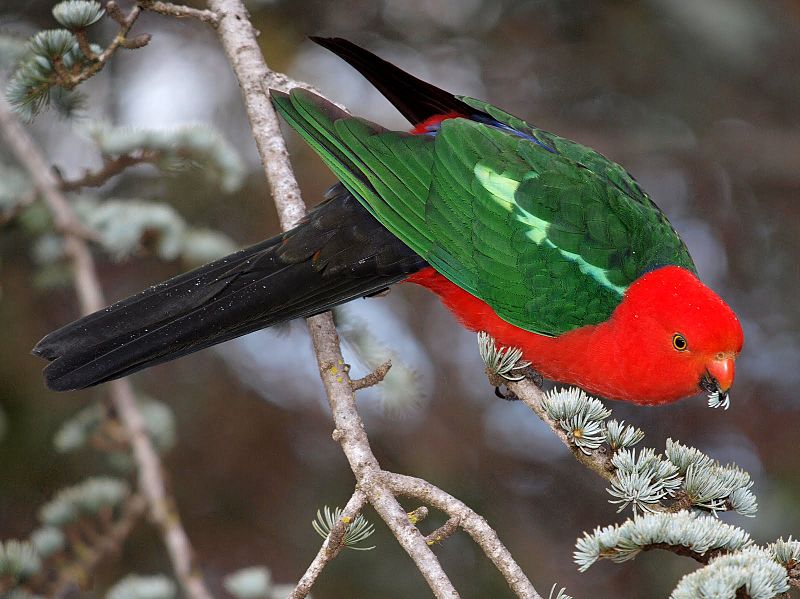
Australian King Parrot (Alisterus scapularis) ©WikiC

Australian King Parrot (Alisterus scapularis) ©WikiC


Lee’s Addition:

And he hath on his vesture and on his thigh a name written, KING OF KINGS, AND LORD OF LORDS. (Revelation 19:16 KJV)

The king parrots are three species of medium-sized parrots in the genus Alisterus; the Australian King Parrot (Alisterus scapularis), the Papuan King Parrot (Alisterus chloropterus), and the Moluccan King Parrot (Alisterus amboinensis). The three species are found in Eastern Australia, New Guinea, and Indonesian islands including the Maluku islands respectively. Predominantly of red and green plumage, the long tailed parrots are related to the genera Aprosmictus and Polytelis.

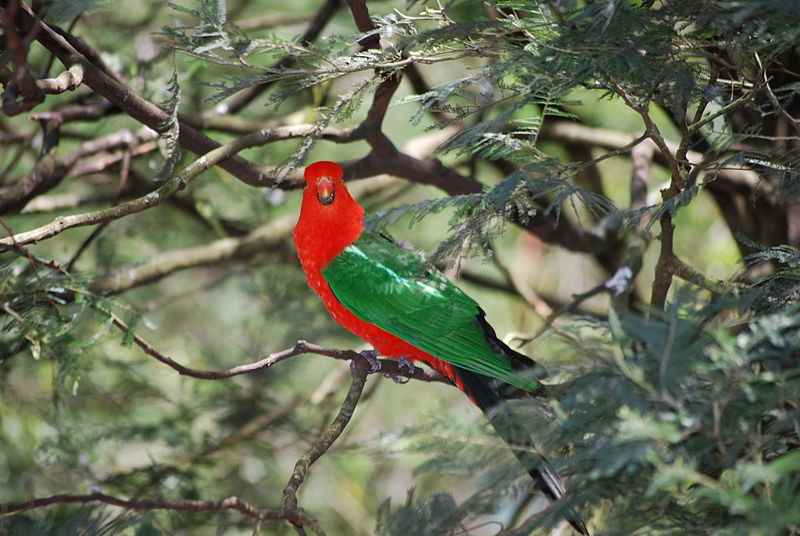
Australian King Parrot (Alisterus scapularis) Female by Ian

Australian King Parrot (Alisterus scapularis) Female by Ian

King parrots are medium-sized parrots, 35–43 cm (14–17 in) in length with long-broad tails. They have relatively small beaks for their size. The beaks of the adults are two colours, blackish and orange-reddish, except for the subspecies buruensis of the Moluccan King Parrot which has a grey-black beak, and female Australian King Parrot which has a grey beak.

Moluccan King Parrot (Alisterus amboinensis) ©WikiC - Brevard_Zoo

Moluccan King Parrot (Alisterus amboinensis) ©WikiC – Brevard_Zoo

Wikipedia show this photo of a King Parrot, but somehow we missed it. The photo was taken in 2009, so it may no longer be there. The first and third photo favor the drawing, but I lean toward the Australian King Parrot. They are all closely related

Papuan King Parrot (Alisterus chloropterus) ©WikiC

Papuan King Parrot (Alisterus chloropterus) ©WikiC

The three species are forest-dwelling, and are found singly, in pairs, or in groups.[2] Australian King Parrots sometimes gather in groups of up to 30 or more around food sources, while Moluccan King Parrots sometimes form groups up to ten, and the Moluccan King Parrots may gather in groups of fives or sixes.[2] They generally feed on seeds, fruits and berries in trees.

The Psittacidae – Parrots Family is where you will find these Parrots. There are 350 species in 77 genus. Quite a large family. Their “cousins”, the Cockatoos and New Zealand Parrots join them in the Psittaciformes Order.


Birds Illustrated by Color Photograhy Vol 1 February 1897 No 2 - Cover

Birds Illustrated by Color Photograhy Vol 1 February 1897 No 2 – Cover

Birds Illustrated by Color Photography – Revisited – Introduction

The above article is the first article in the monthly serial for February 1897 “designed to promote Knowledge of Bird-Live.” These include Color Photography, as they call them, today they are drawings. There are at least three Volumes that have been digitized by Project Gutenberg.

To see the whole series of – Birds Illustrated by Color Photography – Revisited

*

(Information from Wikipedia and other internet sources)

Next Article – The American Robin – The Bird Of The Morning

Previous Article – Mexican Mot Mot

Wordless Birds

Links:

Australian King Parrot
Papuan King Parrot
Moluccan King Parrot

One of their Ads:

ATTEND THE BEST.

CHICAGO BUSINESS COLLEGE

Wabash Ave. & Randolph St.

Chicago Business College - Ad for Birds Illustrated

Chicago Business College – Ad for Birds Illustrated

*


Birds Vol 1 #2 – The Mexican Mot Mot (Turquoise-browed)

Mexican Mot Mot - Turquoise-browed Motmot (Eumomota superciliosa)

Turquoise-browed Motmot (Eumomota superciliosa)

Birds Illustrated by Color Photography – Revisited

Vol 1. February, 1897 No. 2

*

MEXICAN MOT MOT.

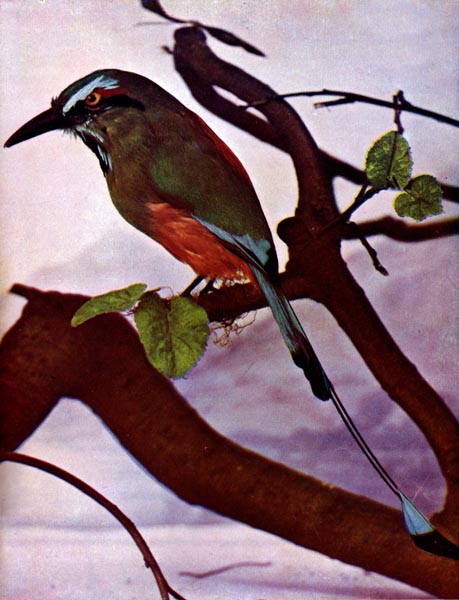
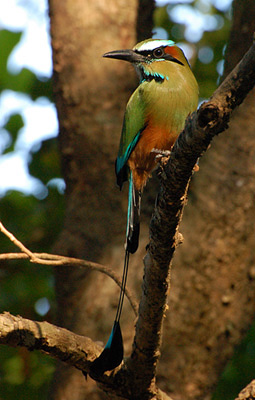
imgmOT MOTS are peculiar to the new world, being found from Mexico throughout the whole of Central America and the South American continent. The general plumage is green, and the majority of the species have a large racket at the end of the center tail feathers, formed by the bird itself.

The Houton, (so called from his note,) according to Waterson, ranks high in beauty among the birds of Demerara. This beautiful creature seems to suppose that its beauty can be increased by trimming its tail, which undergoes the same operation as one’s hair in a barber shop, using its own beak, which is serrated, in lieu of a pair of scissors. As soon as its tail is fully grown, he begins about an inch from the extremity of the two longest feathers in it and cuts away the web on both sides of the shaft, making a gap about an inch long. Both male and female wear their tails in this manner, which gives them a remarkable appearance among all other birds.

To observe this bird in his native haunts, one must be in the forest at dawn. He shuns the society of man. The thick and gloomy forests are preferred by the Houton. In those far extending wilds, about day-break, you hear him call in distinct and melancholy tone, “Houton, Houton!” An observer says, “Move cautiously to the place from which the sound proceeds, and you will see him sitting in the underwood, about a couple of yards from the ground, his tail moving up and down every time he articulates “Houton!”.”

The Mot Mot lives on insects and berries found among the underwood, and very rarely is seen in the lofty trees. He makes no nest, but rears his young in a hole in the sand, generally on the side of a hill.

Mr. Osbert Salvin tells this curious anecdote: “Some years ago the Zoological Society possessed a specimen which lived in one of the large cages of the parrot house by itself. I have a very distinct recollection of the bird, for I used every time I saw it to cheer it up a bit by whistling such of its notes as I had picked up in the forests of America. The bird always seemed to appreciate this attention, for although it never replied, it became at once animated, hopped about the cage, and swung its tail from side to side like the pendulum of a clock. For a long time its tail had perfect spatules, but toward the end of its life I noticed that the median feathers were no longer trimmed with such precision, and on looking at its beak I noticed that from some cause or other it did not close properly, gaped slightly at the tip, and had thus become unfitted for removing the vanes of the feathers.”

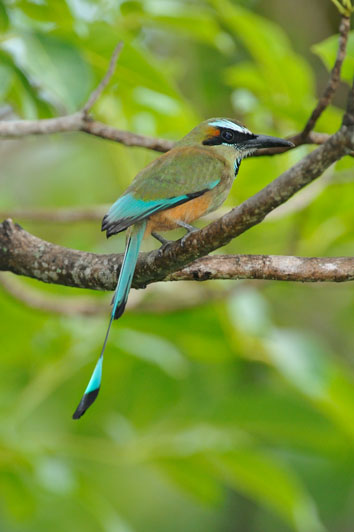
Turquoise-browed Motmot (Eumomota superciliosa) by Reinier Munguia

Turquoise-browed Motmot (Eumomota superciliosa) by Reinier Munguia


Lee’s Addition:

By them shall the fowls of the heaven have their habitation, which sing among the branches. (Psalms 104:12 KJV)

Here is a nice video of a Turquoise-browed Motmot from IBC. What a neat family of birds the Motmot – Momotidae’s contains. There are 14 fantastically created birds species of Motmots in 6 Genus. Our Turquoise-browed is the only one in the Eumomota genus, but at present their are 7 supspecies.

“The bird is approximately 13 in (4 cm) long and weighs about 1.2 oz (65 gr). It has a mostly green body with a rufous back and belly. There is a bright blue stripe above the eye and a blue-bordered black patch on the throat. The flight feathers and upperside of the tail are blue. The tips of the tail feathers are shaped like rackets and the bare feather shafts are longer than in other motmots. Although it is often said that motmots pluck the barbs off their tail to create the racketed shape, this is not true; the barbs are weakly attached and fall off due to abrasion with substrates and with routine preening.

Turquoise-browed Motmot (Eumomota superciliosa) WikiC

Turquoise-browed Motmot (Eumomota superciliosa) WikiC

Unlike most bird species, where only males express elaborate traits, the Turquoise-browed Motmot expresses the extraordinary racketed tail in both sexes. Research indicates that the tail functions differently for the sexes. Males apparently use their tail as a mating signal, as males with longer tails have greater pairing success and reproductive success. In addition to this function, the tail is used by both sexes in a wag-display, whereby the tail is moved back-and-forth in a pendulous fashion. The wag-display is performed in a context unrelated to mating: both sexes perform the wag-display in the presence of a predator, and the display is thought to confer naturally selected benefits by communicating to the predator that it has been seen and that pursuit will not result in capture. This form of interspecific communication is referred to as a pursuit-deterrent signal.” (Wikipedia-edited)

Birds Illustrated by Color Photograhy Vol 1 February 1897 No 2 - Cover

Birds Illustrated by Color Photograhy Vol 1 February 1897 No 2 – Cover

Birds Illustrated by Color Photography – Revisited – Introduction

The above article is the first article in the monthly serial for February 1897 “designed to promote Knowledge of Bird-Live.” These include Color Photography, as they call them, today they are drawings. There are at least three Volumes that have been digitized by Project Gutenberg.

To see the whole series of – Birds Illustrated by Color Photography – Revisited

*

(Information from Wikipedia and other internet sources)

Next Article – King Parrot Or King Lory

Previous Article – The Red Headed Woodpecker and The Drummer Bird

Wordless Birds

Links:

Motmot – Momotidae Family

Wikipedia – Motmotand Turquoise-browed Motmot

*

Birds Vol 1 #2 – The Red-headed Woodpecker

Red-headed Woodpecker (Melanerpes erythrocephalus) - Birds Illustrated

Red-headed Woodpecker (Melanerpes erythrocephalus) – Birds Illustrated

Birds Illustrated by Color Photography – Revisited

Vol 1. February, 1897 No. 2

*

THE RED HEADED WOODPECKER.

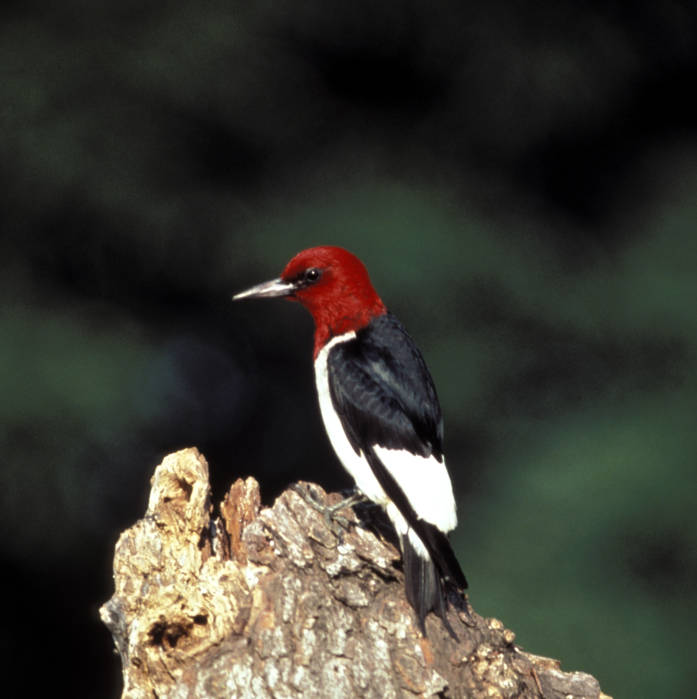
imgpERHAPS no bird in North America is more universally known than the Red Headed Woodpecker. He is found in all parts of the United States and is sometimes called, for short, by the significant name of Red Head. His tri-colored plumage, red, white and black, glossed with steel blue, is so striking and characteristic, and his predatory habits in the orchards and cornfields, and fondness for hovering along the fences, so very notorious, that almost every child is acquainted with the Red Headed Woodpecker. In the immediate neighborhood of large cities, where the old timber is chiefly cut down, he is not so frequently found. Wherever there is a deadening, however, you will find him, and in the dead tops and limbs of high trees he makes his home. Towards the mountains, particularly in the vicinity of creeks and rivers, these birds are extremely numerous, especially in the latter end of summer. It is interesting to hear them rattling on the dead leaves of trees or see them on the roadside fences, where they flit from stake to stake. We remember a tremendous and quite alarming and afterwards ludicrous rattling by one of them on some loose tin roofing on a neighbor’s house. This occurred so often that the owner, to secure peace, had the roof repaired.

They love the wild cherries, the earliest and sweetest apples, for, as is said of him, “he is so excellent a connoisseur in fruit, that whenever an apple or pear is found broached by him, it is sure to be among the ripest and best flavored. When alarmed he seizes a capital one by striking his open bill into it, and bears it off to the woods.” He eats the rich, succulent, milky young corn with voracity. He is of a gay and frolicsome disposition, and half a dozen of the fraternity are frequently seen diving and vociferating around the high dead limbs of some large trees, pursuing and playing with each other, and amusing the passerby with their gambols. He is a comical fellow, too, prying around at you from the bole of a tree or from his nesting hole therein.

Though a lover of fruit, he does more good than injury. Insects are his natural food, and form at least two thirds of his subsistence. He devours the destructive insects that penetrate the bark and body of a tree to deposit their eggs and larvae.

About the middle of May, he begins to construct his nest, which is formed in the body of large limbs of trees, taking in no material but smoothing it within to the proper shape and size. The female lays six eggs, of a pure white. The young appear about the first of June. About the middle of September the Red Heads begin to migrate to warmer climates, travelling at night time in an irregular way like a disbanded army and stopping for rest and food through the day.

The black snake is the deadly foe of the Red Head, frequently entering his nest, feeding upon the young, and remaining for days in possession.

“The eager school-boy, after hazarding his neck to reach the Woodpecker’s hole, at the triumphant moment when he thinks the nestlings his own, strips his arm, launches it down into the cavity, and grasping what he conceives to be the callow young, starts with horror at the sight of a hideous snake, almost drops from his giddy pinnacle, and retreats down the tree with terror and precipitation.”

Red-headed Woodpecker (Melanerpes erythrocephalus) ©USFWS

Red-headed Woodpecker (Melanerpes erythrocephalus) ©USFWS


THE DRUMMER BIRD

My dear girls and boys:

The man who told me to keep still and look pleasant while he took my picture said I might write you a letter to send with it. You say I always keep on the other side of the tree from you. That is because someone has told you that I spoil trees, and I am afraid that you will want to punish me for it. I do not spoil trees. The trees like to have me come to visit them, for I eat the insects that are killing them. Shall I tell you how I do this?

I cling to the tree with my strong claws so sharply hooked. The pointed feathers of my tail are stiff enough to help hold me against the bark. Then my breast bone is quite flat, so that I may press close to the tree. When I am all ready you hear my r-r-rap—just like a rattle. My head goes as quickly as if it were moved by a spring. Such a strong, sharp bill makes the chips fly! The tiny tunnel I dig just reaches the insect.

Then I thrust out my long tongue. It has a sharp, horny tip, and has barbs on it too. Very tiny insects stick to a liquid like glue that covers my tongue. I suppose I must tell you that I like a taste of the ripest fruit and grain. Don’t you think I earn a little when I work so hard keeping the trees healthy?

I must tell you about the deep tunnel my mate and I cut out of a tree. It is just wide enough for us to slip into. It is not straight down, but bent, so that the rain cannot get to the bottom. There we make a nest of little chips for our five white eggs.

I should like to tell you one of the stories that some boys and girls tell about my red head. You will find it on another page of the book. Now I must fly away to peck for more bugs.

Your loving friend,
Woodpecker.

Red-headed Woodpecker (Melanerpes erythrocephalus) by Daves BirdingPix

Red-headed Woodpecker (Melanerpes erythrocephalus) by Daves BirdingPix


Lee’s Addition:

If a bird’s nest happens to be before you along the way, in any tree or on the ground, with young ones or eggs, with the mother sitting on the young or on the eggs, you shall not take the mother with the young; (Deuteronomy 22:6 NKJV)

Not much to add to this one. The writer has told much about this Woodpecker. They are part of the Picadae Family in the Piciformes Order. Most woodpeckers are heard before they are found. They are either making their calls or you can hear them chipping away at the trees or “metal.”

Birds Illustrated by Color Photograhy Vol 1 February 1897 No 2 - Cover

Birds Illustrated by Color Photograhy Vol 1 February 1897 No 2 – Cover

Birds Illustrated by Color Photography – Revisited – Introduction

The above article is the first article in the monthly serial for February 1897 “designed to promote Knowledge of Bird-Live.” These include Color Photography, as they call them, today they are drawings. There are at least three Volumes that have been digitized by Project Gutenberg.

To see the whole series of – Birds Illustrated by Color Photography – Revisited

* (Information from Wikipedia and other internet sources)

Next Article – Mexican Mot Mot

Previous Article – The Swallow-Tailed Indian Roller

ABC’s of the Gospel

Links:

Red-headed Woodpecker – Wikipedia

Here are some more ads from the Birds Illustrated:

Birds Illustrated Ad - Feb

Birds Illustrated Ad – Feb

Birds Vol 1 #2 – The Swallow-tailed Indian Roller (Lilac-breasted, Racket-tailed or Abyssinian)

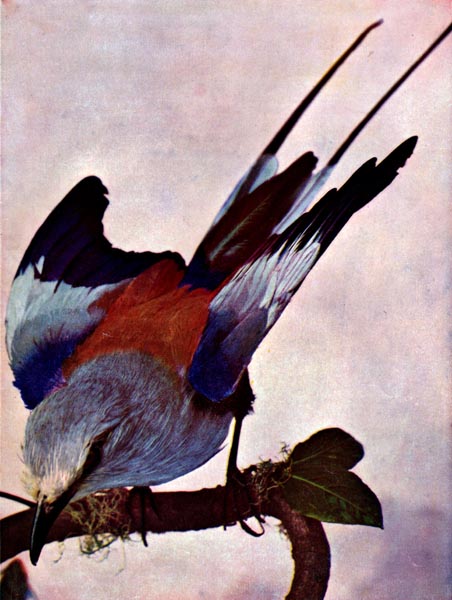
Swallow-tailed Indian Roller for Birds Illustrated by Color Photography - Vol 1-2

Swallow-tailed Indian Roller for Birds Illustrated by Color Photography – Vol 1-2

Birds Illustrated by Color Photography – Revisited

Vol 1. February, 1897 No. 2

*

THE SWALLOW-TAILED INDIAN ROLLER.

imgsWALLOW-TAILED Indian Rollers are natives of Northeastern Africa and Senegambia, and also the interior of the Niger district. The bird is so called from its way of occasionally rolling or turning over in its flight, somewhat after the fashion of a tumbler pigeon. A traveller in describing the habits of the Roller family, says:

“On the 12th of April I reached Jericho alone, and remained there in solitude for several days, during which time I had many opportunities of observing the grotesque habits of the Roller. For several successive evenings, great flocks of Rollers mustered shortly before sunset on some dona trees near the fountain, with all the noise but without the decorum of Rooks. After a volley of discordant screams, from the sound of which it derives its Arabic name of “schurkrak,” a few birds would start from their perches and commence overhead a series of somersaults. In a moment or two they would be followed by the whole flock, and these gambols would be repeated for a dozen times or more.

“Everywhere it takes its perch on some conspicuous branch or on the top of a rock, where it can see and be seen. The bare tops of the fig trees, before they put forth their leaves, are in the cultivated terraces, a particularly favorite resort. In the barren Ghor I have often watched it perched unconcernedly on a knot of gravel or marl in the plain, watching apparently for the emergence of beetles from the sand. Elsewhere I have not seen it settle on the ground.

“Like Europeans in the East, it can make itself happy without chairs and tables in the desert, but prefers a comfortable easy chair when it is to be found. Its nest I have seen in ruins, in holes in rocks, in burrows, in steep sand cliffs, but far more generally in hollow trees. The colony in the Wady Kelt used burrows excavated by themselves, and many a hole did they relinquish, owing to the difficulty of working it. So cunningly were the nests placed under a crumbling, treacherous ledge, overhanging a chasm of perhaps one or two hundred feet, that we were completely foiled in our siege. We obtained a nest of six eggs, quite fresh, in a hollow tree in Bashan, near Gadara, on the 6th of May.

“The total length of the Roller is about twelve inches. The Swallow-tailed Indian Roller, of which we present a specimen, differs from the Europeon Roller only in having the outer tail feathers elongated to an extent of several inches.”


Lee’s Addition:

Then God said, “Let the waters abound with an abundance of living creatures, and let birds fly above the earth across the face of the firmament of the heavens.” (Genesis 1:20 NKJV)

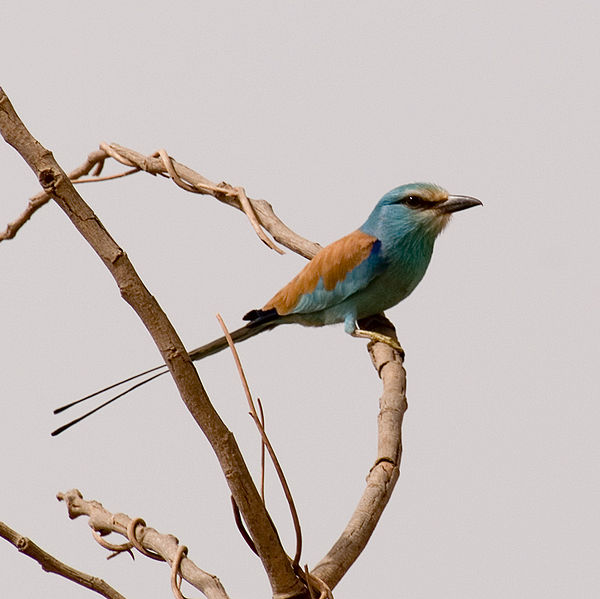
Currently there is not a bird named the Swallow-tailed Indian Roller. Looking at the “photograph,” it appears to be either the Lilac-breasted, Racket-tailed or Abyssinian Roller. Those three have the long tails, “swallow-tail” and they all have black beaks which is typical of the Coracias Genus of the Rollers. The Coraciidae – Rollers family has two Genus, the Coracias and the Eurystomus, which has various colored beaks. None of the three exactly match that drawing, but they are close and in the same family.

The rollers are an Old World family, Coraciidae, of near passerine birds. The group gets its name from the aerial acrobatics some of these birds perform during courtship or territorial flights. Rollers resemble crows in size and build, and share the colourful appearance of kingfishers and bee-eaters, blues and pinkish or cinnamon browns predominating. The two inner front toes are connected, but not the outer one.

They are mainly insect eaters, with Eurystomus species taking their prey on the wing, and those of the genus Coracias diving from a perch to catch food items from on the ground, like giant shrikes.

Lilac-breasted Roller (Coracias caudatus) by BirdingPix

Lilac-breasted Roller (Coracias caudatus) by BirdingPix

According to Wikipedia, “the Lilac-breasted Roller (Coracias caudatus) is a member of the roller family of birds. It is widely distributed in sub-Saharan Africa and the southern Arabian Peninsula, preferring open woodland and savanna; it is largely absent from treeless places. Usually found alone or in pairs, it perches conspicuously at the tops of trees, poles or other high vantage points from where it can spot insects, lizards, scorpions, snails, small birds and rodents moving about at ground level. Nesting takes place in a natural hole in a tree where a clutch of 2–4 eggs is laid, and incubated by both parents, who are extremely aggressive in defence of their nest, taking on raptors and other birds. During the breeding season the male will rise to great heights, descending in swoops and dives, while uttering harsh, discordant cries. The sexes are alike in coloration. Juveniles do not have the long tail feathers that adults do. It is also the national bird of Botswana.”

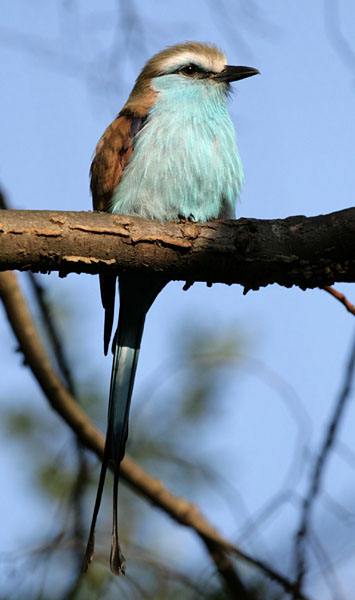
Racket-tailed Roller (Coracias spatulatus) ©WikiC

Racket-tailed Roller (Coracias spatulatus) ©WikiC

“The Racket-tailed Roller (Coracias spatulatus) is a species of bird in the Coraciidae family. It is found in Angola, Botswana, Democratic Republic of the Congo, Malawi, Mozambique, Namibia, South Africa, Swaziland, Tanzania, Zambia, and Zimbabwe.

Abyssinian Roller (Coracias abyssinicus) ©WikiC

Abyssinian Roller (Coracias abyssinicus) ©WikiC

The Abyssinian RollerCoracias abyssinicus, is a member of the roller family of birds which breeds across tropical Africa in a belt south of the Sahara, known as the Sahel. It is resident in the southern part of its range, but northern breeding populations are short-distance migrants, moving further south after the wet season.

Abyssinian Roller is striking in its strong direct flight, with the brilliant blues of the wings contrasting with the brown back and the long tail streamers trailing behind.

This is a common bird of warm open country with some trees, and has adapted to farmland and human habitation. These rollers often perch prominently on trees, posts or overhead wires, like giant shrikes, whilst watching for the large insects and rodents on which they feed. They will dash into the smoke of a forest fire for disturbed invertebrates. They are fearless, and will dive and roll at humans and other intruders.

The display of this bird is a lapwing-like display, with the twists and turns that give this group its English name. It nests in a scantily lined hole in a tree or building, and lays 3-6 eggs.

The call of Abyssinian Roller is a harsh crow-like gak sound, or a screeched aaaargh.

Birds Illustrated by Color Photograhy Vol 1 February 1897 No 2 - Cover

Birds Illustrated by Color Photograhy Vol 1 February 1897 No 2 – Cover


Birds Illustrated by Color Photography – Revisited – Introduction

The above article is the first article in the monthly serial for February 1897 “designed to promote Knowledge of Bird-Live.” These include Color Photography, as they call them, today they are drawings. There are at least three Volumes that have been digitized by Project Gutenberg.

To see the whole series of – Birds Illustrated by Color Photography – Revisited

*

(Information from Wikipedia and other internet sources)

Next Article – The Red Headed Woodpecker and The Drummer Bird

Previous Article – The Blue Jay

Gospel Message

Links:

Wikipedia – Lilac-breasted RollerRacket-tailed Roller –Abyssinian Roller

They even had ads in the Birds Illustrated by Color Photography.

Singer Pianos Ad

Singer Pianos Ad

*

Birds Vol 1 #2 – The Blue Jay

Blue Jay (Cyanocitta cristata)

Blue Jay (Cyanocitta cristata)

Birds Illustrated by Color Photography – Revisited

Vol 1. February, 1897 No. 2

*


THE BLUE JAY.

imgd

URING about three-fourths of the year the American Jay is an extremely tame, noisy and even obstrusive bird in its habits. As the breeding season approaches he suddenly becomes silent, preparing the nest in the most secluded parts of his native forests, and exercising all his cunning to keep it concealed. He is omniverous but is especially fond of eggs and young birds. The Jay may be regarded as eminently injurious though in spring he consumes a number of insects to atone for his sins of stealing fruit and berries in autumn. He is a professional nest robber, and other birds are as watchful of him as is a mother of her babe. He glides through the foliage of the trees so swiftly and noiselessly that his presence is scarcely suspected until he has committed some depredation. The Robin is his most wary foe, and when the Jay is found near his nest will pursue him and drive him from the neighborhood. He is as brave as he is active, however, and dashes boldly in pursuit of his more plainly attired neighbors who venture to intrude upon his domain.

The Jay has a curious antipathy toward the owl, perching on trees above it and keeping up a continual screeching. Some years ago an Ohio gentleman was presented with a magnificent specimen of the horned owl, which he kept for a time in a large tin cage. In favorable weather the cage was set out of doors, when it would soon be surrounded by Jays, much in the manner described of the Toucan, and an incessant screeching followed, to which the owl appeared indifferent. They would venture near enough to steal a portion of his food, the bars of his cage being sufficiently wide apart to admit them. On one occasion, however, he caught the tail of a Jay in his claws and left the tormentor without his proud appendage.

The Jay remains with us throughout the year. He is one of the wildest of our birds, the shyest of man, although seeing him most. He makes no regular migrations at certain seasons, but, unless disturbed, will live out his life close to his favorite haunts. His wings show him to be unfitted for extended flight.

Jays are most easily discovered in the morning about sunrise on the tops of young live oaks. Their notes are varied. Later in the day it is more difficult to find them, as they are more silent, and not so much on the tree tops as among the bushes.

The Jays breed in woods, forests, orchards, preferring old and very shady trees, placing their nests in the center against the body, or at the bifurcation of large limbs. The nest is formed of twigs and roots; the eggs are from four to six.

Blue Jay at Bok Tower by Dan's Pix

Blue Jay II at Bok Tower by Dan’s Pix


THE BLUE JAY.

Something glorious, something gay,
Flits and flashes this-a-way!
’Thwart the hemlock’s dusky shade,
Rich in color full displayed,
Swiftly vivid as a flame—
Blue as heaven and white as snow—
Doth this lovely creature go.
What may be his dainty name?
“Only this”—the people say—
“Saucy, chattering, scolding Jay!”


Lee’s Addition:

Look at the birds of the air, for they neither sow nor reap nor gather into barns; yet your heavenly Father feeds them. Are you not of more value than they? (Matthew 6:26 NKJV)

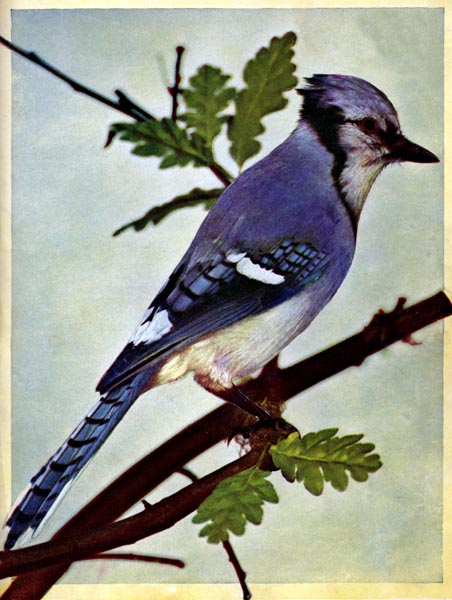
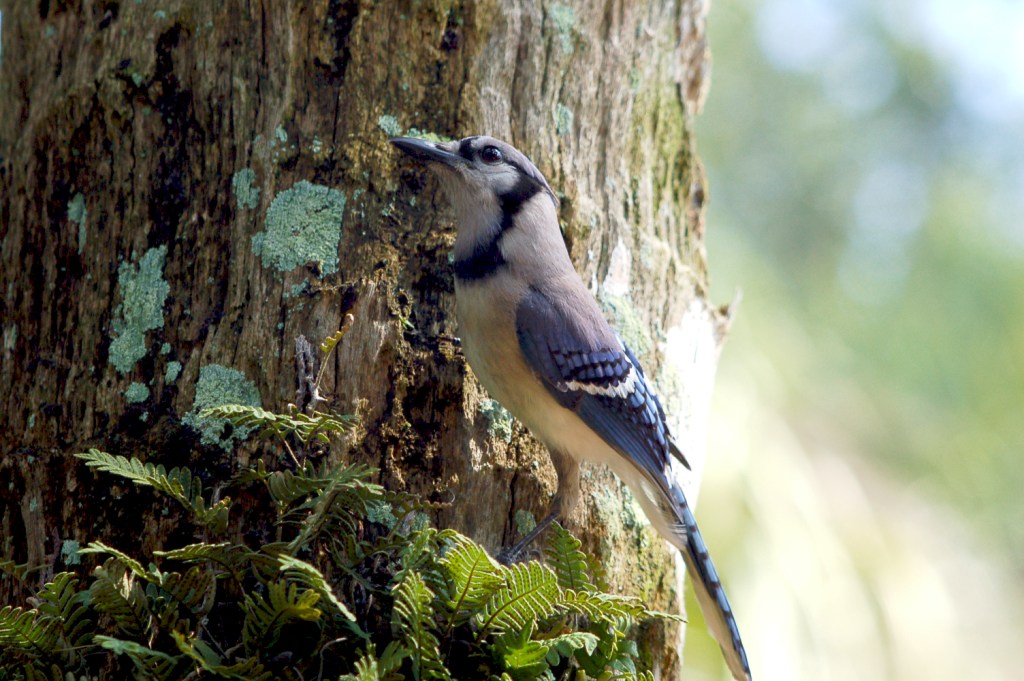
The Blue Jay (Cyanocitta cristata) is a passerine bird in the family Corvidae, native to North America. It is resident through most of eastern and central United States and southern Canada, although western populations may be migratory. It breeds in both deciduous and coniferous forests, and is common near and in residential areas. It is predominately blue with a white breast and underparts, and a blue crest. It has a black, U-shaped collar around its neck and a black border behind the crest. Sexes are similar in size and plumage, and plumage does not vary throughout the year. Four subspecies of the Blue Jay are recognized.

The Blue Jay mainly feeds on nuts and seeds such as acorns, soft fruits, arthropods, and occasionally small vertebrates. It typically gleans food from trees, shrubs, and the ground, though it sometimes hawks insects from the air. It builds an open cup nest in the branches of a tree, which both sexes participate in constructing. The clutch can contain two to seven eggs, which are blueish or light brown with brown spots. Young are altricial, and are brooded by the female for 8–12 days after hatching. They may remain with their parents for one to two months before leaving the nest.

Blue Jay (Cyanocitta cristata) by Daves BirdingPix

Blue Jay (Cyanocitta cristata) by Daves BirdingPix

The bird’s name derives from its noisy, garrulous nature, and it sometimes also called a “jaybird”.

Blue Jay (Cyanocitta cristata) from xeno-canto.org – Call

The Blue Jay measures 22–30 cm (9–12 in) from bill to tail and weighs 70–100 g (2.5–3.5 oz), with a wingspan of 34–43 cm (13–17 in). There is a pronounced crest on the head, a crown of feathers, which may be raised or lowered according to the bird’s mood. When excited or aggressive, the crest may be fully raised. When frightened, the crest bristles outwards, brushlike. When the bird is feeding among other jays or resting, the crest is flattened to the head.

Its plumage is lavender-blue to mid-blue in the crest, back, wings, and tail, and its face is white. The underside is off-white and the neck is collared with black which extends to the sides of the head. The wing primaries and tail are strongly barred with black, sky-blue and white. The bill, legs, and eyes are all black. Males and females are nearly identical.
As with other blue-hued birds, the Blue Jay’s coloration is not derived from pigments but is the result of light interference due to the internal structure of the feathers;[citation needed] if a blue feather is crushed, the blue disappears as the structure is destroyed. This is referred to as structural coloration.

Blue Jays have strong black bills used for cracking nuts and acorns, and for eating corn, grains and seeds, although they also eat insects such as beetles, grasshoppers, and caterpillars.

*

Birds Illustrated by Color Photograhy Vol 1 February 1897 No 2 - Cover

Birds Illustrated by Color Photograhy Vol 1 February 1897 No 2 – Cover

Birds Illustrated by Color Photography – Revisited – Introduction

The above article is the first article in the monthly serial for February 1897 “designed to promote Knowledge of Bird-Live.” These include Color Photography, as they call them, today they are drawings. There are at least three Volumes that have been digitized by Project Gutenberg.

To see the whole series of – Birds Illustrated by Color Photography – Revisited

*

(Information from Wikipedia and other internet sources)

Next Article – The Swallow-Tailed Indian Roller

Previous Article – Vol 1 #1 – The Golden Oriole

Wordless Birds

Links:

Xeno-canto.org

Wikipedia – Blue Jay

*

They even had ads in the Birds Illustrated by Color Photography.

Bicycle and Pen Ad

*

Birds Vol 1 #1 – The Golden Oriole (or Hooded Oriole)

Golden Oriole

Golden Oriole

Birds Illustrated by Color Photography – Revisited

Vol 1. January, 1897 No. 1

*

THE GOLDEN ORIOLE

imgw

E find the Golden Oriole in America only. According to Mr. Nuttall, it is migratory, appearing in considerable numbers in West Florida about the middle of March. It is a good songster, and in a state of captivity imitates various tunes.

This beautiful bird feeds on fruits and insects, and its nest is constructed of blades of grass, wool, hair, fine strings, and various vegetable fibers, which are so curiously interwoven as to confine and sustain each other. The nest is usually suspended from a forked and slender branch, in shape like a deep basin and generally lined with fine feathers.

“On arriving at their breeding locality they appear full of life and activity, darting incessantly through the lofty branches of the tallest trees, appearing and vanishing restlessly, flashing at intervals into sight from amidst the tender waving foliage, and seem like living gems intended to decorate the verdant garments of the fresh clad forest.”

It is said these birds are so attached to their young that the female has been taken and conveyed on her eggs, upon which with resolute and fatal instinct she remained faithfully sitting until she expired.

An Indiana gentleman relates the following story:

“When I was a boy living in the hilly country of Southern Indiana, I remember very vividly the nesting of a pair of fine Orioles. There stood in the barn yard a large and tall sugar tree with limbs within six or eight feet of the ground.

“At about thirty feet above the ground I discovered evidences of an Oriole’s nest. A few days later I noticed they had done considerably more work, and that they were using horse hair, wool and fine strings. This second visit seemed to create consternation in the minds of the birds, who made a great deal of noise, apparently trying to frighten me away. I went to the barn and got a bunch of horse hair and some wool, and hung it on limbs near the nest. Then climbing up higher, I concealed myself where I could watch the work. In less than five minutes they were using the materials and chatted with evident pleasure over the abundant supply at hand.

“They appeared to have some knowledge of spinning, as they would take a horse hair and seemingly wrap it with wool before placing it in position on the nest.

“I visited these birds almost daily, and shortly after the nest was completed I noticed five little speckled eggs in it. The female was so attached to the nest that I often rubbed her on the back and even lifted her to look at the eggs.”


Hooded Oriole (Icterus cucullatus) by Daves BirdingPix

Hooded Oriole (Icterus cucullatus) by Daves BirdingPix


Lee’s Addition:

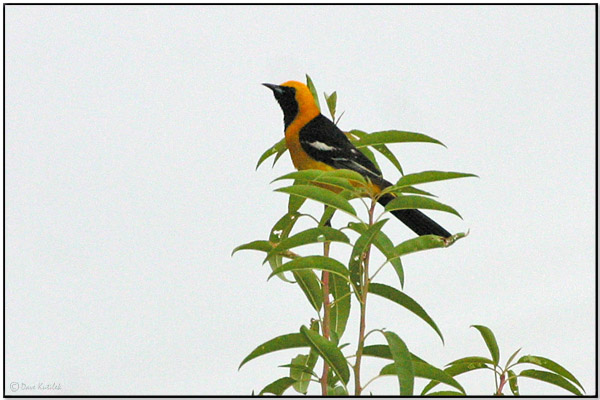
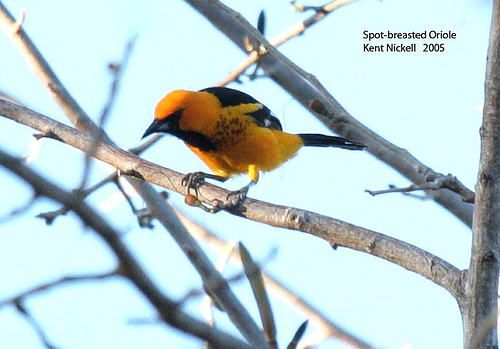
According to the article, the bird came here to Florida. Checking Thayer’s Birding Software and limiting it to Florida and Orioles, I think it must have been the Spot-breasted or the Hooded (but they don’t come to Florida, so it must be the Spot-breasted) Oriole as we call it today. The only “Golden Oriole” is the “Golden Oriole or European (or EurasianGolden Oriole (Oriolus oriolus) is the only member of the oriole family of passerine birds breeding in northern hemisphere temperate regions. It is a summer migrant in Europe and western Asia and spends the winter season in the tropics.” “The African Golden Oriole (Oriolus auratus) is a member of the oriole family of passerine birds which is a resident breeder in Africa south of the Sahara and the “Indian Golden Oriole (Oriolus kundoo)” of India. All three of those birds leave Florida and Indiana out of the picture.

The Orioles are actually found in two different families; the Icteridae – Oropendolas, Orioles, & Blackbirds Family (New World) and the Oriolidae – Figbirds, Orioles Family (Old World).

Spot-breasted Oriole (Icterus pectoralis) by Kent Nickell

Spot-breasted Oriole (Icterus pectoralis) by Kent Nickell

New World orioles, comprising the genus Icterus, are a group of birds in the blackbird family. They are not related to Old World orioles which are in the family Oriolidae, but are strikingly similar in size, diet, behaviour and in their strongly contrasting plumage, and are a good example the Lord’s Creative Hand. Because of similarities and being from the same kind, the two took the same vernacular name.

The males are typically black and yellow or orange, with white markings; the plumage of females and immature birds is duller. These birds go through one moult in a year. They are generally slender with long tails and a pointed bill. They mainly eat insects, often also nectar and fruit. The nest is a woven, elongated pouch. Several species are easy to attract to birdtables by the provision of cut oranges and grape jelly. Species nesting in areas with cold winters (including most of the United States) are strongly migratory, while subtropical and tropical species are more sedentary.

The name “oriole” was first recorded (in the Latin form oriolus) by Albertus Magnus in about 1250, and was stated by him to be onomatopoeic, from the song of the European Golden Oriole.

The genus name Icterus as used by classical authors, referred to a bird with yellow or green plumage. In modern times this has been identified as the golden oriole. Brisson re-applied the name to the New World birds because of their similarity in appearance.

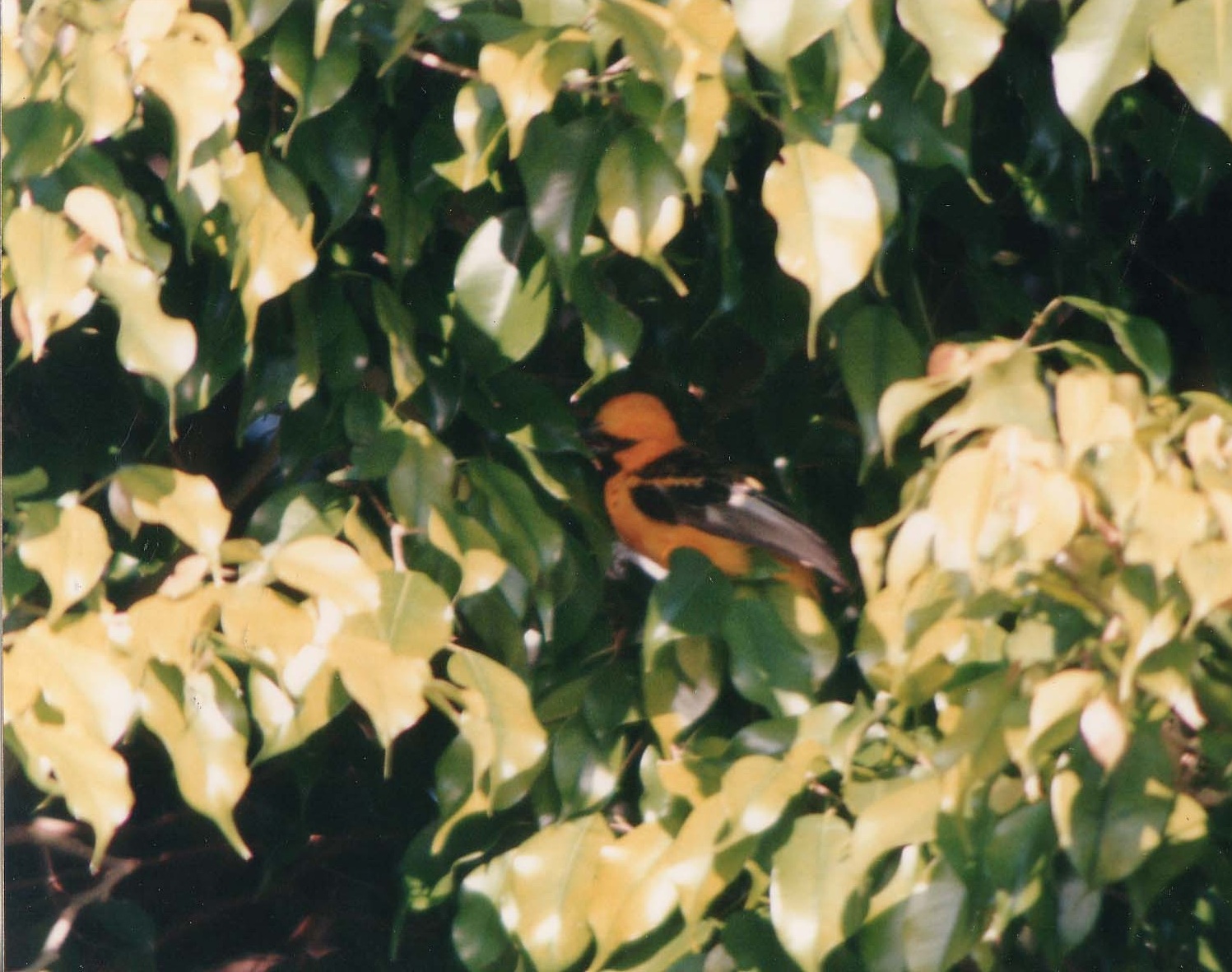
Spot-breasted Oriole (Icterus pectoralis) by Lee -Tamarac from photo

Spot-breasted Oriole (Icterus pectoralis) by Lee -in Tamarac, FL from photo in 1990’s

*

Birds Illustrated by Color Photograhy Vol 1 January 1897 No 1 - Cover

Birds Illustrated by Color Photography – Revisited – Introduction

The above article is the tenth article in the monthly serial that was started in January 1897 “designed to promote Knowledge of Bird-Live.” These include Color Photography, as they call them, today they are drawings. There are at least three Volumes that have been digitized by Project Gutenberg.

To see the whole series of – Birds Illustrated by Color Photography – Revisited

*

(Information from Wikipedia and other internet sources)

Next Article – Vol 1 #2 February 1897

Previous Article – The Red-Rumped Tanager

ABC’s of the Gospel

Links:

New World Oriole – Wikipedia

Spot-breasted Oriole – Wikipedia

*

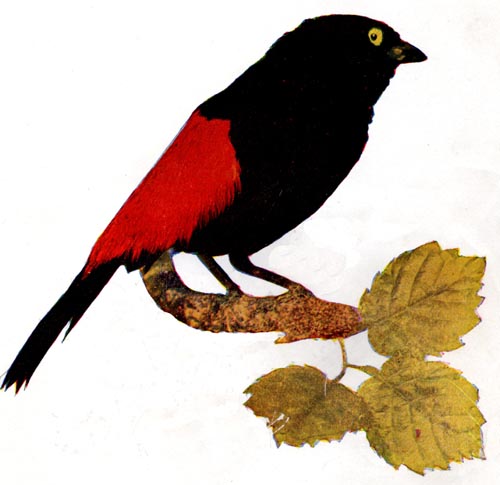
Birds Vol 1 #1 – The Red-Rumped Tanager (Scarlet-Rumped or ?)

Red-Rumped Tanager

Red-Rumped Tanager

Birds Illustrated by Color Photography – Revisited

Vol 1. January, 1897 No. 1

*

THE RED-RUMPED TANAGER.

I have just been singing my morning song, and I wish you could have heard it. I think you would have liked it.

I always sing very early in the morning. I sing because I am happy, and the people like to hear me.

My home is near a small stream, where there are low woods and underbrush along its banks.

There is an old dead tree there, and just before the sun is up I fly to this tree.

I sit on one of the branches and sing for about half an hour. Then I fly away to get my breakfast.

I am very fond of fruit. Bananas grow where I live, and I like them best of all.

I eat insects, and sometimes I fly to the rice fields and swing on the stalks and eat rice.

The people say I do much harm to the rice, but I do not see why it is wrong for me to eat it, for I think there is enough for all.

I must go now and get my breakfast. If you ever come to see me I will sing to you.

I will show you my wife, too. She looks just like me. Be sure to get up very early. If you do not, you will be too late for my song.


“Birds, Birds! ye are beautiful things,
With your earth-treading feet and your cloud-cleaving wings.
Where shall man wander, and where shall he dwell—
Beautiful birds—that ye come not as well?
Ye have nests on the mountain, all rugged and stark,
Ye have nests in the forest, all tangled and dark;
Ye build and ye brood ‘neath the cottagers’ eaves,
And ye sleep on the sod, ’mid the bonnie green leaves;
Ye hide in the heather, ye lurk in the brake,
Ye dine in the sweet flags that shadow the lake;
Ye skim where the stream parts the orchard decked land,
Ye dance where the foam sweeps the desolate strand.”


Silver-beaked Tanager Through wire cage at Lowry Park Zoo by Lee

Silver-beaked Tanager Through wire cage at Lowry Park Zoo by Lee


THE RED-RUMPED TANAGER.

imga1

N American family, the Tanagers are mostly birds of very brilliant plumage. There are 300 species, a few being tropical birds. They are found in British and French Guiana, living in the latter country in open spots of dwellings and feeding on bananas and other fruits. They are also said to do much harm in the rice fields.

In “The Auk,” of July, 1893, Mr. George K. Cherrie, of the Field Museum, says of the Red-Rumped Tanager:

“During my stay at Boruca and Palmar, (the last of February) the breeding season was at its height, and I observed many of the Costa Rica Red-Rumps nesting. In almost every instance where possible I collected both parents of the nests, and in the majority of cases found the males wearing the same dress as the females. In a few instances the male was in mottled plumage, evidently just assuming the adult phase, and in a lesser number of examples the male was in fully adult plumage—velvety black and crimson red. From the above it is clear that the males begin to breed before they attain fully adult plumage, and that they retain the dress of the female until, at least, the beginning of the second year.

“While on this trip I had many proofs that, in spite of its rich plumage, and being a bird of the tropics, it is well worthy to hold a place of honor among the song birds. And if the bird chooses an early hour and a secluded spot for expressing its happiness, the melody is none the less delightful. At the little village of Buenos Aires, on the Rio Grande of Terraba, I heard the song more frequently than at any other point. Close by the ranch house at which we were staying, there is a small stream bordered by low woods and underbrush, that formed a favorite resort for the birds. Just below the ranch is a convenient spot where we took our morning bath. I was always there just as the day was breaking. On the opposite bank was a small open space in the brush occupied by the limbs of a dead tree. On one of these branches, and always the same one, was the spot chosen by a Red-rump to pour forth his morning song. Some mornings I found him busy with his music when I arrived, and again he would be a few minutes behind me. Sometimes he would come from one direction, sometimes from another, but he always alighted at the same spot and then lost no time in commencing his song. While singing, the body was swayed to and fro, much after the manner of a canary while singing. The song would last for perhaps half an hour, and then away the singer would go. I have not enough musical ability to describe the song, but will say that often I remained standing quietly for a long time, only that I might listen to the music.”


Lee’s Addition:

The Red-Rumped Tanager has of course been renamed and renamed again. Tracking this bird was not too difficult because of its “red-rump.” It appears the bird became known as the Scarlet-rumped Tanager and now recently has been split into two species. According to Wikipedia – “The Cherrie’s TanagerRamphocelus costaricensis, is a medium-sized passerine bird. This tanager is a resident breeder in the Pacific lowlands of Costa Rica and western Panama. This bird was formerly known as the Scarlet-rumped Tanager, but was split as a separate species from the Caribbean form, which was itself renamed as Passerini’s Tanager,Ramphocelus passerinii. While most authorities have accepted this split, there are notable exceptions (e.g. the Howard and Moore checklist).

So now you see why I have so much “fun” every three months updating my Birds of the World pages when the IOC (International Ornithologists’ Union) updates their Birds of the World List. That is the standard used for this site.

Take you choice. Is it the Passerini’s Tanager (Ramphocelus passerinii)?

Passerini's Tanager (Ramphocelus passerinii) Male ©BirdPhotos.com

Passerini’s Tanager (Ramphocelus passerinii) Male ©BirdPhotos.com

Passerini’s Tanager (Ramphocelus passerinii) Xeno-canto org

Or is it the Cherrie’s Tanager (Ramphocelus costaricensis)?

Cherrie's Tanager (Ramphocelus costaricensis) WikiC

Cherrie’s Tanager (Ramphocelus costaricensis) WikiC

Cherrie’s Tanager (Ramphocelus costaricensis) xeno-canto.org

Or is it the Flame-rumped Tanager (Ramphocelus flammigerus)?

Flame-rumped Tanager (Ramphocelus flammigerus) ©WikiC

Flame-rumped Tanager (Ramphocelus flammigerus) ©WikiC

Flame-rumped Tanager (Ramphocelus flammigerus) by xeno-canto.org

Which ever one you choose, they are all in the same Genus called Ramphocelus. They are silver-beaked tanagers and are found in Central and South America. They all like fruit and insects and are closely related.

Crimson-collared Tanager (Ramphocelus sanguinolentus )
Masked Crimson Tanager (Ramphocelus nigrogularis )
Crimson-backed Tanager (Ramphocelus dimidiatus )
Huallaga Tanager (Ramphocelus melanogaster )
Silver-beaked Tanager (Ramphocelus carbo )
Brazilian Tanager (Ramphocelus bresilia )
Passerini’s Tanager (Ramphocelus passerinii )
Cherrie’s Tanager (Ramphocelus costaricensis )
Flame-rumped Tanager (Ramphocelus flammigerus )
Lemon-rumped Tanager (Ramphocelus icteronotus )

And they stripped him, and put on him a scarlet robe. And when they had platted a crown of thorns, they put it upon his head, and a reed in his right hand: and they bowed the knee before him, and mocked him, saying, Hail, King of the Jews! (Matthew 27:28-29 KJV)

Birds Illustrated by Color Photograhy Vol 1 January 1897 No 1 - Cover

Birds Illustrated by Color Photography – Revisited – Introduction

The above article is the eighth article in the monthly serial that was started in January 1897 “designed to promote Knowledge of Bird-Live.” These include Color Photography, as they call them, today they are drawings. There are at least three Volumes that have been digitized by Project Gutenberg.

To see the whole series of – Birds Illustrated by Color Photography – Revisited

*

(Information from Wikipedia and other internet sources)

Next Article – The Golden Oriole

Previous Article – The Yellow Throated Toucan

ABC’s of the Gospel

Links:

Birds of the World

Tanagers and Allies – Thraupidae Family

Ramphocelus – Wikipedia

*


Birds Vol 1 #1 – The Yellow Throated or (Black-mandibled) Toucan

Black-mandibled Toucan (Ramphastos ambiguus) for the Birds Illustrated article

Yellow Throated Toucan for the Birds Illustrated article

Birds Illustrated by Color Photography – Revisited

Vol 1. January, 1897 No. 1

*

THE YELLOW THROATED TOUCAN

(Ramphastos ambiguus) or Black-mandibled) Toucan

.

I am a Toucan and I live in a very warm country.

See my handsome black coat and my yellow vest.

My toes are like a parrot’s, two in front and two behind.

They help me to hold to the limbs.

Look at my large beak. It looks heavy but it is not, as it is filled with air cells. These make it very light. Do you like my blue eyes?

My nest is very hard to find. If I tell you where it is, you will not take the eggs, will you? It is in a hollow limb of a very high tree.

I am very fond of fruit, and for this reason the people on the plantations do not like me very well.

I can fly very fast, but I cannot get along so well on the ground. I keep my feet far apart and hop.

I like to sit in the top of the tallest trees. Then I am not afraid. Nothing can reach me there but a rifle ball.

I do not like the owl, he is so ugly. When we find an owl we get in a circle around him and snap our great beaks, and jerk our tails up and down and scream. He is very much afraid of us.

The people where I live like our yellow breasts. They wear them on their heads, and also put them on the ends of their bows.

We sometimes sit together in a tree and snap our beaks and shout. This is why we have been called “Preacher Birds.”

We can scream so loud that we may be heard a mile away. Our song is “Tucano! Tucano!”

I think it is a pretty song, but the people do not like it very much.

Chestnut-mandibled Toucan (Ramphastos swainsonii) by Ian

Chestnut-mandibled Toucan (Ramphastos swainsonii) by Ian


THE YELLOW THROATED TOUCAN.

imgt

HE Toucans are a numerous race of South American birds, at once recognizable by the prodigious size of their beaks and by the richness of their plumage. “These birds are very common,” says Prince Von Wied, “in all parts of the extensive forests of the Brazils and are killed for the table in large numbers during the cool seasons. Their eggs are deposited in the hollow limbs and holes of the colossal trees, so common in the tropical forests, but their nests are very difficult to find. The egg is said to be white. They are very fond of fruit, oranges, guavas and plantains, and when these fruits are ripe make sad havoc among the neighboring plantations. In return for these depredations the planter eats their flesh, which is very delicate.”

The flight of these birds is easy and graceful, sweeping with facility over the loftiest trees of their native forests, their strangely developed bills being no encumbrance to them, replete as they are with a tissue of air-filled cells rendering them very light and even buoyant.

On the ground they get along with a rather awkward hopping movement, their legs being kept widely apart. In ascending a tree they do not climb but mount from one branch to another with a series of jumps, ascending to the tops of the very loftiest trees, safe from every missile except a rifle ball. They have a habit of sitting on the branches in flocks, lifting their bills, clattering them together, and shouting hoarsely all the while, from which custom the natives call them Preacher-birds. Sometimes the whole party, including the sentinel, set up a simultaneous yell so deafeningly loud that it can be heard a mile. They are very loquacious birds and are often discovered through their perpetual chattering. Their cry resembles the word “Tucano,” which has given origin to the peculiar name.

When settling itself to sleep, the Toucan packs itself up in a very systematic manner, supporting its huge beak by resting it on its back, and tucking it completely among the feathers, while it doubles its tail across its back just as if it moved on hinges. So completely is the large bill hidden among the feathers, that hardly a trace of it is visible in spite of its great size and bright color, so that the bird when sleeping looks like a great ball of loose feathers.

Sir R. Owen concludes that the large beak is of service in masticating food compensating for the absence of any grinding structures in the intestinal tract.

Says a naturalist: “We turned into a gloomy forest and for some time saw nothing but a huge brown moth, which looked almost like a bat on the wing. Suddenly we heard high upon the trees a short shrieking sort of noise ending in a hiss, and our guide became excited and said, “Toucan!” The birds were very wary and made off. They are much in quest and often shot at. At last we caught sight of a pair, but they were at the top of such a high tree that they were out of range. Presently, when I had about lost hope, I heard loud calls, and three birds came and settled in a low bush in the middle of the path.”

(Edited)

Gracie the retired Chestnut-mandibled Toucan (Ramphastos swainsonii)

Gracie the retired Chestnut-mandibled Toucan (Ramphastos swainsonii)


Lee’s Addition:

Today the Yellow Throated Toucan is also referred to as the Black-mandibled Toucan, at least by the IOC list of World Birds and the Internet Bird Collection. Actually, there are several Toucans that have a yellow throat and hope this is the one referred to in the 1897 article. The way they keep changing the names and splitting the species, the Chestnut-mandibled is also in that species.

What a fantastic bird and such an amazing creation from the Lord. Such a beautiful beak and yet so light.

All things were made through Him, and without Him nothing was made that was made. (John 1:3 NKJV)

All of these Toucans have Yellow Throats:
Chestnut-mandibled Toucan (Ramphastos swainsonii) Lee petting at National Aviary
Rainbow-billed Toucan (Ramphastos sulfuratus) IBC
Choco Toucan (Ramphastos brevis) IBC
Channel-billed Toucan (Ramphastos vitellinus) IBC
Black-mandibled Toucan (Ramphastos ambiguus) IBC

Toucans are members of the family Ramphastidae of near passerine birds from the Neotropics. The Ramphastidae family is most closely related to the American barbets. They are brightly marked and have large, often colorful bills. The family includes five genera and about forty different species. The name of this bird group is derived from the Tupi word tukana, via Portuguese.

Toucans range in size from the Lettered Aracari (Pteroglossus inscriptus), at 130 g (4.6 oz) and 29 cm (11.5 inches), to the Toco Toucan (Ramphastos toco), at 680 g (1.5 lb) and 63 cm (29 inches). Their bodies are short (of comparable size to a crow’s) and compact. The tail is rounded and varies in length, from half the length to the whole length of the body. The neck is short and thick. The wings are small, as they are forest-dwelling birds who only need to travel short distances, and are often of about the same span as the bill-tip-to-tail-tip measurements of the bird.

The colourful and large bill, which in some large species measures more than half the length of the body, is the hallmark of toucans. Despite its size, the toucan is very light, being composed of bone struts filled with spongy tissue of keratin between them. The bill has forward-facing serrations resembling teeth, which historically led naturalists to believe that toucans captured fish and were primarily carnivorous; today it is known that they eat mostly fruit. Researchers have discovered that the large bill of the toucan is a highly efficient thermoregulation system, though its size may still be advantageous in other ways. It does aid in their feeding behavior (as they sit in one spot and reach for all fruit in range, thereby reducing energy expenditure), and it has also been theorized that the bill may intimidate smaller birds, so that the toucan may plunder nests undisturbed. Also, the beak allows the bird to reach deep into tree-holes to access food unavailable to other birds, and also to ransack suspended nests built by smaller birds. However, as there is no sexual dimorphism in coloration it is unlikely to be a sexual signal.
A toucan’s tongue is long (up to 14–15 cm, or 6 inches), narrow, grey, and singularly frayed on each side, adding to its sensitivity as an organ of taste.

A structural complex probably unique to toucans involves the modification of several tail vertebrae. The rear three vertebrae are fused and attached to the spine by a ball and socket joint. Because of this, toucans may snap their tail forwards until it touches the head. This is the posture in which they sleep, often appearing simply as a ball of feathers, with the tip of the tail sticking out over the head.

Toucans are primarily frugivorous (fruit eating), but are opportunistically omnivorous and will take prey such as insects and small lizards. Captive toucans have been reported to actively hunt insects in their cages, and it is possible to keep toucans on an insect-only diet. They also plunder nests of smaller birds, taking eggs and nestlings. This probably provides a crucial addition of protein to their diet. However, in their range, toucans are the dominant frugivores, and as such play an extremely important ecological role as vectors for seed dispersal of fruiting trees. Often when eating small fruits, toucans will throw their heads back and allow the fruit to roll into their throats before swallowing.

*

Birds Illustrated by Color Photograhy Vol 1 January 1897 No 1 - Cover

Birds Illustrated by Color Photography – Revisited – Introduction

The above article is the second article in the monthly serial that was started in January 1897 “designed to promote Knowledge of Bird-Live.” These include Color Photography, as they call them, today they are drawings. There are at least three Volumes that have been digitized by Project Gutenberg.

To see the whole series of – Birds Illustrated by Color Photography – Revisited

*

(Information from Wikipedia and other internet sources)

Next Article – The Red-Rumped Tanager

Previous Article – The Red Bird Of Paradise

Wordless Toucan

*

Birds Vol 1 #1 – The Cock-Of-The-Rock

Birds Illustrated by Color Photography – Revisited

Vol 1. January, 1897 No. 1

*

Cock-of-th-Rock

Cock-of-th-Rock


THE COCK-OF-THE-ROCK.

imgtHE Cock-of-the-Rock lives in Guiana. Its nest is found among the rocks. T. K. Salmon says: “I once went to see the breeding place of the Cock-of-the-Rock; and a darker or wilder place I have never been in. Following up a mountain stream the gorge became gradually more enclosed and more rocky, till I arrived at the mouth of a cave with high rock on each side, and overshadowed by high trees, into which the sun never penetrated. All was wet and dark, and the only sound heard was the rushing of the water over the rocks. We had hardly become accustomed to the gloom when a nest was found, a dark bird stealing away from what seemed to be a lump of mud upon the face of the rock. This was a nest of the Cock-of-the-Rock, containing two eggs; it was built upon a projecting piece, the body being made of mud or clay, then a few sticks, and on the top lined with green moss. It was about five feet from the water. I did not see the male bird, and, indeed, I have rarely ever seen the male and female birds together, though I have seen both sexes in separate flocks.”

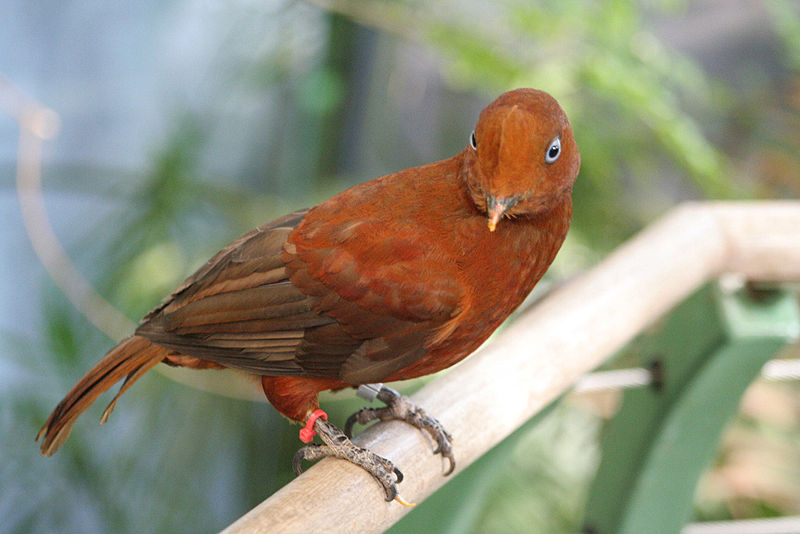
The eggs are described as pale buff with various sized spots of shades from red-brown to pale lilac.

It is a solitary and wary bird, feeding before sunrise and after sunset and hiding through the day in sombre ravines.

Robert Schomburgh describes its dance as follows:

“While traversing the mountains of Western Guiana we fell in with a pack of these splendid birds, which gave me the opportunity of being an eye witness of their dancing, an accomplishment which I had hitherto regarded as a fable. We cautiously approached their ballet ground and place of meeting, which lay some little distance from the road. The stage, if we may so call it, measured from four to five feet in diameter; every blade of grass had been removed and the ground was as smooth as if leveled by human hands. On this space we saw one of the birds dance and jump about, while the others evidently played the part of admiring spectators. At one moment it expanded its wings, threw its head in the air, or spread out its tail like a peacock scratching the ground with its foot; all this took place with a sort of hopping gait, until tired, when on emitting a peculiar note, its place was immediately filled by another performer. In this manner the different birds went through their terpsichorean exercises, each retiring to its place among the spectators, who had settled on the low bushes near the theatre of operations. We counted ten males and two females in the flock. The noise of a breaking stick unfortunately raised an alarm, when the whole company of dancers immediately flew off.”

The Cock-Of-The-Rock video by IBirdCollection


Guianan Cock-of-the-rock (Rupicola rupicola) ©©lolodoc

Guianan Cock-of-the-rock (Rupicola rupicola) ©©lolodoc

Lee’s Addition:

I removed one paragraph that talked about natives killing some of them. The Cock-of the-Rock is an interesting bird. Just their appearance tickles me. They don’t seem to have a beak. There are two Cock-of-the-rocks; the Guianan and the Andean which is the National Bird of Peru.

“The Cock-of-the-rock, which compose the genus Rupicola, are South American cotingid birds. They are found in tropical and subtropical rainforests close to rocky areas, where they build their nests. Like some other cotingids, they have a complex court behaviour, performing impressive lek displays.

Andean Cock-of-the-rock (Rupicola peruvianus) by ©Wiki Closeup

Andean Cock-of-the-rock (Rupicola peruvianus) by ©Wiki Closeup

The males are magnificent birds, not only because of their bright orange or red colors, but also because of their very prominent fan-shaped crests. The far duller females are overall brownish. They are wary animals and primarily feed on fruits and berries.” (Wikipedia)

Andean Cock-of-the-rock (Rupicola peruvianus) female by SanDiegoZoo

Andean Cock-of-the-rock (Rupicola peruvianus) female by SanDiegoZoo

The Cotingidae – Cotingas Family is where you will find the Cock-of-the-Rocks. “The cotingas are a large family of passerine bird species found in Central America and tropical South America. Cotingas are birds of forests or forest edges, which mostly eat fruit or insects and fruit. Comparatively little is known about this diverse group, although all have broad bills with hooked tips, rounded wings, and strong legs. They may be the most diverse passerine family in body size, ranging from the 8-cm Kinglet Calyptura to the 50-cm male Amazonian Umbrellabird, although the smaller bird may not be a true cotinga.

The males of many species, such as the cock-of-the-rocks, are brightly coloured, or decorated with plumes or wattles, like the umbrellabirds, with their umbrella-like crest and long throat wattles. Some, like the bellbirds and the Screaming Piha, have distinctive and far-carrying calls. The females of most species are duller than the males.

Most species are polygynous, and only the females care for the eggs and young. Both brilliant male colors and loud vocalizations are the result of sexual selection. Many have striking courtship displays, often grouped together in leks. In such canopy-dwelling genera as Carpodectes, Cotinga, and Xipholena, males gather high in a single tree or in adjacent trees, but male cocks-of-the-rock, as befits their more terrestrial lives, give their elaborate displays in leks on the ground.

On the other hand, the Purple-throated Fruitcrow lives in mixed groups in which one female lays an egg and the others help provide insects to the chick.

Nests differ greatly. Many species lay a single egg in a nest so flimsy that the egg can be seen from underneath. This may make the nests hard for predators to find. Fruiteaters build more solid cup nests, and the cocks-of-the-rock attach their mud nests to cliffs.”

Birds Illustrated by Color Photograhy Vol 1 January 1897 No 1 - Cover

Birds Illustrated by Color Photography – Revisited  – Introduction

The above article is the sixth article in the monthly serial that was started in January 1897 “designed to promote Knowledge of Bird-Live.” These include Color Photography, as they call them, today they are drawings. There are at least three Volumes that have been digitized by Project Gutenberg.

To see the whole series of – Birds Illustrated by Color Photography – Revisited 

*

(Information from Wikipedia and other internet sources)

Next Article – The Red Bird Of Paradise

Previous Article – The Australian Grass Parrakeet

*

ABC’s Of The Gospel

Links:

Cotingidae – Cotingas Family

Cock-of-the-rock – Wikipedia

Cotinga – Wikipedia

*