McGuffey’s Fifth Reader – VI – The Singing Lesson

Ruddy-capped Nightingale-Thrush (Catharus frantzii) by Ian

Ruddy-capped Nightingale-Thrush (Catharus frantzii) by Ian

The Project Gutenberg EBook of McGuffey’s Fifth Eclectic Reader by William Holmes McGuffey

This eBook is for the use of anyone anywhere at no cost and with almost no restrictions whatsoever. You may copy it, give it away or re-use it under the terms of the Project Gutenberg License included with this eBook or online at gutenberg.net

Title: McGuffey’s Fifth Eclectic Reader Author: William Holmes McGuffey

VI. THE SINGING LESSON.

Jean Ingelow (b. 1830, d.1897) was born at Boston, Lincolnshire, England. Her fame as a poetess was at once established upon the publication of her “Poems” in 1863; since which time several other volumes have appeared. The most generally admired of her poems are “Songs of Seven” and “The High Tide on the Coast of Lincolnshire,” She has also written several successful novels, of which, “Off the Skelligs” is the most popular. “Stories Told to a Child,” “The Cumberers,” “Poor Mat,” “Studies for Stories,” and “Mopsa, the Fairy” are also well known. Miss Ingelow resided in London, England, and spent much of her time in deeds of charity.

1. A nightingale made a mistake;
She sang a few notes out of tune:
Her heart was ready to break,
And she hid away from the moon.
She wrung her claws, poor thing,
But was far too proud to weep;
She tucked her head under her wing,
And pretended to be asleep.

Crested Lark (Galerida cristata)

Crested Lark (Galerida cristata)

2. A lark, arm in arm with a thrush,
Came sauntering up to the place;
The nightingale felt herself blush,
Though feathers hid her face;
She knew they had heard her song,
She felt them snicker and sneer;
She thought that life was too long,
And wished she could skip a year.

Mourning Dove (Zenaida macroura) by Reinier Munguia

Mourning Dove (Zenaida macroura) by Reinier Munguia

3. “O nightingale!” cooed a dove;
“O nightingale! what’s the use?
You bird of beauty and love,
Why behave like a goose?
Don’t sulk away from our sight,
Like a common, contemptible fowl;
You bird of joy and delight,
Why behave like an owl?

4. “Only think of all you have done;
Only think of all you can do;
A false note is really fun
From such a bird as you!
Lift up your proud little crest,
Open your musical beak;
Other birds have to do their best,
You need only to speak!”

Thrush Nightingale (Luscinia luscinia) ©©SergeyYeliseev

Thrush Nightingale (Luscinia luscinia) ©©SergeyYeliseev

6. The nightingale shyly took
Her head from under her wing,
And, giving the dove a look,
Straightway began to sing.
There was never a bird could pass;
The night was divinely calm;
And the people stood on the grass
To hear that wonderful psalm.

Black-headed Nightingale-Thrush (Catharus mexicanus) by Michael Woodruff

Black-headed Nightingale-Thrush (Catharus mexicanus) by Michael Woodruff

6. The nightingale did not care,
She only sang to the skies;
Her song ascended there,
And there she fixed her eyes.
The people that stood below
She knew but little about;
And this tale has a moral, I know,
If you’ll try and find it out.

DEFINITIONS.—2. Saun’ter-ing, wandering idly, strolling. Snick’er, to laugh in a half-suppressed manner. 4. Crest, a tuft growing on an animal’s head. 5. Di-vine’ly, in a supreme degree. 6. Mor’al, the practical lesson which anything is fitted to teach.

NOTE.—The nightingale is a small bird, about six inches in length, with a coat of dark-brown feathers above and of grayish, white beneath. Its voice is astonishingly strong and sweet, and, when wild, it usually sings throughout the evening and night from April to the middle of summer. The bird is common in Europe, but is not found in America.

“The flowers appear on the earth; the time of the singing of birds is come, and the voice of the turtle is heard in our land;” (Song of Solomon 2:12 KJV)

Speaking to yourselves in psalms and hymns and spiritual songs, singing and making melody in your heart to the Lord;
(Ephesians 5:19 KJV)
McGuffey’s Fifth Grade Reader

Wordless Birds

Bible Birds – Swallow-tailed Kites

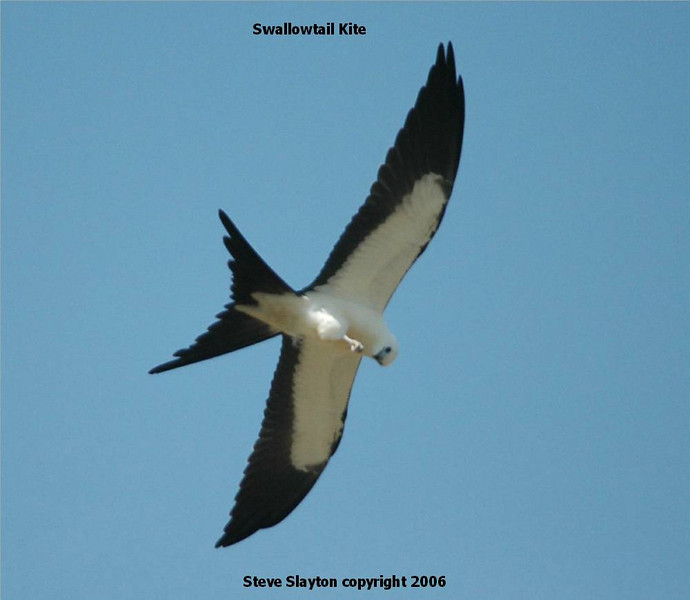
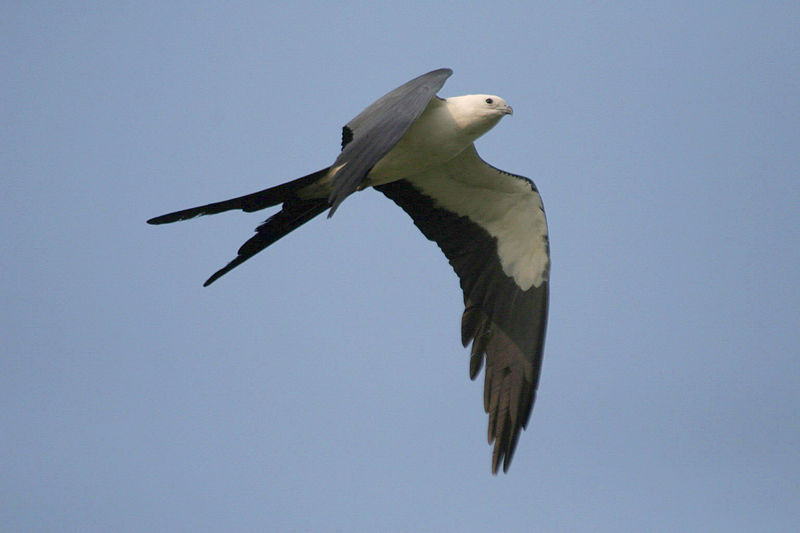
Swallow-tailed Kite by S Slayton

Swallow-tailed Kite by S Slayton

and the red kite, the falcon, and the kite in their kinds, (Deuteronomy 14:13 NASB)

In the Birds of the Bible – Hidden Covenant Part 3, I mistakenly placed this photo of a Swallow-tailed Kite instead of a Swallow. I have since fixed my mistake. A J was talking about the Swallows observing the time of their coming and he used Jeremiah 8:7.

Even the stork in the heavens Knows her appointed times; And the turtledove, the swift, and the swallow Observe the time of their coming. But My people do not know the judgment of the LORD. (Jeremiah 8:7 NKJV)

The reason I mixed them up is because right now, in this area, the Swallow-tailed Kites are being spotted. I have seen a single one three times and just the other day, Dan and I had two of them skim over the top of trees, right in front of us. They have been in the area for a month or so, and soon they will move on again. They “Observe the time of their coming.” Thus the mistake on my part.

They may be one of the Birds of Prey, but they were beautifully created by the Lord. They are so graceful and enjoyable to watch. I am always amazed at the Creator’s use of such variety in the birds and in all the other neat things around us.

God created the great sea monsters and every living creature that moves, which the waters brought forth abundantly, according to their kinds, and every winged bird according to its kind. And God saw that it was good (suitable, admirable) and He approved it. (Genesis 1:21 AMP)

According to the Audubon WatchList, “Two subspecies found in the Americas. Northern subspecies (Elanoides forficatus forficatus) breeds in small sections of seven southeastern U.S. states and in southern Mexico. Members of this group migrate to South America in the late summer. Southern subspecies (Elanoides forficatus yetapa) found through much of South America. The estimated U.S. population of approximately 10,000 birds now breeds in fragmented populations from South Carolina south to Florida and west to Louisiana/Texas border with largest known populations in northern Florida. Formerly bred north to Minnesota and west through Texas to Mexico. Significant populations remain in Florida and along the Pascagoula River in Mississippi.”

I really enjoy seeing these Kites because you just have to be looking in the right direction at the right time. Every time they have been spotted by us, they just sort of “appear” over the tops of the trees. They skim so low, that when they come over you, you either see them or you don’t.

Kites are of course one of our Bible Birds – (Glede and Kites). They are mentioned twice in Scripture in the list of “unclean” birds in Leviticus 11:14 and Deuteronomy 14:13. Each time “after its kind” is given. So, our Swallow-tailed Kite is one of those kinds and would like to introduce you to this amazing bird that is so neat to watch flying. When they spread that tail of theirs, it is just super neat.

Swallow-tailed Kite (Elanoides forficatus) ©Wikipedia

Swallow-tailed Kite (Elanoides forficatus) ©Wikipedia

(Sounds from xeno-canto)

The Swallow-tailed Kite is a member of the Accipitridae Family (Kites, Hawks & Eagles) Family in the Order Accipitriformes. They are considered Abundance Common according the Thayer Birding software.

They are 24 inches (60 cm) with a very long black forked tail, white head, chest, belly and leading portion of underwing. Their flight feathers are black and their back is also black.

They are a medium-sized, graceful, long-winged, long-tailed hawk with pointed wings, a short, dark, hooked bill. The males and females are similar.

Adults have a long, deeply forked tail. white head, neck, chest, underwing coverts, belly, and undertail coverts, a slate gray back and upperwings, black tail and flight feathers. Whereas the immature is duller than adult with fine streaks on head and breast and has a shorter, less deeply-forked tail than adult.

Thayer also says of their habitat and behavior – ” Wet open woodlands, bottomlands, wooded river swamps, marshes, wetlands, and along rivers, ponds and lakes. Agile and graceful in flight. Eats in flight by bending head and neck under body to eat prey held in talon. Will drink in flight, much like a swallow. Gregarious. Will sweep low over open fields and grasslands to catch food or soar very high for flying insects.”

Swallow-tailed Kite (Elanoides forficatus) by Africaddict

Swallow-tailed Kite (Elanoides forficatus) by Africaddict

The Swallow-tails like to breed in “Lowland forest, especially swampy areas extending into open woodland. 1 brood. Mating system is monogamous. Displays are In flight: easy sailing, curving chase often over water. On perch: mutual approach on horizontal limb, face-off, female quickly turns or backs under limb. They also do courtship feeding.

The nest is usually in treetop concealed by thick foliage and they place it on a foundation of preceding year’s nest. It consist of sticks, twigs, moss, pine needles, leaves, lichen. Lined with fine materials, few feathers. Both sexes help with nest construction.

The eggs are white, marked with browns, occasionally lavender, often concentrated at end. 1.8” (47 mm). Both sexes incubate.  with Incubation taking 28 days. Development is semialtricial (immobile, downy, eyes open, fed). Young are able to fly after 36-42 days. Both sexes tend young.

The spend their winters from Colombia and Venezuela S. Marsh drainage, deforestation, and shooting are responsible for reduction in population and range.

Miscellaneous notes; Occasionally nest in loose colonies of a few pairs. Bathe and drink by skimming water surface like swallow. Occasionally soar at great heights. Up to 200 pieces used in nest, carried individually, may require up to 800 miles of flight. Formerly known as American Swallow-tailed Kite; changed by AOU in 1996.

From Thayer Birding Software, The Birder’s Handbook, Wikipedia, and other internet sources.

See also:

Originally posted in 2018 on Birds of the Bible For Kids Blog)

*

Bible Birds – Osprey Introduction

and the osprey

Bible Birds – Osprey Introduction

“But these are they of which ye shall not eat: the eagle, and the ossifrage, and the osprey,” (Deuteronomy 14:12 KJV)

The Osprey is another bird on the “Do Not Eat” list. Here in central Florida, we see Ospreys quite frequently. Their nest are usually noticeable on platforms placed for them. On a road between Eagle Lake and Bartow, (which I have renamed “Osprey Road”) there is a nest in the V structure of almost every power distribution pole. There are at least 15-20 nests in about a mile or so. The Ospreys will show up after the first of the year and stay for about 4 months while they breed and raise their young.

Osprey Family by Phillip Simmons

The Osprey is in a family by itself. They are widely distributed around the world. They are closely related to the Hawk and the Falcon. They are 21-24 inches long with a wingspan of 54-72 inches. The females are slightly larger and both look alike. Their diet is almost entirely fish, but they do eat small rodents and birds. When fishing, they fly 30 to 100 feet above the water and will hover when they find a fish. They will plunge into the water with their feet under them to catch the fish. “Rises from water with fish gripped in both feet, pauses in midair to shake water from plumage, and to arrange fish with the head pointed forward, which reduces its resistance to air, flies with it to” perch or nest to feed young. Can carry up to four or more pounds.

God has designed the Osprey with several interesting features. Their feet have four equal length toes with “long, strong claws, curved about one-third of a circle, and completely round.” “The lower surface, or pads, of the toes are covered with spicules, which help it hold slippery fishes; also, it is the only hawk that has outer toe reversible as in owls; this enables it to grasp its prey with two toes in front, tow in back. Its plumage is compact, which helps blunt its impact and reduces wetting when it plunges into the water.”

All quotes from (The Audubon Society Encyclopedia of North American Birds).

More Bible Birds

Bible Birds – Osprey

Birds of the Bible – Ospreys

(Originally posted in 2018 on Birds of the Bible For Kids Blog)

Bible Birds – Storks at Zoo Tampa

Yellow-billed Stork (Mycteria ibis) LPZ

“Where the birds make their nests: as for the stork, the fir trees are her house.” (Psalms 104:17 KJV)

Bible Birds – Storks at Zoo Tampa

Birds mentioned in the Bible include the Storks. The Yellow-billed Stork is closely related to the Wood Stork. [Bible Birds – Wood Storks]

The Yellow-billed Stork has a very yellow beak and like other storks, it is quite long. They live in “Africa South of Sahara, Madagascar; straggles into Palearctic Africa in Morocco, Tunisia and Egypt.”

These storks are 90–105 cm (35–41 in) tall and have a wingspan 150–165 cm (59-65 in). Males average larger. Non breeding adult has plumage and bare parts duller. Immature duller, especially bare.

Here are some photos of the Yellow-billed Stork taken at Zoo Tampa recently:

*

Scripture Alphabet of Animals: The Stork


The Three Sparrows by Emma Foster

The Three Sparrows

By Emma Foster

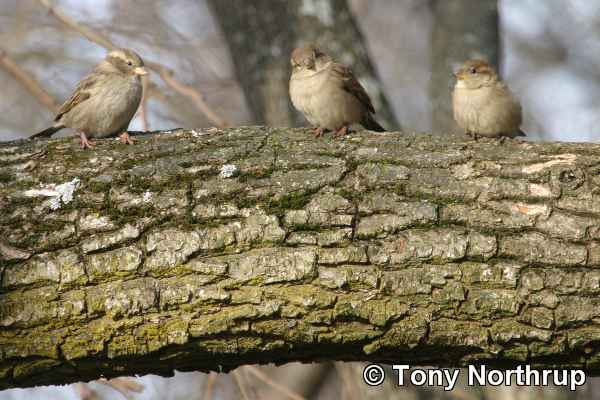
Three Sparrows ©Tony Northrup

Three sparrows, Tip, Tap, and Top, once lived on a college campus, inside a dormitory courtyard. They had built a nest under the metal stair railing leading up to the second floor. They flew out into the courtyard every day to search for food or continue building their nests. Usually however, the three of them preferred to watch the students.Eagle on Pumpkin - Stencil

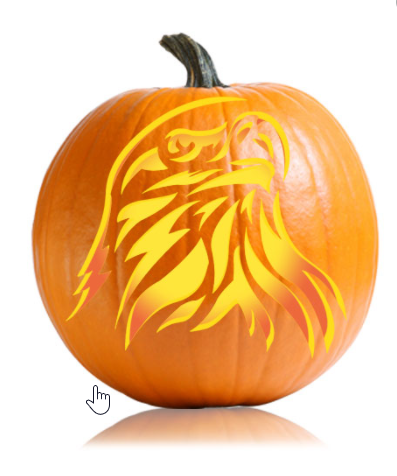
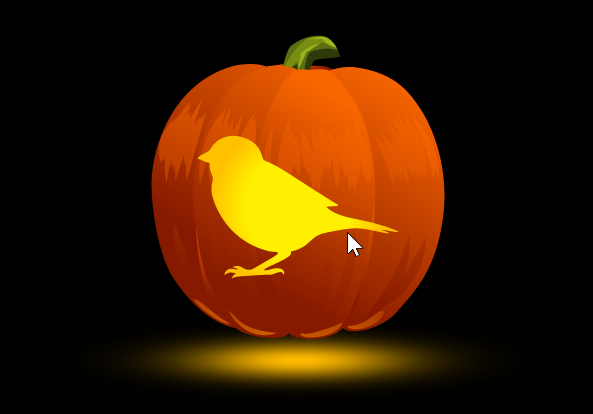
As fall approached, the birds noticed the cooler weather outside. The leaves started to change color and fall, and more students sat outside in their hammocks to study. One evening, Tip, Tap, and Top noticed how many of the students gathered outside, carrying pumpkins into the courtyard. The students sat down in circle and began carving pumpkins. The three sparrows watched as some of the students cut the top off the pumpkins, took the insides out, and drew faces on the pumpkins. Some of the students even brought paint to paint flowers and birds and other designs on the pumpkins. Top’s favorite pumpkin was one with an eagle painted on it, which he believed to be a very majestic sparrow that resembled himself.

Very Majestic Sparrow Pumpkin

Very Majestic Sparrow Pumpkin

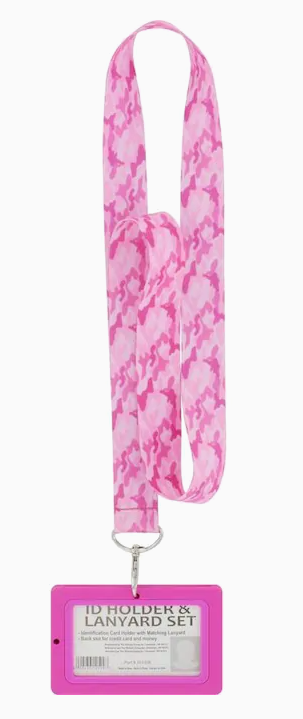
Later that night, after the sun set, Tip hopped off the second-floor railing to examine the pumpkins more closely. Out of all three sparrows, Tip could spot small details the best, which was why it was his job to find food most of the time. While Tip flapped by all the pumpkins, he noticed something pink and something else shiny sitting on the opposite side of the courtyard.

Tip flew to the object and recognized it as something the students carried around with them to identify themselves and to get into their rooms. Tip called for Tap and Top. Tap, the strongest sparrow who was in charge of building the nests, carried it back with him to the nest. But just as they got the wallet back to the nest and looked at the picture on the ID, Tip noticed the same girl come out of one of rooms looking for the wallet in the courtyard, while her friend held the door open so she could get back inside. Tip told Tap to hurry and return it, but when Tap flew back with the wallet, he wasn’t fast enough. The girl returned to her room just as Tip and Top tried to help carry the wallet. Top, however, flew so fast that the lanyard slipped out of his beak and he ran into the door, causing a massive thump.

Tip, Tap, and Top tried to think of a new plan. Top suggested running into the door to get the girl’s attention, while Tap argued that they should just leave the wallet by the door. Tip, on the other hand, had an idea to use the key to get into the room. With Top’s help, he brought the wallet to the door then had Top hold the wallet steady while he inserted the key. Tap flew against the door as best he could, but the door’s weight only let him open it a few inches. Tip yanked the key out with his beak, and he and Top dropped the wallet inside. However, only part of the wallet made it through.

Tip, Tap, and Top all panicked when they heard the girl coming. Tap lifted the top of the pumpkin by the door, and the three of them sneaked inside.

Once the coast seemed clear, and the girl found her wallet (though she had no idea what the commotion was about), Tip, Tap, and Top returned to their nest. From then on, they agreed that was the last time Tip could do any exploring whenever students carved pumpkins. However, they did all agree that pumpkins seemed comfortable to live in. Once winter arrived, they decided, they would each pick their own pumpkin to nestle into before it grew too cold for them in their nest.


Lee’s Addition:

“A friend loves at all times, and a brother is born for a difficult time.” (Proverbs 17:17 HCSB)

These sparrows were definitely trying to be helpful.

I think I like these three adventurous sparrows. Who knows, maybe Tip, Tap, and Top will become another series of stories for Emma. We have all enjoyed the adventures of Reginald the Turkey Commander.

Emma’s Stories

Wordless Birds

Bible Birds – Holding On With My Feet

Tricolored Heron (Egretta tricolor) Viera Wetlands 12-26-17

Holding On With My Feet

“I have refrained my feet from every evil way, that I might keep thy word.” (Psalms 119:101 KJV)

While birdwatching at the Viera Wetlands in Florida, we spotted this Tricolored Heron. He was watching and waiting to find his lunch swim by. The way his feet grabbed the plants was interesting.

Tricolored Heron (Egretta tricolor) Viera Wetlands 12-26-17

“My son, walk not thou in the way with them; refrain thy foot from their path:” (Proverbs 1:15 KJV)

Tricolored Heron (Egretta tricolor) Viera Wetlands 12-26-17
The Tricolored Heron never moved his feet. They were planted solidly on those plants. Our Lord, when he created the birds, gave them quite a variety of feet. The feet this Heron was given works very well for holding steady.

Tricolored Heron Close up of feet – Viera Wetlands

When you first look at the foot, it looks like other bird feet. Yet, when it needs to anchor on those plants. It works very well.

Tricolored Heron’s Foot

Whether you are young or older, friends may try to encourage you to do something that you know you shouldn’t. Either your parents, teachers, and especially the Bible have taught you right and wrong. Hold on and “refrain” [don’t do it] from doing the wrong thing.

“Therefore to him that knoweth to do good, and doeth it not, to him it is sin.” (James 4:17 KJV)

Bible Birds – Herons

Wordless Toucan


Overwhelmed!

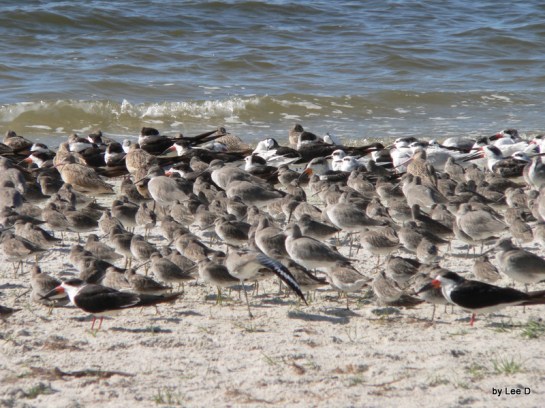
Watching Birds at MacDill AFB Shore by Lee

I apologize for overwhelming many of you with all those posts I released the other day! I wasn’t sure how to return them from the Birds of the Bible for Kids any other way.

If you missed the explanation, I am in the process of closing the “Kids” blog and returning those post and pages back here. Since then, I have been banging around behind the scenes. I have been able to return many that were here, but inactive. Those were completed without OVERWHELMING you.

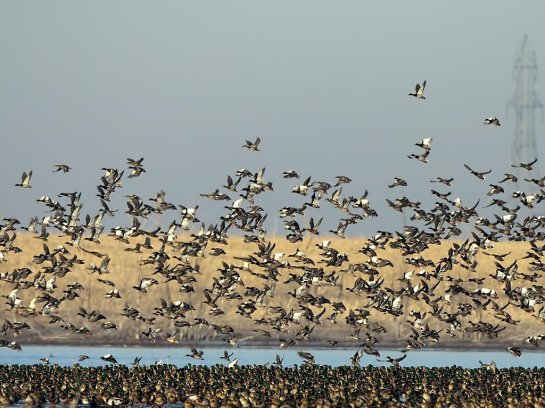
American Wigeon flocks

So far, these have been returned and are active here:

Scripture Alphabet of Animals:

Scripture Alphabet of Animals: The Ant
Scripture Alphabet of Animals: The Ass (Donkey)
Scripture Alphabet of Animals: The Bear
Scripture Alphabet of Animals: The Bee
Scripture Alphabet of Animals: The Camel
Scripture Alphabet of Animals: The Dog
Scripture Alphabet of Animals: The Eagle
Scripture Alphabet of Animals: The Fox or Jackal
Scripture Alphabet of Animals: The Goat
Scripture Alphabet of Animals: The Hart and Hind
Scripture Alphabet of Animals: The Horse
Scripture Alphabet of Animals: The Ibex or the Wild Goat
Scripture Alphabet of Animals: The Jerboa or Mouse
Scripture Alphabet of Animals: The Kite
Scripture Alphabet of Animals: The Leopard
Scripture Alphabet of Animals: The Lion
Scripture Alphabet of Animals: The Locust
Scripture Alphabet of Animals: The Mole
Scripture Alphabet of Animals: The Night-Hawk
Scripture Alphabet of Animals: The Ostrich
Scripture Alphabet of Animals: The Peacock
Scripture Alphabet of Animals: The Quail
Scripture Alphabet of Animals: The Raven
Scripture Alphabet of Animals: The Roe or Gazelle
Scripture Alphabet of Animals: The Scorpion
Scripture Alphabet of Animals: The Sheep
Scripture Alphabet of Animals: The Stork
Scripture Alphabet of Animals: The Turtle-Dove
Scripture Alphabet of Animals: The Unicorn
Scripture Alphabet of Animals: The Vulture
Scripture Alphabet of Animals: The Whale
Scripture Alphabet of Animals: The Wolf

Bible Birds

Other

STAY TUNED!

Scripture Alphabet of Animals: The Wolf

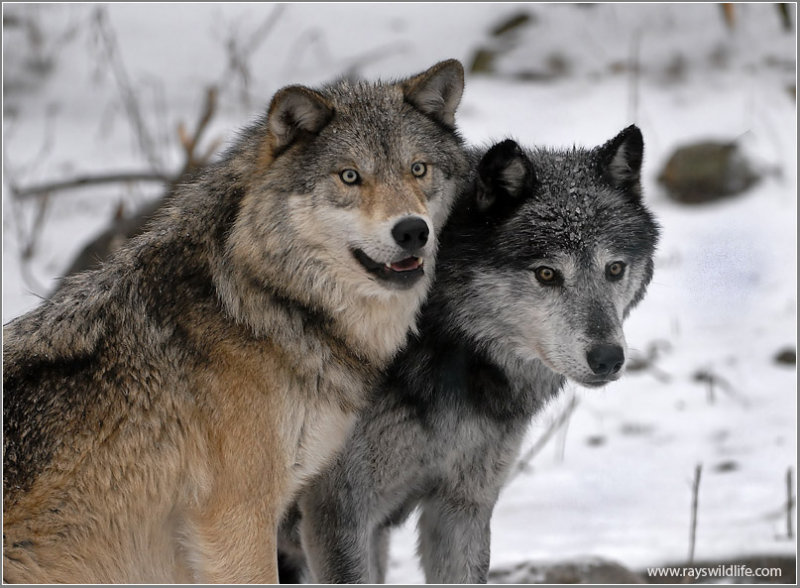
Timber Wolves by Ray

Timber Wolves by Ray

Scripture Alphabet of Animals: The Wolf

By Harriet N. Cook (1814-1843)

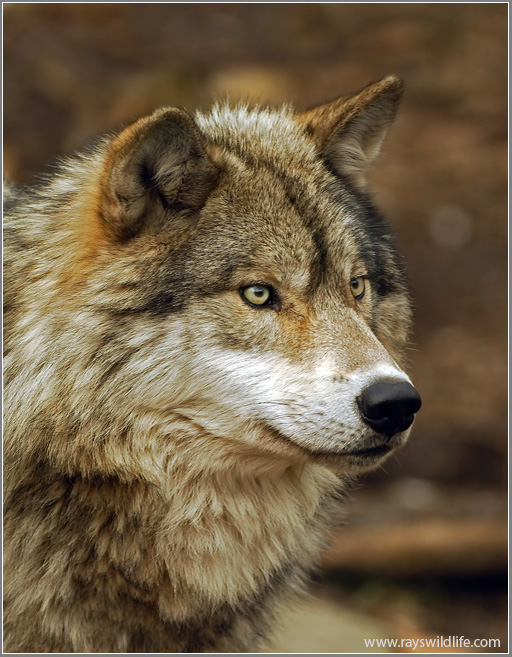
The wolf is rather larger than our largest dogs, and looks somewhat like them; but he seems more wild, savage and cruel. The wolves go in large companies, making a terrible howling noise; and though they are in general cowardly, yet when they are very hungry they attack large animals, and even men. They almost always go out by night, and the Bible refers to this when it says,

Their horses are more fierce than the evening wolves.

Jacob, just before his death, said of one of his sons,

Benjamin shall raven as a wolf; in the morning he shall devour the prey, and at evening he shall divide the spoil.

Timber Wolf by Ray

Timber Wolf by Ray

There were once a great many wolves in New England and in other parts of the United States, and some are left yet, although many have been killed or driven away. There are still great numbers of them in some countries. In England the month of January used to be called Wolf- monat, or wolf-month; “because,” as an old book says, “people are wont in that moneth to be more in danger to be devoured of wolves than in any season els of the yeare, for that through the extremity of cold and snow those ravenous creatures could not find other beasts sufficient to feed upon.”

A sad story is told of something that happened in Russia a few years since. A woman was one day riding on a sledge with her three children over a lonely road, when suddenly she heard the noise of wolves behind her. She was not very far from home, and tried to urge her horse on, to get out of their reach; but they gained upon her every moment, and were just on the point of rushing on the sledge, when the poor woman, to save the lives of the rest, caught up one of the children and threw it to the wolves. This stopped them but a short time; they devoured it at once and again ran howling after the sledge. The mother threw out a second child, hoping to escape with the other; but in vain. Again the cruel animals were close behind her, and to save her own life, hardly knowing what she did, she threw over her only remaining child. She succeeded in reaching home herself, in safety, but where were her children? She told the terrible story; but while she was endeavoring to excuse herself by telling of her exceeding fright and danger, a man who stood by struck her on the head with an axe and killed her at one blow-saying that a woman who would thus give up her children to save her life, was not fit to live.

The Bible tells us of a time yet to come, when

The wolf shall feed with the lamb.

Perhaps this will be exactly true of the animals in those days, though it now seems so unlikely; but I suppose it means also that wicked and cruel men shall become holy and Christ-like. Then all will be peace on earth, and

none shall hurt or destroy in all” God’s “holy mountain.

___
See:

Harriet Newell Cook – Scripture Alphabet of Animals

Nave’s Topical Bible – Wolf

Torrey’s Topical Textbook – Wolf

(Photos ©WikiC)

*

Scripture Alphabet of Animals: The Whale

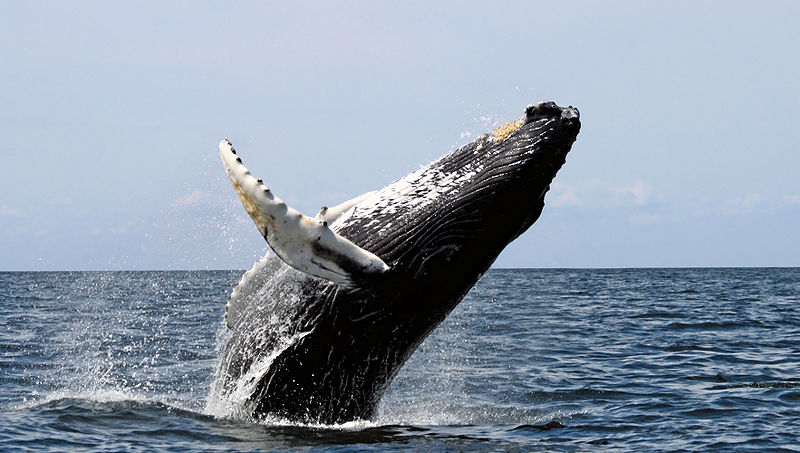
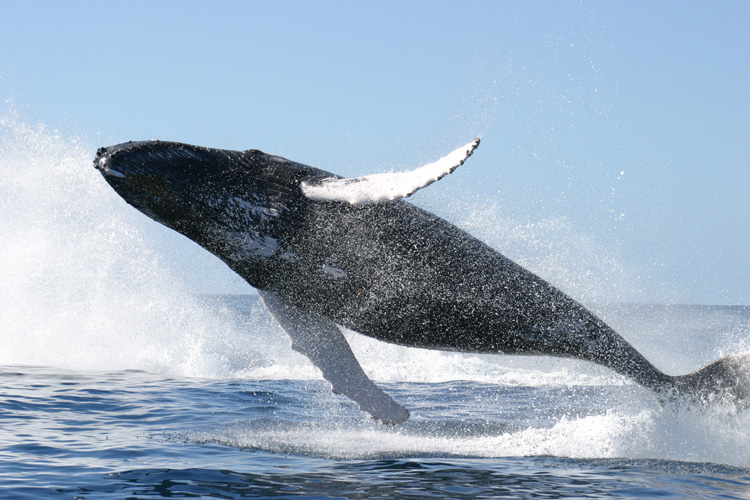
Humpback Whale breaching ©Wikipedia

Humpback Whale breaching ©Wikipedia

Scripture Alphabet of Animals: The Whale

By Harriet N. Cook (1814-1843)

The whale is mentioned in the first chapter of the Bible, 21st verse.

And God created great whales.

Some suppose that large fish of every kind are here meant.

An animal called the leviathan is described in one of the last chapters of Job, which some suppose to be the whale. It certainly means a large and strong animal, as you will see by the questions asked about him:

Canst thou draw out leviathan with a hook ? or his tongue with a cord which thou lettest down? Canst thou put a hook in his nose ? or bore his jaw through with a thorn? Wilt thou play with him as with a bird? When he raiseth himself up, the mighty are afraid. The arrow cannot make him flee; he laugheth at the shaking of a spear; he maketh the deep to boil like a pot; one would think the deep to be hoary.

This is like the whale in some things; but you will remember that it is not certain that he is meant.

Humpback whale jumping©WikiC

Humpback whale jumping©WikiC

The common whale for which so many sailors are always seeking on the great ocean, is an enormous animal. It is often found seventy feet long; and it is said that they have been found of the length of a hundred feet. If you do not know how long this would be, you will do well to ask some friend to tell you of a building or something else with which you can compare it; for it is not very likely that you will ever see the whale itself, and its size is very wonderful. It is covered with a coat of fat, sometimes more than a yard thick; and when this is cut up and put over fires in great kettles, a hundred barrels of oil are sometimes obtained from a single whale.

Perhaps you already know how they take the whale. As soon as the sailors see one, they go towards him in a boat until they get as near to him as they dare. Then they throw their harpoons at him; these are sharp-pointed irons, fastened to a very long rope, one end of which they keep in the boat. As soon as the whale is wounded, he dives down into the water, and swims away to some distance. He is usually obliged to come up again in about half an hour to breathe, for he cannot live all the while under water; and then the men throw other harpoons at him. Sometimes he comes so near as to upset the boat with a blow of his strong tail. The picture shows you a scene of this kind, where the boat was tossed into the air, the men thrown out, and one of them drowned.

___
See:

Harriet Newell Cook – Scripture Alphabet of Animals

Nave’s Topical Bible – Whale

(Photos ©WikiC)

*

Scripture Alphabet of Animals: The Vulture

White-backed Vulture (Gyps africanus) by Africaddict

White-backed Vulture (Gyps africanus) by Africaddict

Scripture Alphabet of Animals: The Vulture

By Harriet N. Cook (1814-1843)

The vulture is called a bird of prey, because it lives on flesh; but it has not such strong claws as the eagle, to seize and tear its food. It does not often kill other animals; but preys upon those that have been killed in some other way, or have died of themselves. It is a disagreeable bird, and one that you would not like very well to see; no wonder the Israelites were forbidden to eat it. It is about a yard long from the top of its head, and it sometimes measures two yards across the wings.

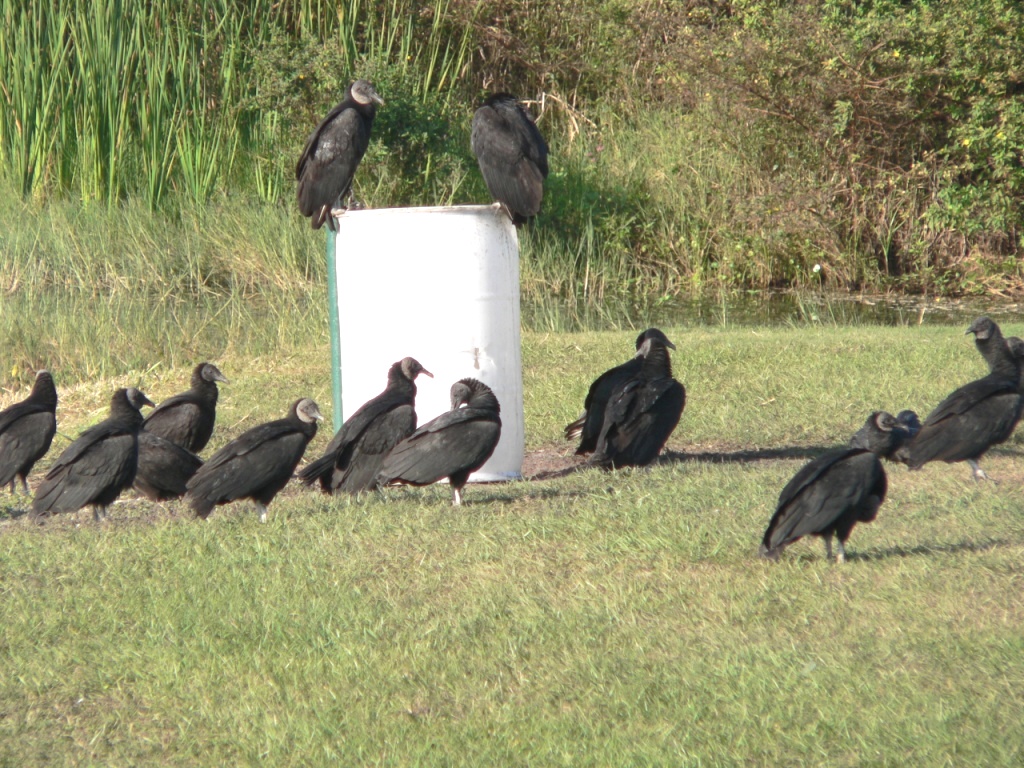
Black Vultures at Saddle Creek by Lee

Black Vultures at Saddle Creek by Lee

It lives only in warm or hot climates, and there it is very useful, though you might at first be puzzled to think how this can be. It is because it lives upon such things as would be very injurious to man if they were left to decay in the open air. It not only consumes the dead bodies of animals, but takes away many things from the streets of the cities which the inhabitants are too indolent to remove. It is for this reason that in the city of Cairo, in Egypt, there is a law forbidding any person to kill a vulture. These birds sometimes follow an army, and prey upon the bodies of those poor soldiers who have been killed in battle. Ah ! it is a sad thing to go to war; almost every thing about it is sad.

The vulture has a very keen eye, and, like the eagle, can see what is on the ground, even when it is very high in the air. This is referred to in the book of Job.

There is a path which no fowl knoweth, and which the vulture’s eye hath not seen.

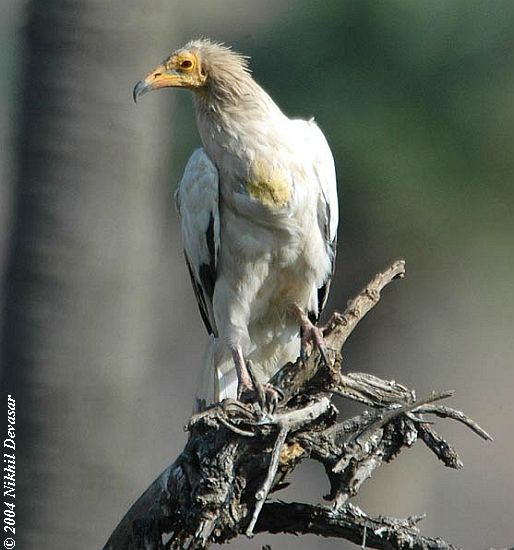
Egyptian Vulture (Neophron percnopterus) by Nikhil

Egyptian Vulture (Neophron percnopterus) by Nikhil

It often happens in those countries that almost as soon as an ox, or a horse, or any other large animal has been killed, great multitudes of vultures will gather around, though not one could be seen in the sky before. they seem to fly down from every part of the heavens, and being to pull and struggle for the flesh of the animal; until in the course of a few hours nothing is left but the bones. We read in Isaiah,

There shall the vultures be gathered, every one with her mate.

This must have been written by one who had seen these birds coming together, as they do in great flocks or companies.

(Blog formatted by Lee)

See:

Harriet Newell Cook – Scripture Alphabet of Animals

Birds of the Bible

Birds of the Bible – Vulture

Accipitridae – Kites, Hawks & Eagles

Nave’s Topical Bible – Vulture

*

Scripture Alphabet of Animals: The Unicorn

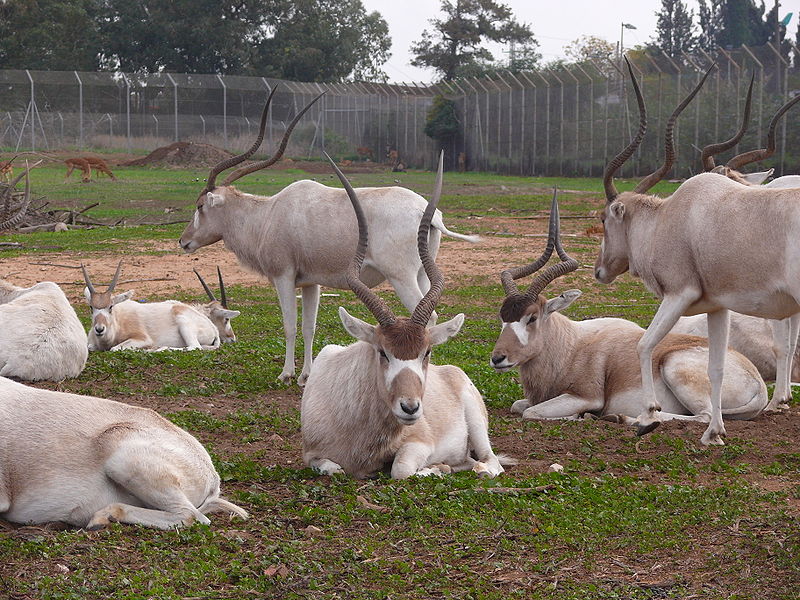
Herd of Addax: note how the horns of one animal at rest on the right appear to be joined as one horn.

Scripture Alphabet of Animals: The Unicorn

By Harriet N. Cook (1814-1843)

There is only this animal mentioned in the Bible, the name of which begins with U, and of this I cannot give you a picture, because no person now knows what sort of an animal it was. Some suppose it was a kind of wild goat; others think that it was a sort of deer; and others, that it was what we call the rhinoceros. Perhaps you have seen pictures with the name of the unicorn under them; but you must remember that those who made them only guessed it was so, and that no person can certainly tell what it was.
___
See:

Harriet Newell Cook – Scripture Alphabet of Animals

Nave’s Topical Bible – Unicorn

Torrey’s Topical Textbook – Unicorn

(Photos ©WikiC)

*

Scripture Alphabet of Animals: The Turtle-Dove

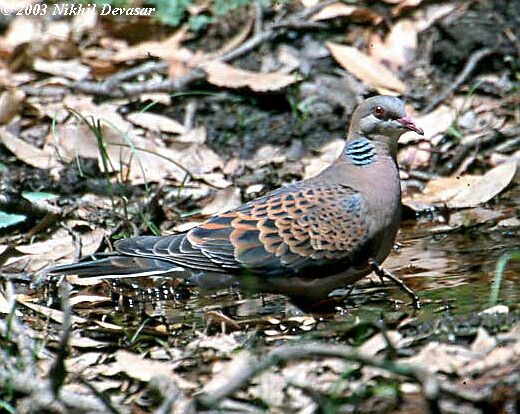
Oriental Turtle Dove (Streptopelia orientalis) by Nikhil Devasar

Oriental Turtle Dove (Streptopelia orientalis) by Nikhil Devasar

Scripture Alphabet of Animals: The Turtle-Dove

By Harriet N. Cook (1814-1843)

This is a very beautiful and innocent bird, and no one is mentioned more frequently in the Bible. It does not live upon the flesh of animals: so when Noah sent one out of the ark, she soon came back again, because she could find nothing to eat, and no rest for the sole of her foot. Noah put out his hand and gently took her in, and she did not go out again for a whole week. Then Noah let her fly, and the beautiful creature came back in the evening, having in her mouth a green leaf which she had plucked from an olive-tree; as though she wanted to tell him that the waters were beginning to dry up. After another week she went out, and did not come back again to the ark, because the earth was dry.

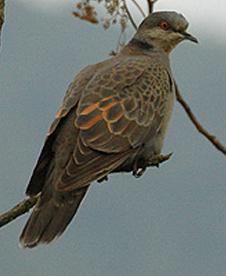
Dusky Turtle Dove (Streptopelia lugens) ©WikiC

Dusky Turtle Dove (Streptopelia lugens) ©WikiC

The dove was often offered as a sacrifice in ancient times; and was a type of our innocent Savior, to show how he would afterwards be put to death for the guilty. The Holy Spirit once condescended to take the form of a dove, when he rested upon Christ at the time of his baptism. Our Savior speaks of the innocence of this bird when he says to his disciples,

I send you forth as sheep in the midst of wolves; be ye wise as serpents, and harmless as doves.

This bird has a very sweet but mournful voice; and this is referred to in the Bible. Hezekiah, one of the Jewish kings, had been very sick and expected to die; but as he lay on his bed, he prayed that God would be pleased to spare his life. God heard his prayer, and promised that he should live fifteen years longer; and soon after he became quite well. He was grateful to God for his goodness, and wrote a beautiful song of praise to be sung in the temple. Among other things he told how he felt when he lay so sick upon his bed. He says,

Like a crane or a swallow, so did I chatter; I did mourn as a dove.

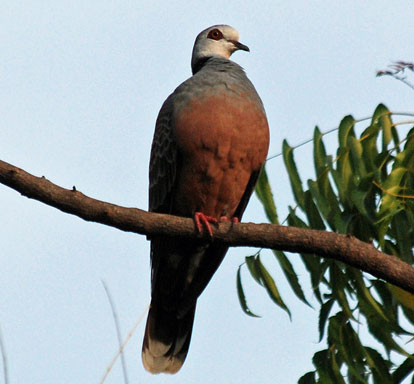
Adamawa Turtle Dove (Streptopelia hypopyrrha) ©WikiC

Adamawa Turtle Dove (Streptopelia hypopyrrha) ©WikiC

The turtle-dove is a bird of passage. It appears in Judea early in the spring, when the leaves are coming out, the flowers opening, and every thing looking lovely and beautiful. This will explain some verses in the Song of Solomon,

Rise up, my love, my fair one, and come away, for lo ! the winter is past, the rain is over and gone; the flowers appear on the earth; the time of the singing of birds is come, and the voice of the turtle (or turtle-dove) is heard in our land.

It remains until summer is gone; and then flies away to a warmer climate to spend the winter. It is in reference to this that David says,

Oh ! that I had wings like a dove ! for then would I flee away, and be at rest; lo, then would I wander far off, and remain in the wilderness; I would hasten my escape from the windy storm and tempest.

You will find these beautiful verses in the 55th Psalm.

Who would not wish to be like the gentle, peaceful dove?

(Blog formatted by Lee)

See:

Harriet Newell Cook -Scripture Alphabet of Animals

Birds of the Bible

Doves and Pigeons

Columbidae Family – Pigeons, Doves

Nave’s Topical Bible – Dove, Turtle

Torrey’s Topical Textbook – Dove

*