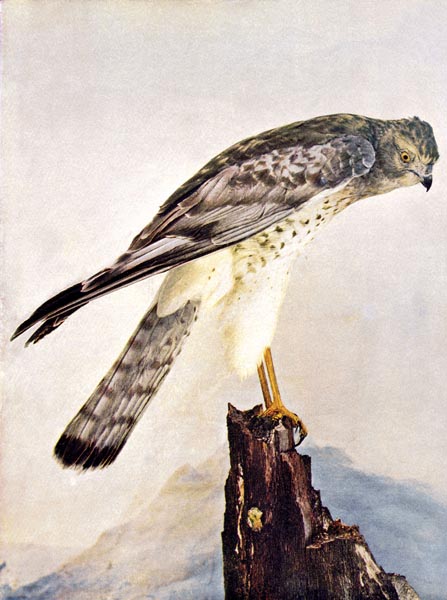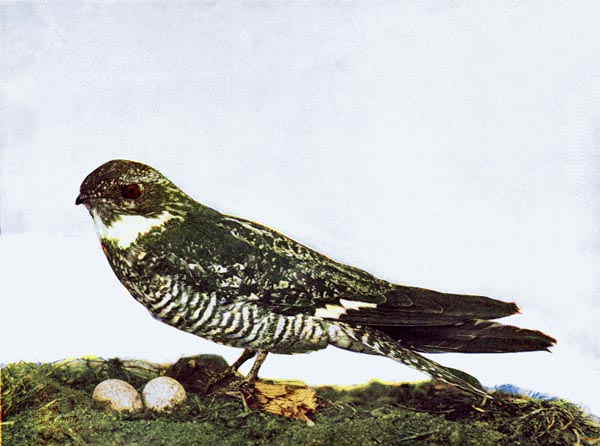
Birds Vol 1 #5 – The Night Hawk

Night Hawk for Birds Illustrated by Color Photography, 1897

Night Hawk for Birds Illustrated by Color Photography, 1897

Birds Illustrated by Color Photography – Revisited

Vol 1. May, 1897 No. 5

*

THE NIGHT HAWK

imgt

HE range of the Night Hawk, also known as “Bull-bat,” “Mosquito Hawk,” “Will o’ the Wisp,” “Pisk,” “Piramidig,” and sometimes erroneously as “Whip-poor-will,” being frequently mistaken for that bird, is an extensive one. It is only a summer visitor throughout the United States and Canada, generally arriving from its winter haunts in the Bahamas, or Central and South America in the latter part of April, reaching the more northern parts about a month later, and leaving the latter again in large straggling flocks about the end of August, moving leisurely southward and disappearing gradually along our southern border about the latter part of October. Major Bendire says its migrations are very extended and cover the greater part of the American continent.

The Night Hawk, in making its home, prefers a well timbered country. Its common name is somewhat of a misnomer, as it is not nocturnal in its habits. It is not an uncommon sight to see numbers of these birds on the wing on bright sunny days, but it does most of its hunting in cloudy weather, and in the early morning and evening, returning to rest soon after dark. On bright moonlight nights it flies later, and its calls are sometimes heard as late as eleven o’clock.

“This species is one of the most graceful birds on the wing, and its aerial evolutions are truly wonderful; one moment it may be seen soaring through space without any apparent movement of its pinions, and again its swift flight is accompanied by a good deal of rapid flapping of the wings, like that of Falcons, and this is more or less varied by numerous twistings and turnings. While constantly darting here and there in pursuit of its prey,” says a traveler, “I have seen one of these birds shoot almost perpendicularly upward after an insect, with the swiftness of an arrow. The Night Hawk’s tail appears to assist it greatly in these sudden zigzag changes, being partly expanded during most of its complicated movements.”

Night Hawks are sociable birds, especially on the wing, and seem to enjoy each other’s company. Their squeaking call note, sounding like “Speek-speek,” is repeated at intervals. These aerial evolutions are principally confined to the mating season. On the ground the movements of this Hawk are slow, unsteady, and more or less laborious. Its food consists mainly of insects, such as flies and mosquitos, small beetles, grasshoppers, and the small night-flying moths, all of which are caught on the wing. A useful bird, it deserves the fullest protection.

The favorite haunts of the Night Hawk are the edges of forests and clearings, burnt tracts, meadow lands along river bottoms, and cultivated fields, as well as the flat mansard roofs in many of our larger cities, to which it is attracted by the large amount of food found there, especially about electric lights. During the heat of the day the Night Hawk may be seen resting on limbs of trees, fence rails, the flat surface of lichen-covered rock, on stone walls, old logs, chimney tops, and on railroad tracks. It is very rare to find it on the ground.

The nesting-time is June and July. No nest is made, but two eggs are deposited on the bare ground, frequently in very exposed situations, or in slight depressions on flat rocks, between rows of corn, and the like. Only one brood is raised. The birds sit alternately for about sixteen days. There is endless variation in the marking of the eggs, and it is considered one of the most difficult to describe satisfactorily.


THE NIGHT HAWK.

As you will see from my name, I am a bird of the night. Daytime is not at all pleasing to me because of its brightness and noise.

I like the cool, dark evenings when the insects fly around the house-tops. They are my food and it needs a quick bird to catch them. If you will notice my flight, you will see it is swift and graceful. When hunting insects we go in a crowd. It is seldom that people see us because of the darkness. Often we stay near a stream of water, for the fog which rises in the night hides us from the insects on which we feed.

None of us sing well—we have only a few doleful notes which frighten people who do not understand our habits.

In the daytime we seek the darkest part of the woods, and perch lengthwise on the branches of trees, just as our cousins the Whippoorwills do. We could perch crosswise just as well. Can you think why we do not? If there be no woods near, we just roost upon the ground.

Our plumage is a mottled brown—the same color of the bark on which we rest. Our eggs are laid on the ground, for we do not care to build nests. There are only two of them, dull white with grayish brown marks on them.

Sometimes we lay our eggs on flat roofs in cities, and stay there during the day, but we prefer the country where there is good pasture land. I think my cousin Whippoorwill is to talk to you next month. People think we are very much alike. You can judge for yourself when you see his picture.


Photographed through cage wires.

Common Nighthawk (Chordeiles minor) at National Aviary by Lee

Lee’s Addition:

Nighthawks are in our list of birds that are “unclean.” Both verses are identical in the KJV.

And the owl, and the night hawk, and the cuckoo, and the hawk after his kind, (Lev 11:16)
And the owl, and the night hawk, and the cuckoo, and the hawk after his kind, (Deu 14:15)

The Nighthawk is part of the Caprimulgidae – Nightjars Family which has 93 species and is one of our Birds of the Bible. The Nighthawks family is part of the Caprimulgiformes Order which has Frogmouths, Oilbird and the Potoos families.

The Common Nighthawk (Chordeiles minor) is a medium-sized crepuscular or nocturnal bird, whose presence and identity are best revealed by its vocalization. Typically dark (grey, black and brown), displaying cryptic colouration and intricate patterns, this bird becomes invisible by day. Once aerial, with its buoyant but erratic flight, this bird is most conspicuous. The most remarkable feature of this aerial insectivore is its small beak belies the massiveness of its mouth. Some claim appearance similarities to owls. With its horizontal stance and short legs, the Common Nighthawk does not travel frequently on the ground, instead preferring to perch horizontally, parallel to branches, on posts, on the ground or on a roof. The males of this species may roost together but the bird is primarily solitary. The Common Nighthawk shows variability in territory size.

This caprimulguid has a large, flattened head with large eyes; facially it lacks rictal bristles. The Common Nighthawk has long slender wings that at rest extend beyond a notched tail. There is noticeable barring on the sides and abdomen, also white wing-patches.
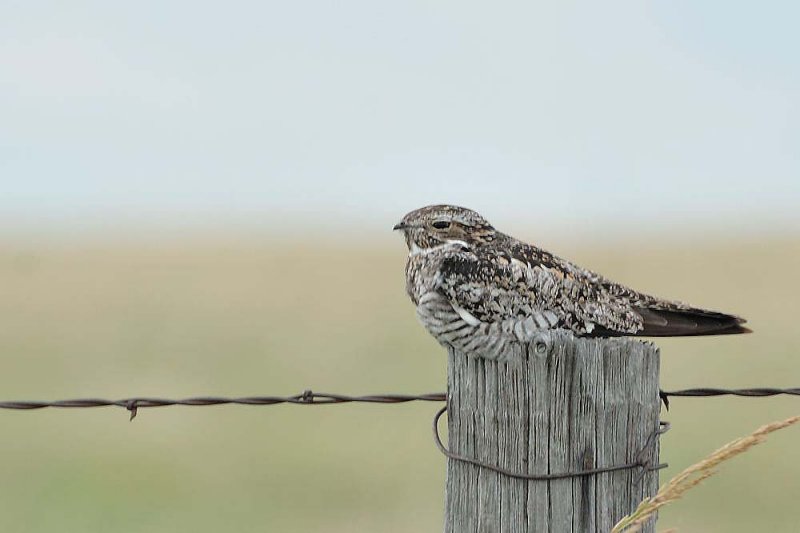
Common Nighthawk by Neal Addy

Common Nighthawk by Neal Addy

The Common Nighthawk measures 8.7-9.4 in/22-25 cm in length, displays a wing span of 21-24 in/54–61 cm, weighs 2.3-3.5 oz/65-98 g, and has a life span of 4–5 years.

Within family Caprimulgidae, subfamily Chordeilinae (Nighthawks) are limited to the New World and are distinguished from the subfamily Caprimulginae, by the lack of rictal bristles.

The most conspicuous vocalization is a nasal peent or beernt during even flight. Peak vocalizations are reported 30–45 minutes after sunset. Croaking auk auk auk vocalized by males while in the presence of a female during courtship. Another courtship sound, thought to be made solely by the males, is the boom, created by air rushing through the primaries after a quick down flex of the wings during a daytime dive.

Sometimes call the “Bull-Bat – due to its perceived “bat-like” flight, and the “bull-like” boom made by its wings as it pulls from a dive.”
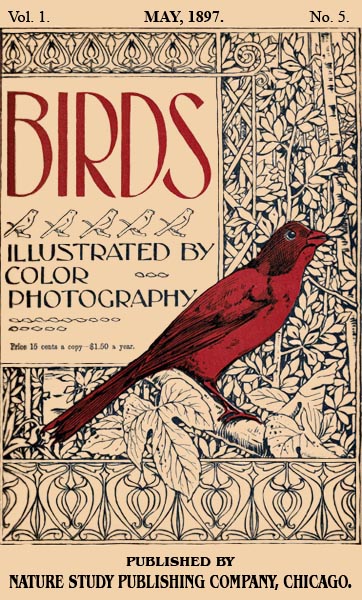
Birds Illustrated by Color Photograhy Vol 1 May, 1897 No 5 - Cover

Birds Illustrated by Color Photograhy Vol 1 May, 1897 No 5 – Cover

Birds Illustrated by Color Photography – Revisited – Introduction

The above article is the first article in the monthly serial that was started in January 1897 “designed to promote Knowledge of Bird-Live.” These include Color Photography, as they call them, today they are drawings. There are at least three Volumes that have been digitized by Project Gutenberg.

To see the whole series of – Birds Illustrated by Color Photography – Revisited

*

(Information from Wikipedia and other internet sources)

Next Article – The Wood Thrush

Previous Article – The Indigo Bunting

Story of the Wordless Book

Links:

Bible Birds – Night Hawks

Birds of the Bible – Nighthawks and Nightjars

Birds of the Bible – NighthawkandNighthawks II

Caprimulgidae – Night Hawks

Common Nighthawk – All About Birds

Common Nighthawk – Wikipedia

Nightjar Wikipedia

*


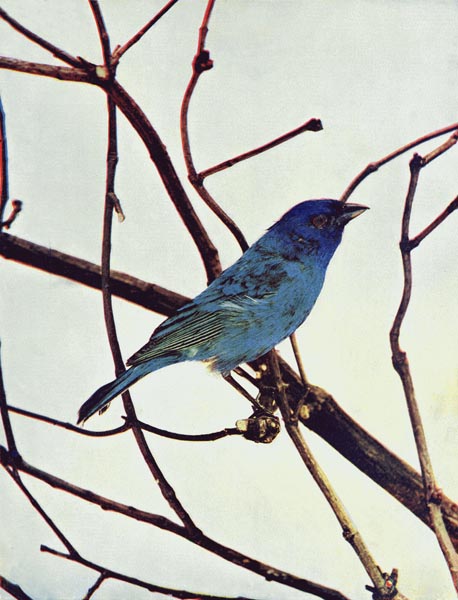
Birds Vol 1 #5 – The Indigo Bunting

Indigo Bunting by Birds Illustrated by Color Photography, 1897

Indigo Bunting by Birds Illustrated by Color Photography, 1897

Birds Illustrated by Color Photography – Revisited

Vol 1. May, 1897 No. 5

*

THE INDIGO BUNTING.

imgt

HE Indigo Bunting’s arrival at its summer home is usually in the early part of May, where it remains until about the middle of September. It is numerous in the eastern and middle states, inhabiting the continent and seacoast islands from Mexico, where they winter, to Nova Scotia. It is one of the very smallest of our birds, and also one of the most attractive. Its favorite haunts are gardens, fields of deep clover, the borders of woods, and roadsides, where, like the Woodpecker, it is frequently seen perched on the fences.

It is extremely active and neat in its manners and an untiring singer, morning, noon, and night his rapid chanting being heard, sometimes loud and sometimes hardly audible, as if he were becoming quite exhausted by his musical efforts. He mounts the highest tops of a large tree and sings for half an hour together. The song is not one uninterrupted strain, but a repetition of short notes, “commencing loud, and rapid, and full, and by almost imperceptible gradations for six or eight seconds until they seem hardly articulated, as if the little minstrel were unable to stop, and, after a short pause, beginning again as before.” Baskett says that in cases of serenade and wooing he may mount the tip sprays of tall trees as he sings and abandon all else to melody till the engrossing business is over.

The Indigo Bird sings with equal animation whether it be May or August, the vertical sun of the dog days having no diminishing effect upon his enthusiasm. It is well known that in certain lights his plumage appears of a rich sky blue, varying to a tint of vivid verdigris green, so that the bird, flitting from one place to another, appears to undergo an entire change of color.

The Indigo Bunting fixes his nest in a low bush, long rank grass, grain, or clover, suspended by two twigs, flax being the material used, lined with fine dry grass. It had been known, however, to build in the hollow of an apple tree. The eggs, generally five, are bluish or pure white. The same nest is often occupied season after season. One which had been used for five successive summers, was repaired each year with the same material, matting that the birds had evidently taken from the covering of grape vines. The nest was very neatly and thoroughly lined with hair.

The Indigo feeds upon the ground, his food consisting mainly of the seed of small grasses and herbs. The male while moulting assumes very nearly the color of the female, a dull brown, the rich plumage not returning for two or three months. Mrs. Osgood Wright says of this tiny creature: “Like all the bright-hued birds he is beset by enemies both of earth and sky, but his sparrow instinct, which has a love for mother earth, bids him build near the ground. The dangers of the nesting-time fall mostly to his share, for his dull brown mate is easily overlooked as an insignificant sparrow. Nature always gives a plain coat to the wives of these gayly dressed cavaliers, for her primal thought is the safety of the home and its young life.”

Indigo Bunting female at fountain in yard through window

Indigo Bunting female at fountain in yard through window


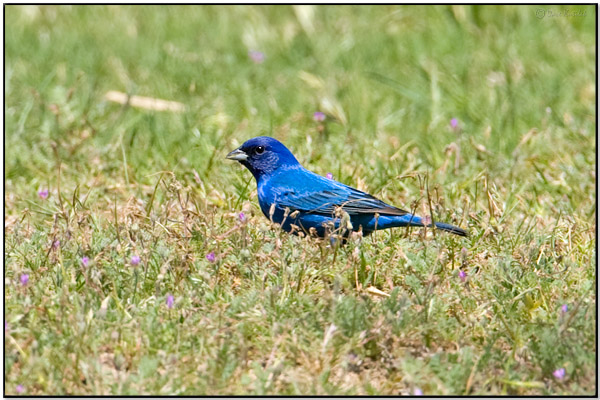
Indigo Bunting (Passerina cyanea) by Daves BirdingPix

Indigo Bunting (Passerina cyanea) by Daves BirdingPix

Lee’s Addition:

Indigo Buntings are in the Grosbeaks, Saltators & Allies – Cardinalidae Family. What a difference between the two as the article said. The Lord gives protection to the female by her coloration so she can sit on the nest and not be noticed. Praise the Lord for His care for the critters and us.

Do not fear therefore; you are of more value than many sparrows (or Buntings). (Matthew 10:31 NKJV)

They are small seed-eating bird. It is migratory, ranging from southern Canada to northern Florida during the breeding season, and from southern Florida to northern South America during the winter. It often migrates by night, using the stars to navigate. Its habitat is farmland, brush areas, and open woodland. The Indigo Bunting is closely related to the Lazuli Bunting, and interbreeds with the latter species where their ranges overlap. (Not sure how the female ended up in our yard, but must have had to land for a drink. Glad it did.)

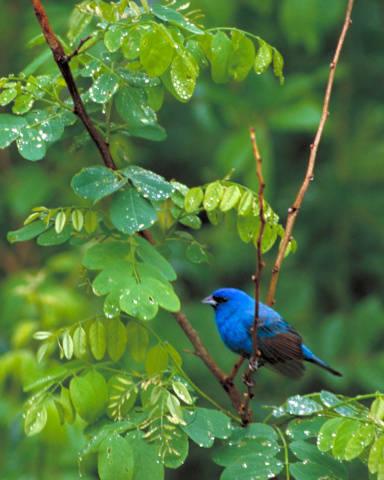
Indigo Bunting (Passerina cyanea) ©USFWS

The Indigo Bunting communicates through vocalizations and visual cues. A sharp chip! call is used by both sexes, and is used as an alarm call if a nest or chick is threatened. A high-pitched, buzzed zeeep is used as a contact call when the Indigo Bunting is in flight. The song of the male bird is a high-pitched buzzed sweet-sweet chew-chew sweet-sweet, lasting two to four seconds, sung to mark his territory to other males and to attract females. Each male has a single complex song, which he sings while perched on elevated objects, such as posts, wires, and bush-tops. In areas where the ranges of the Lazuli Bunting and the Indigo Bunting overlap, the males defend territories from each another. Migration takes place in April and May and then again in September and October. The Indigo Bunting often migrates during the night, using the stars to direct itself. In captivity, since it cannot migrate, it experiences disorientation in April and May and in September and October if it cannot see the stars from its enclosure.

From xeno-canto.org by Doug Knapp

These birds are generally monogamous but not always faithful to their partner. In the western part of their range, they often hybridize with the Lazuli Bunting. Nesting sites are located in dense shrub or a low tree, generally 0.3–1 m (1–3 ft) above the ground, but rarely up to 9 m (30 ft). The nest itself is constructed of leaves, coarse grasses, stems, and strips of bark, lined with soft grass or deer hair and is bound with spider web. It is constructed by the female, who cares for the eggs alone. The clutch consists of one to four eggs, but usually contains three to four. The eggs are white and usually unmarked, though some may be marked with brownish spots, averaging 18.7 × 13.7 mm (0.7 × 0.5 in) in size. The eggs are incubated for 12 to 13 days and the chicks are altricial at hatching. Chicks fledge 10 to 12 days after hatching. Most pairs raise two broods per year, and the male may feed newly fledged young while the females incubate the next clutch of eggs.

The Brown-headed Cowbird may parasitize this species. Indigo Buntings abandon their nest if a cowbird egg appears before they lay any of their own eggs, but accept the egg after that point. Pairs with parasitized nests have less reproductive success. The bunting chicks hatch, but have lower survival rates as they must compete with the cowbird chick for food.

Birds Illustrated by Color Photograhy Vol 1 May, 1897 No 5 - Cover

Birds Illustrated by Color Photograhy Vol 1 May, 1897 No 5 – Cover

Birds Illustrated by Color Photography – Revisited – Introduction

The above article is the first article in the monthly serial that was started in January 1897 “designed to promote Knowledge of Bird-Live.” These include Color Photography, as they call them, today they are drawings. There are at least three Volumes that have been digitized by Project Gutenberg.

To see the whole series of – Birds Illustrated by Color Photography – Revisited

*

(Information from Wikipedia and other internet sources)

Next Article – The Night Hawk

Previous Article –The Prothonotary Yellow Warblers

Wordless Birds – Toucan

Links:

Indigo Bunting – Wikipedia

Sounds of Indigo Bunting – xeno-canto.org

Grosbeaks, Saltators & Allies – Cardinalidae Family


Start Birdwatching Today: Enjoy The Lord’s Paintbrush – Zoos

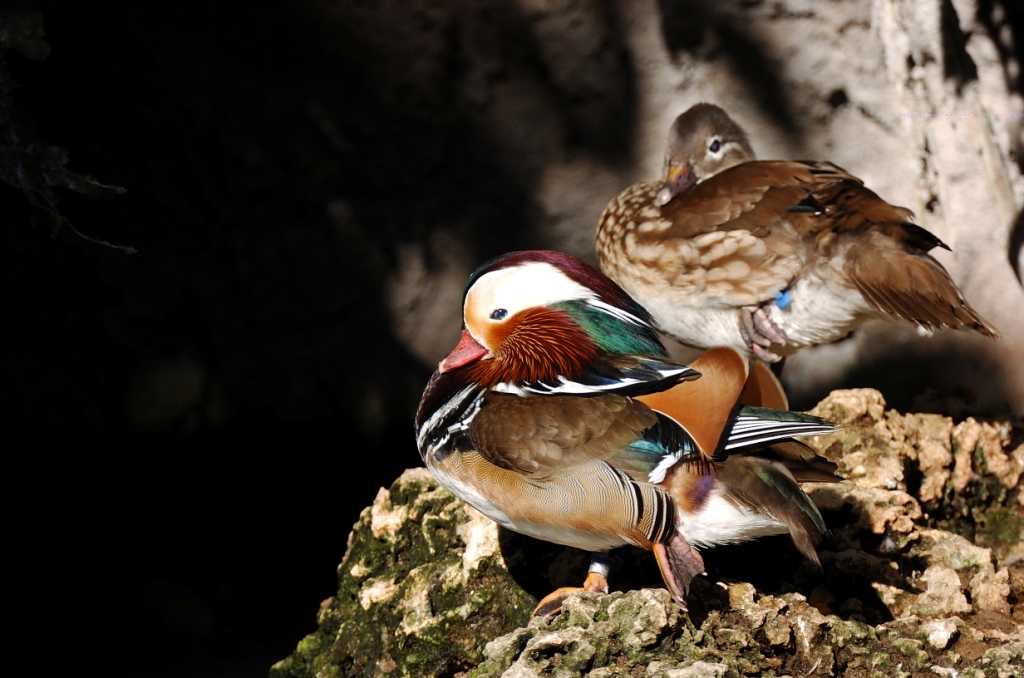
Mandarin Duck (Aix galericulata) by Dan at Zoo Miami

Mandarin Duck (Aix galericulata) by Dan at Zoo Miami

I trust you are enjoying our “Start Birdwatching Today!” series. We have been trying to motivate you to go out and observe the many birds around you. This is the second article about “Enjoying The Lord’s Paintbrush” Click for first one.

Seeing as our subtitle is “Birdwatching from a Christian Perspective,” I want to do a few articles that you won’t see in most birding books. We believe that the world and all that its critters were created by the Lord and not evolved.

For thus says the Lord–Who created the heavens, God Himself, Who formed the earth and made it, Who established it and did not create it to be a worthless waste; He formed it to be inhabited–I am the Lord, and there is no one else. (Isaiah 45:18 AMP) O LORD, how manifold are Your works! In wisdom You have made them all. The earth is full of Your possessions— (Psalms 104:24 NKJV) Have you not known? Have you not heard? The everlasting God, the LORD, The Creator of the ends of the earth, Neither faints nor is weary. His understanding is unsearchable. (Isaiah 40:28 NKJV)

While creating the birds, the Lord has used a fantastic array of colors and designs. I can imagine Him using a fine brush when some of my favorite birds here in America were being dressed for “His pleasure.” Zoos are a fantastic place to see birds that you would have to travel to other countries to see. It is more economical to travel to a Zoo nearby.

The birds at zoos are well cared for and many are being bred to preserve their species. Some birds are so endangered by loss of habitat and other causes, that the only birds left are the ones in the zoos or preserves. We are fortunate to have some very super zoos right here within a day’s drive and our country has many others that are first class also. The birds seen here in this article are some of the fantastically painted birds created by the Lord that Dan and I have seen in Zoos.

Look at the Mandarin Duck at the top. He is related to the Wood Duck up there last week. Another beautiful bird that likes to hide and make it difficult to get a good photo of him. The male is the colorful one and the female is a plain brownish to protect her while on the nest. She is in the background and you can see her painted eyelines.

Now if you have an ugly vulture and want to pretty it up, look at this design on the head of a King Vulture.

King Vulture (Sarcoramphus papa) by Lee at Brevard Zoo

King Vulture (Sarcoramphus papa) by Lee at Brevard Zoo

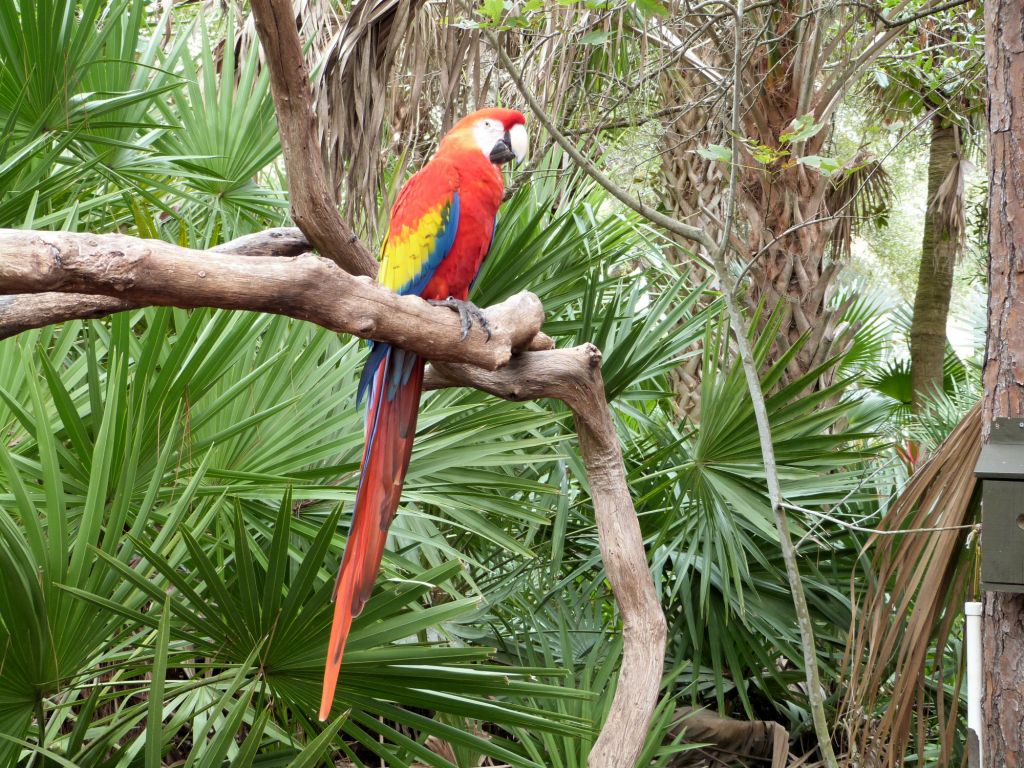
Here are a few more beauties by their Creator: How about these feathers on the Scarlet Macaw?

Scarlet Macaw (Ara macao) Feathers - Brevard Zoo

Scarlet Macaw (Ara macao) Feathers – Brevard Zoo

Scarlet Macaw (Ara macao) by Lee Brevard Zoo

Scarlet Macaw (Ara macao) by Lee Brevard Zoo

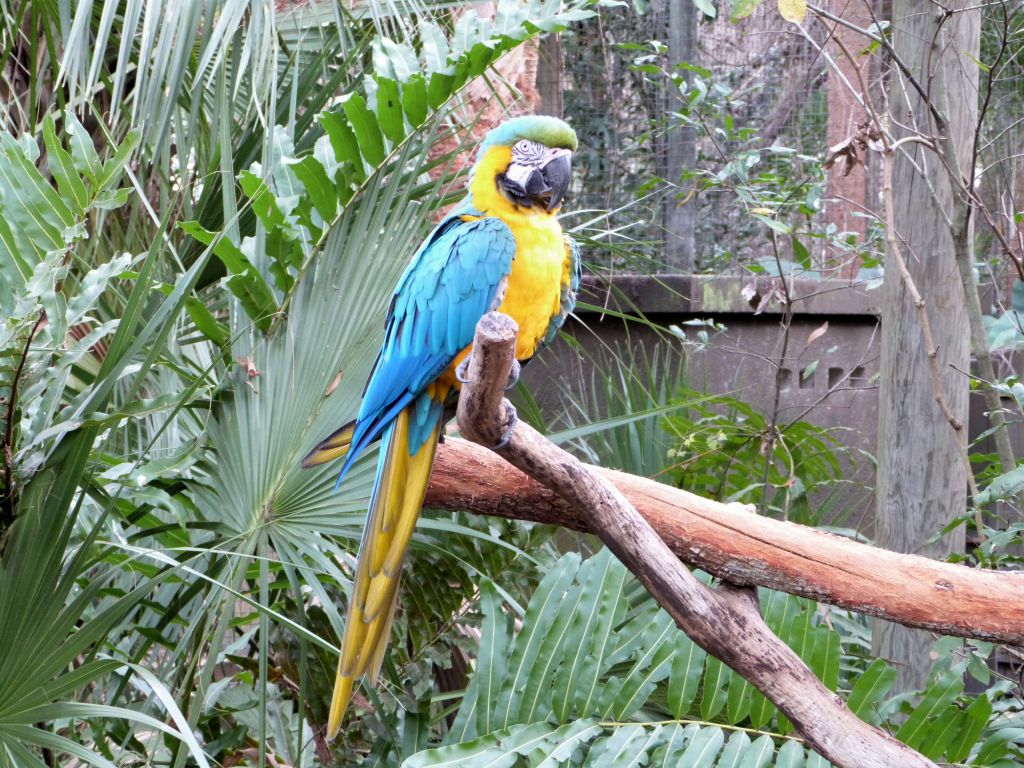
Or the gorgeous Blue-and-yellow Macaw?

Blue-and-yellow Macaw (Ara ararauna) at Brevard Zoo

Blue-and-yellow Macaw (Ara ararauna) at Brevard Zoo

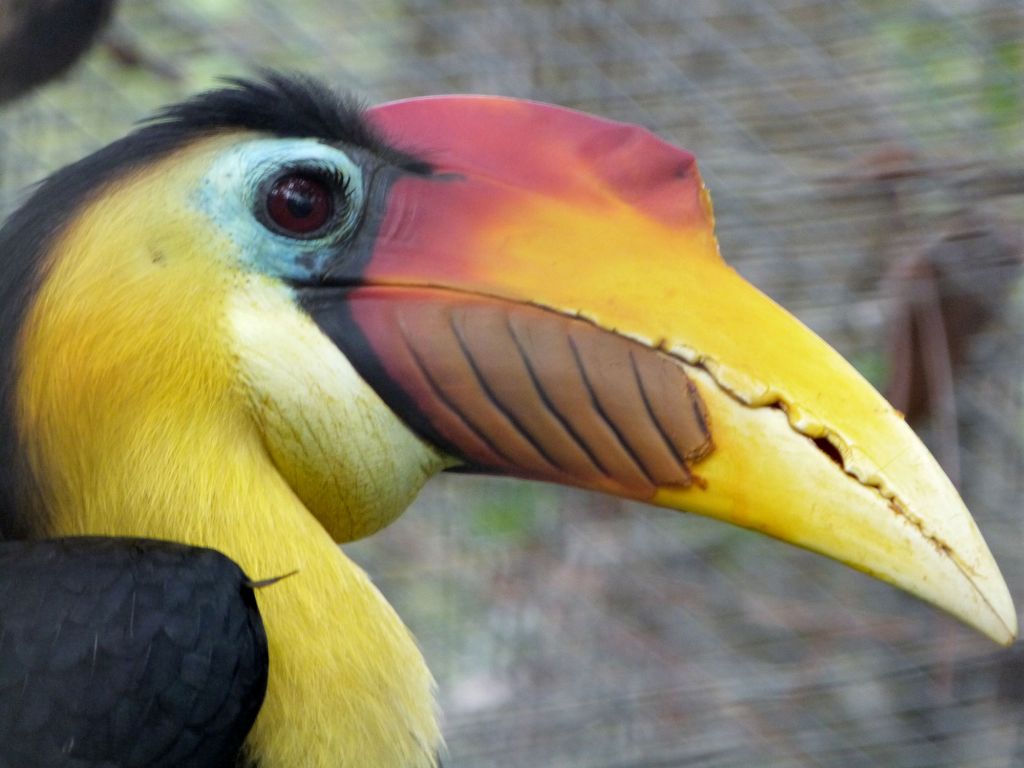
My favorite “painted” bird at the Brevard Zoo was this one:

Wrinkled Hornbill (Aceros corrugatus) Brevard Zoo by Lee

Wrinkled Hornbill (Aceros corrugatus) Brevard Zoo by Lee

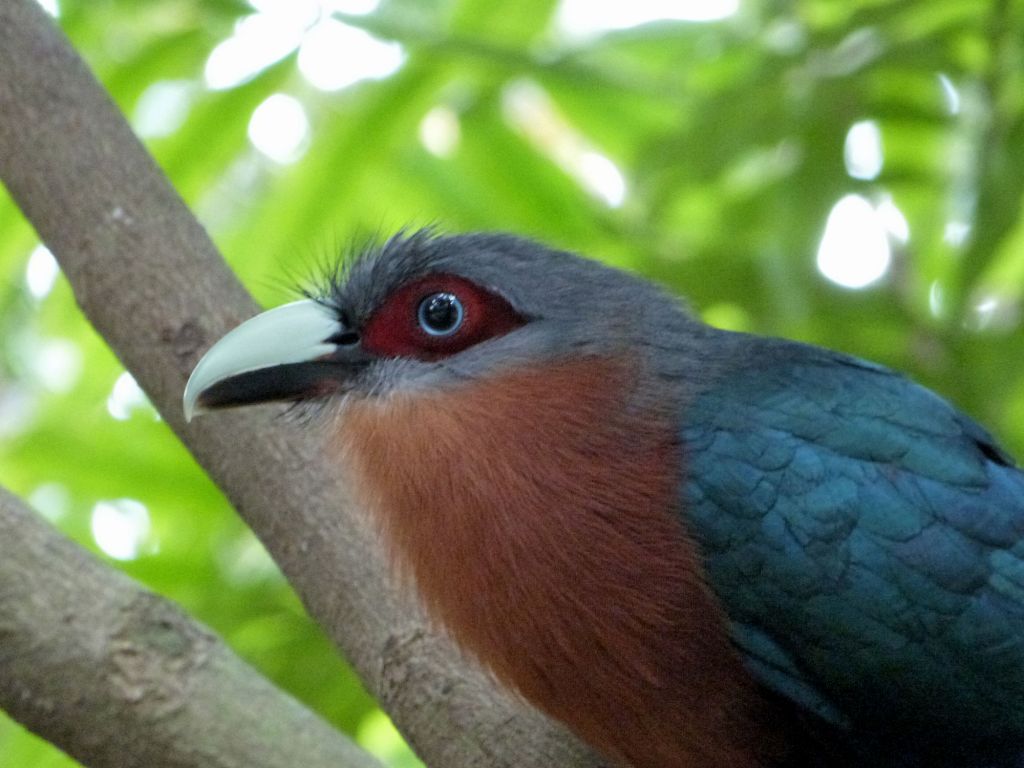
Wow!!! Down in Miami at the Wings of Asia aviary at Zoo Miami we were able to see these beautiful birds: The Chestnut-breasted Cuckoo

Chestnut-breasted Cuckoo (Cacomantis castaneiventris) Wings of Asia

Chestnut-breasted Cuckoo (Cacomantis castaneiventris) Wings of Asia

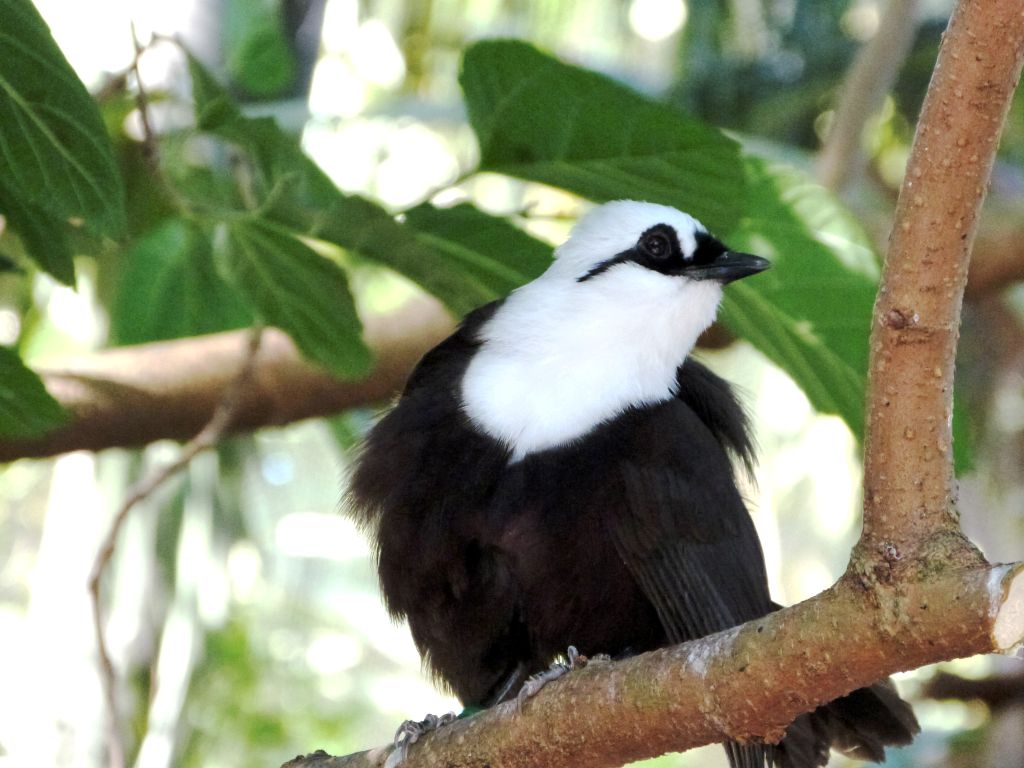
Or this cool bird which I call “Joe Cool.” Looks like the Lord painted sunglasses on it.

(Black and White) Sumatran Laughingthrush (Garrulax bicolor) by Lee

(Black and White) Sumatran Laughingthrush (Garrulax bicolor) by Lee

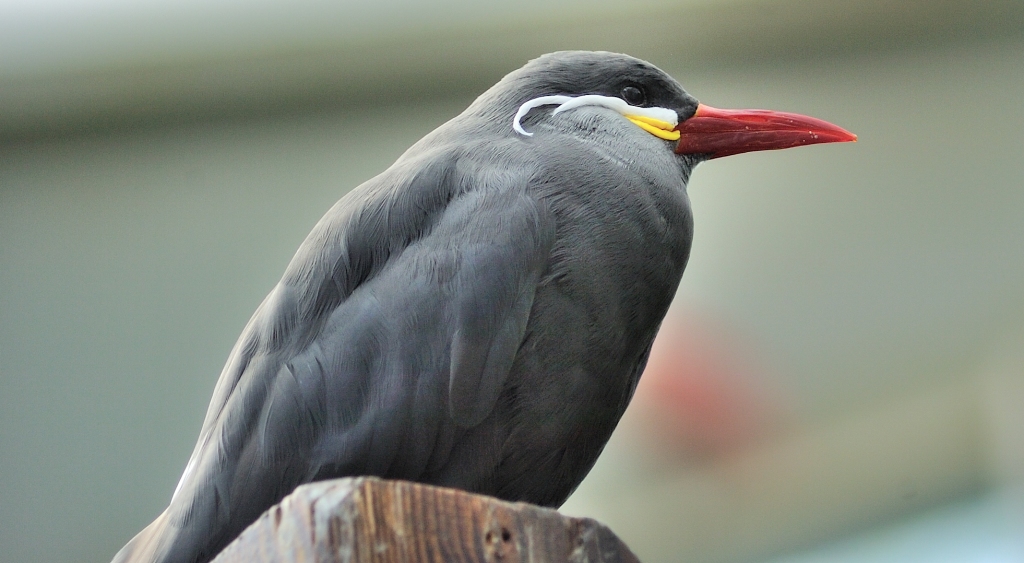
An Inca Tern seen at the National Aviary in Pittsburgh, PA:

Inca Tern by Dan at National Aviary

Inca Tern by Dan at National Aviary

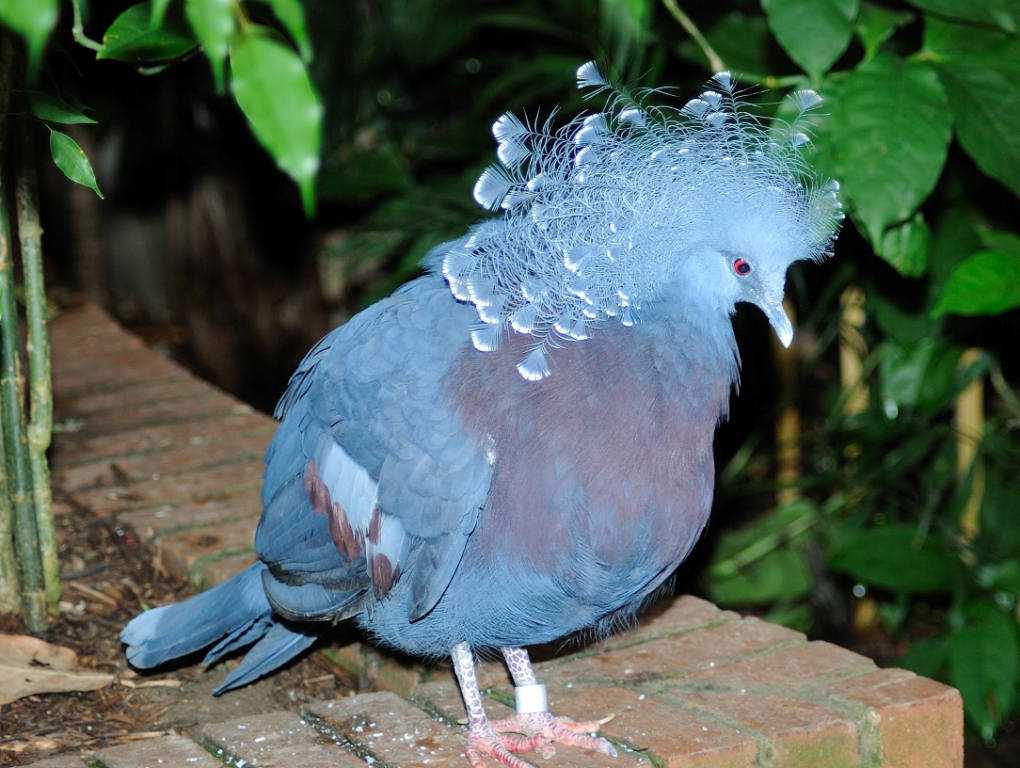
This Victorian-crowned Pigeon is at most of the zoos we have visited. They look like lace was placed on its head.

Victoria Crowned Pigeon by Dan at National Aviary

Victoria Crowned Pigeon by Dan at National Aviary

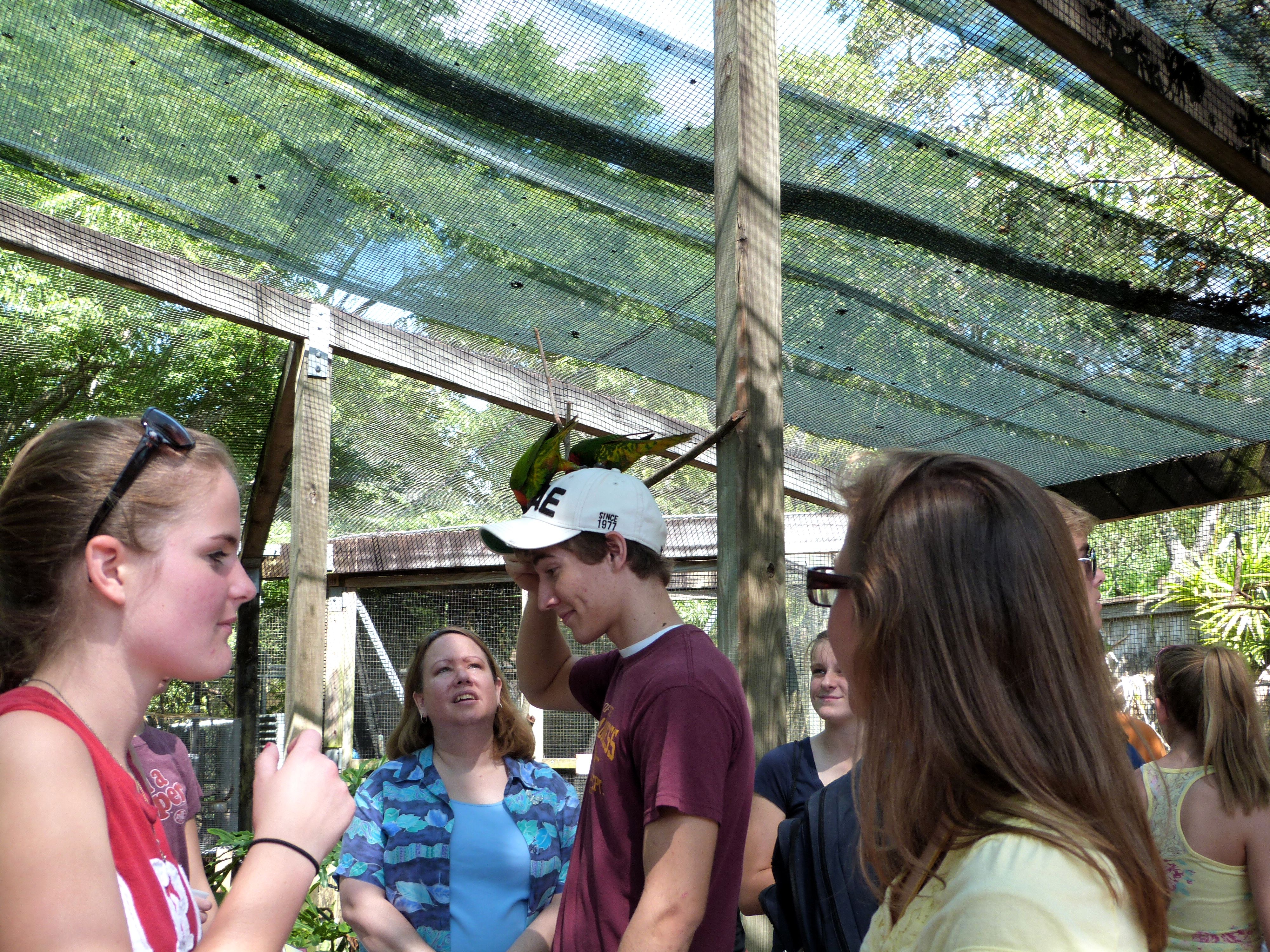
Back here locally to the Lowry Park Zoo in Tampa, there are many birds to enjoy. We met a group of our Homeschoolers over there on Friday and had the pleasure of introducing them to my avian friends there. They enjoyed all of them, but had the most fun feeding the beautiful Lorikeets.

Rainbow Lorikeets at Lowry Park Zoo

Rainbow Lorikeets at Lowry Park Zoo

Homeschoolers at Lowry Park Zoo

Homeschoolers at Lowry Park Zoo

Homeschoolers at Lowry Park Zoo

Homeschoolers at Lowry Park Zoo

Rainbow Lorikeet at Lowry Pk Zoo by Dan

Rainbow Lorikeet at Lowry Pk Zoo by Dan

There are many more that could be shown, but if you”Start Birdwatching Today” with a trip to a zoo or somewhere similiar, you might just be surprised by the beauty and magnificence of the birds. Then thank the Lord for His many blessings to us.

Oh, the depth of the riches both of the wisdom and knowledge of God! How unsearchable are His judgments and His ways past finding out! (Romans 11:33 NKJV)

See the whole “Start Birdwatching Today” series *

Birds Vol 1 #5 – The Prothonotary Yellow Warblers

Prothonotary Yellow Warblers Birds by Illustrated by Color Photography, 1897

Prothonotary Yellow Warblers Birds by Illustrated by Color Photography, 1897

Birds Illustrated by Color Photography – Revisited

Vol 1. May, 1897 No. 5

*

PROTHONOTARY YELLOW WARBLERS.

Quite a long name for such small birds—don’t you think so? You will have to get your teacher to repeat it several times, I fear, before you learn it.

These little yellow warblers are just as happy as the pair of wrens I showed you in April “Birds.” In fact, I suspect they are even happier, for their nest has been made and the eggs laid. What do you think of their house? Sometimes they find an old hole in a stump, one that a woodpecker has left, perhaps, and there build a nest. This year they have found a very pretty place to begin their housekeeping. What kind of tree is it? I thought I would show only the part of the tree that makes their home. I just believe some boy or girl who loves birds made those holes for them. Don’t you think so? They have an upstairs and a down stairs, it seems.

Like the Wrens I wrote about last month, they prefer to live in swampy land and along rivers. They nearly always find a hole in a decayed willow tree for their nest—low down. This isn’t a willow tree, though.

Whenever I show you a pair of birds, always pick out the father and the mother bird. You will usually find that one has more color than the other. Which one is it? Maybe you know why this is. If you don’t I am sure your teacher can tell you. Don’t you remember in the Bobolink family how differently Mr. and Mrs. Bobolink were dressed?

I think most of you will agree with me when I say this is one of the prettiest pictures you ever saw.

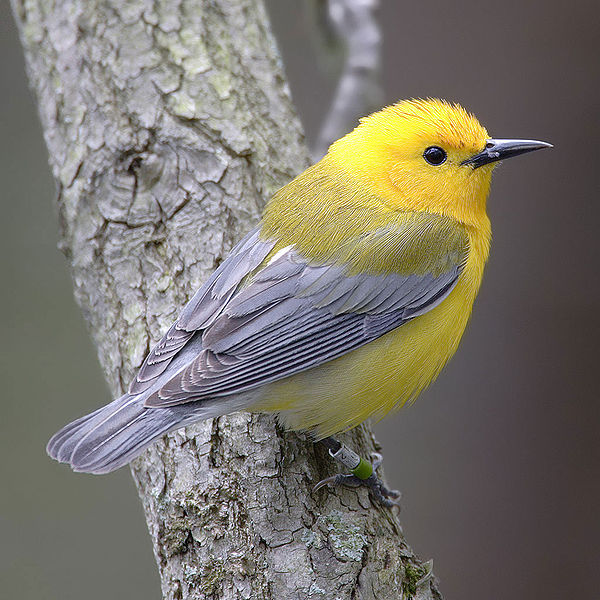
Prothonotary Warbler (Protonotaria citrea) ©WikiC

Prothonotary Warbler (Protonotaria citrea) ©WikiC

THE PROTHONOTARY, OR GOLDEN SWAMP WARBLER.

imgt

HE Golden Swamp Warbler is one of the very handsomest of American birds, being noted for the pureness and mellowness of its plumage. Baird notes that the habits of this beautiful and interesting warbler were formerly little known, its geographical distribution being somewhat irregular and over a narrow range. It is found in the West Indies and Central America as a migrant, and in the southern region of the United States. Further west the range widens, and it appears as far north as Kansas, Central Illinois, and Missouri.

Its favorite resorts are creeks and lagoons overshadowed by large trees, as well as the borders of sheets of water and the interiors of forests. It returns early in March to the Southern states, but to Kentucky not before the last of April, leaving in October. A single brood only is raised in a season.

A very pretty nest is sometimes built within a Woodpecker’s hole in a stump of a tree, not more than three feet high. Where this occurs the nest is not shaped round, but is made to conform to the irregular cavity of the stump. This cavity is deepest at one end, and the nest is closely packed with dried leaves, broken bits of grasses, stems, mosses, decayed wood, and other material, the upper part interwoven with fine roots, varying in size, but all strong, wiry, and slender, and lined with hair.

Other nests have been discovered which were circular in shape. In one instance the nest was built in a brace hole in a mill, where the birds could be watched closely as they carried in the materials. They were not alarmed by the presence of the observer but seemed quite tame.

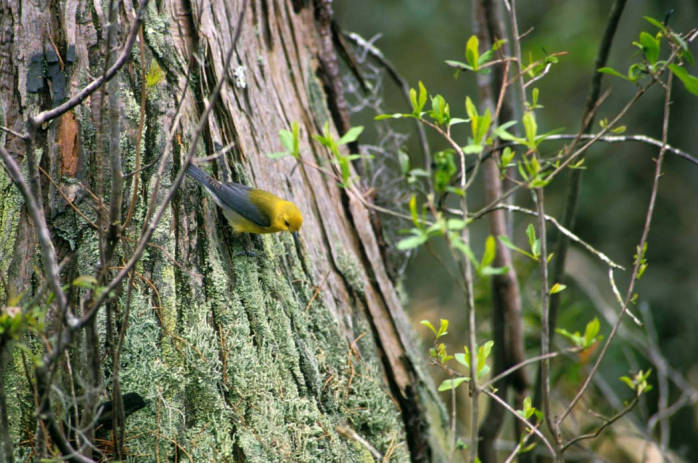
So far from being noisy and vociferous, Mr. Ridgway describes it as one of the most silent of all the warblers, while Mr. W. Brewster maintains that in restlessness few birds equal this species. Not a nook or corner of his domain but is repeatedly visited during the day. “Now he sings a few times from the top of some tall willow that leans out over the stream, sitting motionless among the marsh foliage, fully aware, perhaps, of the protection afforded by his harmonizing tints. The next moment he descends to the cool shadows beneath, where dark, coffee-colored waters, the overflow of a pond or river, stretch back among the trees. Here he loves to hop about the floating drift-wood, wet by the lapping of pulsating wavelets, now following up some long, inclining, half submerged log, peeping into every crevice and occasionally dragging forth from its concealment a spider or small beetle, turning alternately its bright yellow breast and olive back towards the light; now jetting his beautiful tail, or quivering his wings tremulously, he darts off into some thicket in response to a call from his mate; or, flying to a neighboring tree trunk, clings for a moment against the mossy hole to pipe his little strain, or look up the exact whereabouts of some suspected insect prize.”


Lee’s Addition:

Prothonotary Warbler (Protonotaria citrea) Neal Addy Gallery

Prothonotary Warbler (Protonotaria citrea) Neal Addy Gallery

By them the birds of the heavens have their home; They sing among the branches. (Psalms 104:12 NKJV)

Another one of the Lord’s neat little birds, the Prothonotary Warbler is a member of the Parulidae Family. The Prothonotary Warbler (Protonotaria citrea) is a small songbird of the New World warbler family. It is the only member of the genus Protonotaria. This bird was named after officials in the Roman Catholic Church known as the “protonotarii”, who wore golden robes. It was once known as the Golden Swamp Warbler.

The Prothonotary Warbler is 5.1 in/13 cm long and weighs 0.44 oz/12.5 g. It has an olive back with blue-grey wings and tail, yellow underparts, a relatively long pointed bill and black legs. The adult male has a bright orange-yellow head; females and immature birds are duller and have a yellow head. In flight from below, the short, wide tail has a distinctive two-toned pattern that is white at the base and dark at the tip.

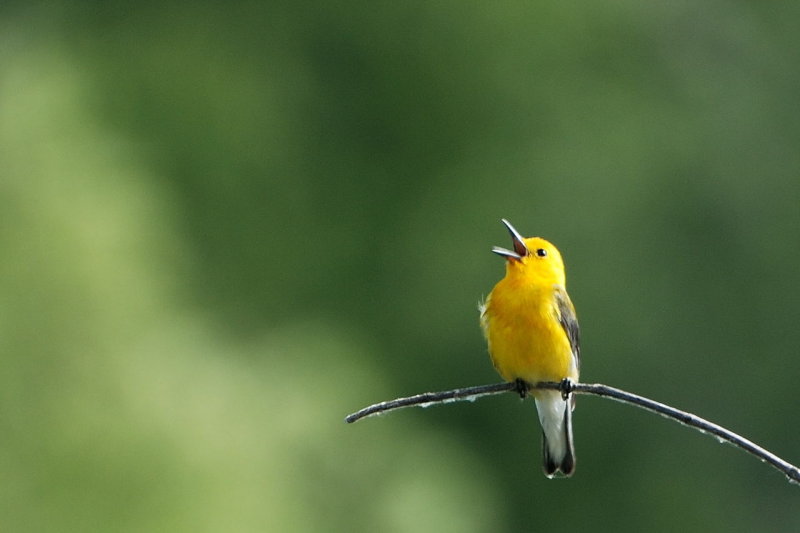
Prothonotary Warbler (Protonotaria citrea) ©USFWS

Prothonotary Warbler (Protonotaria citrea) ©USFWS

The preferred foraging habitat is dense, woody streams, where the Prothonotary Warbler forages actively in low foliage, mainly for Insects and snails. There are only two Warblers that make nest in tree cavities, this one and the Lucy’s Warbler. They like to use abandoned Woodpecker holes in or near water. They usually lay 3-7 eggs and only one clutch per year.

The song of this bird is a simple, loud, ringing sweet-sweet-sweet-sweet-sweet. The call is a loud, dry chip, like that of a Hooded Warbler. Its flight call is a loud seeep.

Sound of Pronthonotary Warbler song by xeno-canto.org

Birds Illustrated by Color Photograhy Vol 1 May, 1897 No 5 - Cover

Birds Illustrated by Color Photograhy Vol 1 May, 1897 No 5 – Cover

Birds Illustrated by Color Photography – Revisited – Introduction

The above article is the first article in the monthly serial that was started in January 1897 “designed to promote Knowledge of Bird-Live.” These include Color Photography, as they call them, today they are drawings. There are at least three Volumes that have been digitized by Project Gutenberg.

To see the whole series of – Birds Illustrated by Color Photography – Revisited

*

(Information from Wikipedia and other internet sources)

Next Article – The Indigo Bunting

Previous Article – The Scissor-Tailed Flycatcher

Links:

Prothonotary Warbler – All About Birds

Prothonotary Warbler – Wikipedia

The Parulidae Family

*


True Duck Story – From an e-Mail

I received this from a friend and it was too good not to share.
*****

This is a really neat story.

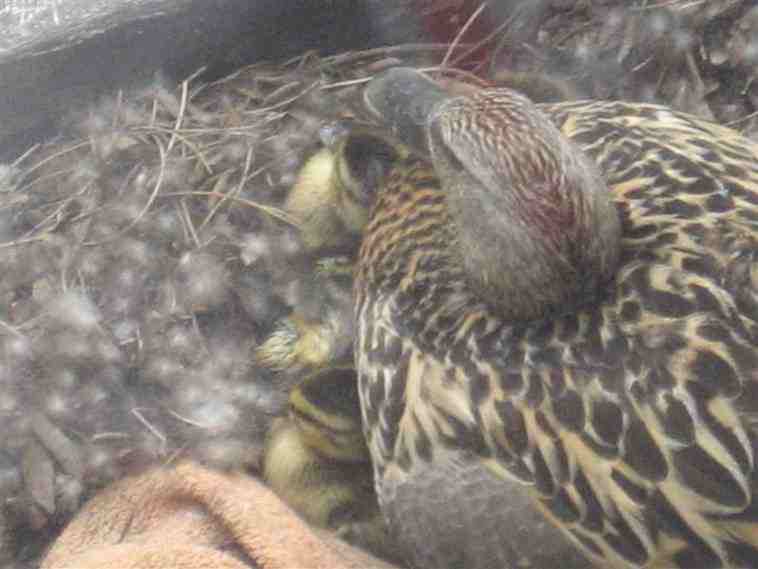
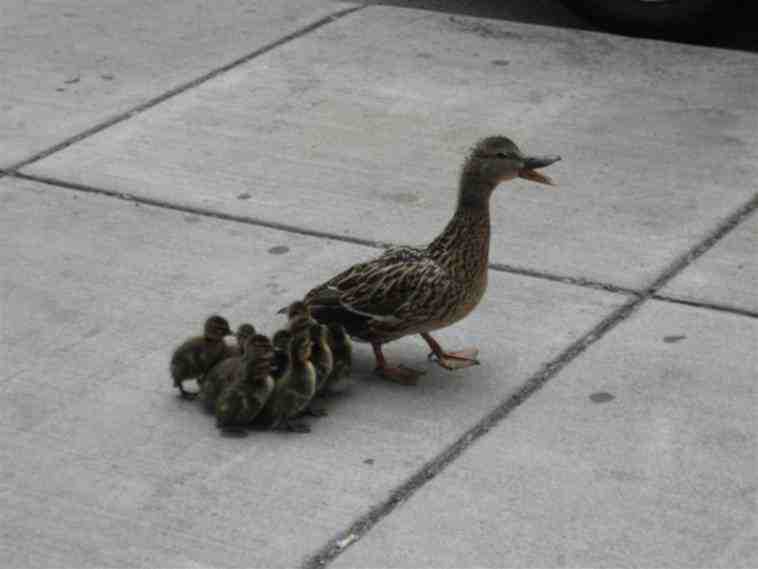
True duck story – San Antonio , Texas – Bravo something really cute happened this week. Michael R. Is an accounting clerk at Frost Bank and works there in a second story office. Several weeks ago, he watched a mother duck choose the concrete awning outside his window as the unlikely place to build a nest above the sidewalk. The mallard laid ten eggs in a nest in the corner of the planter that is perched over 10 feet in the air. She dutifully kept the eggs warm for weeks, and Monday afternoon all of her ten ducklings hatched.

Duck Story 1

Michael worried all night how the momma duck was going to get those babies safely off their perch in a busy, downtown, urban environment to take to water, which typically happens in the first 48 hours of a duck hatching. Tuesday morning, Michael watched the mother duck encourage her babies to the edge of the perch with the intent to show them how to jump off. Office work came to a standstill as everyone gathered to watch.

The mother flew down below and started quacking to her babies above. In disbelief Michael watched as the first fuzzy newborn trustingly toddled to the edge and astonishingly leapt into thin air, crashing onto the cement below. Michael couldn’t stand to watch this risky effort nine more times! He dashed out of his office and ran down the stairs to the sidewalk where the first obedient duckling, near its mother, was resting in a stupor after the near-fatal fall. Michael stood out of sight under the awning-planter, ready to help.

As the second one took the plunge, Michael jumped forward and caught it with his bare hands before it hit the concrete. Safe and sound, he set it down it by its momma and the other stunned sibling, still recovering from that painful leap. (The momma must have sensed that Michael was trying to help her babies.)

One by one the babies continued to jump.. Each time Michael hid under the awning just to reach out in the nick of time as the duckling made its free fall. At the scene the busy downtown sidewalk traffic came to a standstill. Time after time, Michael was able to catch the remaining eight and set them by their approving mother.

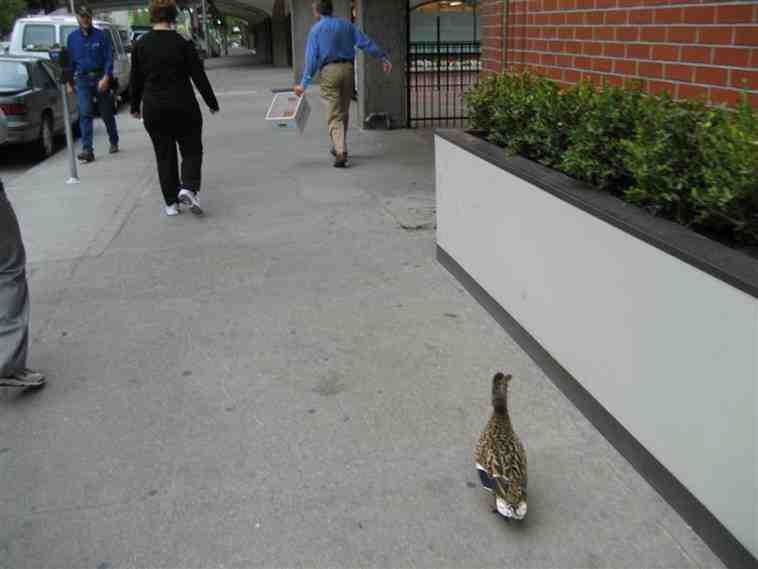
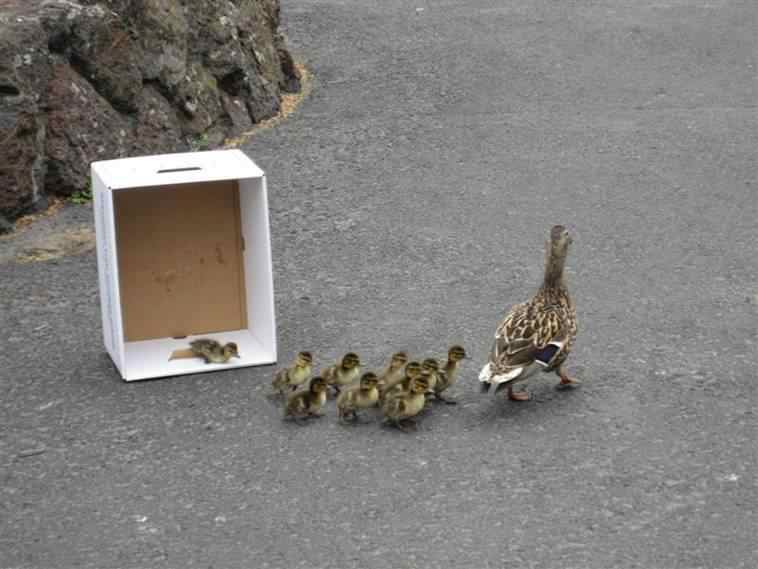
At this point Michael realized the duck family had only made part of its dangerous journey. They had two full blocks to walk across traffic, crosswalks, curbs and past pedestrians to get to the closest open water, the San Antonio River , site of the famed “River Walk.” The onlooking office secretaries and several San Antonio police officers joined in. An empty copy-paper box was brought to collect the babies. They carefully corralled them, with the mother’s approval, and loaded them in the container.. Michael held the box low enough for the mom to see her Brood. He then slowly navigated through the downtown streets toward the San Antonio River . The mother waddled behind and kept her babies in sight, all the way.

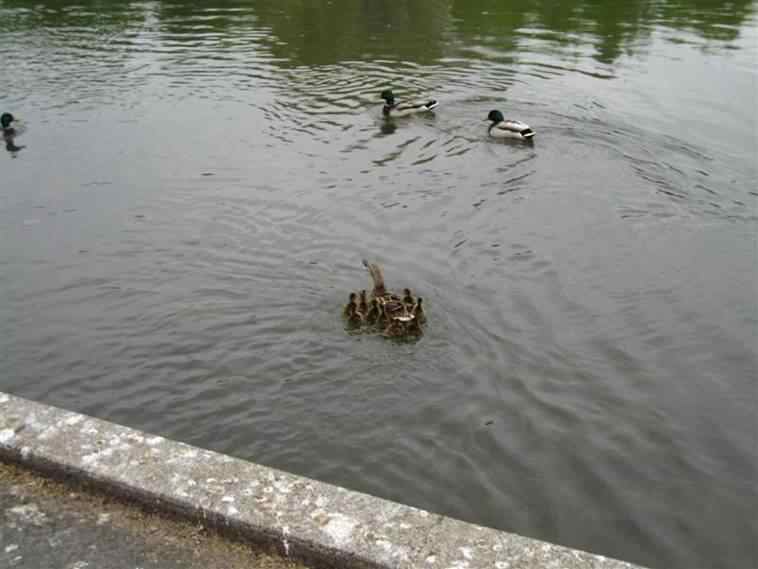
As they reached the river, the mother took over and passed him, jumping in the river and quacking loudly. At the water’s edge, Michael tipped the box and helped shepherd the babies toward the water and to the waiting mother after their adventurous ride.

All ten darling ducklings safely made it into the water and paddled up snugly to momma. Michael said the mom swam in circles, looking back toward the beaming bank bookkeeper, and proudly quacking.

At last, all present and accounted for: “We’re all together again. We’re here! We’re here!”

And here’s a family portrait before they head outward to further adventures….

Like all of us in the big times of our life, they never could have made it alone without lots of helping hands. I think it gives the name of San Antonio ‘s famous “River Walk” a whole new meaning! Maybe you will want to share this story with others. It’s too good to lose! Live honestly, Love generously, Care deeply, Speak kindly & Leave the rest to God.

Birds Vol 1 #5 – The Scissor-tailed Flycatcher

Scissor-tailed Flycatcher Birds Illustrated by Color Photography, 1897

Scissor-tailed Flycatcher Birds Illustrated by Color Photography, 1897

Birds Illustrated by Color Photography – Revisited

Vol 1. May, 1897 No. 5

*

THE SCISSOR-TAILED FLYCATCHER.

F for Birds Illustrated by Color Photography

LYCATCHERS are all interesting, and many of them are beautiful, but the Scissor-tailed species of Texas is especially attractive. They are also known as the Swallow-tailed Flycatcher, and more frequently as the “Texan Bird of Paradise.” It is a common summer resident throughout the greater portion of that state and the Indian Territory, and its breeding range extends northward into Southern Kansas. Occasionally it is found in southwestern Missouri, western Arkansas, and Illinois. It is accidental in the New England states, the Northwest Territory, and Canada. It arrives about the middle of March and returns to its winter home in Central America in October. Some of the birds remain in the vicinity of Galveston throughout the year, moving about in small flocks.

There is no denying that the gracefulness of the Scissor-tailed Flycatcher should well entitle him to the admiration of bird-lovers, and he is certain to be noticed wherever he goes. The long outer tail feathers he can open and close at will. His appearance is most pleasing to the eye when fluttering slowly from tree to tree on the rather open prairie, uttering his twittering notes, “Spee-spee.” When chasing each other in play or anger these birds have a harsh note like “Thish-thish,” not altogether agreeable. Extensive timber land is shunned by this Flycatcher, as it prefers more open country, though it is often seen in the edges of woods. It is not often seen on the ground, where its movements are rather awkward. Its amiability and social disposition are observed in the fact that several pairs will breed close to each other in perfect harmony. Birds smaller than itself are rarely molested by it, but it boldly attacks birds of prey. It is a restless bird, constantly on the lookout for passing insects, nearly all of which are caught on the wing and carried to a perch to be eaten. It eats moths, butterflies, beetles, grasshoppers, locusts, cotton worms, and, to some extent, berries. Its usefulness cannot be doubted. According to Major Bendire, these charming creatures seem to be steadily increasing in numbers, being far more common in many parts of Texas, where they are a matter of pride with the people, than they were twenty years ago.

The Scissor-tails begin housekeeping some time after their arrival from Central America, courting and love making occupying much time before the nest is built. They are not hard to please in the selection of a suitable nesting place, almost any tree standing alone being selected rather than a secluded situation. The nest is bulky, commonly resting on an exposed limb, and is made of any material that may be at hand. They nest in oaks, mesquite, honey locust, mulberry, pecan, and magnolia trees, as well as in small thorny shrubs, from five to forty feet from the ground. Rarely molested they become quite tame. Two broods are often raised. The eggs are usually five. They are hatched by the female in twelve days, while the male protects the nest from suspicious intruders. The young are fed entirely on insects and are able to leave the nest in two weeks. The eggs are clear white, with markings of brown, purple, and lavender spots and blotches.

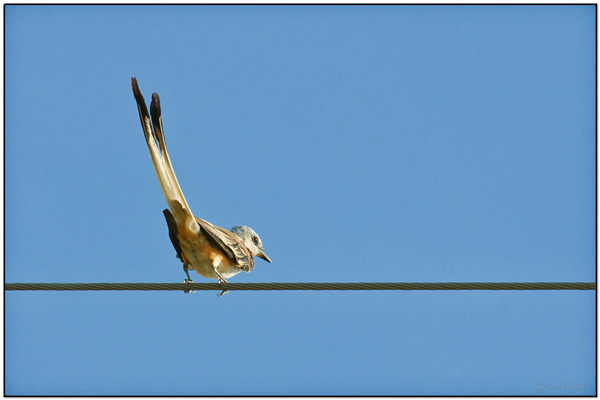
Scissor-tailed Flycatcher (Tyrannus forficatus) by Daves BirdingPix

Scissor-tailed Flycatcher (Tyrannus forficatus) by Daves BirdingPix


Lee’s Addition:

I know all the birds of the mountains, And the wild beasts of the field are Mine. (Psalms 50:11 NKJV)

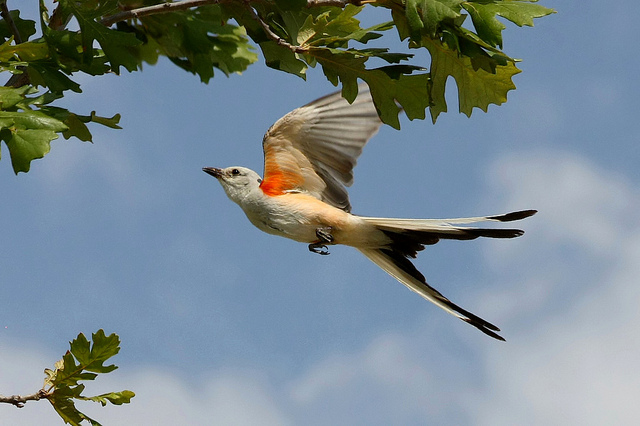
The Lord has given us another beautiful bird to enjoy. The Scissor-tailed Flycatchers are in the Tyrant Flycatchers – Tyrannidae Family. Adult birds have pale gray heads and upper parts, light underparts, salmon-pink flanks, and dark gray wings. Their extremely long, forked tails, which are black on top and white on the underside, are characteristic and unmistakable. At maturity, the bird may be up to 14.5 inches (37 cm) in length. Immature birds are duller in color and have shorter tails. A lot of these birds have been reported to be more than 40 cm.

They build a cup nest in isolated trees or shrubs, sometimes using artificial sites such as telephone poles near towns. The male performs a spectacular aerial display during courtship with his long tail forks streaming out behind him. Both parents feed the young. Like other kingbirds, they are very aggressive in defending their nest. Clutches contain three to six eggs.

Scissor-tailed Flycatcher (Tyrannus forficatus) ©TexasEagle

Scissor-tailed Flycatcher (Tyrannus forficatus) ©TexasEagle

In the summer, Scissor-tailed flycatchers feed mainly on insects (grasshoppers, robber-flies, and dragonflies), which they may catch by waiting on a perch and then flying out to catch them in flight (hawking). For additional food in the winter they will also eat some berries.

Since the article was written they are increased their range. Their breeding habitat is open shrubby country with scattered trees in the south-central states of Texas, Oklahoma, Kansas; western portions of Louisiana, Arkansas, and Missouri; far eastern New Mexico; and northeastern Mexico. Reported sightings record occasional stray visitors as far north as southern Canada and as far east as Florida and Georgia. They migrate through the Gulf states of Mexico to their winter non-breeding range, from southern Mexico to Panama. Pre-migratory roosts and flocks flying south may contain as many as 1,000 birds.

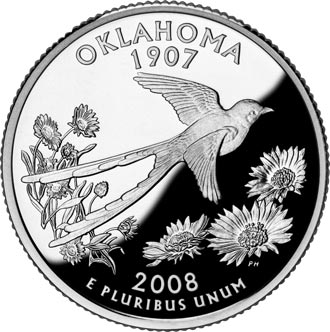
Scissor-tailed Flycatcher - Oklahoma-quarter

Scissor-tailed Flycatcher – Oklahoma-quarter

The scissor-tailed flycatcher is the state bird of Oklahoma, and is displayed in flight with tail feathers spread on the reverse of the Oklahoma Commemorative Quarter.

There are actually four Scissor-tailed named birds in the world:

Scissor-tailed Flycatcher
Scissor-tailed Hummingbird
Scissor-tailed Kite
Scissor-tailed Nightjar

Birds Illustrated by Color Photograhy Vol 1 May, 1897 No 5 - Cover

Birds Illustrated by Color Photograhy Vol 1 May, 1897 No 5 – Cover

Birds Illustrated by Color Photography – Revisited – Introduction

The above article is the first article in the monthly serial that was started in January 1897 “designed to promote Knowledge of Bird-Live.” These include Color Photography, as they call them, today they are drawings. There are at least three Volumes that have been digitized by Project Gutenberg.

To see the whole series of – Birds Illustrated by Color Photography – Revisited

*

(Information from Wikipedia and other internet sources)

Next Article – The Prothonotary Yellow Warblers

Previous Article – The Black-Capped Chickadee

Gospel Message

Links:

Birds of Oklahoma Plus

Scissor-tailed Flycatcher – All About Birds

Scissor-tailed Flycatcher – Wikipedia

Tyrant Flycatchers – Tyrannidae Family

*

Birds Vol 1 #5 – The Black-capped Chickadee

Chickadee by.Birds Illustrated by Color Photography, 1897

Chickadee by.Birds Illustrated by Color Photography, 1897

Birds Illustrated by Color Photography – Revisited

Vol 1. May, 1897 No. 5

*

CHICKADEE.

Bird of the Merry Heart.Here is a picture of a bird that is always merry. He is a bold, saucy little fellow, too, but we all love him for it. Don’t you think he looks some like the Canada Jay that you saw in April “Birds?” I think most of you must have seen him, for he stays with us all the year, summer and winter. If you ever heard him, you surely noticed how plainly he tells you his name. Listen—“Chick-a-dee-dee; Chick-a-dee; Hear, hear me”—That’s what he says as he hops about from twig to twig in search of insects’ eggs and other bits for food. No matter how bitter the wind or how deep the snow, he is always around—the same jolly, careless little fellow, chirping and twittering his notes of good cheer.

Like the Yellow Warblers, Chickadees like best to make their home in an old stump or hole in a tree—not very high from the ground. Sometimes they dig for themselves a new hole, but this is only when they cannot find one that suits them. The Chickadee is also called Black-capped Titmouse. If you look at his picture you will see his black cap. You’ll have to ask someone why he is called Titmouse. I think Chickadee is the prettier name, don’t you? If you want to get well acquainted with this saucy little bird, you want to watch for him next winter, when most of the birds have gone south. Throw him crumbs of bread and he will soon be so tame as to come right up to the door step.

THE BLACK-CAPPED CHICKADEE.

“Chic-chickadee dee!” I saucily say; My heart it is sound, my throat it is gay! Every one that I meet I merrily greet With a chickadee dee, chickadee dee! To cheer and to cherish, on roadside and street, My cap was made jaunty, my note was made sweet.

Chickadeedee, Chickadeedee! No bird of the winter so merry and free; Yet sad is my heart, though my song one of glee, For my mate ne’er shall hear my chickadeedee.

I “chickadeedee” in forest and glade, “Day, day, day!” to the sweet country maid; From autumn to spring time I utter my song Of chickadeedee all the day long! The silence of winter my note breaks in twain, And I “chickadeedee” in sunshine and rain.

Chickadeedee Chickadeedee! No bird of the winter so merry and free; Yet sad is my heart, though my song one of glee, For my mate ne’er shall hear my chickadeedee.—C. C. M.

imga1

SAUCY little bird, so active and familiar, the Black-Capped Chickadee, is also recognized as the Black Capped Titmouse, Eastern Chickadee, and Northern Chickadee. He is found in the southern half of the eastern United States, north to or beyond forty degrees, west to eastern Texas and Indian Territory. The favorite resorts of the Chickadee are timbered districts, especially in the bottom lands, and where there are red bud trees, in the soft wood of which it excavates with ease a hollow for its nest. It is often wise enough, however, to select a cavity already made, as the deserted hole of the Downy Woodpecker, a knot hole, or a hollow fence rail.

In the winter season it is very familiar, and is seen about door yards and orchards, even in towns, gleaning its food from the kitchen remnants, where the table cloth is shaken, and wherever it may chance to find a kindly hospitality. In an article on “Birds as Protectors of Orchards,” Mr. E. H. Forbush says of the Chickadee: “There is no bird that compares with it in destroying the female canker-worm moths and their eggs.” He calculated that one Chickadee in one day would destroy 5,550 eggs, and in the twenty-five days in which the canker-worm moths run or crawl up the trees 138,750 eggs. Mr. Forbush attracted Chickadees to one orchard by feeding them in winter, and he says that in the following summer it was noticed that while trees in neighboring orchards were seriously damaged by canker-worms, and to a less degree by tent caterpillars, those in the orchard which had been frequented by the Chickadee during the winter and spring were not seriously infested, and that comparatively few of the worms and caterpillars were to be found there. His conclusion is that birds that eat eggs of insects are of the greatest value to the farmer, as they feed almost entirely on injurious insects and their eggs, and are present all winter, where other birds are absent.

The tiny nest of the Chickadee is made of all sorts of soft materials, such as wool, fur, feathers, and hair placed in holes in stumps of trees. Six to eight eggs are laid, which are white, thickly sprinkled with warm brown. Mrs. Osgood Wright tells a pretty incident of the Chickadees, thus: “In the winter of 1891-2, when the cold was severe, the snow deep, and the tree trunks often covered with ice, the Chickadees repaired in flocks daily to the kennel of our old dog Colin and fed from his dish, hopping over his back and calling Chickadee, dee, dee, in his face, a proceeding that he never in the least resented, but seemed rather to enjoy it.”

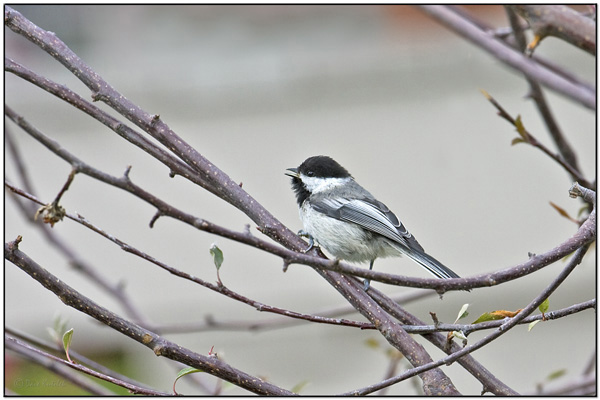
Black-capped Chickadee (Poecile atricapillus) by Kent Nickell

Black-capped Chickadee (Poecile atricapillus) by Kent Nickell


Lee’s Addition:

A merry heart makes a cheerful countenance, But by sorrow of the heart the spirit is broken. The heart of him who has understanding seeks knowledge, But the mouth of fools feeds on foolishness. All the days of the afflicted are evil, But he who is of a merry heart has a continual feast. Better is a little with the fear of the LORD, Than great treasure with trouble. (Proverbs 15:13-16 NKJV)

The Black-capped Chickadee (Poecile atricapillus) is a small, North American songbird, a passerine bird in the Tit, Chickadee – Paridae Family. It is the state bird of both Maine and Massachusetts in the United States, and the provincial bird of New Brunswick in Canada. It is notable for its capacity to lower its body temperature during cold winter nights, its good spatial memory to relocate the caches where it stores food, and its boldness near humans (they can feed from the hand).

On cold winter nights, these birds reduce their body temperature by up to 10–12 °C (from their normal temperature of about 42 °C) to conserve energy.[8] Such a capacity for torpor is rare in birds (or at least, rarely studied). Other bird species capable of torpor include the Common Swift Apus apus, the Common Poor-will Phalaenoptilus nuttallii, the Lesser Nighthawk Chordeiles acutipennis, and various species of hummingbirds.

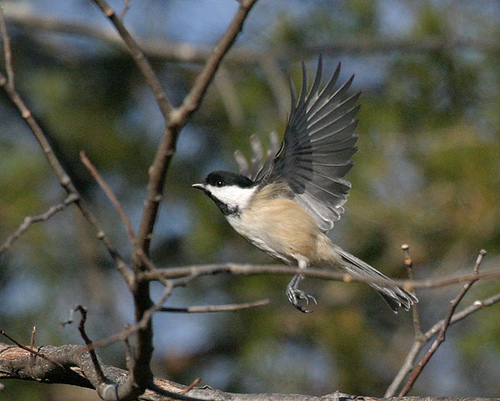
Black-capped Chickadee by Dave's BirdingPix

Black-capped Chickadee by Dave’s BirdingPix

The Black-capped Chickadee has a black cap and bib with white sides to the face. Its underparts are white with rusty brown on the flanks. Its back is gray and the tail is normally slate-gray. This bird has a short dark bill (8.0-9.5 mm), short rounded wings (63.5-67.5 mm) and a long tail (58–63 mm). Total body length is 12–15 cm (4.7–5.9 in), wingspan is 16–21 cm (6.3–8.3 in) and body mass is 9–14 g (0.32–0.49 oz). Sexes look alike, but males are slightly larger and longer than females.

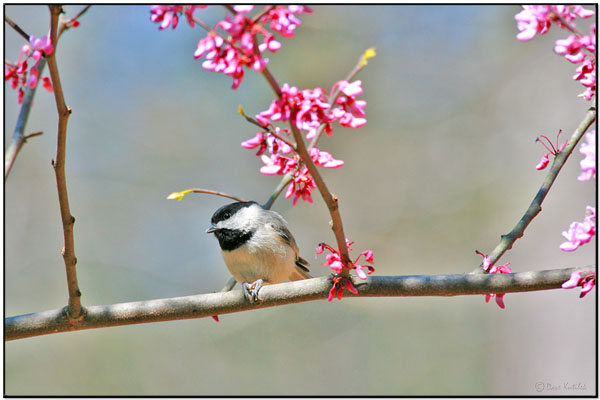
Although range can generally be used to separate them, the Black-capped Chickadee is very similar in appearance to the Carolina Chickadee. The Black-capped is larger on average but this cannot be used reliably for identification. The most obvious difference between the two is in the wing feathers. In the Black-capped Chickadee, the wing feathers have white edges that are larger and more conspicuous than those of the Carolina Chickadee.

Carolina Chickadee (Poecile carolinensis) by Daves BirdingPix

Carolina Chickadee (Poecile carolinensis) by Daves BirdingPix

A merry heart does good, like medicine, But a broken spirit dries the bones. (Proverbs 17:22 NKJV)

*

Birds Illustrated by Color Photograhy Vol 1 May, 1897 No 5 - Cover

Birds Illustrated by Color Photograhy Vol 1 May, 1897 No 5 – Cover

Birds Illustrated by Color Photography – Revisited – Introduction

The above article is the first article in the monthly serial that was started in January 1897 “designed to promote Knowledge of Bird-Live.” These include Color Photography, as they call them, today they are drawings. There are at least three Volumes that have been digitized by Project Gutenberg.

To see the whole series of – Birds Illustrated by Color Photography – Revisited

*

(Information from Wikipedia and other internet sources)

Next Article – The Scissor-Tailed Flycatcher

Previous Article – The Marsh Hawk

Links:

Black-capped Chickadee All About Birds

All About Black-capped Chickadee – Sialis

Black-capped Chickadee – National Geographic

Tit, Chickadee – Paridae Family

Black-capped Chickadee – Wikipedia

*


Start Birdwatching Today: Enjoy The Lord’s Paintbrush – U.S.

Wood Duck by Dan at Lake Hollingsworth

Wood Duck by Dan at Lake Hollingsworth

I trust you are enjoying our “Start Birdwatching Today!” series. We have been trying to motivate you to go out and observe the many birds around you.

Seeing as our subtitle is “Birdwatching from a Christian Perspective,” I want to do a few articles that you won’t see in most birding books. We believe that the world and all that its critters were created by the Lord and not evolved.

For thus says the Lord–Who created the heavens, God Himself, Who formed the earth and made it, Who established it and did not create it to be a worthless waste; He formed it to be inhabited–I am the Lord, and there is no one else. (Isaiah 45:18 AMP)
O LORD, how manifold are Your works! In wisdom You have made them all. The earth is full of Your possessions—
(Psalms 104:24 NKJV)
Have you not known? Have you not heard? The everlasting God, the LORD, The Creator of the ends of the earth, Neither faints nor is weary. His understanding is unsearchable. (Isaiah 40:28 NKJV)

While creating the birds, the Lord has used a fantastic array of colors and designs. I can imagine Him using a fine brush when some of my favorite birds here in America were being dressed for “His pleasure.”

Look at this Blue Jay, seen in most parts of our country or his cousins out west. Can’t you just imagine a painter or artist putting the colors and marks on him?

Blue Jay (Cyanocitta cristata) by Daves BirdingPix

Blue Jay (Cyanocitta cristata) by Daves BirdingPix

His cousin the Green Jay from down in the valley of Texas.

Green Jay (Cyanocorax luxuosus) by S Slayton

Green Jay (Cyanocorax luxuosus) by S Slayton

Or, how about a Painted Bunting that looks like He just took a little dab of this and a little dab of that?

Painted Bunting (Passerina ciris) ©©Flickr

Painted Bunting (Passerina ciris) ©©Flickr

The Northern Flicker

Northern Flicker (Colaptes auratus) Red-shafted ©WikiC

Northern Flicker (Colaptes auratus) Red-shafted ©WikiC

and its cousin the Acorn Woodpecker.

Acorn Woodpecker (Melanerpes formicivorus) (3) by Raymond Barlow

Acorn Woodpecker (Melanerpes formicivorus) (3) by Raymond Barlow

Tiny birds that have iridescent colors like our Hummingbirds just glisten when the light shines on them the right way. Our eastern Ruby-throated Hummingbird

Ruby-throated Hummingbird by Ray's Wildlife

Ruby-throated Hummingbird by Ray’s Wildlife

and the western Magnificent Hummingbird.

Magnificent Hummingbird (Eugenes fulgens) by Judd Patterson

Magnificent Hummingbird (Eugenes fulgens) by Judd Patterson

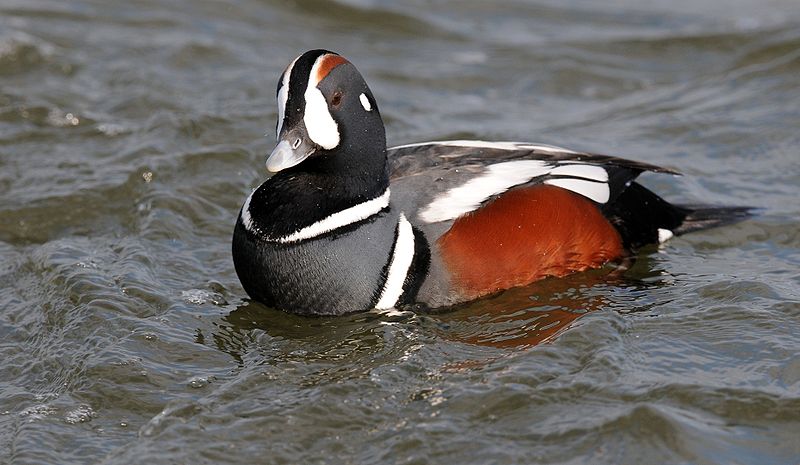
Do you see a designer and a painter at work? My favorite one of all is the Wood Duck at the top. Dan took that at Lake Morton in Lakeland. (It really is a live duck, not a painting.)  Those fine lines are just awesome to me. They actually have a cousin that hangs out more on the western side of America. It is the Harlequin Duck.

Harlequin Duck (Histrionicus histrionicus) ©WikiC

Harlequin Duck (Histrionicus histrionicus) ©WikiC

There are many more that could be shown, but if you”Start Birdwatching Today” they may just pass by for you to take a look. Then thank the Lord for His many blessings to us.

Oh, the depth of the riches both of the wisdom and knowledge of God! How unsearchable are His judgments and His ways past finding out! (Romans 11:33 NKJV)

See the whole “Start Birdwatching Today” series

*

Birds in Hymns – Pleasant Are Thy Courts Above

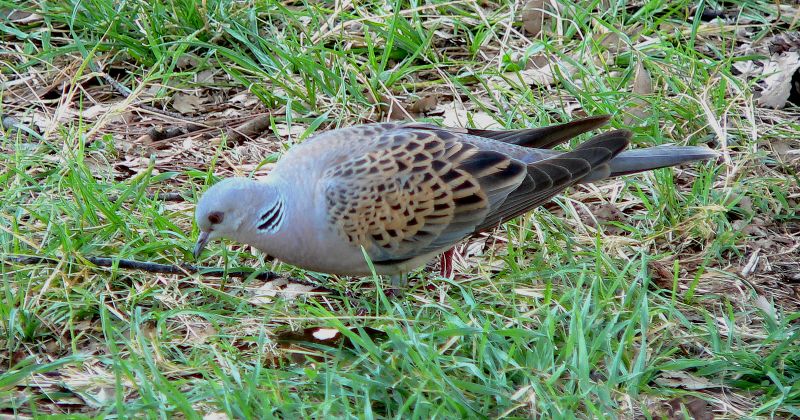
European Turtle Dove (Streptopelia turtur) ©WikiC

European Turtle Dove (Streptopelia turtur) ©WikiC

For a day in thy courts is better than a thousand. I had rather be a doorkeeper in the house of my God, than to dwell in the tents of wickedness. (Psalms 84:10 KJV)

Words – Hen­ry F. Lyte, 1834

Music – Ben­e­ven­to, ar­ranged from Sam­u­el Webbe, Sr.,  (1740-1816), 1792

Al­ter­nate tune:  Maid­stone, Wal­ter B. Gil­bert, 1863


Pleasant Are Thy Courts Above

Ben­e­ven­to

Maid­stone

Pleasant are Thy courts above,
In the land of light and love;
Pleasant are Thy courts below
In this land of sin and woe;
O, my spirit longs and faints
For the converse of Thy saints,
For the brightness of Thy face,
For Thy fullness, God of grace.

Happy birds that sing and fly
Round Thy altars, O most High;
Happier souls that find a rest
In a heavenly Father’s breast;
Like the wandering dove that found
No repose on earth around,
They can to their ark repair,
And enjoy it ever there.

Happy souls, their praises flow
Even in this vale of woe;
Waters in the desert rise,
Manna feeds them from the skies;
On they go from strength to strength,
Till they reach Thy throne at length,
At Thy feet adoring fall,
Who hast led them safe through all.

Lord, be mine this prize to win,
Guide me through a world of sin,
Keep me by Thy saving grace,
Give me at Thy side a place;
Sun and shield alike Thou art,
Guide and guard my erring heart.
Grace and glory flow from Thee;
Shower, O shower them, Lord, on me.

*

Wordless Birds

Song Sparrow (Melospiza melodia) by Ray

Song Sparrow

*

Birds Vol 1 #5 – Marsh Hawk

Marsh Hawk for Birds Illustrated by Color Photography, 1897

Marsh Hawk for Birds Illustrated by Color Photography, 1897

Birds Illustrated by Color Photography – Revisited

Vol 1. May, 1897 No. 5

*

THE MARSH HAWK.

imgo

NE of the most widely distributed birds of North America is the Marsh Hawk, according to Wilson, breeding from the fur regions around Hudson’s Bay to Texas, and from Nova Scotia to Oregon and California. Excepting in the Southern portion of the United States, it is abundant everywhere. It makes its appearance in the fur countries about the opening of the rivers, and leaves about the beginning of November. Small birds, mice, fish, worms, and even snakes, constitute its food, without much discrimination. It is very expert in catching small green lizards, animals that can easily evade the quickest vision.

It is very slow on the wing, flies very low, and in a manner different from all others of the hawk family. Flying near the surface of the water, just above the weeds and canes, the Marsh Hawk rounds its untiring circles hour after hour, darting after small birds as they rise from cover. Their never ending flight, graceful as it is, becomes monotonous to the watcher. Pressed by hunger, they attack even wild ducks.

In New Jersey, Pennsylvania, and Delaware, where it sweeps over the low lands, sailing near the earth, in search of a kind of mouse very common in such situations, it is chiefly known as the Mouse Hawk. In the southern rice fields it is useful in preventing to some extent the ravages of the swarms of Bobolinks. It has been stated that one Marsh Hawk was considered by planters equal to several negroes for alarming the rice birds. This Hawk when feeding is readily approached.

The birds nest in low lands near the sea shore, in the barrens, and on the clear table-lands of the Alleghanies, and once a nest was found in a high covered pine barrens of Florida.

The Marsh Hawks always keep together after pairing, working jointly in building the nest, in sitting upon the eggs, and in feeding the young. The nest is clumsily made of hay, occasionally lined with feathers, pine needles, and small twigs. It is built on the ground, and contains from three to five eggs of a bluish white color, usually more or less marked with purplish brown blotches. Early May is their breeding time.

It will be observed that even the Hawk, rapacious as he undoubtedly is, is a useful bird. Sent for the purpose of keeping the small birds in bounds, he performs his task well, though it may seem to man harsh and tyranical. The Marsh Hawk is an ornament to our rural scenery, and a pleasing sight as he darts silently past in the shadows of falling night.

Hen (Northern) Harrier (Circus cyaneus) by J Fenton

Hen (Northern) Harrier (Circus cyaneus) by J Fenton


Lee’s Addition:

Is it by your wisdom [Job] that the hawk soars and stretches her wings toward the south [as winter approaches]? (Job 39:26 AMP)

“Hawks are one of our Birds of the Bible and belongs to the Kites, Hawk & Eagles – Accipitridae Family. The Marsh Hawk today is know as the Hen Harrier (Circus cyaneus). Most know it as the Northern Harrier or Marsh Hawk. It migrates to more southerly areas in winter. Eurasian birds move to southern Europe and southern temperate Asia, and American breeders to the southernmost USA, Mexico, and Central America. In the mildest regions, such as France, Great Britain, and the southern US, Hen Harriers may be present all year, but the higher ground is largely deserted in winter.

C. c. hudsonius (Linnaeus, 1766), the Northern Harrier, breeds in North America and is sometimes considered a distinct species C. hudsonius. The male’s plumage is darker grey than that of C. c. cyaneus and the female is also darker and more rufous in colour.” (Wikipedia places it with the Hen Harrier)(*Update*) The IOC 3.1 shows the Hen and Northern Harriers re-split. The Northern Harrier is now Circus hudsonius. Are you confused? So am I.

The Hen Harrier is 43–52 cm (17–20 in) long with a 97–118 cm (38–46 in) wingspan. It resembles other harriers in having distinct male and female plumages. The sexes also differ in weight, with males weighing an average of 350 grams (12 oz) and females an average of 530 grams (19 oz).

Northern Harrier (Circus hudsonius) ©WikiC

Northern Harrier (Circus hudsonius) ©WikiC

*

Birds Illustrated by Color Photograhy Vol 1 May, 1897 No 5 - Cover

Birds Illustrated by Color Photograhy Vol 1 May, 1897 No 5 – Cover

Birds Illustrated by Color Photography – Revisited – Introduction

The above article is the first article in the monthly serial that was started in January 1897 “designed to promote Knowledge of Bird-Live.” These include Color Photography, as they call them, today they are drawings. There are at least three Volumes that have been digitized by Project Gutenberg.

To see the whole series of – Birds Illustrated by Color Photography – Revisited

*

(Information from Wikipedia and other internet sources)

Next Article – The Black-Capped Chickadee

Previous Article – The Orchard Oriole

Links:

Northern Harrier – All About Birds

Hen Harrier – Wikipedia

*
 

Birds Vol 1 #5 – Orchard Oriole

Orchard Oriole by Birds Illustrated by Color Photography, 1897

Orchard Oriole by Birds Illustrated by Color Photography, 1897

Birds Illustrated by Color Photography – Revisited

Vol 1. May, 1897 No. 5

*
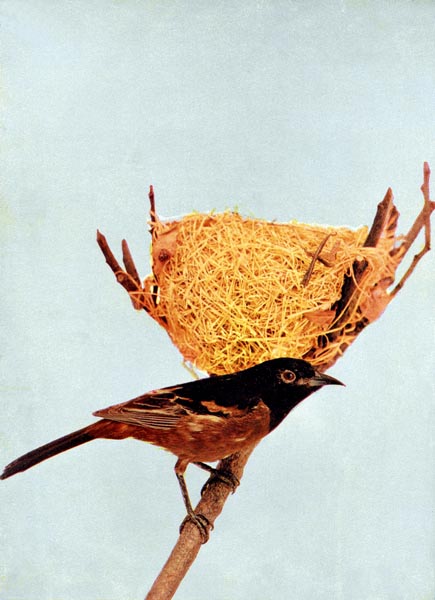
THE ORCHARD ORIOLE

The Orchard Oriole is here.
Why has he come? To cheer, to cheer—C. C. M.

imgt

HE Orchard Oriole has a general range throughout the United States, spending the winter in Central America. It breeds only in the eastern and central parts of the United States. In Florida it is a summer resident, and is found in greatest abundance in the states bordering the Mississippi Valley. This Oriole appears on our southern border about the first of April, moving leisurely northward to its breeding grounds for a month or six weeks, according to the season, the males preceding the females several days.

Though a fine bird, and attractive in his manners and attire, he is not so interesting or brilliant as his cousin, the Baltimore Oriole. He is restless and impulsive, but of a pleasant disposition, on good terms with his neighbors, and somewhat shy and difficult to observe closely, as he conceals himself in the densest foliage while at rest, or flies quickly about from twig to twig in search of insects, which, during the summer months, are his exclusive diet.

The favorite haunts of this very agreeable songster, as his name implies, are orchards, and when the apple and pear trees are in bloom, and the trees begin to put out their leaves, his notes have an ecstatic character quite the reverse of the mournful lament of the Baltimore species. Some writers speak of his song as confused, but others say this attribute does not apply to his tones, the musician detecting anything but confusion in the rapidity and distinctness of his gushing notes. These may be too quick for the listener to follow, but there is harmony in them.

In the Central States hardly an orchard or a garden of any size can be found without these birds. They prefer to build their nests in apple trees. The nest is different, but quite as curiously made as that of the Baltimore. It is suspended from a small twig, often at the very extremity of the branches. The outer part of the nest is usually formed of long, tough grass, woven through with as much neatness and in as intricate a manner as if sewed with a needle. The nests are round, open at the top, about four inches broad and three deep.

It is admitted that few birds do more good and less harm than our Orchard Oriole, especially to the fruit grower. Most of his food consists of small beetles, plant lice, flies, hairless caterpillars, cabbage worms, grasshoppers, rose bugs, and larvæ of all kinds, while the few berries it may help itself to during the short time they last are many times paid for by the great number of insect pests destroyed, making it worthy the fullest protection.

The Orchard Oriole is very social, especially with the king bird. Most of his time is spent in trees. His flight is easy, swift, and graceful. The female lays from four to six eggs, one each day. She alone sits on the eggs, the male feeding her at intervals. Both parents are devoted to their young.

The fall migration begins in the latter part of July or the beginning of August, comparatively few remaining till September.

Orchard Oriole (Icterus spurius) ©WikiC

Orchard Oriole (Icterus spurius) ©WikiC


Lee’s Addition:

Its leaves were fair and its fruit abundant, and in it was food for all. The living creatures of the field found shade under it, and the birds of the sky dwelt in its branches; and all flesh was fed from it. (Daniel 4:12 AMP)

The Orchard Oriole is in the Icteridae – Oropendolas, Orioles & Blackbirds Family. It  is the smallest North American species of icterid blackbird. The subspecies of the Caribbean coast of Mexico, I. s. fuertesi, is sometimes considered a separate species, the Ochre Oriole.

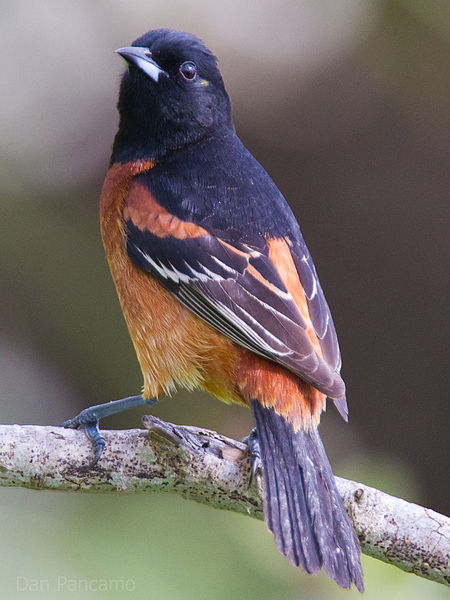
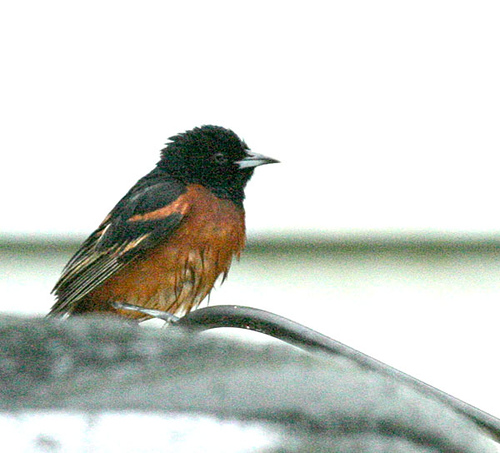
This species is 6.3 inches (16 cm) long and weighs 20 g. The bill is pointed and black with some blue-gray at the base of the lower mandible (Howell and Webb 1995). The adult male of the nominate subspecies has chestnut on the underparts, shoulder, and rump, with the rest of the plumage black. In the subspecies I. s. fuertesi, the chestnut is replaced with ochre (Howell and Webb 1995). The adult female and the juvenile of both subspecies have olive-green on the upper parts and yellowish on the breast and belly. All adults have pointed bills and white wing bars. (Orchard Orioles are considered to be adults after their second year.) One-year-old males are yellow-greenish with a black bib.

Orchard Oriole (Icterus spurius) m by Kent Nickell

Orchard Oriole (Icterus spurius) m by Kent Nickell

Orchard Oriole sound from xeno-canto.org

Birds Illustrated by Color Photograhy Vol 1 May, 1897 No 5 - Cover

Birds Illustrated by Color Photograhy Vol 1 May, 1897 No 5 – Cover

Birds Illustrated by Color Photography – Revisited – Introduction

The above article is the first article in the monthly serial that was started in January 1897 “designed to promote Knowledge of Bird-Live.” These include Color Photography, as they call them, today they are drawings. There are at least three Volumes that have been digitized by Project Gutenberg.

To see the whole series of – Birds Illustrated by Color Photography – Revisited

*

(Information from Wikipedia and other internet sources)

Next Article – The Marsh Hawk

Previous Article – The Screech Owl

Sharing The Gospel

Links:

Icteridae – Oropendolas, Orioles & Blackbirds Family

Orchard Oriole – All About Birds

Orchard Oriole – Wikipedia

Orchard Oriole – National Geographic

*


Feedback: Dinosaurs Living with People—The Biblical Worldview – Answers in Genesis

Dinosaur Fossil from OCR.org

I love this statement that they started their answer with in the excerpt they had in their Answers Weekly Newsletter.

Since the Bible is the Word of God, and since God cannot lie, then the Bible is trustworthy. That is our starting point.

That is exactly how I feel about what is written by me here on this blog. I start with knowing that God’s Word is truth and that all these birds that were created for our enjoyment, were Created By God, Not Made in China or Made in the USA, but Made By God.

Anyway, the following article excerpt came from Feedback. It has to do with Dinosaurs living with humans.

Q: Why do we believe dinosaurs lived with people?

A: Since the Bible is the Word of God, and since God cannot lie, then the Bible is trustworthy. That is our starting point. We are told that land animals were created on Day Six, and this would include dinosaurs. Since Day Six is also when man was created, we certainly believe dinosaurs lived at the same time as man.

How do you explain the various petroglyphs of dinosaurs found around the world? How do you explain the fact that so many dragon legends from around the world describe creatures that match what we know about dinosaurs from their fossils? How do you explain the biblical account that seems to describe something like a brachiosaurus, called behemoth in Job 40:15–24?

Feedback: Dinosaurs Living with People—The Biblical Worldview – Answers in Genesis.

To read the whole article CLICK HERE

*