Latest Visitors to Yard

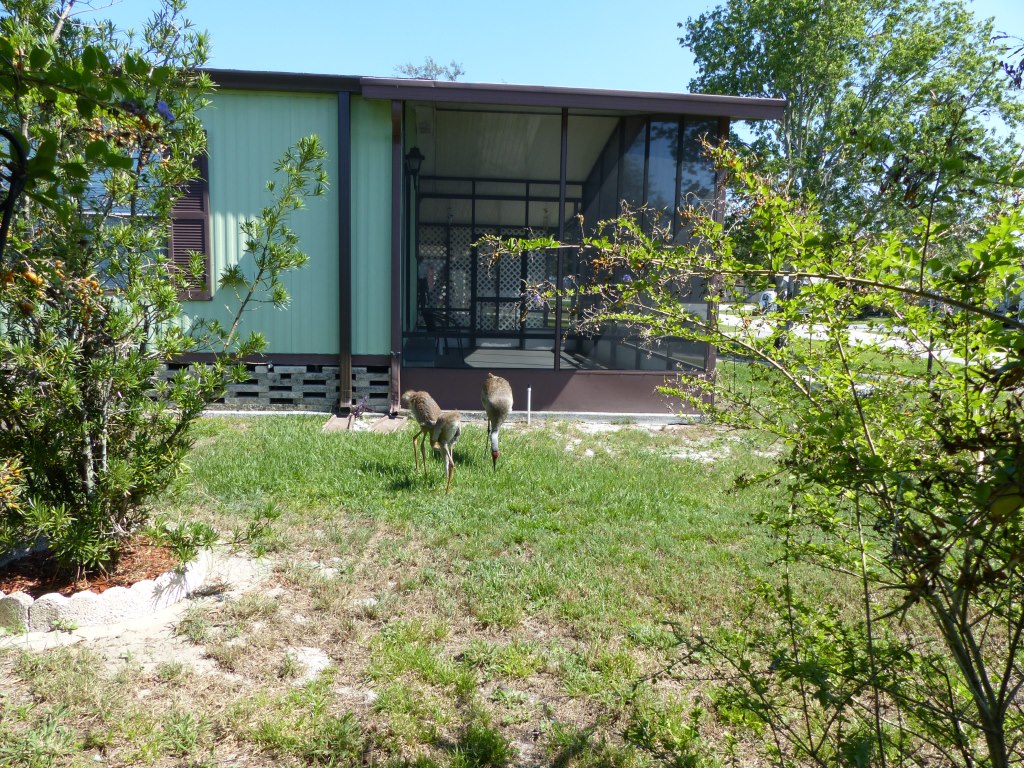
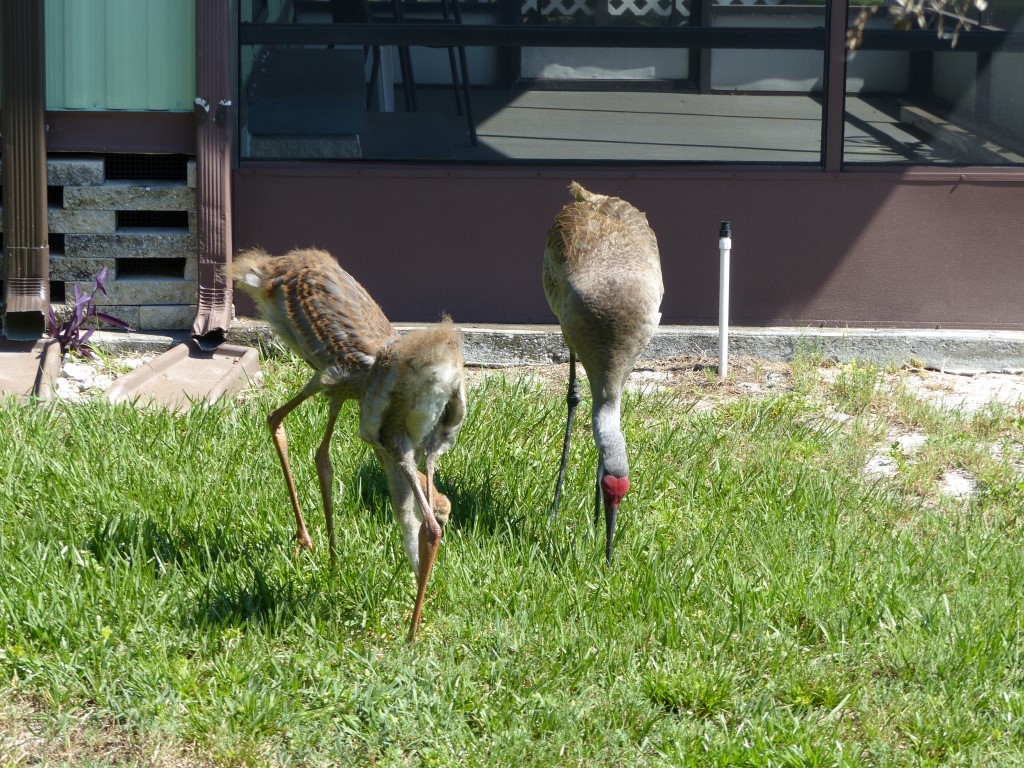
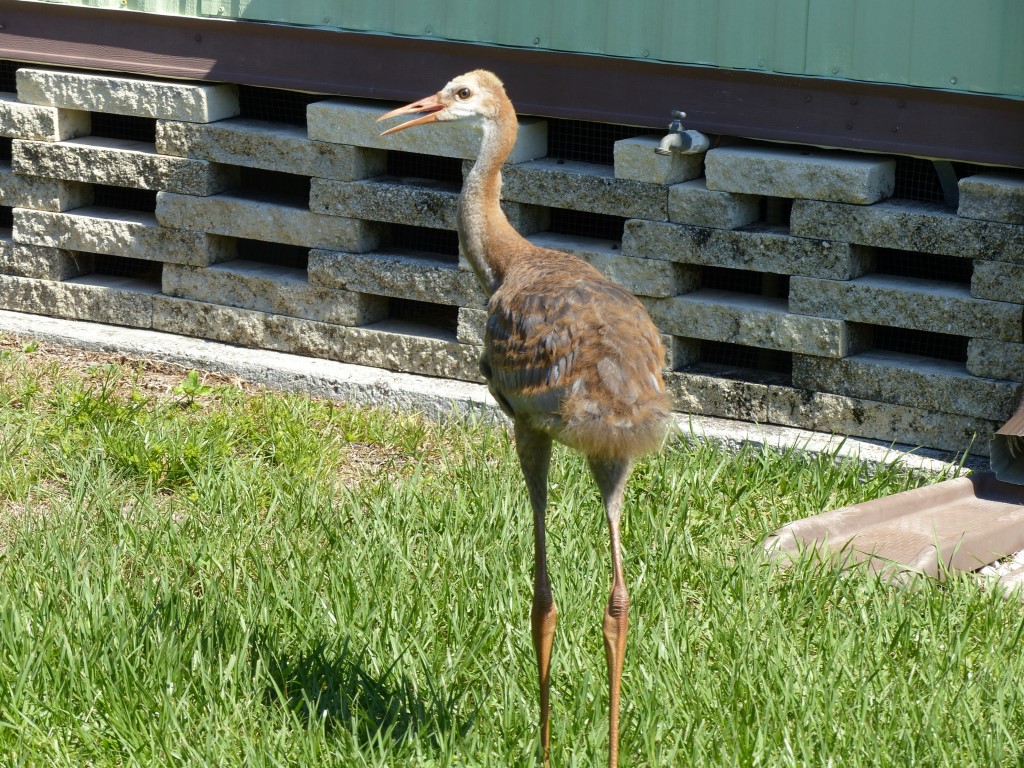
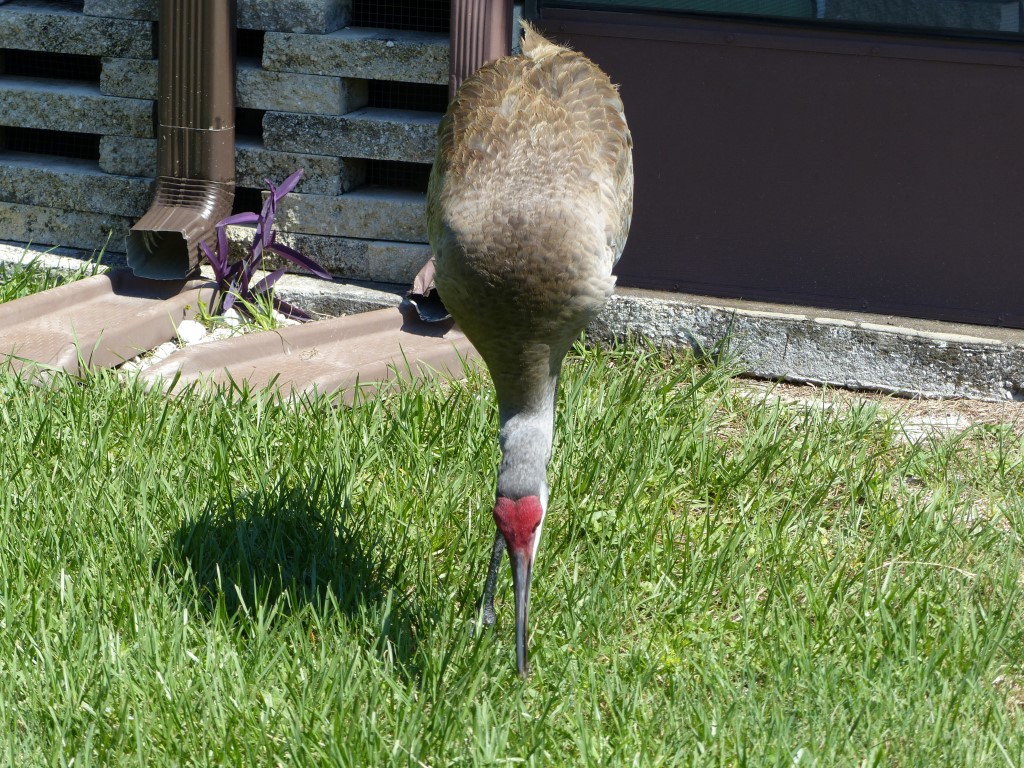
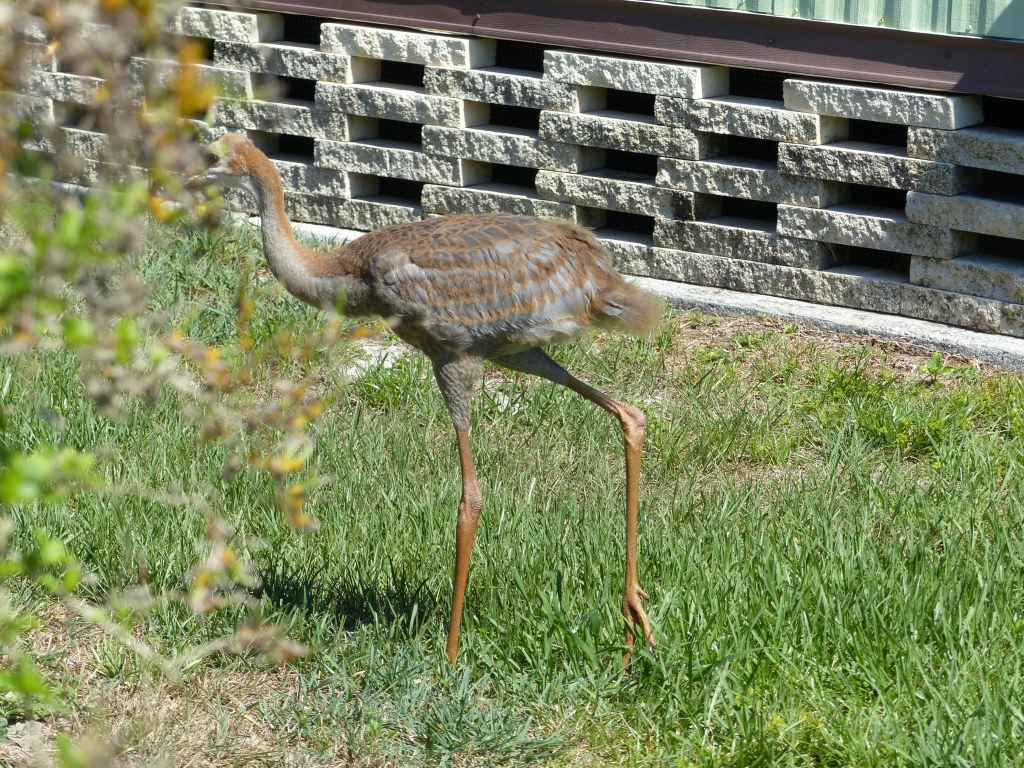
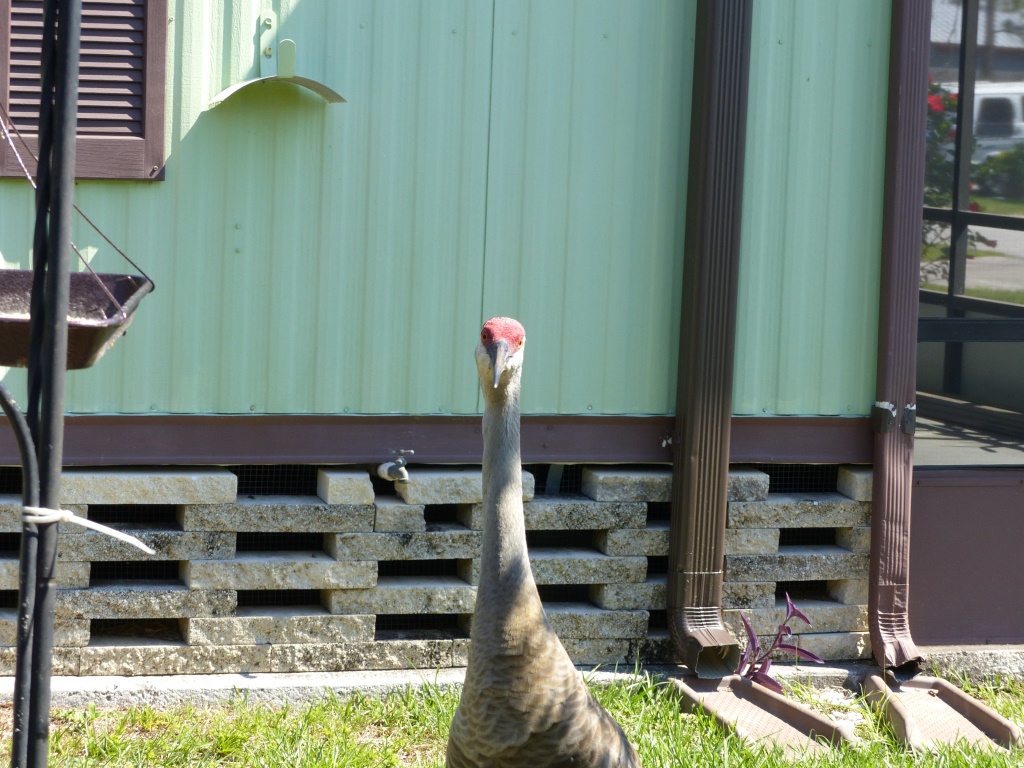
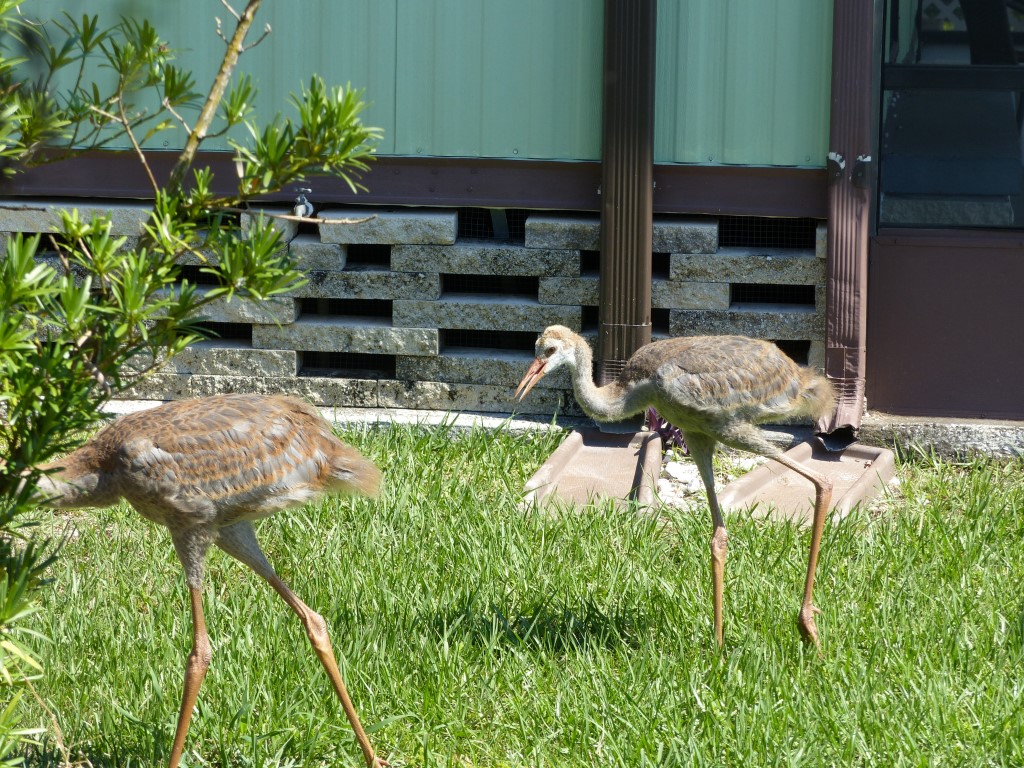
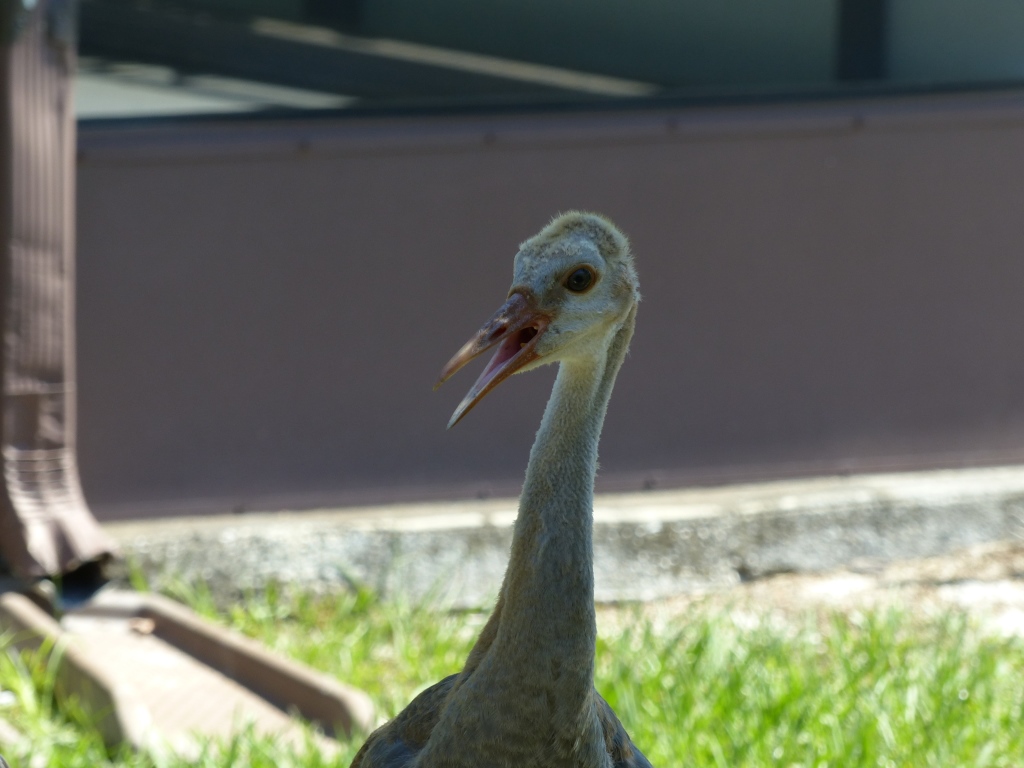
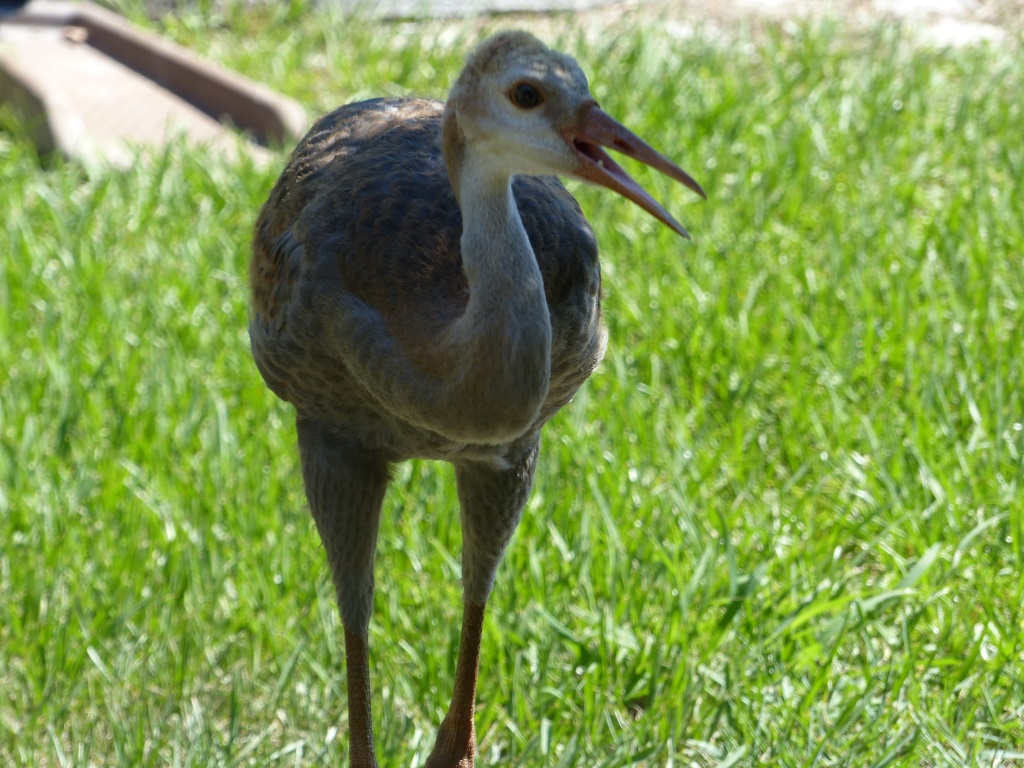
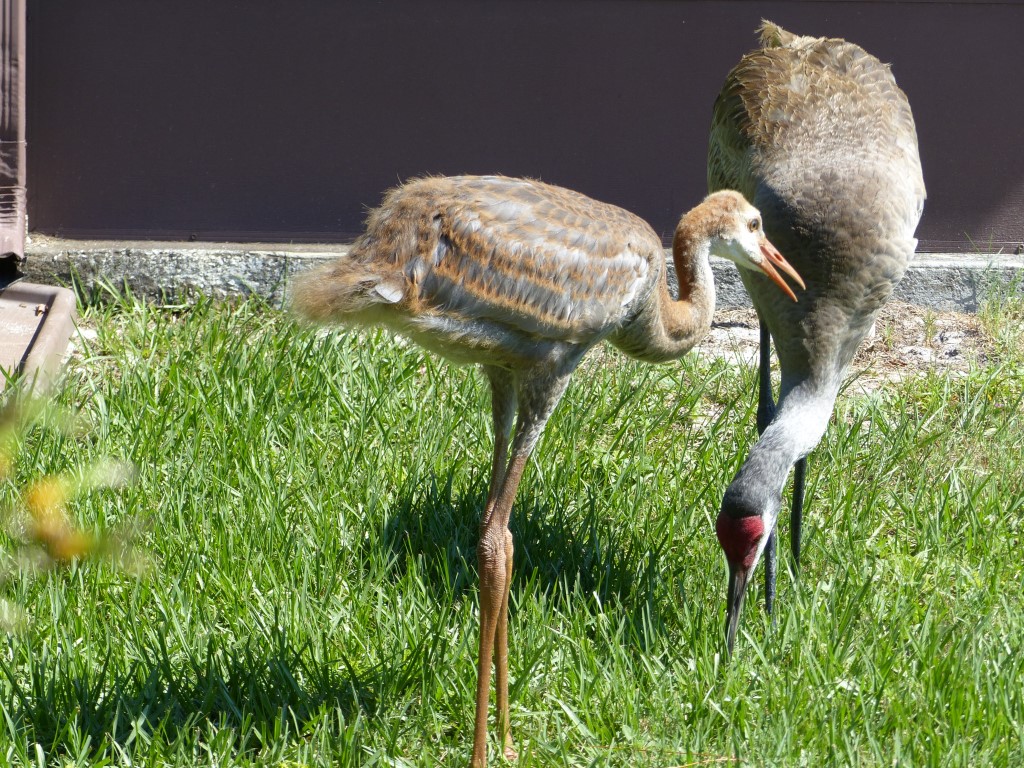
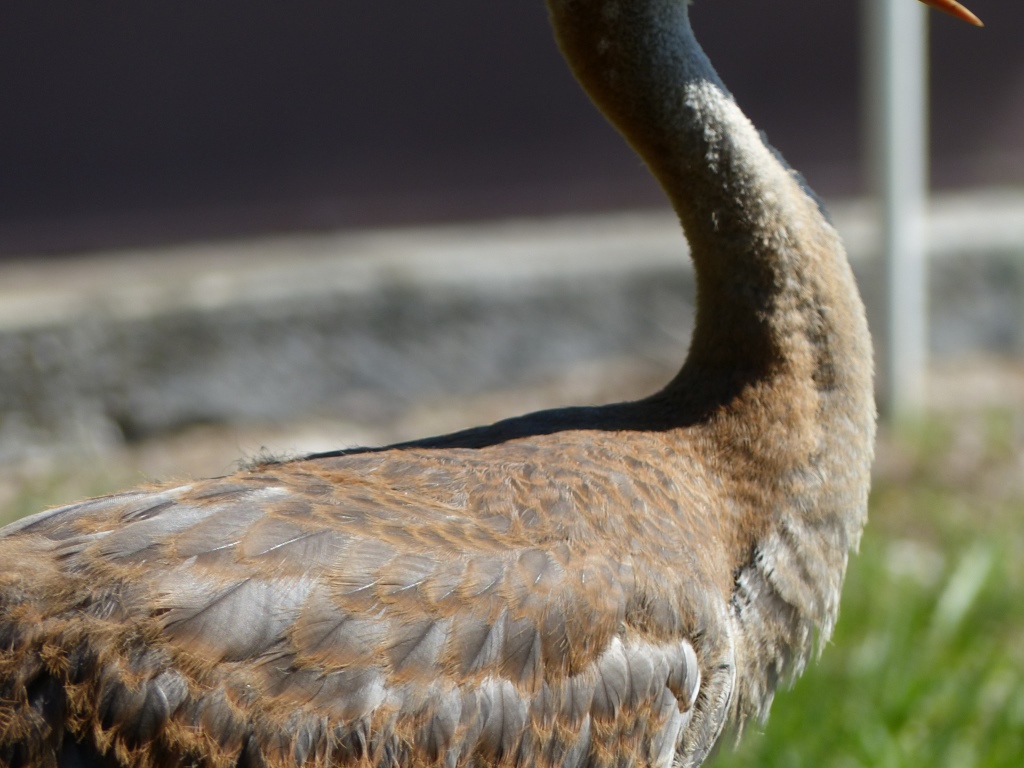
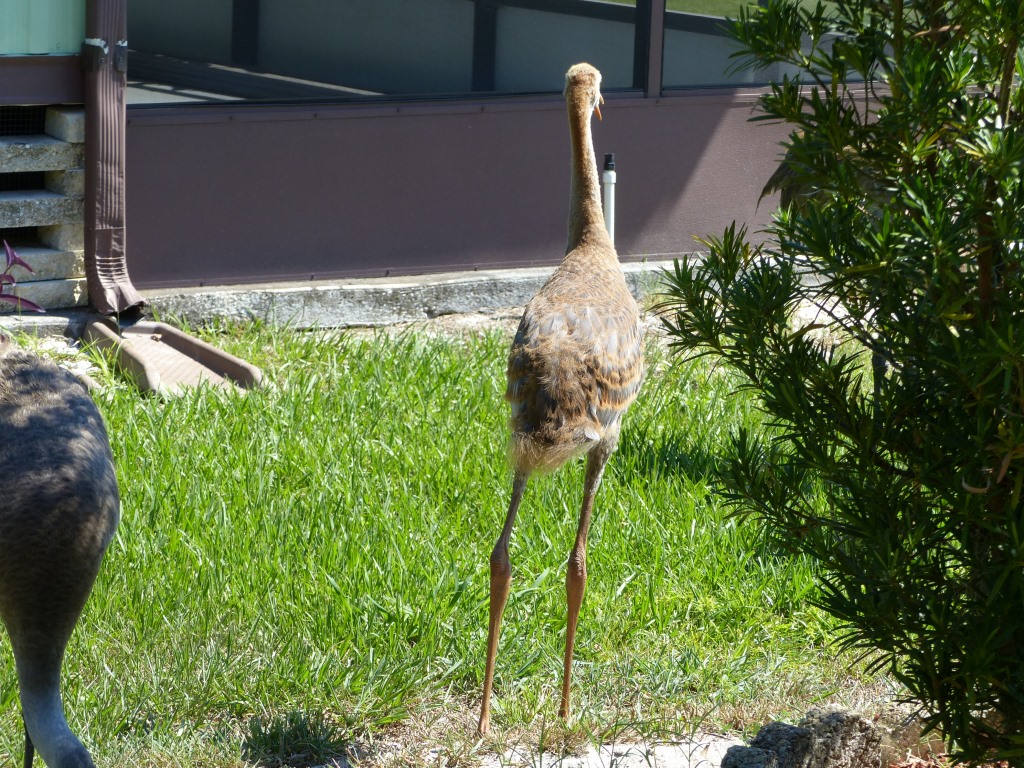
A few days ago while I was filling up my feeders, I looked up and here came Mom and Pop Sandhill Crane with their two latest youngsters. (The 2015 family) Needless to say I stopped and watched them for a while and then remembered to go get my camera. Here are some of those images. I shared a little seed with them. Not suppose to feed cranes, but even if I put seed in that hanging tray for the other birds, they have been known to eat from it. ( I felt sorry for the little ones. :) )

It looks like the little Sandhills need to grow into their knees.

Leaving

Leaving

I always enjoy when the Sandhill Crane parents bring their little ones by to check them out. When you get to watch the Lord’s created critters up close and see how really look and act is enjoyable. The Cranes are mentioned in Scripture and so they are some of our Birds of the Bible.

Like a crane or a swallow, so did I chatter: I did mourn as a dove: mine eyes fail with looking upward: O LORD, I am oppressed; undertake for me. (Isaiah 38:14 KJV)

The parents made some chatter when I got too close to the little ones, but didn’t get it on video. Here is video of them in the yard (The noise is Dan edging the driveway):

*

You can tell by how many articles that I’ve written about that the cranes, that I like them and they visit often:

*

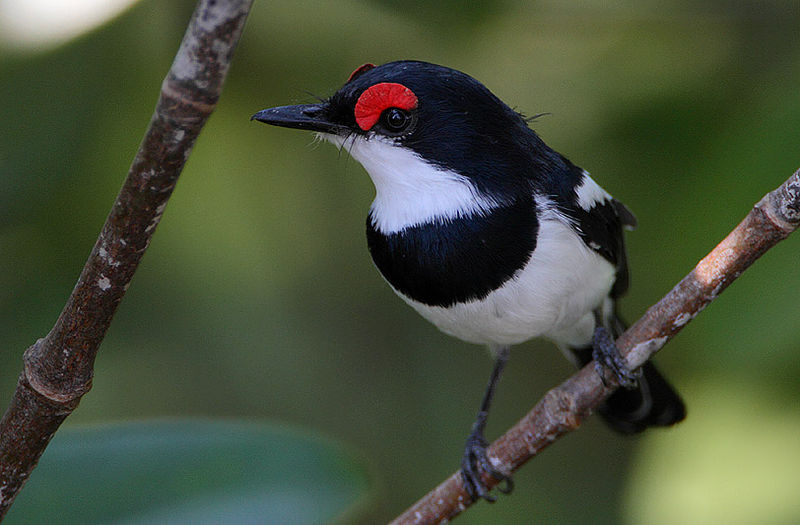
Sunday Inspiration – Bushshrikes and Boatbills

Rosy-patched Bushshrike (Telophorus cruentus) ©WikiC

Rosy-patched Bushshrike (Telophorus cruentus) ©WikiC

And the angel of the LORD appeared unto him in a flame of fire out of the midst of a bush: and he looked, and, behold, the bush burned with fire, and the bush was not consumed. And Moses said, I will now turn aside, and see this great sight, why the bush is not burnt. (Exodus 3:2-3 KJV)

This Sunday you get to meet two more families from the Song Birds (Passerines), the Malaconotidae – Bushshrikes Family with 50 members and the Machaerirhynchidae – Boatbills Family with only 2 species.

Orange-breasted Bushshrike (Chlorophoneus sulfureopectus) ©WikiC

Orange-breasted Bushshrike (Chlorophoneus sulfureopectus) ©WikiC

The Bushshrikes are smallish passerine bird species. They were formerly classed with the true shrikes in the family Laniidae, but are now considered sufficiently distinctive to be separated from that group as the family Malaconotidae.

This is an African group of species which are found in scrub or open woodland. They are similar in habits to shrikes, hunting insects and other small prey from a perch on a bush. Although similar in build to the shrikes, these tend to be either colorful species or largely black; some species are quite secretive.

Some bushshrikes have flamboyant displays. The male puffbacks puff out the loose feathers on their rump and lower back, to look almost ball-like.
These are mainly insectivorous forest or scrub birds. Up to four eggs are laid in a cup nest in a tree.

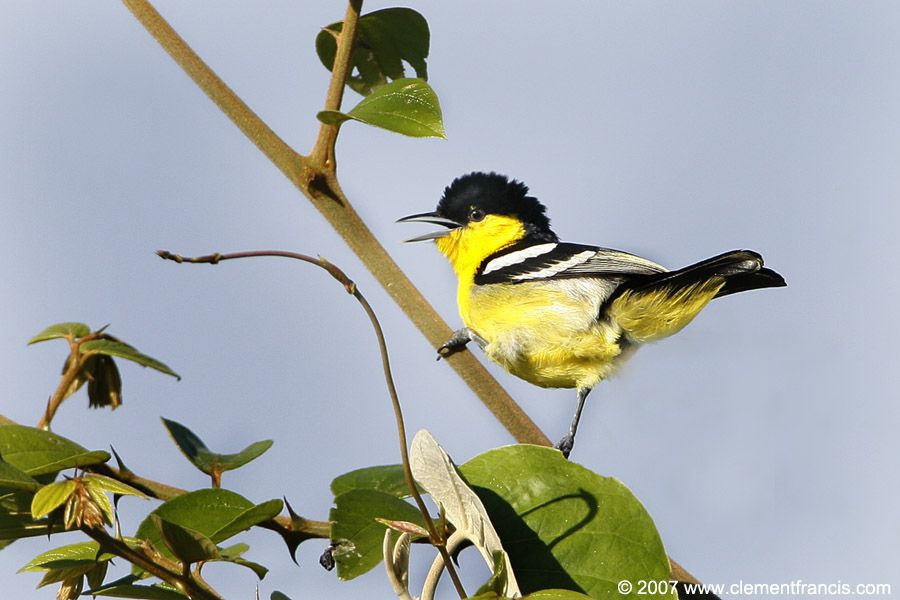
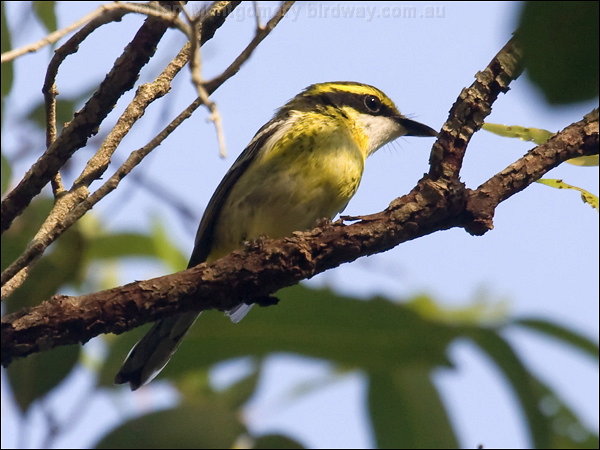
Yellow-breasted Boatbill (Machaerirhynchus flaviventer) by Ian

Yellow-breasted Boatbill (Machaerirhynchus flaviventer) by Ian

Boatbills or the Machaerirhynchus is a genus of passerine birds with affinities to woodswallows and butcherbirds. The two species are known as boatbills. The genus is distributed across New Guinea and northern Queensland. (Info from Wikipedia)

This slideshow requires JavaScript.

Listen to a quartet sing as you watch these two beautifully created families of birds:

“We Shall See Jesus” ~ Margaret Hiebert, Pastor and Jill Osborne and Pastor Jerry Smith

Sunday Inspirations

Birds of the World

*

Gospel Message

*

Little Gray Feather

01:33. As the Robin flies away, the Grackle cries, “More!”

01:33. As the Robin flies away, the Grackle cries, “More!”

Little Gray Feather,
the Adopted Common Grackle Chick

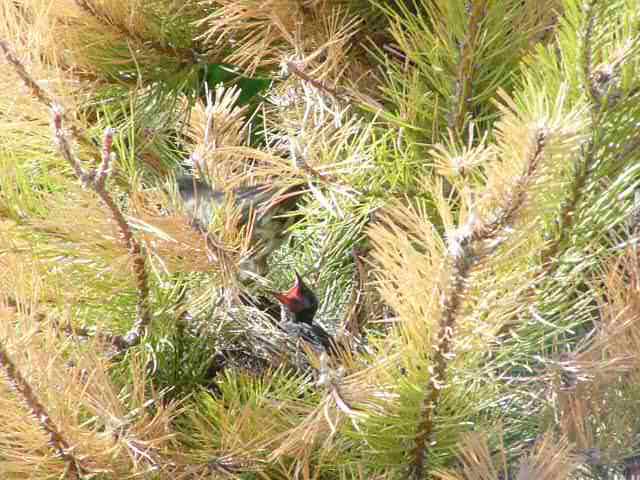
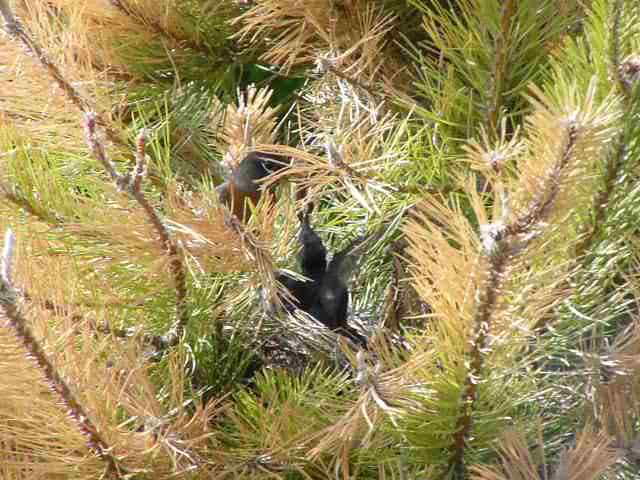
One of the most bizarre anomalies in the world of ornithology I have ever witnessed was in May 2009.

It was in that month when my wife happened to look out a second floor bedroom window of our condo townhome in Aurora, Colorado and see two little boys carrying bird nests, prompting her to investigate. As it turns out, the two boys were innocently engaged in the exploration of birds’ nests they had discovered—apparently having observed adult birds flying to and from the nests. My wife lovingly explained to them that it wasn’t a good idea to move nests with eggs or chicks and suggested they return the nests to where they had found them.

However, by then the boys had already relocated at least two nests to a not-so-tall conifer at the southeast corner of the townhome complex. Apparently, they figured that by relocating the nests to lower, shorter branches, they could keep a better eye on things. The relatively short evergreen presently had a total three nests and a number of chicks had fallen to the ground. Not knowing what type of birds she was dealing with or what nests the chicks on the ground had fallen out of, my wife donned a pair of gloves and placed the fallen chicks back into two of the nests. When I returned home from work, she requested I examine the situation. Upon doing so, I found that she had mistakenly placed Common Grackle chicks with American Robin chicks and a few chicks had again fallen out of their nests—one to the ground, a couple of others onto branches. It was a problematic scenario for all parties involved, especially the chicks.

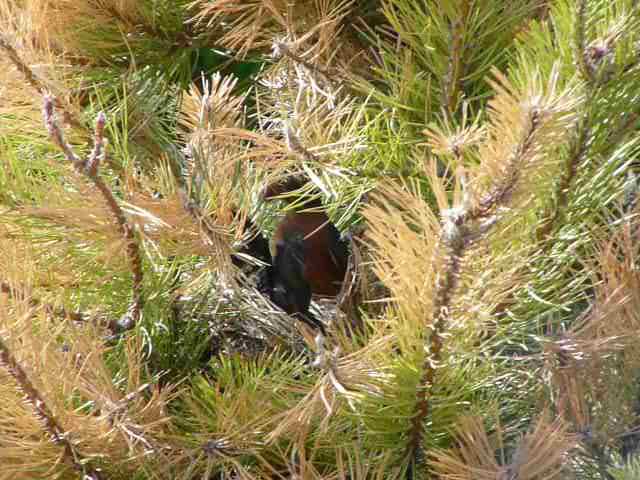
01:09. Oh, what joy as the Robin emerges on the west side of the nest with something substantial in its mouth.

Appearances suggested we were dealing with two broods of Robins and one of Grackles, both types of birds being common to the complex. Presuming the highest nest in the tree to be that of a Grackle, I placed the Grackle chicks in that one and divided the Robins evenly between the other two lower nests, holding out little hope for a positive outcome.

In less than two days all chicks died except for one: a Grackle. And soon, the nest had become tipped. I adjusted it so the sole survivor wouldn’t fall out.

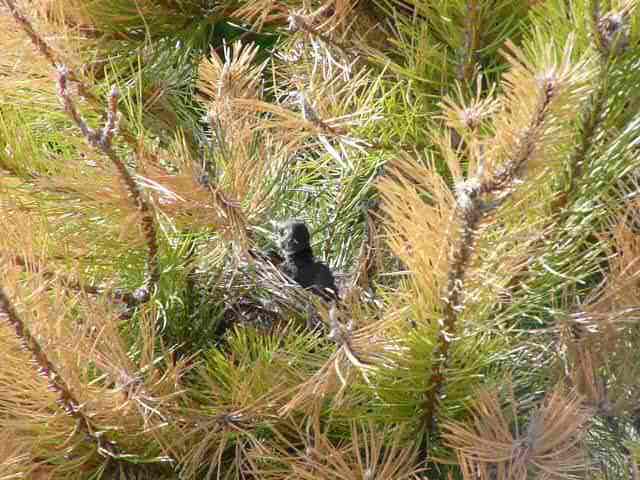
Now, one would think an adult Robin would know the difference between one of its own and a stranger. Yet, to our amazement, a pair of mating Robins quickly adopted the baby Grackle and took to raising it as their own. This caused me to think that the nest had actually been built by the mother Robin. We named the chick Little Gray Feather and observed its development into June until it left the nest and was capable of very short flights while still being tended to by its adoptive parents.

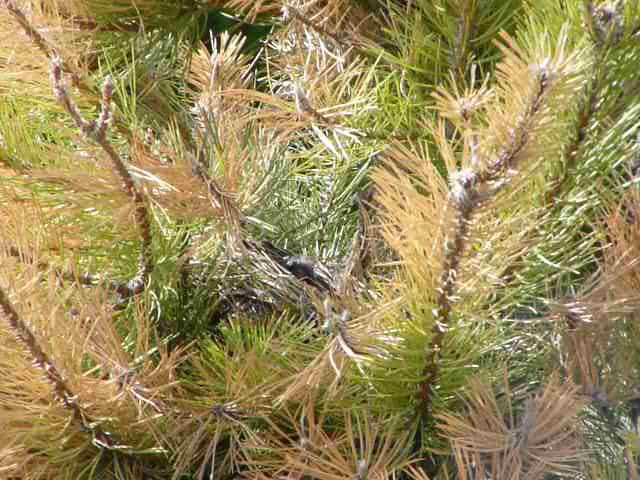
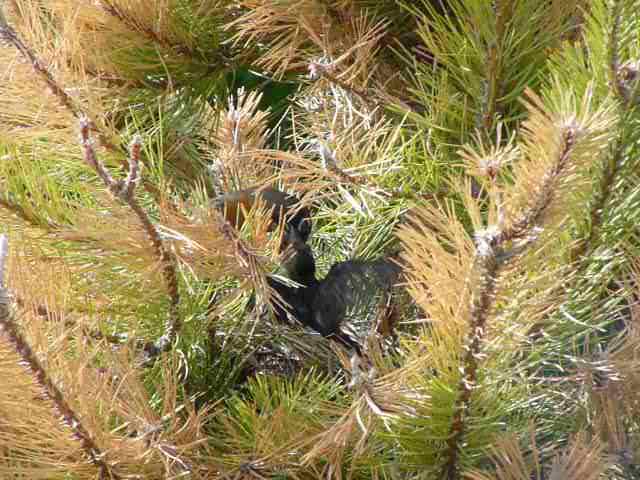
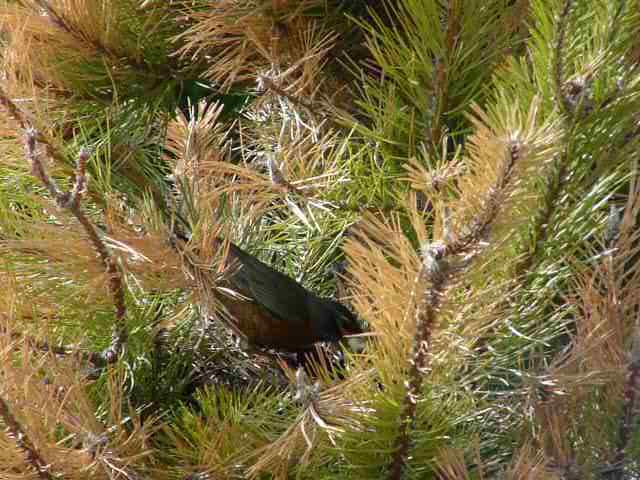
Using a Panasonic Lumix-DMC FZ8 digital camera, on May 29, 2009, I took a video of the Grackle in the nest and one of its adoptive Robin parents feeding it and cleaning up after it. Following are photos captured from the video, arranged in chronological order from left to right:

*

Little Gray Feather
Copyright ©2015 Dan Vaisanen


Lee’s Addition:

What an amazing story and the photos and video to go along with it. Thanks Dan for sharing this with us. Dan Vaisanen is an acquaintance of James J. S. Johnson.

Other birds have fed babies that are not their own, but this was all done by accident. It is interesting that one species, the Robins, were willing to feed another species’ baby, but that the Grackles would not do the same for the Robin babies. Must be a truth there somewhere.

“So then, whatever you desire that others would do to and for you, even so do also to and for them, for this is (sums up) the Law and the Prophets. (Matthew 7:12 AMP)

Deceit:

Good Behavior:

*

“Flag That Bird!” (Part 4)

“Flag That Bird!”  (Part 4)

He who has an ear, let him hear what the Spirit says unto the churches; unto him who overcomes will I give to eat of the tree of life, which is in the midst of the paradise of God.   (Revelation 2:7)
Luzon Bleeding-heart by Dan

Orni-Theology

The time will eventually come when the words “tree” and “paradise” coincide, in a truly heavenly way.  But until then, we do have a bird of “paradise” that is known for habituating trees, especially the tropical trees of Papua New Guinea.  Various birds, each known as a Bird of paradise, are known for their flamboyant color and beauty, especially long, thin, streamer-like tail feathers that show off the bird’s fancy status as a flying exhibit of heavenly design and construction.

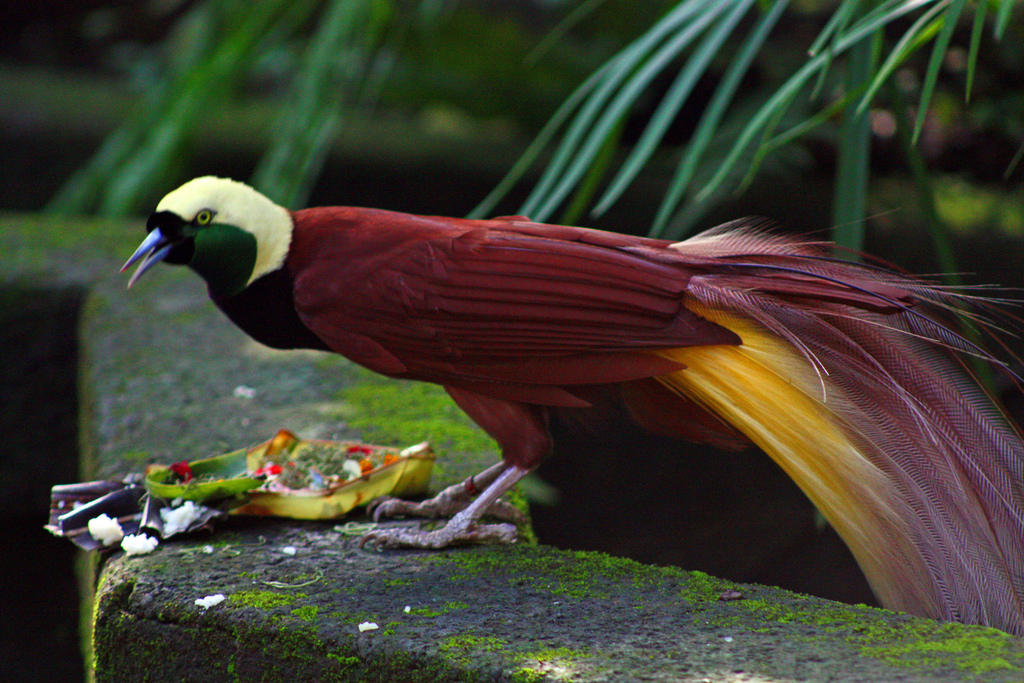
The first of today’s featured creatures, the Raggiana Bird-of-Paradise (Paradisaea raggiana), is a tropical rainforest bird with feathery flamboyance.  Indeed, extravagant feathers are commonplace for birds-of-paradise, and this variety sports scarlet red, bright green, lemon yellow, black, combined to maroonish-mauve/rusty-brown, comprising a challenge for any wildlife painter!
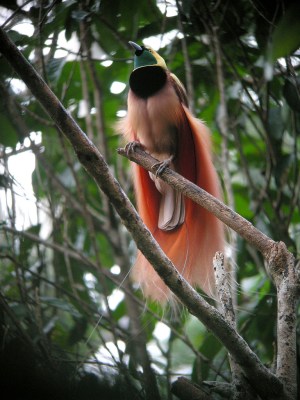
Raggiana Bird-of-paradise (Paradisaea raggiana) ©WikiC

Raggiana Bird-of-paradise (Paradisaea raggiana) ©WikiC

However, as beautiful as Bird-of-Paradise feathers may be, be cautious about buying their feathers from any foreign vendors, because commercial exporting transactions involving these birds are regulated according to Appendix II of a wildlife protection treaty called “Convention on International Trade in Endangered Species of Wild Fauna and Flora” (a/k/a the “Washington Convention”, usually abbreviated as “CITES” – opened for signature AD1973, adopted by USA  in AD1975).  The USA vigorously enforces CITES protections , internationally, by investigating, arresting, and prosecuting poachers who violate the endangered species provisions of the CITES treaty.

In Flag Those Birds! (Part 1)”,  we considered 4 “banner birds”  –  besides eagles  –  that appear on national flags:  Belgium’s Wallonian Chicken (Gallus gallus domesticus); Portugal’s Northern Goshawk (Accipiter gentilis); Burma’s Green Peafowl (Pavo muticus); and Dominica’s Sisserou Parrot (Amazona imperialis).  In Flag Those Birds! (Part 2)”,  we reviewed 2 more “banner birds”:  the British Antarctic Territory’s Emperor Penguin (Aptenodytes forsteri), and the Saint Helena Plover, a/k/a Saint Helena’s skinny-legged “Wirebird” (Charadrius sanctaehelenae).  In Flag That Bird! (Part 3)”,  we showcased 1 more “banner bird”:  Kiribati’s Great Frigatebird Emperor Penguin (Fregata minor), as well as the importance and popularity of Mother’s Day.

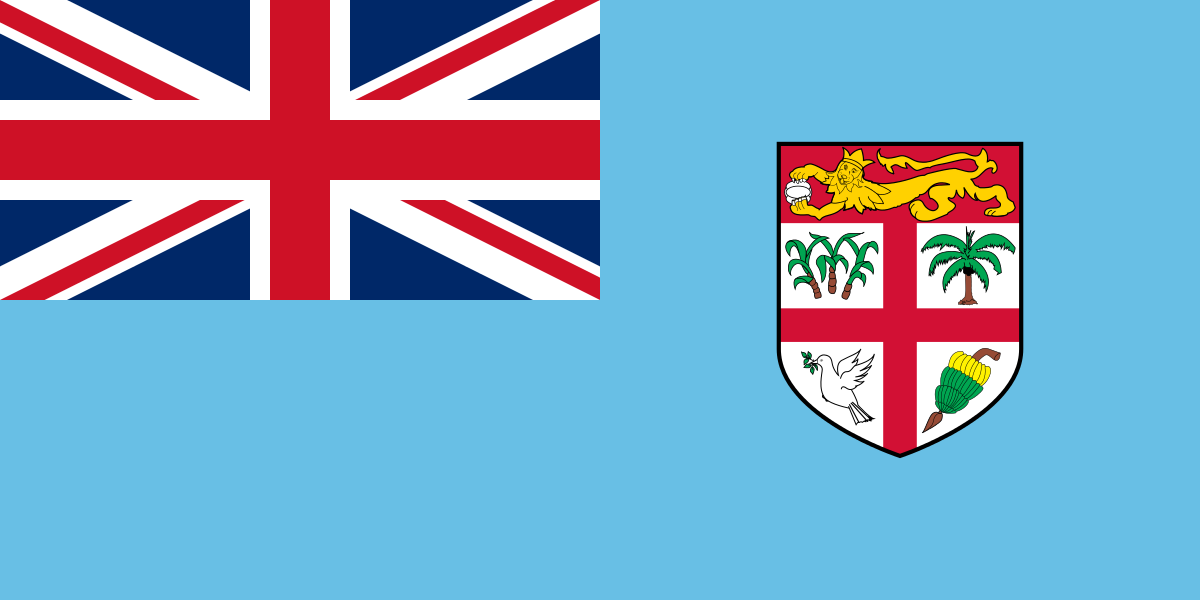
In this posting, we have two more “banner birds”:  Papua New Guinea’s bird of paradise, featured on the flag of Papua New Guinea, and the ubiquitous dove, featured on Fiji’s flag (as well as on the royal standard of Tonga).  God willing, we will subsequently review the black swan of Western Australia, the piping shrike of South Australia, the condor of Bolivia; and Uganda’s crested crane.

So for now, let us resume our series with Papua New Guinea’s Raggiana Bird of Paradise (Paradisaea raggiana).

Raggiana Bird-of-Paradise (Paradisaea raggiana, f/k/a Gerrus paradisaea).
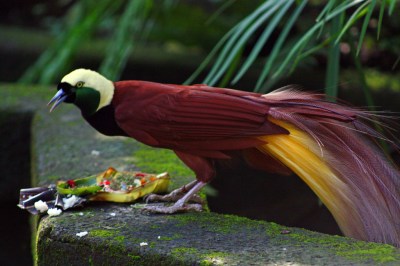
Raggiana Bird-of-paradise (Paradisaea raggiana) ©WikiC

Raggiana Bird-of-paradise (Paradisaea raggiana) ©WikiC

Birds-of-paradise routinely eat a diet of fruits and bugs, which are plentiful in New Guinea jungles, so no one should expect birds-of-paradise to miss a meal, much less to starve in their tropical habitats!  Birds-of-paradise are known to hybridise, in the wild, wreaking havoc on taxonomy charts.  [See David Chandler & Dominic Couzens, 100 Birds to See Before You Die:  The Ultimate Wish List for Birders Everywhere (San Diego, CA: Thunder Bay Press, 2008), page 207.]

Raggiana birds-of-paradise especially appreciate tropical fruit, including nutmeg.  After eating jungle fruits the birds-of-paradise serve fruit-trees by dispersing the seeds, post-digestion, with natural “fertilizer”, and thereby promote the planting of the next generation of fruit trees, which eventually germinate and fruit somewhere within the range of the tree-planting bird-of-paradise.

Raggiana Bird-of-paradise (Paradisaea raggiana) by Dan

Raggiana Bird-of-paradise (Paradisaea raggiana) Lowry Park Zoo by Dan

The Raggiana Bird of Paradise (a/k/a “Count Raggi’s bird-of-paradise”, being named for Marquis Francis Raggi of Genoa, Italy) is the national bird of Papua New Guinea, since AD1971, when it was included on that nation’s national flag and coat-of-arms.
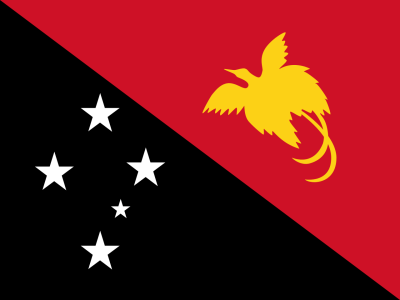
Flag of Papua New Guinea ©PD

Flag of Papua New Guinea ©PD

The next “banner bird” is a dove (which is really a family of similar birds), the most common species of which is the ubiquitous Rock Dove (Columbia livia), a species that includes within it a domesticated subspecies (i.e., breeder’s variety) called the homing pigeon (Columbia livia domestica  –  a/k/a “carrier pigeons” when they carry messages), many of which are completely white.

Of course the world is home to many other common doves and pigeons (e.g., Mourning Dove, Key West Quail-Dove, Inca Dove, White-winged Dove, various Turtle Doves, etc.), but earlier comments about doves and pigeons are now cited, rather than being repeated here,  [See, for examples, Lee’s Birdwatching dove articles at Birds of the Bible – Dove and Turtle Dove,  Birds of the Bible – Descending Like A Dove, and Birds of the Bible – Dove and Pigeon Distribution  —  as well as brief comments on the Mourning Dove (Zenaida macroura), while recalling a wonderful morning of bird-watching (with Chaplain Bob and Marcia Webel) in Pond-side Birdwatching In Florida III.]

Flag of Fiji ©PD

Flag of Fiji ©PD

A completely white “dove of peace” appears on the flag of Fiji.  But what variety of “dove” is it?  (Well, it looks like it could be a white homing pigeon, but is that what the Fiji flag designers had in mind?)

Fiji is a tropical archipelago (i.e., cluster of islands) in the South Pacific Ocean.  Ironically, the special habitat of the Fiji archipelago is the only “home” for 3 endemic varieties of fruit-eating doves (a/k/a “fruit doves” or “fruit pigeons”): the Orange Fruit Dove (Ptilinopus victor, a/k/a Flame Dove), Golden Fruit Dove (Ptilinopus luteovirens, a/k/a Lemon Dove or Yellow Dove), and Whistling Fruit Dove (Ptilinopus layardi, a/k/a Velvet Dove or Yellow-headed Dove), —  yet none of those doves are completely white.

So the Fiji flag’s white dove, which derives from the coat-of-arms of the Kingdom of Fiji (AD1871-AD1874), does not match any particular variety of dove that is endemic to the Fiji islands.
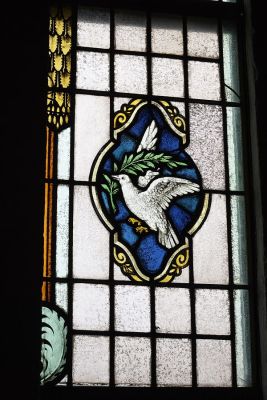
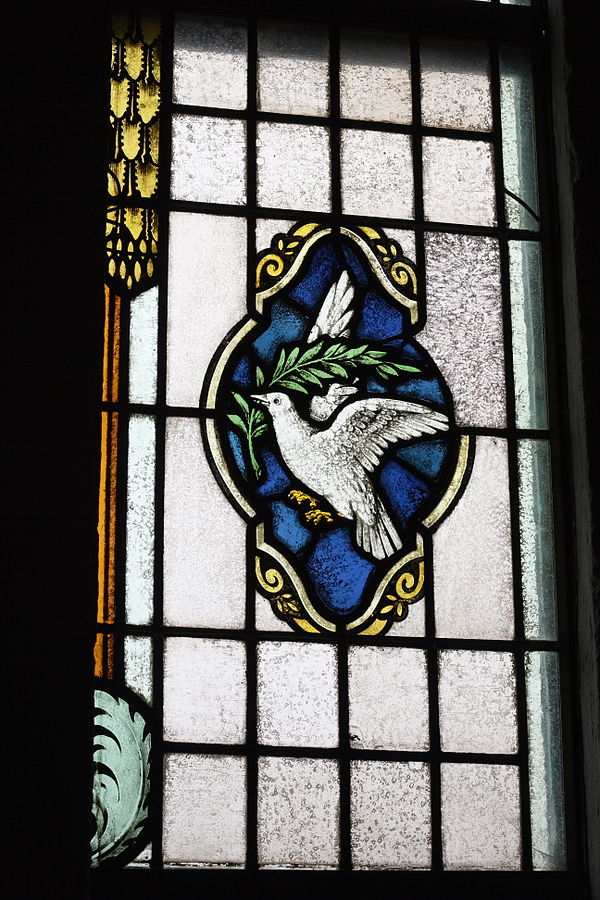
White Dove With Olive Branch - Stained Glass ©WikiC

White Dove With Olive Branch – Stained Glass ©WikiC

[ image taken from http://en.wikipedia.org/wiki/Doves_as_symbols ]

The olive leaf branch in the white dove’s beak suggests that the dove portrayed (in the flag of Fiji) is the olive-bearing dove that Noah released, received, and released again (see Genesis 8:8-12), which Ark-borne dove many have guessed was all white (although the Bible says nothing about that dove’s color).  Likewise, the royal standard of Tonga depicts a similar all-white dove, bearing a green olive leaf.

Royal Standard of Tonga

Royal Standard of Tonga

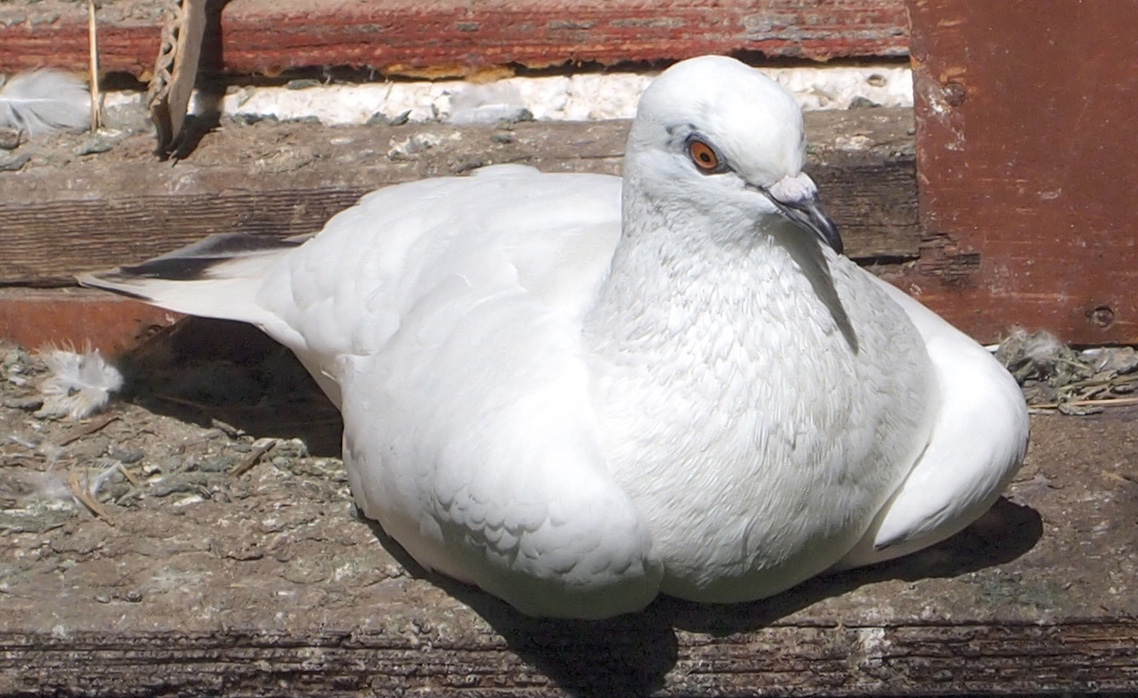
There are, of course, some doves that are completely white.  As noted above, one example of a pure-white dove is the white homing pigeon. That is as good a guess as many.  After all, homing pigeons are famous for returning “home”, and the olive-bearing dove returned home (to its “house-boat”) after the Flood, — so maybe Noah’s famous dove was a homing pigeon!
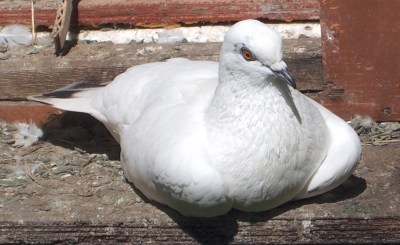
White Homing Pigeon © WikiC

White Homing Pigeon © WikiC

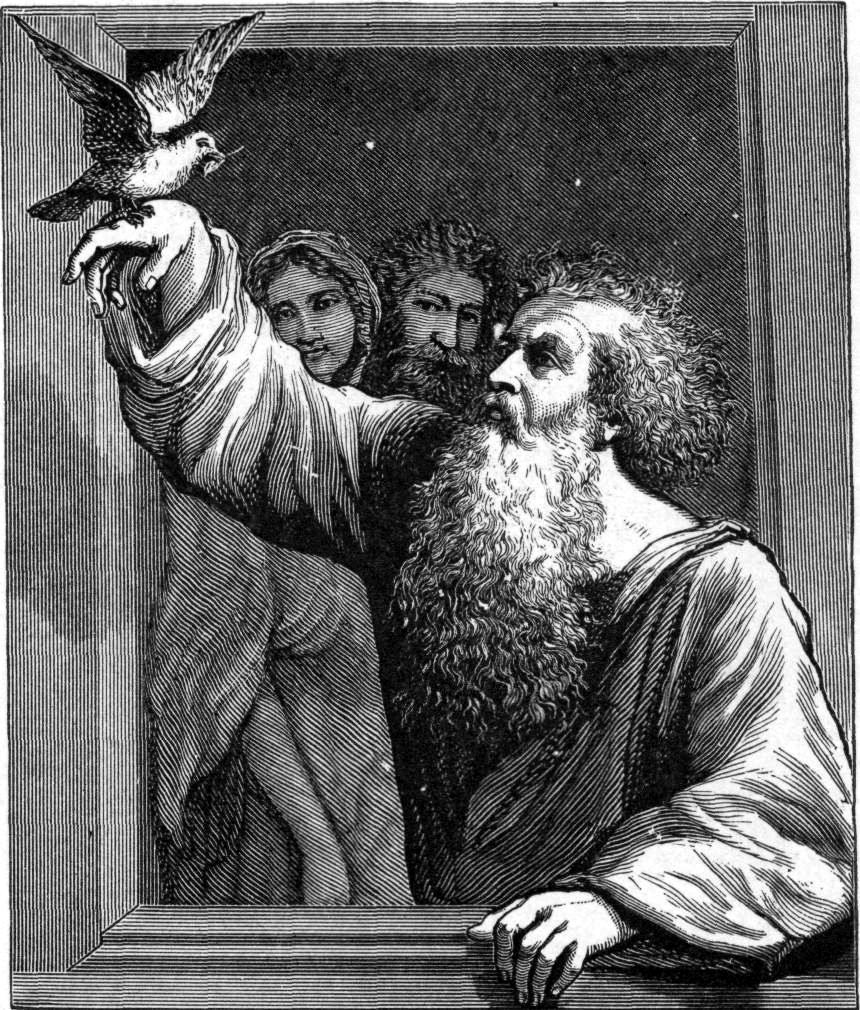
But we probably need to wait — until we have a chance to speak with Noah, himself, because Noah was the bird-handling one (of only 8 humans) who personally knows which variety of “dove” brought back that famous olive leaf unto him, after the year-long global Flood.  (What a voyage those 8 had!)  And the world’s people-groups, to this day, have multifarious records (usually literary, but not always) of remembering the unique ocean voyage that those 8 survivors took, some 4½ thousand years ago  —  as is briefly illustrated in “Genesis in Chinese Pictographs” (posted at www.icr.org/article/8643 ).  For a thoroughly researched and documented cornucopia of ancient flood accounts, see Dr. Bill Cooper’s THE AUTHENTICITY OF THE BOOK OF GENESIS (Creation Science Movement, 2011 — available through http://www.csm.org.uk ), 424 pages.
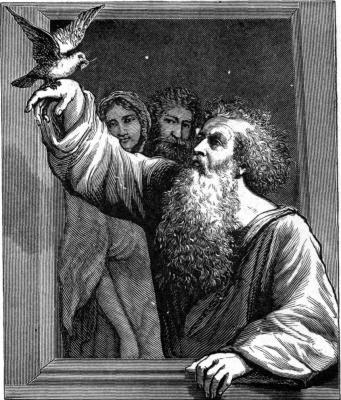
Noah with a Dove ©Drawing WikiC

Noah with a Dove ©Drawing WikiC

And the dove came in to him in the evening; and, lo, in her mouth was an olive leaf plucked off; so Noah knew that the waters were abated from off the earth.  And he [i.e., Noah] stayed yet other 7 days; and sent forth the dove, which returned not again unto him anymore.  (Genesis 8:11-2)

With those short comments, as Noah did centuries ago (Genesis 8:12), we now “release” the dove into the wide wild world, where many of that tribe thrive, faithfully being fruitful, multiplying, and filling the earth (Genesis 1:22 & 9:8-12).

Another day, God willing, we shall consider the black swan of Western Australia,  the piping shrike of South Australia,  the condor of Bolivia,  and Uganda’s crested crane.  So please stay tuned!

*

“Flag That Bird!”  (Part 1)

“Flag That Bird!”  (Part 2)

“Flag That Bird!”  (Part 3)

More Articles by James J. S. Johnson

Orni-Theology

*
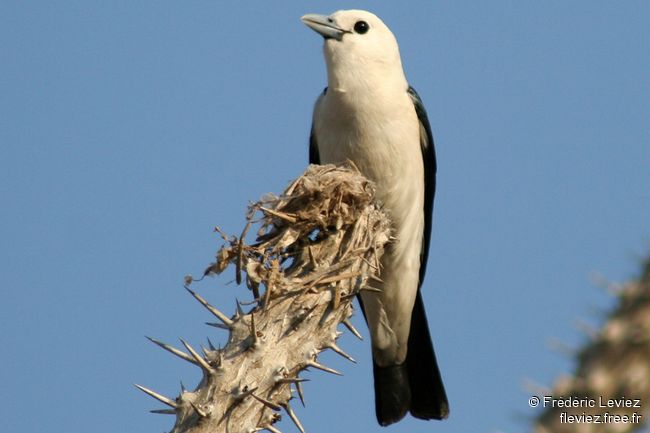
Sunday Inspiration – Woodshrikes and Helmetshrikes

White-crested Helmetshrike (Prionops plumatus) ©WikiC

White-crested Helmetshrike (Prionops plumatus) ©WikiC

And take the helmet of salvation, and the sword of the Spirit, which is the word of God: (Ephesians 6:17 KJV)

The two families this week are the Woodshrikes from tropical Asia and the Helmetshrikes are birds of Africa. Both are from the PASSERIFORMES – Passerines Order, which are Songbirds. The Lord has given them all a song to sing. Trust you will enjoy seeing them and listening to our orchestra play about ‘Joy.”

Large woodshrike (Tephrodornis gularis) ©WikiC

Large woodshrike (Tephrodornis gularis) ©WikiC

Tephrodornithidae – Woodshrikes and allies – 8 Species – is a family of birds that includes the genera Hemipus, Tephrodornis and Philentoma. The family was proposed in 2006 on the basis of a molecular phylogenetic study by Moyle which showed a close relation between Hemipus and Tephrodornis. Some taxonomists argue for a broader treatment of the genera under the Vangidae

Chestnut-fronted Helmetshrike (Prionops scopifrons) ©WikiC

Chestnut-fronted Helmetshrike (Prionops scopifrons) ©WikiC

Prionopidae – Helmetshrikes – 8 Species –This is an African and south Asian group of species which are found in scrub or open woodland. They are similar in feeding habits to shrikes, hunting insects and other small prey from a perch on a bush or tree. Although similar in build to the shrikes, these tend to be colourful species with the distinctive crests or other head ornaments, such as wattles, from which they get their name.

Helmetshrikes are noisy and sociable birds, some of which breed in loose colonies. They lay 2-4 eggs in neat, well-hidden nests.

This slideshow requires JavaScript.

But let us who are of the day be sober, putting on the breastplate of faith and love, and as a helmet the hope of salvation. For God did not appoint us to wrath, but to obtain salvation through our Lord Jesus Christ, (1 Thessalonians 5:8-9 NKJV)

But the fruit of the Spirit is love, joy, peace, longsuffering, gentleness, goodness, faith, (Galatians 5:22 KJV)

Make me to hear joy and gladness; that the bones which thou hast broken may rejoice. (Psalms 51:8 KJV)

Listen to the Faith Baptist Orchestra play as you watch these two beautifully created families of birds:

” I’ve Got Joy” ~ by the Faith Baptist Orchestra

Sunday Inspirations

Birds of the World

Tephrodornithidae – Wikipedia

Tephrodornithidae – Le quide ornitho

Helmetshrike – Wikipedia

Helmetshrikes – Bird Families of the World

Wordless Birds

*

I.O.C. Version 5.2 Updated

Ashy Gerygone (Gerygone cinerea) ©PNG Katerina Tvardikova

Grey Thornbill (Acanthiza cinerea) – (was the Ashy Gerygone) ©PNG Katerina Tvardikova

For the last few days I have been updating to the new I.O.C. Version 5.2. This update wasn’t too bad.

“The IOC World Bird List 5.2 contains 10,567 extant species (and 149 extinct species)  classified in 40 Orders,  238 Families (plus 2 Incertae Sedis) and 2277 Genera.  The list also includes 20,803 subspecies.” I don’t list the subspecies here.

Version 5.2 added 10 species:

And Deleted 3 species:

  • Forsten’s Megapode (Megapodius forsteni)
  • Central Nicobar Serpent Eagle (Spilornis [cheela] minimus)
  • Northern Parrotbill (Paradoxornis polivanovi)

They changed the name of 8 species:

Bluebonnet (Northiella haematogaster) to Eastern Bluebonnet
Swan River Honeyeater (Melithreptus chloropsis) to Gilbert’s Honeyeater
Wattled Honeyeater (Foulehaio carunculatus) to Greater Wattled Honeyeater
Giant Honeyeater (Gymnomyza viridis) to Yellow-billed Honeyeater
Ashy Gerygone (Acanthiza [Gerygone] cinerea) to Grey Thornbill
Chestnut-backed Quail-thrush (Cinclosoma castanotum) to Chestnut Quail-thrush
Mottled Whistler (Rhagologus leucostigma) to Mottled Berryhunter
Blue Seedeater (Amaurospiza concolor) to Cabanis’s Seedeater

They changed 2 scientific names:

  • Ashy Gerygone – Gerygone cinerea to Acanthiza cinerea (then changed the name to Grey Thornbill – see above)
  • Yellow-bellied Fantail – Chelidorhynx hypoxantha to Chelidorhynx hypoxanthus

As far as I know, all Family pages and all the Indexes have been changed. The Update is so new that photos are difficult to locate at this time. Many of the “new species” are subspecies raised to specie level. I am sure the Lord knows all about how many birds He Created and where they all are.

My son, fear thou the LORD and the king: and meddle not with them that are given to change: (Proverbs 24:21 KJV)

For I am the LORD, I change not; (Malachi 3:6a KJV)

Jesus Christ the same yesterday, and to day, and for ever. (Hebrews 13:8 KJV)

Birds of the World

*

“Flag That Bird!” (Part 3)

“Flag that bird!”  (Part 3)

 As birds flying [‘aphôth = “winging” in air], so will the Lord of hosts defend Jerusalem; defending also He will deliver it; and passing over He will preserve it. (Isaiah 31:5)

Luzon Bleeding-heart by Dan

Orni-Theology

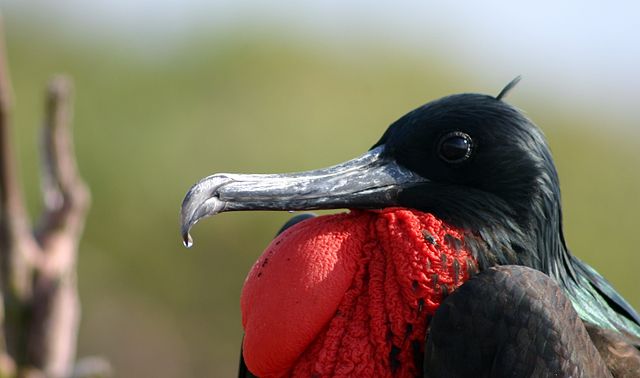
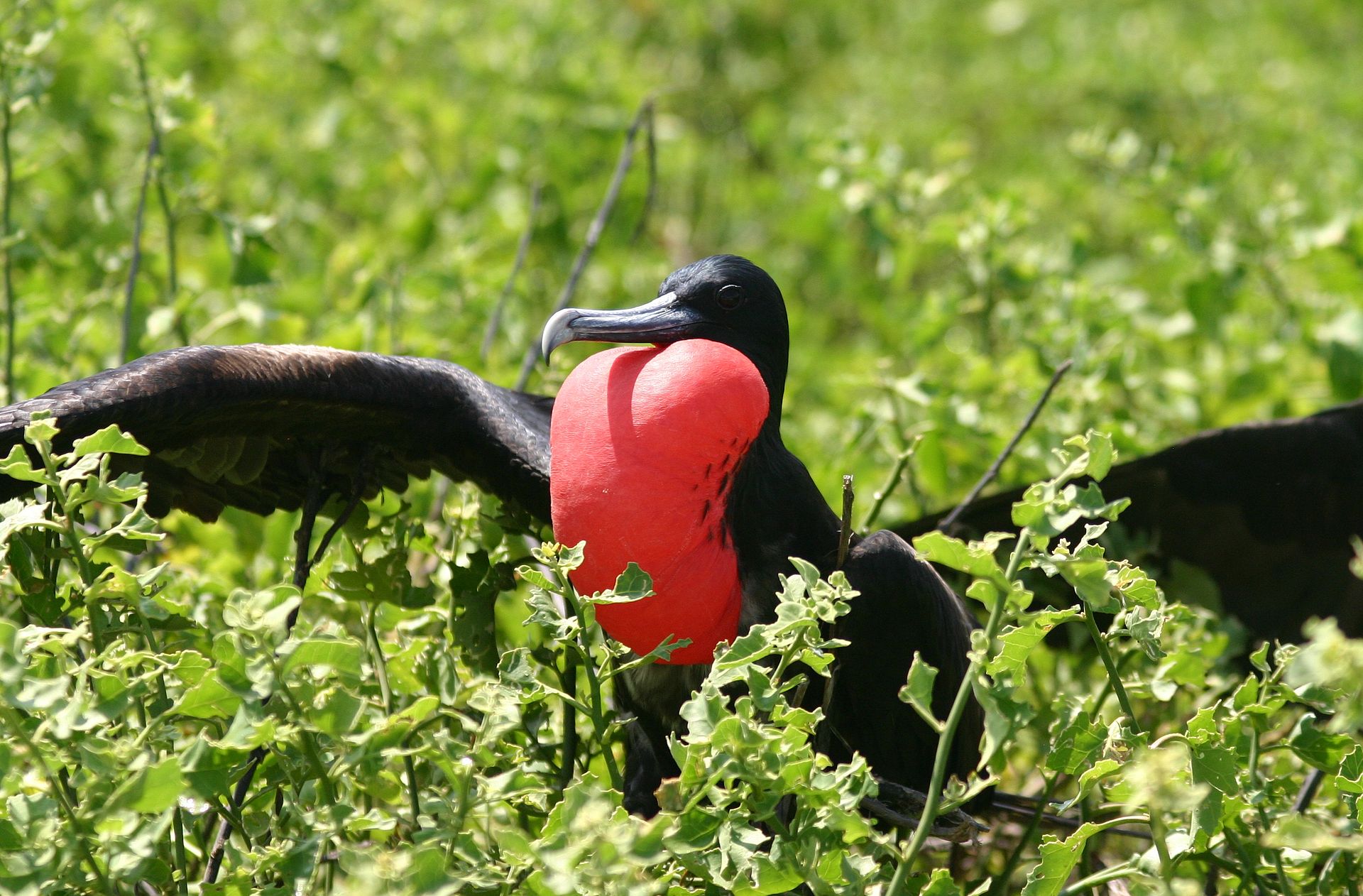
Some birds are known for perching – we call them passerines.  Some wade in shoreline tidewaters – we call them waders.  Some birds don’t even fly at all – the flightless penguins only “fly” underwater!  Many other birds, however, we rarely see doing anything but flying — winging in the air (to use the Biblical Hebrew’s word-picture). Today’s featured creature, the Great Frigatebird, is truly a bird of flight – it is conspicuous in the air, and its wings are both acrobatic and enormous. Great Frigatebird (Fregata minor) Female by Ian In Flag those Birds! (Part 1)”,  we considered 4 “banner birds”  –  besides globally popular eagles  –  that appear on national flags:  Belgium’s Wallonian Chicken (Gallus gallus domesticus); Portugal’s Northern Goshawk (Accipiter gentilis); Burma’s Green Peafowl (Pavo muticus); and Dominica’s Sisserou Parrot (Amazona imperialis). In Flag those Birds! (Part 2)”,  we considered 2 more “banner birds”:  the British Antarctic Territory’s Emperor Penguin (Aptenodytes forsteri), and the Saint Helena Plover, a/k/a Saint Helena’s skinny-legged “Wirebird” (Charadrius sanctaehelenae). As promised, this mini-series is continuing with more “flagged birds”, this time, with the Great Frigatebird (Fregata minor), the soaring seabird officially featured on the flag of Kiribati, a Pacific Ocean nation. God willing, we will subsequently review Papua New Guinea’s bird of paradise (on the flag of Papua New Guinea), the ubiquitous dove (on Fiji’s flag, as well as on the royal standard of Tonga), the black swan of Western Australia,  the white piping shrike of South Australia,  the condor of Bolivia;  and Uganda’s crested crane. So for now, let us consider the frigatebird, which appears on the flag of Kiribati. In case you haven’t visited Kiribati yet, the Republic of Kiribati is an archipelago  —  a cluster of islands — located in the middle of the Pacific Ocean.  Specifically it is comprised of 34 islands, one of which (Banaba) is a “raised coral” island, and the rest of which are reef islands or atolls. The term “middle” (in the phrase “middle of the Pacific”) is fitting, because Kiribati straddles the equator and the International Date Line. To avoid confusion about what “day” it is, — because it would be awkward for neighboring islands to be simultaneously experiencing different “days” on the calendar (e.g., some government offices were closed, observing Sunday, while others were open for business, observing Monday!), — the International Date Line is indented, so that now the Kiribati Islands are, technically speaking, Earth’s farthest frontal time zone (called “UTC+14”, meaning “Universal Time Coordinated”, a/k/a Coordinated Universal Time, f/k/a Universal Time [UT] or Greenwich Mean Time [GMT], — so UTC+14 is 14 hours ahead of the time observed in Greenwich, London,  at the Royal Observatory).   Sorry for taking so much time on this digression’s details. 

Great Frigatebird (Fregata minor) pair ©Flickr Len Blumin

Great Frigatebird (Fregata minor) pair ©Flickr Len Blumin

Interestingly, Kiribati’s time-of-day matches that of Hawaii – but it is deemed one “day” ahead on the calendar.  (Hawaii’s time zone is very “late” in the Earth’s rotational “day”,  a fact that I recall because I worked with some lawyers who took advantage of that once — when a contract option deadline appeared to be lost, because locking in a particular contract option required a signature before 5:00pm on a certain day, but no time zone was specified – the solution was to FAX the contract papers to the Hawaii office and have them signed there, before it was 5:00pm Hawaii time!). Previously Kiribati was within (and almost synonymous with) the Gilbert Islands, just west of the old “date line” – when it was a British colony.  (In fact, the name “Kiribati” is how the native language says “Gilberts”.)   And, if you think that is confusing, you should check out how “daylight saving time” (which may locally vary from “UTC” time, during parts of the year) is applied in the central Pacific Ocean and to some of the neighboring island nations, such as Tonga, Samoa, and Tokelau!

Great Frigatebird (Fregata minor) Male ©WikiC

Great Frigatebird (Fregata minor) Male ©WikiC

Great Frigatebird (Fregata minor).  The Great Frigatebird is found soaring above tropical oceans all over the world.  Because it is almost always seen at sea, it is not surprising that English sailors (centuries ago) called it the “man-of-war”, a term that indicated a fast-sailing oceanic warship, the same kind of ship that the French called a “frigate” (la frégate). If you ever watch a frigatebird in the air, contextualized by a background (or foreground) that provides distance indexing – as I once did (a Magnificent Frigatebird “cousin”, actually, near the shoreline of Grand Cayman, one of the Cayman Islands), – you too will be impressed with the frigatebird’s speedy flight maneuvers.  In fact, its habit of stealing food (such as fish) from other seabirds is so well-known that the bird might have been better labeled the “pirate-bird”.   Why?  Frigatebirds often harass seagulls carrying fish, in the air, repeatedly, until the seagull drops – abandons – his or her piscatorial food-catch, in order to escape the threatening frigatebird.  As the bullied victim (seagull) flees the scene of the crime, empty-beaked, the buccaneering frigatebird swoops down after the plummeting food, snatching it out of the air before it drops into the water. The physical appearance of a frigatebird is not to be easily forgotten.  Frigatebirds are mostly black, with long angular wings, with a long sharply forked tail that looks pointed when “closed”.  (Males are almost all black, except for the red gular pouch (described below); the females have a white “bib” covering most of the neck-to-chest area (but have no gular pouch).  Frigatebirds “have long, thin, hooked bills and the males [each] possess an inflatable gular pouch which can be blown up to form a huge scarlet ball during courtship”.  [Quoting Marc Dando, Michael Burchett, & Geoffrey Waller, SeaLife, a Complete Guide to the Marine Environment (Smithsonian Institute Press, 1996), page 248.]  The male’s bright red “gular pouch” is a skin-covered (i.e., featherless) inflatable throat sac that connects the lower half of the bird’s beak down to and below the bird’s neck.  This inflatable throat sac, quite conspicuous during breeding season, is showcased during courtship displays, swelling into a balloon-like inflation (like a bullfrog), for a timeframe that may exceed 15 minutes!  The noise produced by this throat sac “sound-box” is the frigatebird’s rattling equivalent to yodeling.

Great Frigatebird (Fregata minor) Male Displaying ©WikiC

Great Frigatebird (Fregata minor) Male Displaying ©WikiC

The Great Frigatebird is usually seen soaring above ocean waters, or swooping through the air near island beaches, looking (“on the fly”) for a meal.  In fact, frigatebirds are rarely seen on land during daylight, though they must use land for sleeping and for nesting activities, such as laying and hatching their eggs.  [See www.icr.org/article/why-we-want-go-home/ — citing Tony Soper, Oceans of Birds (London:  David & Charles Press, 1989), pages 82-83.] Oceanographer Tony Soper describes the winged magnificence of this oceanic flier:  “Frigatebirds live up to their reputation [i.e., “frigate” = seafaring warship] with spectacular manoeuvres in aerial pursuit and piracy, stalling and turning with total control in a way which outclasses any competition.  Supremely aerial seabirds, they can hang seemingly motionless in the sky for hours [gliding], waiting to pounce.  The air is their daytime medium, they alight on the water only at their peril, for they have small oil glands and their plumage is not waterproof. … They are equally at a disadvantage on dry land, for their legs are short and hopelessly inadequate for walking.  They must shuffle and climb to a point from which they can take off [and “land” on a rising thermal air current, as if it was an elevator].  By night they roost on a tree or bush which offers a convenient launch-pad when the sunrise brings a thermal lift.  They have huge wings, up to 7ft. (2.1m) in span….  With their shapely wings they float effortlessly in dynamic soaring flight, plunging only to retrieve food items from the surface or to snatch a flying fish.  Sometimes they chase other seabirds to relieve [i.e., rob] them of their catch. “   [Quoting Tony Soper, Oceans of Birds (London:  David & Charles Press, 1989), pages 82-83.] Frigatebirds congregate in breeding colonies, often near colonies of other seabirds (such as cormorants, pelicans, and boobies), not infrequently mooching food collected by their avian neighbors.

Republic of Kiribati, adopted AD1979 ©PD

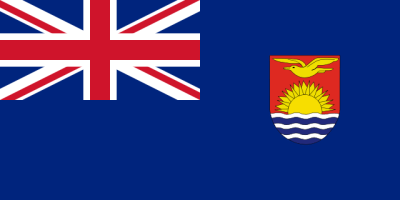
The frigatebird appears to be soaring in sunrise-dominated sky above the ocean waters, in the colorful flag of Kiribati, with the three white stripes representing the three island subsets of Kiribati, the Gilbert Islands, Phoenix Islands, and some of the Line Islands.   (The national coat-of-arms is similar.) Earlier, when Kiribati belonged to the British colony of “Gilbert and Ellice Islands”, the colonial flag included the image of a yellow frigatebird (within a coat-of-arms emblem) soaring in the sunrise above ocean waters.

Gilbert and Ellice Island, as a British colony, AD1937 ©PD

Gilbert and Ellice Island, as a British colony, AD1937 ©PD

Kiribati is a nation that celebrates its past, including its providential heritage as a colony Christianized by the British.  Its official public holidays not only include Easter (celebrating the resurrection of the Lord Jesus Christ) and related days (“Good Friday”, “Holy Saturday”, and “Easter Monday”)), as well as Christmas (celebrating the birth of the Lord Jesus Christ), but also “Gospel Day” (a moveable holiday scheduled on or near July 11th), to celebrate the coming of the Christian faith to these Pacific islands, thanks to God sending Christian missionaries.  Now that’s a day worth celebrating! (See Romans 10:20.) Other national holidays celebrate elderly men (“Unimwane Day”), elderly women (“Unaine Day”),  youth (“Youth Day”), servants (“Boxing Day” – for giving boxed Christmas presents to men and women who serve), and women in general (“International Women’s Day”).   So why not have a holiday to celebrate the value of men in general?  Maybe the omission should be compared to the difference between Mother’s Day and Father’s Day, as they are celebrated in most churches.  On Mother’s Day the typical sermon raves about how wonderful and precious mothers are (and they are applauded, given roses, etc.),  —  but on Father’s Day the typical sermon castigates men for being such sorry fathers, failing, failing, and failing yet again to carry their paternal responsibilities properly — why won’t they do a better job?  (Yet consider this related fact about ingrates:  God the Heavenly Father, Who never fails, knows the ugly ingratitude of billions of humans who fail to appreciate His wonderful, caring providences.  The Lord Jesus was a “man of sorrows”, the Holy Spirit is sometimes “grieved”, and surely God the Father is often disappointed.) The next scheduled bird, on this mini-series list, is the Bird of Paradise, but that bird must wait for another day.  Please stay tuned (and don’t forget Mother’s Day)!

*

“Flag That Bird!”  (Part 1)

“Flag That Bird!”  (Part 2)

More Articles by James J. S. Johnson

Orni-Theology

Fregatidae – Frigatebirds Family

*
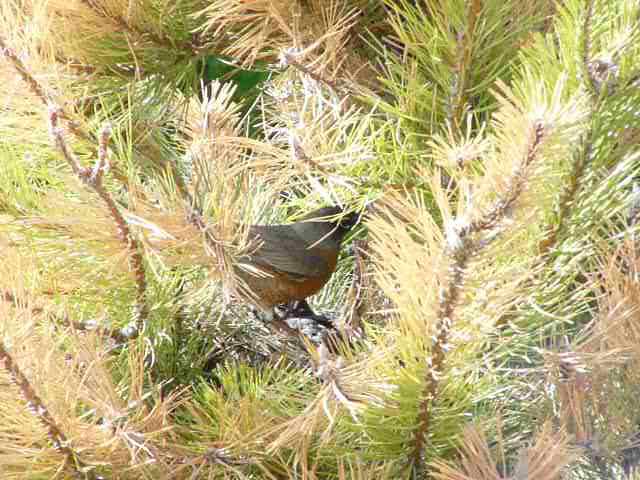
Plus – Melipona Bee Defies Evolution

Melipona Bee ©WikiC

Melipona Bee ©WikiC

For by him were all things created, that are in heaven, and that are in earth, visible and invisible, whether they be thrones, or dominions, or principalities, or powers: all things were created by him, and for him: And he is before all things, and by him all things consist. (Colossians 1:16-17 KJV)

While reading an article from Sage Brush’s “The Vine Vigil” he included this video from exploration films:

To find out more about this relationship between bees and the vanilla bean plus other videos, go to:

God’s Creation – Vanilla Beans and Melipona Bees

Let them praise the name of the LORD: for he commanded, and they were created. (Psalms 148:5 KJV)

*
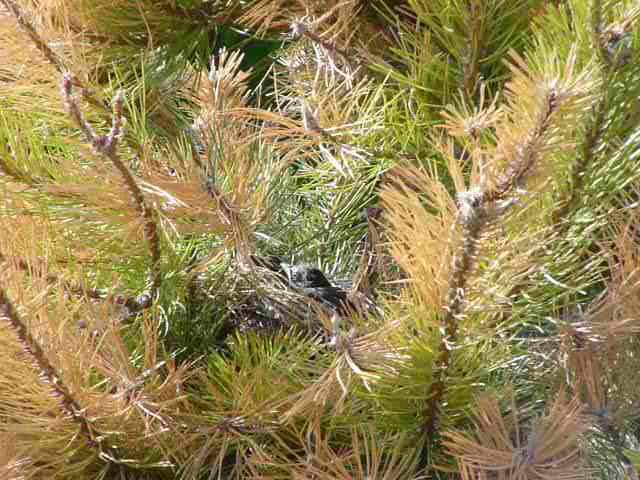
Just realized this little jewel has been written about before, but Sage Brush’s article is very interesting.

*

Tickle Me Tuesday – Laughing Kookaburras

Kookaburra at Brevard Zoo by Dan

Kookaburra at Brevard Zoo by Dan

…God has made me to laugh; all who hear will laugh with me. (Genesis 21:6 AMP – emphasis by me)

He will yet fill your mouth with laughter [Job] and your lips with joyful shouting. (Job 8:21 AMP)

While at the Lowry Park Zoo, we were able to hear and video the Laughing Kookaburras. They will put a smile on your face and a tickle in your heart. We have featured them before, but thought they should be featured again.

For You, O Lord, have made me glad by Your works; at the deeds of Your hands I joyfully sing. (Psalms 92:4 AMP)

Make a joyful noise to the Lord, all the earth; break forth and sing for joy, yes, sing praises! (Psalms 98:4 AMP)

and

Then were our mouths filled with laughter, and our tongues with singing. Then they said among the nations, The Lord has done great things for them. The Lord has done great things for us! We are glad! (Psalms 126:2-3 AMP)

See also:

Unless, I change my mind or someone sends me a link to some birds in a “Tickle Me” action, this will probably be the last one for now. While trying to find some videos to use or photos, I became frustrated while searching for appropriate items for this blog. Either evolution, cuss words, or innuendos were used, that I choose not to share. Call me “old-fashioned” or whatever, but we try to honor the Lord on this site.

Here are the Tickle Me Tuesday that were produced. This post will become a link on the menu under PLUS, so all of them can be found again, if you choose. Typing “Tickle Me” in the search will also bring them all back up.

Other Tickle Me Tuesday’s

*

Sunday Inspiration – Whipbirds, Wattle-eyes and Allies

As you have been viewing the Sunday Inspirations lately, we have been going through the Passerines or Passerfiormes Order in taxonomic order. So far, I have shown you 30 families, which makes us almost a forth of the way through the 125 Passerine families.

Today’s families are the Psophodidae – Whipbirds, Jewel-babblers, Quail-thrushes Family with 16 members and the Platysteiridae – Wattle-eyes, Batises Family with 33 species.

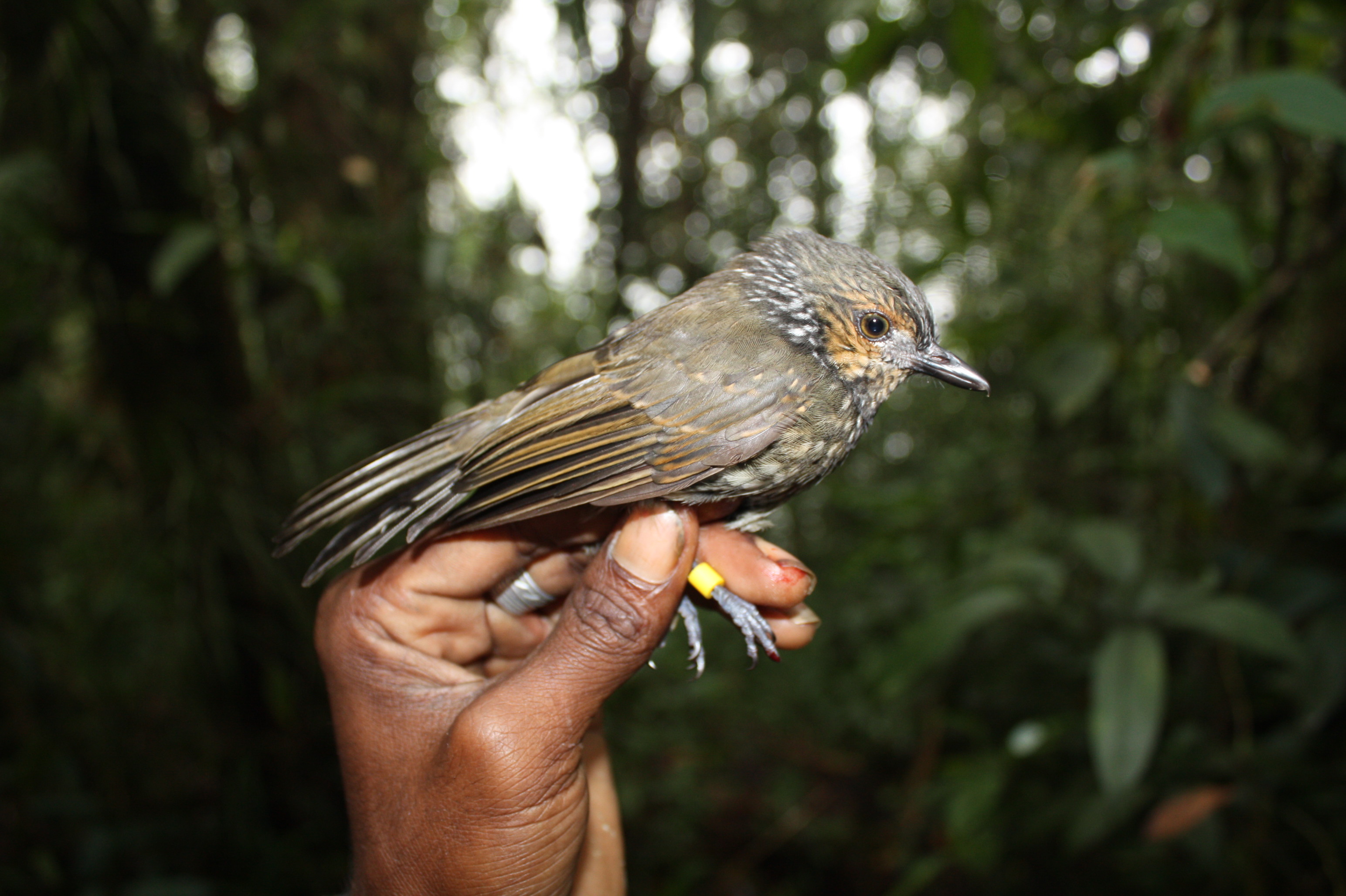
Whipbirds, Jewel-babblers, Quail-thrushes that make up the Psophodidae family are native to Australia and nearby areas. They occur in forest, generally replacing each other at different altitudes. The painted quail-thrush is also found in the forests of New Guinea.The other quail-thrushes are restricted to Australia where they are found in drier habitats, occurring in open forest, scrub and on stony ground.[8] None of the species are thought to be threatened but one subspecies of the spotted quail-thrush is possibly extinct.

The whipbirds and wedgebills are all found in Australia, occurring in a range of habitats from rainforest to arid scrub. The western whipbird is considered to be near-threatened because of habitat loss and fires while the Papuan whipbird is classed as data deficient..

They are terrestrial birds which fly fairly weakly and prefer to squat or run when disturbed. They forage on the ground feeding mainly on insects and other invertebrates.[9] In the desert, quail-thrushes also eat some seeds. They build a cup-shaped nest among shrubs or on the ground. Two or three eggs are laid.

Eastern Whipbird (Psophodes olivaceus) by Ian

Eastern Whipbird (Psophodes olivaceus) by Ian

Here is the song of the Eastern Whipbird. It sounds like someone snapping a whip.

Brown-throated Wattle-eye (Platysteira cyanea) ©WikiC

Brown-throated Wattle-eye (Platysteira cyanea) Male ©WikiC

The Platysteiridae Wattle-eyes, Batises Family are a favorite of mine because of their eyes. They are a family of small stout birds living in trees, primarily of the woodlands and forests of sub-Saharan Africa. The family contains the wattle-eyes, batises and shrike-flycatchers. They were previously classed as a subfamily of the Old World flycatcher family Muscicapidae.

These insect-eating birds are found in usually open forests or bush. They hunt by flycatching, or by taking prey from the ground like a shrike. The nest is a small neat cup low in a tree or bush. The most important component of the diet of all species is insects, although spiders, millipedes and scorpions are also taken, and there are even records of small lizards being consumed.

This slideshow requires JavaScript.

For the ways of man are before the eyes of the LORD, And He ponders all his paths. (Proverbs 5:21 NKJV)

My son, give me your heart, And let your eyes observe my ways. (Proverbs 23:26 NKJV)

The humble shall see this and be glad; And you who seek God, your hearts shall live. (Psalms 69:32 NKJV)

Listen to Sean play as you watch these two beautifully created families of birds:

” Be Thou My Vision and Battle Hymn of the Republic” ~ played by Sean Fielder

Sunday Inspirations

Passeriformes Birds so far:

Birds of the World

Cinclosomatidae or Psophodidae Family – Wikipedia

Platysteiridae – Wattle-eye – Wikipedia

Good News

*

Ian’s Bird of the Week – Collared Sparrowhawk

Collared Sparrowhawk (Accipiter cirrocephalus) by Ian

Ian’s Bird of the Week – Brown Sparrowhawk ~ by Ian Montgomery

Newsletter ~ 4/17/15

I sent the previous post by mistake when I was working on the ebook version of the birds of the week this afternoon. This was actually bird of the week in May 2009, and then I thought it was a Brown Goshawk until a raptor expert recently pointed out the error of my ways with these photos on the website.

I’m making good progress with the ebook. It’s getting quite large, so I’m going to publish it two volumes. The first will be 2002 to 2009. I’ll keep you posted on progress. I think I’m going to call it ‘Diary of a Bird Photographer‘ as it reads like a (weekly) diary.

Anyway, here is the full, corrected posting, six years late!

*Note: this was originally posted as a Brown Goshawk, but the bird is actually a Collared Sparrowhawk. Please accept my apologies.

I’m still sorting through the photos that I took at Gluepot last month. One surprising visitor to the watering point near the hide was a Collared Sparrowhawk that came in to drink and bathe. She (it was rather large) spent nearly half an hour at the tank and bathed several times. Naturally, all the other traffic at the watering point came to a standstill, though I was amused to see a flock of Brown Honeyeaters becoming increasingly restless and approaching much closer than I would have expected. Eventually, she vanished as swiftly as she had appeared and things returned to normal.
Collared Sparrowhawk (Accipiter cirrocephalus) by Ian
The Sparrowhawk seemed very wary, particularly when preparing to bathe and looked around repeatedly as if making sure the coast was clear. It was almost as if the Queen of the Forest couldn’t be seen to be doing her toilet in public and she certainly looked very undignified both when bathing, second photo, and when she emerged wet and bedraggled from the water, third photo. I was impressed by how soft and owl-like the feathers were – the original stealth attack aircraft, I suppose.
Collared Sparrowhawk (Accipiter cirrocephalus) by Ian
Collared Sparrowhawks are smallish hawks,30-40cm/12-16in long, with a wingspan to 70cm/28in. As with many birds of prey, the females are larger and this is thought to be to protect the nestlings from the males in a weak moment. The Collared Sparrowhawk is widespread in all except the driest areas of Australia and New Guinea and because of its furtive behaviour and confusion with the similar Brown Goshawk, is probably commoner than might be supposed.

Recent updates* to the website include new galleries for the Australo-PapuanTreecreepers (), additional photos of various Honeyeaters, Wedge-tailed Eagle and White-bellied Sea-Eagle.

*recent in 2009, but the links are still valid.

**************************************************
Ian Montgomery, Birdway Pty Ltd,
454 Forestry Road, Bluewater, Qld 4818
Tel 0411 602 737 ian@birdway.com.au
Bird Photos http://www.birdway.com.au/
Where to Find Birds in Northern Queensland: iTunesGoogle Play Kobo Books
Recorder Society http://www.nqrs.org.au


Lee’s Addition:

Doth the hawk fly by thy wisdom, and stretch her wings toward the south? Doth the eagle mount up at thy command, and make her nest on high? She dwelleth and abideth on the rock, upon the crag of the rock, and the strong place. From thence she seeketh the prey, and her eyes behold afar off. (Job 39:26-29 KJV)

Another neat bird he has introduced us to, even though it is apparently six years late. Ian gave his permission and I started doing his newsletter in July of 2009. That Brown Goshawk (was dated in May 2009, so it was never written up) I did go back and catch some of his older newsletters as you can see from the list.

Wow! Has it been 6 years? Ian, thank you for that permission. With his newsletter and photograph usage, Ian has been a large input for this blog.

See:

Ian’s Bird of the Week (list of newsletters)

Ian’s Honeyeaters, Wedge-tailed Eagle and White-bellied Sea-Eagle.

Ian’s Accipitridae Family

Accipitridae – Kites, Hawks, Eagles Family

Collared Sparrowhawk – Wikipedia

Collared Sparrowhawk – Birds in Backyards

Collared Sparrowhawk – Avian Web

*

Ian’s Bird of the Week – Black-faced Monarch

Ian’s Bird of the Week – Black-faced Monarch ~ by Ian Montgomery

Newsletter ~ 4/15/15

On the way to Orbost in East Gippsland in March on the great owl hunt, we stopped for a break at Fairy Dell Nature Reserve between Bairnsdale and Lakes Entrance. This has a lovely walk through temperate rainforest along a creek with plenty of interesting birds – we saw our first Lyrebird of the weekend here. We also found this Black-faced Monarch showing its black face to great advantage through the fronds of a tree fern.

Black-faced Monarch (Monarcha melanopsis) by Ian

Black-faced Monarchs are usually inconspicuous solitary inhabitants of dense forest and are best located by their calls, the most distinctive of which is a vibrant fluty call, rendered by Pizzey and Knight as ‘Why-you, which-you’. Here they search for insects, sometimes making sallies after flying insects when they are easier to spot. The combination of grey back and wings, black face and rich, rufous underparts is striking, though the rufous breast is best seen in the gloom of the forest using a flash, as in the second photo taken in the highlands of Northeastern Queensland. These two photos encompass most of the breeding range of this species along the east coast of Australia from Melbourne to Cape York.

Black-faced Monarch (Monarcha melanopsis) by Ian

These birds are resident in the highlands of Northeastern Queensland but breeding summer visitors to areas farther south. In winter many migrate to southern and eastern New Guinea, and some immature birds spend their first summer there. In the lowlands of Northeastern Queensland, around Townsville for example, we see them only as passage migrants in March-April and September-October and I saw one last week along Bluewater Creek near the house, reminding me that autumn is here. The bird in the third photo is an immature one photographed on the creek ten years ago. Juvenile lack the black face, have brownish wings and dark bills with a pinkish edge to the base of the lower mandible – which you can just see in this photo.

Black-faced Monarch (Monarcha melanopsis) juvenile by Ian

Black-faced Monarch build beautiful, conical nests wedged into the fork of a shrub or sapling in moist gullies. This is constructed of fibrous plant material, including ferns and moss, glued together using gossamer from spiders’ webs as in the fourth photo.

Black-faced Monarch (Monarcha melanopsis) Nest by Ian

Autumn here means warm, clear sunny days and (relatively) cool nights with low humidity, very welcome after the wet season and my favourite time of the year. The wet usually leaves a legacy of lush green grassland and forest, though this year it has been fairly dry with good rain only in January. The Dollarbirds have left for the winter and the forests and gardens are rather silent without the loud calls of the Koels and Channel-billed Cuckoos, leaving just the Blue-winged Kookaburras and Bar-shouldered Doves to fill the gap.

Greetings
Ian

**************************************************
Ian Montgomery, Birdway Pty Ltd,
454 Forestry Road, Bluewater, Qld 4818
Tel 0411 602 737 ian@birdway.com.au
Bird Photos http://www.birdway.com.au/
Where to Find Birds in Northern Queensland:  iTunesGoogle Play Kobo Books
Recorder Society http://www.nqrs.org.au


Lee’s Addition:

“If a bird’s nest happens to be before you along the way, in any tree or on the ground, with young ones or eggs, with the mother sitting on the young or on the eggs, you shall not take the mother with the young; you shall surely let the mother go, and take the young for yourself, that it may be well with you and that you may prolong your days”. (Deuteronomy 22:6-7 NKJV)

What a nice looking bird, Ian. That breast color reminds me of our American Robin’s outfit. Thanks again for sharing so many birds with us over the weeks. With over 10,000 of the Lord’s avian creations flying around, you nor I will ever cover them all.

Here is the Black-faced Monarch’s call from xeno-canto:

You can see Ian’s Monarch family photos at Monarch Flycatchers & Allies [Family: Monarchidae]
Monarchidae – Monarchs Family

Black-faced Monarch –  Wikipedia
Black-faced Monarch – Birds in Backyards
Black-faced Monarch – New Zealand Birds Online

*