Ian’s Bird of the Moment – Eastern Grass Owl

Seeing as Bird of the Moment has been such a rarity lately, I thought I’d finish the year on a special note. So here’s a species that I always wanted to photograph, but never thought I would: maybe on the ‘if the god(s) is/are kind bucket list’.

But before that here is my greetings of the season; too late for Christmas but in time for 2018, which is perhaps the more important – longer anyway.

Two weeks ago I went spotlighting in the Townsville Town Common Conservation Park with some local birding experts, including one who has an official key to the locked gates that normally keep vehicles out of the more remote areas of the Park: the saline flats near Bald Rock and a track that runs through some lovely forest along a tributary of the Bohle River to Shelley Beach.

The target species, and rather a long shot at that, was the Spotted Nightjar which sometimes turns up along the grassy, saline flats. Anyway, the forest produced five Owlet Nightjars, some of which posed for photos and a Tawny Frogmouth, also photographed. On the return through the normally accessible parts of the Park along the main track, we photographed a cooperative Large-tailed NIghtjar and a more distant Barking Owl

The highlight of the night was a Tyto owl on the grass beside the track though the saline flat. Provisionally identified as a Barn Owl, we soon realised that it was a female Eastern Grass Owl, a species recorded only occasionally around Townsville, though more common near Ingham, for example at the eponymous Tyto Wetlands. The female differs from the smaller male in having orange-buff underparts and is distinctive but both genders can be distinguished from the otherwise similar Barn Owl by darker upperparts and much longer, slender legs which trail behind the tail in flight. After photographing it, we flushed it to get a look at its long legs and confirm the identification.

We didn’t find any Spotted Nightjars, but no one cared amid the jubilation at getting such good view of the Grass Owl. We returned a week later for another look. That night, the Tawny Frogmouths were out in force and no sign of either Spotted Nightjars or the Grass Owl. Instead we found a cooperative Barn Owl along perched obligingly in a dead tree in woodland beside the main track. Here it is for comparison.

Grass and Barn Owls have extensive ranges and the ‘Eastern’ in both cases refers to Eastern Eurasia and Australasia. Grass Owls also occur in Africa and there is disagreement whether this is is the same species as the Eastern Form. Similarly, the Eastern Barn Owl, Tyto delicatula, is sometimes split from the Western Eurasian, African and American forms, Tyto alba. Anyway, they’re all gorgeous birds and Australia has an unusually rich selection of five species of about sixteen in total worldwide. Four of the Australian ones are here http://www.birdway.com.au/tytonidae/index_aus.php.

We’ve checked earlier records and it appears that most records of Spotted Nightjars in the Townsville District are in winter, June-August. So, we’ll try again next year, and I hope you have a healthy and rewarding 2018 too.Ian


Lee’s Addition:

“Give instruction to a wise man, and he will be yet wiser: teach a just man, and he will increase in learning. The fear of the LORD is the beginning of wisdom: and the knowledge of the holy is understanding. For by me thy days shall be multiplied, and the years of thy life shall be increased.” (Proverbs 9:9-11 KJV)

>Ian, I believe the Creator of this beautiful Eastern Grass Owl has been very kind to your “Bucket List.” Over the years, you have seen and photographed numerous Avian Wonders that you have graciously shared with us.

May your New Year be a great one and, hopefully, your Birds of the Moment/Week articles might come more frequently again.
Ian’s Bird of the Week/Moment
*

Avian And Attributes – Ear(ed)

Eared Pygmy Tyrant (Myiornis auricularis) ©WikiC

Eared Pygmy Tyrant (Myiornis auricularis) ©WikiC

“LORD, thou hast heard the desire of the humble: thou wilt prepare their heart, thou wilt cause thine ear to hear:” (Psalms 10:17 KJV)

“Bow down thine ear to me; deliver me speedily: be thou my strong rock, for an house of defence to save me.” (Psalms 31:2 KJV)


Avian and Attributes – Ear (Eared)

E’AR, n. [L. auris, whence auricula; audio.]
1. The organ of hearing; the organ by which sound is perceived; and in general, both the external and internal part is understood by the term. The external ear is a cartilaginous funnel, attached, by ligaments and muscles, to the temporal bone.
2. The sense of hearing, or rather the power of distinguishing sounds and judging of harmony; the power of nice perception of the differences of sound, or of consonances and dissonances. She has a delicate ear for music, or a good ear.
5. A favorable hearing; attention; heed; regard. Give no ear to flattery.
I cried to God–and he gave ear to me. Psa 77.
He could not gain the prince’s ear.
6. Disposition to like or dislike what is heard; opinion; judgment; taste.
7. Any part of a thing resembling an ear; a projecting part from the side of any thing; as the ears of a vessel used as handles. [Edited]


Eared Dove (Zenaida auriculata) by Robert Scanlon

Eared Dove (Zenaida auriculata) by Robert Scanlon

“The hearing ear, and the seeing eye, the LORD hath made even both of them.” (Proverbs 20:12 KJV)

Our Creator, the Lord Jesus Christ, created the ear which is able to receive sounds and messages. A Lord who Listens. He listens to our request to Him and expects us to listen to the messages He gives to us. So, today, we see that there are five birds named “Eared.”

Eared Dove (Zenaida auriculata) is a New World dove. It is a resident breeder throughout South America from Colombia to southern Argentina and Chile, and on the offshore islands from the Grenadines southwards. It may be a relatively recent colonist of Tobago and Trinidad. It appears to be partially migratory, its movements driven by food supplies.

Eared Pitta (Hydrornis phayrei) ©WikiC

Eared Pitta (Hydrornis phayrei) is a species of bird in the pitta family, Pittidae and is found in Southeast Asia. Its natural habitats are subtropical or tropical moist lowland forests and subtropical or tropical moist montane forests.

Eared Poorwill (Nyctiphrynus mcleodii) is a species of nightjar in the family Caprimulgidae. It is endemic to Mexico.
Its natural habitats are subtropical or tropical dry forests and subtropical or tropical moist montane forests.

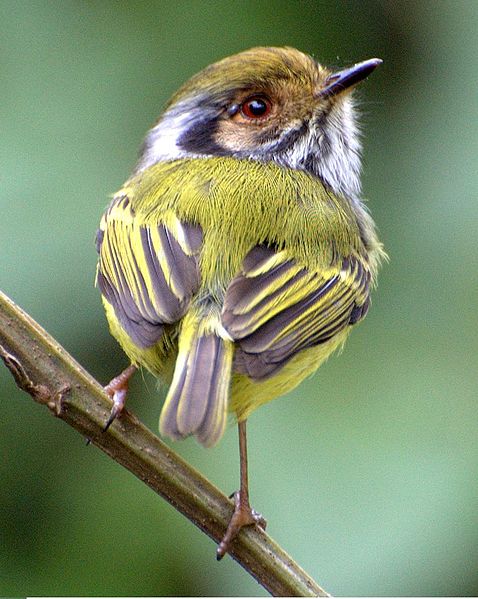
Eared Pygmy-Tyrant - Intervales - Brazil_S4E9991

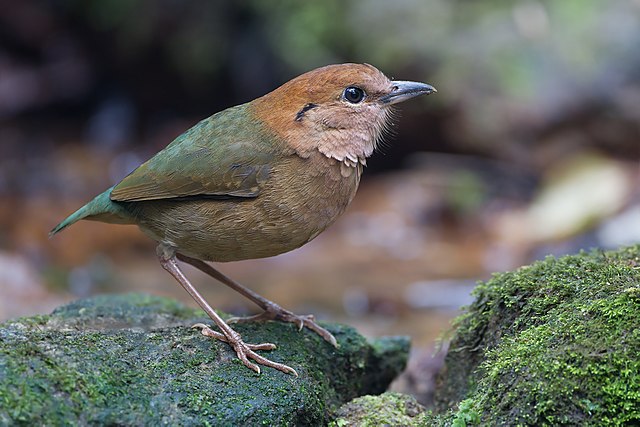
Eared Pygmy Tyrant (Myiornis auricularis) is a species of bird in the family Tyrannidae. It is found in Brazil, Paraguay and northeastern Argentina. Its natural habitats are subtropical or tropical moist lowland forests and heavily degraded former forest.

Eared Quetzal (Euptilotis neoxenus), also known as the eared trogon, is a near passerine bird in the trogon family, Trogonidae. It breeds in streamside pine-oak forests and canyons in the Sierra Madre Occidental of Mexico south to western Michoacán. It is sometimes seen as a vagrant to southeasternmost Arizona in the United States and has bred there. This range includes part of the Madrean Sky Islands region of southeastern Arizona, southwestern New Mexico, and northern Sonora.


More Avian and Attributes

Birds whose first or last name start with “E”

Good News

*
[Definitions from Webster’s Dictionary of American English (1828), unless noted. Bird info from Wikipedia plus.]

*** Dan and I were away for four day on a Birdwatching Adventure. We just arrived back today and will soon have some photos and tales to tell. Stay Tuned! ***

Christmas Bird from the Christmas Islands

Christmas Island White-eye (Zosterops natalis) by Ian

Christmas Island White-eye (Zosterops natalis) by Ian

“For unto you is born this day in the city of David a Saviour, which is Christ the Lord. And this shall be a sign unto you; Ye shall find the babe wrapped in swaddling clothes, lying in a manger.” (Luke 2:11-12 KJV)

MERRY CHRISTMAS from Dan and I, and from our writers, who add so much to this blog. James J. S. Johnson, Emma Foster, and Ian Montgomery are the other authors currently. We have produced quite a few articles about “Christmas Birds,” yet not much about the birds named “Christmas.” Here is a brief description of them, with links to other “Christmas Bird” articles over the years.

Christmas Boobook (Ninox natalis) by Ian

Christmas Boobook (Ninox natalis) by Ian

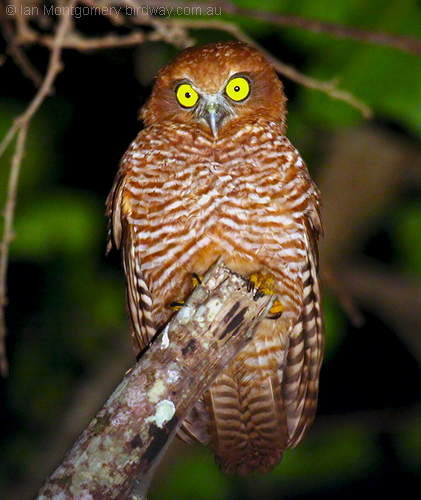
The Christmas Boobook (Ninox natalis), also known more specifically as the Christmas Island hawk-owl, is a species of owl in the family Strigidae. Closely related to the hawk owls of Southeast Asia and Australia. N. natalis was first classified at species level by J.J.Lister in 1888. It was not until 1998 however that DNA testing confirmed its status as a separate species from other owls.

The Christmas Island Hawk Owl is a small, rufous-brown hawk-owl with a barred breast, dark chestnut facial mask, whitish brow, lores and throat, yellow eyes, legs and feet. It is approximately 26–29 cm in length and 130-190 grams in weight with the female slightly larger than the male. The double-noted hoot, boo-book, has a clucking quality with the second note usually lower in pitch. The begging call of juveniles is a high-pitched trill.

Christmas Frigatebird (Fregata andrewsi) by Ian

Christmas Frigatebird (Fregata andrewsi) by Ian

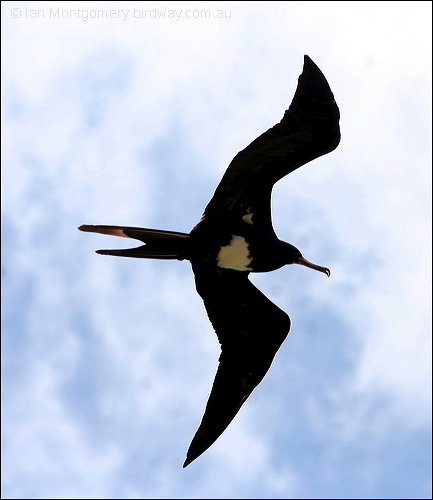
Christmas Frigatebird (Fregata andrewsi) or Christmas Island Frigatebird (Fregata andrewsi) is a seabird of the frigatebird family Fregatidae which is endemic to Christmas Island in the Indian Ocean. The Christmas frigatebird is a large lightly built seabird with brownish-black plumage, long narrow wings and a deeply forked tail. It has a wingspan of around 2.15 m (7.1 ft). The male has an egg shaped white patch on its belly and a striking red gular sac which it inflates to attract a mate. The female is slightly larger than the male and has a white breast and belly. They feed on fish taken in flight from the ocean’s surface (mostly flying fish), and sometimes indulge in kleptoparasitism, harassing other birds to force them to regurgitate their food.

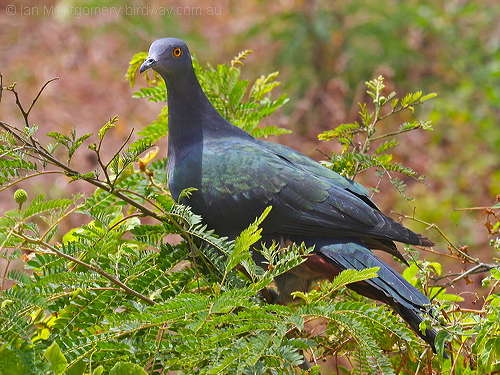
Christmas Island Imperial-Pigeon (Ducula whartoni) by Ian

Christmas Island Imperial-Pigeon (Ducula whartoni) by Ian

Christmas Imperial Pigeon (Ducula whartoni), is a large (39 cm in length, 450-700 g in weight) pigeon, mainly dark grey in colour with an iridescent sheen. Fruit from forest trees with occasional buds and leaves are it main diet. It builds a platform nest of twigs high in a forest tree. It utters a deep booming call.

See: Ian’s Bird of the Week – Christmas Imperial Pigeon

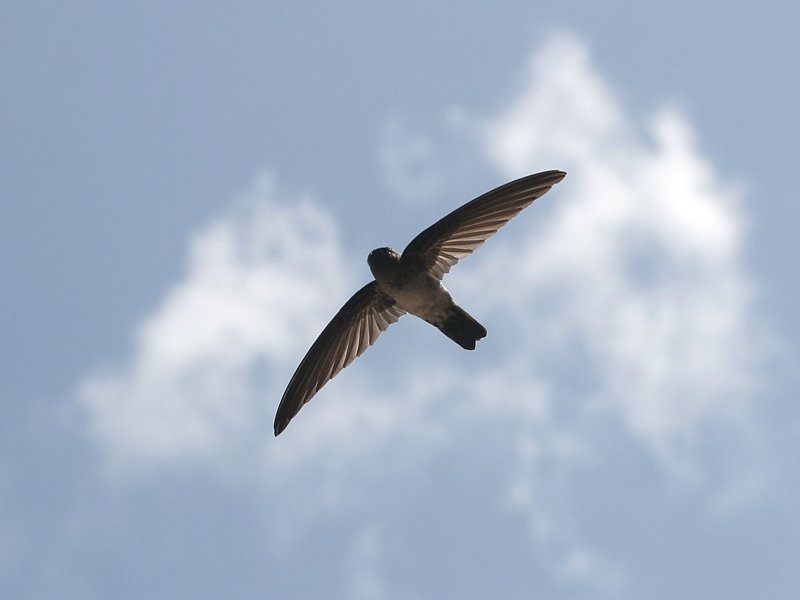
Christmas Island Swiftlet (Collocalia natalis) ©Christmas IS Wildlife

Christmas Island Swiftlet (Collocalia natalis), also known as the Christmas glossy swiftlet or the Christmas cave swiftlet, is a small bird in the swift family Apodidae. It is endemic to Christmas Island, an Australian territory in the eastern Indian Ocean. It was formerly commonly treated as a subspecies of the glossy swiftlet.

Christmas Shearwater (Puffinus nativitatis) ©WikiC 2 FK Starr

Christmas Shearwater (Puffinus nativitatis) is a medium-sized shearwater of the tropical Central Pacific. It is a poorly known species due to its remote nesting habits, and it has not been extensively studied at sea either.

The Christmas Shearwater nests on remote islands of the Central Pacific: the Northwestern Hawaiian Islands, Tuamotu, the Marshall Islands, Kiritimati (for which the species is named) and Sala-y-Gómez. It has become locally extinct on a number of islands, including Wake Island. Outside of the breeding season it ranges across the Pacific, having been recorded off the coast of Mexico and Guatemala in the east, and Bonin Islands in the west. Further south it is rare, having been recorded off Fiji only twice (one time in early to mid-May).

Christmas White-eye (Zosterops natalis) by Ian

Christmas White-eye (Zosterops natalis) by Ian

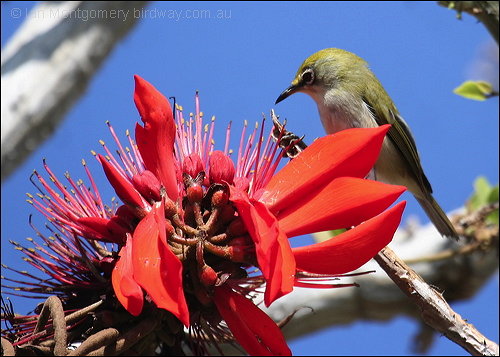
The Christmas White-eye (Zosterops natalis) is a species of bird in the family Zosteropidae. It is endemic to Christmas Island. Its natural habitats are subtropical or tropical moist lowland forests and subtropical or tropical moist shrubland. It is threatened by habitat loss.

See also: Ian’s Bird of the Week – Christmas Island White-eye

It is always refreshing to take a look back at other Christmas Blogs. Just as we are all looking back to the first “Christmas” event, when the Saviour of the World, took on human flesh, as a baby. Totally human, totally God. It is difficult for us to wrap our thoughts around that truth.

Some Christmas Birds (Re-posted)

The Christmas Birds Series in 2013

In 2014 – Sunday Inspiration – Christmas Birds  Please watch the video near the end.

MAY YOUR CHRISTMAS BE FILLED WITH BLESSINGS AS YOU REMEMBER THE REASONS FOR CELEBRATING OUR SAVIOUR’S BIRTH.

Joys and Challenges of Birdwatching

Northern Mockingbird (Mimus polyglottos) at Gatorland by Lee

“Delight thyself also in the LORD; and he shall give thee the desires of thine heart.” (Psalms 37:4 KJV)

While enjoying the birds and critters at Gatorland this week, I had another enjoyable adventure. In fact, at breakfast this morning, I was chuckling as I was again relating my tale to Dan. Most know that Dan is the “Bird Photographer” and I am the “Bird Watcher.” I only use a nice “point-and-shoot” camera that is always set on “Program” mode. In other words, I don’t know an “F-stop” from a “bus stop.”

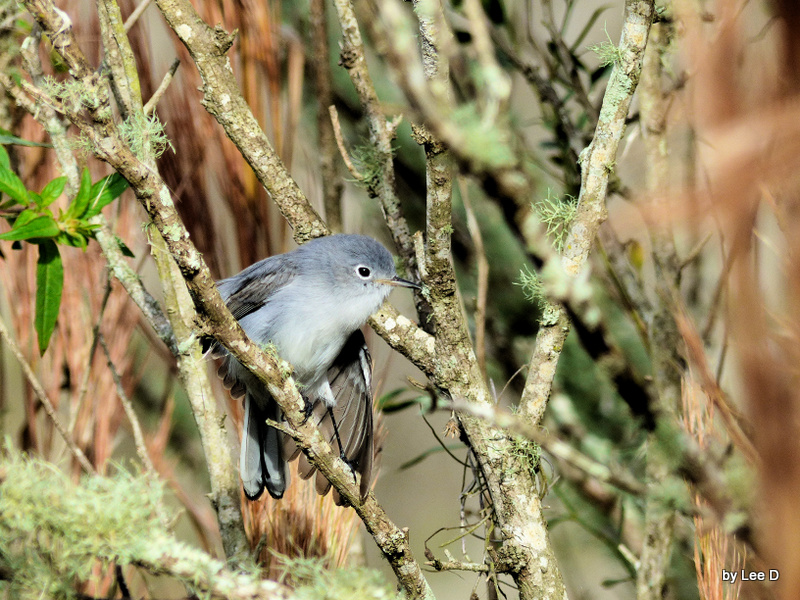
Earlier, at Gatorland, I had been listening to, and watching a Blue-grey Gnatcatcher in the trees. I kept waiting for him to pop out so I could get a photo. This went on for some time, and most birders know how they do not stay still. Finally, he popped out on a limb in clear view. Pulled my camera and…. it was turned off. Needless to say by the time it was on, he was gone. Yuk! [Here is a photo from another adventure.]

Blue-grey Gnatcatcher preening at Circle B by Lee

Oh, well! There must be another adventure yet to enjoy.

Off I rolled on the motorized wheels, while Dan rested. Aha! I heard a Northern Mockingbird. Let’s see if I can have better luck this time.

“But the meek shall inherit the earth; and shall delight themselves in the abundance of peace.” (Psalms 37:11 KJV)

True birders know that “patience is a virtue.” I visually chased that Mockingbird through the bushes waiting for him to pop out. This time I made sure my camera was on. [Program mode also takes great “bush” pictures. Notice how clear the limb in the upper right corner.:o) ]

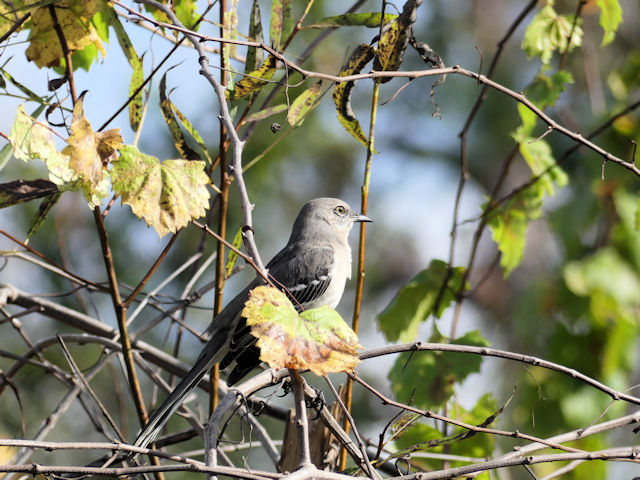
Northern Mockingbird (Mimus polyglottos) at Gatorland

“Better is the end of a thing than the beginning thereof: and the patient in spirit is better than the proud in spirit.” (Ecclesiastes 7:8 KJV)

I heard the Mockingbird first coming from these bushes, and thus began my delightful challenge of getting a photo of it.

Northern Mockingbird (Mimus polyglottos) at Gatorland

The northern mockingbird (Mimus polyglottos) is the only mockingbird commonly found in North America. This bird is mainly a permanent resident, but northern birds may move south during harsh weather. This species has rarely been observed in Europe. This species was first described by Linnaeus in his Systema Naturæ in 1758 as Turdus polyglottos. The northern mockingbird is known for its mimicking ability, as reflected by the meaning of its scientific name, ‘many-tongued mimic.’ The northern mockingbird has gray to brown upper feathers and a paler belly. Its tail and wings have white patches which are visible in flight.

Mockingbird in there

They teach taking photos with a 1/3 rule. Birdwatchers like me place them right in the center so we can find them later.

Northern Mockingbird (cropped)

Cropped – See, it is there.

The northern mockingbird is an omnivore. It eats both insects and fruits. It is often found in open areas and forest edges but forages in grassy land. The northern mockingbird breeds in southeastern Canada, the United States, northern Mexico, the Bahamas, the Cayman Islands and the Greater Antilles.

Almost got him - at least the eye

Getting better, can see part of it.

The northern mockingbird is known for its intelligence. A 2009 study showed that the bird was able to recognize individual humans, particularly noting those who had previously been intruders or threats. Also, birds recognize their breeding spots and return to areas in which they had the greatest success in previous years. Urban birds are more likely to demonstrate this behavior. Finally, the mockingbird is influential in United States culture, being the state bird of five states, appearing in book titles, songs and lullabies, and making other appearances in popular culture. [Wikipedia with editing]

FINALLY!!!

Finally Northern Mockingbird (Mimus polyglottos) at Gatorland

NOW HE FOUND ME!!!

He found me Northern Mockingbird (Mimus polyglottos) at Gatorland

This is the Joy of Birdwatching. You have to love the Adventures, and saying a prayer now and then to ask the Lord to “Please” let the bird come in to view!!!

The whole series on Flickr

More Gatorland Adventures

*

Reginald and Oliver’s Christmas Tree by Emma Foster

Wild Turkeys ©Pixabay

Reginald and Oliver’s Christmas Tree by Emma Foster

Before the heavy snow fell, Reginald and the turkeys settled into their fortress. Reginald knew now that he had to start looking for a Christmas tree. When the snow lightened, Reginald decided he should find a tree. One morning he left in search of the perfect Christmas tree, accompanied by Oliver.

Reginald and Oliver traveled for some time, dragging themselves through the snow. Oliver insisted on wearing his army helmet because he was afraid they would run into hunters. He followed Reginald through the snow, occasionally having to be pulled out of the snow with Reginald’s help.

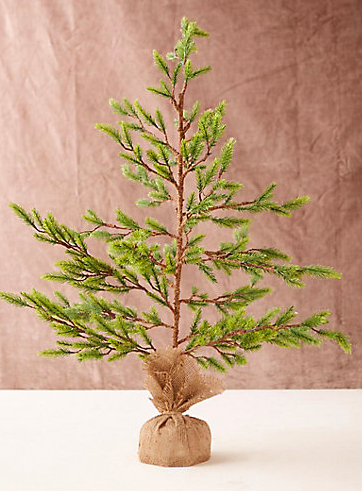
After walking a little way, Reginald and Oliver found a wide open space near a circle of trees. In the sunlight, a small tiny pine tree stood in front of most of the other trees, and Reginald thought it would be the perfect tree for Christmas that year. The trunk was just right for Reginald and Oliver to be able to push the tree over since they had nothing to cut it with.

Tiny Tree

Just as they were about to head for the tree, Reginald noticed some hunters lurking in some bushes nearby. Oliver and Reginald hid and attempted to form a plan. Reginald decided that he would go off and distract the hunters so Oliver could knock the tree over and take it back to the fortress.

Reginald left Oliver by the bushes and walked a few yards away. He began gobbling, hoping that the hunters would hear him and try to see where he was. Reginald quickly hid in the bushes near a river where he wouldn’t be seen and waited for the hunters to come look for him. Eventually, he heard footsteps as the hunters moved closer.

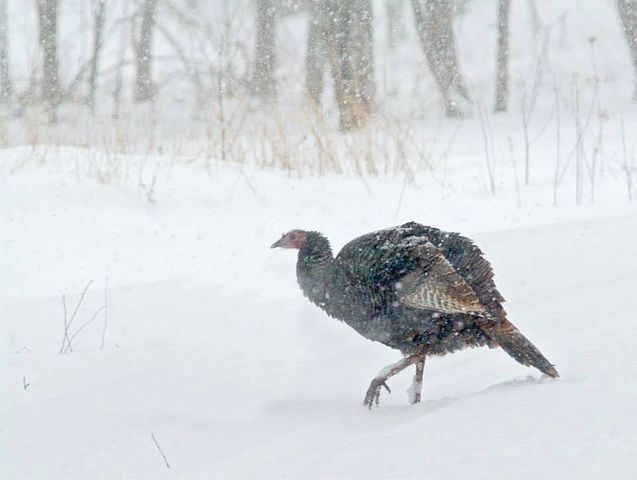
Turkey in Snow ©SABaking

Once the hunters had gone Oliver quickly ran to the tree and began pushing on it until it toppled over. Unfortunately, when Oliver pushed the tree down it began rolling forward, dragging Oliver into its branches until it fell into the nearby river and began drifting away. Reginald watched Oliver fall into the river and quickly ran after him, shaking his head and hoping the hunters couldn’t see him. He caught up to Oliver and tried to pull him to shore, but Oliver only dragged him onto the tree, causing Reginald to get soaked.

Oliver and Reginald floated down the river on the tree for a very long time until they ran into a rock, which kept the tree from drifting farther down the river. Oliver began gobbling loudly, but Reginald quickly told him to be quiet. Fortunately, they had floated far away from the hunters toward their fortress.

Reginald and Oliver quickly dragged the tree up onto land and carried it back to the fortress. The turkeys had already begun making ornaments and stringing berries by the time they arrived back at the fortress. After they set up the tree, Reginald and the turkeys hung the ornaments and sang some turkey carols quietly. As for the hunters, they searched all day for Reginald and Oliver, but eventually had to go home because more snow had begun to fall. Again, it was ham for Christmas.

Christmas Ham ©WikiC


Lee’s Addition:

“Who remembered us in our lowly state, For His mercy endures forever; And rescued us from our enemies, For His mercy endures forever; Who gives food to all flesh, For His mercy endures forever. Oh, give thanks to the God of heaven! For His mercy endures forever.” (Psalms 136:23-26 NKJV)

Well, Oliver has again given Reginald his challenge. This time, their need for a Christmas tree provides the adventure. We trust you have been enjoying the various adventures through the pen of Ms. Emma Foster. Emma, you have written another enjoyable tale for us. Thank you, and Merry Christmas to you.

More of Emma’s Stories

Wordless Birds

*

Great Egret Preening at Gatorland

I love watching the Great Egret with their long flowing feathers. Today the breeze was blowing gently and was able to catch this beautiful Great Egret on Video. Enjoy!

“He who dwells in the secret place of the Most High Shall abide under the shadow of the Almighty. I will say of the LORD, “He is my refuge and my fortress; My God, in Him I will trust.” Surely He shall deliver you from the snare of the fowler And from the perilous pestilence. He shall cover you with His feathers, And under His wings you shall take refuge; His truth shall be your shield and buckler.” (Psalms 91:1-4 NKJV)

These photos were also taken:

Great Egret at Gatorland

Great Egret at Gatorland

Great Egret Feathers at Gatorland

Great Egret at Gatorland

These photos are on the Flickr Site. Still testing.


Grey Parrot at Gatorland – December 2017

The Grey Parrot today at Gatorland looked quite bright-eyed. This was taken straight from the camera, no editing, and loaded up on my Flickr Site. This is an experiment. Since so many photos disappeared off of WordPress, I am trying to see how placing them on Flickr might be a new option. [One problem: Can’t seem to center the photo. Stays on left.]

Grey Parrot (Psittacus erithacus)

“The lamp of the body is the eye. Therefore, when your eye is good, your whole body also is full of light. But when your eye is bad, your body also is full of darkness. Therefore take heed that the light which is in you is not darkness. If then your whole body is full of light, having no part dark, the whole body will be full of light, as when the bright shining of a lamp gives you light.” (Luke 11:34-36 NKJV)

The Grey Parrot or African grey parrot (Psittacus erithacus) is an Old World parrot in the family Psittacidae. This article describes the Congo grey parrot. The Timneh parrot (Psittacus timneh) was earlier treated as conspecific but has since been split as a full species.

Grey parrots are monogamous breeders which nest in tree cavities. Each couple of parrots needs its own tree to nest. The hen lays three to five eggs, which she incubates for 30 days while being fed by her mate. The adults defend their nesting sites.  Both parents help take care of the chicks until they can go off on their own. Grey parrot chicks require feeding and care from their parents in the nest. The parents take care of them until four or five weeks after they are fledged. Young leave the nest at the age of 12 weeks. Little is known about the courtship behavior of this species in the wild. They weigh between 12 and 14 g at hatching and between 372 and 526 g when they leave their parents.

They are mostly frugivorous; most of their diet consists of fruit, nuts, and seeds. The species prefers oil palm fruit and also eat flowers and tree bark, as well as insects and snails. In the wild, the grey is partly a ground feeder. In captivity, it can eat sunflower seeds, bird pellets, a variety of fruits such as pears, orange, pomegranate, apple, and banana, and vegetables such as carrots, cooked sweet potato, celery, fresh kale, peas, and green beans. They also need a source of calcium. [Wikipedia with editing]

Yeah! We did a little birdwatching today!

Gatorland

Here was another bright-eyed Parrot today.

Parrot at Gatorland 12-21-17


Birds of the Bible – Return of the Hoopoe Video

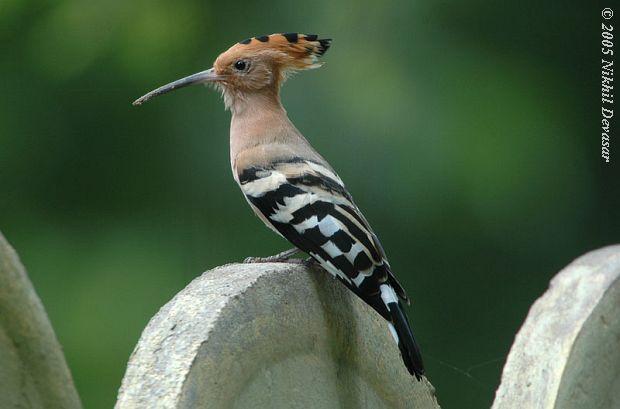
Eurasian Hoopoe (Upupa epops) by Nikhil

Updated 2/20/18 The original video is no longer online. Here is a cute Hoopoe chick sticking its head out to see the world.

This is a very interesting video about a Hoopoe parent and chick. It is worth the watch. I have always enjoyed looking at their beauty. The Creator really put a special touch on the Hoopoe. Also, they are one of the Birds of the Bible.

“‘And these you shall regard as an abomination among the birds; they shall not be eaten, they are an abomination: the eagle, the vulture, the buzzard, the kite, and the falcon after its kind; every raven after its kind, the ostrich, the short-eared owl, the sea gull, and the hawk after its kind; the little owl, the fisher owl, and the screech owl; the white owl, the jackdaw, and the carrion vulture; the stork, the heron after its kind, the hoopoe, and the bat.” (Leviticus 11:13-19 NKJV)

Birds of the Bible

Birds of the Bible – Hoopoe

Other articles:

*

Mandarin Duck Pair at Zoo Miami

While working on the Life List of All the Birds We Have Seen, I came across this video and decided to share it. We were at the Wings of Asia Aviary at Zoo Miami.

“When I consider thy heavens, the work of thy fingers, the moon and the stars, which thou hast ordained; What is man, that thou art mindful of him? and the son of man, that thou visitest him? For thou hast made him a little lower than the angels, and hast crowned him with glory and honour.” (Psalms 8:3-5 KJV)

“The Mandarin Duck (Aix galericulata) is a perching duck species found in East Asia. It is medium-sized, at 41–49 cm (16–19 in) long with a 65–75 cm (26–30 in) wingspan. It is closely related to the North American wood duck, the only other member of the genus Aix. Aix is an Ancient Greek word which was used by Aristotle to refer to an unknown diving bird, and galericulata is the Latin for a wig, derived from galerum, a cap or bonnet.

The adult male has a red bill, large white crescent above the eye and reddish face and “whiskers”. The breast is purple with two vertical white bars, and the flanks ruddy, with two orange “sails” at the back. The female is similar to female wood duck, with a white eye-ring and stripe running back from the eye, but is paler below, has a small white flank stripe, and a pale tip to its bill.

Both the males and females have crests, but the crest is more pronounced on the male.

Like many other species of ducks, the male undergoes a moult after the mating season into eclipse plumage. When in eclipse plumage, the male looks similar to the female, but can be told apart by their bright yellow-orange beak, lack of any crest, and a less-pronounced eye-stripe.”[Wikipedia]

Life List of All the Birds We Have Seen – Part I

Life List of All the Birds We Have Seen

Avian And Attributes – Elegant

Elegant Euphonia - Panama_H8O1931

Elegant Euphonia

“Then Herod and his soldiers ridiculed and mocked him. Dressing him in an elegant robe, they sent him back to Pilate.” (Luke 23:11 NIV)

“And Herod with his men of war set him at nought, and mocked him, and arrayed him in a gorgeous robe, and sent him again to Pilate.” (Luke 23:11 KJV)

Christ wore an elegant or gorgeous robe. They were mocking him, yet, he was very worthy of wearing an elegant robe.


Avian and Attributes – Elegant

EL’EGANT, a. [L. elegans.] Polished; polite; refined; graceful; pleasing to good taste; as elegant manners.
1. Polished, neat; pure; rich in expressions; correct in arrangement; as an elegant style or composition.
2. Uttering or delivering elegant language with propriety and grace; as an elegant speaker.
3. Symmetrical; regular; well formed in its parts, proportions and distribution; as an elegant structure.
5. Beautiful in form and colors; pleasing; as an elegant flower.
6. Rich; costly and ornamental; as elegant furniture or equipage.


Our Creator and Savior knew about creating Elegant beauty, especially in the avian creations. Here is a list of birds that birdwatchers have place the word, Elegant, in their first names:

Elegant Quail (Callipepla douglasii) Male ©WikiC

Elegant Crescentchest 1

Elegant Crescentchest (from Flickr)

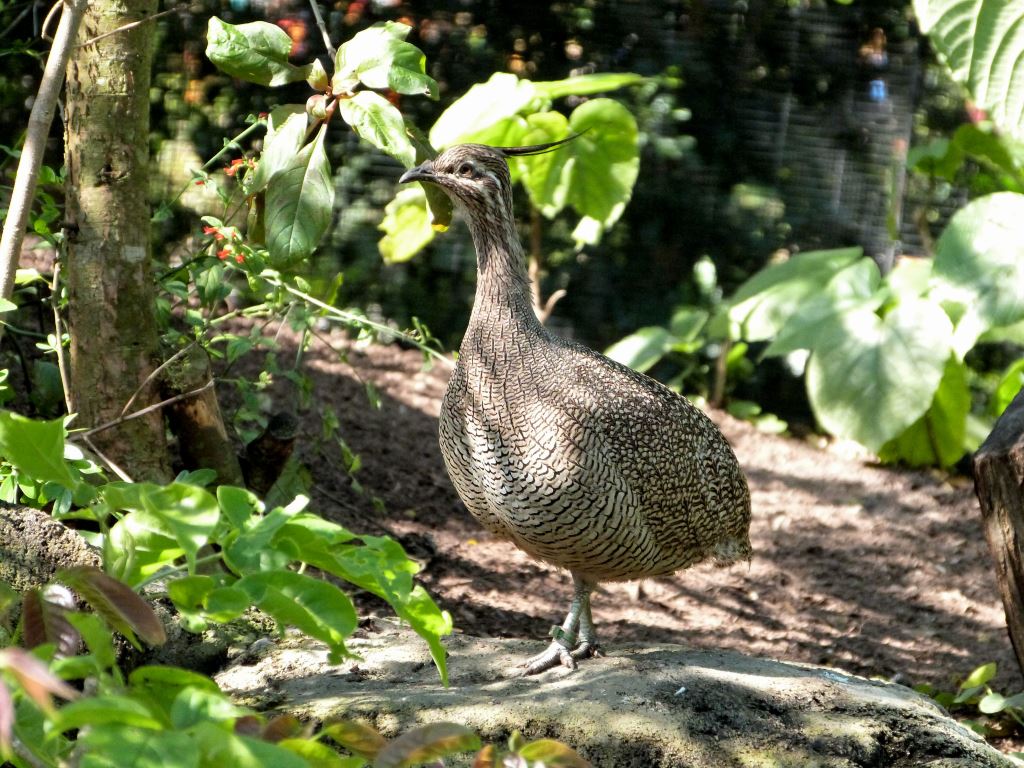
Elegant Crested Tinamou (Eudromia elegans) Cloud Forest at Zoo Miami by Lee

Elegant Crested Tinamou (Eudromia elegans) Cloud Forest at Zoo Miami by Lee

Elegant Euphonia (Euphonia elegantissima) ©WikiC

Links to: Elegant Honeyeater, and  Elegant Imperial Pigeon,

Elegant Parrot (Neophema elegans) WikiC

Elegant Parrot (Neophema elegans) WikiC

Elegant Tern by Ian Montgomery

Elegant Tern by Ian Montgomery

Link to Elegant Pitta

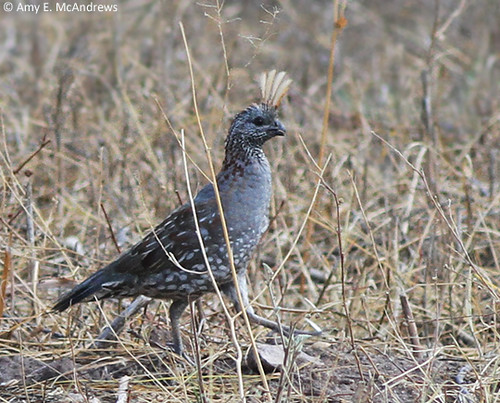
Elegant Quail

Elegant Quail (from Flickr)

Links to Elegant Sunbird, Elegant Tit,

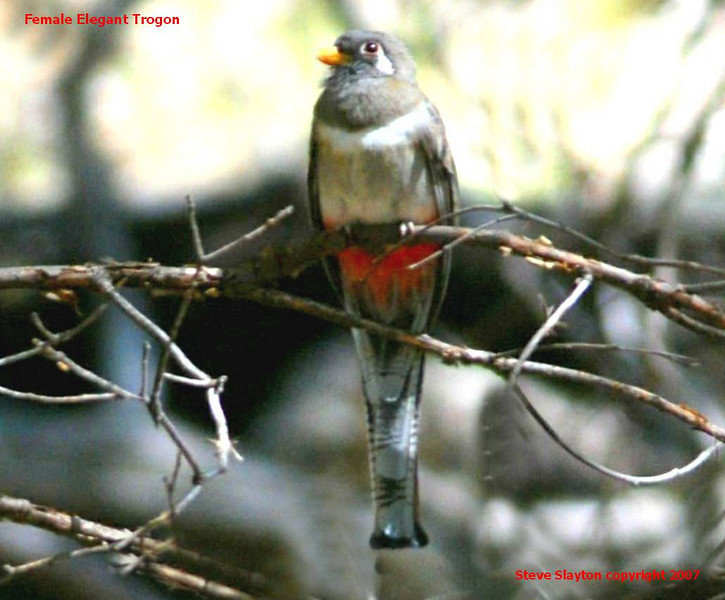
Elegant Trogon (Trogon elegans) by S Slayton

Elegant Trogon (Trogon elegans) by S Slayton

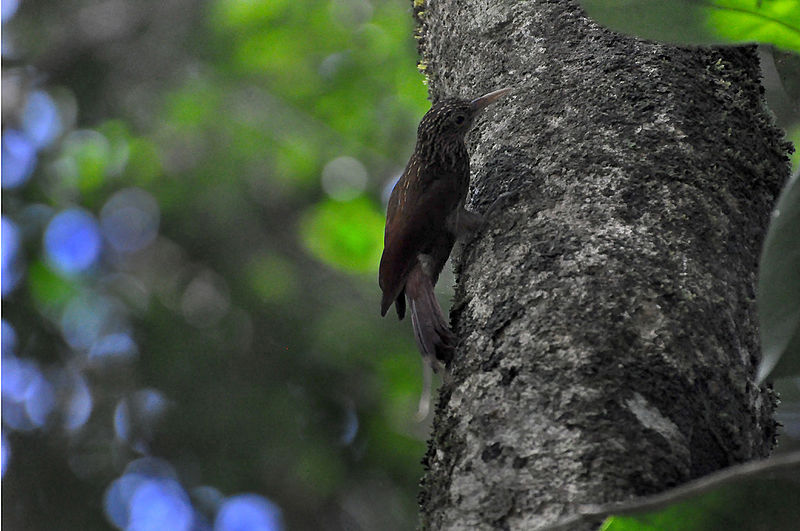
Elegant Woodcreeper (Xiphorhynchus elegans) ©WikiC


More Avian and Attributes

Birds whose first name start with “E”

Good News

*
[Definitions from Webster’s Dictionary of American English (1828), unless noted. Bird info from Wikipedia plus. Edited]

Avian And Attributes – Diamond

Diamond Dove (Geopelia cuneata) by Ian 1

“Thou hast been in Eden the garden of God; every precious stone was thy covering, the sardius, topaz, and the diamond, the beryl, the onyx, and the jasper, the sapphire, the emerald, and the carbuncle, and gold: the workmanship of thy tabrets and of thy pipes was prepared in thee in the day that thou wast created.” (Ezekiel 28:13 KJV)

“In the beginning was the Word, and the Word was with God, and the Word was God. The same was in the beginning with God. All things were made by him; and without him was not any thing made that was made.” (John 1:1-3 KJV)


Avian and Attributes – Diamond

Diamond, n. Dimond. [L., Gr. See Adamant.]
1. A mineral, gem or precious stone, of the most valuable kind, remarkable for its hardness, as it scratches all other minerals. When pure, the diamond is usually clear and transparent, but it is sometimes colored. In its rough state, it is commonly in the form of a roundish pebble, or of octahedral crystals. It consists of carbon, and when heated to 14 degrees Wedgewood, and exposed to a current of air, it is gradually, but completely combustible. When pure and transparent, it is said to be of the first water.
2. A very small printing letter.
3. A figure, otherwise called a rhombus.
DIAMOND, a. Resembling a diamond, as a diamond color; or consisting of diamonds, as a diamond chain.

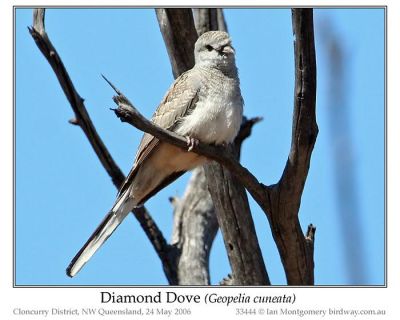
Diamond Dove (Geopelia cuneata) by Ian

Diamond Dove (Geopelia cuneata) by Ian

The Diamond Dove (Geopelia cuneata) is a resident bird in Australia. The dove predominantly exists in areas near water but which are lightly arid or semi-arid in nature, being Central, West and Northern Australia. They are one of Australia’s smallest pigeons along with the peaceful dove. They have been spotted occasionally in Southern Australia in parks and gardens when the centre of Australia is very dry.

Diamond Firetail (Stagonopleura guttata) by Ian

The Diamond Firetail (Stagonopleura guttata) is a species of estrildid finch that is endemic to Australia. The diamond firetail is a finch that has a fiery red bill, eyes, and rump. Just below the throat, it has a thick black band that extends horizontally until it reaches the lower part of the wings which are also black with white spots. There is also a black eye band that starts at the beak and ends right at the eye. The bird’s tail is also black. The rest of the wings are a slightly tan, light brown colour. Its head and back is light grey and its belly and chin are white. The colour of the egg is also white. This bird is considered one of the smallest of the finches.


More Avian and Attributes

Birds whose first or last name start with “D”

Good News

*
[Definitions from Webster’s Dictionary of American English (1828), unless noted. Bird info from Wikipedia plus.]

Whinchat, Redstart, & Redchat: Debunking the “Speciation” Myth Again

Whinchat-perching.Parrotletsuk-photo

WHINCHAT photo credit: Parrotletsuk.typepad.com

 Whinchat, Redstart, and Redchat:  Debunking the “Speciation” Myth Again

Dr. James J. S. Johnson

Are not two sparrows [στρουθια] sold for a farthing? and one of them shall not fall on the ground without your Father. But the very hairs of your head are all numbered.  Fear ye not therefore, ye are of more value than many sparrows [στρουθιων].   (Matthew 10:29-31)

Are not five sparrows [στρουθια] sold for two farthings, and not one of them is forgotten before God?  But even the very hairs of your head are all numbered. Fear not therefore: ye are of more value than many sparrows [στρουθιων].   (Luke 12:6-7)

It’s good to know that we are worth far more, to God Himself, than many “sparrows”.  However, the term “sparrows” (as quoted above) is an English translation of the New Testament Greek noun strouthion, a fairly general word for “small bird’ that can include many varieties of perching songbirds, in general, including yet not limited to the birds we label “sparrows”(1) —  including the Whinchat, a sometimes inconspicuous little songbird that resembles a thrush, wheatear, or a flycatcher.  (Or maybe a redstart?)

Whinchat-male.ScottishOrnithologistsClub

WHINCHAT Scottish Ornithologists’ Club

It was my privilege, on July 13th of AD2006, to view a Whinchat (Saxicola rubetra) among some roadside weeds, while in the fine company of my wonderful wife (Sherry) and Dr. Bill Cooper, England’s top-tier gentleman and scholar.

The bird-book that I was using, that day (as Laird Bill drove us along a motorway between Harwich and London), described the common Whinchat as follows:

Restless, short-tailed chat that perches openly on bush-tops, tall weeds and fences, flicking its wings and tail. Males in summer distinctive.  Females and autumn birds can be confused with the female Stonechat, but Whinchat’s conspicuous creamy eyebrows, boldly streaked rump and white wedges at base of tail (often noticed as birds flick tail to balance in the wind) are reliable fieldmarks.

[Quoting Chris Knightley & Steve Madge, POCKET GUIDE TO THE BIRDS OF BRITAIN AND NORTH-WEST EUROPE (Yale Univ. Press, 1998), page 212.]  The Whinchat is a summer migrant, visiting (and nesting in) Great Britain and much of western Europe during the spring and summer months, migrating south to northwestern Africa for the winter months.  Its habits are typical of many other insect-eating passerines:

Nests on heaths, grassy moors, rough fields, damp rushy meadows and young coniferous plantations. Like Stonechat, pounces to the ground for insects, returning to same slightly elevated perch or flying quickly to another sprig nearby.  Broken song mixes short musical phrases with dry churrs and distinct pauses.  Call an agitated tu-tek, tu-tek-tek. Widespread on migration, often in some numbers in coastal bushes and fields.

[Again quoting Chris Knightley & Steve Madge, POCKET GUIDE TO THE BIRDS OF BRITAIN AND NORTH-WEST EUROPE (Yale Univ. Press, 1998), page 212.]

The Whinchat has other names, including Paapje (Dutch), Braunkehlchen (German), Traquet tarier (French), and Buskskvätta (Swedish: “bush chat”).  [See Roger Tory Peterson, Guy Mountfort, & P.A.D. Hollom, BIRDS OF BRITAIN AND EUROPE (Houghton Mifflin / Peterson Field Guides, 5th rev. ed., 1993), pages 175-176.]  Moreover, to the chagrin of taxonomic “splitters”, the Whinchat is known to hybridize with the Siberian Stonechat and the Common (European) Stonechat of western (and southern) Europe.  [See Eugene McCarthy, HANDBOOK OF AVIAN HYBRIDS OF HE WORLD (Oxford, 2006), page 238.] – proving that those 3 chats descend form a common ancestor pair that survived the worldwide Flood aboard Noah’s Ark.

More surprising, to the birding community, is the capture and DNA verification (by the Lista Bird Observatory in Vest-Agder, Norway, during September AD2013) of a hybrid parented by male Common Redstart (Phoenicurus phoenicurus) and a female Whinchat (Saxicola rubetra), published in the Journal of Ornithology.(2)

Redchat-Redstart-Whinchat-hybrid.Norway-JonasLangbraten-photo

Common Redstart x   Whinchat HYBRID

Photograph by Jonas Langbråten

(18 Sept. AD2013, Lista Bird Observatory, Vest-Agder, Norway)

The male Redstart-Whinchat hybrid was captured by bird-banding volunteers, near the southern tip of Norway’s peninsula.

“We have a standardized bird banding project where we mark migratory birds in the spring and autumn. We have volunteer bird watchers going every hour to catch birds in mist nets to band them,” says Jan Erik Røer from the Norwegian Ornithological Society.
[Quoting Ingrid Spilde’s “Mysterious Bird was Unique Cross of Two Unrelated [sic] Species”, Science Nordic, (3-11-AD2015), at http://sciencenordic.com/mysterious-bird-was-unique-cross-two-unrelated-species . ]

The hybrid’s unofficial name is rødskvett (“redchat”), blending parts of the Norwegian words (Buskskvett and Rødstjert) for its two parents.

Needless to say, this little “redchat” has caused a lot of confusion and controversy among evolutionists at the Natural History Museum in Oslo, where the “speciation” mythology (of supposed biogenetic divergence, “13.3 million years” ago) is popularly taught, as if there was real “science” (empirical or forensic) to support that imaginary scenario.(3)

Once again the “speciation” myth of “natural selection”-advocating evolutionists, both theistic and atheistic, is debunked by the real-world evidence.


References

  1. When the Lord Jesus referred to God’s watchcare over “sparrows” (English translation for Greek strouthion], He used a Greek word that is more general in its categorical coverage than is our English term “sparrow”. The Greek noun strouthion denotes a bird in the wild, possibly any small perching songbird, including but not limited to what we call “sparrows”. (In fact, the Septuagint translators used strouthion to translate the Hebrew noun tsippôr, in Psalm 84:3a [84:4a BH], which is usually translated simply as “bird” (e.g., Genesis 7:14; Deuteronomy 14:11 & 22:6; Psalm 104:1; Ezekiel 39:4) or “fowl” (e.g., Deuteronomy 4:17; Nehemiah 5:18; Ezekiel 17:23 & 39:17). The Septuagint translators also used strouthion to translate the Hebrew double-noun qe’ath-midbâr in Psalm 102:7b, a construct phrase that refers to some bird or birds that habituate open desert or semi-desert areas.)
  2. See Silje Hogner, Albert Burgas Riera, Margrethe Wold, Jan T. Lifjeld, & Arild Johnsen, “Intergeneric Hybridization Between Common Redstart Phoenicurus phoenicurus and Whinchat Saxicola rubetra Revealed by Molecular Analyses”, JOURNAL OF ORNITHOLOGY, 156(3):829-836 (2015), cited in Dave Appleton’s “Common Redstart x Whinchat”, BIRD HYBRIDS (1-13-AD2016), posted at http://birdhybrids.blogspot.com/2016/01/common-redstart-x-whinchat.html . This unexpected hybrid is discussed in Ingrid Spilde’s “Mysterious Bird was Unique Cross of Two Unrelated [sic] Species”, Science Nordic (3-11-AD2015), posted at http://sciencenordic.com/mysterious-bird-was-unique-cross-two-unrelated-species .
  3. See 1st Timothy 6:20, regarding the folly of “’science’ falsely so-called”.  See also, accord, John 3:12.