Sunday Inspiration – Cuckooshrikes

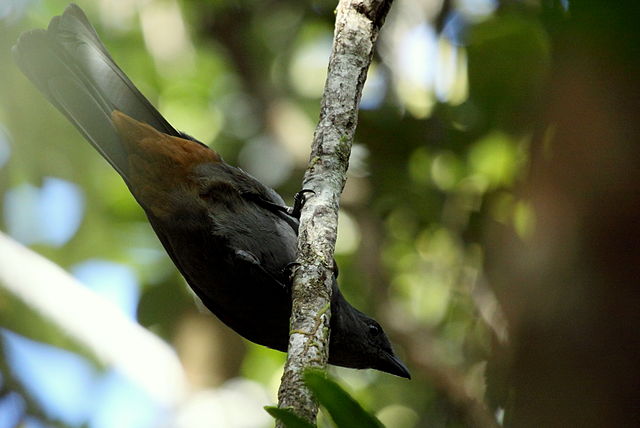
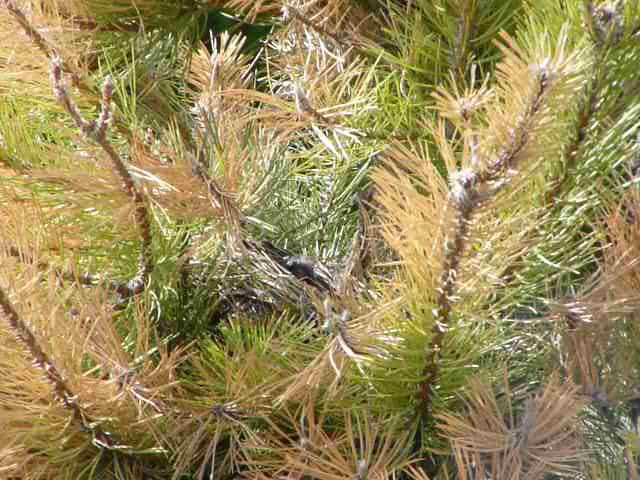
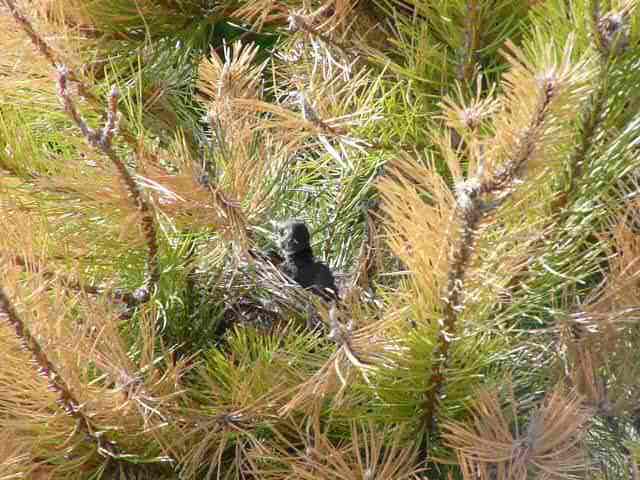
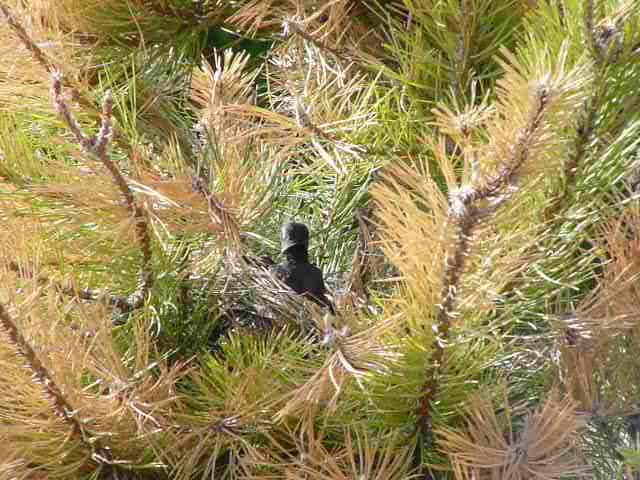
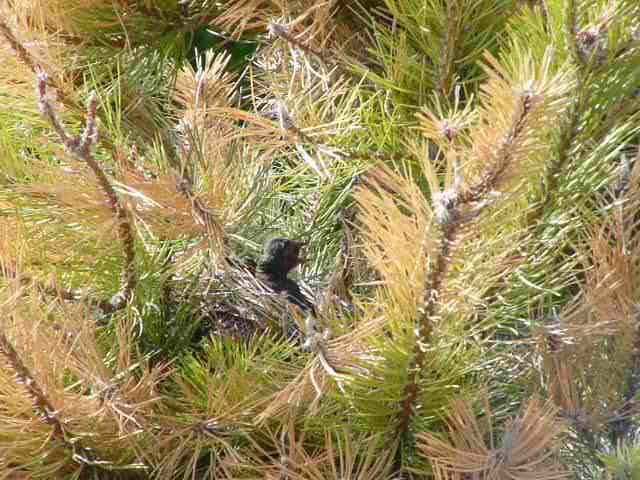
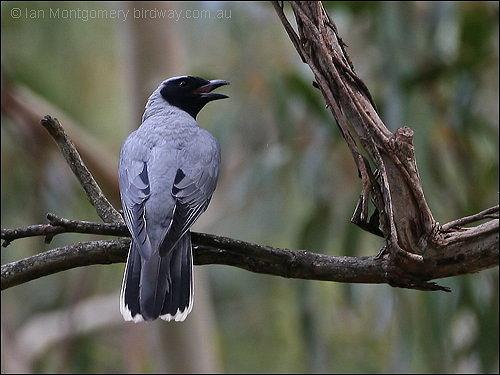
Black-faced Cuckooshrike (Coracina novaehollandiae) by Ian

Black-faced Cuckooshrike (Coracina novaehollandiae) by Ian

Out of the ground the LORD God formed every beast of the field and every bird of the air, and brought them to Adam to see what he would call them. And whatever Adam called each living creature, that was its name. (Genesis 2:19 NKJV)

The cuckooshrikes and allies in the Campephagidae family are small to medium-sized passerine bird species found in the subtropical and tropical Africa, Asia and Australasia. The roughly 92 species are found in eight (or nine) genera which comprise five distinct groups, the ‘true’ cuckooshrikes (Campephaga, Coracina, Lobotos, Pteropodocys and Campochaera) the trillers (Lalage), the minivets (Pericrocotus), the flycatcher-shrikes (Hemipus). The woodshrikes (Tephrodornis) were often considered to be in this family but are probably better placed in their own family, the Tephrodornithidae, along with the philentomas and the flycatcher-shrikes.

Pied Triller (Lalage nigra) ©WikiC

Pied Triller (Lalage nigra) ©WikiC

Overall the cuckooshrikes are medium to small arboreal birds, generally long and slender. The smallest species is the small minivet at 16 cm (6.3 in) and 6-12 grams (0.2-0.4 oz), while the largest is the south Melanesian cuckooshrike at 35 cm (14 in) and 180 grams (6 oz). They are predominantly greyish with white and black, although the minivets are brightly coloured in red, yellow and black, and the blue cuckooshrike of central Africa is all-over glossy blue. The four cuckooshrikes in the genus Campephaga exhibit sexual dimorphism, with males that have glossy black plumage and bright red or yellow wattles, the females having more subdued olive-green plumage. The genus Coracina is not monophyletic.

New Caledonian Cuckooshrike (Coracina analis) ©WikiC

New Caledonian Cuckooshrike (Coracina analis) ©WikiC

The majority of cuckooshrike are forest birds. Some species are restricted to primary forest, like the New Caledonian cuckooshrike, others are able to use more disturbed forest. Around eleven species use much more open habitat, one Australian species, the ground cuckooshrike being found in open plains and scrubland with few trees.

The ‘true’ cuckooshrikes are usually found singly, in pairs, and in small family groups, whereas the minivets, flycatcher-shrikes and wood-shrikes more frequently form small flocks. There is a considerable amount of variation within the family as a whole with regards to calls, some call very infrequently and some, principally the minivets, are extremely vocal.

(Info from Wikipedia with editing)

This slideshow requires JavaScript.

For the invisible things of him from the creation of the world are clearly seen, being understood by the things that are made, even his eternal power and Godhead; so that they are without excuse: (Romans 1:20 KJV)

Jesus answered them, “I told you, and you do not believe. The works that I do in My Father’s name, they bear witness of Me. (John 10:25 NKJV)

Giving thanks always for all things unto God and the Father in the name of our Lord Jesus Christ; (Ephesians 5:20 KJV)

Listen to the Hyssongs as you watch the interesting Cuckooshrike family whom the Lord created:

“There’s Something About That Name” © The Hyssongs

*

More Sunday Inspirations

Birds of the World

Cuckooshrike – Wikipedia

Cuckoo-shrike – IBC

Cuckooshrikes – Birds of the World

Falling Plates

*

A Swallow and One Who Isn’t – Chapter 15

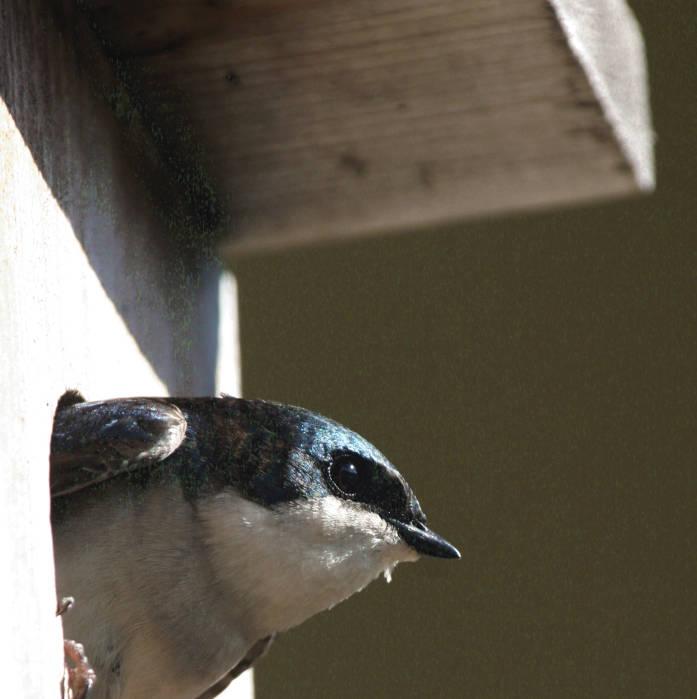
Tree Swallow (Tachycineta bicolor) in box ©USFWS

A Swallow and One Who Isn’t

The Tree Swallow and the Chimney Swift.

*

The Burgess Bird Book For Children

*

Listen to the story read.

CHAPTER 15. A Swallow and One Who Isn’t.

Johnny and Polly Chuck had made their home between the roots of an old apple-tree in the far corner of the Old Orchard. You know they have their bedroom way down in the ground, and it is reached by a long hall. They had dug their home between the roots of that old apple-tree because they had discovered that there was just room enough between those spreading roots for them to pass in and out, and there wasn’t room to dig the entrance any larger. So they felt quite safe from Reddy Fox; and Bowser the Hound, either of whom would have delighted to dig them out but for those roots.

Right in front of their doorway was a very nice doorstep of shining sand where Johnny Chuck delighted to sit when he had a full stomach and nothing else to do. Johnny’s nearest neighbors had made their home only about five feet above Johnny’s head when he sat up on his doorstep. They were Skimmer the Tree Swallow and his trim little wife, and the doorway of their home was a little round hole in the trunk of that apple-tree, a hole which had been cut some years before by one of the Woodpeckers.

Johnny and Skimmer were the best of friends. Johnny used to delight in watching Skimmer dart out from beneath the branches of the trees and wheel and turn and glide, now sometimes high in the blue, blue sky, and again just skimming the tops of the grass, on wings which seemed never to tire. But he liked still better the bits of gossip when Skimmer would sit in his doorway and chat about his neighbors of the Old Orchard and his adventures out in the Great World during his long journeys to and from the far-away South.

To Johnny Chuck’s way of thinking, there was no one quite so trim and neat appearing as Skimmer with his snowy white breast and blue-green back and wings. Two things Johnny always used to wonder at, Skimmer’s small bill and short legs. Finally he ventured to ask Skimmer about them.

“Gracious, Johnny!” exclaimed Skimmer. “I wouldn’t have a big bill for anything. I wouldn’t know what to do with it; it would be in the way. You see, I get nearly all my food in the air when I am flying, mosquitoes and flies and all sorts of small insects with wings. I don’t have to pick them off trees and bushes or from the ground and so I don’t need any more of a bill than I have. It’s the same way with my legs. Have you ever seen me walking on the ground?

Johnny thought a moment. “No,” said he, “now you speak of it, I never have.”

“And have you ever seen me hopping about in the branches of a tree?” persisted Skimmer.

Again Johnny Chuck admitted that he never had.

“The only use I have for feet,” continued Skimmer, “is for perching while I rest. I don’t need long legs for walking or hopping about, so Mother Nature has made my legs very short. You see I spend most of my time in the air.”

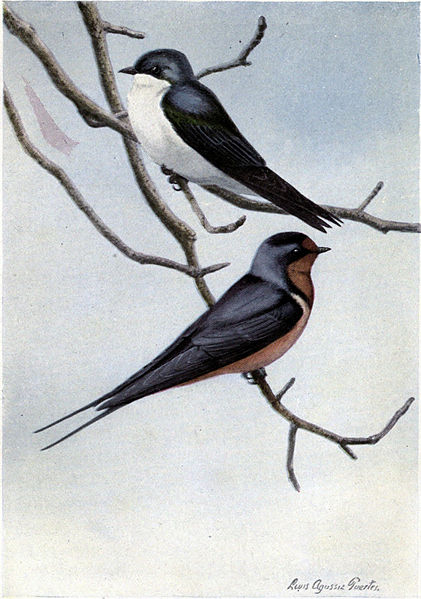
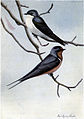
Skimmer The Tree Swallow and Forktail The Barn Swallow

“I suppose it’s the same with your cousin; Sooty the Chimney Swallow,” said Johnny.

“That shows just how much some people know!” twittered Skimmer indignantly. “The idea of calling Sooty a Swallow! The very idea! I’d leave you to know, Johnny Chuck, that Sooty isn’t even related to me. He’s a Swift, and not a Swallow.

“He looks like a Swallow,” protested Johnny Chuck.

“He doesn’t either. You just think he does because he happens to spend most of his time in the air the way we Swallows do,” sputtered Skimmer. “The Swallow family never would admit such a homely looking fellow as he is as a member.

“Tut, tut, tut, tut! I do believe Skimmer is jealous,” cried Jenny Wren, who had happened along just in time to hear Skimmer’s last remarks.

“Nothing of the sort,” declared Skimmer, growing still more indignant. “I’d like to know what there is about Sooty the Chimney Swift that could possibly make a Swallow jealous.”

Jenny Wren cocked her tail up in that saucy way of hers and winked at Johnny Chuck. “The way he can fly,” said she softly.

“The way he can fly!” sputtered Skimmer, “The way he can fly! Why, there never was a day in his life that he could fly like a Swallow. There isn’t any one more graceful on the wing than I am, if I do say so. And there isn’t any one more ungraceful than Sooty.”

Chimney Swift of Birds Illustrated by Color Photography, 1897

Chimney Swift of Birds Illustrated by Color Photography, 1897

Just then there was a shrill chatter overhead and all looked up to see Sooty the Chimney Swift racing through the sky as if having the very best time in the world. His wings would beat furiously and then he would glide very much as you or I would on skates. It was quite true that he wasn’t graceful. But he could twist and turn and cut up all sorts of antics, such as Skimmer never dreamed of doing.

“He can use first one wing and then the other, while you have to use both wings at once,” persisted Jenny Wren. “You couldn’t, to save your life, go straight down into a chimney, and you know it, Skimmer. He can do things with his wings which you can’t do, nor any other bird.”

“That may be true, but just the same I’m not the least teeny-weeny bit jealous of him,” said Skimmer, and darted away to get beyond the reach of Jenny’s sharp tongue.

“Is it really true that he and Sooty are not related?” asked Johnny Chuck, as they watched Skimmer cutting airy circles high up in the slay.

Jenny nodded. “It’s quite true, Johnny,” said site. “Sooty belongs to another family altogether. He’s a funny fellow. Did you ever in your life see such narrow wings? And his tail is hardly worth calling a tail.”

Johnny Chuck laughed. “Way up there in the air he looks almost alike at both ends,” said he. “Is he all black?”

“He isn’t black at all,” declared Jenny. “He is sooty-brown, rather grayish on the throat and breast. Speaking of that tail of his, the feathers end in little, sharp, stiff points. He uses them in the same way that Downy the Woodpecker uses his tail feathers when he braces himself with them on the trunk of a tree.”

“But I’ve never seen Sooty on the trunk of a tree,” protested Johnny Chuck. “In fact, I’ve never seen him anywhere but in the air.”

“And you never will,” snapped Jenny. “The only place he ever alights is inside a chimney or inside a hollow tree. There he clings to the side just as Downy the Woodpecker clings to the trunk of a tree.”

Johnny looked as if he didn’t quite believe this. “If that’s the case where does he nest?” he demanded. “And where does he sleep?”

In a chimney, stupid. In a chimney, of course,” retorted Jenny Wren. “He fastens his nest right to the inside of a chimney. He makes a regular little basket of twigs and fastens it to the side of the chimney.”

“Are you trying to stuff me with nonsense?” asked Johnny Chuck indignantly. “How can he fasten his nest to the side of a chimney unless there’s a little shelf to put it on? And if he never alights, how does he get the little sticks to make a nest of? I’d just like to know how you expect me to believe any such story as that.”

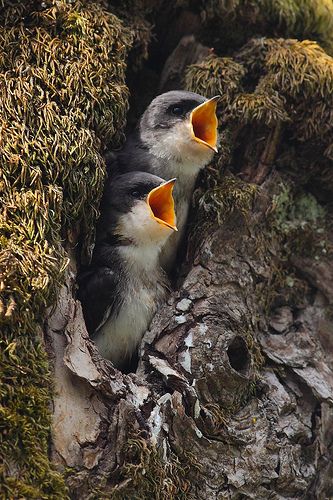
Tree Swallows Ridgefield National Wildlife Refuge by jeremyjonkman on Flickr From Pinterest

Jenny Wren’s sharp little eyes snapped. “If you half used your eyes you wouldn’t have to ask me how he gets those little sticks,” she sputtered. “If you had watched him when he was flying close to the tree tops you would have seen him clutch little dead twigs in his claws and snap them off without stopping. That’s the way he gets his little sticks, Mr. Smarty, He fastens them together with a sticky substance he has in his mouth, and he fastens the nest to the side of the chimney in the same way. You can believe it or not, but it’s so.”

“I believe it, Jenny, I believe it,” replied Johnny Chuck very humbly. “If you please, Jenny, does Sooty get all his food in the air too?”

“Of course,” replied Jenny tartly. “He eats nothing but insects, and he catches them flying. Now I must get back to my duties at home.”

“Just tell me one more thing,” cried Johnny Chuck hastily. “Hasn’t Sooty any near relatives as most birds have?”

“He hasn’t any one nearer than some sort of second cousins, Boomer the Nighthawk, Whippoorwill, and Hummer the Hummingbird.”

“What?” cried Johnny Chuck, quite as if he couldn’t believe he had heard aright. “Did you say Hummer the Hummingbird?” But he got no reply, for Jenny Wren was already beyond hearing.

*

Even the stork in the sky Knows her seasons; And the turtledove and the swift and the thrush Observe the time of their migration; But My people do not know The ordinance of the LORD. (Jeremiah 8:7 NASB)

Like a sparrow in its flitting, like a swallow in its flying, a curse that is causeless does not alight. (Proverbs 26:2 ESV)

A man’s pride will bring him low, But the humble in spirit will retain honor. (Proverbs 29:23 NKJV)

Both of these birds belong to avian families that are mentioned in the Bible

Questions to think about:

  1. Can you describe Skimmer the Swift?
  2. What color is his breast, back and wings?
  3. What is common about the legs of both Skimmer and Sooty?
  4. How do both these birds catch their food?
  5. Why was Skimmer showing a little pride?
  6. Should we be prideful?
  7. Can you describe Sooty the Swallow?
  8. Where and how do Chimney Swallows they make their nest?
  9. Are Skimmer and Sooty in the same bird family?
  10. Who is Sooty second cousins with?
  11. Are both of these birds mentioned in the Bible?

Links:

*

Links:

  Next Chapter (A Robber in the Old Orchard)


Burgess-Bird-Book-for-Children

Burgess Bird Book For Children


  ABC’s Of The Gospel

*


The Purple Thief – (Re-post)

THE PURPLE THIEF

Creation Moments

  “He hath made his wonderful works to be remembered: the LORD is gracious and full of compassion.” (Psalm 111:4)

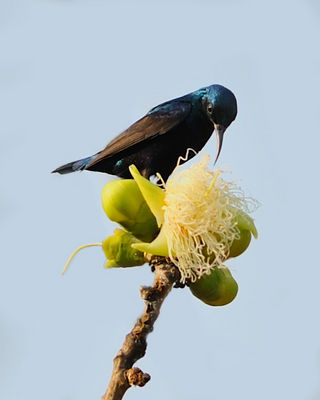
Birds and insects that take nectar from a flower without picking up any pollen are known as nectar robbers. Now, you’d probably think that nectar robbers would be harmful to plants and trees, but the desert teak tree couldn’t survive without a nectar robber – the purple sunbird.

Purple Sunbird (Cinnyris asiaticus) ©J M Garg

Purple Sunbird (Cinnyris asiaticus) ©J M Garg

In order to reproduce, this tree needs birds to pollinate its flowers. But since a tree cannot reproduce with its own pollen, it needs birds to fly from flower to flower and from one tree to another. Anything that encourages the pollinating birds to fly farther away helps out the teak trees.

That’s where the purple thief comes in. Researchers at the University of Delhi discovered that the sunbird visits the flowers one hour before the pollinating birds arrive. The purple sunbird has a long, sharp beak that pierces the base of the flower to feed, so it doesn’t pick up any pollen. It does, however, empty the flower of about 60 percent of its nectar, leaving relatively little for the pollinators. This means that the pollinators will have to travel to more flowers and trees to get enough food, spreading pollen wherever they stop for a meal.

The researchers noted that “the robber plays a constructive and crucial role in the reproductive performance of [a] threatened tree species.” How right they are. And this unusual but crucial dining arrangement shows once again what an ingenious God we serve!

Prayer:

Lord, only You could come up with such an ingenious way to help the desert teak tree to reproduce! Surely such an arrangement could not have come about through blind chance! Amen.

Notes:

“These trees don’t mind getting robbed”, Science News, 7­-25­-14. Photo: Purple sunbird. Courtesy of J.M.Garg. licensed under the Creative Commons Attribution­Share Alike 3.0 Unported license.


Lee’s Addition:

Purple Sunbird (Cinnyris asiaticus) by TAJA

Purple Sunbird (Cinnyris asiaticus) by TAJA

Sunbirds belong to the Nectariniidae – Sunbirds Family which currently has 143 species. They are amazing colored by their Creator and well designed for the plants they pull the nectar from.

From Sunday Inspiration – Sunbirds, “These are very small passerine birds. Most sunbirds feed largely on nectar, but also take insects and spiders, especially when feeding young. Flower tubes that bar access to nectar because of their shape, are simply punctured at the base near the nectaries. Fruit is also part of the diet of some species. Their flight is fast and direct on their short wings.

The family is distributed throughout Africa, the Indian Subcontinent, Southeast Asia and just reaches northern Australia.

See:

Nectariniidae – Sunbirds Family

Sunday Inspiration – Sunbirds

Sunbird – Wikipedia

Who Paints the Leaves

*

Sunday Inspiration – Vangas and Friends

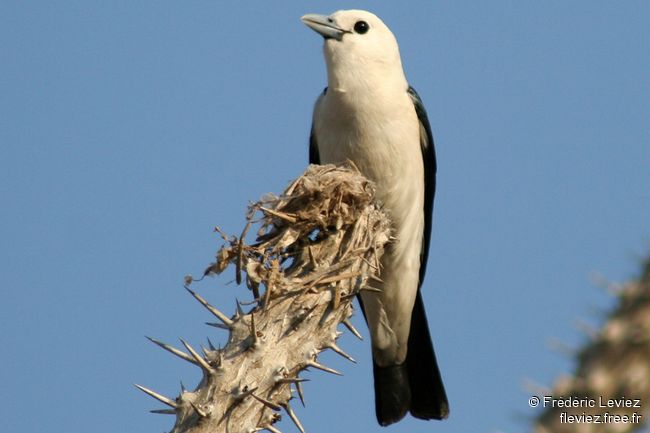
White-headed Vanga (Artamella viridis) ©WikiC

White-headed Vanga (Artamella viridis) ©WikiC

For every beast of the forest is mine, the cattle on a thousand hills. I know all the birds of the hills, and all that moves in the field is mine. (Psalms 50:10-11 ESV)

The Vangas (from vanga, Malagasy for the hook-billed vanga, Vanga curvirostris) are a group of little-known small to medium-sized passerine birds restricted to Madagascar and the Comoros. They are usually classified as the family Vangidae. There are about 21 or 22 species, depending on taxonomy. Most species are shrike-like, arboreal forest birds, feeding on reptiles, frogs and insects. Several other Madagascan birds more similar to Old World warblers, Old World babblers or Old World flycatchers are now often placed in this family. Vangas differ greatly in bill shape and have a variety of foraging methods. Their stick nests are built in trees. They do not migrate.

Mounted Bornean Bristlehead (Pityriasis gymnocephala), at the Muséum d'Histoire naturelle de Genève. ©WikiC

Mounted Bornean Bristlehead (Pityriasis gymnocephala), at the Muséum d’Histoire naturelle de Genève. ©WikiC

The Bornean Bristlehead (Pityriasis gymnocephala), also variously known as the bristled shrike, bald-headed crow or the bald-headed wood-shrike, is the only member of the passerine family Pityriaseidae and genus Pityriasis. It is an enigmatic and uncommon species of the rainforest canopy of the island of Borneo, to which it is endemic.

White-breasted Woodswallow (Artamus leucorynchus amydrus) by Lee Zoo Miami

White-breasted Woodswallow (Artamus leucorynchus amydrus) by Lee ZM

Woodswallows are soft-plumaged, somber-coloured passerine birds. There are 24 a single genus, Artamus, The woodswallows are either treated as a subfamily, Artaminae in an expanded family Artamidae, which includes the butcherbirds and Australian Magpie, or as the only genus in that family. The generic name, which in turn gives rise to the family name, is derived from the Ancient Greek artamos, meaning butcher or murder. The name was given due to their perceived similarity to shrikes, indeed a former common name for the group was “swallow-starlings”

Woodswallows are smooth, agile flyers with moderately large, semi-triangular wings. They are among the very few passerines birds that soar, and can often be seen feeding just above the treetops. One sedentary species aside, they are nomads, following the best conditions for flying insects, and often roosting in large flocks.
Although woodswallows have a brush-tipped tongue they seldom use it for gathering nectar.

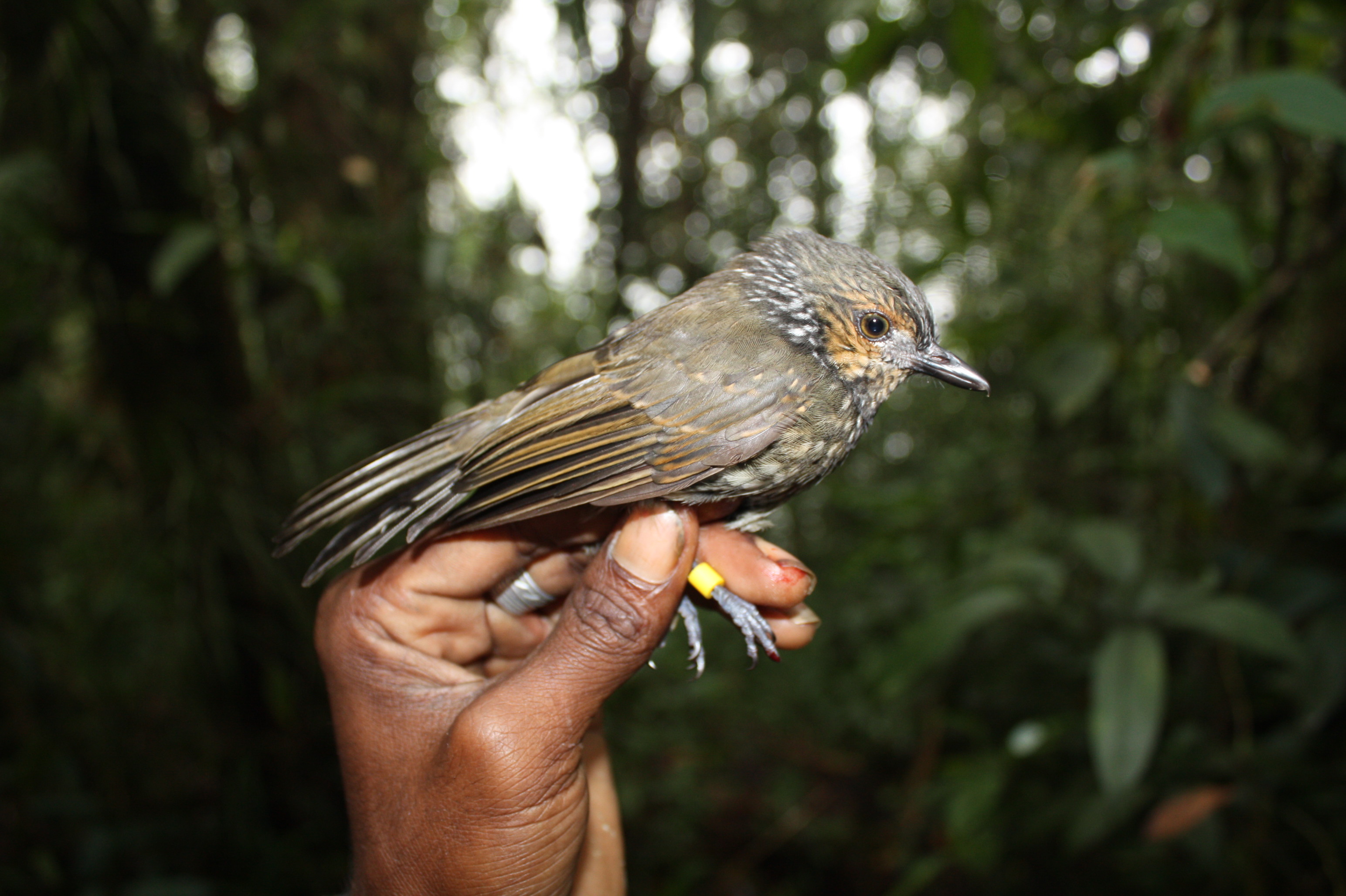
Mottled Whistler (Rhagologus leucostigma) ©©Katerina Tvardikova

Mottled Whistler (Rhagologus leucostigma) ©©Katerina Tvardikova

The Mottled Whistler (Rhagologus leucostigma) is a species of bird whose relationships are unclear but most likely related to the woodswallows, boatbills and butcherbirds. It is monotypic within the genus Rhagologus and family Rhagologidae. It is found in Indonesia and Papua New Guinea, where its natural habitat is subtropical or tropical moist montane forests

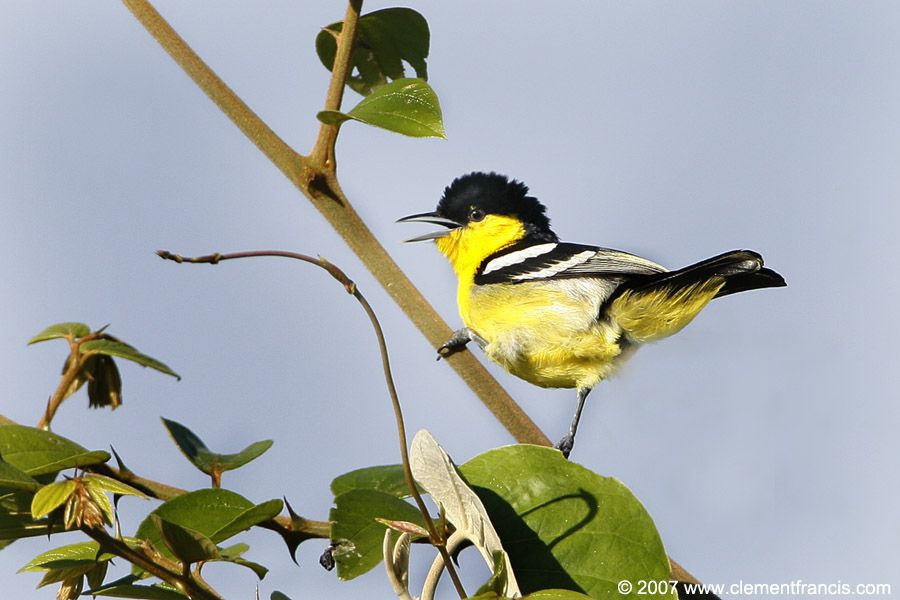
Common Iora (Aegithina tiphia) by Clement Francis

Common Iora (Aegithina tiphia) by Clement Francis

The Ioras (Aegithinidae) are a small family of four passerine bird species found in India and southeast Asia. The Ioras are small to medium small sized passerines, ranging from 11.5 to 15.5 cm (4.5–6.1 in) in length. Overall the males are larger than the females. These are reminiscent of the bulbuls, but whereas that group tends to be drab in colouration, the ioras are more brightly colored. The group exhibits sexual dimorphism in its plumage, with the males being brightly plumaged in yellows and greens. Unlike the leafbirds, ioras have thin legs, and their bills are proportionately longer. Calls are strident whistles; songs are musical to human ears.

This slideshow requires JavaScript.

Jesus said unto him, If thou canst believe, all things are possible to him that believeth. (Mark 9:23 KJV)

Then said Jesus unto the twelve, Will ye also go away? Then Simon Peter answered him, Lord, to whom shall we go? thou hast the words of eternal life. And we believe and are sure that thou art that Christ, the Son of the living God. (John 6:67-69 KJV)

Listen to the Hyssongs as you watch these five different families the Lord has created for us to enjoy.

“I Still Believe” – ©The Hyssongs

Sunday Inspirations

Birds of the World

*

Gospel Presentation

*

Bob White and Carol the Meadow Lark – Chapter 14

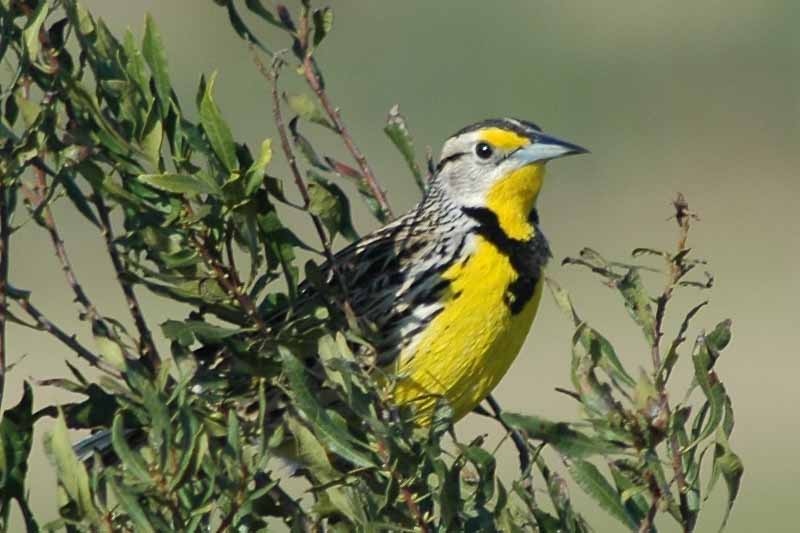
Eastern Meadowlark (Sturnella magna) by Bob-Nan

Eastern Meadowlark (Sturnella magna) by Bob-Nan

Bob White and Carol the Meadow Lark

The So-called Quail and the Meadow Lark.

The Burgess Bird Book For Children

*

Listen to the story read.

CHAPTER 14. Bob White and Carol the Meadow Lark.

“Bob—Bob White! Bob—Bob White! Bob—Bob White!” clear and sweet, that call floated over to the dear Old Briar-patch until Peter could stand it no longer. He felt that he just had to go over and pay an early morning call on one of his very best friends, who at this season of the year delights in whistling his own name—Bob White.

“I suppose,” muttered Peter, “that Bob White has got a nest. I wish he would show it to me. He’s terribly secretive about it. Last year I hunted for his nest until my feet were sore, but it wasn’t the least bit of use. Then one morning I met Mrs. Bob White with fifteen babies out for a walk. How she could hide a nest with fifteen eggs in it is more than I can understand.”

Bob White - Burgess Bird Book ©©

Bob White – Burgess Bird Book ©©

Peter left the Old Briar-patch and started off over the Green Meadows towards the Old Pasture. As he drew near the fence between the Green Meadows and the Old Pasture he saw Bob White sitting on one of the posts, whistling with all his might. On another post near him sat another bird very near the size of Welcome Robin. He also was telling all the world of his happiness. It was Carol the Meadow Lark.

Peter was so intent watching these two friends of his that he took no heed to his footsteps. Suddenly there was a whirr from almost under his very nose and he stopped short, so startled that he almost squealed right out. In a second he recognized Mrs. Meadow Lark. He watched her fly over to where Carol was singing. Her stout little wings moved swiftly for a moment or two, then she sailed on without moving them at all. Then they fluttered rapidly again until she was flying fast enough to once more sail on them outstretched. The white outer feathers of her tail showed clearly and reminded Peter of the tail of Sweetvoice the Vesper Sparrow, only of course it was ever so much bigger.

Peter sat still until Mrs. Meadow Lark had alighted on the fence near Carol. Then he prepared to hurry on, for he was anxious for a bit of gossip with these good friends of his. But just before he did this he just happened to glance down and there, almost at his very feet, he caught sight of something that made him squeal right out. It was a nest with four of the prettiest eggs Peter ever had seen. They were white with brown spots all over them. Had it not been for the eggs he never would have seen that nest, never in the world. It was made of dry, brown grass and was cunningly hidden is a little clump of dead grass which fell over it so as to almost completely hide it. But the thing that surprised Peter most was the clever way in which the approach to it was hidden. It was by means of a regular little tunnel of grass.

“Oh!” cried Peter, and his eyes sparkled with pleasure. “This must be the nest of Mrs. Meadow Lark. No wonder I have never been able to find it, when I have looked for it. It is just luck and nothing else that I have found it this time. I think it is perfectly wonderful that Mrs. Meadow Lark can hide her home in such a way. I do hope Jimmy Skunk isn’t anywhere around.”

Peter sat up straight and anxiously looked this way and that way. Jimmy Skunk was nowhere to be seen and Peter gave a little sigh of relief. Very carefully he walked around that nest and its little tunnel, then hurried over toward the fence as fast as he could go.

“It’s perfectly beautiful, Carol!” he cried, just as soon as he was near enough. “And I won’t tell a single soul!”

“I hope not. I certainly hope not,” cried Mrs. Meadow Lark in an anxious tone. “I never would have another single easy minute if I thought you would tell a living soul about my nest. Promise that you won’t, Peter. Cross your heart and promise that you won’t.”

Peter promptly crossed his heart and promised that he wouldn’t tell a single soul. Mrs. Meadow Lark seemed to feel better. Right away she flew back and Peter turned to watch her. He saw her disappear in the grass, but it wasn’t where he had found the nest. Peter waited a few minutes, thinking that he would see her rise into the air again and fly over to the nest. But he waited in vain. Then with a puzzled look on his face, he turned to look up at Carol.

Carol’s eyes twinkled. “I know what you’re thinking, Peter,” he chuckled. “You are thinking that it is funny Mrs. Meadow Lark didn’t go straight hack to our nest when she seemed so anxious about it. I would have you to know that she is too clever to do anything so foolish as that. She knows well enough that somebody might see her and so find our secret. She has walked there from the place where you saw her disappear in the grass. That is the way we always do when we go to our nest. One never can be too careful these days.”

Then Carol began to pour out his happiness once more, quite as if nothing had interrupted his song.

Western Meadowlark (Sturnella neglecta)©USFWS

Western Meadowlark (Sturnella neglecta)©USFWS

Somehow Peter never before had realized how handsome Carol the Meadow Lark was. As he faced Peter, the latter saw a beautiful yellow throat and waistcoat, with a broad black crescent on his breast. There was a yellow line above each eye. His back was of brown with black markings. His sides were whitish, with spats and streaks of black. The outer edges of his tail were white. Altogether he was really handsome, far handsomer than one would suspect, seeing him at a distance.

Having found out Carol’s secret, Peter was doubly anxious to find Bob White’s home, so he hurried over to the post where Bob was whistling with all his might. “Bob!” cried Peter. “I’ve just found Carol’s nest and I’ve promised to keep it a secret. Won’t you show me your nest, too, if I’ll promise to keep THAT a secret?”

Rob threw back his head and laughed joyously. “You ought to know, Peter, by this time,” said he, “that there are secrets never to be told to anybody. My nest is one of these. If you find it, all right; but I wouldn’t show it to my very best friend, and I guess I haven’t any better friend than you, Peter.” Then from sheer happiness he whistled, “—Bob White! Bob—Bob White!” with all his might.

Peter was disappointed and a little put out. “I guess,” said he, “I could find it if I wanted to. I guess it isn’t any better hidden than Mrs. Meadow Lark’s, and I found that. Some folks aren’t as smart as they think they are.”

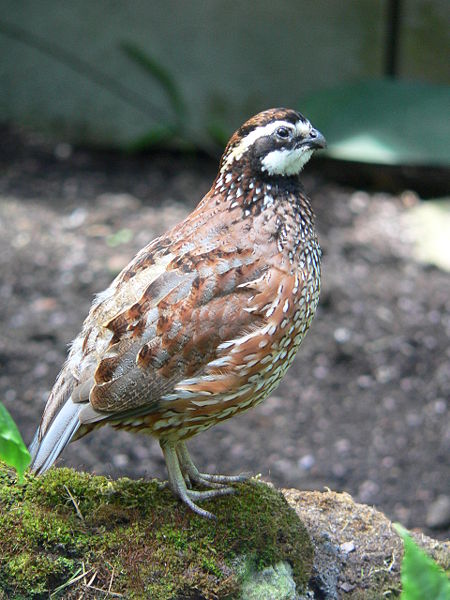
Bob White, who is sometimes called Quail and sometimes called Partridge, and who is neither, chuckled heartily. “Go ahead, old Mr. Curiosity, go ahead and hunt all you please,” said he. “It’s funny to me how some folks think themselves smart when the truth is they simply have been lucky. You know well enough that you just happened to find Carol’s nest. If you happen to find mine, I won’t have a word to say.”

Bob White took a long breath, tipped his head back until his bill was pointing right up in the blue, blue sky, and with all his might whistled his name, “Bob—Bob White! Bob—Bob White!”

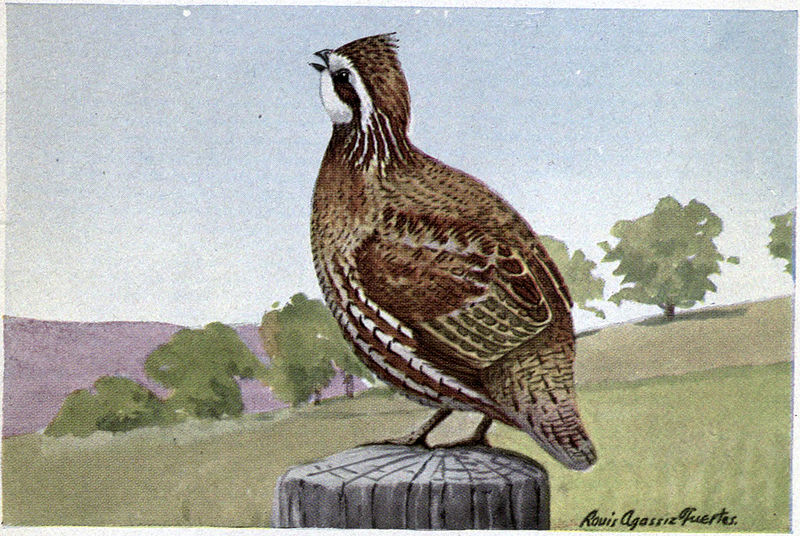
Northern Bobwhite

Northern Bobwhite

As Peter looked at him it came over him that Bob White was the plumpest bird of his acquaintance. He was so plump that his body seemed almost round. The shortness of his tail added to this effect, for Bob has a very short tail. The upper part of his coat was a handsome reddish-brown with dark streaks and light edgings. His sides and the upper part of his breast were of the same handsome reddish-brown, while underneath he was whitish with little bars of black. His throat was white, and above each eye was a broad white stripe. His white throat was bordered with black, and a band of black divided the throat from the white line above each eye. The top of his head was mixed black and brown. Altogether he was a handsome little fellow in a modest way.

Suddenly Bob White stopped whistling and looked down at Peter with a twinkle in his eye. “Why don’t you go hunt for that nest, Peter?” said he.

“I’m going,” replied Peter rather shortly, for he knew that Bob knew that he hadn’t the least idea where to look. It might be somewhere on the Green Meadows or it might be in the Old Pasture; Bob hadn’t given the least hint. Peter had a feeling that the nest wasn’t far away and that it was on the Green Meadows, so he began to hunt, running aimlessly this way and that way, all the time feeling very foolish, for of course he knew that Bob White was watching him and chuckling down inside.

It was very warm down there on the Green Meadows, and Peter grew hot and tired. He decided to run up in the Old Pasture in the shade of an old bramble-tangle there. Just the other side of the fence was a path made by the cows and often used by Farmer Brown’s boy and Reddy Fox and others who visited the Old Pasture. Along this Peter scampered, lipperty-lipperty-lip, on his way to the bramble-tangle. He didn’t look either to right or left. It didn’t occur to him that there would be any use at all, for of course no one would build a nest near a path where people passed to and fro every day.

And so it was that in his happy-go-lucky way Peter scampered right past a clump of tall weeds close beside the path without the least suspicion that cleverly hidden in it was the very thing he was looking for. With laughter in her eyes, shrewd little Mrs. Bob White, with sixteen white eggs under her, watched him pass. She had chosen that very place for her nest because she knew that it was the last place anyone would expect to find it. The very fact that it seemed the most dangerous place she could have chosen made it the safest.

… and do not reveal another’s secret, (Proverbs 25:9b ESV)

Can anyone hide himself in secret places, So I shall not see him?” says the LORD; “Do I not fill heaven and earth?” says the LORD. (Jeremiah 23:24 NKJV)

Questions:

  • Which bird whistles his own name?
  • How many little ones did they have?
  • Did Peter ever find their nest?
  • Who’s nest did Peter find?
  • What did he promise not to tell?
  • Can you describe the Meadow Lark?
  • What does the Bob White look like?
  • How does the Meadow Lark fly?
  • How do the birds keep people and animals from finding their nest?
  • Do you keep others secret, or do you tell them?
  • Who knows all secrets?

Links:

*

Links:


  Next Chapter (A Swallow and One Who Isn’t)


Burgess-Bird-Book-for-Children


Burgess Bird Book For Children


Savannah Sparrow by Ray    Wordless Birds

*

FEATHERED DINOSAURS from Creation Moments

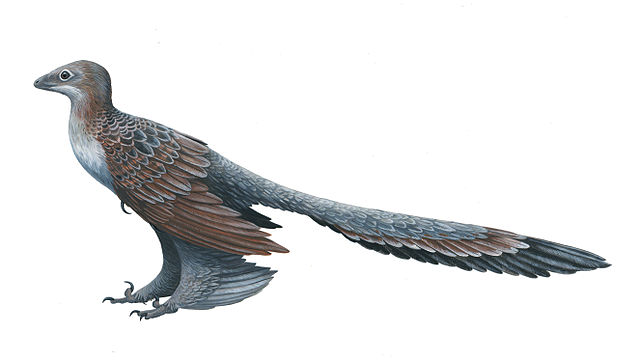
Changyuraptor yangi (aka feathered dinosaur)©WikiC

Changyuraptor yangi (aka feathered dinosaur)©WikiC

FEATHERED DINOSAURS

“As birds flying, so will the LORD of hosts defend Jerusalem; defending also he will deliver it; and passing over he will preserve it.” Isaiah 31:5

A new species of dinosaur has been found. Scientists are calling Changyuraptor yangi the biggest feathered dinosaur ever discovered. Here at Creation Moments, however, we’re calling it a feathered bird. Dinosaur-to-bird evolution is nothing more than a flight of fancy.

Changyuraptor yangi (aka feathered dinosaur) ©Stephanie Abramowicz

Changyuraptor yangi (aka feathered dinosaur) ©Stephanie Abramowicz

Naturally, USA Today, BBC News and many other news outlets are calling it a four-winged dinosaur. Changyuraptor yangi, they say, is a new species of dinosaur that offers “clues to the origin of flight – and the transition from feathered dinosaurs to birds.” Research scientists also say that “the new fossil possesses the longest known feathers for any non-avian dinosaur.”

Non-avian? No, we’re still calling them birds, and here’s why. For one thing, dinosaurs and other reptiles have scales, which are folds in their skin. Birds, on the other hand, have feathers which grow out of follicles. Scales and feathers are completely different. No known fossils, in fact, provide evidence of a transition from scales to feathers.

Furthermore, for a dinosaur to evolve into a bird, it would need to develop hollow bones, and it would need to gain powerful flight muscles and develop a new heart with four chambers rather than three.

So, too, do we need a new heart to understand the things of God. We don’t evolve our old heart into a new one. Our new heart comes to us through the work of the Holy Spirit.

Prayer:
Thank You, Father, for sending the Holy Spirit so we can have a close and enduring relationship with You! Amen.

Notes:
Scientists discover largest four-winged dinosaur to date“, USA Today, 7/15/14. “Four-winged dinosaur is ‘biggest ever‘”, BBC News Science & Environment, 7/16/14. “A new raptorial dinosaur with exceptionally long feathering provides insights into dromaeosaurid flight performance,” Nature Communications, 7/15/14. Illustration: Changyuraptor yangi. Courtesy of Stephanie Abramowicz, Dinosaur Institute, NHM. Used for educational purposes under U.S. fair use doctrine.

Used with permission from Creation Moments©2015


Lee’s Addition:

Actually, there are several verses in Scripture that mention a creature with four wings. Ezekiel 1:6&8: 10:21 and this verse in Daniel 7:6 says:

“After this I looked, and there was another, like a leopard, which had on its back four wings of a bird. The beast also had four heads, and dominion was given to it. (Daniel 7:6 NKJV)

Flying with four wings seems to be possible.

Now for some other rebuttal  articles from Christian Creation sources:

Plus

Falling Plates

Latest Visitors to Yard

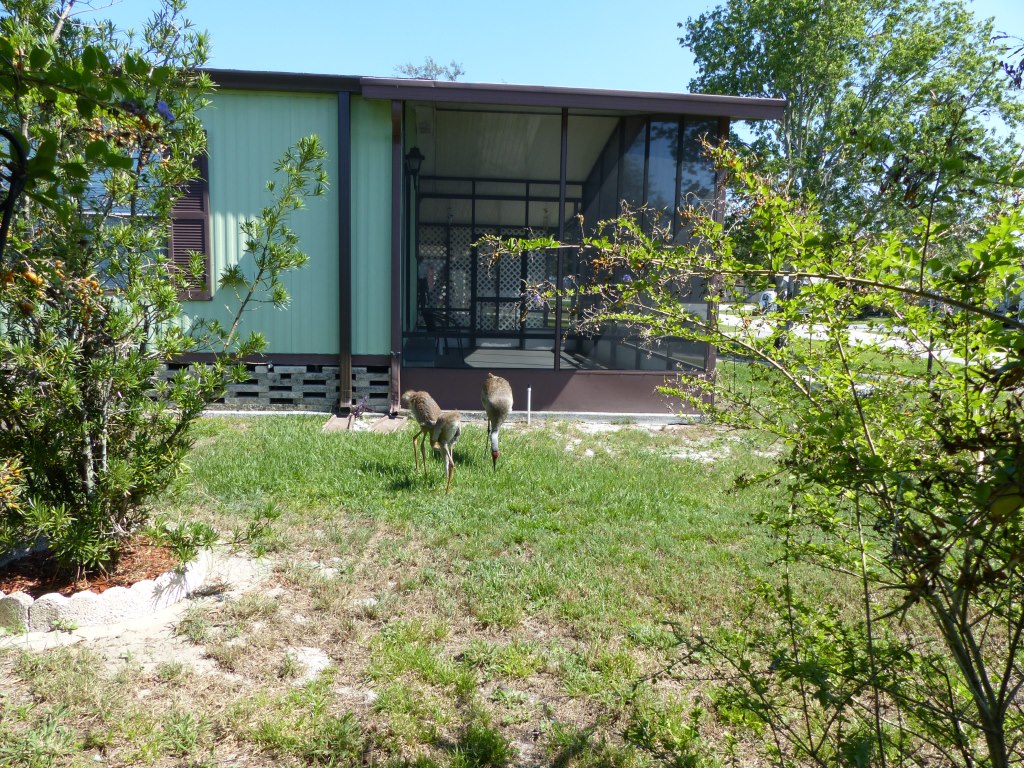
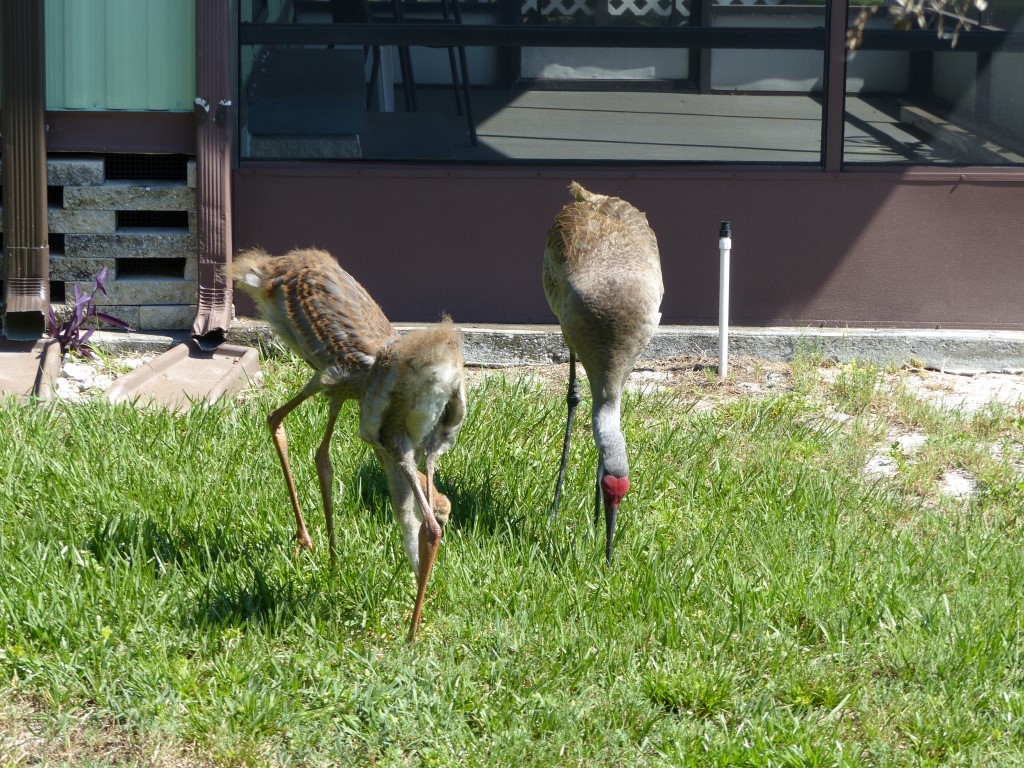
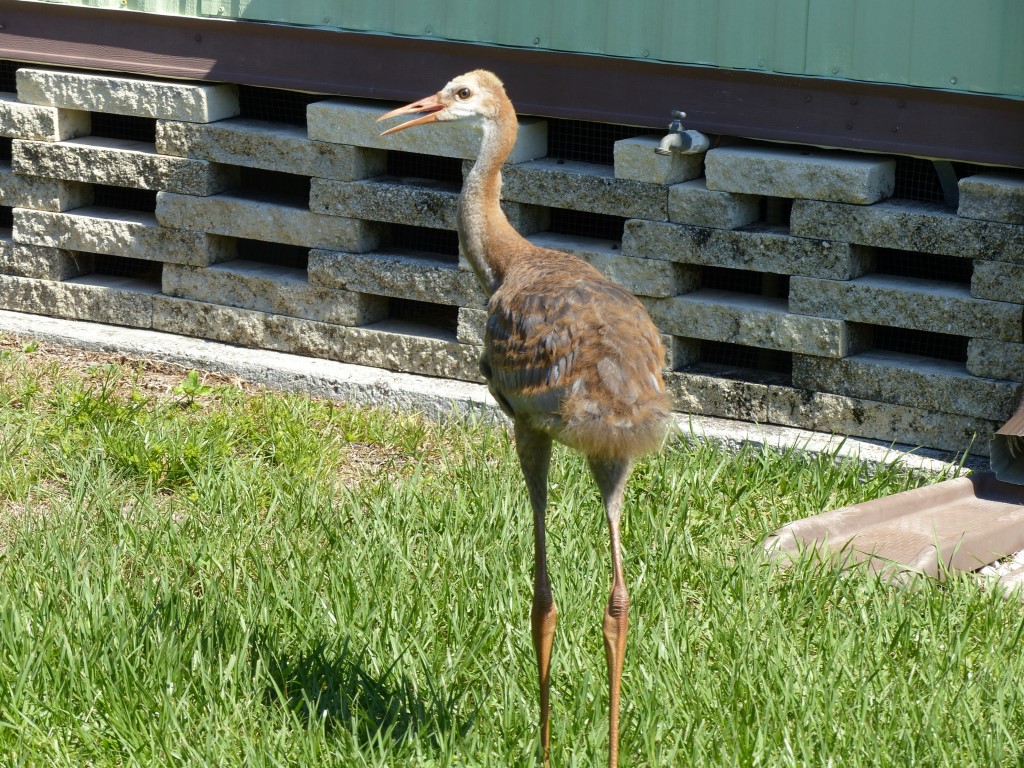
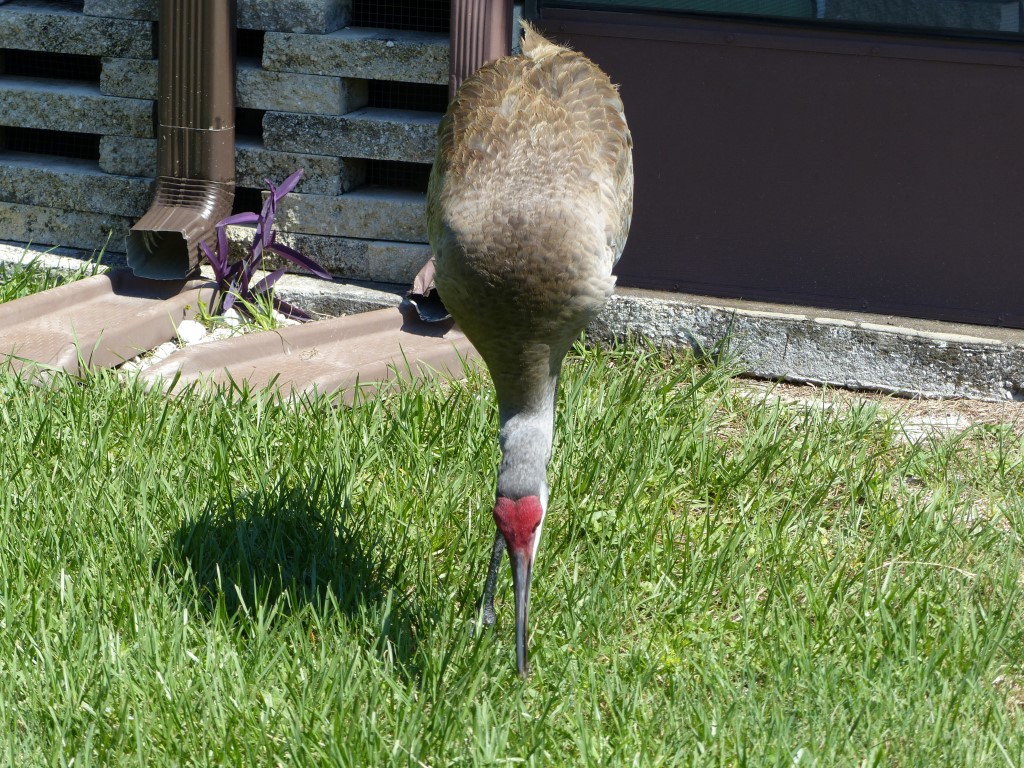
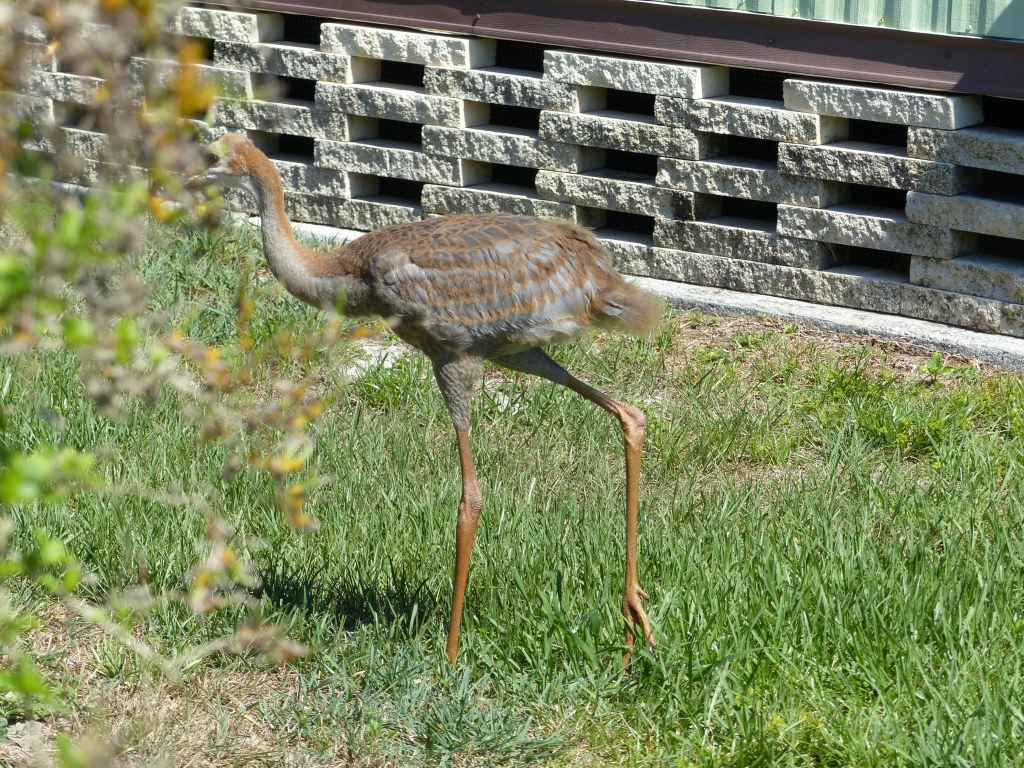
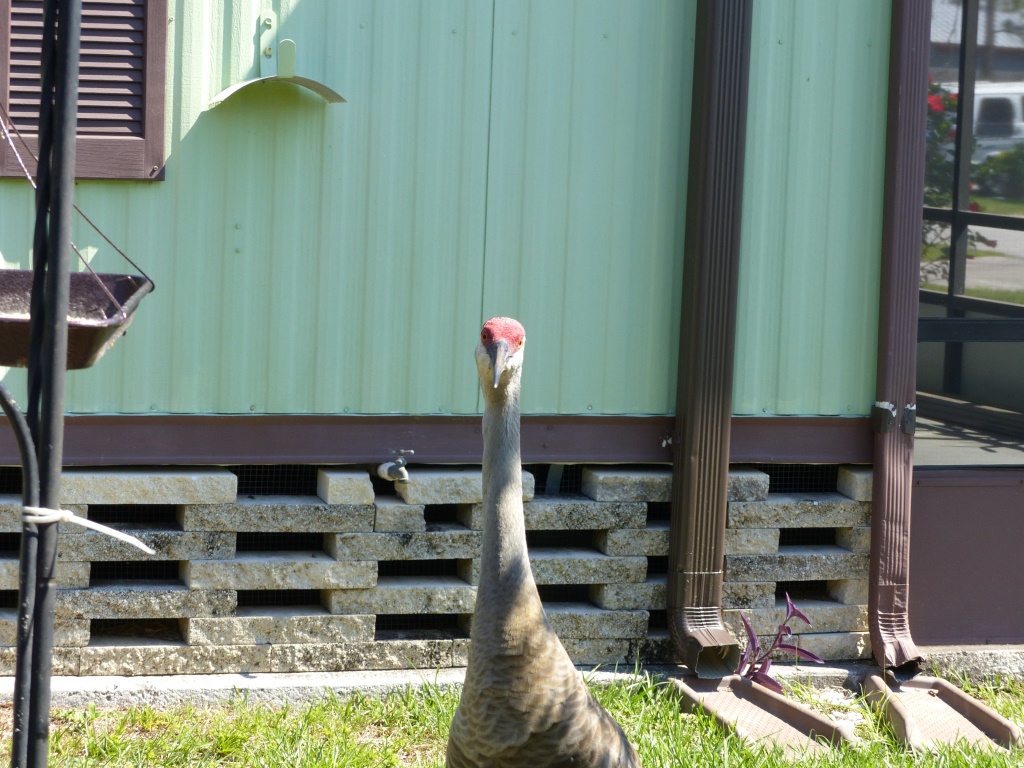
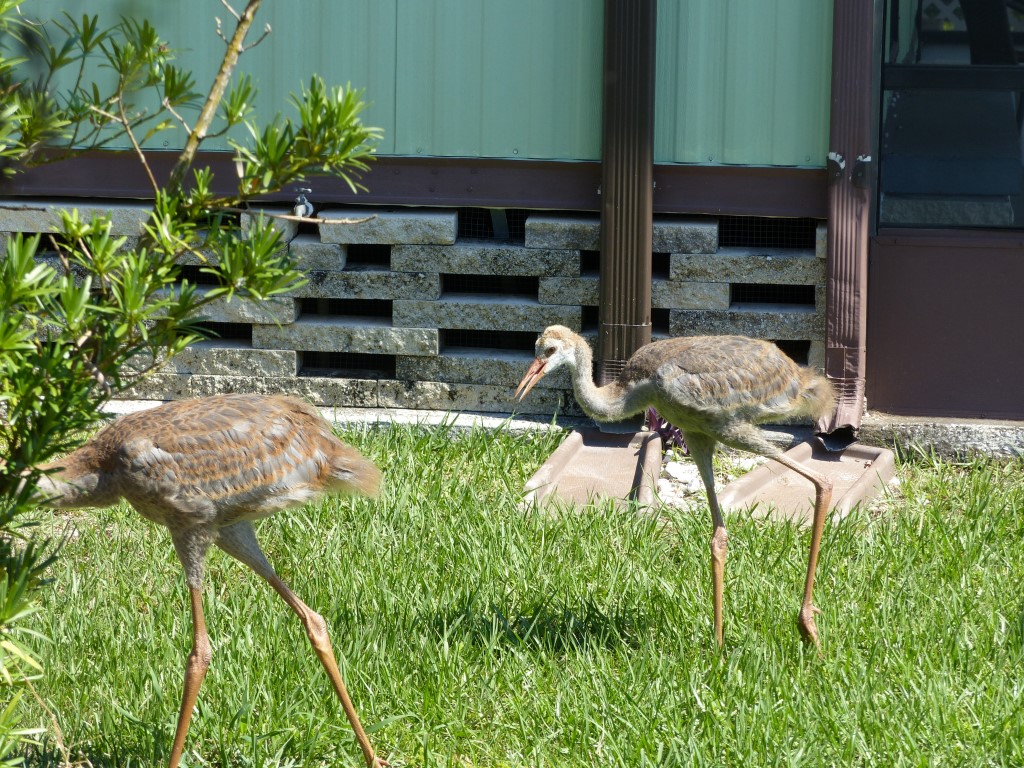
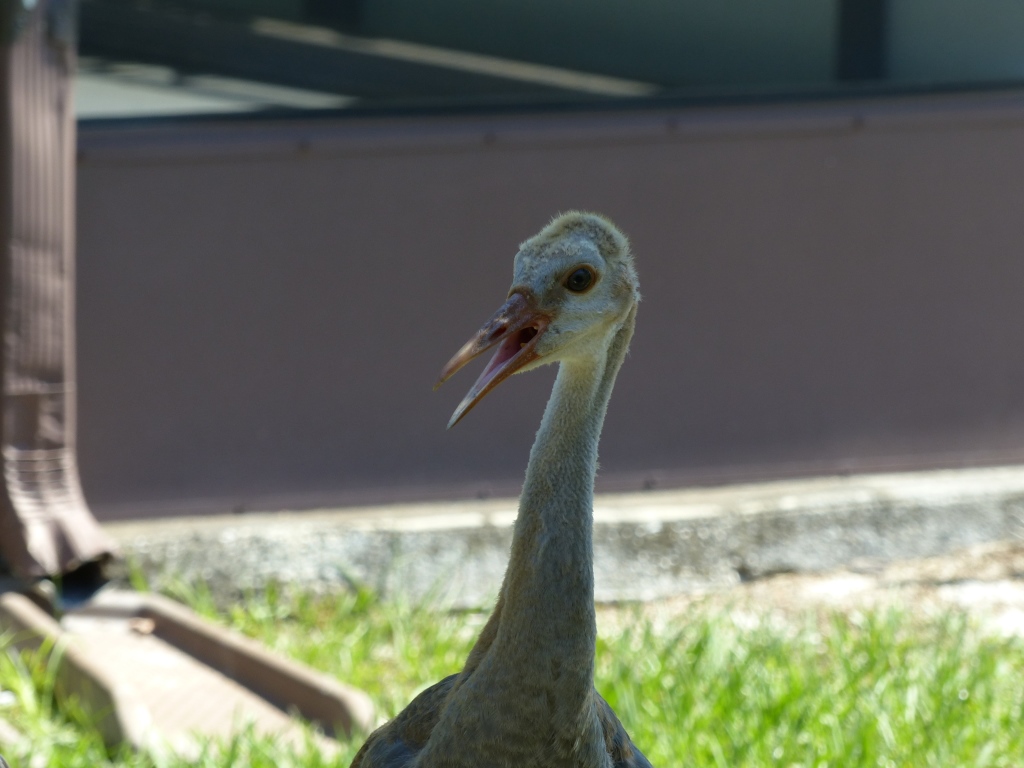
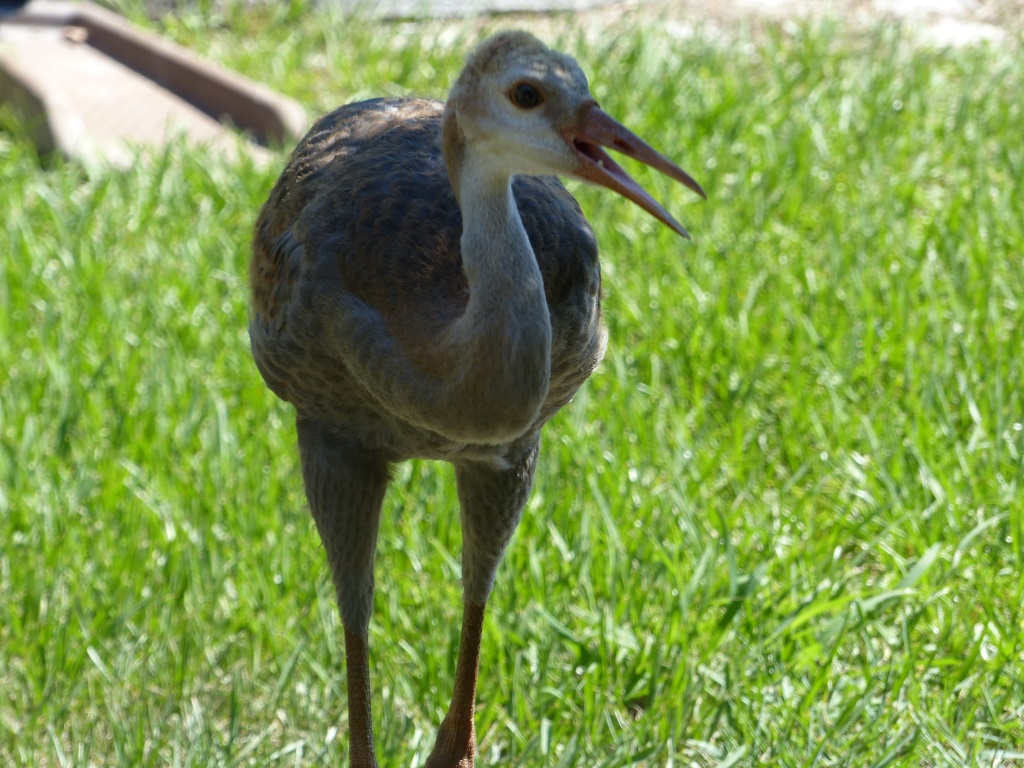
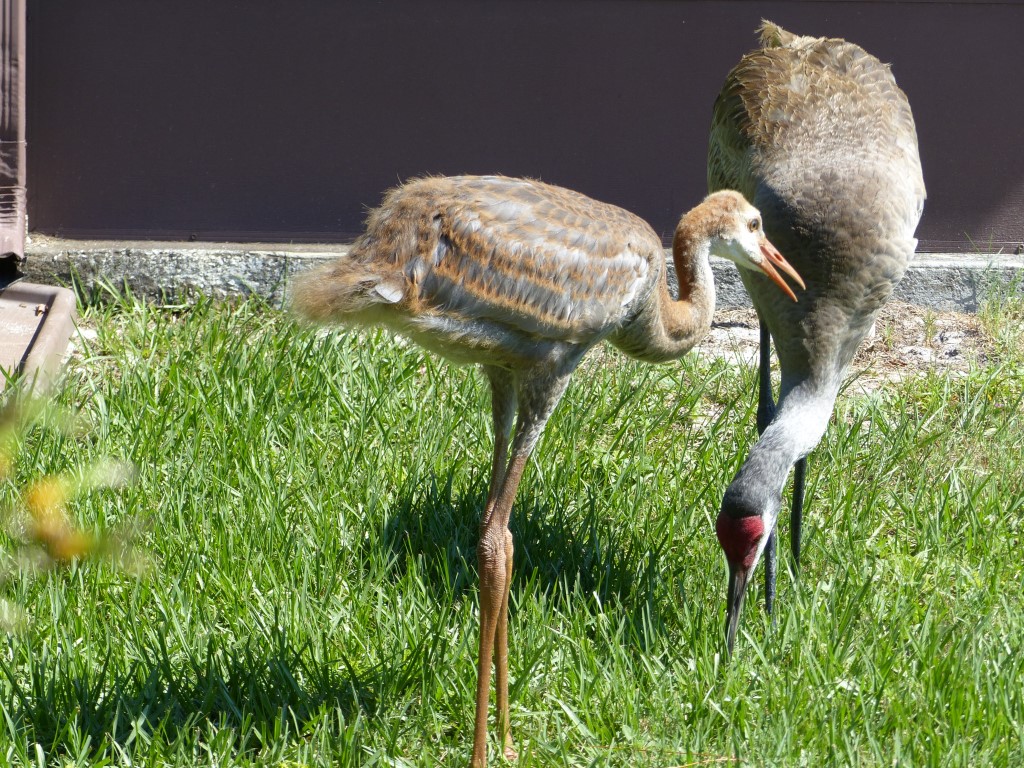
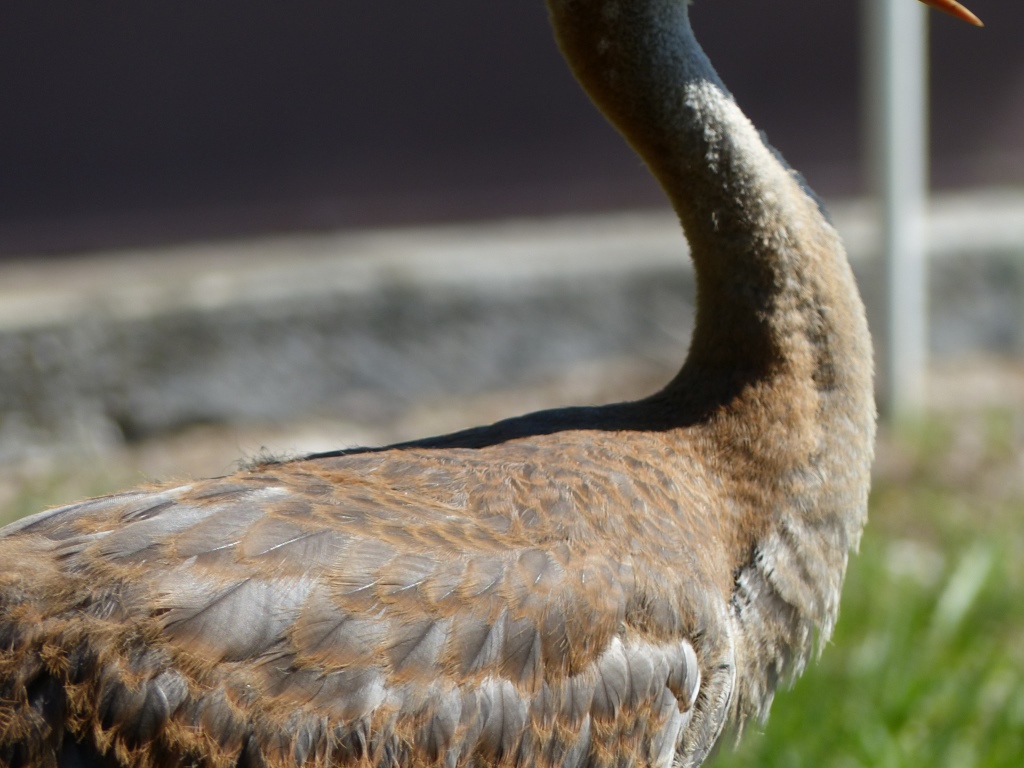
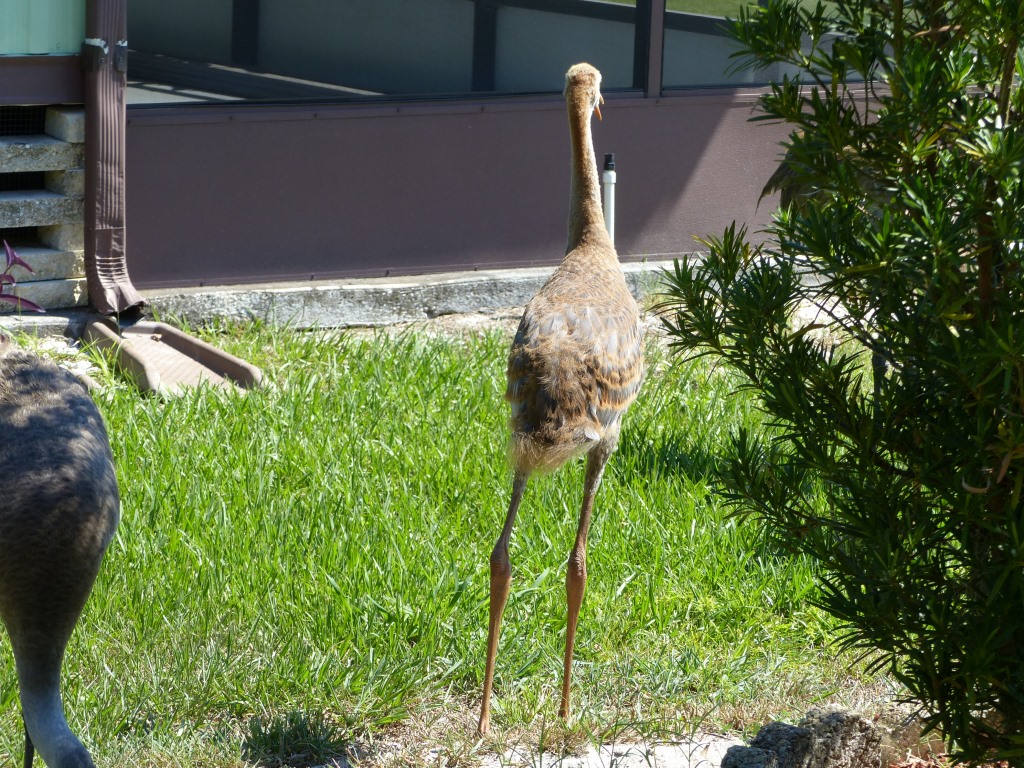
A few days ago while I was filling up my feeders, I looked up and here came Mom and Pop Sandhill Crane with their two latest youngsters. (The 2015 family) Needless to say I stopped and watched them for a while and then remembered to go get my camera. Here are some of those images. I shared a little seed with them. Not suppose to feed cranes, but even if I put seed in that hanging tray for the other birds, they have been known to eat from it. ( I felt sorry for the little ones. :) )

It looks like the little Sandhills need to grow into their knees.

Leaving

Leaving

I always enjoy when the Sandhill Crane parents bring their little ones by to check them out. When you get to watch the Lord’s created critters up close and see how really look and act is enjoyable. The Cranes are mentioned in Scripture and so they are some of our Birds of the Bible.

Like a crane or a swallow, so did I chatter: I did mourn as a dove: mine eyes fail with looking upward: O LORD, I am oppressed; undertake for me. (Isaiah 38:14 KJV)

The parents made some chatter when I got too close to the little ones, but didn’t get it on video. Here is video of them in the yard (The noise is Dan edging the driveway):

*

You can tell by how many articles that I’ve written about that the cranes, that I like them and they visit often:

*

Sunday Inspiration – Bushshrikes and Boatbills

Rosy-patched Bushshrike (Telophorus cruentus) ©WikiC

Rosy-patched Bushshrike (Telophorus cruentus) ©WikiC

And the angel of the LORD appeared unto him in a flame of fire out of the midst of a bush: and he looked, and, behold, the bush burned with fire, and the bush was not consumed. And Moses said, I will now turn aside, and see this great sight, why the bush is not burnt. (Exodus 3:2-3 KJV)

This Sunday you get to meet two more families from the Song Birds (Passerines), the Malaconotidae – Bushshrikes Family with 50 members and the Machaerirhynchidae – Boatbills Family with only 2 species.

Orange-breasted Bushshrike (Chlorophoneus sulfureopectus) ©WikiC

Orange-breasted Bushshrike (Chlorophoneus sulfureopectus) ©WikiC

The Bushshrikes are smallish passerine bird species. They were formerly classed with the true shrikes in the family Laniidae, but are now considered sufficiently distinctive to be separated from that group as the family Malaconotidae.

This is an African group of species which are found in scrub or open woodland. They are similar in habits to shrikes, hunting insects and other small prey from a perch on a bush. Although similar in build to the shrikes, these tend to be either colorful species or largely black; some species are quite secretive.

Some bushshrikes have flamboyant displays. The male puffbacks puff out the loose feathers on their rump and lower back, to look almost ball-like.
These are mainly insectivorous forest or scrub birds. Up to four eggs are laid in a cup nest in a tree.

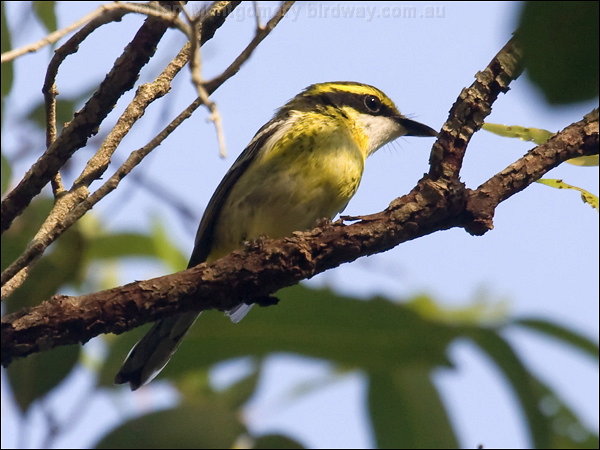
Yellow-breasted Boatbill (Machaerirhynchus flaviventer) by Ian

Yellow-breasted Boatbill (Machaerirhynchus flaviventer) by Ian

Boatbills or the Machaerirhynchus is a genus of passerine birds with affinities to woodswallows and butcherbirds. The two species are known as boatbills. The genus is distributed across New Guinea and northern Queensland. (Info from Wikipedia)

This slideshow requires JavaScript.

Listen to a quartet sing as you watch these two beautifully created families of birds:

“We Shall See Jesus” ~ Margaret Hiebert, Pastor and Jill Osborne and Pastor Jerry Smith

Sunday Inspirations

Birds of the World

*

Gospel Message

*

Little Gray Feather

01:33. As the Robin flies away, the Grackle cries, “More!”

01:33. As the Robin flies away, the Grackle cries, “More!”

Little Gray Feather,
the Adopted Common Grackle Chick

One of the most bizarre anomalies in the world of ornithology I have ever witnessed was in May 2009.

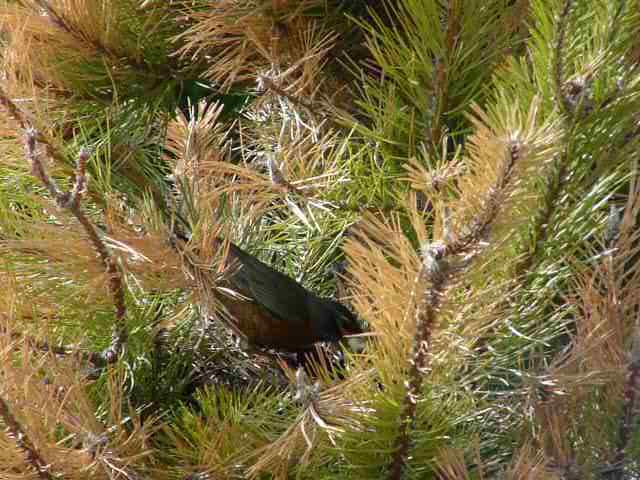
It was in that month when my wife happened to look out a second floor bedroom window of our condo townhome in Aurora, Colorado and see two little boys carrying bird nests, prompting her to investigate. As it turns out, the two boys were innocently engaged in the exploration of birds’ nests they had discovered—apparently having observed adult birds flying to and from the nests. My wife lovingly explained to them that it wasn’t a good idea to move nests with eggs or chicks and suggested they return the nests to where they had found them.

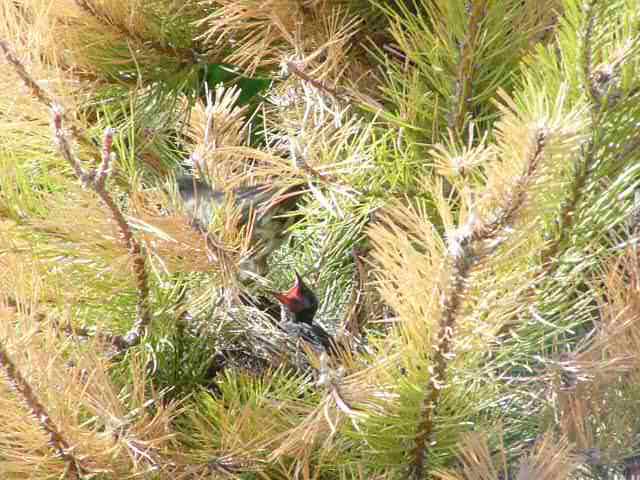
However, by then the boys had already relocated at least two nests to a not-so-tall conifer at the southeast corner of the townhome complex. Apparently, they figured that by relocating the nests to lower, shorter branches, they could keep a better eye on things. The relatively short evergreen presently had a total three nests and a number of chicks had fallen to the ground. Not knowing what type of birds she was dealing with or what nests the chicks on the ground had fallen out of, my wife donned a pair of gloves and placed the fallen chicks back into two of the nests. When I returned home from work, she requested I examine the situation. Upon doing so, I found that she had mistakenly placed Common Grackle chicks with American Robin chicks and a few chicks had again fallen out of their nests—one to the ground, a couple of others onto branches. It was a problematic scenario for all parties involved, especially the chicks.

01:09. Oh, what joy as the Robin emerges on the west side of the nest with something substantial in its mouth.

Appearances suggested we were dealing with two broods of Robins and one of Grackles, both types of birds being common to the complex. Presuming the highest nest in the tree to be that of a Grackle, I placed the Grackle chicks in that one and divided the Robins evenly between the other two lower nests, holding out little hope for a positive outcome.

In less than two days all chicks died except for one: a Grackle. And soon, the nest had become tipped. I adjusted it so the sole survivor wouldn’t fall out.

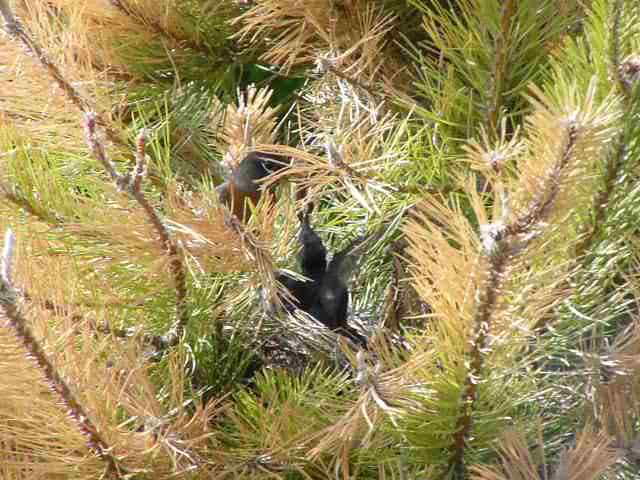
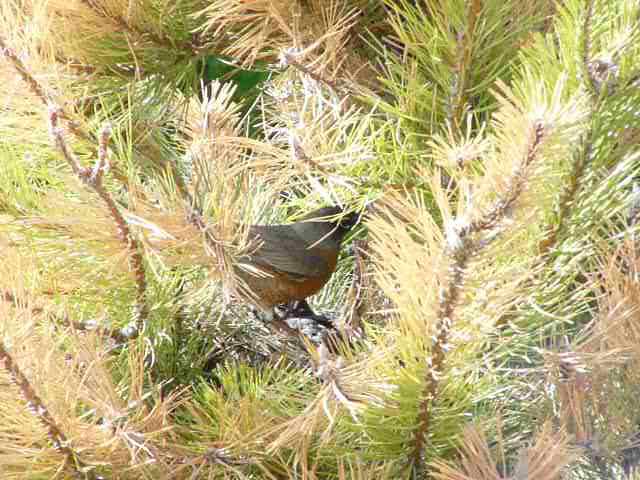
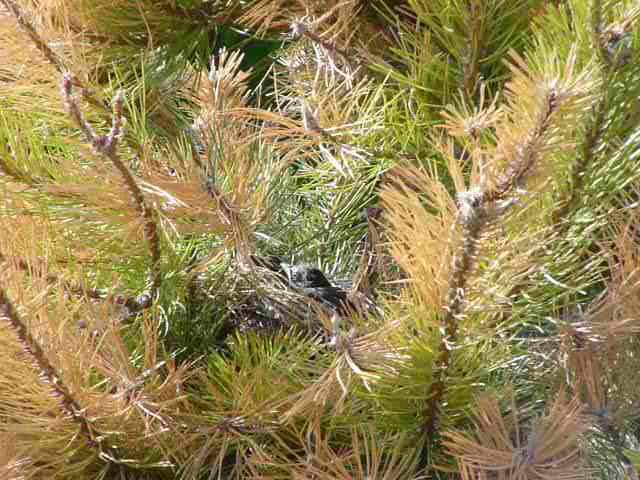
Now, one would think an adult Robin would know the difference between one of its own and a stranger. Yet, to our amazement, a pair of mating Robins quickly adopted the baby Grackle and took to raising it as their own. This caused me to think that the nest had actually been built by the mother Robin. We named the chick Little Gray Feather and observed its development into June until it left the nest and was capable of very short flights while still being tended to by its adoptive parents.

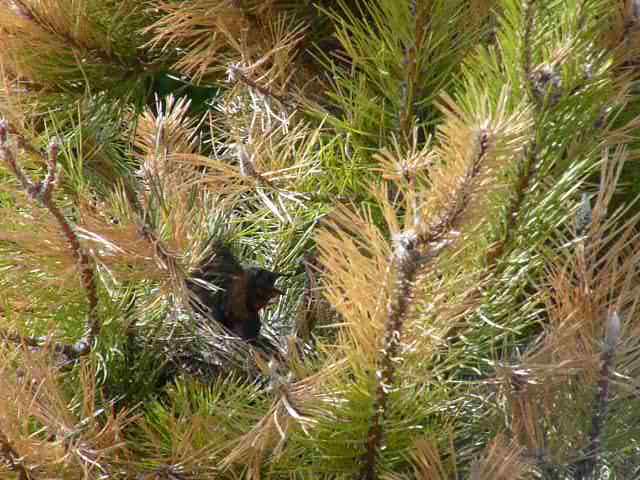
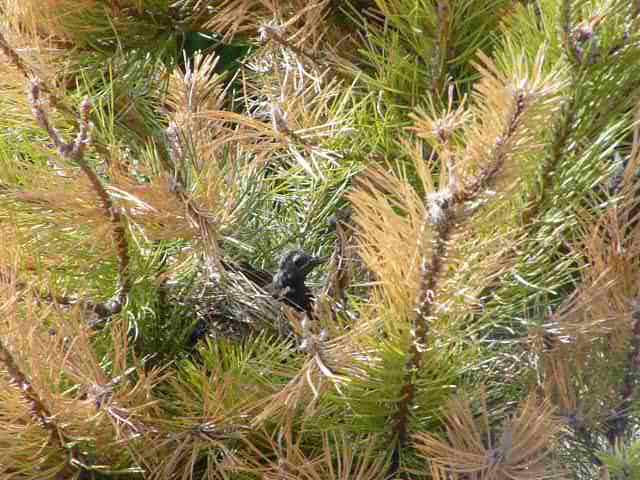
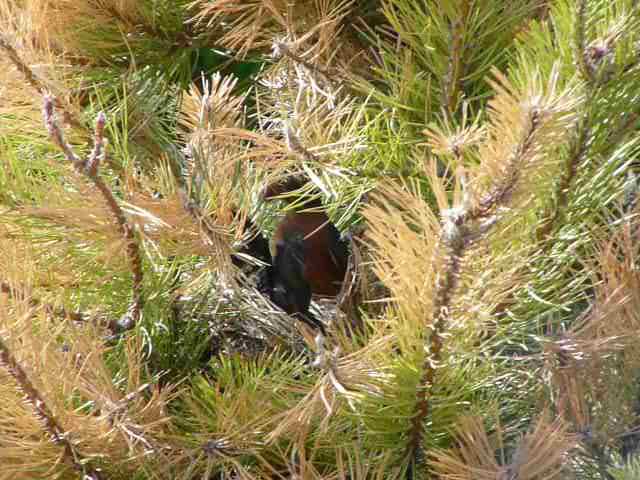
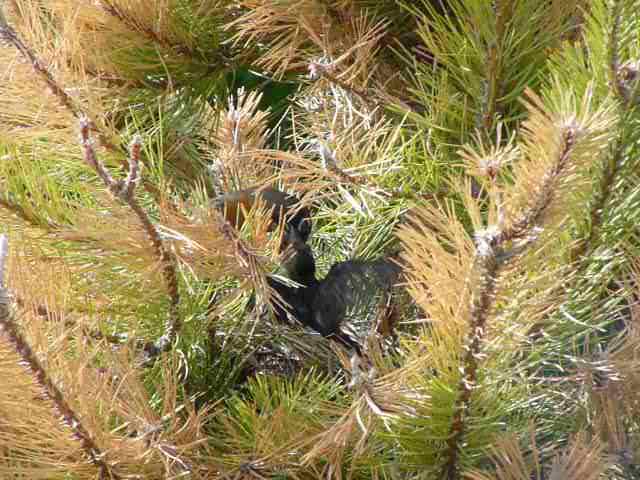
Using a Panasonic Lumix-DMC FZ8 digital camera, on May 29, 2009, I took a video of the Grackle in the nest and one of its adoptive Robin parents feeding it and cleaning up after it. Following are photos captured from the video, arranged in chronological order from left to right:

*

Little Gray Feather
Copyright ©2015 Dan Vaisanen


Lee’s Addition:

What an amazing story and the photos and video to go along with it. Thanks Dan for sharing this with us. Dan Vaisanen is an acquaintance of James J. S. Johnson.

Other birds have fed babies that are not their own, but this was all done by accident. It is interesting that one species, the Robins, were willing to feed another species’ baby, but that the Grackles would not do the same for the Robin babies. Must be a truth there somewhere.

“So then, whatever you desire that others would do to and for you, even so do also to and for them, for this is (sums up) the Law and the Prophets. (Matthew 7:12 AMP)

Deceit:

Good Behavior:

*

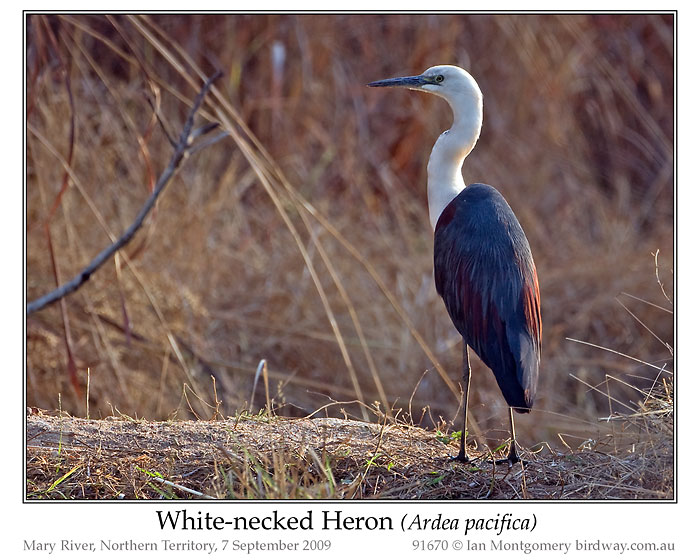
Ian’s Bird of the Week – White-necked Heron

White-faced Heron (Ardea Pacifica) by IanIan’s Bird of the Week – White-necked Heron ~ by Ian Montgomery

Newsletter – 5/29/15

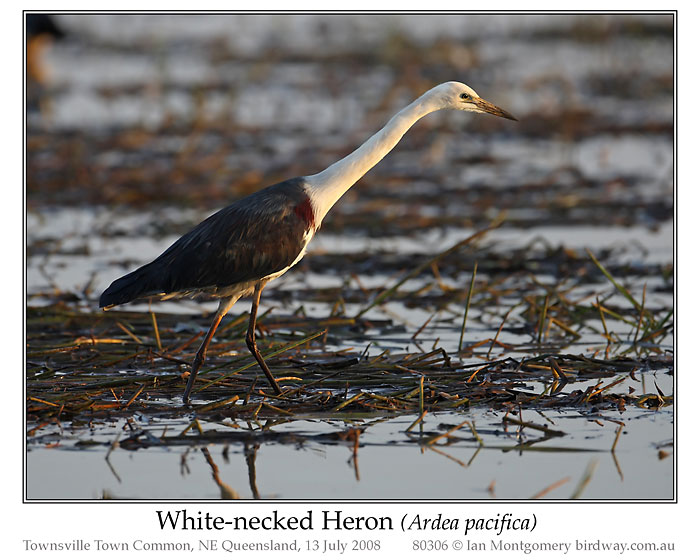
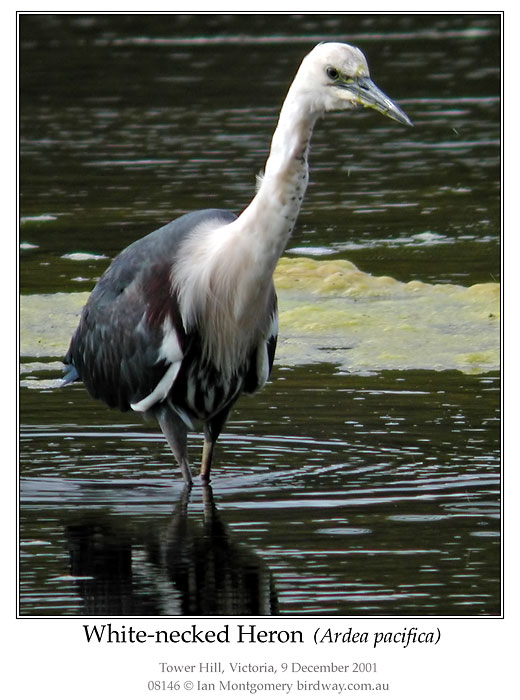
Continuing last week’s theme (White-faced Heron) of common – but in these pages neglected – Australian herons here is the other very widespread species, the White-necked or Pacific. It’s not as abundant or as well-known as the White-faced, but much bigger and a striking bird with its white head and neck and slate-grey back and wings. In length it varies from 76-106cm/30-42in with wingspan to 160cm/63in.

In breeding plumage, it develops plum-coloured plumes on the back (first photo at sunrise) and shoulders (second photo at sunset). It’s predominantly a bird of freshwater and is only rarely seen in estuaries. It’s quite partial to small shallow ponds and is widespread in inland Australia when water is available, moving to more coastal areas in dry seasons. So it can turn up almost anywhere in the country. In southern Australia it breeds in Spring and Summer; in northern Australia it can breed at any time of the year depending on rainfall – the one in the second photo was photographed in mid-winter in Townsville, but the first half of 2008 was very wet in northern Australia.

White-faced Heron (Ardea Pacifica) by IanAccording to the field guides, non-breeding birds have rows of grey spots on the front of the neck, like the one in the third photo. The neck is supposedly completely white in breeding plumage, but it is not unusual to see birds with both purple plumes and grey neck spots. Both the second and third photos show the white patches on the leading edge of the wing. These are obvious (and diagnostic) in flight when they look like the landing lights of a passenger aircraft.

White-faced Heron (Ardea Pacifica) by IanThe bird in the fourth photo was in Boulia, in far western Queensland north of Birdsville. The field guides and HBW (Handbook of Birds of the World) are vague about juvenile plumage but are supposed to have more spots on the neck than non-breeding adults and may have greyish head and neck. the one in the Boulia bird has a white head and neck with grey spots on the sides of the neck, while the bird in the fifth photo has a grey head and neck.

White-faced Heron (Ardea Pacifica) by IanI assume that both of these are juveniles. Both have pale spots on the wings, but I can’t find are reference to that in the field guides. I haven’t got HANZAB (Handbook of Australian, New Zealand and Antarctic Birds) so if anyone reading this does, I’d be grateful for any illuminating feedback on juvenile plumage.

White-faced Heron (Ardea Pacifica) by IanThe White-necked Heron breeds only on mainland Australia. It does, however, turn up regularly in Tasmania and southern New Guinea and has been recorded as a vagrant on Norfolk Island and in New Zealand.

Greetings
Ian

**************************************************
Ian Montgomery, Birdway Pty Ltd,
454 Forestry Road, Bluewater, Qld 4818
Tel 0411 602 737 ian@birdway.com.au
Bird Photos http://www.birdway.com.au/
Where to Find Birds in Northern Queensland:: iTunesGoogle Play Kobo Books
Recorder Society http://www.nqrs.org.au


Lee’s Addition:

the stork, the heron of any kind; the hoopoe and the bat. (Deuteronomy 14:18 ESV)

Thanks again, Ian. I really like that reflection in that fourth photo. Also, those spots on the non-breeding heron are very noticeable. We don’t have those here in the US of course, since they are native to your area. They sort of look like our Great Egret on the top part and our Great Blue Heron on the body part.

What you might consider common, we would consider it a delight to see and the other way around. Our common birds would by your delight to see.

*

Ian’s Birds of the Week

Ian’s Heron Family

Ardeidae – Herons, Bitterns

Ian’s Home Page

*


“Flag That Bird!” (Part 4)

“Flag That Bird!”  (Part 4)

He who has an ear, let him hear what the Spirit says unto the churches; unto him who overcomes will I give to eat of the tree of life, which is in the midst of the paradise of God.   (Revelation 2:7)
Luzon Bleeding-heart by Dan

Orni-Theology

The time will eventually come when the words “tree” and “paradise” coincide, in a truly heavenly way.  But until then, we do have a bird of “paradise” that is known for habituating trees, especially the tropical trees of Papua New Guinea.  Various birds, each known as a Bird of paradise, are known for their flamboyant color and beauty, especially long, thin, streamer-like tail feathers that show off the bird’s fancy status as a flying exhibit of heavenly design and construction.

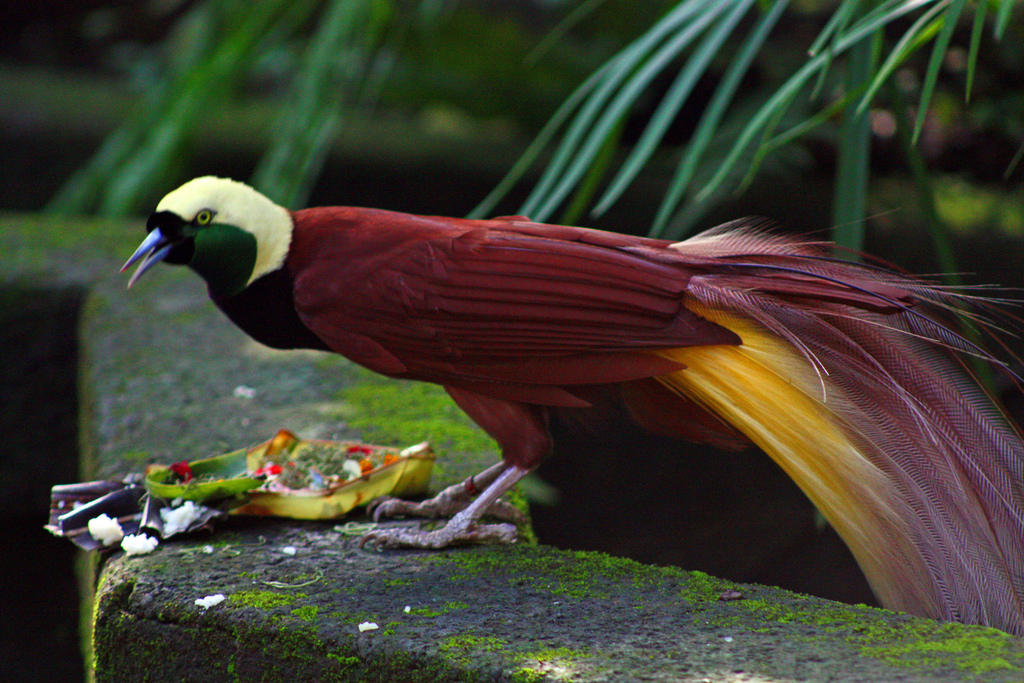
The first of today’s featured creatures, the Raggiana Bird-of-Paradise (Paradisaea raggiana), is a tropical rainforest bird with feathery flamboyance.  Indeed, extravagant feathers are commonplace for birds-of-paradise, and this variety sports scarlet red, bright green, lemon yellow, black, combined to maroonish-mauve/rusty-brown, comprising a challenge for any wildlife painter!
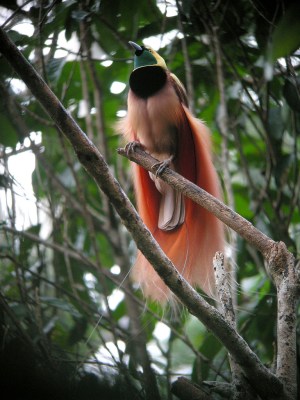
Raggiana Bird-of-paradise (Paradisaea raggiana) ©WikiC

Raggiana Bird-of-paradise (Paradisaea raggiana) ©WikiC

However, as beautiful as Bird-of-Paradise feathers may be, be cautious about buying their feathers from any foreign vendors, because commercial exporting transactions involving these birds are regulated according to Appendix II of a wildlife protection treaty called “Convention on International Trade in Endangered Species of Wild Fauna and Flora” (a/k/a the “Washington Convention”, usually abbreviated as “CITES” – opened for signature AD1973, adopted by USA  in AD1975).  The USA vigorously enforces CITES protections , internationally, by investigating, arresting, and prosecuting poachers who violate the endangered species provisions of the CITES treaty.

In Flag Those Birds! (Part 1)”,  we considered 4 “banner birds”  –  besides eagles  –  that appear on national flags:  Belgium’s Wallonian Chicken (Gallus gallus domesticus); Portugal’s Northern Goshawk (Accipiter gentilis); Burma’s Green Peafowl (Pavo muticus); and Dominica’s Sisserou Parrot (Amazona imperialis).  In Flag Those Birds! (Part 2)”,  we reviewed 2 more “banner birds”:  the British Antarctic Territory’s Emperor Penguin (Aptenodytes forsteri), and the Saint Helena Plover, a/k/a Saint Helena’s skinny-legged “Wirebird” (Charadrius sanctaehelenae).  In Flag That Bird! (Part 3)”,  we showcased 1 more “banner bird”:  Kiribati’s Great Frigatebird Emperor Penguin (Fregata minor), as well as the importance and popularity of Mother’s Day.

In this posting, we have two more “banner birds”:  Papua New Guinea’s bird of paradise, featured on the flag of Papua New Guinea, and the ubiquitous dove, featured on Fiji’s flag (as well as on the royal standard of Tonga).  God willing, we will subsequently review the black swan of Western Australia, the piping shrike of South Australia, the condor of Bolivia; and Uganda’s crested crane.

So for now, let us resume our series with Papua New Guinea’s Raggiana Bird of Paradise (Paradisaea raggiana).

Raggiana Bird-of-Paradise (Paradisaea raggiana, f/k/a Gerrus paradisaea).
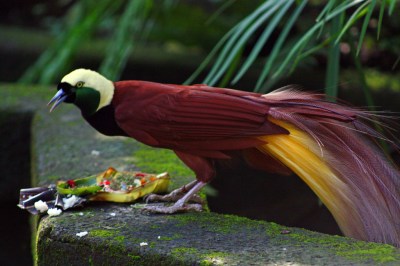
Raggiana Bird-of-paradise (Paradisaea raggiana) ©WikiC

Raggiana Bird-of-paradise (Paradisaea raggiana) ©WikiC

Birds-of-paradise routinely eat a diet of fruits and bugs, which are plentiful in New Guinea jungles, so no one should expect birds-of-paradise to miss a meal, much less to starve in their tropical habitats!  Birds-of-paradise are known to hybridise, in the wild, wreaking havoc on taxonomy charts.  [See David Chandler & Dominic Couzens, 100 Birds to See Before You Die:  The Ultimate Wish List for Birders Everywhere (San Diego, CA: Thunder Bay Press, 2008), page 207.]

Raggiana birds-of-paradise especially appreciate tropical fruit, including nutmeg.  After eating jungle fruits the birds-of-paradise serve fruit-trees by dispersing the seeds, post-digestion, with natural “fertilizer”, and thereby promote the planting of the next generation of fruit trees, which eventually germinate and fruit somewhere within the range of the tree-planting bird-of-paradise.

Raggiana Bird-of-paradise (Paradisaea raggiana) by Dan

Raggiana Bird-of-paradise (Paradisaea raggiana) Lowry Park Zoo by Dan

The Raggiana Bird of Paradise (a/k/a “Count Raggi’s bird-of-paradise”, being named for Marquis Francis Raggi of Genoa, Italy) is the national bird of Papua New Guinea, since AD1971, when it was included on that nation’s national flag and coat-of-arms.

Flag of Papua New Guinea ©PD

Flag of Papua New Guinea ©PD

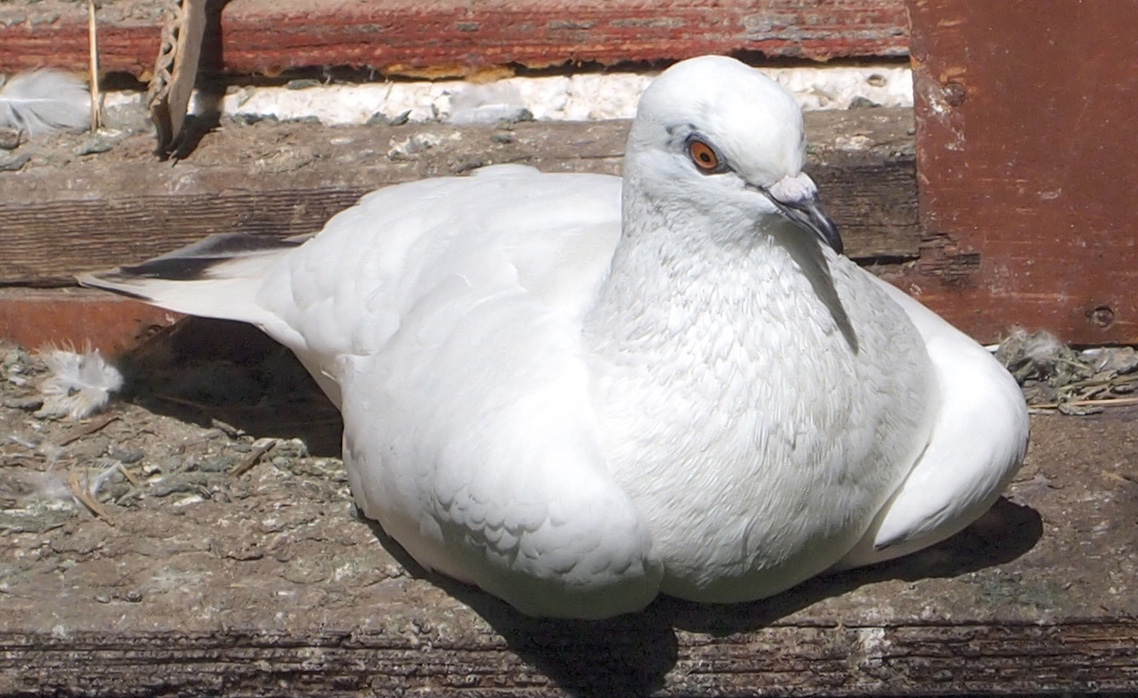
The next “banner bird” is a dove (which is really a family of similar birds), the most common species of which is the ubiquitous Rock Dove (Columbia livia), a species that includes within it a domesticated subspecies (i.e., breeder’s variety) called the homing pigeon (Columbia livia domestica  –  a/k/a “carrier pigeons” when they carry messages), many of which are completely white.

Of course the world is home to many other common doves and pigeons (e.g., Mourning Dove, Key West Quail-Dove, Inca Dove, White-winged Dove, various Turtle Doves, etc.), but earlier comments about doves and pigeons are now cited, rather than being repeated here,  [See, for examples, Lee’s Birdwatching dove articles at Birds of the Bible – Dove and Turtle Dove,  Birds of the Bible – Descending Like A Dove, and Birds of the Bible – Dove and Pigeon Distribution  —  as well as brief comments on the Mourning Dove (Zenaida macroura), while recalling a wonderful morning of bird-watching (with Chaplain Bob and Marcia Webel) in Pond-side Birdwatching In Florida III.]

Flag of Fiji ©PD

Flag of Fiji ©PD

A completely white “dove of peace” appears on the flag of Fiji.  But what variety of “dove” is it?  (Well, it looks like it could be a white homing pigeon, but is that what the Fiji flag designers had in mind?)

Fiji is a tropical archipelago (i.e., cluster of islands) in the South Pacific Ocean.  Ironically, the special habitat of the Fiji archipelago is the only “home” for 3 endemic varieties of fruit-eating doves (a/k/a “fruit doves” or “fruit pigeons”): the Orange Fruit Dove (Ptilinopus victor, a/k/a Flame Dove), Golden Fruit Dove (Ptilinopus luteovirens, a/k/a Lemon Dove or Yellow Dove), and Whistling Fruit Dove (Ptilinopus layardi, a/k/a Velvet Dove or Yellow-headed Dove), —  yet none of those doves are completely white.

So the Fiji flag’s white dove, which derives from the coat-of-arms of the Kingdom of Fiji (AD1871-AD1874), does not match any particular variety of dove that is endemic to the Fiji islands.
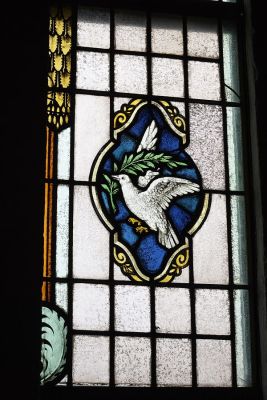
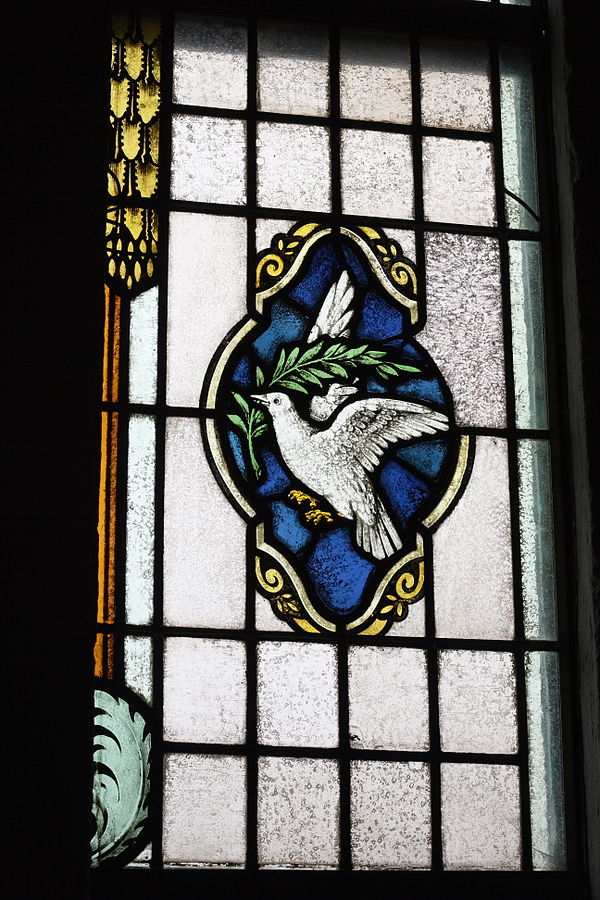
White Dove With Olive Branch - Stained Glass ©WikiC

White Dove With Olive Branch – Stained Glass ©WikiC

[ image taken from http://en.wikipedia.org/wiki/Doves_as_symbols ]

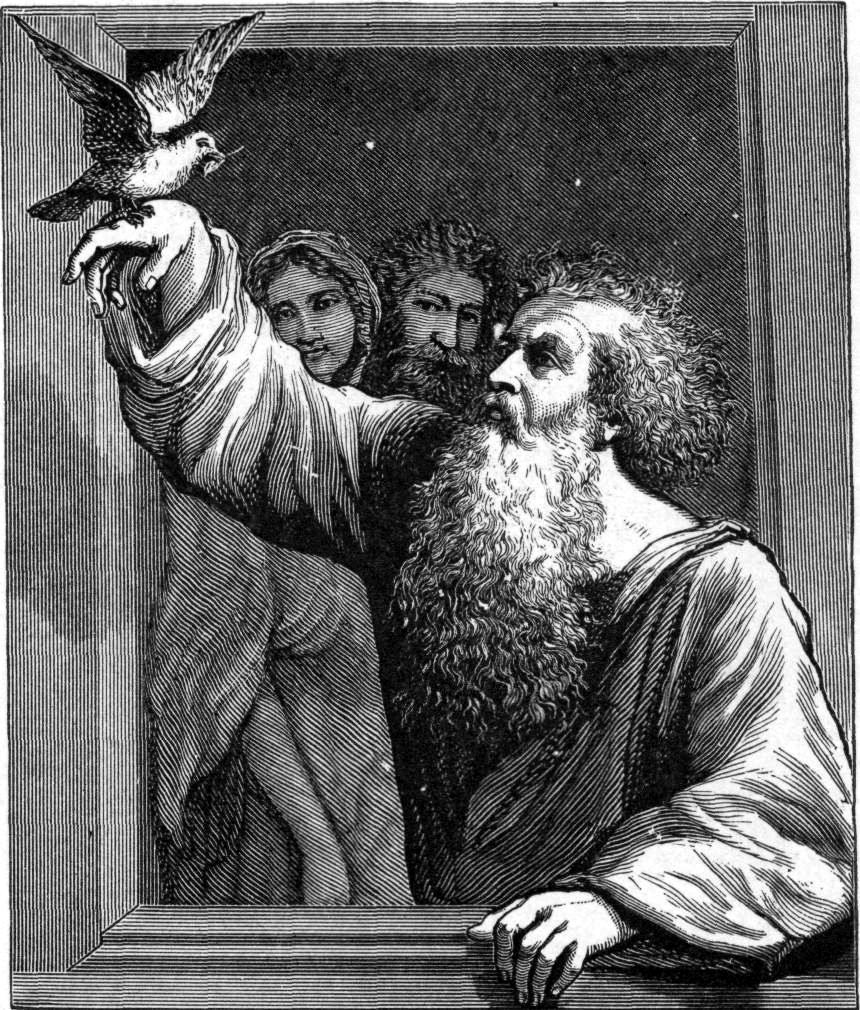
The olive leaf branch in the white dove’s beak suggests that the dove portrayed (in the flag of Fiji) is the olive-bearing dove that Noah released, received, and released again (see Genesis 8:8-12), which Ark-borne dove many have guessed was all white (although the Bible says nothing about that dove’s color).  Likewise, the royal standard of Tonga depicts a similar all-white dove, bearing a green olive leaf.

Royal Standard of Tonga

Royal Standard of Tonga

There are, of course, some doves that are completely white.  As noted above, one example of a pure-white dove is the white homing pigeon. That is as good a guess as many.  After all, homing pigeons are famous for returning “home”, and the olive-bearing dove returned home (to its “house-boat”) after the Flood, — so maybe Noah’s famous dove was a homing pigeon!
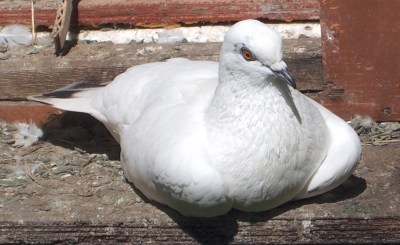
White Homing Pigeon © WikiC

White Homing Pigeon © WikiC

But we probably need to wait — until we have a chance to speak with Noah, himself, because Noah was the bird-handling one (of only 8 humans) who personally knows which variety of “dove” brought back that famous olive leaf unto him, after the year-long global Flood.  (What a voyage those 8 had!)  And the world’s people-groups, to this day, have multifarious records (usually literary, but not always) of remembering the unique ocean voyage that those 8 survivors took, some 4½ thousand years ago  —  as is briefly illustrated in “Genesis in Chinese Pictographs” (posted at www.icr.org/article/8643 ).  For a thoroughly researched and documented cornucopia of ancient flood accounts, see Dr. Bill Cooper’s THE AUTHENTICITY OF THE BOOK OF GENESIS (Creation Science Movement, 2011 — available through http://www.csm.org.uk ), 424 pages.
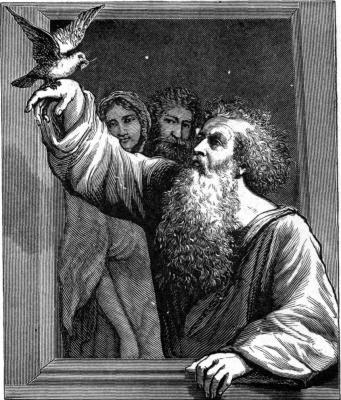
Noah with a Dove ©Drawing WikiC

Noah with a Dove ©Drawing WikiC

And the dove came in to him in the evening; and, lo, in her mouth was an olive leaf plucked off; so Noah knew that the waters were abated from off the earth.  And he [i.e., Noah] stayed yet other 7 days; and sent forth the dove, which returned not again unto him anymore.  (Genesis 8:11-2)

With those short comments, as Noah did centuries ago (Genesis 8:12), we now “release” the dove into the wide wild world, where many of that tribe thrive, faithfully being fruitful, multiplying, and filling the earth (Genesis 1:22 & 9:8-12).

Another day, God willing, we shall consider the black swan of Western Australia,  the piping shrike of South Australia,  the condor of Bolivia,  and Uganda’s crested crane.  So please stay tuned!

*

“Flag That Bird!”  (Part 1)

“Flag That Bird!”  (Part 2)

“Flag That Bird!”  (Part 3)

More Articles by James J. S. Johnson

Orni-Theology

*
The World’s Ugliest Animal – Creation Moment

Blobfish ©Simon Elgood

Blobfish ©Simon Elgood

Now here is an interesting and “ugly” fish. This was shared by Creation Moments.

For in six days the LORD made heaven and earth, the sea, and all that in them is, and rested the seventh day: wherefore the LORD blessed the sabbath day, and hallowed it. (Exodus 20:11 KJV)

Published on Apr 22, 2015

http://www.CreationMoments.com

When this fish is taken out of the water, its face almost looks like a very sad person. In 2013 it was voted the “World’s Ugliest Animal”. What is this creature that was adopted as the mascot of the Ugly Animal Preservation Society? It’s the appropriately named blobfish.
Photos of the ugly blobfish have been making the rounds on the Internet. And yet, even the blobfish has beauty when you consider that it was designed to function perfectly in its environment.

Blobfish inhabit the deep waters off the coasts of Australia, Tasmania and New Zealand. If you wanted to see one in its natural habitat, you would have to dive to a depth of between 2,000 and 3,900 feet where the pressure is several dozen times higher than at sea level. The pressure is no problem for the blobfish, though. Its jelly-like body is slightly less dense than water, allowing it to float effortlessly just above the sea floor.
Blobfish don’t have much muscle for swimming, but they don’t need it. They simply swallow edible matter that floats into their mouth. Sadly, they are an endangered species because of fishing trawlers dragging their nets on the seafloor.

Yes, the blobfish is far from attractive. But it serves as a reminder that sinful human beings are unattractive in the sight of God. And yet, while we were still sinners, God sent His Son to die for us and to exchange His righteousness for our sins, making us acceptable in God’s sight. What a Savior!
Prayer:

Father, thank You for sending Your Holy Spirit to reveal the ugliness brought about by sin. Thank You also for sending Your Son to remove my sin and make me righteous in Your sight. Amen.

*
Plus