Now here is an interesting and “ugly” fish. This was shared by Creation Moments.
For in six days the LORD made heaven and earth, the sea, and all that in them is, and rested the seventh day: wherefore the LORD blessed the sabbath day, and hallowed it. (Exodus 20:11 KJV)
When this fish is taken out of the water, its face almost looks like a very sad person. In 2013 it was voted the “World’s Ugliest Animal”. What is this creature that was adopted as the mascot of the Ugly Animal Preservation Society? It’s the appropriately named blobfish.
Photos of the ugly blobfish have been making the rounds on the Internet. And yet, even the blobfish has beauty when you consider that it was designed to function perfectly in its environment.
Blobfish inhabit the deep waters off the coasts of Australia, Tasmania and New Zealand. If you wanted to see one in its natural habitat, you would have to dive to a depth of between 2,000 and 3,900 feet where the pressure is several dozen times higher than at sea level. The pressure is no problem for the blobfish, though. Its jelly-like body is slightly less dense than water, allowing it to float effortlessly just above the sea floor.
Blobfish don’t have much muscle for swimming, but they don’t need it. They simply swallow edible matter that floats into their mouth. Sadly, they are an endangered species because of fishing trawlers dragging their nets on the seafloor.
Yes, the blobfish is far from attractive. But it serves as a reminder that sinful human beings are unattractive in the sight of God. And yet, while we were still sinners, God sent His Son to die for us and to exchange His righteousness for our sins, making us acceptable in God’s sight. What a Savior!
Prayer:
Father, thank You for sending Your Holy Spirit to reveal the ugliness brought about by sin. Thank You also for sending Your Son to remove my sin and make me righteous in Your sight. Amen.
For by him were all things created, that are in heaven, and that are in earth, visible and invisible, whether they be thrones, or dominions, or principalities, or powers: all things were created by him, and for him: And he is before all things, and by him all things consist. (Colossians 1:16-17 KJV)
While reading an article from Sage Brush’s “The Vine Vigil” he included this video from exploration films:
To find out more about this relationship between bees and the vanilla bean plus other videos, go to:
God’s Creation – Vanilla Beans and Melipona Bees
Let them praise the name of the LORD: for he commanded, and they were created. (Psalms 148:5 KJV)
*
Just realized this little jewel has been written about before, but Sage Brush’s article is very interesting.
Peter Rabbit was dozing. Yes, sir, Peter was dozing. He didn’t mean to doze, but whenever Peter sits still for a long time and tries to think, he is pretty sure to go to sleep. By and by he wakened with a start. At first he didn’t know what had wakened him, but as he sat there blinking his eyes, he heard a few rich notes from the top of the nearest apple-tree. “It’s Goldy the Oriole,” thought Peter, and peeped out to see.
But though he looked and looked he couldn’t see Goldy anywhere, but he did see a stranger. It was some one of about Goldy’s size and shape. In fact he was so like Goldy, but for the color of his suit, that at first Peter almost thought Goldy had somehow changed his clothes. Of course he knew that this couldn’t be, but it seemed as if it must be, for the song the stranger was singing was something like that of Goldy. The stranger’s head and throat and back were black, just like Goldy’s, and his wings were trimmed with white in just the same way. But the rest of his suit, instead of being the beautiful orange of which Goldy is so proud, was a beautiful chestnut color.
Peter blinked and stared very hard. “Now who can this be?” said he, speaking aloud without thinking.
“Don’t you know him?” asked a sharp voice so close to Peter that it made him jump. Peter whirled around. There sat Striped Chipmunk grinning at him from the top of the old stone wall. “That’s Weaver the Orchard Oriole,” Striped Chipmunk rattled on. “If you don’t know him you ought to, because he is one of the very nicest persons in the Old Orchard. I just love to hear him sing.”
“Is—is—he related to Goldy?” asked Peter somewhat doubtfully.
“Of course,” retorted Striped Chipmunk. “I shouldn’t think you would have to look at him more than once to know that. He’s first cousin to Goldy. There comes Mrs. Weaver. I do hope they’ve decided to build in the Old Orchard this year.”
“I’m glad you told me who she is because I never would have guessed it,” confessed Peter as he studied the newcomer. She did not look at all like Weaver. She was dressed in olive-green and dull yellow, with white markings on her wings.
Peter couldn’t help thinking how much easier it must be for her than for her handsome husband to hide among the green leaves.
As he watched she flew down to the ground and picked up a long piece of grass. “They are building here, as sure as you live!” cried Striped Chipmunk. “I’m glad of that. Did you ever see their nest, Peter? Of course you haven’t, because you said you had never seen them before. Their nest is a wonder, Peter. It really is. It is made almost wholly of fine grass and they weave it together in the most wonderful way.”
“Do they have a hanging nest like Goldy’s?” asked Peter a bit timidly.
“Not such a deep one,” replied Striped Chipmunk. “They hang it between the twigs near the end of a branch, but they bind it more closely to the branch and it isn’t deep enough to swing as Goldy’s does.”
Peter had just opened his mouth to ask another question when there was a loud sniffing sound farther up along the old stone wall. He didn’t wait to hear it again. He knew that Bowser the Hound was coming.
“Good-by, Striped Chipmunk! This is no place for me,” whispered Peter and started for the dear Old Briar-patch. He was in such a hurry to get there that on his way across the Green Meadows he almost ran into Jimmy Skunk before he saw him.
“What’s your hurry, Peter?” demanded Jimmy
“Bowser the Hound almost found me up in the Old Orchard,” panted Peter. “It’s a wonder he hasn’t found my tracks. I expect he will any minute. I’m glad to see you, Jimmy, but I guess I’d better be moving along.”
“Don’t be in such a hurry, Peter. Don’t be in such a hurry,” replied Jimmy, who himself never hurries. “Stop and talk a bit. That old nuisance won’t bother you as long as you are with me.”
Peter hesitated. He wanted to gossip, but he still felt nervous about Bowser the Hound. However, as he heard nothing of Bowser’s great voice, telling all the world that he had found Peter’s tracks, he decided to stop a few minutes. “What are you doing down here on the Green Meadows?” he demanded.
Jimmy grinned. “I’m looking for grasshoppers and grubs, if you must know,” said he. “And I’ve just got a notion I may find some fresh eggs. I don’t often eat them, but once in a while one tastes good.”
“If you ask me, it’s a funny place to be looking for eggs down here on the Green Meadows,” replied Peter. “When I want a thing; I look for it where it is likely to be found.”
“Just so, Peter; just so,” retorted Jimmy Skunk, nodding his head with approval. “That’s why I am here.”
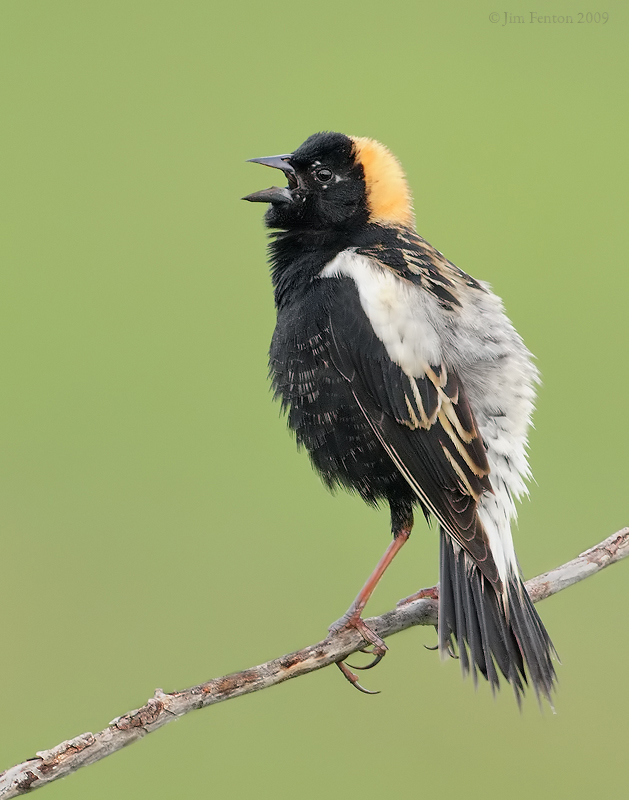
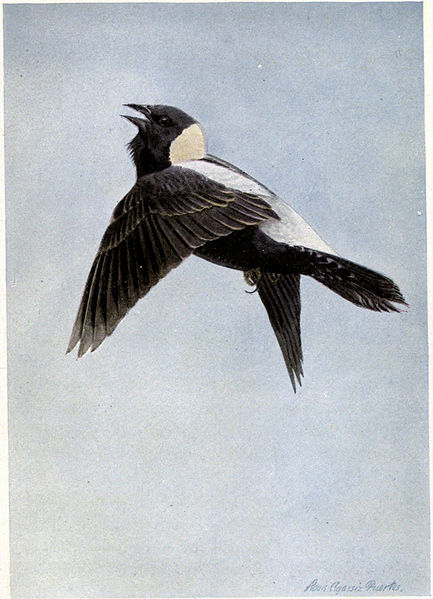
Peter looked puzzled. He was puzzled. But before he could ask another question a rollicking song caused both of them to look up. There on quivering wings in mid-air was the singer. He was dressed very much like Jimmy Skunk himself, in black and white, save that in places the white had a tinge of yellow, especially on the back of his neck. It was Bubbling Bob the Bobolink. And how he did sing! It seemed as if the notes fairly tumbled over each other.
Jimmy Skunk raised himself on his hind-legs a little to see just where Bubbling Bob dropped down in the grass. Then Jimmy began to move in that direction. Suddenly Peter understood. He remembered that Bubbling Bob’s nest is always on the ground. It was his eggs that Jimmy Skunk was looking for.
“You don’t happen to have seen Mrs. Bob anywhere around here, do you, Peter?” asked Jimmy, trying to speak carelessly.
“No,” replied Peter. “If I had I wouldn’t tell you where. You ought to be ashamed, Jimmy Skunk, to think of robbing such a beautiful singer as Bubbling Bob.”
“Pooh!” retorted Jimmy. “What’s the harm? If I find those eggs he and Mrs. Bob could simply build another nest and lay some more. They won’t be any the worse off, and I will have had a good breakfast.”
“But think of all the work they would have to do to build another nest,” replied Peter.
“I should worry,” retorted Jimmy Skunk. “Any one who can spend so much time singing can afford to do a little extra work.”
“You’re horrid, Jimmy Skunk. You’re just horrid,” said Peter. “I hope you won’t find a single egg, so there!”
Bobolink (Dolichonyx oryzivorus) by J Fenton
With this, Peter once more headed for the dear Old Briar-patch, while Jimmy Skunk continued toward the place where Bubbling Bob had disappeared in the long grass. Peter went only a short distance and then sat up to watch Jimmy Skunk. Just before Jimmy reached the place where Bubbling Bob had disappeared, the latter mounted into the air again, pouring out his rollicking song as if there were no room in his heart for anything but happiness. Then he saw Jimmy Shrunk and became very much excited. He flew down in the grass a little farther on and then up again, and began to scold.
It looked very much as if he had gone down in the grass to warn Mrs. Bob. Evidently Jimmy thought so, for he at once headed that way. When Bubbling Bob did the same thing all over again. Peter grew anxious. He knew just how patient Jimmy Skunk could be, and he very much feared that Jimmy would find that nest. Presently he grew tired of watching and started on for the dear Old Briar-patch. Just before he reached it a brown bird, who reminded him somewhat of Mrs. Redwing and Sally Sly the Cowbird, though she was smaller, ran across the path in front of him and then flew up to the top of a last year’s mullein stalk. It was Mrs. Bobolink. Peter knew her well, for he and she were very good friends.
“Oh!” cried Peter. “What are you doing here? Don’t you know that Jimmy Skunk, is hunting for your nest over there? Aren’t you worried to death? I would be if I were in your place.”
Mrs. Bob chuckled. “Isn’t he a dear? And isn’t he smart?” said she, meaning Bubbling Bob, of course, and not Jimmy Skunk. “Just see him lead that black-and-white robber away.”
Peter stared at her for a full minute. “Do you mean to say,” said he “that your nest isn’t over there at all?”
Mrs. Bob chuckled harder than ever. “Of course it isn’t over there,” said she.
“Then where is it?” demanded Peter.
“That’s telling,” replied Mrs. Bob. “It isn’t over there, and it isn’t anywhere near there. But where it is is Bob’s secret and mine, and we mean to keep it. Now I must go get something to eat,” and with a hasty farewell Mrs. Bobolink flew over to the other side of the dear Old Briar-patch.
Peter remembered that he had seen Mrs. Bob running along the ground before she flew up to the old mullein stalk. He went back to the spot where he had first seen her and hunted all around in the grass, but without success. You see, Mrs. Bobolink had been quite as clever in fooling Peter as Bubbling Bob had been in fooling Jimmy Skunk.
He who dwells in the secret place of the Most High Shall abide under the shadow of the Almighty. I will say of the LORD, “He is my refuge and my fortress; My God, in Him I will trust.” (Psalms 91:1-2 NKJV)
He who goes about as a talebearer reveals secrets; therefore associate not with him who talks too freely. [Rom. 16:17, 18.] (Proverbs 20:19 AMP)
*
What was Peter Rabbit doing when he heard singing?
Can you tell what the Orchard Oriole looks like?
What does their nest look like?
Who was Peter afraid my find him?
Who told Peter not to worry as long as he was with him? Why?
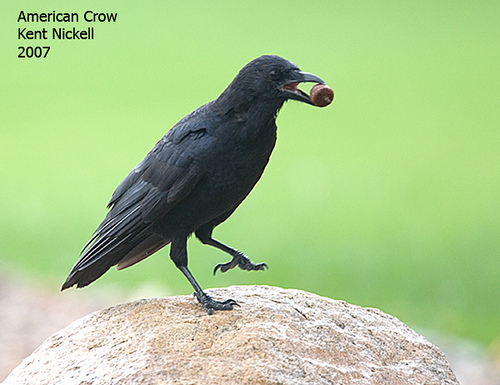
Once there was a crow named Albert who would come to the front yard of a young girl’s house with other crows every day. They came daily because the girl would wait for the crows and feed them bread. This went on every day until the crows decided to bring her a gift in return for the bread.
One by one the crows started bringing little gifts for the girl. One crow found a nickel in a gutter, another found two paperclips by the side of the road, and a third found a shiny gum wrapper by a trashcan.
Albert wanted to bring something to the girl who was very special. Every day after the girl fed all the crows their bread, Albert would start his search. It couldn’t be just anything.
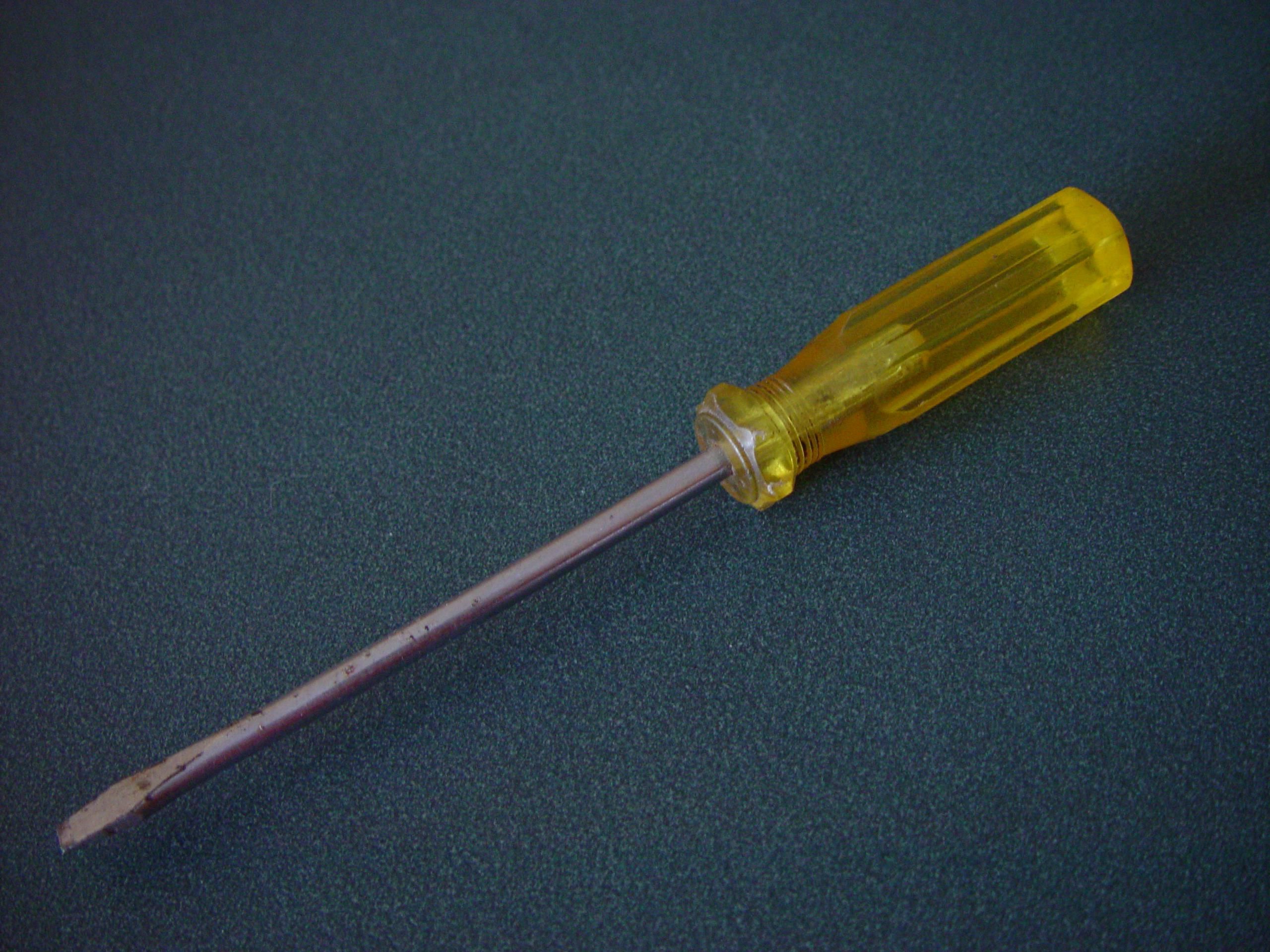
Albert didn’t know it, but a few days before, the girl’s father had been driving down a rough and bumpy road. The girl’s father worked at a construction company so all of his tools were in a toolbox in the passenger seat. The window had been open when the girl’s father went down the rough road so the screwdriver had fallen out the window after the truck had hit a small hole.
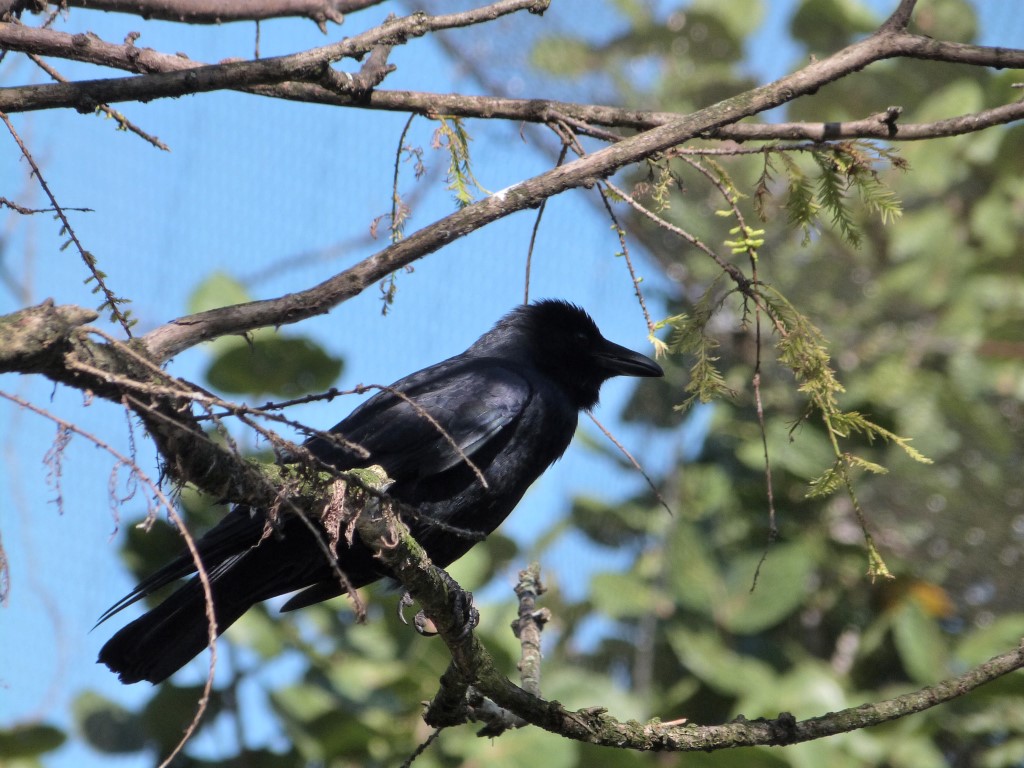
Crow
Albert had been flying past that road when he noticed something shiny. Swooping down, Albert found the screwdriver and decided to bring it back to the girl.
It took a while for Albert to get the screwdriver in his beak to carry because it was very heavy, but Albert eventually was able to fly off the ground a few feet.
It took even longer to get back to the girl’s house, but when Albert flew to the front yard, the girl walked out to find Albert sitting there with the screwdriver next to him. The girl and her father were happy to see the screwdriver because the girl’s father had been looking for it and he needed it for construction. It was the only screwdriver that he owned.
From then on, the girl was sure to give Albert an extra big crumb of bread whenever he came to her front yard.
The End
And when she has found it, she calls her friends and neighbors together, saying, ‘Rejoice with me, for I have found the piece which I lost!’
(Luke 15:9 NKJV)
Another fine tale from our developing young writer, Emma. Thanks again, Emma. We can all learn from caring about other, even when it quite a struggle to help.
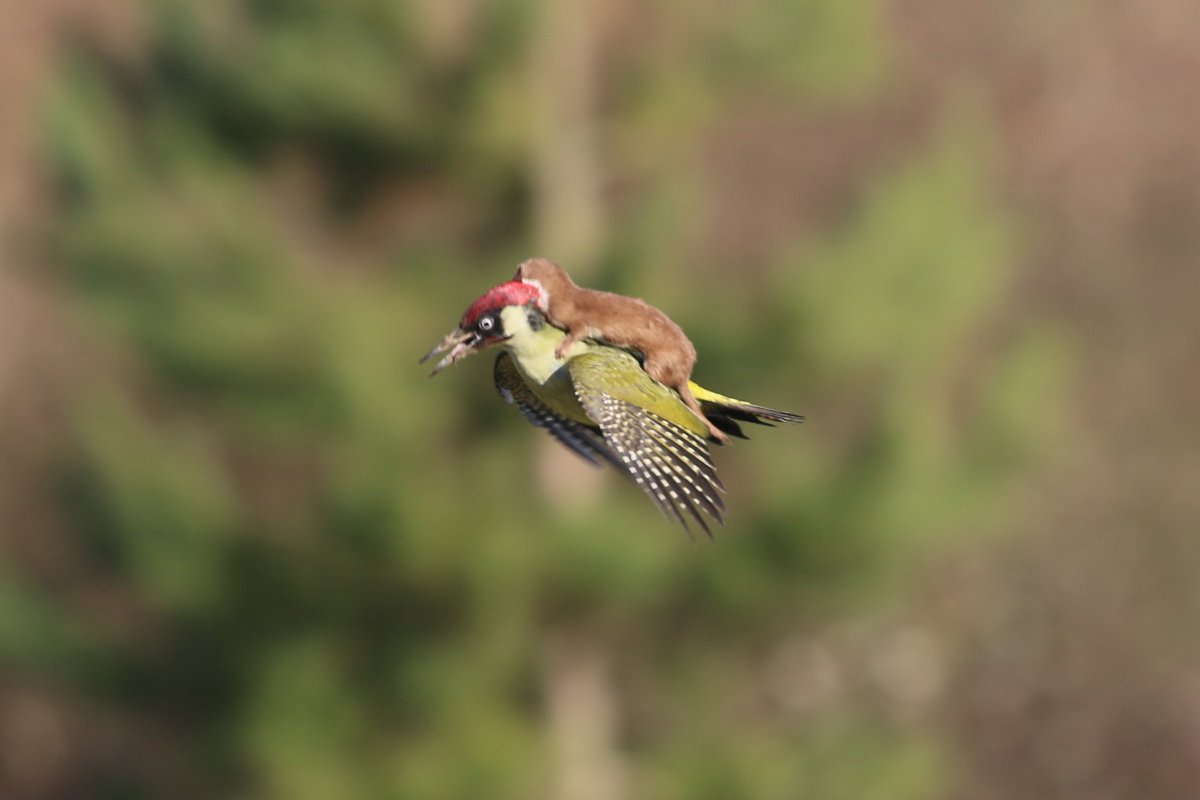
Amateur photographer Martin Le-May, from Essex, has recorded the extraordinary image of a weasel riding on the back of a green woodpecker as it flies through the air.
Now behold, there was a man named Zacchaeus who was a chief tax collector, and he was rich. And he sought to see who Jesus was, but could not because of the crowd, for he was of short stature. So he ran ahead and climbed up into a sycamore tree to see Him, for He was going to pass that way. And when Jesus came to the place, He looked up and saw him, and said to him, “Zacchaeus, make haste and come down, for today I must stay at your house.” (Luke 19:2-5 NKJV)
Maybe the Weasel, like Zacchaeus, thought Jesus was going to come by and he wanted to get a better look.
* Picadae – Woodpeckers
Having other things to attend to, or rather having other things to arouse his curiosity, Peter Rabbit did not visit the Old Orchard for several days. When he did it was to find the entire neighborhood quite upset. There was an indignation meeting in progress in and around the tree in which Chebec and his modest little wife had their home. How the tongues did clatter! Peter knew that something had happened, but though he listened with all his might he couldn’t make head or tail of it.
Finally Peter managed to get the attention of Jenny Wren. “What’s happened?” demanded Peter. “What’s all this fuss about?”
Jenny Wren was so excited that she couldn’t keep still an instant. Her sharp little eyes snapped and her tail was carried higher than ever. “It’s a disgrace! It’s a disgrace to the whole feathered race, and something ought to be done about it!” sputtered Jenny. “I’m ashamed to think that such a contemptible creature wears feathers! I am so!”
“But what’s it all about?” demanded Peter impatiently. “Do keep still long enough to tell me. Who is this contemptible creature?”
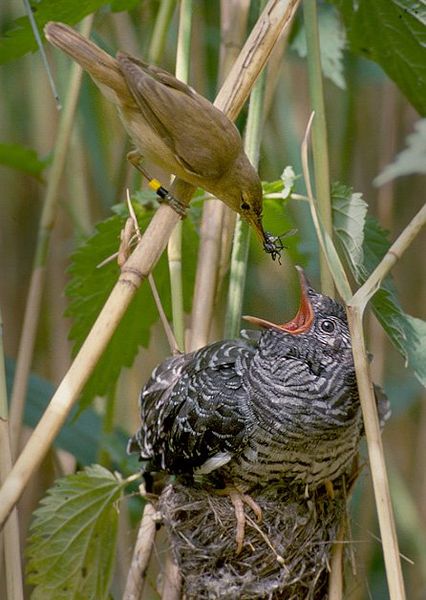
“Sally Sly,” snapped Jenny Wren. “Sally Sly the Cowbird. I hoped she wouldn’t disgrace the Old Orchard this year, but she has. When Mr. and Mrs. Chebec returned from getting their breakfast this morning they found one of Sally Sly’s eggs in their nest. They are terribly upset, and I don’t blame them. If I were in their place I simply would throw that egg out. That’s what I’d do, I’d throw that egg out!”
Peter was puzzled. He blinked his eyes and stroked his whiskers as he tried to understand what it all meant. “Who is Sally Sly, and what did she do that for?” he finally ventured.
“For goodness’ sake, Peter Rabbit, do you mean to tell me you don’t know who Sally Sly is?” Then without waiting for Peter to reply, Jenny rattled on. “She’s a member of the Blackbird family and she’s the laziest, most good-for-nothing, sneakiest, most unfeeling and most selfish wretch I know of!” Jenny paused long enough to get her breath. “She laid that egg in Chebec’s nest because she is too lazy to build a nest of her own and too selfish to take care of her own children. Do you know what will happen, Peter Rabbit? Do you know what will happen?”
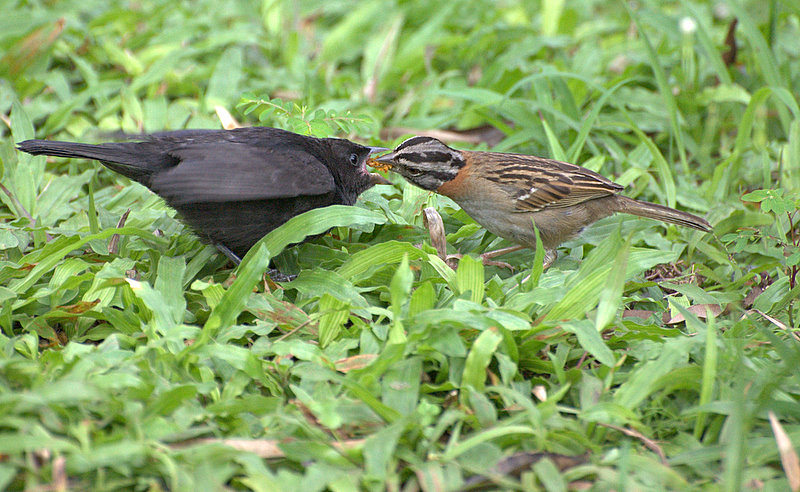
A Shiny Cowbird (Molothrus bonariensis) chick being fed by a Rufous-collared Sparrow (Zonotrichia Capensis)
Peter shook his head and confessed that he didn’t. “When that egg hatches out, that young Cowbird will be about twice as big as Chebec’s own children,” sputtered Jenny. “He’ll be so big that he’ll get most of the food. He’ll just rob those little Chebecs in spite of all their mother and father can do. And Chebec and his wife will be just soft-hearted enough to work themselves to skin and bone to feed the young wretch because he is an orphan and hasn’t anybody to look after him. The worst of it is, Sally Sly is likely to play the same trick on others. She always chooses the nest of some one smaller than herself. She’s terribly sly. No one has seen her about. She just sneaked into the Old Orchard this morning when everybody was busy, laid that egg and sneaked out again.”
“Did you say that she is a member of the Blackbird family?” asked Peter.
Jenny Wren nodded vigorously. “That’s what she is,” said she. “Thank goodness, she isn’t a member of MY family. If she were I never would be able to hold my head up. Just listen to Goldy the Oriole over in that big elm. I don’t see how he can sing like that, knowing that one of his relatives has just done such a shameful deed. It’s a wierd thing that there can be two members of the same family so unlike. Mrs. Goldy builds one of the most wonderful nests of any one I know, and Sally Sly is too lazy to build any. If I were in Goldy’s place I—”
“Hold on!” cried Peter. “I thought you said Sally Sly is a member of the Blackbird family. I don’t see what she’s got to do with Goldy the Oriole.”
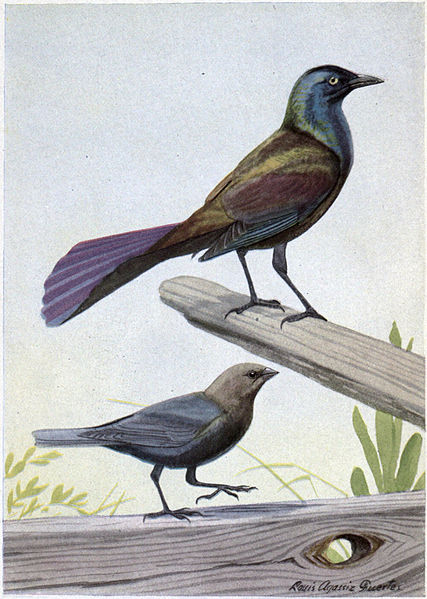
“You don’t, eh?” exclaimed Jenny. “Well, for one who pokes into other people’s affairs as you do, you don’t know much. The Orioles and the MeadowLarks and the Grackles and the Bobolinks all belong to the Blackbird family. They’re all related to Redwing the Blackbird, and Sally Sly the Cowbird belongs in the same family.”
Peter gasped. “I—I—hadn’t the least idea that any of these folks were related,” stammered Peter.
“Well, they are,” retorted Jenny Wren. “As I live, there’s Sally Sly now!”
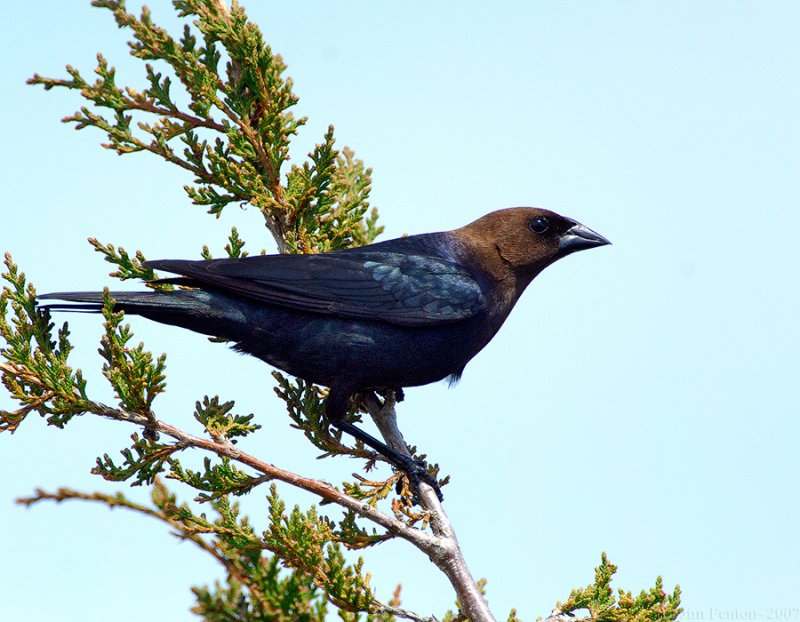
Peter caught a glimpse of a brownish-gray bird who reminded him somewhat of Mrs. Redwing. She was about the same size and looked very much like her. It was plain that she was trying to keep out of sight, and the instant she knew that she had been discovered she flew away in the direction of the Old Pasture. It happened that late that afternoon Peter visited the Old Pasture and saw her again. She and some of her friends were busily walking about close to the feet of the cows, where they seemed to be picking up food. One had a brown head, neck and breast; the rest of his coat was glossy black. Peter rightly guessed that this must be Mr. Cowbird. Seeing them on such good terms with the cows he understood why they are called Cowbirds.
Sure that Sally Sly had left the Old Orchard, the feathered folks settled down to their personal affairs and household cares, Jenny Wren among them. Having no one to talk to, Peter found a shady place close to the old stone wall and there sat down to think over the surprising things he had learned. Presently Goldy the Baltimore Oriole alighted in the nearest apple-tree, and it seemed to Peter that never had he seen any one more beautifully dressed. His head, neck, throat and upper part of his back were black. The lower part of his back and his breast were a beautiful deep orange color. There was a dash of orange on his shoulders, but the rest of his wings were black with an edging of white. His tail was black and orange. Peter had heard him called the Firebird, and now he understood why. His song was quite as rich and beautiful as his coat.
Shortly he was joined by Mrs. Goldy. Compared with her handsome husband she was very modestly dressed. She wore more brown than black, and where the orange color appeared it was rather dull. She wasted no time in singing. Almost instantly her sharp eyes spied a piece of string caught in the bushes almost over Peter’s head. With a little cry of delight she flew down and seized it. But the string was caught, and though she tugged and pulled with all her might she couldn’t get it free. Goldy saw the trouble she was having and cutting his song short, flew down to help her. Together they pulled and tugged and tugged and pulled, until they had to stop to rest and get their breath.
“We simply must have this piece of string,” said Mrs. Goldy. “I’ve been hunting everywhere for a piece, and this is the first I’ve found. It is just what we need to bind our nest fast to the twigs. With this I won’t have the least bit of fear that that nest will ever tear loose, no matter how hard the wind blows.”
Once more they tugged and pulled and pulled and tugged until at last they got it free, and Mrs. Goldy flew away in triumph with the string in her bill. Goldy himself followed. Peter watched them fly to the top of a long, swaying branch of a big elm-tree up near Farmer Brown’s house. He could see something which looked like a bag hanging there, and he knew that this must be the nest.
“Gracious!” said Peter. “They must get terribly tossed about when the wind blows. I should think their babies would be thrown out.”
“Don’t you worry about them,” said a voice.
Peter looked up to find Welcome Robin just over him. “Mrs. Goldy makes one of the most wonderful nests I know of,” continued Welcome Robin. “It is like a deep pocket made of grass, string, hair and bark, all woven together like a piece of cloth. It is so deep that it is quite safe for the babies, and they seem to enjoy being rocked by the wind. I shouldn’t care for it myself because I like a solid foundation for my home, but the Goldies like it. It looks dangerous but it really is one of the safest nests I know of. Snakes and cats never get ‘way up there and there are few feathered nest-robbers who can get at those eggs so deep down in the nest. Goldy is sometimes called Golden Robin. He isn’t a Robin at all, but I would feel very proud if he were a member of my family. He’s just as useful as he is handsome, and that’s saying a great deal. He just dotes on caterpillars. There’s Mrs. Robin calling me. Good-by, Peter.”
With this Welcome Robin flew away and Peter once more settled himself to think over all he had learned.
*
Let him who stole steal no longer, but rather let him labor, working with his hands what is good, that he may have something to give him who has need. (Ephesians 4:28 NKJV)
That is an interesting verse. Did Sally Sly “steal” another bird’s nest? Could she have made her own nest, raise her own chicks and feed them? Sure she could have and many of the Cowbirds do. But there are a few that sneak around and place eggs in other nests.
Are we suppose to steal answers from someone else’s paper? No, we are supposed to study and write our own answers.
*
Why were all the birds upset?
What kind of bird caused the problem?
What Family of birds does it belong to?
What other birds belong to that bird family?
Was Sally Sly being kind?
Eph 4:32 And be kind to one another, tenderhearted, forgiving one another, even as God in Christ forgave you.
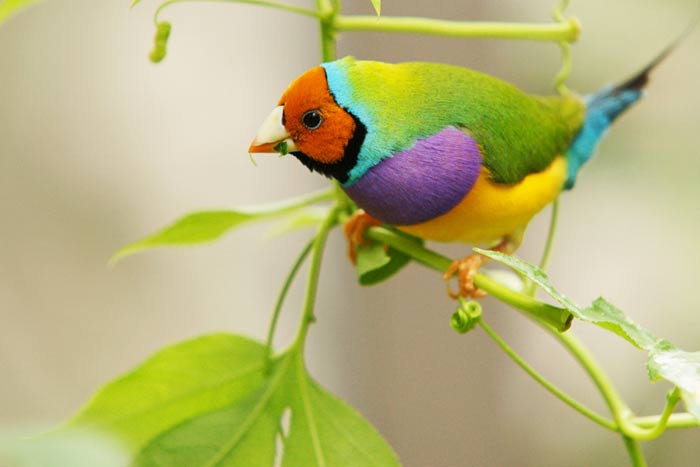
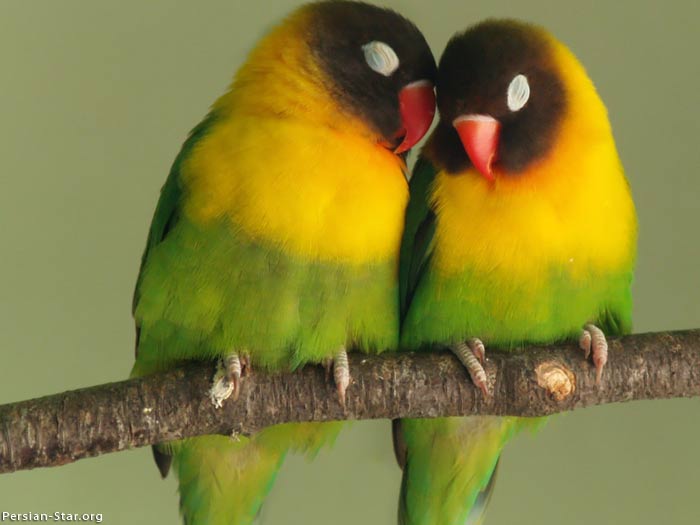
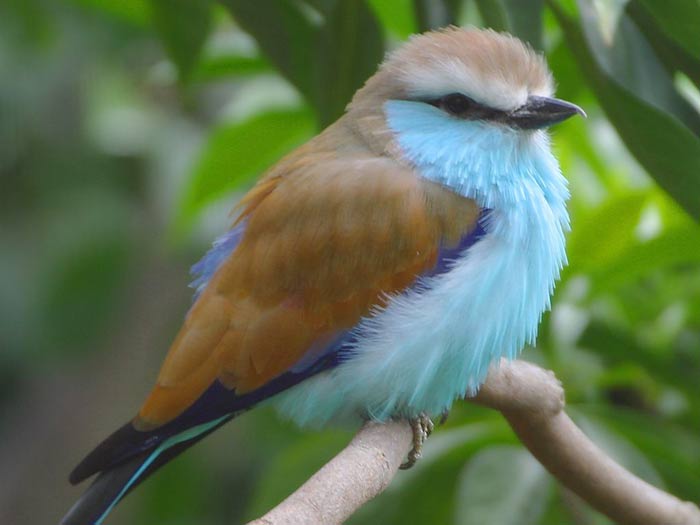
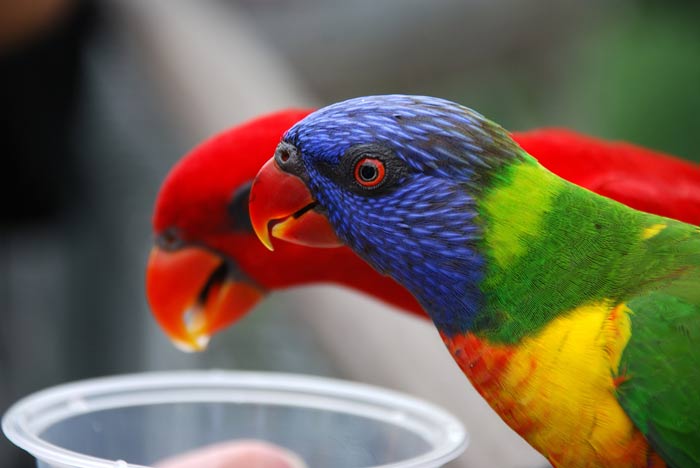
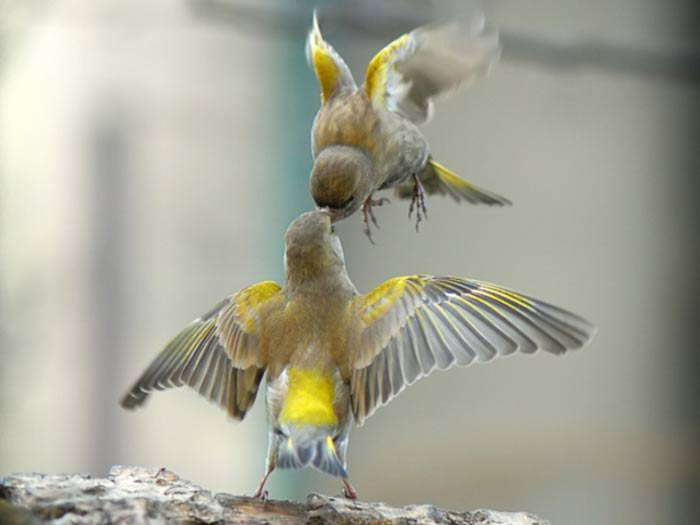
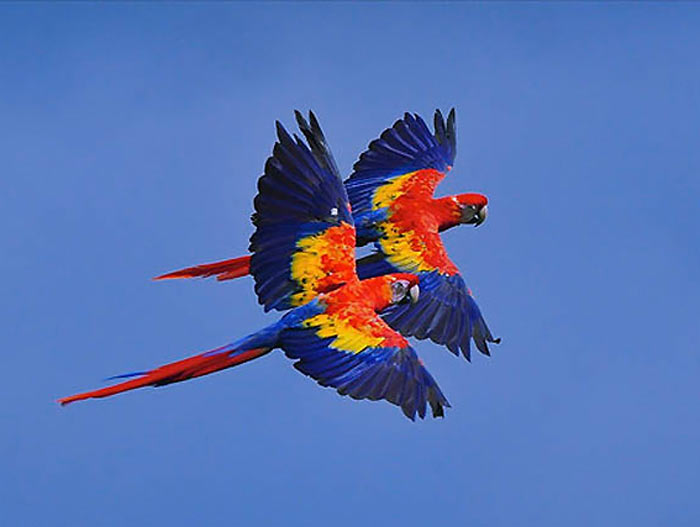
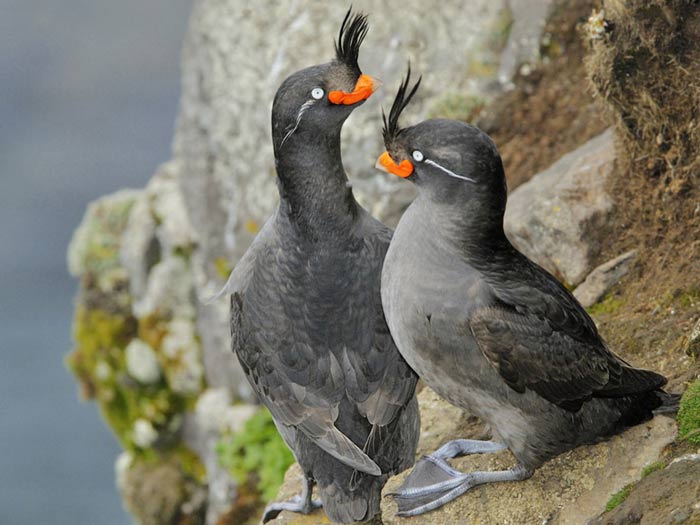
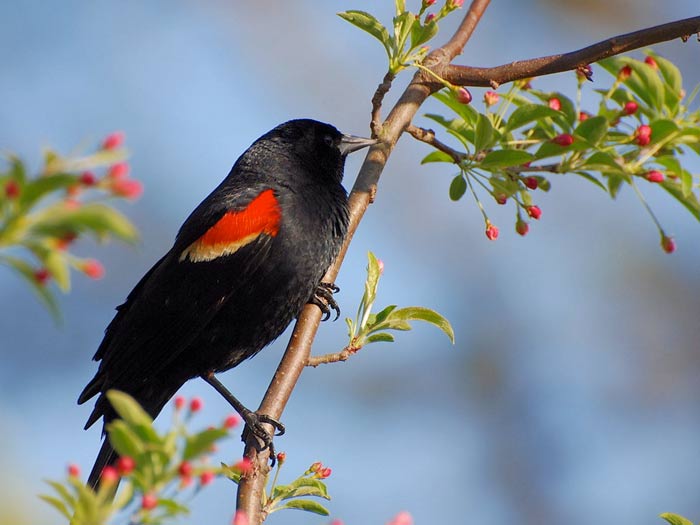
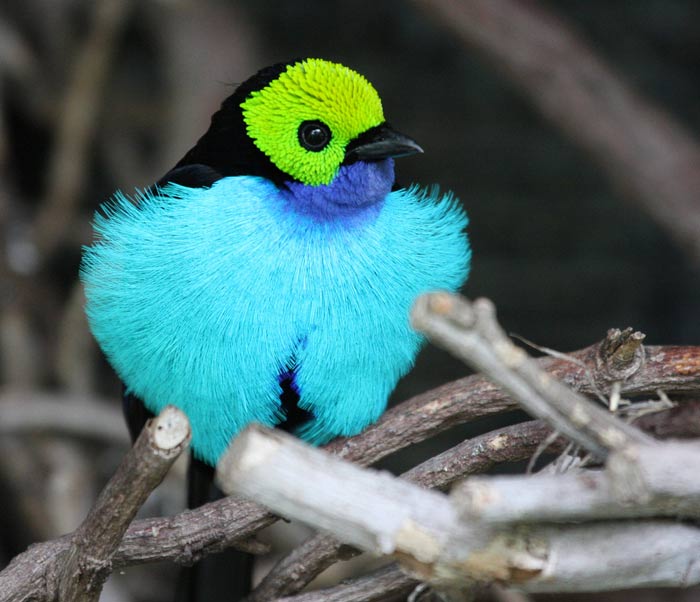
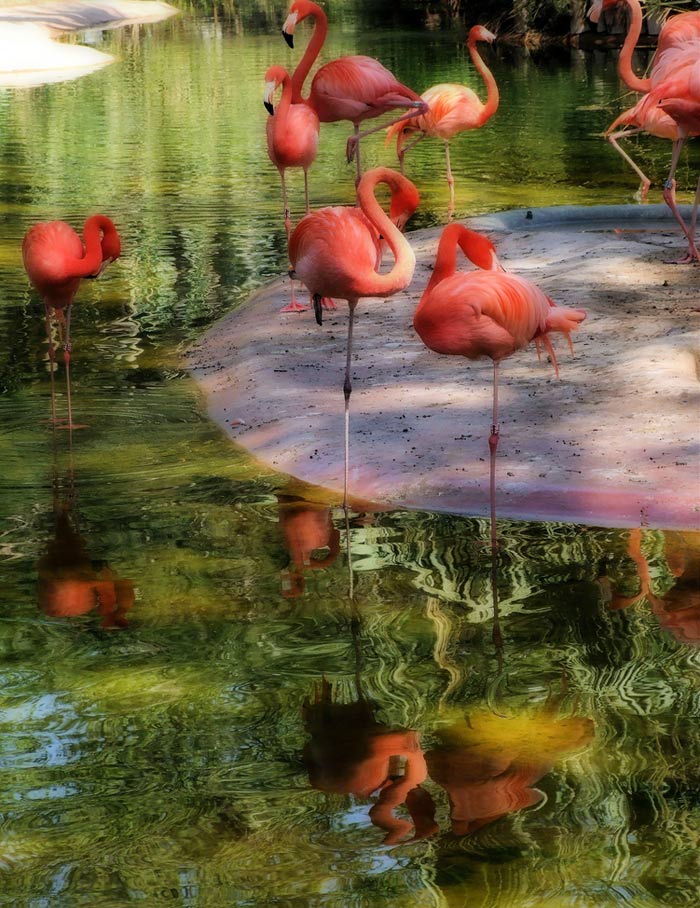
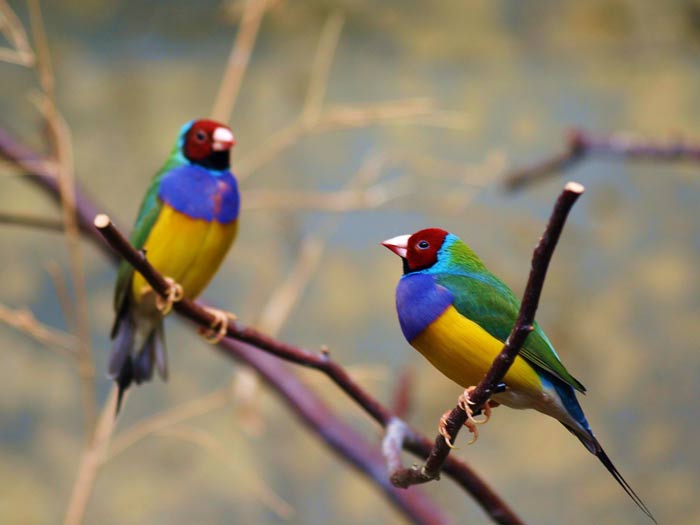
COLOR THAT MAN DID NOT (COULD NOT) CREATE… ONLY THE MASTER CREATOR COULD
Received this in an email and thought I would share it. Not sure of the source of the photos, but absolutely know who the Master Creator was.
So God created great sea creatures and every living thing that moves, with which the waters abounded, according to their kind, and every winged bird according to its kind. And God saw that it was good. And God blessed them, saying, “Be fruitful and multiply, and fill the waters in the seas, and let birds multiply on the earth.” So the evening and the morning were the fifth day. (Genesis 1:21-23 NKJV)
“But now ask the beasts, and they will teach you; And the birds of the air, and they will tell you; (Job 12:7 NKJV)
Today we finally got to go birdwatching at Circle B Bar Reserve. We were asked to join Baron Brown (A.K.A. Golden Eagle) and one of the classes he teaches. We were introducing them to Birdwatching. For most of the twelve students, this was their first trip of watch birds.
“Train up a child in the way he should go [and in keeping with his individual gift or bent], and when he is old he will not depart from it. (Proverbs 22:6 AMP)
After we finished, we went to our church where I presented a Powerpoint presentation on birding. Then they got to eat pizza. Not sure which they enjoyed more, the birds or the pizza. ;0)
For Dan and I, this was our first real birdwatching trip of the year. We stopped by the shore of the AF base a week or so ago and birded for about 15-20 minutes. Today’s trip was about two hours long.
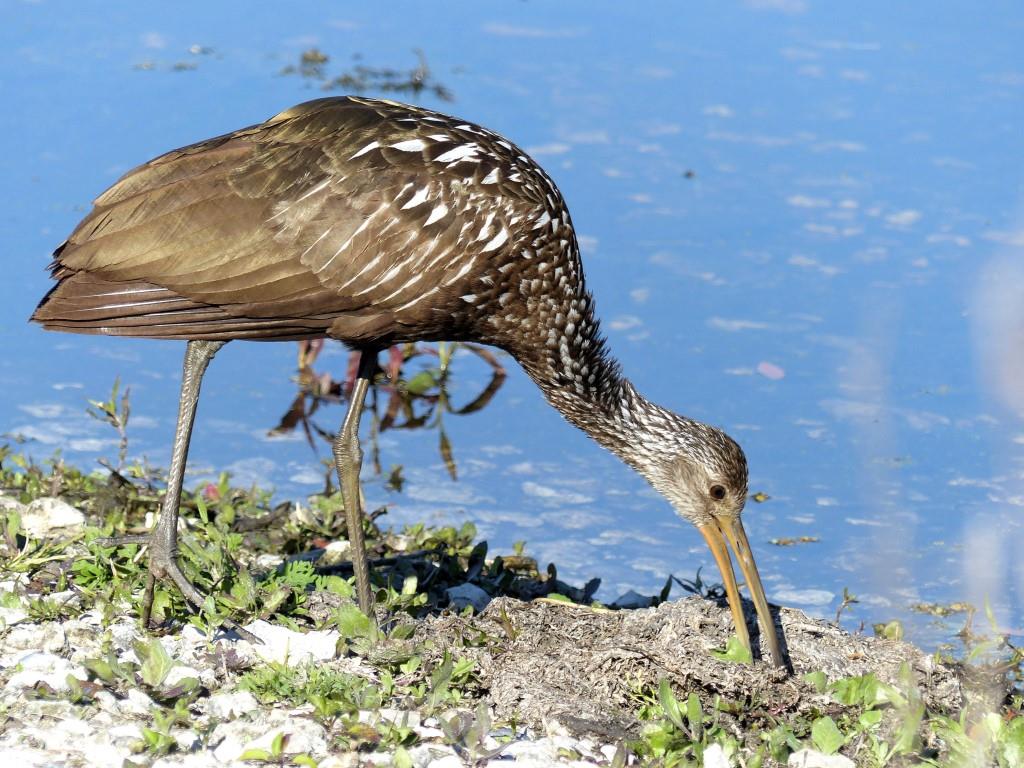
Limpkin
What did we see? Altogether, about 25-26 species were spotted. We saw some they didn’t see and they saw three Bald Eagles, that we didn’t see. (I stopped and waited for them to make a short trip up one of the trails. They are younger, you know.)
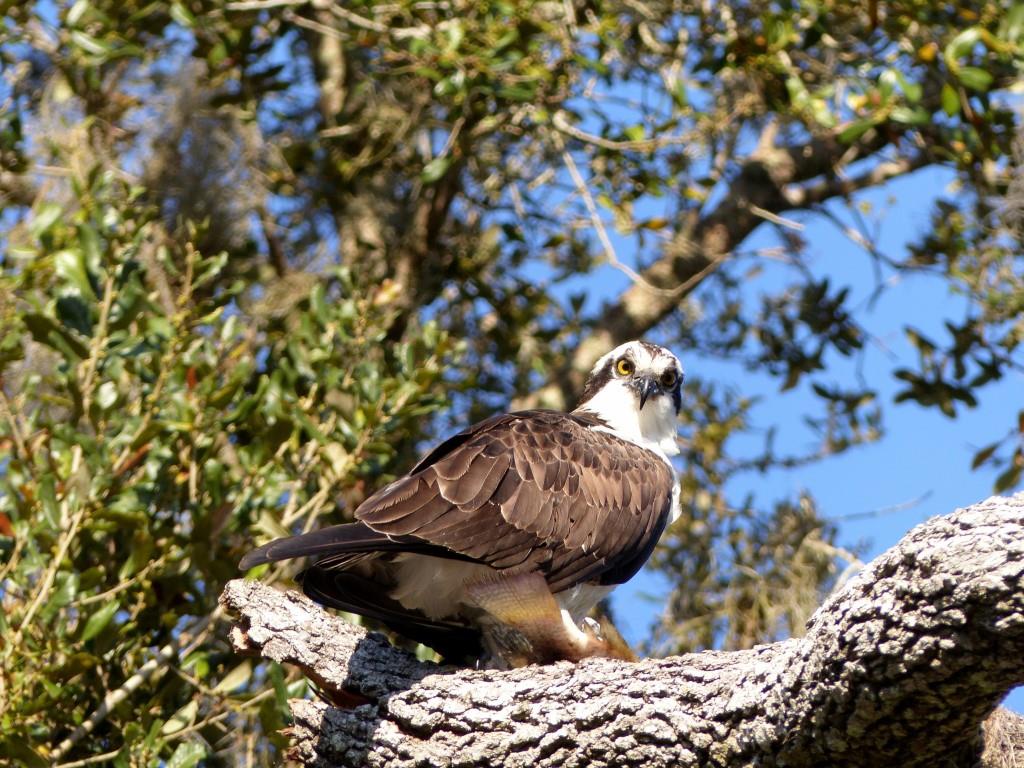
Osprey
We were greeted in the parking lot by an Osprey sitting in the tree with a fish in his feet. That was a good start for them. From there we went out to the marsh where we started seeing the usual birds at Circle B; Great Egrets, Tri-colored Heron, Snowy Egrets, Little Blue Herons, Glossy and White Ibises, an Anhinga with wings spread, Limpkins, Great Blue Herons. There were lots of Turkey and Black Vultures flying overhead, and the Tree Swallows were zipping around all over the place. There was also a tree way down the marsh that was hosting a group of Double-crested Cormorants.
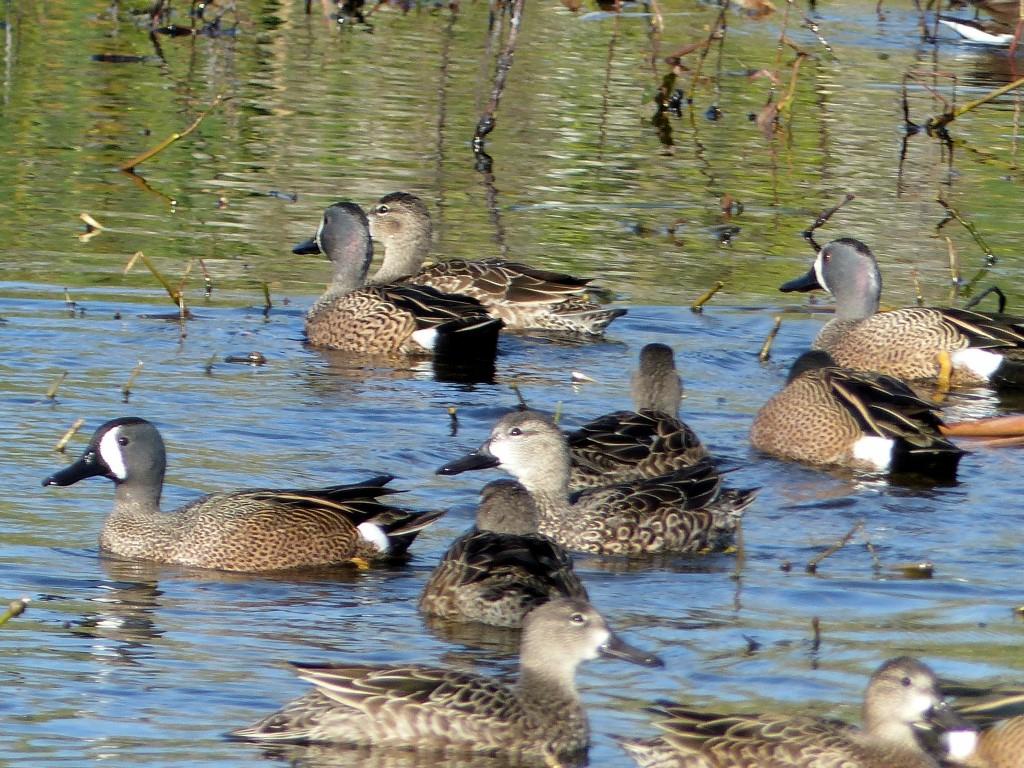
Water birds spotted were Coots, Common Moorhens, and a group of Blue-winged Teals.
Blue-winged Teals
All the heads turned when a Roseate Spoonbill flew by and later we saw one up close in the water. There was a pair of Red-shouldered Hawks sitting in a tree way off, but I zoomed in and was able to get a half-way decent photo of them. One even raised its tail up to preen, I suppose.
We were teaching them about listening for birds and some Mourning Doves, a Carolina Wren, some Red-bellied and Pileated Woodpeckers and a few others were heard.
While they were off down the trail, we added Red-winged Blackbirds and Blue-gray Gnatcatcher to our list. We had also seen 16 White Pelicans flying right by the park as we were arriving.
All total, not a bad birdwatching trip. Looking forward to more trips as 2015 progresses. Here are just some of today’s photos.
Is it a Downy or Hairy Woodpecker? Brevard Zoo by Dan
Drummers and Carpenters
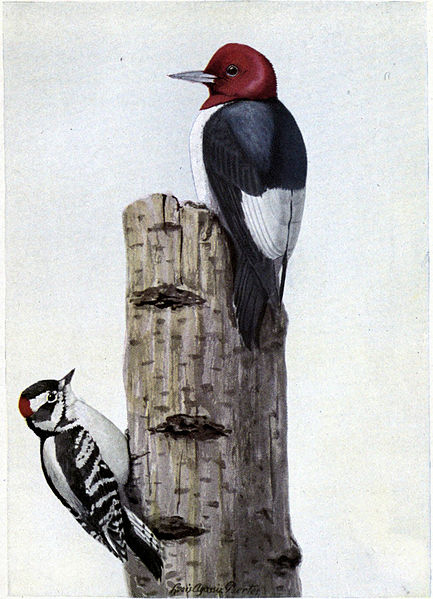
The Downy, Hairy and Red-headed Woodpeckers.
The Burgess Bird Book For Children
*
Listen to the story read.
CHAPTER 11. Drummers and Carpenters.
Peter Rabbit was so full of questions that he hardly knew which one to ask first. But Yellow Wing the Flicker didn’t give him a chance to ask any. From the edge of the Green forest there came a clear, loud call of, “Pe-ok! Pe-ok! Pe-ok!”
“Excuse me, Peter, there’s Mrs. Yellow Wing calling me,” exclaimed Yellow Wing, and away he went. Peter noticed that as he flew he went up and down. It seemed very much as if he bounded through the air just as Peter bounds over the ground. “I would know him by the way he flies just as far as I could see him,” thought Peter, as he started for home in the dear Old Briar-patch. “Somehow he doesn’t seem like a Woodpecker because he is on the ground so much. I must ask Jenny Wren about him.”
It was two or three days before Peter had a chance for a bit of gossip with Jenny Wren. When he did the first thing he asked was if Yellow Wing is a true Woodpecker.
“Certainly he is,” replied Jenny Wren. “Of course he is. Why under the sun should you think he isn’t?”
“Because it seems to me he is on the ground more than he’s in the trees,” retorted Peter. “I don’t know any other Woodpeckers who come down on the ground at all.”
“Tut, tut, tut, tut!” scolded Jenny. “Think a minute, Peter! Think a minute! Haven’t you ever seen Redhead on the ground?”
Peter blinked his eyes. “Ye-e-s,” he said slowly. “Come to think of it, I have. I’ve seen him picking up beechnuts in the fall. The Woodpeckers are a funny family. I don’t understand them.”
Just then a long, rolling rat-a-tat-tat rang out just over their heads. “There’s another one of them,” chuckled Jenny. “That’s Downy, the smallest of the whole family. He certainly makes an awful racket for such a little fellow. He is a splendid drummer and he’s just as good a carpenter. He made the very house I am occupying now.”
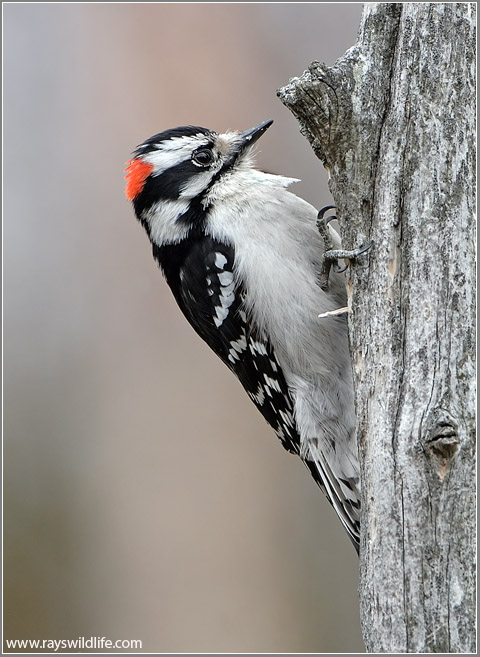
Peter was sitting with his head tipped back trying to see Downy. At first he couldn’t make him out. Then he caught a little movement on top of a dead limb. It was Downy’s head flying back and forth as he beat his long roll. He was dressed all in black and white. On the back of his head was a little scarlet patch. He was making a tremendous racket for such a little chap, only a little bigger than one of the Sparrow family.
“Is he making a hole for a nest up there?” asked Peter eagerly.
“Gracious, Peter, what a question! What a perfectly silly question!” exclaimed Jenny Wren scornfully. “Do give us birds credit for a little common sense. If he were cutting a hole for a nest, everybody within hearing would know just where to look for it. Downy has too much sense in that little head of his to do such a silly thing as that. When he cuts a hole for a nest he doesn’t make any more noise than is absolutely necessary. You don’t see any chips flying, do you?”
“No-o,” replied Peter slowly. “Now you speak of it, I don’t. Is—is he hunting for worms in the wood?”
Jenny laughed right out. “Hardly, Peter, hardly,” said she. “He’s just drumming, that’s all. That hollow limb makes the best kind of a drum and Downy is making the most of it. Just listen to that! There isn’t a better drummer anywhere.”
But Peter wasn’t satisfied. Finally he ventured another question. “What’s he doing it for?”
“Good land, Peter!” cried Jenny. “What do you run and jump for in the spring? What is Mr. Wren singing for over there? Downy is drumming for precisely the same reason—happiness. He can’t run and jump and he can’t sing, but he can drum. By the way, do you know that Downy is one of the most useful birds in the Old Orchard?”
Just then Downy flew away, but hardly had he disappeared when another drummer took his place. At first Peter thought Downy had returned until he noticed that the newcomer was just a bit bigger than Downy. Jenny Wren’s sharp eyes spied him at once.
“Hello!” she exclaimed. “There’s Hairy. Did you ever see two cousins look more alike? If it were not that Hairy is bigger than Downy it would be hard work to tell them apart. Do you see any other difference, Peter?”
Downy Woodpecker (Picoides pubescens) by Raymond Barlow
Peter stared and blinked and stared again, then slowly shook his head. “No,” he confessed, “I don’t.”
“That shows you haven’t learned to use your eyes, Peter,” said Jenny rather sharply. “Look at the outside feathers of his tail; they are all white. Downy’s outside tail feathers have little bars of black. Hairy is just as good a carpenter as is Downy, but for that matter I don’t know of a member of the Woodpecker family who isn’t a good carpenter. Where did you say Yellow Wing the Flicker is making his home this year?”
“Over in the Big Hickory-tree by the Smiling Pool,” replied Peter. “I don’t understand yet why Yellow Wing spends so much time on the ground.”
“Ants,” replied Jenny Wren. “Just ants. He’s as fond of ants as is Old Mr. Toad, and that is saying a great deal. If Yellow Wing keeps on he’ll become a ground bird instead of a tree bird. He gets more than half his living on the ground now. Speaking of drumming, did you ever hear Yellow Wing drum on a tin roof?”
Peter shook his head.
“Well, if there’s a tin roof anywhere around, and Yellow Wing can find it, he will be perfectly happy. He certainly does love to make a noise, and tin makes the finest kind of a drum.”
Just then Jenny was interrupted by the arrival, on the trunk of the very next tree to the one on which she was sitting, of a bird about the size of Sammy Jay. His whole head and neck were a beautiful, deep red. His breast was pure white, and his back was black to nearly the beginning of his tail, where it was white.
“Hello, Redhead!” exclaimed Jenny Wren. “How did you know we were talking about your family?”
“Hello, chatterbox,” retorted Redhead with a twinkle in his eyes. “I didn’t know you were talking about my family, but I could have guessed that you were talking about some one’s family. Does your tongue ever stop, Jenny?”
Jenny Wren started to become indignant and scold, then thought better of it. “I was talking for Peter’s benefit,” said she, trying to look dignified, a thing quite impossible for any member of the Wren family to do. “Peter has always had the idea that true Woodpeckers never go down on the ground. I was explaining to him that Yellow Wing is a true Woodpecker, yet spends half his time on the ground.”
Redhead nodded. “It’s all on account of ants,” said he. “I don’t know of any one quite so fond of ants unless it is Old Mr. Toad. I like a few of them myself, but Yellow Wing just about lives on them when he can. You may have noticed that I go down on the ground myself once in a while. I am rather fond of beetles, and an occasional grasshopper tastes very good to me. I like a variety. Yes, sir, I certainly do like a variety—cherries, blackberries, raspberries, strawberries, grapes. In fact most kinds of fruit taste good to me, not to mention beechnuts and acorns when there is no fruit.”
Jenny Wren tossed her head. “You didn’t mention the eggs of some of your neighbors,” said she sharply.
Redhead did his best to look innocent, but Peter noticed that he gave a guilty start and very abruptly changed the subject, and a moment later flew away.
“Is it true,” asked Peter, “that Redhead does such a dreadful thing?”
Jenny bobbed her head rapidly and jerked her tail. “So I am told,” said she. “I’ve never seen him do it, but I know others who have. They say he is no better than Sammy Jay or Blacky the Crow. But gracious, goodness! I can’t sit here gossiping forever.” Jenny twitched her funny little tail, snapped her bright eyes at Peter, and disappeared in her house.
Bold points for questions at the bottom or for Christian traits.
*
For thou shalt eat the labour of thine hands: happy shalt thou be, and it shall be well with thee. (or your beak) (Psalms 128:2 KJV)
He that handleth a matter wisely shall find good: and whoso trusteth in the LORD, happy is he. (Proverbs 16:20 KJV)
Seems like these woodpeckers enjoy doing what that is a sign they are happy?
Who are the four members of the Woodpecker family mentioned?
How does a Woodpecker fly?
Which is the smallest member of the family?
Can you describe him?
Which Woodpecker is just a little bit larger?
What about its tail?
Which one likes to eat on the ground half the time?
Thought you might enjoy this sent to me by a friend. Not sure how it was done, but National Geographic was involved.
A couple of verses come to mind:
But God hath chosen the foolish things of the world to confound the wise; and God hath chosen the weak things of the world to confound the things which are mighty; (1 Corinthians 1:27 KJV)
Call unto me, and I will answer thee, and shew thee great and mighty things, which thou knowest not. (Jeremiah 33:3 KJV)
If he watches out for these two, how much more does God watch out for us?
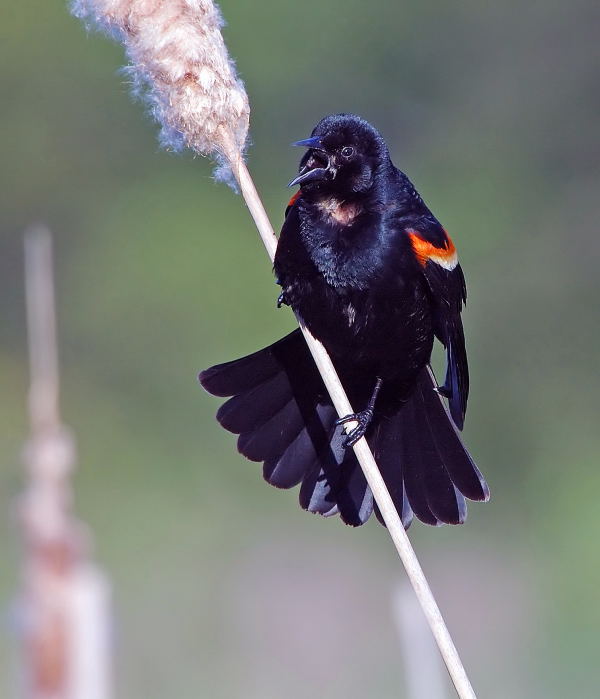
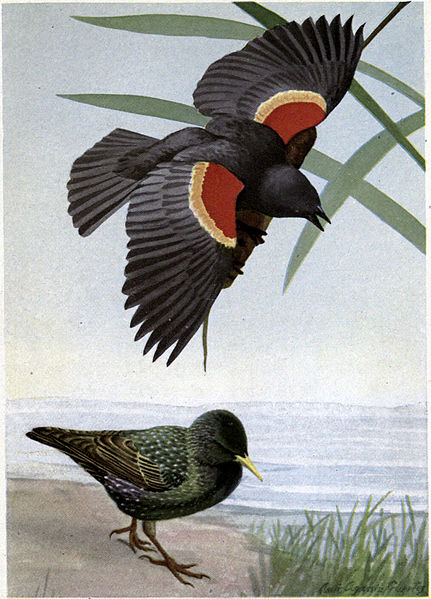
The Red-winged Blackbird and the Golden-winged Flicker.
The Burgess Bird Book For Children
*
CHAPTER 10. Redwing and Yellow Wing.
Listen to the story read.
Peter had come over to the Smiling Pool especially to pay his respects to Redwing the Blackbird, so as soon as he could, without being impolite, he left Mrs. Teeter sitting on her eggs, and Teeter himself bobbing and bowing in the friendliest way, and hurried over to where the bulrushes grow. In the very top of the Big Hickory-tree, a little farther along on the bank of the Smiling Pool, sat some one who at that distance appeared to be dressed all in black. He was singing as if there were nothing but joy in all the great world. “Quong-ka-reee! Quong-ka-reee! Quong-ka-reee!” he sang. Peter would have known from this song alone that it was Redwing the Blackbird, for there is no other song quite like it.
As soon as Peter appeared in sight Redwing left his high perch and flew down to light among the broken-down bulrushes. As he flew, Peter saw the beautiful red patch on the bend of each wing, from which Redwing gets his name. “No one could ever mistake him for anybody else,” thought Peter, “For there isn’t anybody else with such beautiful shoulder patches.”
“What’s the news, Peter Rabbit?” cried Redwing, coming over to sit very near Peter.
“There isn’t much,” replied Peter, “excepting that Teeter the Sandpiper has four eggs just a little way from here.”
Redwing chuckled. “That is no news, Peter,” said he. “Do you suppose that I live neighbor to Teeter and don’t know where his nest is and all about his affairs? There isn’t much going on around the Smiling Pool that I don’t know, I can tell you that.”
Peter looked a little disappointed, because there is nothing he likes better than to be the bearer of news. “I suppose,” said he politely, “that you will be building a nest pretty soon yourself, Redwing.”
Redwing chuckled softly. It was a happy, contented sort of chuckle. “No, Peter,” said he. “I am not going to build a nest.”
“What?” exclaimed Peter, and his two long ears stood straight up with astonishment.
“No,” replied Redwing, still chuckling. “I’m not going to build a nest, and if you want to know a little secret, we have four as pretty eggs as ever were laid.”
Peter fairly bubbled over with interest and curiosity. “How splendid!” he cried. “Where is your nest, Redwing? I would just love to see it. I suppose it is because she is sitting on those eggs that I haven’t seen Mrs. Redwing. It was very stupid of me not to guess that folks who come as early as you do would be among the first to build a home. Where is it, Redwing? Do tell me.”
Redwing’s eyes twinkled.
     "A secret which is known by three
      Full soon will not a secret be,"
said he. “It isn’t that I don’t trust you, Peter. I know that you wouldn’t intentionally let my secret slip out. But you might do it by accident. What you don’t know, you can’t tell.”
“That’s right, Redwing. I am glad you have so much sense,” said another voice, and Mrs. Redwing alighted very near to Redwing.
Peter couldn’t help thinking that Old Mother Nature had been very unfair indeed in dressing Mrs. Redwing. She was, if anything, a little bit smaller than her handsome husband, and such a plain, not to say homely, little body that it was hard work to realize that she was a Blackbird at all. In the first place she wasn’t black. She was dressed all over in grayish-brown with streaks of darker brown which in places were almost black. She wore no bright-colored shoulder patches. In fact, there wasn’t a bright feather on her anywhere. Peter wanted to ask why it was that she was so plainly dressed, but he was too polite and decided to wait until he should see Jenny Wren. She would be sure to know. Instead, he exclaimed, “How do you do, Mrs. Redwing? I’m ever so glad to see you. I was wondering where you were. Where did you come from?”
“Straight from my home,” replied Mrs. Redwing demurely. “And if I do say it, it is the best home we’ve ever had.”
Redwing chuckled. He was full of chuckles. You see, he had noticed how eagerly Peter was looking everywhere.
“This much I will tell you, Peter,” said Redwing; “our nest is somewhere in these bulrushes, and if you can find it we won’t say a word, even if you don’t keep the secret.”
Then Redwing chuckled again and Mrs. Redwing chuckled with him. You see, they knew that Peter doesn’t like water, and that nest was hidden in a certain clump of brown, broken-down rushes, with water all around. Suddenly Redwing flew up in the air with a harsh cry. “Run, Peter! Run!” he screamed. “Here comes Reddy Fox!”
Peter didn’t wait for a second warning. He knew by the sound of Redwing’s voice that Redwing wasn’t joking. There was just one place of safety, and that was an old hole of Grandfather Chuck’s between the roots of the Big Hickory-tree. Peter didn’t waste any time getting there, and he was none too soon, for Reddy was so close at his heels that he pulled some white hairs out of Peter’s tail as Peter plunged headfirst down that hole. It was a lucky thing for Peter that that hole was too small for Reddy to follow and the roots prevented Reddy from digging it any bigger.
For a long time Peter sat in Grandfather Chuck’s old house, wondering how soon it would be safe for him to come out. For a while he heard Mr. and Mrs. Redwing scolding sharply, and by this he knew that Reddy Fox was still about. By and by they stopped scolding, and a few minutes later he heard Redwing’s happy song. “That means,” thought Peter, “that Reddy Fox has gone away, but I think I’ll sit here a while longer to make sure.”
Now Peter was sitting right under the Big Hickory-tree. After a while he began to hear faint little sounds, little taps, and scratching sounds as of claws. They seemed to come from right over his head, but he knew that there was no one in that hole but himself. He couldn’t understand it at all.
Finally Peter decided it would be safe to peek outside. Very carefully he poked his head out. Just as he did so, a little chip struck him right on the nose. Peter pulled his head back hurriedly and stared at the little chip which lay just in front of the hole. Then two or three more little chips fell. Peter knew that they must come from up in the Big Hickory-tree, and right away his curiosity was aroused. Redwing was singing so happily that Peter felt sure no danger was near, so he hopped outside and looked up to find out where those little chips had come from. Just a few feet above his head he saw a round hole in the trunk of the Big Hickory-tree. While he was looking at it, a head with a long stout bill was thrust out and in that bill were two or three little chips. Peter’s heart gave a little jump of glad surprise.
“Yellow Wing!” he cried. “My goodness, how you startled me!”
The chips were dropped and the head was thrust farther out. The sides and throat were a soft reddish-tan and on each side at the beginning of the bill was a black patch. The top of the head was gray and just at the back was a little band of bright red. There was no mistaking that head. It belonged to Yellow Wing the Flicker beyond a doubt.
“Hello, Peter!” exclaimed Yellow Wing, his eyes twinkling. “What are you doing here?”
“Nothing,” replied Peter, “but I want to know what you are doing. What are all those chips?”
“I’m fixing up this old house of mine,” replied Yellow Wing promptly. “It wasn’t quite deep enough to suit me, so I am making it a little deeper. Mrs. Yellow Wing and I haven’t been able to find another house to suit us, so we have decided to live here again this year.” He came wholly out and flew down on the ground near Peter. When his wings were spread, Peter saw that on the under sides they were a beautiful golden-yellow, as were the under sides of his tail feathers. Around his throat was a broad, black collar. From this, clear to his tail, were black dots. When his wings were spread, the upper part of his body just above the tail was pure white.
“My,” exclaimed Peter, “you are a handsome fellow! I never realized before how handsome you are.”
Yellow Wing looked pleased. Perhaps he felt a little flattered. “I am glad you think so, Peter,” said he. “I am rather proud of my suit, myself. I don’t know of any member of my family with whom I would change coats.”
A sudden thought struck Peter. “What family do you belong to?” He asked abruptly.
“The Woodpecker family,” replied Yellow Wing proudly.
*
Nevertheless if you warn the righteous man that the righteous should not sin, and he does not sin, he shall surely live because he took warning; also you will have delivered your soul.” (Ezekiel 3:21 NKJV)
I do not write these things to shame you, but as my beloved children I warn you. (1 Corinthians 4:14 NKJV)
That was mighty nice of Redwing to warn Peter Rabbit. We need to listen when others warn us. Like, “don’t get too close to the fire” or “watch out for the cars!” We should also help others by warning them so they don’t get hurt. We need to tell others about Christ and warn them to not ignore His teaching.
From the decided way in which Jenny Wren had popped into the little round doorway of her home, Peter knew that to wait in the hope of more gossip with her would be a waste of time. He wasn’t ready to go back home to the dear Old Briar-patch, yet there seemed nothing else to do, for everybody in the Old Orchard was too busy for idle gossip. Peter scratched a long ear with a long hind foot, trying to think of some place to go. Just then he heard the clear “peep, peep, peep” of the Hylas, the sweet singers of the Smiling Pool.
“That’s where I’ll go!” exclaimed Peter. “I haven’t been to the Smiling Pool for some time. I’ll just run over and pay my respects to Grandfather Frog, and to Redwing the Blackbird. Redwing was one of the first birds to arrive, and I’ve neglected him shamefully.”
When Peter thinks of something to do he wastes no time. Off he started, lipperty-lipperty-lip, for the Smiling Pool. He kept close to the edge of the Green Forest until he reached the place where the Laughing Brook comes out of the Green Forest on its way to the Smiling Pool in the Green Meadows. Bushes and young trees grow along the banks of the Laughing Brook at this point. The ground was soft in places, quite muddy. Peter doesn’t mind getting his feet damp, so he hopped along carelessly. From right under his very nose something shot up into the air with a whistling sound. It startled Peter so that he stopped short with his eyes popping out of his head. He had just a glimpse of a brown form disappearing over the tops of some tall bushes. Then Peter chuckled. “I declare,” said he, “I had forgotten all about my old friend, Longbill the Woodcock. He scared me for a second.”
“Then you are even,” said a voice close at hand. “You scared him. I saw you coming, but Longbill didn’t.”
Peter turned quickly. There was Mrs. Woodcock peeping at him from behind a tussock of grass.
“I didn’t mean to scare him,” apologized Peter. “I really didn’t mean to. Do you think he was really very much scared?”
“Not too scared to come back, anyway,” said Longbill himself, dropping down just in front of Peter. “I recognized you just as I was disappearing over the tops of the bushes, so I came right back. I learned when I was very young that when startled it is best to fly first and find out afterwards whether or not there is real danger. I am glad it is no one but you, Peter, for I was having a splendid meal here, and I should have hated to leave it. You’ll excuse me while I go on eating, I hope. We can talk between bites.”
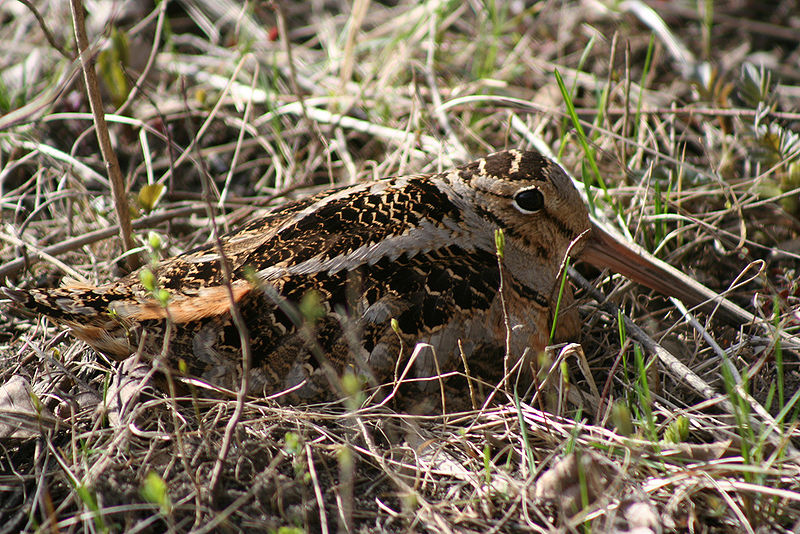
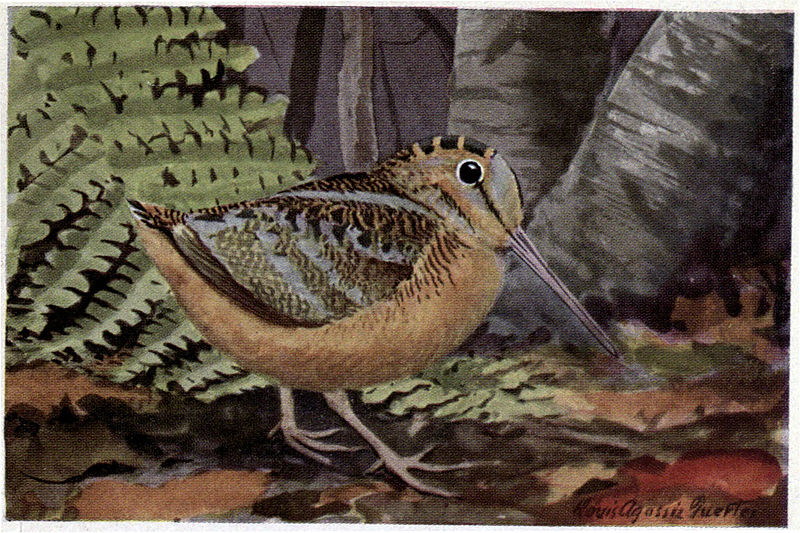
“Certainly I’ll excuse you,” replied Peter, staring around very hard to see what it could be Longbill was making such a good meal of. But Peter couldn’t see a thing that looked good to eat. There wasn’t even a bug or a worm crawling on the ground. Longbill took two or three steps in rather a stately fashion. Peter had to hide a smile, for Longbill had such an air of importance, yet at the same time was such an odd looking fellow. He was quite a little bigger than Welcome Robin, his tail was short, his legs were short, and his neck was short. But his bill was long enough to make up. His back was a mixture of gray, brown, black and buff, while his breast and under parts were a beautiful reddish-buff. It was his head that made him look queer. His eyes were very big and they were set so far back that Peter wondered if it wasn’t easier for him to look behind him than in front of him.
Suddenly Longbill plunged his bill into the ground. He plunged it in for the whole length. Then he pulled it out and Peter caught a glimpse of the tail end of a worm disappearing down Longbill’s throat. Where that long bill had gone into the ground was a neat little round hole. For the first time Peter noticed that there were many such little round holes all about. “Did you make all those little round holes?” exclaimed Peter.
“Not at all,” replied Longbill. “Mrs. Woodcock made some of them.”
“And was there a worm in every one?” asked Peter, his eyes very wide with interest.
Longbill nodded. “Of course,” said he. “You don’t suppose we would take the trouble to bore one of them if we didn’t know that we would get a worm at the end of it, do you?”
Peter remembered how he had watched Welcome Robin listen and then suddenly plunge his bill into the ground and pull out a worm. But the worms Welcome Robin got were always close to the surface, while these worms were so deep in the earth that Peter couldn’t understand how it was possible for any one to know that they were there. Welcome Robin could see when he got hold of a worm, but Longbill couldn’t. “Even if you know there is a worm down there in the ground, how do you know when you’ve reached him? And how is it possible for you to open your bill down there to take him in?” asked Peter.
Longbill chuckled. “That’s easy,” said he. “I’ve got the handiest bill that ever was. See here!” Longbill suddenly thrust his bill straight out in front of him and to Peter’s astonishment he lifted the end of the upper half without opening the rest of his bill at all. “That’s the way I get them,” said he. “I can feel them when I reach them, and then I just open the top of my bill and grab them. I think there is one right under my feet now; watch me get him.” Longbill bored into the ground until his head was almost against it. When he pulled his bill out, sure enough, there was a worm. “Of course,” explained Longbill, “it is only in soft ground that I can do this. That is why I have to fly away south as soon as the ground freezes at all.”
“It’s wonderful,” sighed Peter. “I don’t suppose any one else can find hidden worms that way.”
“My cousin, Jack Snipe, can,” replied Longbill promptly. “He feeds the same way I do, only he likes marshy meadows instead of brushy swamps. Perhaps you know him.”
WWilson’s Snipe (Gallinago delicata) at Circle B by Dan
Peter nodded. “I do,” said he. “Now you speak of it, there is a strong family resemblance, although I hadn’t thought of him as a relative of yours before. Now I must be running along. I’m ever so glad to have seen you, and I’m coming over to call again the first chance I get.”
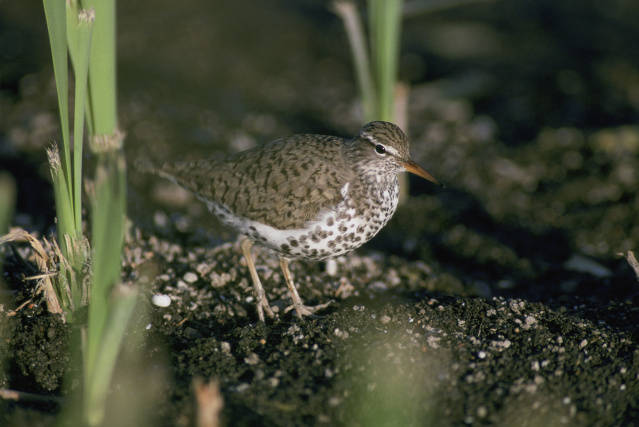
So Peter said good-by and kept on down the Laughing Brook to the Smiling Pool. Right where the Laughing Brook entered the Smiling Pool there was a little pebbly beach. Running along the very edge of the water was a slim, trim little bird with fairly long legs, a long slender bill, brownish-gray back with black spots and markings, and a white waistcoat neatly spotted with black. Every few steps he would stop to pick up something, then stand for a second bobbing up and down in the funniest way, as if his body was so nicely balanced on his legs that it teetered back and forth like a seesaw. It was Teeter the Spotted Sandpiper, an old friend of Peter’s. Peter greeted him joyously.
“Peet-weet! Peet-weet!” cried Teeter, turning towards Peter and bobbing and bowing as only Teeter can. Before Peter could say another word Teeter came running towards him, and it was plain to see that Teeter was very anxious about something. “Don’t move, Peter Rabbit! Don’t move!” he cried.
“Why not?” demanded Peter, for he could see no danger and could think of no reason why he shouldn’t move. Just then Mrs. Teeter came hurrying up and squatted down in the sand right in front of Peter.
“Thank goodness!” exclaimed Teeter, still bobbing and bowing. “If you had taken another step, Peter Rabbit, you would have stepped right on our eggs. You gave me a dreadful start.”
Peter was puzzled. He showed it as he stared down at Mrs. Teeter just in front of him. “I don’t see any nest or eggs or anything,” said he rather testily.
Mrs. Teeter stood up and stepped aside. Then Peter saw right in a little hollow in the sand, with just a few bits of grass for a lining, four white eggs with big dark blotches on them. They looked so much like the surrounding pebbles that he never would have seen them in the world but for Mrs. Teeter. Peter hastily backed away a few steps. Mrs. Teeter slipped back on the eggs and settled herself comfortably. It suddenly struck Peter that if he hadn’t seen her do it, he wouldn’t have known she was there. You see she looked so much like her surroundings that he never would have noticed her at all.
“My!” he exclaimed. “I certainly would have stepped on those eggs if you hadn’t warned me,” said he. “I’m so thankful I didn’t. I don’t see how you dare lay them in the open like this.”
Mrs. Teeter chuckled softly. “It’s the safest place in the world, Peter,” said she. “They look so much like these pebbles around here that no one sees them. The only time they are in danger is when somebody comes along, as you did, and is likely to step on them without seeing them. But that doesn’t happen often.”































 Lee's Birdwatching Adventures Plus