Dino to Bird Display – Desert Museum Tucson by Lee
DINOSAUR-TO-BIRD EVOLUTION CHALLENGED
“For the LORD knoweth the way of the righteous: but the way of the ungodly shall perish.” (Psalm 1:6)
Most evolutionists today hold to the belief that modern-day birds evolved from dinosaurs. In fact, they now feel that large, carnivorous theropods like T. Rex rapidly shrank over a period of 50 million years until they evolved into our fine feathered friends.
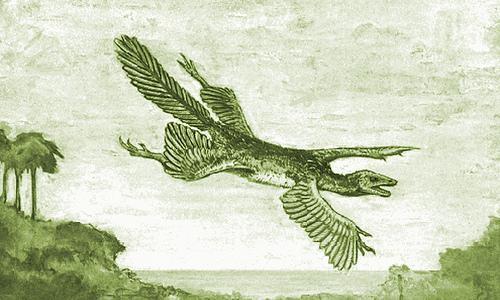
William Beebe’s hypothetical -Tetrapteryx- with four wings 1915
An image drawn in 1915 by naturalist William Beebe suggests a hypothetical view of what early birds may have looked like. But not all evolutionists agree with this belief. Some, in fact, claim that birds evolved into dinosaurs. A study published in PNAS, the Proceedings of the National Academy of Sciences, provides evidence that birds did not descend from ground-dwelling theropod dinosaurs.
According to Oregon State University zoology professor John Ruben, the research was well done and consistent with a string of studies in recent years that pose an increasing challenge to the birds-from-dinosaurs theory. The weight of the evidence, he added, is now suggesting that not only did birds not descend from dinosaurs, but that some species now believed to be dinosaurs may have descended from birds.
Professor Ruben’s most revealing comment, however, was that the old dinosaurs-to-birds theories, instead of carefully interpreting the data, had public appeal, and that “many people saw what they wanted to see.”
How true for scientists on both sides of this issue! When scientists start with the assumption that evolution is true, then every bit of evidence they uncover will support evolution. They don’t even consider a third option – that God made the birds on the fifth day of Creation Week and the land-dwelling dinosaurs on the sixth day.
Prayer: Heavenly Father, while people say that the Bible is not a science textbook, Your book does provide factual information that scientists would be wise to take into consideration. Open their eyes, I pray. Amen.
Notes:
“Bird-from-dinosaur theory of evolution challenged: Was it the other way around?”, ScienceDaily, Source: Oregon State University, 2-10-10. Illustration: An image drawn in 1915 by naturalist William Beebe suggests a hypothetical view of what early birds may have looked like.
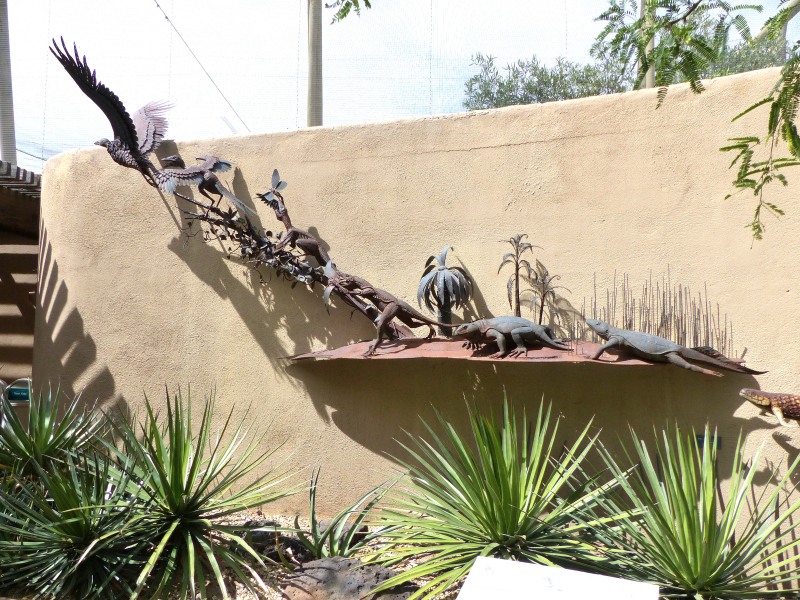
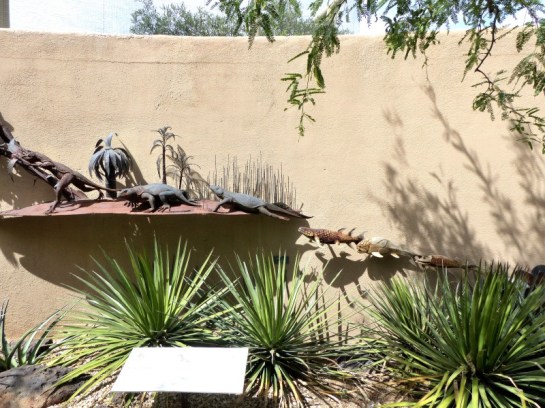
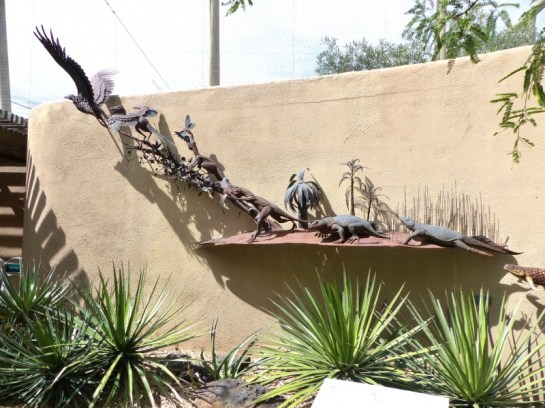
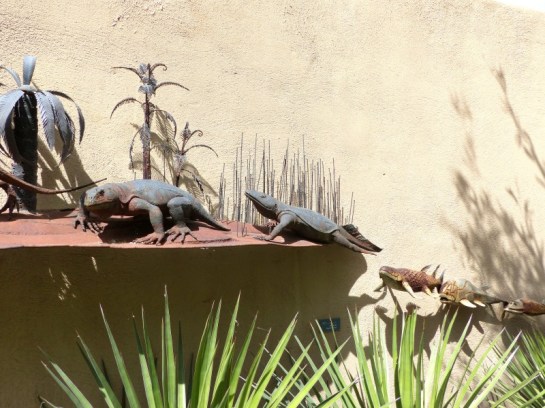
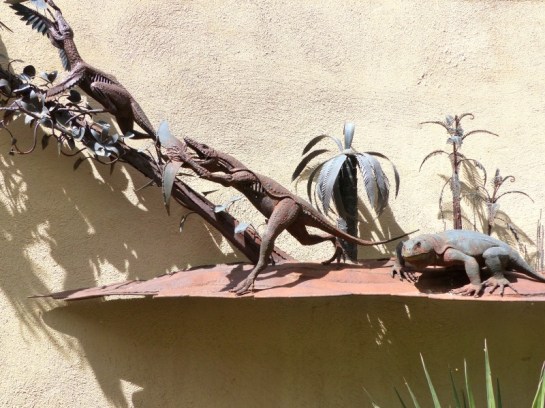
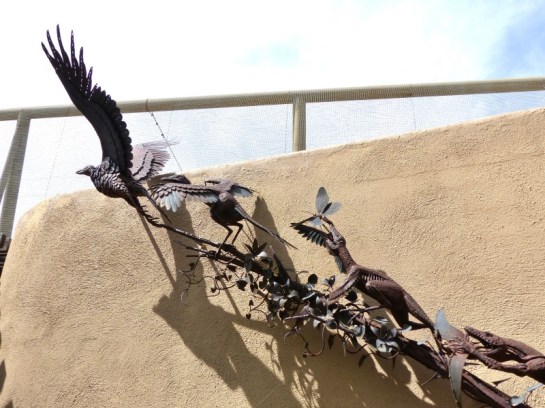
While at the Desert Museum recently, I took these pictures of this “Dinosaur to Bird’ display on one of their walls. It is seen more and more at zoos and museums, especially near the bird exhibits. Their exhibit started with the critters in the water, then fish type, getting out of the water, etc. until you have the dinosaur turning into a bird.
Dino to Bird Display – Desert Museum Tucson by Lee
Dino to Bird Display – Desert Museum Tucson by Lee
Dino to Bird Display – Desert Museum Tucson by Lee
Dino to Bird Display – Desert Museum Tucson by Lee
Dino to Bird Display – Desert Museum Tucson by Lee
Dino to Bird Display – Desert Museum Tucson by Lee
Dino to Bird Display – Desert Museum Tucson by Lee
Dino to Bird Display – Desert Museum Tucson by Lee
Dino to Bird Display – Desert Museum Tucson by Lee
God’s Word – The Bible states “All flesh is not the same flesh, but there is one kind of flesh of men, another flesh of animals, another of fish, and another of birds.” (1 Cor 15:39)
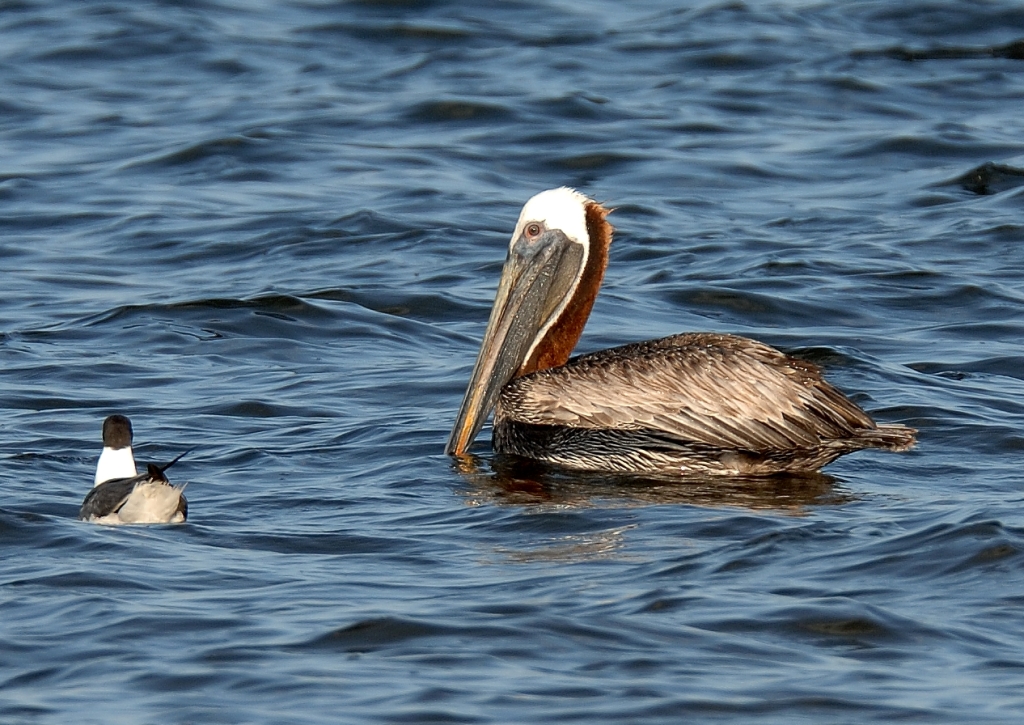
Brown Pelican and Laughing Gull by Dan MacDill Shore 2014
Alexander and the Fishing Contest ~ by Emma Foster
Once there was a pelican named Alexander who lived near the beach. Every day, he would go fishing and he would always bring his favorite fishing pole. One day, as he was flying to the shore, he landed on a huge rock and noticed a sign on the beach. Alexander read the sign. The sign said in big, red letters:
FISHING CONTEST TODAY,
FREE ADMISSION FOR ALL AGES.
FIRST PRIZE FOR THE BIGGEST FISH IS A NEW BOAT.
Alexander decided he would join the fishing contest to see if he could catch the biggest fish. All day he practiced his fishing Every now and then Alexander would catch a fish, but he knew there was a bigger fish somewhere in the water. At noon, it was time for the fishing contest to start and many people had entered. There were people sitting on the beach fishing as far as Alexander could see. A referee blew a whistle and the contest began. Eventually fish started biting and Alexander caught a few, but he knew there was a bigger fish somewhere in the ocean.
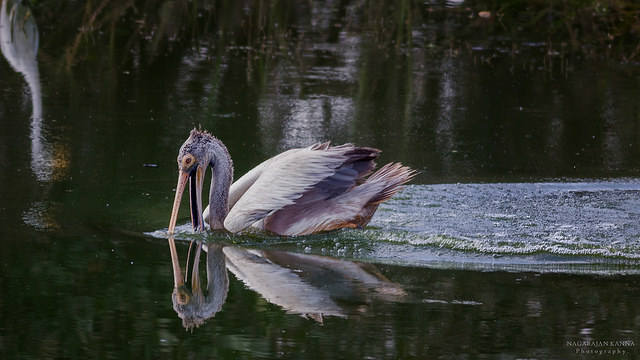
Pelican Reaching in water – Flickr Nagarajan Kanna
And then, something started tugging on Alexander’s line. He had to pull so hard Alexander almost fell off the rock he was fishing on. Eventually, Alexander had to dive down and scoop part of the fish up in his beak and pull the fish out of the water and drag it onto the shore. The referee blew his whistle again to signal that the contest was over. The judges came over to look at Alexander’s fish and immediately agreed that his fish was the winner. Alexander’s fish was almost twelve feet long! From then on, whenever Alexander went fishing, he brought his favorite fishing pole and his new boat The End
Lee’s Addition:
Simon Peter went up and dragged the net to land, full of large fish, one hundred and fifty-three; and although there were so many, the net was not broken. (Joh 21:11)
Well our young writer, Emma, has really come up with a “fish story” this time. She has such a great creative mind and even though the story is a little far-fetched, I like it very much. I wonder if Peter’s net contained any fish as large as Alexander’s? Humm? *
While reading in Isaiah lately, I came across this verse:
“Seeing many things, but you do not observe; Opening the ears, but he does not hear.” (Isaiah 42:20 NKJV)
When Dan and I visit aviaries, we spend quite a bit of time in them. Yes, we are birdwatchers and do photography, but it still amazes me the ones who come in, look around as they walk through, and then leave. They may be in there five minutes. We are there for 30, 45, 60 minutes or longer, depending on the size of the aviary.
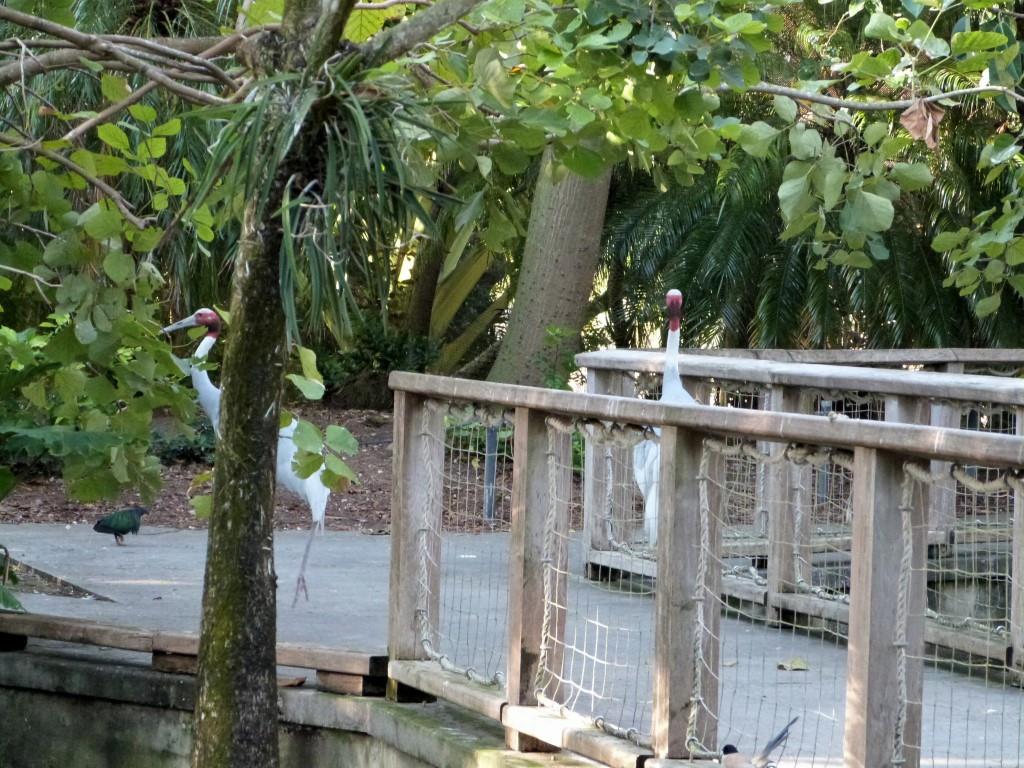
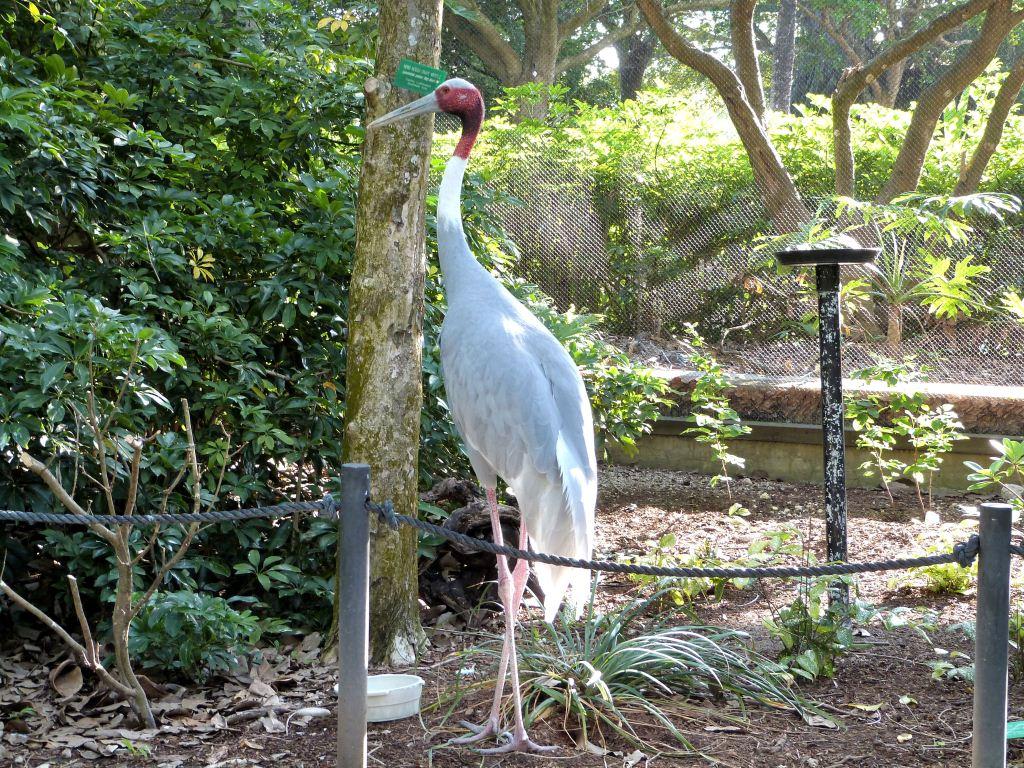
Me and my big mouth causes me to speak up and point out birds they just walked by and never saw. Most times it is appreciated, but there are times when the kids (especially) only want to see the “big” animals. Well, a 6 foot Sarus Crane is “big.”
Sarus Crane (Grus antigone) by Lee at Wings of Asia
Sarus Crane (Grus antigone) by Lee at Wings of Asia
Also, some people don’t even hear the birds chirping and singing. Sometimes we all get so wrapped up in what we are thinking or doing, we forget to look, see, and hear what the Lord has created for us to enjoy. I am so glad for creationist scientist and organizations which study birds and animals. They see so many marvelous things in the way the Lord made the animals and birds, Even fish, other critters and especially the human body.
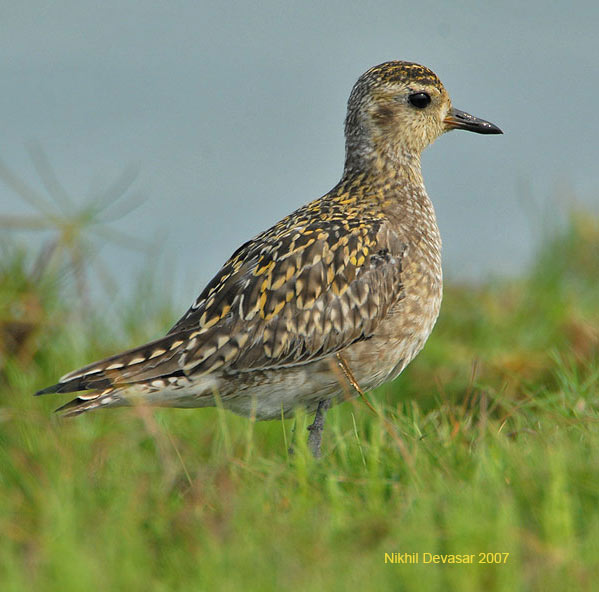
Pacific Golden Plover by Nikhil Devasar Flies to Hawaii from Alaska without the help of its parents.
Back to the verse, Isaiah 42:20. I like this from John Gill’s Exposition of the Entire Bible:
Isaiah 42:20 Seeing many things, but thou observest not,…. The Scribes and Pharisees, saw Christ in the flesh; they saw the miracles he did; they saw the blind receive their sight, the lame walk, the lepers cleansed, the deaf hear, and the dead raised; yet they did not give note to these things, and keep them in their minds, and regard them as clear proofs of his being the Messiah:
opening the ears, but he heareth not; they heard John Baptist preach, the forerunner of Christ, and the testimony he bore of him; they heard Christ himself and his apostles; they sometimes opened their ears, and seemed to listen and hear with attention, and wonder at what they heard; and some would own, that never man spake like Jesus; and yet understood not his speech, and hardened their hearts against him; they saw many things with their bodily eyes, but perceived them not with the eyes of their understandings; they heard with their ears, but understood not in their hearts; for their eyes were shut and their ears heavy, Isa_6:9.
May we, that know the Lord as our Savior, keep our eyes and ears open to God’s Word. May we see His creation and realize, what was spoken in Isaiah 46:9-10:
Remember the former things of old: for I am God, and there is none else; I am God, and there is none like me,Declaring the end from the beginning, and from ancient times the things that are not yet done, saying, My counsel shall stand, and I will do all my pleasure: (Isaiah 46:9-10 KJV)
God created it all and He has prophesied things that would transpire, which many have already come true, like the prophesies of the Lord Jesus Christ coming and dying as our Savior. Plus many, many more fulfilled prophecies.
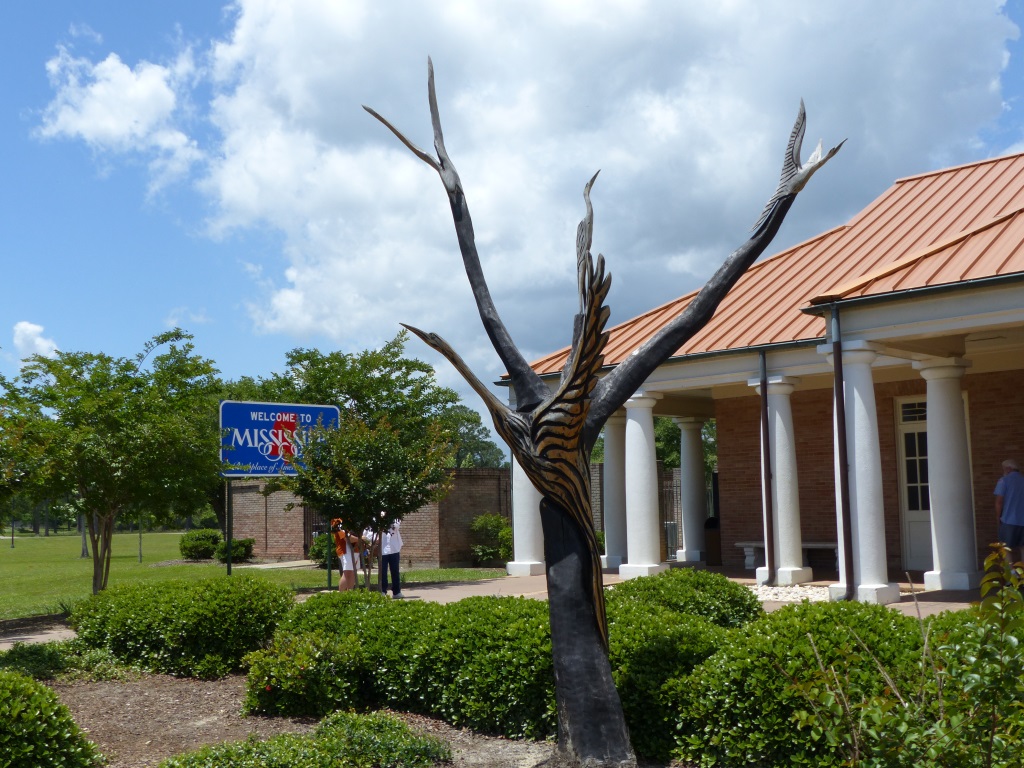
Birds at the Mississippi Welcome Center were a welcome sight. While on our most recent vacation, we saw these trees with birds carved on the end of each limb.
Welcome Center at Moss Point, Mississippi
The center is at Moss Point, MS (the eastern center on I-10 headed west) and were carved by Martin Miller with a chain saw. Mr. Miller uses trees that were destroyed or damaged by Hurricane Katrina.
This slideshow requires JavaScript.
Look at the birds of the air, for they neither sow nor reap nor gather into barns; yet your heavenly Father feeds them. Are you not of more value than they? (Mat 6:26)
Mr. Miller’s bird creations are copied from fantastic creations of their Creator.
Johnny and Polly Chuck had made their home between the roots of an old apple-tree in the far corner of the Old Orchard. You know they have their bedroom way down in the ground, and it is reached by a long hall. They had dug their home between the roots of that old apple-tree because they had discovered that there was just room enough between those spreading roots for them to pass in and out, and there wasn’t room to dig the entrance any larger. So they felt quite safe from Reddy Fox; and Bowser the Hound, either of whom would have delighted to dig them out but for those roots.
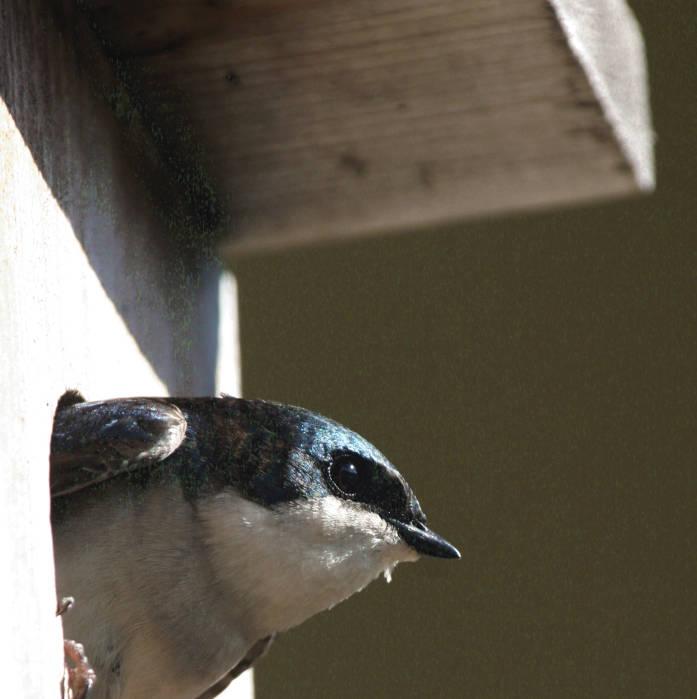
Right in front of their doorway was a very nice doorstep of shining sand where Johnny Chuck delighted to sit when he had a full stomach and nothing else to do. Johnny’s nearest neighbors had made their home only about five feet above Johnny’s head when he sat up on his doorstep. They were Skimmer the Tree Swallow and his trim little wife, and the doorway of their home was a little round hole in the trunk of that apple-tree, a hole which had been cut some years before by one of the Woodpeckers.
Johnny and Skimmer were the best of friends. Johnny used to delight in watching Skimmer dart out from beneath the branches of the trees and wheel and turn and glide, now sometimes high in the blue, blue sky, and again just skimming the tops of the grass, on wings which seemed never to tire. But he liked still better the bits of gossip when Skimmer would sit in his doorway and chat about his neighbors of the Old Orchard and his adventures out in the Great World during his long journeys to and from the far-away South.
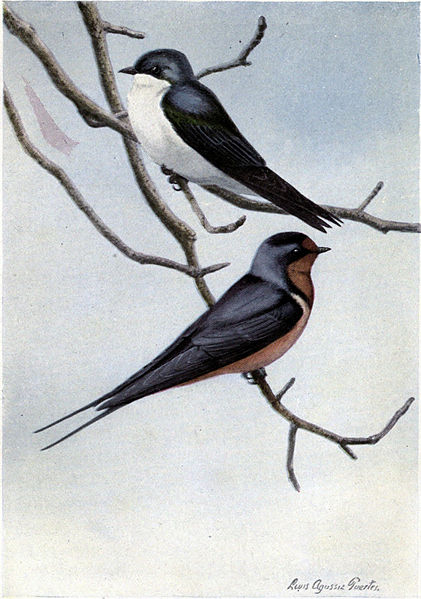
To Johnny Chuck’s way of thinking, there was no one quite so trim and neat appearing as Skimmer with his snowy white breast and blue-green back and wings. Two things Johnny always used to wonder at, Skimmer’s small bill and short legs. Finally he ventured to ask Skimmer about them.
“Gracious, Johnny!” exclaimed Skimmer. “I wouldn’t have a big bill for anything. I wouldn’t know what to do with it; it would be in the way. You see, I get nearly all my food in the air when I am flying, mosquitoes and flies and all sorts of small insects with wings. I don’t have to pick them off trees and bushes or from the ground and so I don’t need any more of a bill than I have. It’s the same way with my legs. Have you ever seen me walking on the ground?”
Johnny thought a moment. “No,” said he, “now you speak of it, I never have.”
“And have you ever seen me hopping about in the branches of a tree?” persisted Skimmer.
Again Johnny Chuck admitted that he never had.
“The only use I have for feet,” continued Skimmer, “is for perching while I rest. I don’t need long legs for walking or hopping about, so Mother Nature has made my legs very short. You see I spend most of my time in the air.”
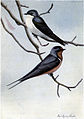
Skimmer The Tree Swallow and Forktail The Barn Swallow
“I suppose it’s the same with your cousin; Sooty the Chimney Swallow,” said Johnny.
“That shows just how much some people know!” twittered Skimmer indignantly. “The idea of calling Sooty a Swallow! The very idea! I’d leave you to know, Johnny Chuck, that Sooty isn’t even related to me. He’s a Swift, and not a Swallow.”
“He looks like a Swallow,” protested Johnny Chuck.
“He doesn’t either. You just think he does because he happens to spend most of his time in the air the way we Swallows do,” sputtered Skimmer. “The Swallow family never would admit such a homely looking fellow as he is as a member.
“Tut, tut, tut, tut! I do believe Skimmer is jealous,” cried Jenny Wren, who had happened along just in time to hear Skimmer’s last remarks.
“Nothing of the sort,” declared Skimmer, growing still more indignant. “I’d like to know what there is about Sooty the Chimney Swift that could possibly make a Swallow jealous.”
Jenny Wren cocked her tail up in that saucy way of hers and winked at Johnny Chuck. “The way he can fly,” said she softly.
“The way he can fly!” sputtered Skimmer, “The way he can fly! Why, there never was a day in his life that he could fly like a Swallow. There isn’t any one more graceful on the wing than I am, if I do say so. And there isn’t any one more ungraceful than Sooty.”
Chimney Swift of Birds Illustrated by Color Photography, 1897
Just then there was a shrill chatter overhead and all looked up to see Sooty the Chimney Swift racing through the sky as if having the very best time in the world. His wings would beat furiously and then he would glide very much as you or I would on skates. It was quite true that he wasn’t graceful. But he could twist and turn and cut up all sorts of antics, such as Skimmer never dreamed of doing.
“He can use first one wing and then the other, while you have to use both wings at once,” persisted Jenny Wren. “You couldn’t, to save your life, go straight down into a chimney, and you know it, Skimmer. He can do things with his wings which you can’t do, nor any other bird.”
“That may be true, but just the same I’m not the least teeny-weeny bit jealous of him,” said Skimmer, and darted away to get beyond the reach of Jenny’s sharp tongue.
“Is it really true that he and Sooty are not related?” asked Johnny Chuck, as they watched Skimmer cutting airy circles high up in the slay.
Jenny nodded. “It’s quite true, Johnny,” said site. “Sooty belongs to another family altogether. He’s a funny fellow. Did you ever in your life see such narrow wings? And his tail is hardly worth calling a tail.”
Johnny Chuck laughed. “Way up there in the air he looks almost alike at both ends,” said he. “Is he all black?”
“He isn’t black at all,” declared Jenny. “He is sooty-brown, rather grayish on the throat and breast. Speaking of that tail of his, the feathers end in little, sharp, stiff points. He uses them in the same way that Downy the Woodpecker uses his tail feathers when he braces himself with them on the trunk of a tree.”
“But I’ve never seen Sooty on the trunk of a tree,” protested Johnny Chuck. “In fact, I’ve never seen him anywhere but in the air.”
“And you never will,” snapped Jenny. “The only place he ever alights is inside a chimney or inside a hollow tree. There he clings to the side just as Downy the Woodpecker clings to the trunk of a tree.”
Johnny looked as if he didn’t quite believe this. “If that’s the case where does he nest?” he demanded. “And where does he sleep?”
“In a chimney, stupid. In a chimney, of course,” retorted Jenny Wren. “He fastens his nest right to the inside of a chimney. He makes a regular little basket of twigs and fastens it to the side of the chimney.”
“Are you trying to stuff me with nonsense?” asked Johnny Chuck indignantly. “How can he fasten his nest to the side of a chimney unless there’s a little shelf to put it on? And if he never alights, how does he get the little sticks to make a nest of? I’d just like to know how you expect me to believe any such story as that.”
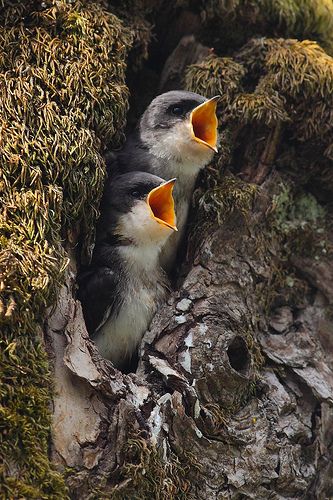
Tree Swallows Ridgefield National Wildlife Refuge by jeremyjonkman on Flickr From Pinterest
Jenny Wren’s sharp little eyes snapped. “If you half used your eyes you wouldn’t have to ask me how he gets those little sticks,” she sputtered. “If you had watched him when he was flying close to the tree tops you would have seen him clutch little dead twigs in his claws and snap them off without stopping. That’s the way he gets his little sticks, Mr. Smarty, He fastens them together with a sticky substance he has in his mouth, and he fastens the nest to the side of the chimney in the same way. You can believe it or not, but it’s so.”
“I believe it, Jenny, I believe it,” replied Johnny Chuck very humbly. “If you please, Jenny, does Sooty get all his food in the air too?”
“Of course,” replied Jenny tartly. “He eats nothing but insects, and he catches them flying. Now I must get back to my duties at home.”
“Just tell me one more thing,” cried Johnny Chuck hastily. “Hasn’t Sooty any near relatives as most birds have?”
“He hasn’t any one nearer than some sort of second cousins, Boomer the Nighthawk, Whippoorwill, and Hummer the Hummingbird.”
“What?” cried Johnny Chuck, quite as if he couldn’t believe he had heard aright. “Did you say Hummer the Hummingbird?” But he got no reply, for Jenny Wren was already beyond hearing.
*
Even the stork in the sky Knows her seasons; And the turtledove and the swift and the thrush Observe the time of their migration; But My people do not know The ordinance of the LORD. (Jeremiah 8:7 NASB)
Like a sparrow in its flitting, like a swallow in its flying, a curse that is causeless does not alight. (Proverbs 26:2 ESV)
A man’s pride will bring him low, But the humble in spirit will retain honor. (Proverbs 29:23 NKJV)
Both of these birds belong to avian families that are mentioned in the Bible
Questions to think about:
Can you describe Skimmer the Swift?
What color is his breast, back and wings?
What is common about the legs of both Skimmer and Sooty?
How do both these birds catch their food?
Why was Skimmer showing a little pride?
Should we be prideful?
Can you describe Sooty the Swallow?
Where and how do Chimney Swallows they make their nest?
“He hath made his wonderful works to be remembered: the LORD is gracious and full of compassion.” (Psalm 111:4)
Birds and insects that take nectar from a flower without picking up any pollen are known as nectar robbers. Now, you’d probably think that nectar robbers would be harmful to plants and trees, but the desert teak tree couldn’t survive without a nectar robber – the purple sunbird.
In order to reproduce, this tree needs birds to pollinate its flowers. But since a tree cannot reproduce with its own pollen, it needs birds to fly from flower to flower and from one tree to another. Anything that encourages the pollinating birds to fly farther away helps out the teak trees.
That’s where the purple thief comes in. Researchers at the University of Delhi discovered that the sunbird visits the flowers one hour before the pollinating birds arrive. The purple sunbird has a long, sharp beak that pierces the base of the flower to feed, so it doesn’t pick up any pollen. It does, however, empty the flower of about 60 percent of its nectar, leaving relatively little for the pollinators. This means that the pollinators will have to travel to more flowers and trees to get enough food, spreading pollen wherever they stop for a meal.
The researchers noted that “the robber plays a constructive and crucial role in the reproductive performance of [a] threatened tree species.” How right they are. And this unusual but crucial dining arrangement shows once again what an ingenious God we serve!
Prayer:
Lord, only You could come up with such an ingenious way to help the desert teak tree to reproduce! Surely such an arrangement could not have come about through blind chance! Amen.
Notes:
“These trees don’t mind getting robbed”, Science News, 7-25-14. Photo: Purple sunbird. Courtesy of J.M.Garg. licensed under the Creative Commons AttributionShare Alike 3.0 Unported license.
Lee’s Addition:
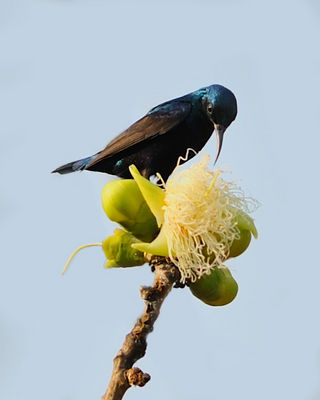
Purple Sunbird (Cinnyris asiaticus) by TAJA
Sunbirds belong to the Nectariniidae – Sunbirds Family which currently has 143 species. They are amazing colored by their Creator and well designed for the plants they pull the nectar from.
From Sunday Inspiration – Sunbirds, “These are very small passerine birds. Most sunbirds feed largely on nectar, but also take insects and spiders, especially when feeding young. Flower tubes that bar access to nectar because of their shape, are simply punctured at the base near the nectaries. Fruit is also part of the diet of some species. Their flight is fast and direct on their short wings.
The family is distributed throughout Africa, the Indian Subcontinent, Southeast Asia and just reaches northern Australia.
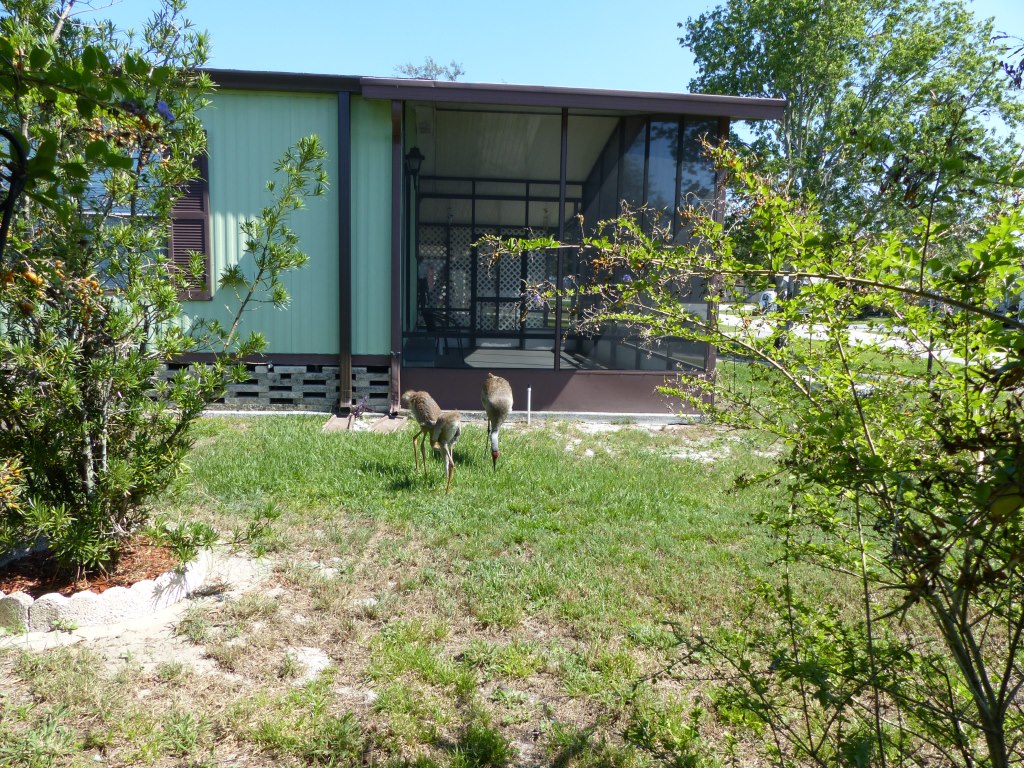
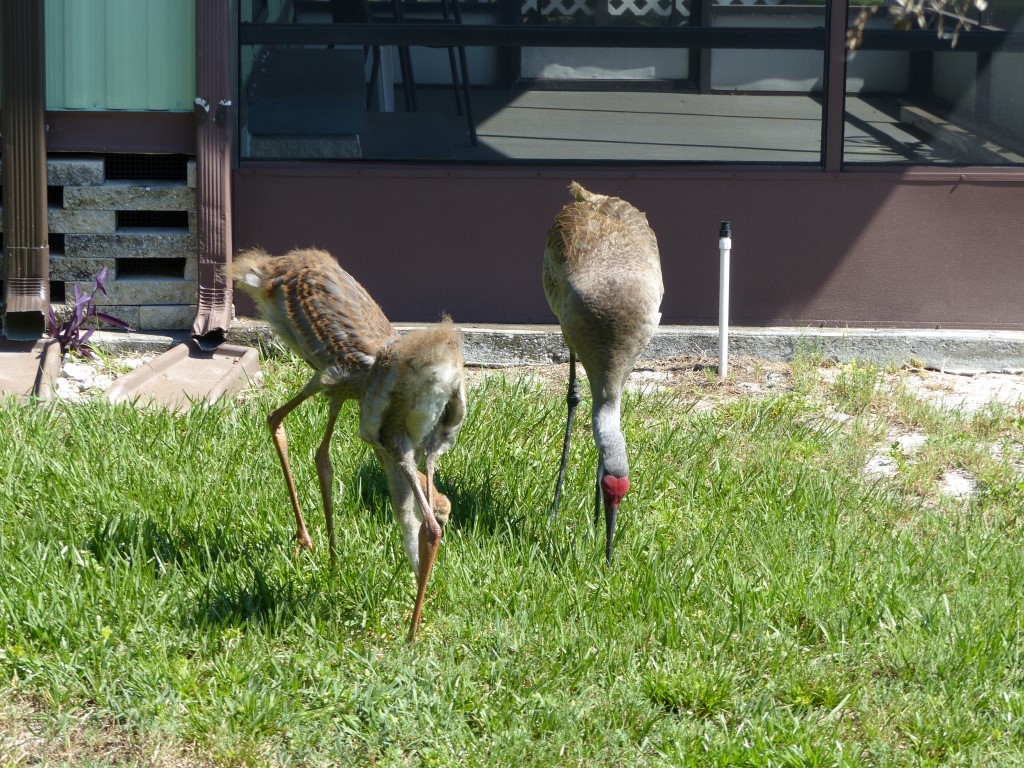
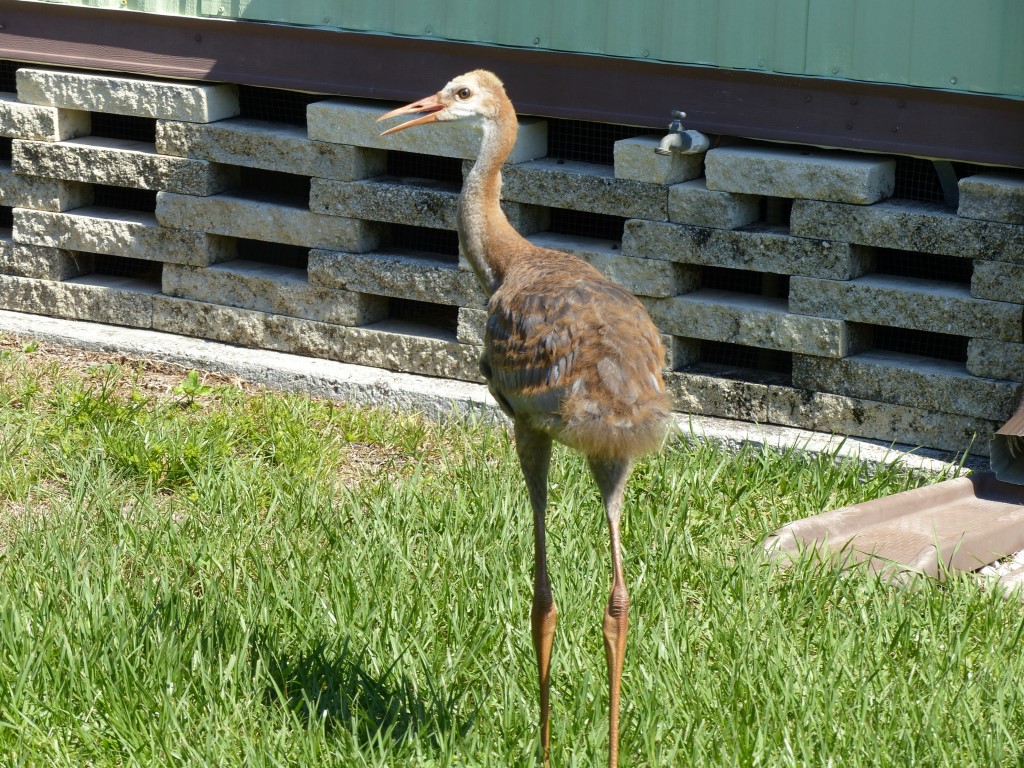
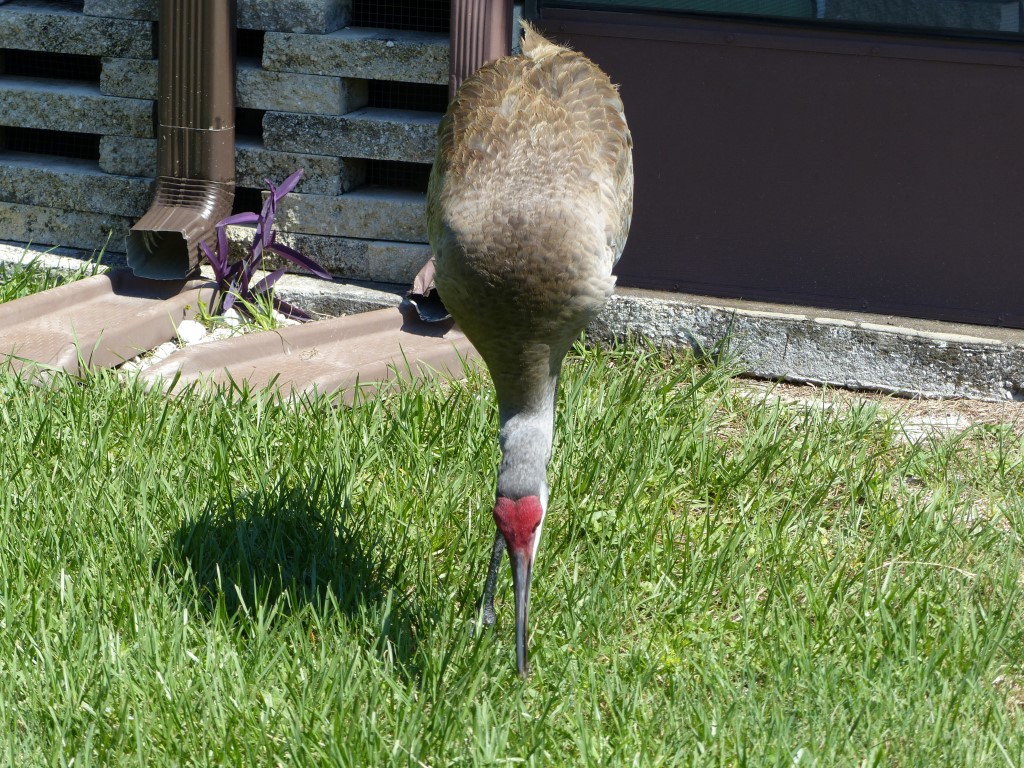
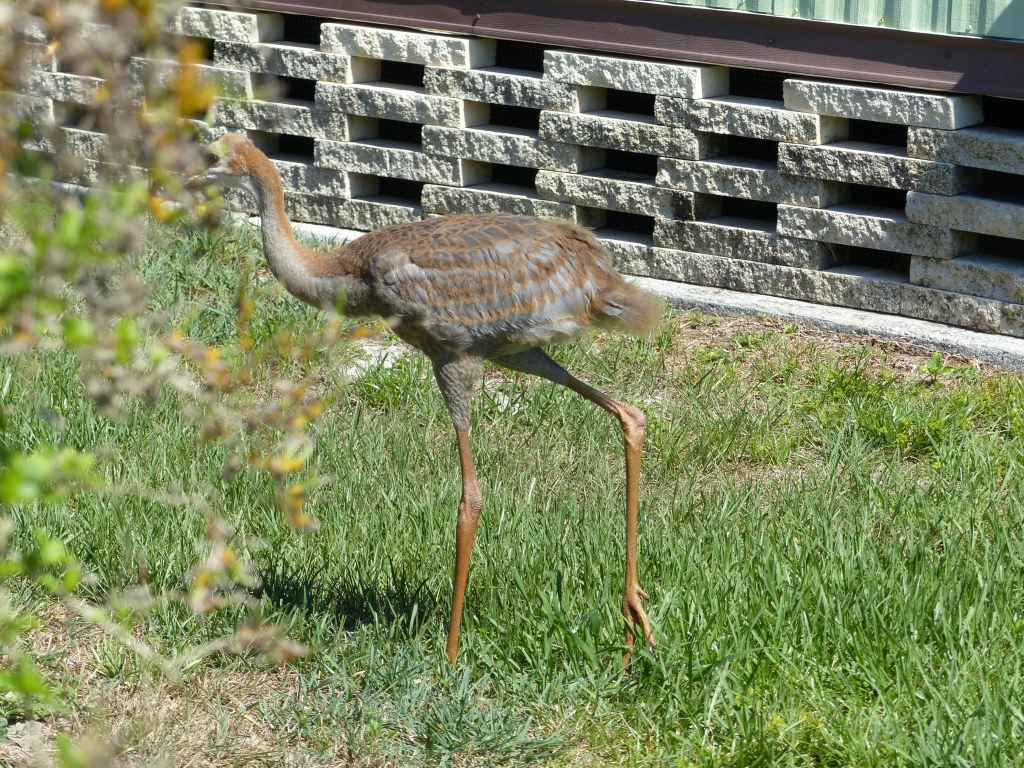
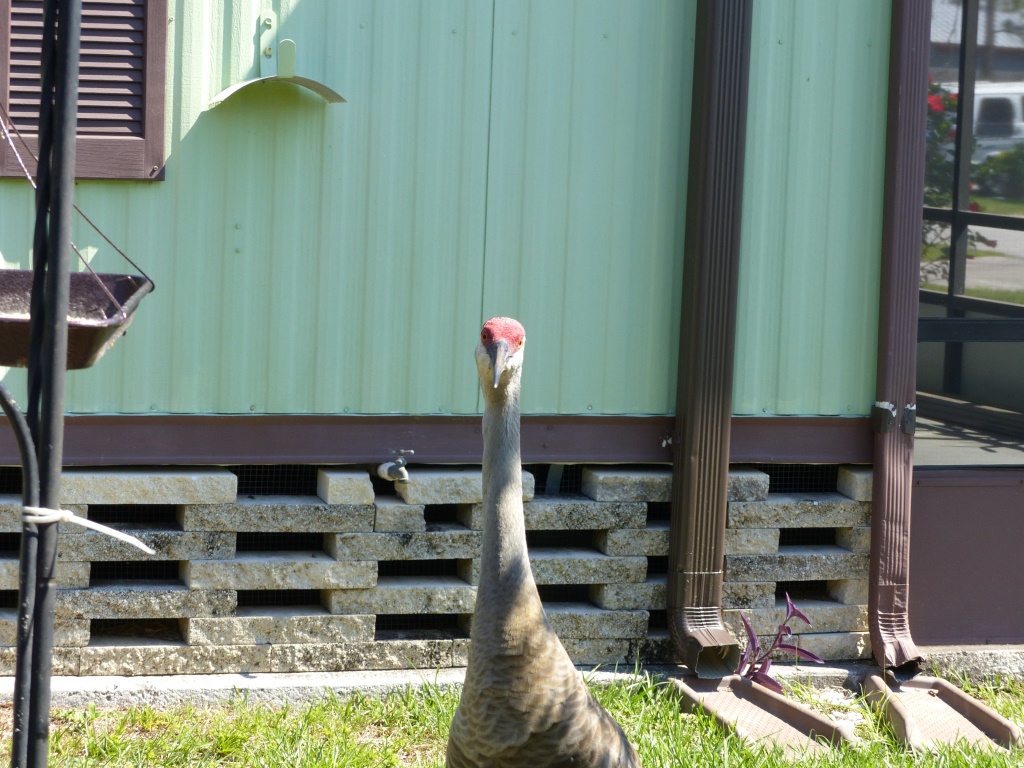
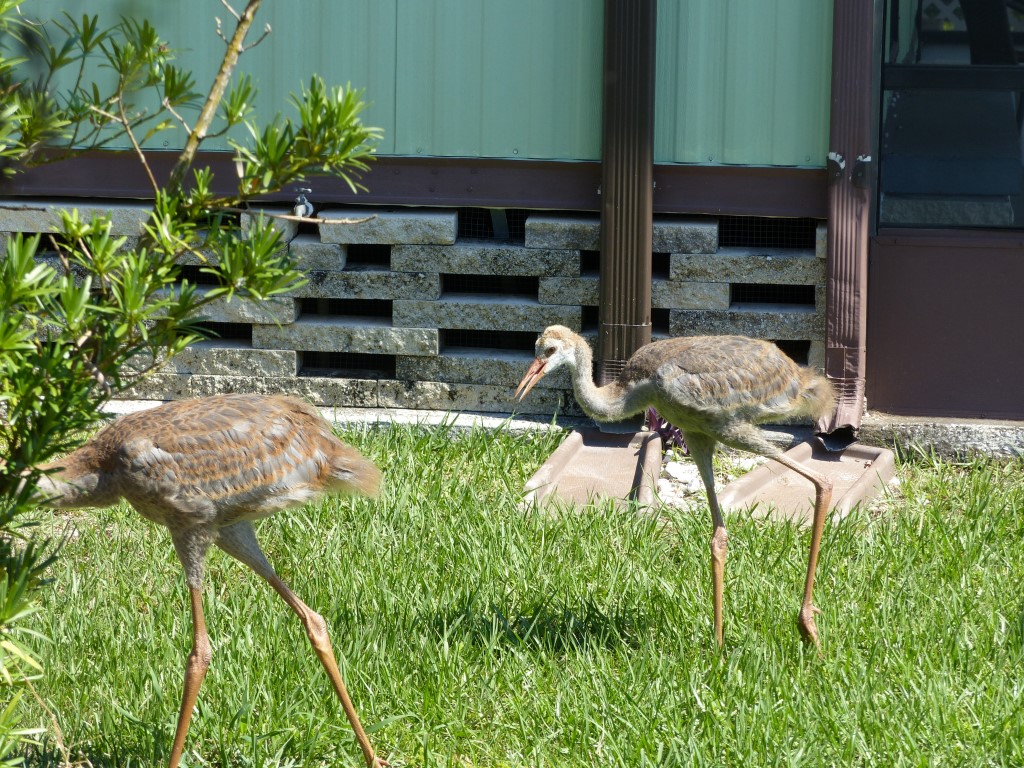
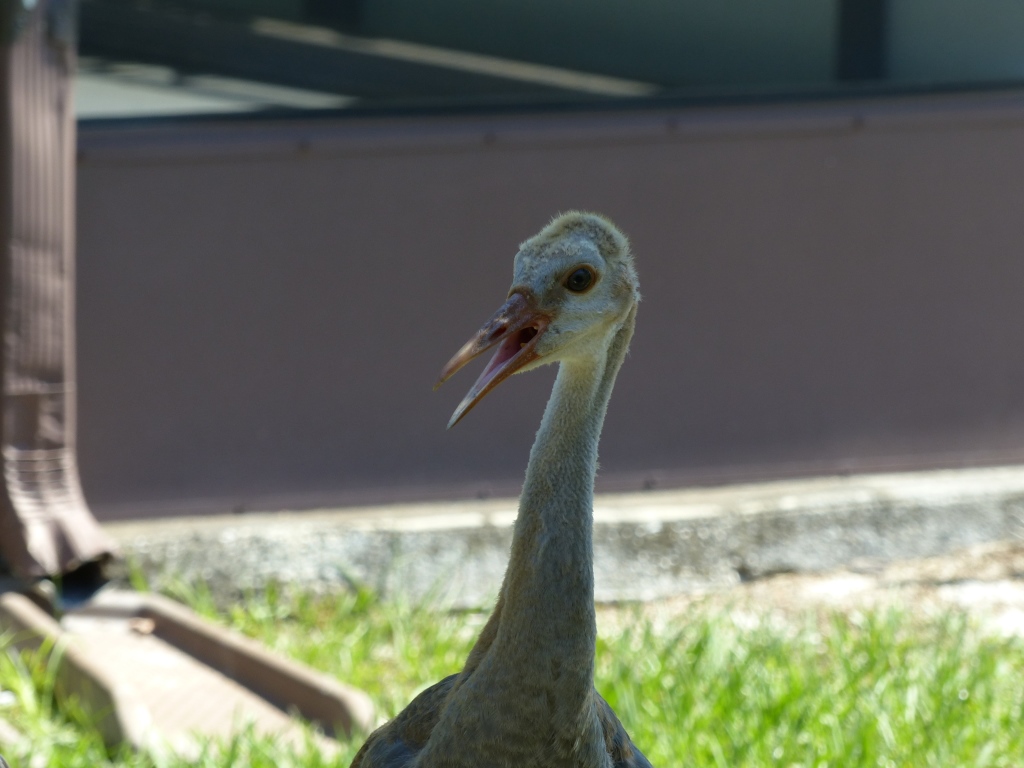
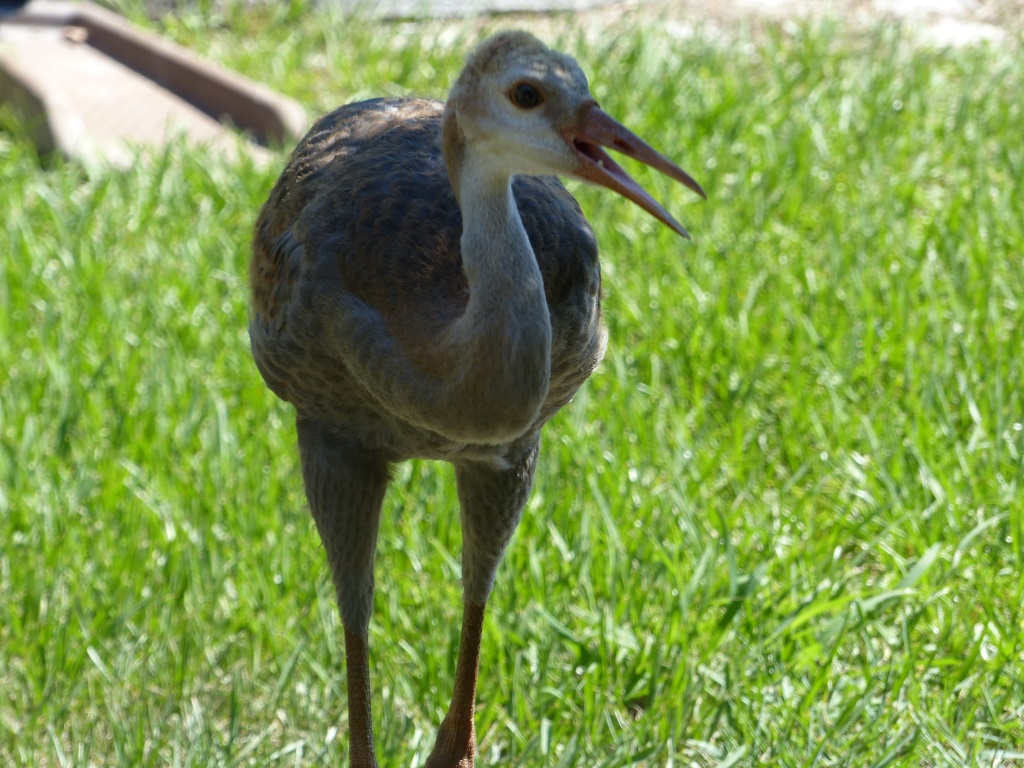
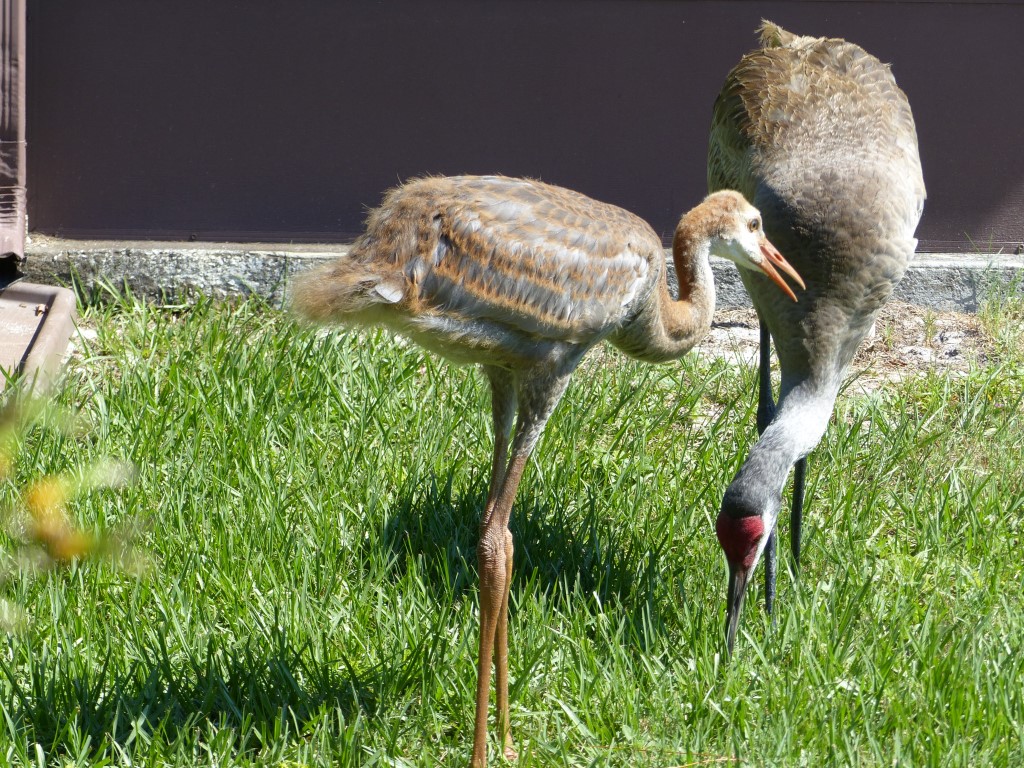
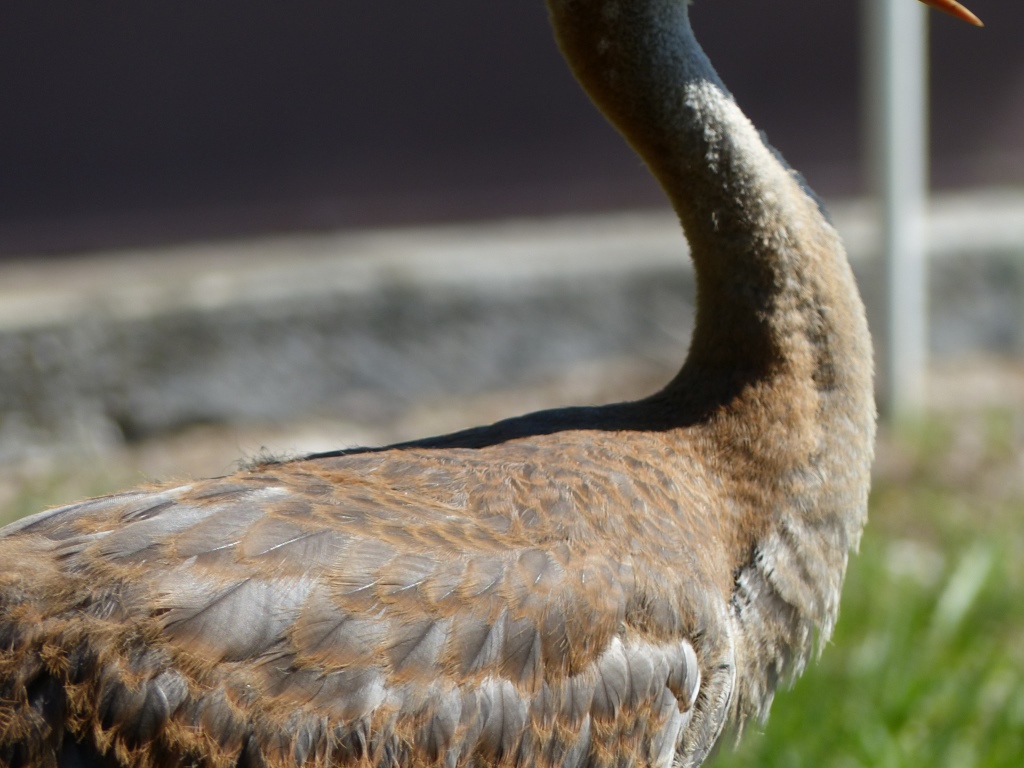
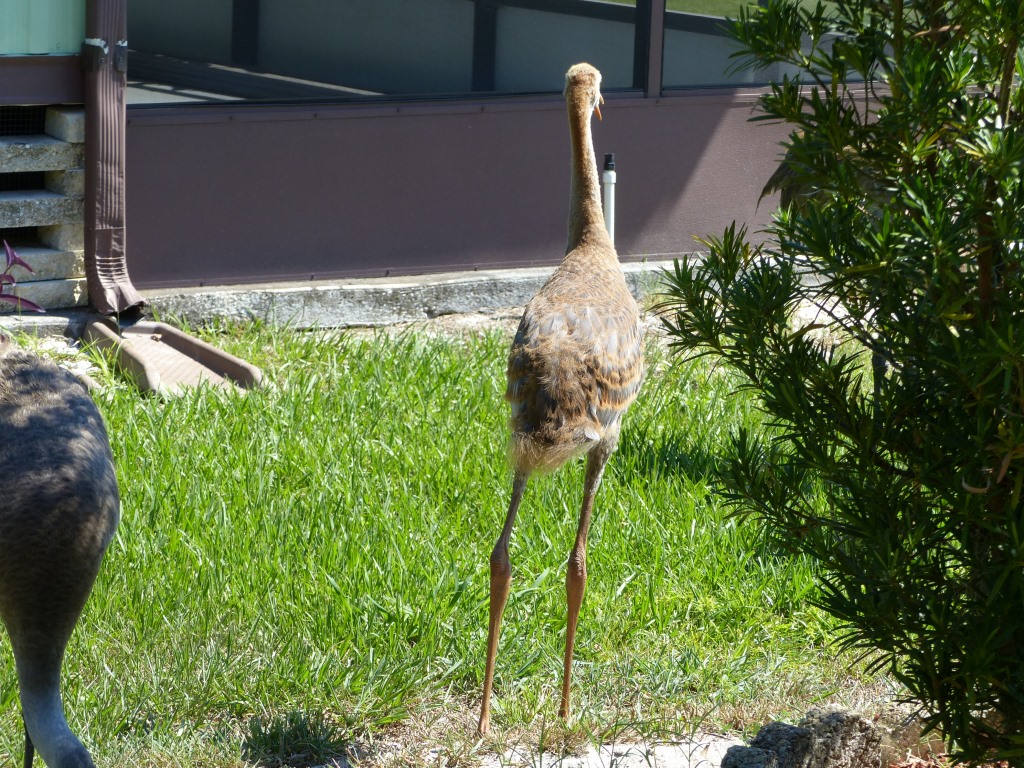
A few days ago while I was filling up my feeders, I looked up and here came Mom and Pop Sandhill Crane with their two latest youngsters. (The 2015 family) Needless to say I stopped and watched them for a while and then remembered to go get my camera. Here are some of those images. I shared a little seed with them. Not suppose to feed cranes, but even if I put seed in that hanging tray for the other birds, they have been known to eat from it. ( I felt sorry for the little ones. :) )
Sandhill Cranes in Sideyard 5-1-15 by Lee
Leaving
It looks like the little Sandhills need to grow into their knees.
Leaving
I always enjoy when the Sandhill Crane parents bring their little ones by to check them out. When you get to watch the Lord’s created critters up close and see how really look and act is enjoyable. The Cranes are mentioned in Scripture and so they are some of our Birds of the Bible.
Like a crane or a swallow, so did I chatter: I did mourn as a dove: mine eyes fail with looking upward: O LORD, I am oppressed; undertake for me. (Isaiah 38:14 KJV)
The parents made some chatter when I got too close to the little ones, but didn’t get it on video. Here is video of them in the yard (The noise is Dan edging the driveway):
*
You can tell by how many articles that I’ve written about that the cranes, that I like them and they visit often:
01:33. As the Robin flies away, the Grackle cries, “More!”
Little Gray Feather,
the Adopted Common Grackle Chick
One of the most bizarre anomalies in the world of ornithology I have ever witnessed was in May 2009.
It was in that month when my wife happened to look out a second floor bedroom window of our condo townhome in Aurora, Colorado and see two little boys carrying bird nests, prompting her to investigate. As it turns out, the two boys were innocently engaged in the exploration of birds’ nests they had discovered—apparently having observed adult birds flying to and from the nests. My wife lovingly explained to them that it wasn’t a good idea to move nests with eggs or chicks and suggested they return the nests to where they had found them.
However, by then the boys had already relocated at least two nests to a not-so-tall conifer at the southeast corner of the townhome complex. Apparently, they figured that by relocating the nests to lower, shorter branches, they could keep a better eye on things. The relatively short evergreen presently had a total three nests and a number of chicks had fallen to the ground. Not knowing what type of birds she was dealing with or what nests the chicks on the ground had fallen out of, my wife donned a pair of gloves and placed the fallen chicks back into two of the nests. When I returned home from work, she requested I examine the situation. Upon doing so, I found that she had mistakenly placed Common Grackle chicks with American Robin chicks and a few chicks had again fallen out of their nests—one to the ground, a couple of others onto branches. It was a problematic scenario for all parties involved, especially the chicks.
01:09. Oh, what joy as the Robin emerges on the west side of the nest with something substantial in its mouth.
Appearances suggested we were dealing with two broods of Robins and one of Grackles, both types of birds being common to the complex. Presuming the highest nest in the tree to be that of a Grackle, I placed the Grackle chicks in that one and divided the Robins evenly between the other two lower nests, holding out little hope for a positive outcome.
In less than two days all chicks died except for one: a Grackle. And soon, the nest had become tipped. I adjusted it so the sole survivor wouldn’t fall out.
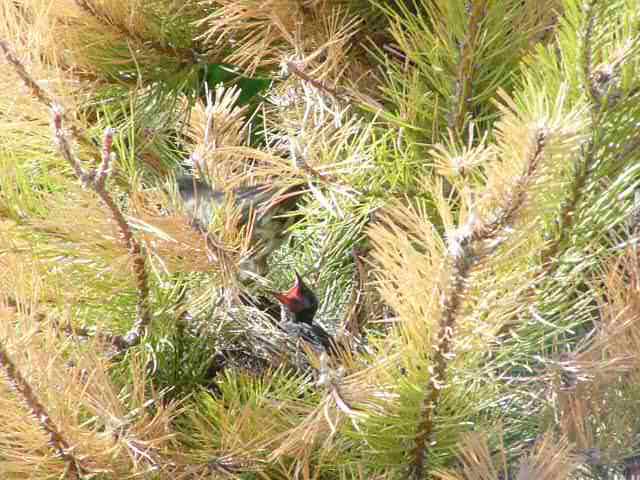
Now, one would think an adult Robin would know the difference between one of its own and a stranger. Yet, to our amazement, a pair of mating Robins quickly adopted the baby Grackle and took to raising it as their own. This caused me to think that the nest had actually been built by the mother Robin. We named the chick Little Gray Feather and observed its development into June until it left the nest and was capable of very short flights while still being tended to by its adoptive parents.
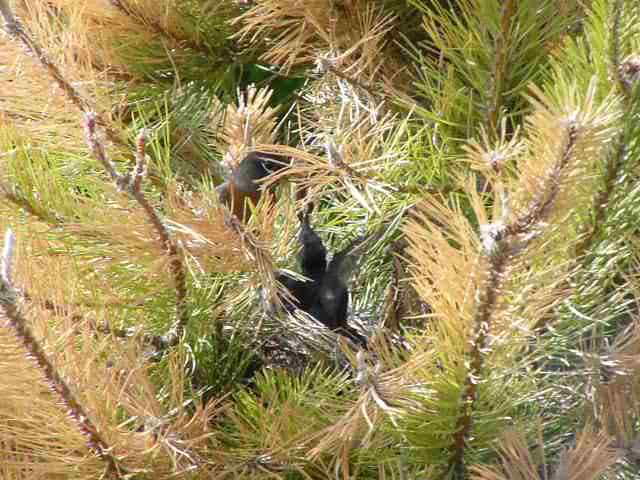
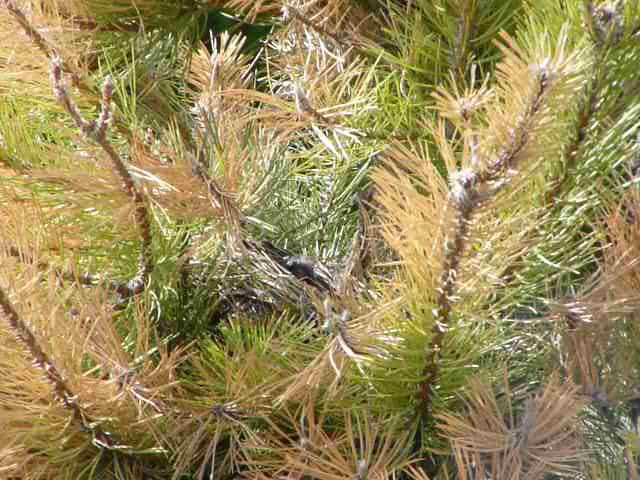
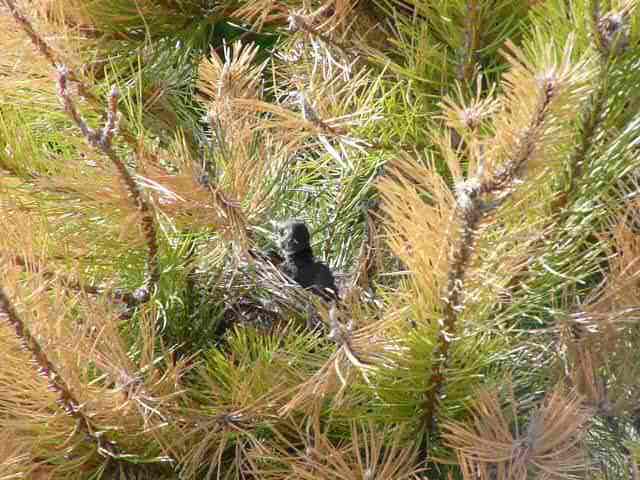
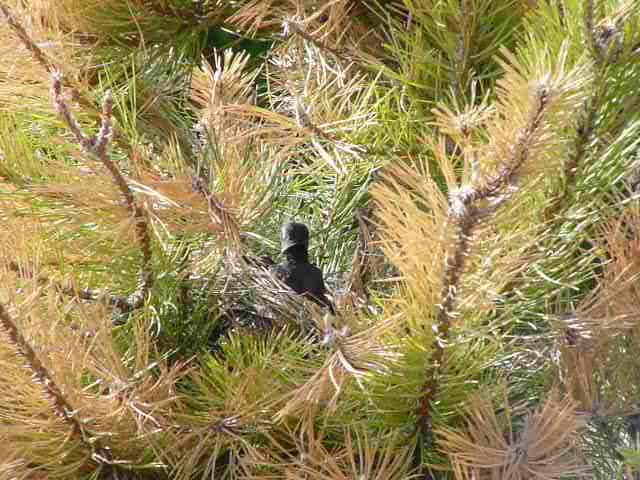
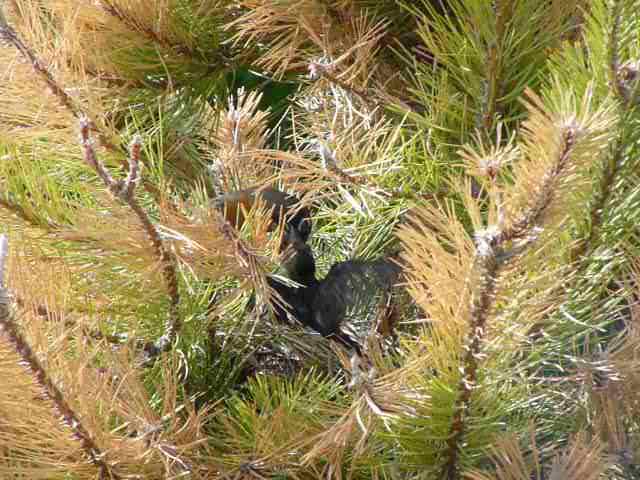
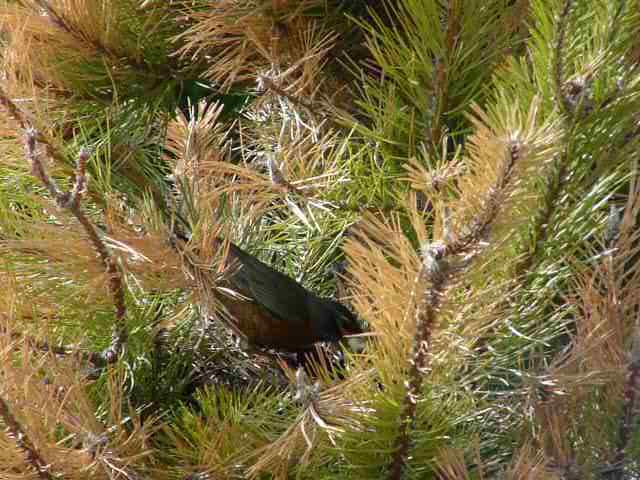
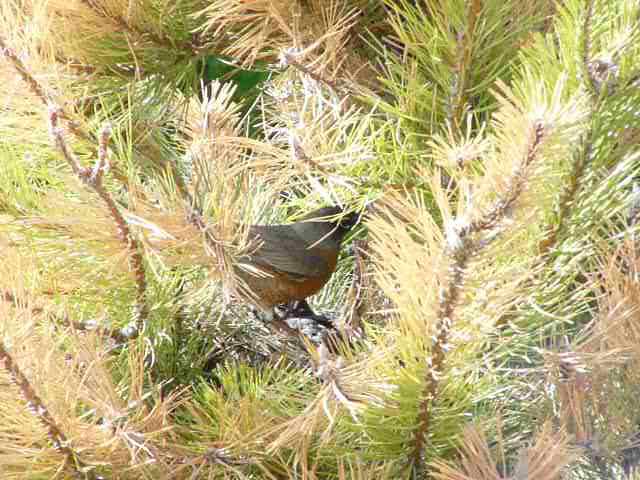
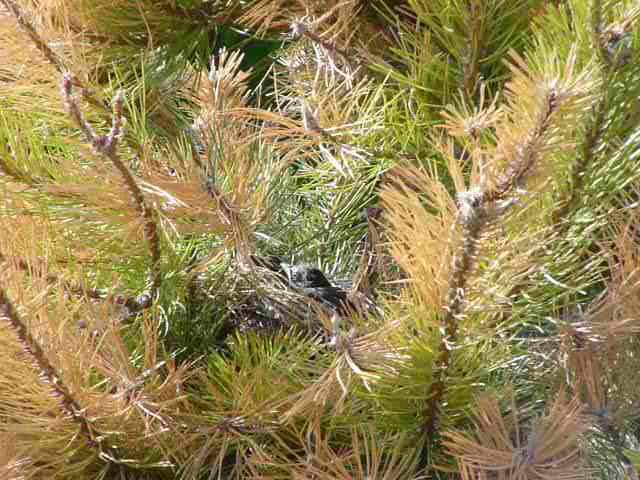
Using a Panasonic Lumix-DMC FZ8 digital camera, on May 29, 2009, I took a video of the Grackle in the nest and one of its adoptive Robin parents feeding it and cleaning up after it. Following are photos captured from the video, arranged in chronological order from left to right:
*
00:00. Little Gray Feather sits low in the nest, facing West.
00:05. The Common Grackle chick gets up suddenly as if hearing one of its parents coming.
00:07. False alarm? The chick ponders things for a moment.
00:18. The nestling lets out a few chirps…
00:40. …then settles down into the nest again.
01:05. Having waited for what seemed like too long, the little Grackle suddenly becomes all excited, flapping its wings wildly as one of its parents, an American Robin, lands on a lower branch on the north side of the tree.
01:07. The nestling will nonetheless have to settle down a bit before the parent will come the rest of the way.
01:09. Oh, what joy as the Robin emerges on the west side of the nest with something substantial in its mouth
01:11. An earthworm!
01:12. With some help, the little one gets it all in and down.
01:20. The Robin then gets about the task of cleaning up after its adopted child, swallowing up excrement before taking off and vomiting it out away from the nest.
01:31. The Robin pauses a moment, looking about … perhaps noticing me with the camera some yards away.
01:33. As the Robin flies away, the Grackle cries, “More!”
01:39. Little Gray Feather will just have to be patient … again.
What an amazing story and the photos and video to go along with it. Thanks Dan for sharing this with us. Dan Vaisanen is an acquaintance of James J. S. Johnson.
Other birds have fed babies that are not their own, but this was all done by accident. It is interesting that one species, the Robins, were willing to feed another species’ baby, but that the Grackles would not do the same for the Robin babies. Must be a truth there somewhere.
“So then, whatever you desire that others would do to and for you, even so do also to and for them, for this is (sums up) the Law and the Prophets. (Matthew 7:12 AMP)
For the last few days I have been updating to the new I.O.C. Version 5.2. This update wasn’t too bad.
“The IOC World Bird List 5.2 contains 10,567 extant species (and 149 extinct species) classified in 40 Orders, 238 Families (plus 2 Incertae Sedis) and 2277 Genera. The list also includes 20,803 subspecies.” I don’t list the subspecies here.
As far as I know, all Family pages and all the Indexes have been changed. The Update is so new that photos are difficult to locate at this time. Many of the “new species” are subspecies raised to specie level. I am sure the Lord knows all about how many birds He Created and where they all are.
My son, fear thou the LORD and the king: and meddle not with them that are given to change: (Proverbs 24:21 KJV)
For I am the LORD, I change not; (Malachi 3:6a KJV)
Jesus Christ the same yesterday, and to day, and for ever. (Hebrews 13:8 KJV)
As birds flying [‘aphôth = “winging” in air], so will the Lord of hosts defend Jerusalem; defending also He will deliver it; and passing over He will preserve it. (Isaiah 31:5)
Orni-Theology
Some birds are known for perching – we call them passerines. Some wade in shoreline tidewaters – we call them waders. Some birds don’t even fly at all – the flightless penguins only “fly” underwater! Many other birds, however, we rarely see doing anything but flying — winging in the air (to use the Biblical Hebrew’s word-picture). Today’s featured creature, the Great Frigatebird, is truly a bird of flight – it is conspicuous in the air, and its wings are both acrobatic and enormous. In “Flag those Birds! (Part 1)”, we considered 4 “banner birds” – besides globally popular eagles – that appear on national flags: Belgium’s Wallonian Chicken (Gallus gallus domesticus); Portugal’s Northern Goshawk (Accipiter gentilis); Burma’s Green Peafowl (Pavo muticus); and Dominica’s Sisserou Parrot (Amazona imperialis). In “Flag those Birds! (Part 2)”, we considered 2 more “banner birds”: the British Antarctic Territory’s Emperor Penguin (Aptenodytes forsteri), and the Saint Helena Plover, a/k/a Saint Helena’s skinny-legged “Wirebird” (Charadrius sanctaehelenae). As promised, this mini-series is continuing with more “flagged birds”, this time, with the Great Frigatebird (Fregata minor), the soaring seabird officially featured on the flag of Kiribati, a Pacific Ocean nation. God willing, we will subsequently review Papua New Guinea’s bird of paradise (on the flag of Papua New Guinea), the ubiquitous dove (on Fiji’s flag, as well as on the royal standard of Tonga), the black swan of Western Australia, the white piping shrike of South Australia, the condor of Bolivia; and Uganda’s crested crane. So for now, let us consider the frigatebird, which appears on the flag of Kiribati. In case you haven’t visited Kiribati yet, the Republic of Kiribati is an archipelago — a cluster of islands — located in the middle of the Pacific Ocean. Specifically it is comprised of 34 islands, one of which (Banaba) is a “raised coral” island, and the rest of which are reef islands or atolls. The term “middle” (in the phrase “middle of the Pacific”) is fitting, because Kiribati straddles the equator and the International Date Line. To avoid confusion about what “day” it is, — because it would be awkward for neighboring islands to be simultaneously experiencing different “days” on the calendar (e.g., some government offices were closed, observing Sunday, while others were open for business, observing Monday!), — the International Date Line is indented, so that now the Kiribati Islands are, technically speaking, Earth’s farthest frontal time zone (called “UTC+14”, meaning “Universal Time Coordinated”, a/k/a Coordinated Universal Time, f/k/a Universal Time [UT] or Greenwich Mean Time [GMT], — so UTC+14 is 14 hours ahead of the time observed in Greenwich, London, at the Royal Observatory). Sorry for taking so much time on this digression’s details.
Interestingly, Kiribati’s time-of-day matches that of Hawaii – but it is deemed one “day” ahead on the calendar. (Hawaii’s time zone is very “late” in the Earth’s rotational “day”, a fact that I recall because I worked with some lawyers who took advantage of that once — when a contract option deadline appeared to be lost, because locking in a particular contract option required a signature before 5:00pm on a certain day, but no time zone was specified – the solution was to FAX the contract papers to the Hawaii office and have them signed there, before it was 5:00pm Hawaii time!). Previously Kiribati was within (and almost synonymous with) the Gilbert Islands, just west of the old “date line” – when it was a British colony. (In fact, the name “Kiribati” is how the native language says “Gilberts”.) And, if you think that is confusing, you should check out how “daylight saving time” (which may locally vary from “UTC” time, during parts of the year) is applied in the central Pacific Ocean and to some of the neighboring island nations, such as Tonga, Samoa, and Tokelau!
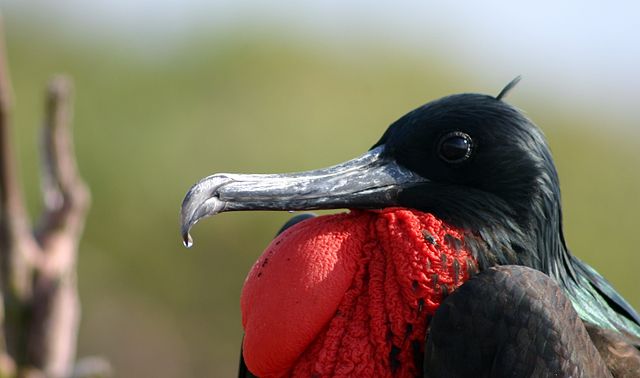
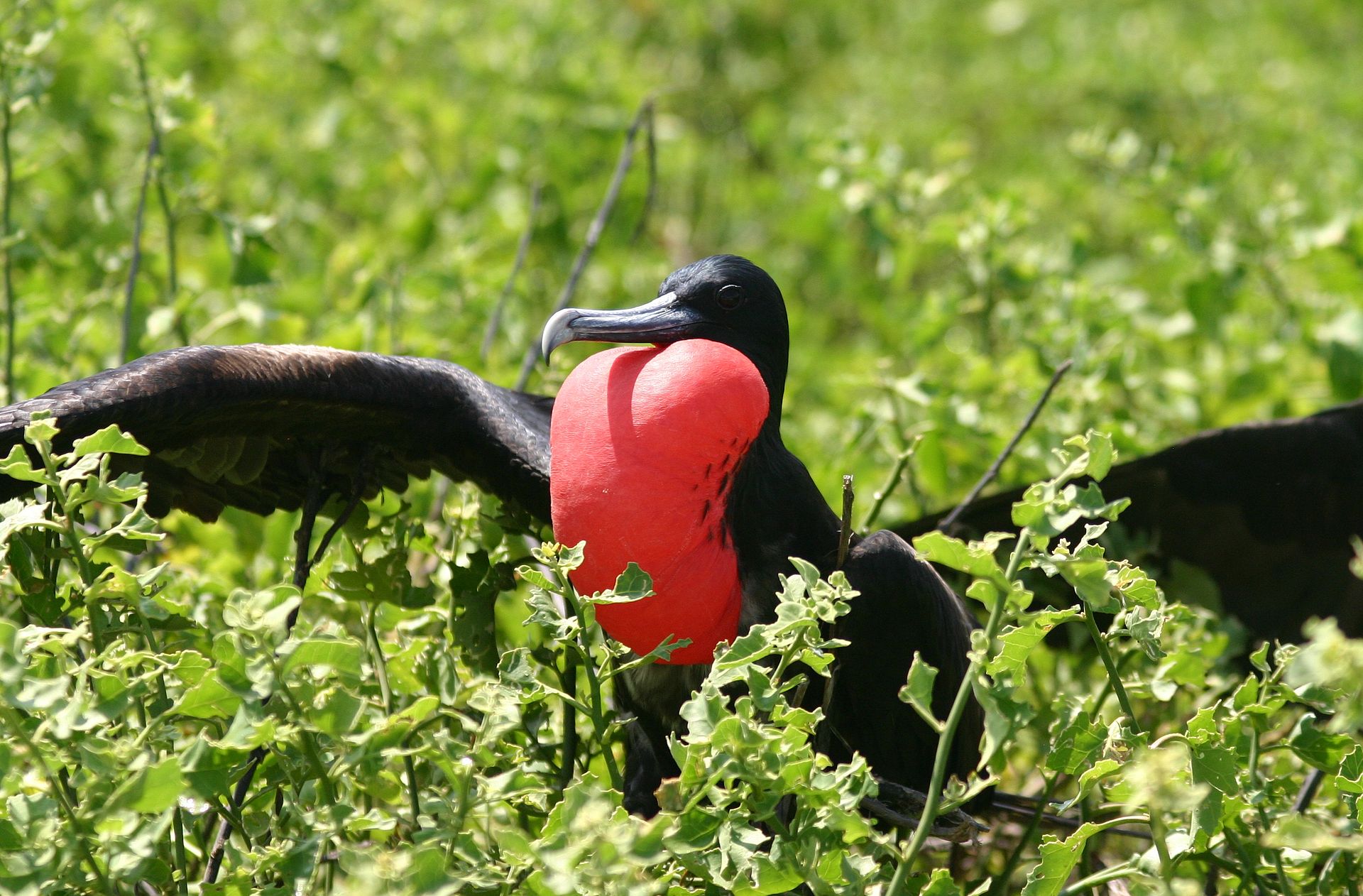
Great Frigatebird (Fregata minor). The Great Frigatebird is found soaring above tropical oceans all over the world. Because it is almost always seen at sea, it is not surprising that English sailors (centuries ago) called it the “man-of-war”, a term that indicated a fast-sailing oceanic warship, the same kind of ship that the French called a “frigate” (la frégate). If you ever watch a frigatebird in the air, contextualized by a background (or foreground) that provides distance indexing – as I once did (a Magnificent Frigatebird “cousin”, actually, near the shoreline of Grand Cayman, one of the Cayman Islands), – you too will be impressed with the frigatebird’s speedy flight maneuvers. In fact, its habit of stealing food (such as fish) from other seabirds is so well-known that the bird might have been better labeled the “pirate-bird”. Why? Frigatebirds often harass seagulls carrying fish, in the air, repeatedly, until the seagull drops – abandons – his or her piscatorial food-catch, in order to escape the threatening frigatebird. As the bullied victim (seagull) flees the scene of the crime, empty-beaked, the buccaneering frigatebird swoops down after the plummeting food, snatching it out of the air before it drops into the water. The physical appearance of a frigatebird is not to be easily forgotten. Frigatebirds are mostly black, with long angular wings, with a long sharply forked tail that looks pointed when “closed”. (Males are almost all black, except for the red gular pouch (described below); the females have a white “bib” covering most of the neck-to-chest area (but have no gular pouch). Frigatebirds “have long, thin, hooked bills and the males [each] possess an inflatable gular pouch which can be blown up to form a huge scarlet ball during courtship”. [Quoting Marc Dando, Michael Burchett, & Geoffrey Waller, SeaLife, a Complete Guide to the Marine Environment (Smithsonian Institute Press, 1996), page 248.] The male’s bright red “gular pouch” is a skin-covered (i.e., featherless) inflatable throat sac that connects the lower half of the bird’s beak down to and below the bird’s neck. This inflatable throat sac, quite conspicuous during breeding season, is showcased during courtship displays, swelling into a balloon-like inflation (like a bullfrog), for a timeframe that may exceed 15 minutes! The noise produced by this throat sac “sound-box” is the frigatebird’s rattling equivalent to yodeling.
The Great Frigatebird is usually seen soaring above ocean waters, or swooping through the air near island beaches, looking (“on the fly”) for a meal. In fact, frigatebirds are rarely seen on land during daylight, though they must use land for sleeping and for nesting activities, such as laying and hatching their eggs. [See www.icr.org/article/why-we-want-go-home/ — citing Tony Soper, Oceans of Birds (London: David & Charles Press, 1989), pages 82-83.] Oceanographer Tony Soper describes the winged magnificence of this oceanic flier: “Frigatebirds live up to their reputation [i.e., “frigate” = seafaring warship] with spectacular manoeuvres in aerial pursuit and piracy, stalling and turning with total control in a way which outclasses any competition. Supremely aerial seabirds, they can hang seemingly motionless in the sky for hours [gliding], waiting to pounce. The air is their daytime medium, they alight on the water only at their peril, for they have small oil glands and their plumage is not waterproof. … They are equally at a disadvantage on dry land, for their legs are short and hopelessly inadequate for walking. They must shuffle and climb to a point from which they can take off [and “land” on a rising thermal air current, as if it was an elevator]. By night they roost on a tree or bush which offers a convenient launch-pad when the sunrise brings a thermal lift. They have huge wings, up to 7ft. (2.1m) in span…. With their shapely wings they float effortlessly in dynamic soaring flight, plunging only to retrieve food items from the surface or to snatch a flying fish. Sometimes they chase other seabirds to relieve [i.e., rob] them of their catch. “ [Quoting Tony Soper, Oceans of Birds (London: David & Charles Press, 1989), pages 82-83.] Frigatebirds congregate in breeding colonies, often near colonies of other seabirds (such as cormorants, pelicans, and boobies), not infrequently mooching food collected by their avian neighbors.
The frigatebird appears to be soaring in sunrise-dominated sky above the ocean waters, in the colorful flag of Kiribati, with the three white stripes representing the three island subsets of Kiribati, the Gilbert Islands, Phoenix Islands, and some of the Line Islands. (The national coat-of-arms is similar.) Earlier, when Kiribati belonged to the British colony of “Gilbert and Ellice Islands”, the colonial flag included the image of a yellow frigatebird (within a coat-of-arms emblem) soaring in the sunrise above ocean waters.
Kiribati is a nation that celebrates its past, including its providential heritage as a colony Christianized by the British. Its official public holidays not only include Easter (celebrating the resurrection of the Lord Jesus Christ) and related days (“Good Friday”, “Holy Saturday”, and “Easter Monday”)), as well as Christmas (celebrating the birth of the Lord Jesus Christ), but also “Gospel Day” (a moveable holiday scheduled on or near July 11th), to celebrate the coming of the Christian faith to these Pacific islands, thanks to God sending Christian missionaries. Now that’s a day worth celebrating! (See Romans 10:20.) Other national holidays celebrate elderly men (“Unimwane Day”), elderly women (“Unaine Day”), youth (“Youth Day”), servants (“Boxing Day” – for giving boxed Christmas presents to men and women who serve), and women in general (“International Women’s Day”). So why not have a holiday to celebrate the value of men in general? Maybe the omission should be compared to the difference between Mother’s Day and Father’s Day, as they are celebrated in most churches. On Mother’s Day the typical sermon raves about how wonderful and precious mothers are (and they are applauded, given roses, etc.), — but on Father’s Day the typical sermon castigates men for being such sorry fathers, failing, failing, and failing yet again to carry their paternal responsibilities properly — why won’t they do a better job? (Yet consider this related fact about ingrates: God the Heavenly Father, Who never fails, knows the ugly ingratitude of billions of humans who fail to appreciate His wonderful, caring providences. The Lord Jesus was a “man of sorrows”, the Holy Spirit is sometimes “grieved”, and surely God the Father is often disappointed.) The next scheduled bird, on this mini-series list, is the Bird of Paradise, but that bird must wait for another day. Please stay tuned (and don’t forget Mother’s Day)!
As you have been viewing the Sunday Inspirations lately, we have been going through the Passerines or Passerfiormes Order in taxonomic order. So far, I have shown you 30 families, which makes us almost a forth of the way through the 125 Passerine families.
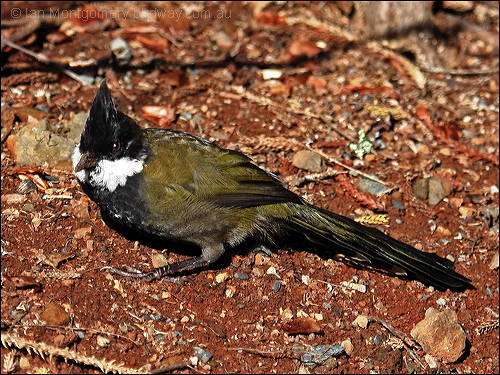
Whipbirds, Jewel-babblers, Quail-thrushes that make up the Psophodidae family are native to Australia and nearby areas. They occur in forest, generally replacing each other at different altitudes. The painted quail-thrush is also found in the forests of New Guinea.The other quail-thrushes are restricted to Australia where they are found in drier habitats, occurring in open forest, scrub and on stony ground.[8] None of the species are thought to be threatened but one subspecies of the spotted quail-thrush is possibly extinct.
The whipbirds and wedgebills are all found in Australia, occurring in a range of habitats from rainforest to arid scrub. The western whipbird is considered to be near-threatened because of habitat loss and fires while the Papuan whipbird is classed as data deficient..
They are terrestrial birds which fly fairly weakly and prefer to squat or run when disturbed. They forage on the ground feeding mainly on insects and other invertebrates.[9] In the desert, quail-thrushes also eat some seeds. They build a cup-shaped nest among shrubs or on the ground. Two or three eggs are laid.
Eastern Whipbird (Psophodes olivaceus) by Ian
Here is the song of the Eastern Whipbird. It sounds like someone snapping a whip.
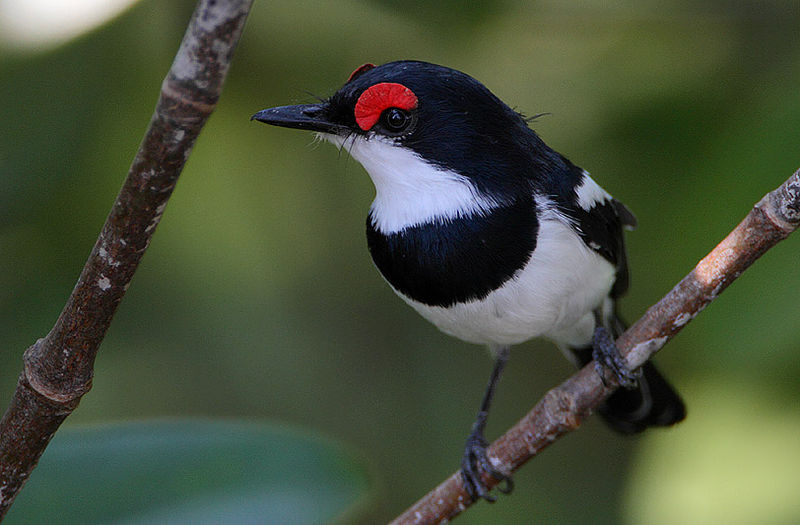
The Platysteiridae – Wattle-eyes, Batises Family are a favorite of mine because of their eyes. They are a family of small stout birds living in trees, primarily of the woodlands and forests of sub-Saharan Africa. The family contains the wattle-eyes, batises and shrike-flycatchers. They were previously classed as a subfamily of the Old World flycatcher family Muscicapidae.
These insect-eating birds are found in usually open forests or bush. They hunt by flycatching, or by taking prey from the ground like a shrike. The nest is a small neat cup low in a tree or bush. The most important component of the diet of all species is insects, although spiders, millipedes and scorpions are also taken, and there are even records of small lizards being consumed.
This slideshow requires JavaScript.
For the ways of man are before the eyes of the LORD, And He ponders all his paths. (Proverbs 5:21 NKJV)
My son, give me your heart, And let your eyes observe my ways. (Proverbs 23:26 NKJV)
The humble shall see this and be glad; And you who seek God, your hearts shall live. (Psalms 69:32 NKJV)
Listen to Sean play as you watch these two beautifully created families of birds:
” Be Thou My Vision and Battle Hymn of the Republic” ~ played by Sean Fielder
Trust in Him. is from Picture My Thoughts by Myra Johnson’s blog that I follow. She always has a photo with scripture. Thanks, Myra, for encouraging us daily.
















 Lee's Birdwatching Adventures Plus