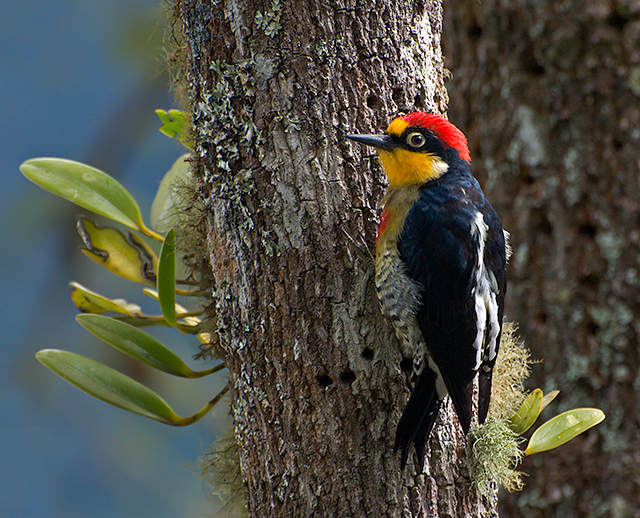
Yellow-fronted Woodpecker (Melanerpes flavifrons) by Dario Sanches
She (Wisdom) is a tree of life to those who lay hold on her; and happy (blessed, fortunate, to be envied) is everyone who holds her fast. The Lord by skillful and godly Wisdom has founded the earth; by understanding He has established the heavens. [Col. 1:16.] (Proverbs 3:18-19 AMP)
Be anxious for nothing, but in everything by prayer and supplication, with thanksgiving, let your requests be made known to God; and the peace of God, which surpasses all understanding, will guard your hearts and minds through Christ Jesus. (Philippians 4:6-7 NKJV)
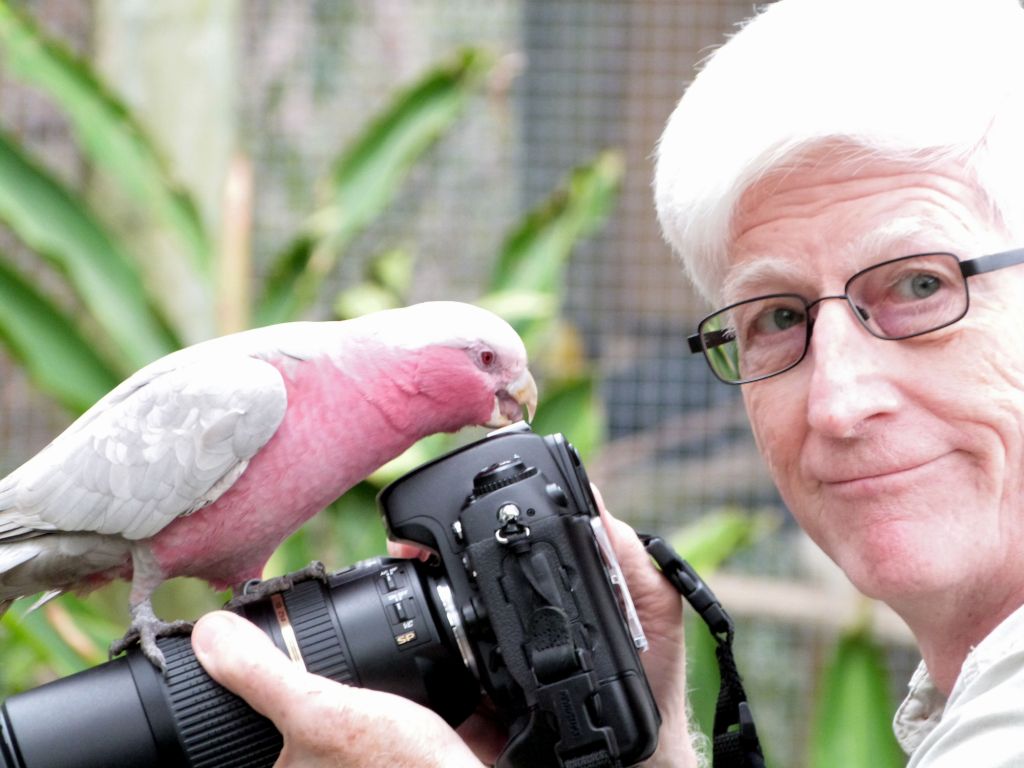
Galah (Eolophus roseicapilla) and Dan
How blessed are the people who are so situated; How blessed are the people whose God is the LORD! (Psalms 144:15 NASB)
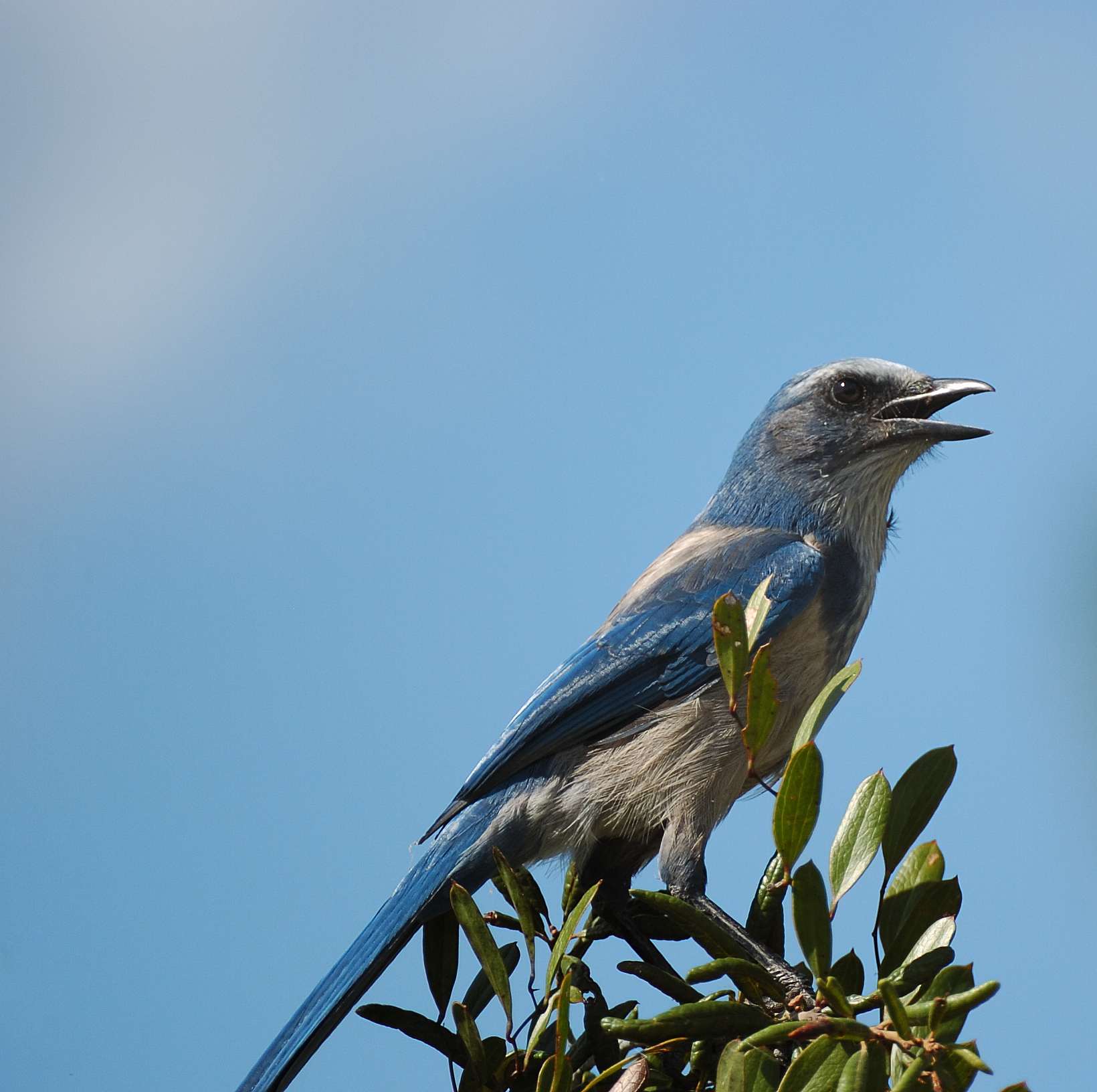
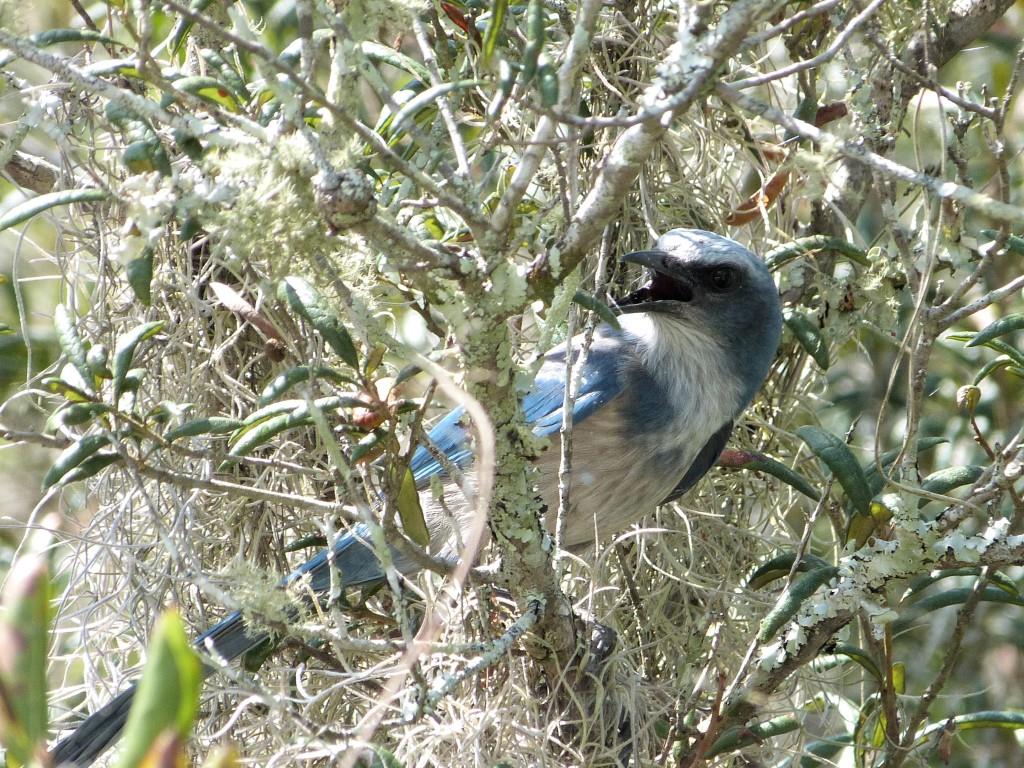
Florida Scrub Jay (Aphelocoma coerulescens) by Dan
Praise the LORD, for the LORD is good; Sing praises to His name, for it is lovely. (Psalms 135:3 NASB)
Ian’s Bird of the Week – Spotted Pardalote ~ by Ian Montgomery
Newsletter ~ 10/30/13
I mentioned a while ago that while preparing photos for the electronic version of the book Where to Find Birds in North-East Queensland by Jo Wieneke (http://www.nqbirds.com), I found that many bird species hadn’t yet had their moment of fame as bird of the week. Spotted Pardalote is one and a surprising omission as pardalotes – http://www.birdway.com.au/pardalotidae/index.htm – are among the most of beautiful small Australian birds. The first photo shows a male of the nominate red-rumped race.
At 8-10cm/3.2-4in in length, the Spotted Pardalote is one of the smallest and only the Weebill (8-9cm) is consistently smaller. Because of the square spots on the wing, it is also called the Diamondbird, risking dreadful puns about ‘gems’. The female is similar, but not so strongly marked and lacks the yellow throat, second photo. Both these birds were close to the ground, but they spend a lot of time in the upper foliage of tall trees, where they’re very hard to see well. All the pardalotes, however, have distinctive calls, very loud for such small birds, and this usually reveals their presence.
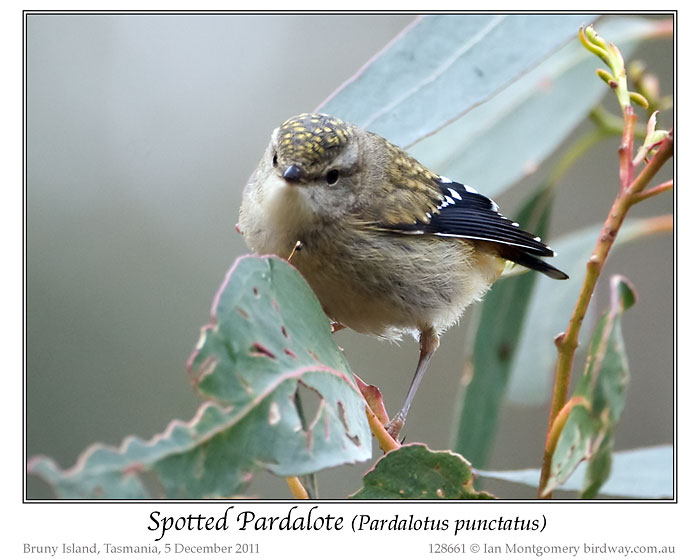
The third photo shows a slightly uncertain-looking juvenile. These are similar to females, but the markings are less obvious: in particular the background colour of the crown is grey rather blackish.
Spotted Pardalotes usually nest in burrows in sand banks or road cuttings. If you surprise one near the ground, there’s a good chance that there is a nest nearby. The range of the Spotted Pardalote includes eastern and southern mainland Australia from Northeastern Queensland to SW Western Australia and Tasmania.
I’ve been continuing to add reptiles to the website. The latest lot are lizards, mainly dragons http://www.birdway.com.au/lacertilia/index.htm. Here is one of the more spectacular, the gorgeous Boyd’ Forest Dragon, endemic to Northeastern Queensland.
Progress with Jo’s book has been steady. I’ve added all the bird photos (over 400) and have just finished adding website-like internal links from all the places to all the birds and back again to make navigation easier. The next thing is to visit as many places as possible to check that the information is still up-to-date and get lots of location photos. That stage will start get underway seriously towards the end of November when a birding pal Madeleine joins me from Sydney for the travelling.
The beast of the field shall honour me, the dragons and the owls: because I give waters in the wilderness, and rivers in the desert, to give drink to my people, my chosen. (Isaiah 43:20 KJV)
Wow! I really like those Pardalotes and that Dragon is really neat also.
The Pardalotes belong to the Pardalotidae Family and only has the Spotted, Forty-spotted, Red-browed, and the Striated Pardalotes.
Pardalotes or peep-wrens are a family, Pardalotidae, of very small, brightly coloured birds native to Australia, with short tails, strong legs, and stubby blunt beaks. This family is composed of four species in one genus, Pardalotus, and several subspecies. The name derives from a Greek word meaning “spotted”. The family once contained several other species now split into the family Acanthizidae.
Pardalotes spend most of their time high in the outer foliage of trees, feeding on insects, spiders, and above all lerps (a type of sap sucking insect). Their role in controlling lerp infestations in the eucalyptus forests of Australia may be significant. They generally live in pairs or small family groups but sometimes come together into flocks after breeding.
Pardalotes are seasonal breeders in temperate areas of Australia but may breed year round in warmer areas. They are monogamous breeders, and both partners share nest construction, incubation and chick rearing duties. All four species nest in deep horizontal tunnels drilled into banks of earth. Externally about the size of a mouse-hole, they can be very deep, at a metre or more. Some species also nest in tree hollows.
Be thou exalted, LORD, in thine own strength: so will we sing and praise thy power. (Psalms 21:13 KJV)
Had a very productive hour and 40 minute trip to Circle B Bar Reserve Saturday afternoon enjoying the Lord’s creation. The birds are definitely heading back down. After a sparse summer, things are starting to get interesting once more.
Limpkin (Aramus guarauna) by Lee at Circle B
We haven’t been out there for a while and was a little disappointed in the viewing. It rained considerably this summer and the plants have really grown up making it hard to see the water birds. Even with that, to see 34 species in just under 2 hours is not bad.
Alligator about 8 ft by Lee at Circle B
We were greeted with the sounds of the Blue Jays, Carolina Wrens and an Eastern Phoebe. Also, an Armadillo was walking right along the path to the marsh. Later, I spotted about an 8 foot alligator. Those and the normal squirrels were the only, non-birds I saw.
One of the highlights was seeing five Bald Eagles flying over. Two in one group and three in the other. We had just seen an Eagle on Friday down in Lake Wales. I love seeing Eagles.
American White Ibis (Eudocimus albus) by Lee at Circle B
In God we boast all the day long, and praise thy name for ever. Selah. (Psalms 44:8 KJV)
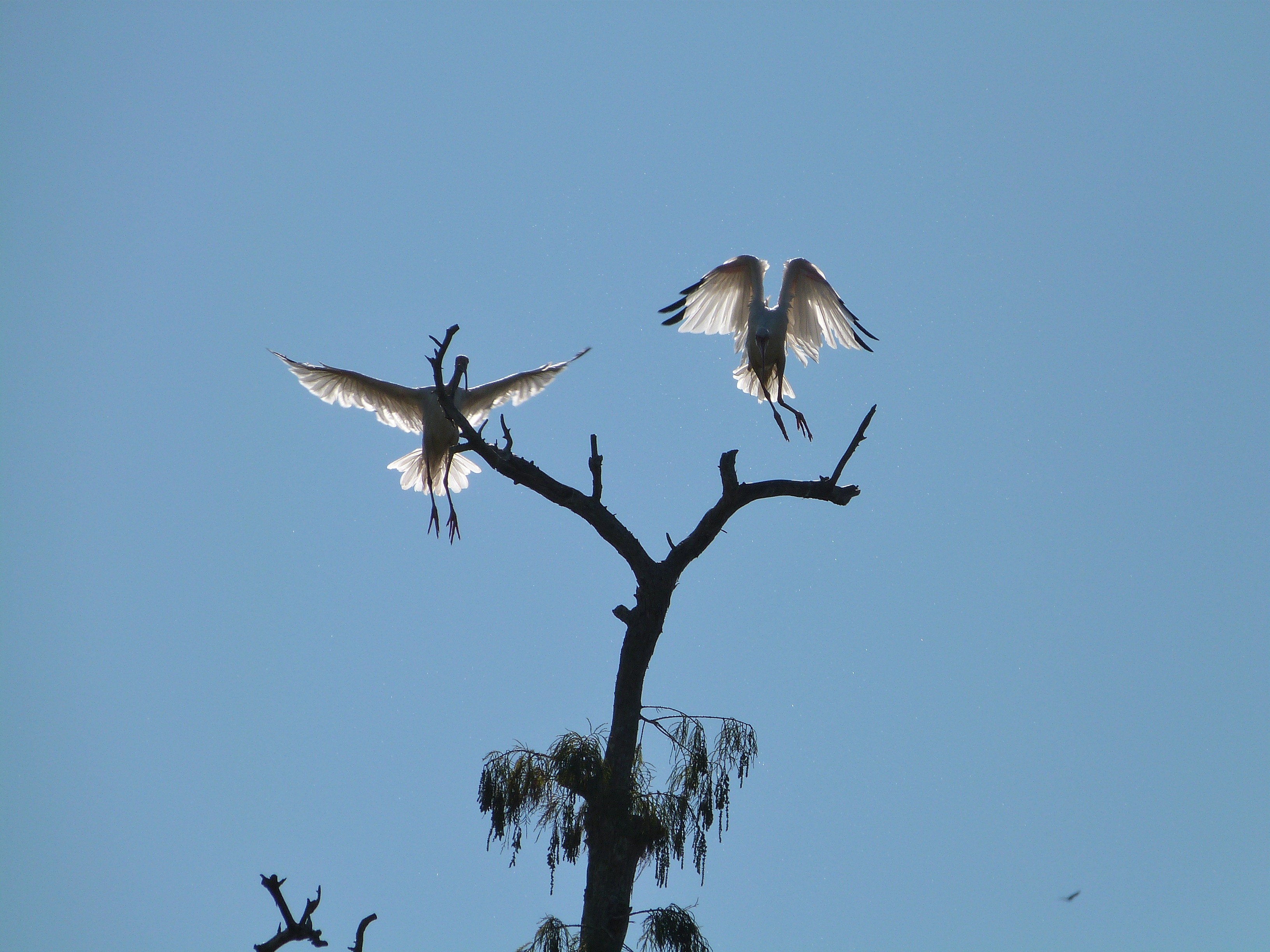
Two White Ibises landed in one of the trees when we first arrived. With the sun behind them, they remind you of Angel’s Wings. As you can see by the second photo the tree was being loaded up for the night when we passed it on the way out. That is one of the favorite “roosting” places at Circle B.
American White Ibis (Eudocimus albus) and friends
I am including a slideshow to give you an idea of how it was out there. The photography is not the best, but you can tell what the birds are at least. Dan doesn’t have his photos ready.
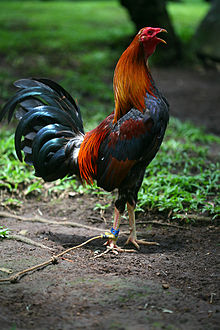
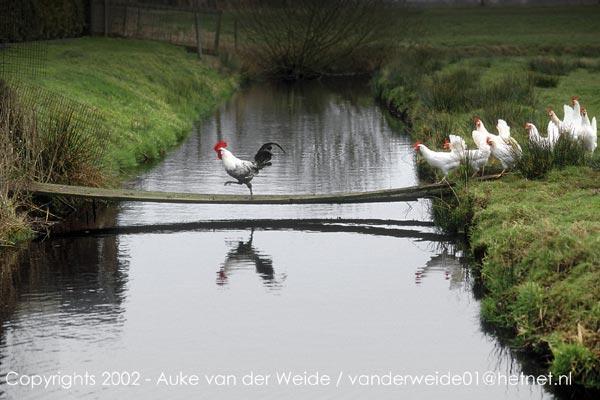
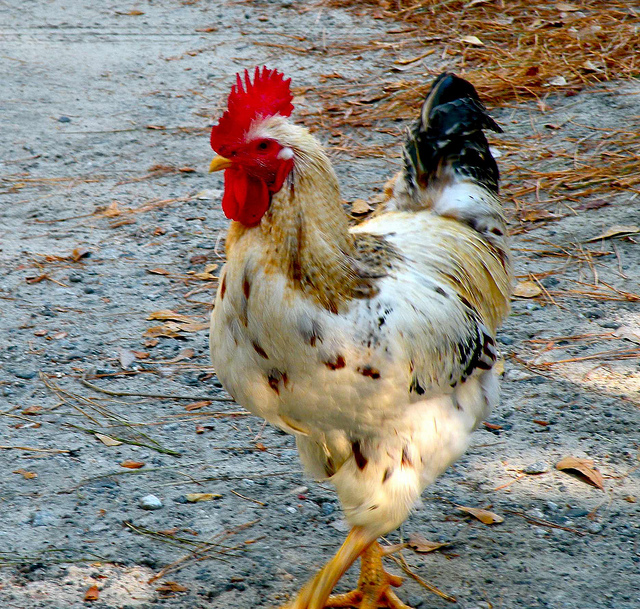
There are three things which are stately in their march, Even four which are stately when they walk: The lion which is mighty among beasts And does not retreat before any, The strutting rooster, the male goat also, And a king when his army is with him. (Proverbs 30:29-31 NASB)
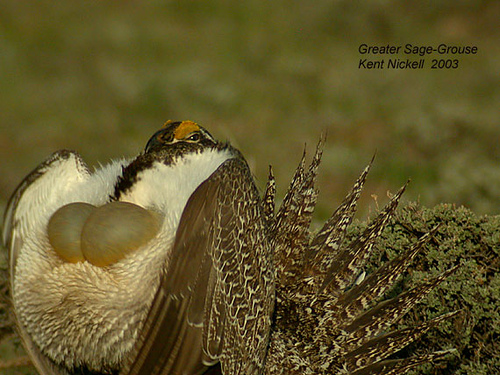
The Roosters referred to in this article are from the Phasianidae – Pheasants, Fowl & Allies Family. The term “rooster” can used other in ways. The Pheasants and Fowls are known to strut or display to try to win the eye of the female. The male is called a “rooster,” especially within the Domesticated Fowls.
Sage Grouse (Centrocercus urophasianus) by Kent Nickel in Phasianidae Family
Have you ever seen a parade with the King or a Captain marching in front of his troops? He sure doesn’t slouch or just walk nonchalantly. No, especially if a band is playing, they almost “strut.”
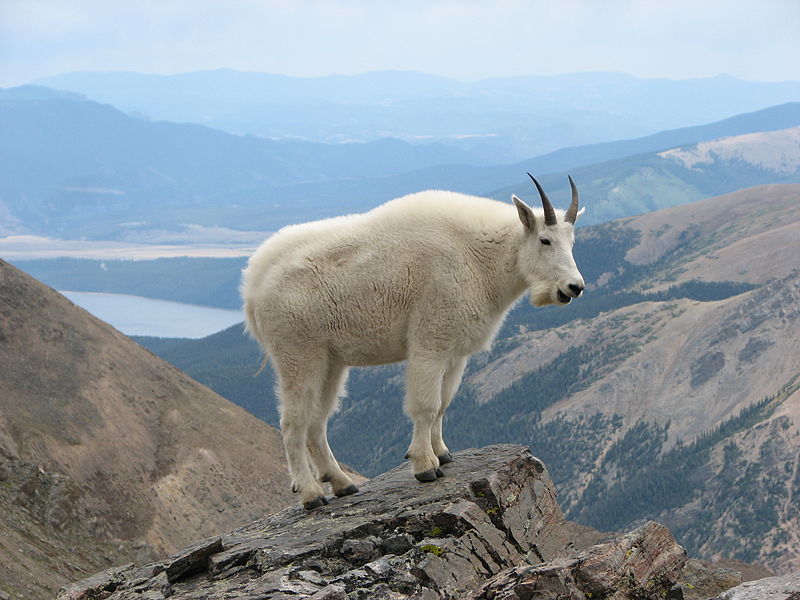
The Lion and a Goat can also be known to walk stately, or “strut.” These verses are not referring to a false pride, but something that is good. There are times to present a stately presence, David was rejoicing when he brought the Ark back to Jerusalem.
I like what Harry Ironside wrote in his Notes on Selected Books:
“30:29-31
It is quite proper to speak of the first three creatures as excelling in their movement, though it would hardly apply to a king. Majestic and glorious, he moves with stately bearing and therefore comes under the second head.
The lion is characterized by unflinching boldness; it represents that holy courage which should mark the Christian soldier as he contends earnestly for the faith once delivered to the saints. In his faith, he is to have virtue, true courage, to withstand in the evil day and remain true to his course. It is not mere dogged determination that is contemplated, but “the irresistible might of weakness” that leans on God; this is what led Paul to write, “when I am weak, then am I strong” (2 Corinthians 12:10).
The second in this series has been variously translated as “a greyhound,” “a girded horse,” “a zebra,” and “a strutting rooster.” The latter is preferred in the Septuagint, Syriac, Vulgate, and Chaldee versions. But according to the best authorities the word simply means girded as to the loins. It may therefore be applied to any slender creature characterized by swiftness. The translators of the King James version preferred “greyhound” as most fully expressing the idea of an animal adapted to running. It matters little what beast is signified. The lesson for us is clear enough. As a girded animal does not rest until it reaches its prey or the goal to which it is running, so the saint is to press swiftly on, refusing to be turned aside by the attractions of this world. He is viewed as a racer in Philippians 3:13-14:
Brethren, I count not myself to have apprehended: but this one thing I do, forgetting those things which are behind, and reaching forth unto those things which are before, I press toward the mark for the prize of the high calling of God in Christ Jesus.
This should always be the Christian’s attitude. Having no city here, he does not halt to dally with the insignificant things of earth. With girded loins and eyes fixed on Christ, he hastens on to the judgment seat where the prize is to be awarded.
Wherefore seeing we also are compassed about with so great a cloud of witnesses, let us lay aside every weight, and the sin which doth so easily beset us, and let us run with patience the race that is set before us, Looking unto Jesus the author and finisher of our faith; who for the joy that was set before him endured the cross, despising the shame, and is set down at the right hand of the throne of God (Hebrews 12:1-2).
Christ was the great pattern-pilgrim, passing through this world as a stranger; He found only sorrow and grief here, but His joy is now full in glory!
The male goat is the climber. Refusing the low and often un-healthful valleys, he mounts up higher and higher to the rocky hills and the peaks of the mountains. (See Psalm 104:18). Breathing the exhilarating air of the top of the rocks, he finds both pleasure and safety in his retreat. The lesson is simple. The Christian must walk on the high places; then like Habakkuk, he will be able to rejoice in the day of trouble and joy in the God of his salvation when everything of earth seems to fail (Habakkuk 3:17-19). From the soul of the climbing saint there will ever be melody.
A heavenly-minded soul is lifted above all the mists of this poor world and enabled to view all from God’s standpoint.
If ye then be risen with Christ, seek those things which are above, where Christ sitteth on the right hand of God. Set your affection on things above, not on things on the earth. For ye are dead, and your life is hid with Christ in God (Colossians 3:1-3).
This is the lesson of the male goat. Would that every believer could enter into it!
The last in the list of these pleasant things is the king going forth in undisputed, majestic strength. It is the overcomer, the man of faith, made a king unto God; his dignity is never greater than when he walks in lowliness and meekness through this world, drawing his supplies from above not from below. Great is the honor conferred on all who have been redeemed. No longer children of the night, but of the day, they are called to overcome the world in the power of the truth revealed to them by faith. Abraham was such a “king” as he went from Melchizedek’s presence to meet Sodom’s fawning monarch. He vanquished this ruler in a different way from that in which he had defeated the confederacy headed by Chedorlaomer (Genesis 14). God would have every Christian defeat his enemy in stately majesty, joining forces with Him, and counting the richest treasures of earth as dung and dross. “This is the victory that overcometh the world, even our faith” (1 John 5:4). Strong in faith, the man of God views his present situation in the light of his future reward. Then, even though accounted as sheep for the slaughter, he can exclaim, “Nay, in all these things we are more than conquerors through him that loved us” (Romans 8:37).”
African Fish Eagle (Haliaeetus vocifer) by Africaddict
Wilt thou set thine eyes upon that which is not? for riches certainly make themselves wings; they fly away as an eagle toward heaven. (Proverbs 23:5)
Using e-Sword’s search for just the word “fly,” there are 15 verses in the AMP, 16 in the ESV, and 25 in the KJV. They can’t all refer to a bird flying around, so let’s see how many actually refer to the birds.
Here are the verses from the KJV:
And God said, Let the waters bring forth abundantly the moving creature that hath life, and fowl that may fly above the earth in the open firmament of heaven. (Gen_1:20)
Wherefore then didst thou not obey the voice of the LORD, but didst fly upon the spoil, and didst evil in the sight of the LORD? (1Sa_15:19)
And he rode upon a cherub, and did fly: and he was seen upon the wings of the wind. (2Sa_22:11)
Yet man is born unto trouble, as the sparks fly upward. (Job_5:7)
He shall fly away as a dream, and shall not be found: yea, he shall be chased away as a vision of the night. (Job_20:8)
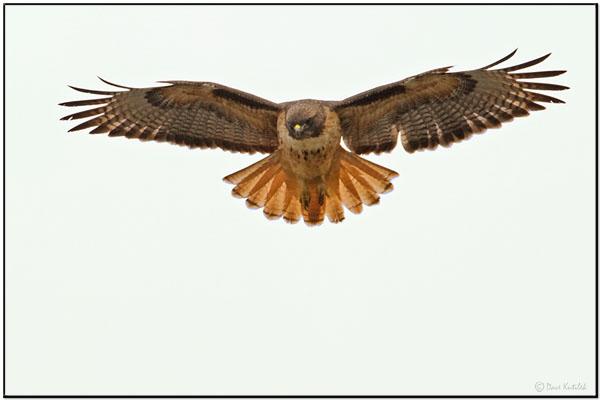
Doth the hawk fly by thy wisdom, and stretch her wings toward the south? (Job_39:26)
And he rode upon a cherub, and did fly: yea, he did fly upon the wings of the wind. (Psa_18:10)
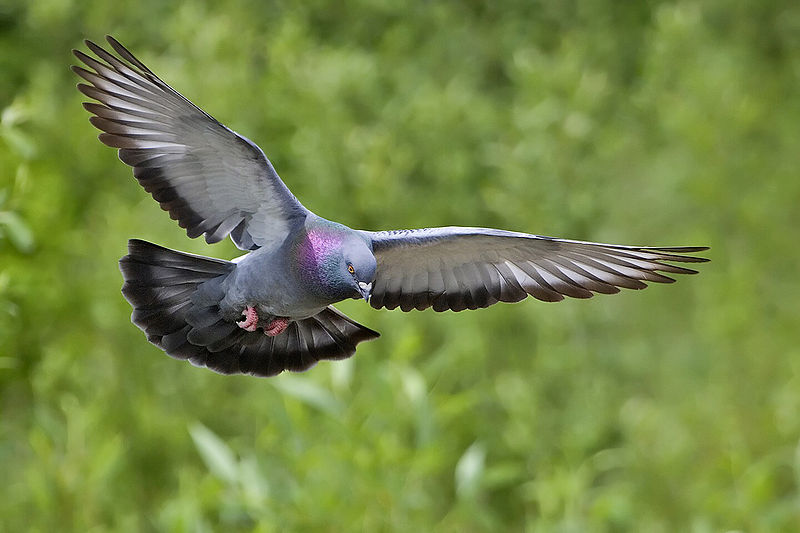
And I said, Oh that I had wings like a dove! for then would I fly away, and be at rest. (Psa_55:6)
The days of our years are threescore years and ten; and if by reason of strength they be fourscore years, yet is their strength labour and sorrow; for it is soon cut off, and we fly away. (Psa_90:10)
Wilt thou set thine eyes upon that which is not? for riches certainly make themselves wings; they fly away as an eagle toward heaven. (Pro_23:5)
Above it stood the seraphims: each one had six wings; with twain he covered his face, and with twain he covered his feet, and with twain he did fly. (Isa_6:2)
And it shall come to pass in that day, that the LORD shall hiss for the fly that is in the uttermost part of the rivers of Egypt, and for the bee that is in the land of Assyria. (Isa_7:18)
But they shall fly upon the shoulders of the Philistines toward the west; they shall spoil them of the east together: they shall lay their hand upon Edom and Moab; and the children of Ammon shall obey them. (Isa_11:14)
Who are these that fly as a cloud, and as the doves to their windows? (Isa_60:8)
For thus saith the LORD; Behold, he shall fly as an eagle, and shall spread his wings over Moab. (Jer_48:40)
Behold, he shall come up and fly as the eagle, and spread his wings over Bozrah: and at that day shall the heart of the mighty men of Edom be as the heart of a woman in her pangs. (Jer_49:22)
Wherefore thus saith the Lord GOD; Behold, I am against your pillows, wherewith ye there hunt the souls to make them fly, and I will tear them from your arms, and will let the souls go, even the souls that ye hunt to make them fly. (Eze_13:20)
Yea, whiles I was speaking in prayer, even the man Gabriel, whom I had seen in the vision at the beginning, being caused to fly swiftly, touched me about the time of the evening oblation. (Dan_9:21)
As for Ephraim, their glory shall fly away like a bird, from the birth, and from the womb, and from the conception. (Hos_9:11)
Their horses also are swifter than the leopards, and are more fierce than the evening wolves: and their horsemen shall spread themselves, and their horsemen shall come from far; they shall fly as the eagle that hasteth to eat. (Hab_1:8)
And to the woman were given two wings of a great eagle, that she might fly into the wilderness, into her place, where she is nourished for a time, and times, and half a time, from the face of the serpent. (Rev_12:14)
And I saw another angel fly in the midst of heaven, having the everlasting gospel to preach unto them that dwell on the earth, and to every nation, and kindred, and tongue, and people, (Rev_14:6)
And I saw an angel standing in the sun; and he cried with a loud voice, saying to all the fowls that fly in the midst of heaven, Come and gather yourselves together unto the supper of the great God; (Rev_19:17)
How many do you think directly relate to birds? Some refer to their speed of flying. How many birds were actually named?
Red-tailed Hawk (Buteo jamaicensis) by Daves BirdingPix
I trust you enjoy digging into God’s Word more than just reading it. If you have a program like e-Sword (free) or something similiar or a good concordance, you can do these type of searches.
Back to the questions – which verses have birds mentioned?
fowlthat may fly above the earth (Gen_1:20)
hawk fly (Job_39:26)
dove! for then would I fly away, and be at rest. (Psa_55:6)
fly away as an eagletoward heaven. (Pro_23:5)
fly as a cloud, and as the doves to their windows? (Isa_60:8)
shall fly as an eagle, and shall spread his wings over Moab. (Jer_48:40)
fly as the eagle, and spread his wings over Bozrah (Jer_49:22)
their glory shall fly away like a bird, (Hos_9:11)
fly as the eaglethat hasteth to eat. (Hab_1:8)
two wings of a great eagle, that she might fly into the wilderness (Rev_12:14)
all the fowls that fly in the midst of heaven (Rev_19:17)
The Bible tells us:
But now ask the beasts, and they will teach you; And the birds of the air, and they will tell you; (Job 12:7 NKJV)
If you had never watched a bird fly, would any of those verses above make sense to you? The Lord not only has given all the numerous birds for us to enjoy, but also to teach us lessons.
Would you understand “…for riches certainly make themselves wings; they fly away as an eagle toward heaven. (Proverbs 23:5) if you had not seen how fast an eagle flies? How fast can we waste our riches?
Thinking about how birds fly, reread the verses above, even the ones that do not mention birds and see if that doesn’t help explain parts of the verse.
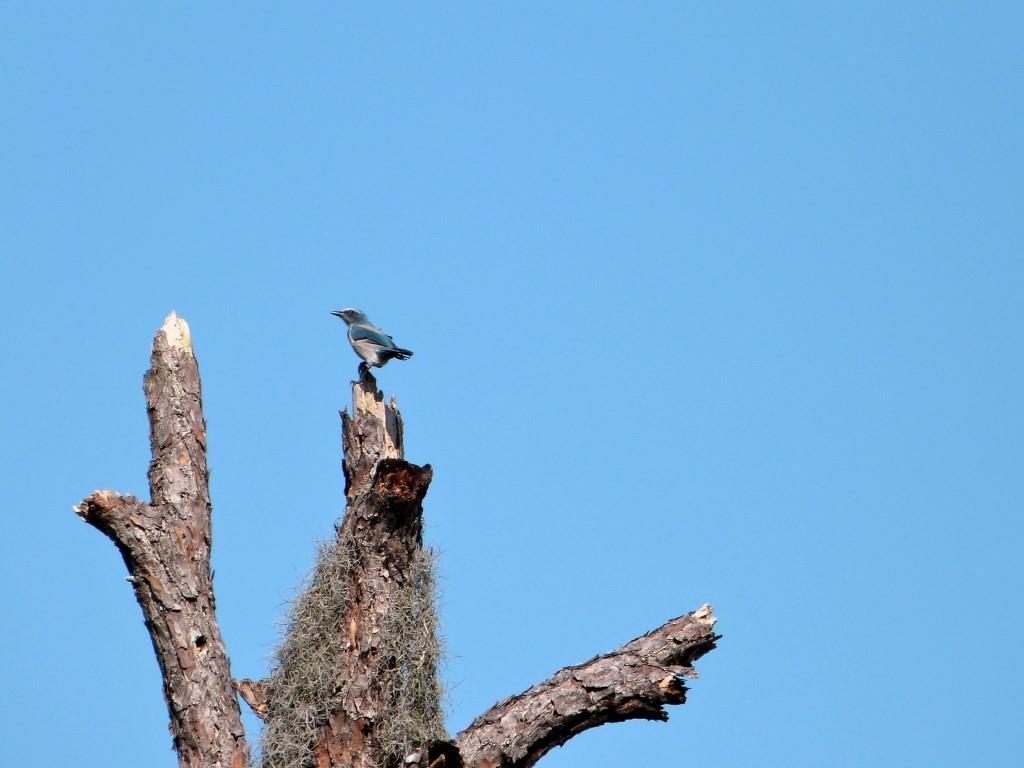
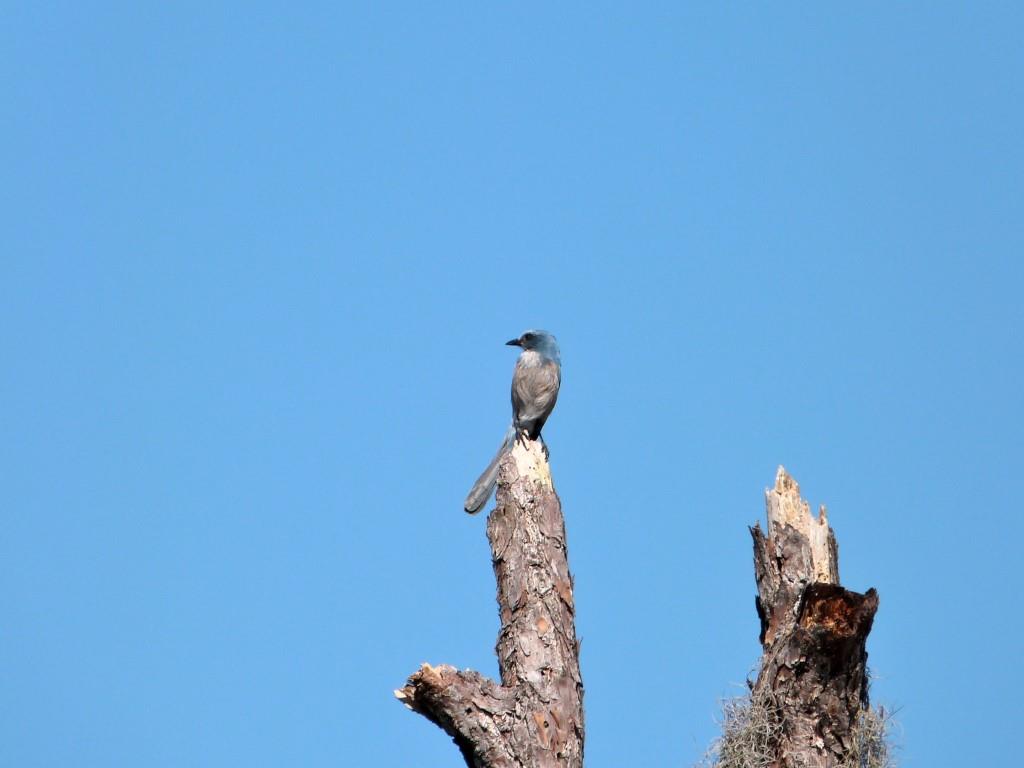
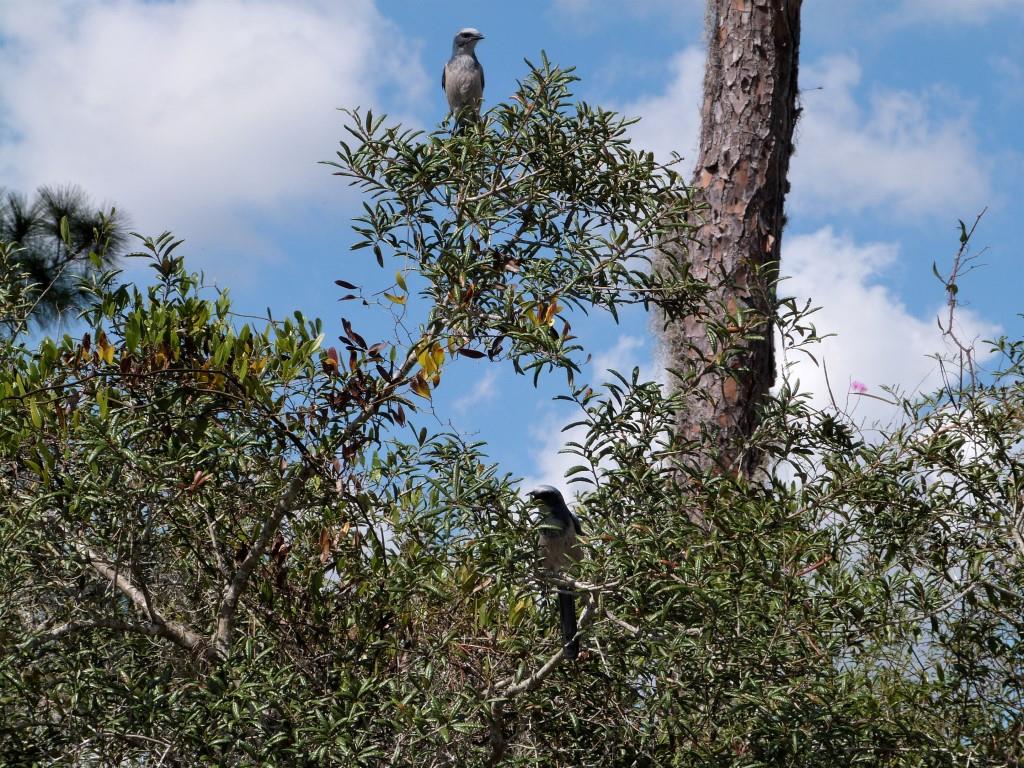
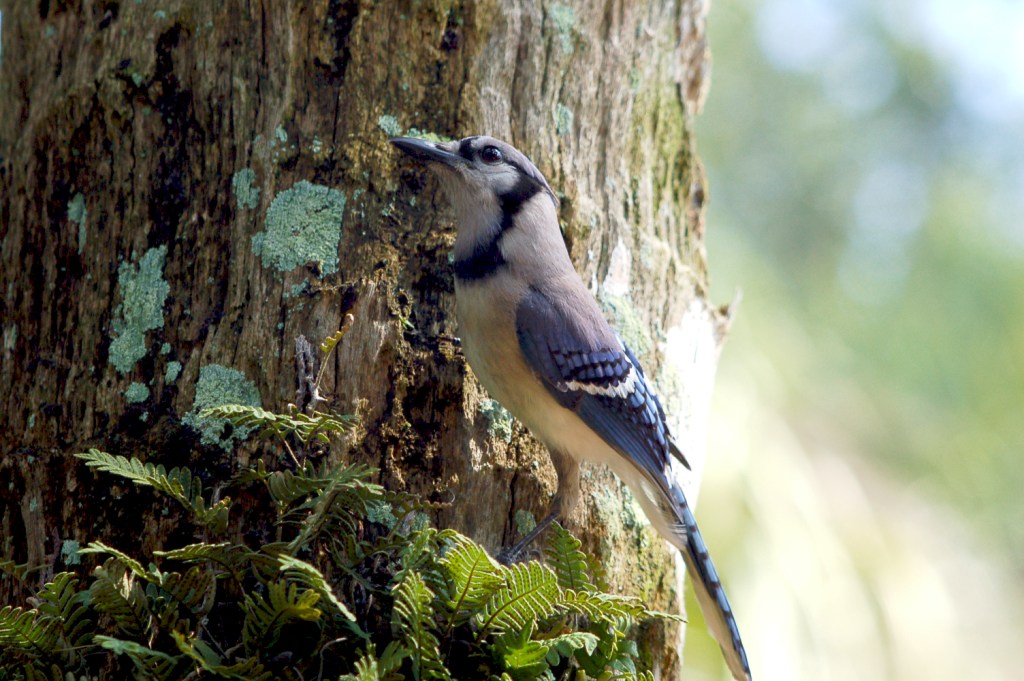
Florida Scrub Jay (Aphelocoma coerulescens) Highlands Hammock S Pk
Look at the birds of the air, for they neither sow nor reap nor gather into barns; yet your heavenly Father feeds them. Are you not of more value than they? (Matthew 6:26 NKJV)
The main reason we went to Highlands Hammock State Park yesterday was to find some Florida Scrub Jays. The ranger told us where to find theirs and also where more could be found in another park.
Florida Scrub Jay (Aphelocoma coerulescens) Highlands Hammock SPk 10-14-13
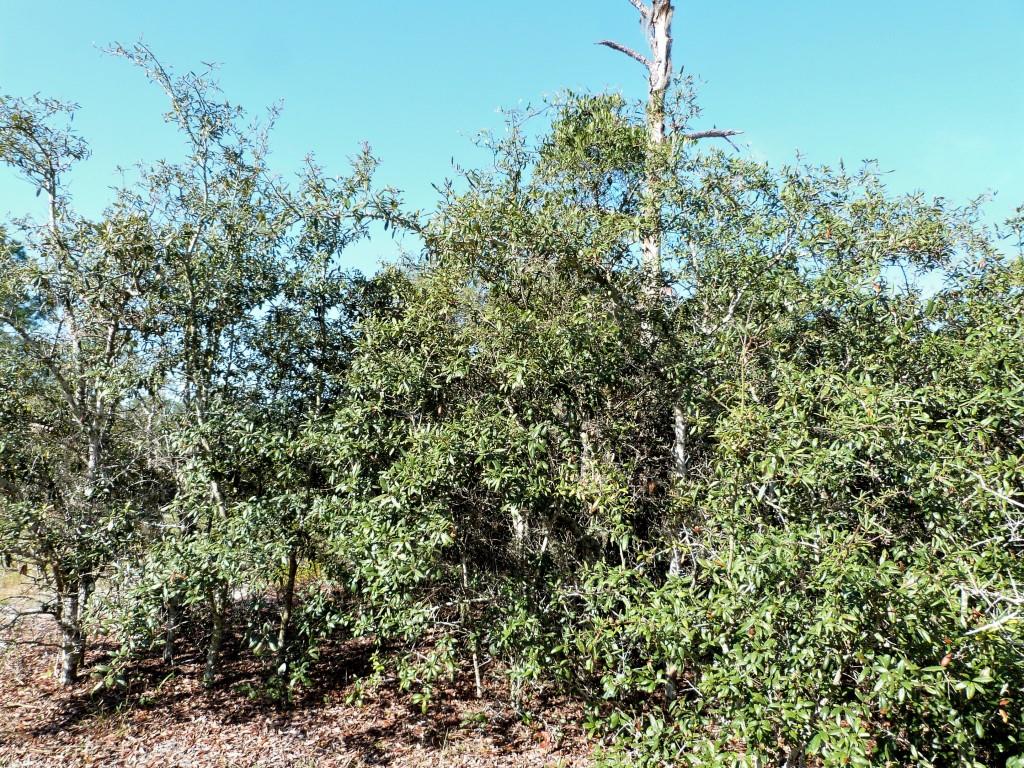
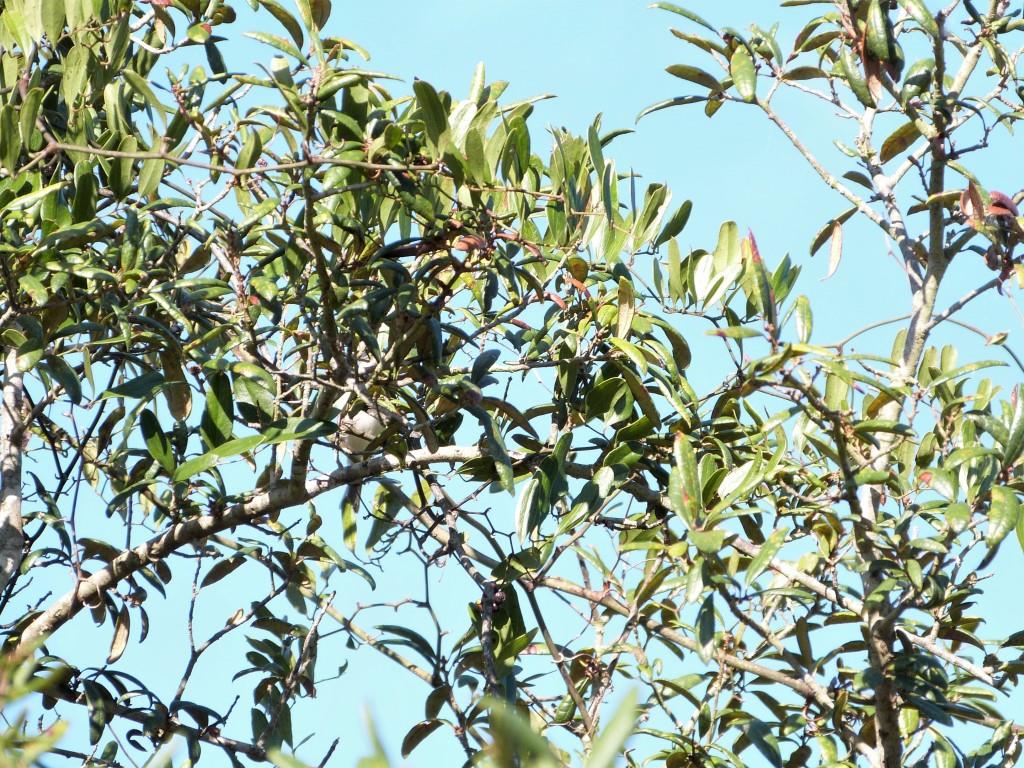
Went on the drive where the Wilderness Camping Area is located. Florida Scrub Jays prefer the scrub areas. The ranger told us that they had recently had a controlled burn and this family moved in right after that. From the pictures, you will see the kind of habitat they like.
This is the area where we found the Scrub Jays at Highlands Hammock S P.
We found the Florida Scrub Jays, but they never got very close. We were also initiating our new “birding mobile”, as I have named it. Off the subject, but here is a photo of a Red-shouldered Hawk I shot through the “moonroof.” My first attempt at that. Next time, when we are not right under a hawk, it will be opened.
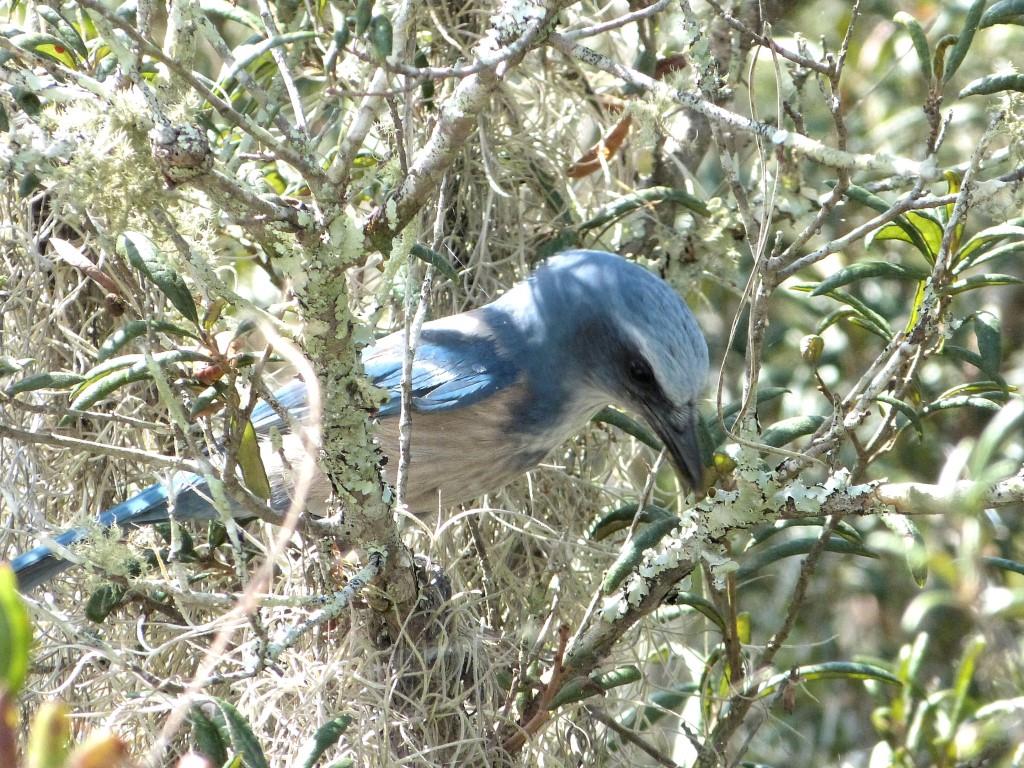
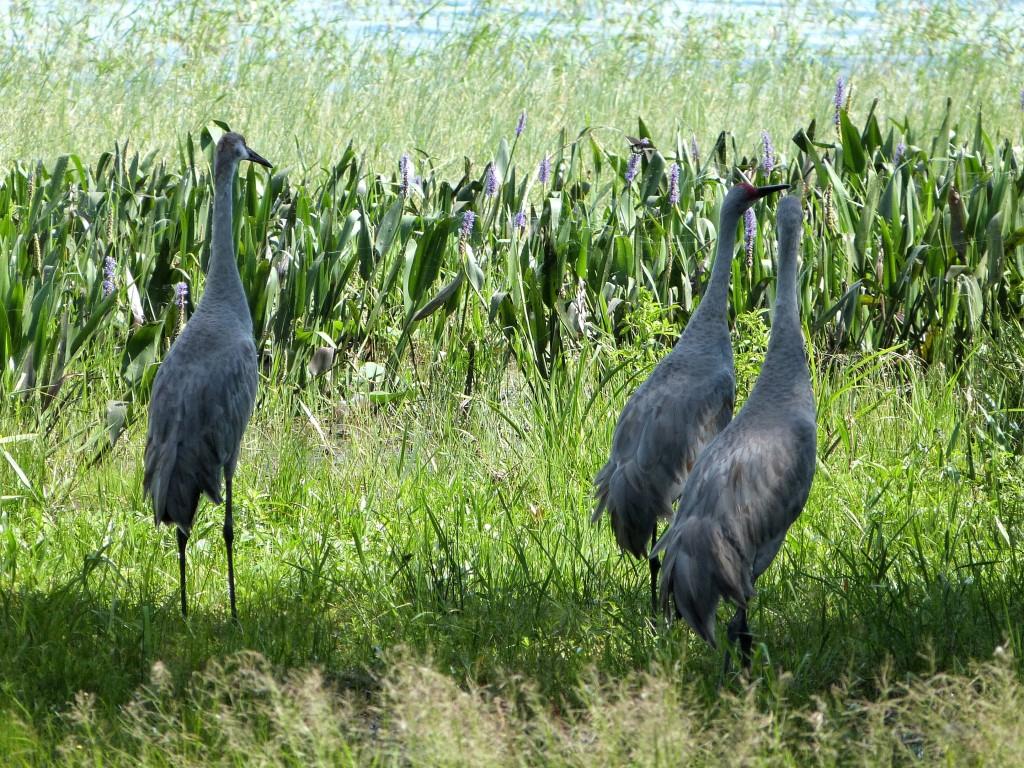
After driving through the rest of that park, we headed for the Lake June-in-Winter State Park. Never heard of it before. It is very tiny and we were the only ones there. Well, the birds of course were there, especially the Scrub Jays. We were able to get quite a few photos of them and they were quite friendly. There were also three Sandhill Cranes plus sounds of birds I do not recognize. The photos will be intermingled with some information about the jays from Wikipedia.
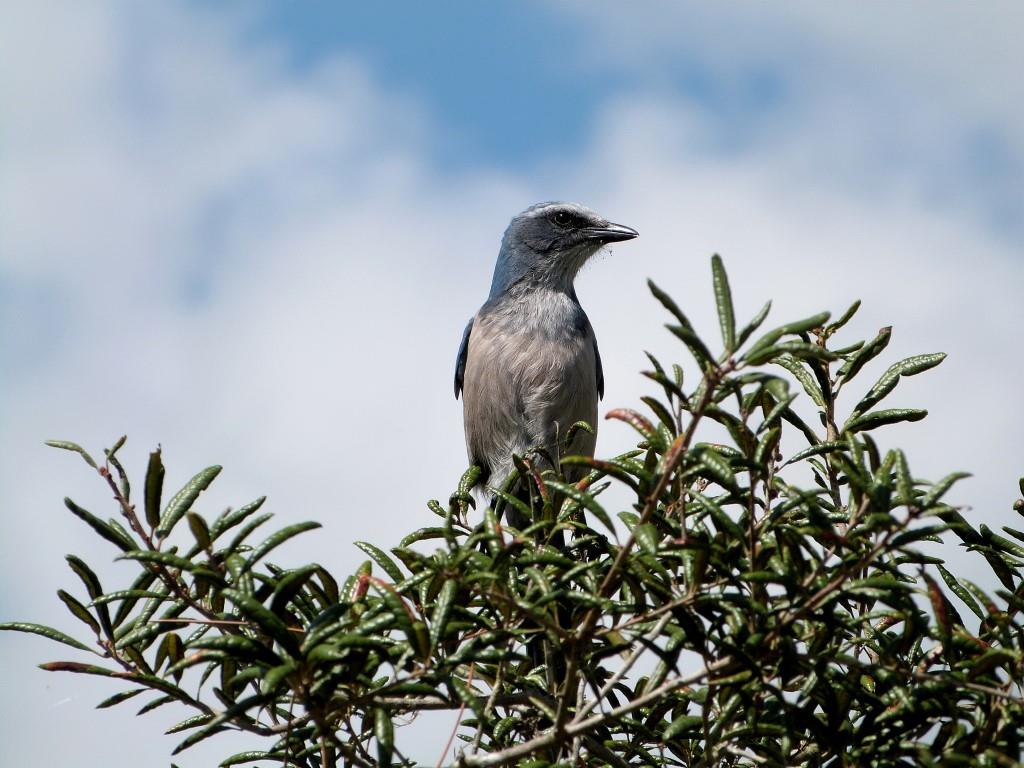
Florida Scrub Jay (Aphelocoma coerulescens) Lake June-in-Winter SPk
The Florida Scrub Jay (Aphelocoma coerulescens) is one of the species of scrub jay native to North America. It is the only species of bird endemic to the U.S. state of Florida and one of only 15 species endemic to the United States. Because of this, it is heavily sought by birders who travel from across the country to observe this unique species. It is possibly derived from the ancestors of Woodhouse’s Scrub Jay, the inland forms of the Western Scrub-jay. They belong to the Corvidae – Crows, Jays, Ravens Family.
Florida Scrub Jay (Aphelocoma coerulescens) Lake June-in-Winter SPk
It measures 9.1 to 11 in (23 to 28 cm) in length, and weighs from 2.3 to 3.2 oz (66 to 92 g), with an average 2.83 oz (80.2 g). The wingspan of the jay is 13–14 in (33–36 cm). It has a strong black bill, blue head and nape without a crest, a whitish forehead and supercilium, blue bib, blue wings, grayish underparts, gray back, long blue tail, black legs and feet.
Florida Scrub Jay (Aphelocoma coerulescens) Lake June-in-Winter SPk
The Florida Scrub Jay is found only in Florida scrub habitat, an ecosystem that exists only in central Florida and is characterized by nutrient-poor soil, occasional drought, and frequent wildfires. Because of its somewhat harsh weather pattern, this habitat is host to a small assortment of very specific plants, including Sand Pine, Sand Live Oak, Myrtle Oak, Chapman’s Oak, Sandhill Oak, Florida Rosemary[11] and various other hardy plants such as Eastern prickly pear.
Florida Scrub Jay (Aphelocoma coerulescens) Lake June-in-Winter SPk
Florida Scrub Jays are omnivorous and eat a wide variety of acorns, seeds, peanuts, insects, tree frogs, turtles, snakes, lizards, and young mice. Florida Scrub Jays have also been occasionally observed to eat other birds’ eggs or nestlings, but this occurs rarely. They routinely cache thousands of acorns a year, burying them just beneath the surface. The acorns are typically buried in the fall and consumed during the winter and spring. Acorns that are forgotten or missed may germinate, making the Florida Scrub-Jay an effective agent for the dispersal of a variety of oak trees.
Florida Scrub Jay (Aphelocoma coerulescens) Lake June-in-Winter SPk
Scrub jays may also take silverware and other shiny objects in a manner similar to the American Crow.
Sandhill Crane (Grus canadensis) Lake June-in-Winter SPk
Here are some more of the photos from this “birdwatching adventure.”
Western Kingbird (Tyrannus verticalis) Highlands Hammock S Pk by Lee
I know all the birds of the mountains, And the wild beasts of the field are Mine. (Psalms 50:11 NKJV)
We have been off on several birdwatching adventures the last few days. We were out enjoying the Lord’s creation, especially His birds. Still sorting through the photos, but wanted to share two birds we saw today. They were at Highlands Hammock State Park in Sebring, FL. Both are birds that I have seen, but only when another birder pointed them out. That always gives a joy when you find and can figure out what a bird is.
The first one, I was only able to get one decent photo because it moved on quickly. Here is the bird cropped. (I trust this is the correct ID)
Western Kingbird (Tyrannus verticalis) Highlands Hammock SP by Lee
Kingbirds are members of the Tyrannidae – Tyrant Flycatchers Family. Adults are grey-olive on the upperparts with a grey head and a dark line through the eyes; the underparts are light becoming light orange-yellow on the lower breast and belly. They have a long black tail with white outer feathers. Western kingbirds also have a reddish crown that they only display during courtship and confrontations with other species.
These birds migrate in flocks to Florida and the Pacific coast of southern Mexico and Central America. (Lucky for us.)
They wait on an open perch and fly out to catch insects in flight, sometimes hovering and then dropping to catch food on the ground. They also eat berries.
The song is a squeaky chatter, sometimes compared to a dog’s squeaky toy. The call is a sharp loud whit. Occasionally sings before sunrise.
I have only seen this bird maybe three or four times before, so it was a nice find.
Highlands Hammock State Park
My next challenge started out in the trees and bushes above. This bird was all over the place and wouldn’t stay still as I tried to catch a photo of it. (Which is typical for those small birds.)
Here are some of my attempts to catch this bird. I do not use the “rule of thirds” because when I get home, finding the bird is easier if it’s centered. I figured out that it had a white breast by this photo. Let me zoom in.
That white eye is what nailed the ID on this bird. This is the first time that I’ve photographed one. When trying to figure these birds out, a good field guide and the internet sure come in handy.
My first ID in the field was wrong on both of these birds. I thought the Kingbird was some sort of Flycatcher and that this Vireo was a Warbler. Even though I only shoot in Program mode, and I do not claim to be a photographer, it does help to take proof or ID photos to help figure out what you really are seeing. It is more fun to just enjoy the birds while you are watching them and figure what it was later.
White-eyed Vireo (Vireo griseus) Highlands Hammock SP by Lee
They belong to the Vireonidae – Vireos, Greenlets Family. The White-eyed Vireo (Vireo griseus) is a small songbird. It breeds in the southeastern USA from New Jersey west to northern Missouri and south to Texas and Florida, and also in eastern Mexico, northern Central America, Cuba and the Bahamas.
Populations on the US Gulf coast and further south are resident, but most North American birds migrate south in winter.The White-eyed Vireo (Vireo griseus) is a small songbird. It breeds in the southeastern USA from New Jersey west to northern Missouri and south to Texas and Florida, and also in eastern Mexico, northern Central America, Cuba and the Bahamas.
Populations on the US Gulf coast and further south are resident, but most North American birds migrate south in winter.
More of these trips will be shared. Saw lots of Wood Ducks and Florida Scrub Jays that I will “Show and Tell” later.
Thank all of you up North who have finally been sending your birds down for the coming winter. The birdwatching was getting a little boring.
Birds of the Bible – Worry and Sparrows was the introduction to the “Better Than The Birds” message by Pastor Stephen Harvey. We were told that “1. Worry denies the gracious care of God.”
Now for part II:
2. Secondly, worry depreciates the higher value of mankind
He’s not finished with the birds yet – notice verse 7 again – the last part – Do not fear; you are more valuable than many sparrows.
Matthews account says, “Are you not worth much more than they?
In case we didn’t pick up on the lesson – in case we’re a little slow – God’s care of the lesser creation ensures His care of His highest creation.
Evidently Jesus thinks we just might be a little slow on the uptake here – or maybe find it hard to believe – so He circles back around to this subject again and adds another pearl to the string – look over at verse 24. Consider the ravens, for they neither sow nor reap, they have no store room nor barn, and yet God feeds them; how much more valuable you are than the birds!
Maybe Jesus repeated this lesson simply because He knew that billions of people one day would struggle with believing they were less valuable than animals.
Was God peering into the 21st century or what?
You sit through the average Animal Planet program or read the latest evolutionary textbook taught to middle schoolers and you’ll get the message loud and clear that human beings have messed up the circle of life; humans have interrupted the food chain; humans are in the way and if we’d only get out of the way, the animals who evidently have the right to be on the planet – because they evolved first – would get what they deserve; if we’d just go back to living in caves, the animals would be able to enjoy their lives so much better.
That message is coming across loud and clear! Whenever you remove the glory of God’s created order, Genesis 1 and 2, where mankind was made in the image of God and given the right to rule earth – to train and subjugate and benefit from the animal kingdom – you end up with a culture where animals ultimately matter more.
You now exist to serve them; you now live to make their lives more comfortable.
Now I’m not defending animal abuse, by the way. We’re to be good stewards of earth and the animal kingdom.
But go visit India today, and watch, as I did, sacred cows which have been given superior rights within their culture – watch them meander across busy roadways and down streets cluttered with starving children – and begging mothers with babies on their hips; where a child starving to death is less important than a cow having something to eat.
How do we know that human beings are more valuable than animals? How do we know that?
Apart from God, we don’t.
Apart from the words of Jesus Christ, the creator of all things (Colossians 1), we might be confused – look again at verse 24 – you are more valuable than the birds.
Is that radical news or what?
And this really got the attention of Jesus’ Jewish audience, by the way, because Jesus used ravens as an example here – ravens were considered unclean according to Mosaic Law (Leviticus 11:13-15).vii
The ravens were unclean birds.
I’m sorry for how that makes you Baltimore Ravens fans feel – I’m sorry you had to find that out – you’ve been cheering all along for unclean animals . . . you already knew that.
Here’s why this was so stunning an analogy for Christ to make: It’s one thing to be insignificant like a sparrow and be cared for by God – it’s another thing to be unclean and despised and be cared for by God.
And you know why I’m so glad Jesus added this illustration?
Because the enemy of our heart and spirit and joy will more than likely come and whisper in our ear – sparrows might be cheap, but at least they’re clean animals – no wonder God cares about them; but you’re more like an unclean bird . . . despised and unclean according to God’s holy law . . . you don’t deserve God’s attention.
You have very reason to worry about your life.
But notice – verse 24. God has managed to care for them too – He effectively feeds them too – and get this – “How much more valuable you are than the animal kingdom!”
‘And these you shall regard as an abomination among the birds; they shall not be eaten, they are an abomination: the eagle, the vulture, the buzzard, the kite, and the falcon after its kind; every raven after its kind, (Leviticus 11:13-15 NKJV)
Consider the ravens, for they neither sow nor reap, which have neither storehouse nor barn; and God feeds them. Of how much more value are you than the birds? (Luke 12:24 NKJV)
Another great encouragement not to worry. Thanks, Pastor Davey, for a great message.
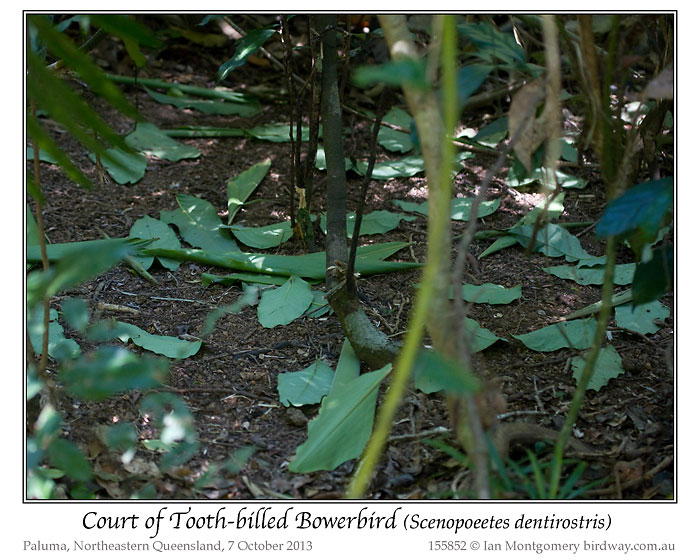
Tooth-billed Bowerbird (Scenopoeetes dentirostris) Court by Ian
Ian’s Bird of the Week – Tooth-billed Bowerbird ~ by Ian Montgomery
Newsletter ~ 10/9/13
At the weekend, I followed some friends for an overnight stay at Paluma, the small village in highland rainforest about 60km north of Townsville. and they took me to view 4 display courts of the Tooth-billed Bowerbird near the village that they had already checked out. This species featured as bird of the week three years ago, but it’s an interesting subject and I got better photos this time. In contrast to some of the bowerbirds, it is sombre in plumage and cryptic in pattern but makes up for this with unique behaviour.
Alone among the promiscuous bowerbirds (the catbirds are monogamous), the male doesn’t build a bower to attract females but has a display platform or court, a cleared space on the forest floor with a central tree trunk or stem and it decorates the court with the leaves of rainforest trees, carefully placed lower side up. The central tree in the first photo is smaller than usual, but I’ve chosen this one as there are signs of the bird having chewed through some offending shoot near to it to keep the space clear. The same court is used from one year to another and the courts of different males may be relatively close proximity (50-100m/yards) to each other in what is called an extended lek. and there were four courts along the path where we were.
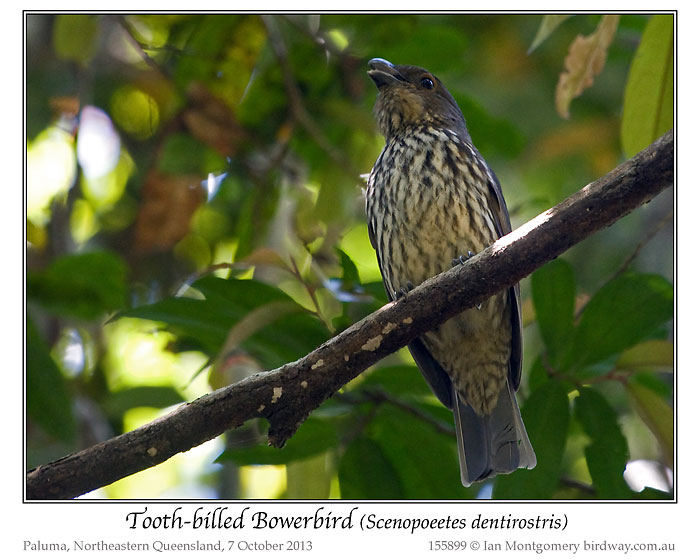
The males sing a strange, loud and varied song with lots of mimicry from perches above the court. So during the breeding season – September to January – they are quite easy to find. The vegetation in their preferred habitat is dense so hearing them is easier than seeing them and seeing them is easier than photographing them: the second photo is a fairly typical view of one through the foliage.
When they’re singing, they are fairly approachable and I got quite close to this one before it flew up onto an unencumbered branch above the court and continued singing in full view (third photo). The fourth photo is cropped to show both the toothed edge to the lower mandible and the ridged inside of the upper one, a clever designed mechanism of chewing off leaves. Some while later, at another court we saw a male pick and drop a leaf, which it let fall. It then picked another on and flew off with it in the direction of its court. Apparently, it is not unusual for the birds to steal the leaves of other males, so there is the same competition for accumulating decorations as in other bowerbirds.
I recorded the calls of three males on my phone and included one of the files below.
Last week, I mentioned a pending Snake of the Week and this aroused some interest, so here it is. I photographed this small whip snake seven years ago in a dry area in far Northwestern Queensland near the border with the Northern Territory. We tried to identify it by consulting a weighty tome on the Reptiles of Australia, but failed to find anything that quite matched it and gave up.
Sombre Whip Snake by Ian
Some years later, I bought the 2008 edition of A Complete Guide to the Reptiles of Australia by Steve Wilson and Gerry Swan. It contains an Appendix which starts: “Late in the preparation of this 2008 revised second edition, a timely study of small tropical whip snakes (Demansia) was published. The work formally recognises additional species of these swift diurnal snakes, some of which have been familiar to herpetologists for many years.” So, there you are: the first time I’ve photographed a yet to be described species of vertebrate; it doesn’t often happen with birds.
What a neat bird and description of them. Now we not only get to see them, but hear them also. Thanks again, Ian, for allowing me to share these newsletters.
The snake, is interesting also, though I am not a big snake fan. I know most are beneficial and I don’t go out of my way to kill them, I just keep my distance.
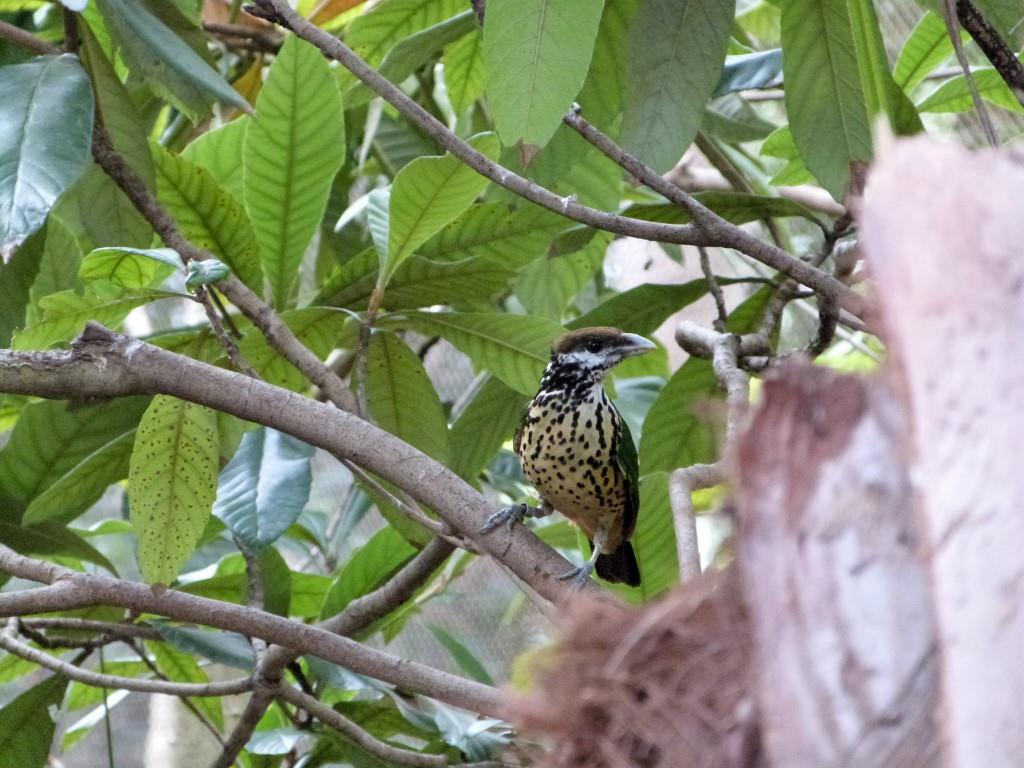
White-eared Catbird (Ailuroedus buccoides) at National Aviary
Bowerbirds are an interesting group of birds. They belong to the Ptilonorhynchidae – Bowerbirds Family, which has twenty members currently. Looking at the Family page, I realized this is the second time Ian has written about the Tooth-billed Bowerbird. That was in August of 2010.
Fawn-breasted Bowerbird (Chlamydera cerviniventris) Bower at Zoo Miami
We were able to see the White-eared Catbird at Zoo Miami and at the National Aviary. At Zoo Miami, the keeper showed me the bower of the Fawn-breasted Bowerbird. You can see how he lined his bower with leaves. Unfortunately the birds were off display at the time.
White-eared Catbird (Ailuroedus buccoides) – Photo by Lee at Zoo Miami
I remember the days of old; I meditate on all Your doings; I ponder the work of Your hands. (Psalms 143:5 AMP)
If you read yesterday’s post, Birds of the Bible Review II, you know I am in a “coasting mode” due to surgery on my neck. Today, I am encouraging you to look around the blog at some of the many Birdwatching articles that have been written over the last five years. Also, continue to pray that my cut heals and the infection clears up. It is better today.
Here are some of those many articles:
(Black and White) Sumatran Laughingthrush (Garrulax bicolor) by Lee
Thou art worthy, O Lord, to receive glory and honour and power: for thou hast created all things, and for thy pleasure they are and were created (Revelation 4:11 KJV)
I will remember the works of the LORD: surely I will remember thy wonders of old. I will meditate also of all thy work, and talk of thy doings. (Psalms 77:11-12 KJV)
In 2008 Birds of the Bible – Review was written. Needless to say, many more articles have been added since then. Please take some time over the next few days and check out articles that you may have missed or you are new and didn’t know of their existence.
Scripture tells us to remember the Lord’s blessings and all His benefits. I consider watching birds one of the Lord’s great blessings. The previous articles were written in an attempt to honor the Lord through telling about His birds. I trust you will dig around and discover some interesting new or old avian friends to read and learn about.
Another reason for this blog is to ask for prayer for me. On Wednesday last week, I had a Squamous Cell Cancer removed from my neck, just under my chin. They attempted to remove it 6 months ago, but didn’t get it all. This time, he cut it out and I have an inch and half row of stitches. On Saturday, it started turning red and irritating me. Monday when I went back to have it looked at, it was infected. So, now I am on an antibiotic, which makes me sort of drowsy. It hurts to lift my head up to look at the monitor (it pulls on the stitches), so the blogs have slowed down. My stitches are supposed to come out next Tuesday, the 8th of October.
Praise the Lord, with over 1,500 articles and 1,100 pages of material, surely there is something you haven’t read before. There are tabs or menus along the top which help you find different topics. Check them out. By you reading, it will also help my page view counts while I am in a “coasting” mode. Thank you.
While listening to Wisdom For The Heart on BBN (Bible Broadcasting Network) last week, I heard this message by Pastor Stephen Davey and wanted to share it. His message was “Better than the Birds” and of course it caught my attention. There are four parts, but I am only sharing the introduction and part one here.
Better than the Birds
Luke 12:6-31
I have read that a dense fog – so extensive that it covers seven city blocks a hundred feet deep is actually composed of no more than one glass of water; water, of course that’s divided into more than 60 billion droplets of water.i
Just a couple gallons of water can cripple an entire city.
In many ways, this perfectly illustrates the substance of worry. Just a little bit of it can spread and deepen and ultimately cripple the mind and the heart of even believers.
One author put it this way when he wrote, “Worry is a thin stream of fear that trickles through the mind, which, if encouraged, will cut a channel so wide that all other thoughts will be drained out.”ii
I find it extremely gracious of our Lord that whenever He addressed the subject of worry, and He did on several occasions, He went much further than simply saying, “You know better than that . . . worrying isn’t good for you . . . it’ll mess up your mind . . . isn’t right . . . stop worrying right now!”
Instead, Jesus graciously causes us to think through this vaporous substance of worry; He gives us several reasons to stop worrying and He even condescends in His patience to give us illustrations – effectively – giving us principles to teach us why we really don’t ever need to worry.
And several of His key principles are the form of questions.
Let me invite you to Luke chapter 12 where Jesus asks some profound questions.
He’s teaching His disciples – this chapter in Luke corresponds to His sermon in Matthew’s Gospel.
Now if you’ve ever read His sermon, you’ll notice that He goes from one subject to the next – almost randomly touching on a series of different topics.
Jesus is actually employing a Jewish teaching style called Charaz – which means, stringing pearls.iii
In other words, Jesus will string pearls of wisdom on a number of subjects, like someone might string together a rare necklace of pearls.
And one of the pearls He adds to his string of pearls is this subject of worry.
Let me give you four principles in this regard as we work through His comments on overcoming worry.
The first principle to understand is that:
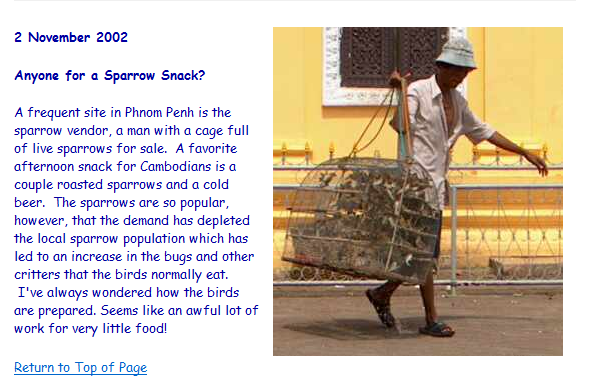
Anyone for a Sparrow Snack?
1. Worry denies the gracious care of God
And He proves His point by asking two questions – notice His first question at verse 6. Are not five sparrows sold for two cents? Yet not one of them is forgotten before God.
Now if you compared this account with Matthews account, we’re told that 2 sparrows were sold for 1 penny.
The Greek term for this coin refers to a small brass coin worth about 1/10th of a day’s wage for a working laborer.
Which is a long way of saying, sparrows were the cheapest meat sold in the marketplace.iv
They were the food of the poorest of the poor. You barely got a mouthful of meat from a little sparrow.
In fact, Matthew’s Gospel tells us that you can buy 2 sparrows for a penny and Luke here tells us that you can get 5 sparrows for 2 penny’s; how’s that add up?
Well, we know from history that during the days of Christ, sparrows were so abundant and so cheaply sold to the poor that if you bought 4, you got one thrown in for nothing.
And that’s what Luke alludes to here – are not five sparrows sold for two cents? Yet not one of them is forgotten before God.
Now watch this – Luke is effectively saying, even the free sparrow is not forgotten by God. Even the sparrow that got thrown in for nothing matters to God.
You want to know why you never need to worry? Because to God you are never lost in the crowd.v
Not only does God not lose track of even one sparrow – he doesn’t even lose track of one single hair from your head.
Notice further in verse 7. Indeed the very hairs of your head are all numbered.
I’ve read that the average person’s head holds more than 100,000 hairs. Some of us are down to a few hundred.vi
A few dozen . . .
Now some commentators don’t think Jesus is being serious here – that He’s just exaggerating to make a point.
I mean, come on . . . He counts the number of the hairs on our heads? That number changes daily. Surely God doesn’t bother with that kind of detail. Gary Hallquist – 60,000; Dr. Burggraff – 12 . . . hundred.
No, I think that’s exactly His point. The glory of God revealed here is that He actually does know!
Jesus is effectively asking us, “Look, do you really think you can slip out of your Heavenly Father’s care – that you can somehow slip out from underneath the radar of His divine omniscience? Do you think He’s forgotten about you or that your problems are too numerous to keep up with?
I mean if He can keep track of 100,000 hairs on somebody’s head of hair, do you think He’ll get frustrated with you coming to Him over and over again to give Him your worries?
Do you think He’s going to say, “Look, there’s only so much room on my ledger and you’ve already been here a dozen times today . . . I just can’t keep track.”
Listen, if God is actually such a gracious, omniscient God – that He doesn’t overlook a single sparrow – even the one that gets thrown in for free – He will never overlook you either.
Worry denies the gracious care of God
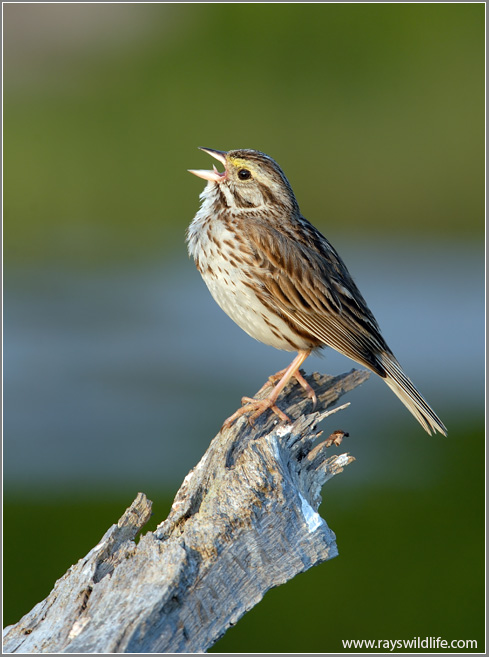
Savannah Sparrow singing by Ray
(Copied with permission from Wisdom for the Heart and Pastor Stephen Davey.)
i John MacArthur, Matthew 1-7 (Moody Publishers, 1985), p. 419 ii Ibid iii William Barclay, The Gospel of Luke (Westminster, 1975), p. p. 160 iv Bruce B. Barton, Life Application Bible: Luke (Tyndale, 1997), p. 314 v Barclay, p. 161 vi MacArthur, p. 119
Lee’s Addition:
Are not five sparrows sold for two farthings, and not one of them is forgotten before God? But even the very hairs of your head are all numbered. Fear not therefore: ye are of more value than many sparrows. (Luke 12:6-7 KJV)
What a great encouragement not to worry. Thanks, Pastor Davey for a great message.




















 Lee's Birdwatching Adventures Plus