You may remember from the last Irregular Bird (Green Sandpiper) that the plan is to work through all the waders in the genus Tringa, the Shanks and relatives, in the order used by the IOC, below. This is the next one the Solitary Sandpiper.
It’s fairly similar to the Green Sandpiper and they were originally treated as a single species. In fact, they are easy to distinguish in flight as the Green Sandpiper has a white rump and a tail with side to side barring, while the central feathers of the rump and tail of the Solitary Sandpiper are brown creating a longitudinal stripe. These features are visible under the flight feathers in the first photo and shown in a drawing later.
In practice you can also use their ranges as the Green Sandpiper occurs in Eurasia and Africa, while the Solitary Sandpiper is an American species. It nesting range is almost entirely in Canada and Alaska. It migrates through the United States and winters in Mexico, Central America, and in northern, central and eastern South America as far south as Peru in the west and northern Argentina in the east.
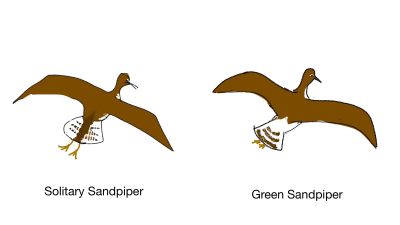
I haven’t got photos of either species in flight so here is a crude drawing to illustrate the difference in flight pattern. Don’t take too much notice of anything except the different rumps, tail and length of the legs. The latter are longer and protrude farther beyond the tail in the Solitary Sandpiper. So, if you’re a dedicated twitcher, as I am now, keep a beady eye out for something special if you are in a place where either or both of these birds don’t usually occur. There are a few records of Green Sandpipers in northern Australia and a few records of Solitary Sandpiper in Siberia and Western Europe.
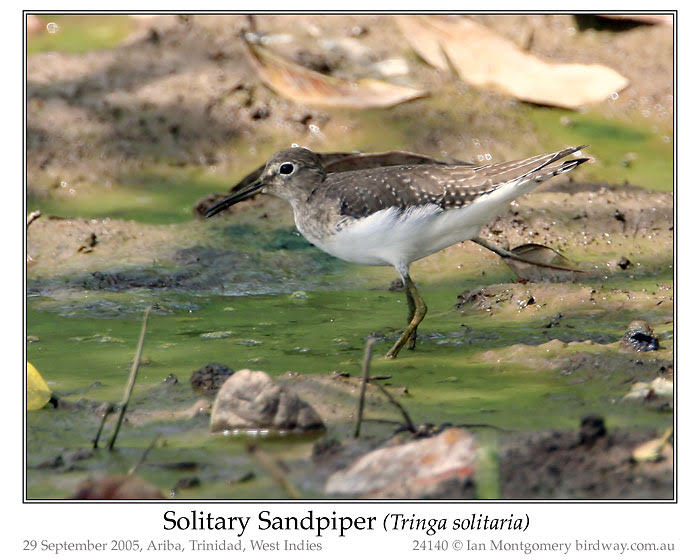
There isn’t much difference among the plumages of breeding adults, non-breeding adults, and juveniles though there is less streaking in juveniles and the spots on breeding adults are whiter, rather than buff and more conspicuous. I think the bird in the second photo in Trinidad is a juvenile, the one in the third photo in Brazil is an adult but I don’t know about the one in the first photo. If you’re an expert on the plumages of Solitary Sandpipers, I’d be happy to get your opinion: ianbirdway@gmail.com.
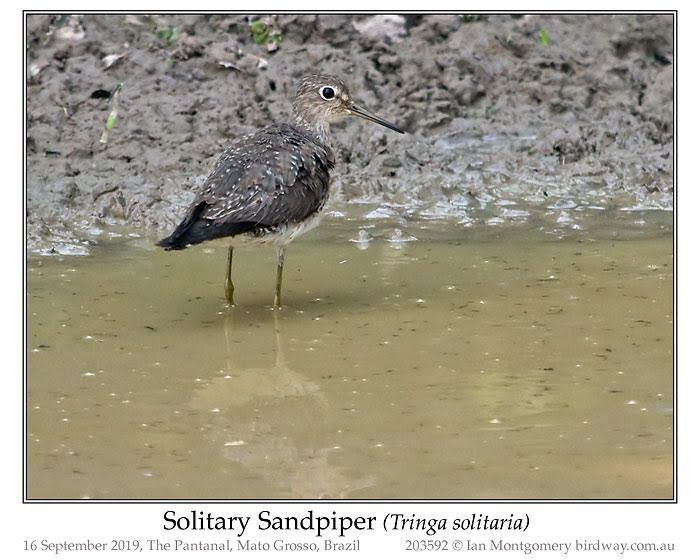
Actually, I misidentified the two in Trinidad as Spotted Sandpipers in non-breeding plumage but maybe I had Spotted Sandpiper on the brain as I’d seen the one in the third photo in Tobago eleven days earlier. Non-breeding Spotted Sandpipers don’t have spots (go figure, as they say), just a little barring on the wings but they have conspicuous long white eyebrow stripes and shorter, much yellower legs, so I lack a reasonable excuse for the confusion.
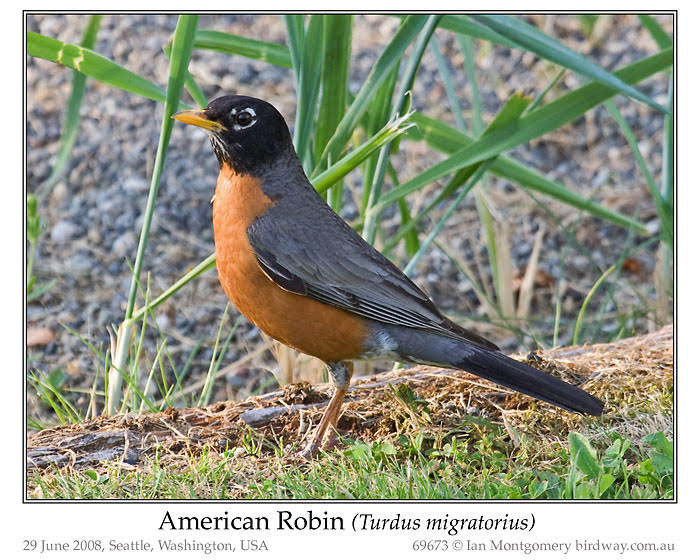
Like their Eurasian cousins, Solitary Sandpipers breed in trees and shrubs using the old nests of thrushes. It so happens that the range of perhaps the commonest thrush in North America, the American Robin, overlaps the range of the Solitary Sandpiper in Canada and Alaska. The Robin, despite its name which is based on colour not taxonomy, is a Thrush and a close relative of the Eurasian Blackbird and is the most likely candidate as a provider of nests, though not much is known about the breeding behaviour of the Sandpiper.
So how does the Solitary Sandpiper get its name? Amazingly, unlike most waders which believe in safety in numbers, it migrates either alone or in small groups and often appear at stopovers or at the destination in ones or twos. It migrates mostly at night. I don’t know whether juvenile birds instinctively know where to go or whether the adults teach them. The mind boggles at what we don’t know about bird migration.
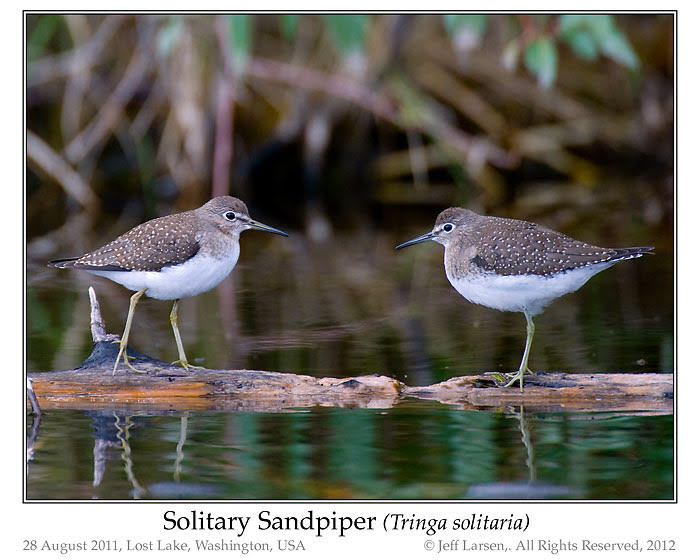
Jeff Larsen sent me this lovely photo of two birds together in Washington state, so they’re clearly not completely antisocial. He calls them Solitary Chickens, which appeals to me and he gave me permission to share this photo with you.
Solitary Sandpipers are birds of freshwater and are usually found on small ponds or in marshy areas, even in winter. We spotted the one in Brazil in a roadside pond in the Pantanal.
Next time we’ll talk about the Tattlers, two rather similar species that are next on the IOC list.
The last irregular bird, Nordmann’s Greenshank, could have had a sub-heading of The Joys of Twitching. In it, I confessed to being a Twitcher at heart, discarding the respectable facade of “Wildlife Photographer”. Here follows the justifications, or at least illustrations of why it can be enjoyable. The background to this particular obsession/passion was the fact that, worldwide, there are thirteen species of Tringa sandpipers, or Shanks, characterised by different coloured legs. I had reasonable photos of all of them except the rarest, Nordmann’s Greenshank, since 2008 (when I photographed the second last one, the Willet of North America). That is, the seven-year itch twice over.
If you are, or ever were, a stamp collector, you would know the feeling. Suppose the following stamps are from a set of 13 stamps of Queen Victoria, including the first ever stamp, the Penny Black and imagine you have all of them except the rarest, the iconic Two Penny Blue, issued shortly after the first ever stamp, The Penny Black, in May 1840.
Imagine the thrill when you finally lay your hands on one, as I did in the 1960s. This one is a rather daggy example, but it is one from the original two plates issued until February 1841 and lacking white lines under “POSTAGE” and above “TWO PENCE”. The much commoner later series called ‘white lines added issue’ continued until 1858. I’m still a kid at heart, and the subtlety of distinguishing different series of Two Penny Blues has a similar appeal to separating Common and Nordmann’s Greenshank.
Alternatively, maybe you were or are a card player. Suppose you’re playing a game in which you the best hand is an entire suit of cards, say a complete Straight Flush, as opposed to a mere Royal Straight Flush in Poker, but you lack the Queen.
At long last, after fourteen nail-biting years, you finally get the missing card. I’ve chosen the Queen as it’s number twelve (if you have the Ace as the first rather than the last in the suit) and Nordmann’s Greenshank is also the twelfth Tringa if you follow the IOC classification of birds. Continuing the metaphor, I’ve chosen Spades as the Queen of Spades is the most valuable card in the game Hearts. The metaphor fails if you go any further, because in Hearts, a vicious game which we loved as kids, the aim is not to win points and to force your opponents to get a high score, It’s Whist in reverse. Clearly, I also have a passion for Queens.
After that it’s just a question of whether you’re an introvert or an extrovert. An introvert gets a deep personal satisfaction from achieving a complete collection, an extrovert gets a sense of triumph in beating the competition. Of course, you may be a bit of both: I’m mainly an introvert, but publishing all this stuff as the Irregular Bird, showing off obviously, is characteristic of extroverts.
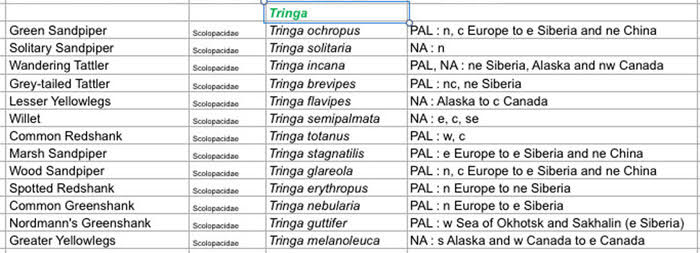
So, back to Tringas. Waders (birdway) are fascinating birds, not least because many of them migrate extraordinary distances. As a consequence, they’re of special interest to twitchers when avian GPSs go awry and they end up in strange places. Many species, however, are hard to distinguish in non-breeding plumages, which is how we usually see them in temperate and tropical latitudes except just before the migration back to the breeding zones. Most, but not all, of the Shanks are fairly easy to identify because of their coloured legs; many of them having corresponding common names as you can see in the IOC table. Four of them, comprising the two Redshanks and the two Tattlers, have featured as Irregular Birds in the past, so I want to do a series on the remaining eight and I’ll do them in the IOC order shown in the table at the beginning of this article. The first is the Green Sandpiper.
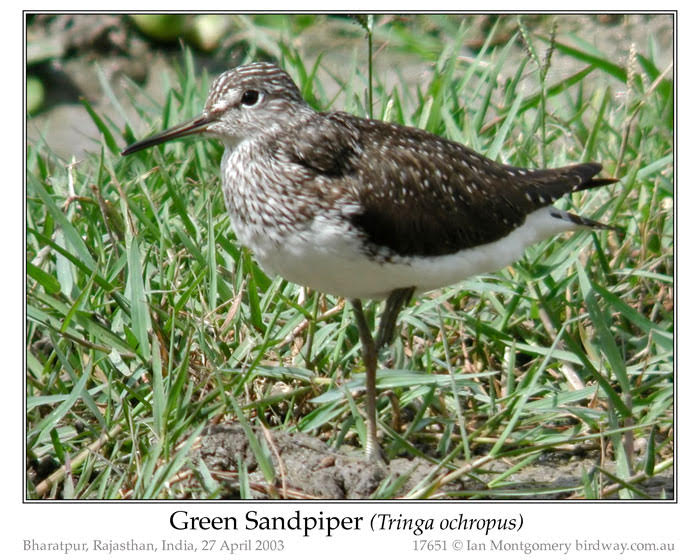
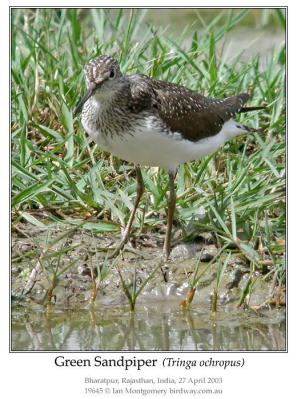
The breeding range of the Green Sandpiper stretches right across northern Eurasian from Norway to Siberia and it winters mainly in tropical Africa, South and Southeast Asia, around the Mediterranean and, to a lesser extent in Western Europe. It’s mainly a bird of fresh water marshy areas even in the non-breeding zones. I’ve photographed it only once, in India in 2003, though I had seen it in England in the 1960s before I came to Australia.It’s even rarer in Australia than Nordmann’s Greenshank with only one confirmed record, near Darwin in 1998. There are a few unconfirmed records but care needs to be taken to distinguish it from the closely related Solitary Sandpiper of America and the Wood Sandpiper.
In fact, I mistakenly identified the Indian bird as a Wood Sandpiper, reasonably common in Australia and also a fresh water species, and posted it as such to the website, and only years later did the twitcher in me take a closer look and realise happily that it was actually a Green Sandpiper. Distinguishing features of the Green Sandpiper include larger size, bulkier appearance, short white eye-stripe ending at eye, longer bill, shorter, greenish legs, sharp gradation from streaked breast to white belly and, particularly in breeding plumage like this one, darker, greener rather than brown upper parts.
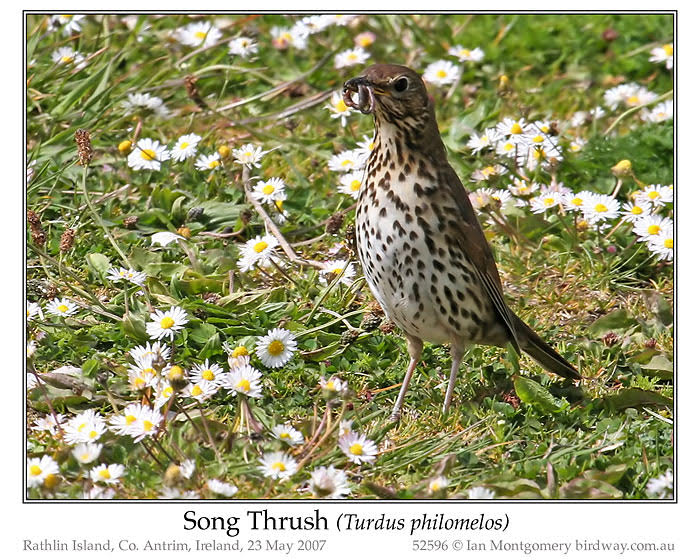
I mentioned when discussing the unusual arboreal nest building habits of Nordmann’s Greenshank that the Green and Solitary Sandpipers also nest in trees, but use the old nests of thrushes. Coincidentally the name Tringa comes from a description of a thrush-sized waterbird by Aristotle (“trungas”). He didn’t distinguish it further but later authors have suggested it was a sandpiper, a Wagtail Motacilla or a Dipper Cinclus. Thanks very much. While we’re at it, ochropus means pale-yellow footed, while the specific identifier of Normann’s Greenshank, guttifer, means spotted, which isn’t very illuminating either. Aristotle preceded the taxonomic and evolutionary ideas of Linnaeus and Darwin, and “thrush-like waterbird” is a reasonable description, except for the length of the legs. He was interested in biology, classified 500 species of animals in the work later known by philosophers as the Scala Naturae and would have been familiar with the Song Thrush, below, in Greece. The Scala Naturae was approved by the Christian Church (and probably all others) as it is hierarchical in form with man at the top, towering above all the lower species.
On the subject of passion and obsession, I’ve decided that the difference is mainly one of perception. A person might think they (in deference to gender fluidity) have a passion for another person and, if not reciprocated, the other party might regard it as an obsession. My cousin in Ireland suggests that obsessions have a negative effect, so maybe it’s more than just perception. Either way, I’ll continue the passion for Tringas next time with the closely related but geographically distinct (“allopatric”), thrush-nest-using, Solitary Sandpiper of America.
You can’t reply directly to these emails, so if you want to write to me, use my email address below. I’ve recently had occasional problems with receiving emails to ian@birdway.com.au, so ianbirdway@gmail.com is preferable.
Seems that Ian is getting active again with his birdwatching. He, like the rest of us, was quite for awhile during all these lockdowns. I have another of his articles coming soon. Stay tuned.
“As a bird that wandereth from her nest, so is a man that wandereth from his place.” (Proverbs 27:8 KJV)
Black-headed Gulls and Great Black-backed Gulls: Birdwatching in the Scottish Hebrides, Part 4
Dr. James J. S. Johnson
For the earth shall be filled with the knowledge of the glory of the LORD, as the waters cover the sea.
(Habakkuk 2:14)
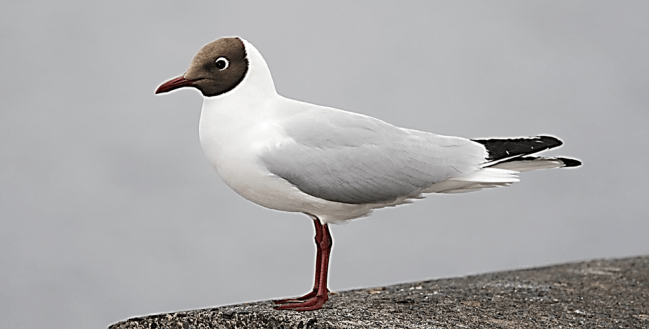
Black-headed Gull (BirdGuides.com photo credit)
Great Black-backed Gull (National Audubon Society photo credit)
The islands of Scotland’s Outer Hebrides are a familiar territory for various seagulls, including two in particular: (1) the largest seagull, the low-sounding “laughing” Great Black-backed Gull (Larus marinus); and (2) a much smaller yet loud-“laughing” Black-headed Gull (Larus ridibundus, a/k/a Chroicocephalus ridibundus).
Great Black-backed Gulls are large (more than 2’ long, with wingspan about 5’ wide; often males weigh up to 4 or 5 pounds, while females weigh slightly less), deserving their nickname “King of Gulls”. Thanks to God-given toughness these gulls can survive and thrive in coastlands of the North, breeding in parts of Russia, Scandinavia, along Baltic coasts, the British Isles, Iceland, Greenland, the Faroe Islands, plus the Atlantic seacoasts of Canada and America’s New England shorelines. In winter many of these gulls migrate south.
In Nornian, the ancient Old Norse-derived language of the Shetland Islands, the Great Black-backed Gull was once called swaabie, from swartbak, meaning “black back”—whereas in AD1758 Karl (“Linnaeus”) von Linné taxonomically designated theseseagulls as Larus marinus, denoting a marine seagull/seabird (from Greekλάῥος). In a previous study (titled “Birdwatching at Staffa, near Iona: Puffins, Shags, and Herring Gulls”), the Great Black-backed Gull was noted as a prominent predator of Atlantic puffins, yet this gull avoids puffins who nest near humans.
BLACK-HEADED GULL perching (Nat’l Audubon Society photo credit)
However, it is not just the Atlantic puffins that must beware the apex-predatory pursuits of Black-backed Gulls, because these gulls also prey on terns and many other birds, as well as almost any other organic food smaller than themselves, living or nonliving, if they can swallow it. Accordingly, these scavenging gulls are attracted to garbage dumps filled with human wastes, as well as to egg-filled nests of smaller birds, plus available rodents (e.g., rats) and lagomorphs (e.g., rabbits). Likewise, these bullies practice “klepto-parasitism”, i.e., aerial bullying-based robberies of food from other birds—when accosted by Great Black-backed Gull, the smaller birds drop their food—as the Great Black-backed Gull chases the dropping food, to capture it in the air, the robbery victim flies away to safety.
During the winter months these gulls spend less time over land, because the sea itself then offers better opportunities for food—especially lots of fish! Any fish who are close to the ocean’s surface are at risk when these gulls scout for catchable food. In fact, quantitative studies of their stomachs show that marine fish (such as herring) are the primary diet of Great Black-backed Gulls, although they also eat other birds (like herring gulls, murres, puffins, terns, Manx shearwaters, grebes, ducks, and migrant songbirds), plus small mollusks (like young squid), crustaceans (like crabs), marine worms, coastline insects and rodents, as well as inland berries, and lots of garbage and carrion (found in places as diverse as saltmarshes, landfills, parking lots, airport runways, piers, fishing docks, surface ocean-waters, etc.).
[See William Threlfall, “The Food of Three Species of Gull in Newfoundland”, Canadian Field-Naturalist, 82:176-180 (1968). See also, accord, Kirk Zufelt, “Seven Species of Gulls Simultaneously at the Landfill”, Larusology (http://Larusology.blogspot.com/2009/11/7-species-of-gulls-simultaneously-at.html ), posted Nov. 15, 2009.]
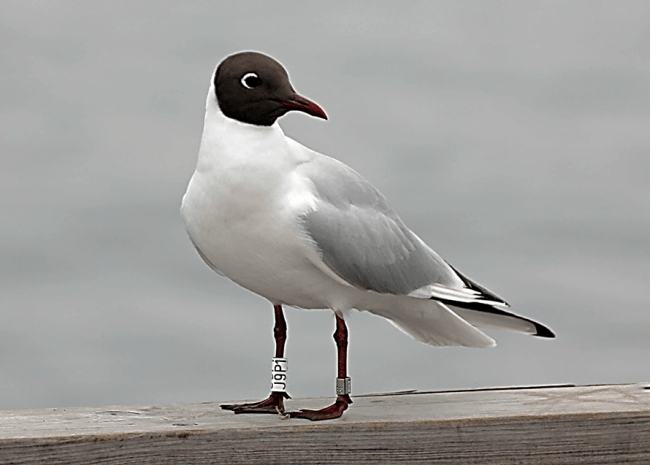
BLACK-HEADED GULL with “ankle bracelet” (Oslo Birder photo credit)
Like the above-described Great Black-backed Gull, the gregarious (i.e., colony-dwelling) Black-headed Gull is notorious for its omnivorous scavenging and often-predatory habits, opportunistically frequenting oceans, intertidal beaches and estuarial coastlands, marshlands and other inland wetlands, lakes, rivers, and even agricultural fields. These gulls, as breeding adults, sport dark-chocolate (almost black) heads.
Black-headed Gulls can soar high in the air, swim in the ocean, and walk along a sandy beach—they are equally comfortable moving to wherever they want to go to. These noisy seagulls sometimes appear to “laugh” when they call. Like other seagulls, they enjoy eating fish—sometimes they dip their heads under the tidewater surface, while swimming. When scouting along a coastal beach, these gulls probe for coastline critters (which they probe for and snatch). Also, they are fast enough to capture flying insects, which they catch “on the wing”.
BLACK-HEADED GULL (Shells of Florida’s Gulf Coast photo credit)
Gulls come in many varieties, plus some of these varieties are known to hybridize. For example, Great Black-backed Gulls (Larus marinus) hybridize with Herring Gulls (Larus argentatus). Black-headed Gulls (Larus ridibundus) often hybridize with Mediterranean Gulls (Larus melanocephalus), and also with Laughing Gull (Larus atricilla) and Common Gull (Larus canus). Other hybrids exist, too, and many of these gull hybrids have been verified by genetics (i.e., DNA parentage verification).
[ As a boy this author watched seagulls, both inland and at seacoasts, with wonder. God made them all! A half-century later, I still watch seagulls (and many other birds) with wonder. “He (God) does great things beyond searching out … and wonders without number.” (Job 9:10) — God shows how wonderful He is! ]
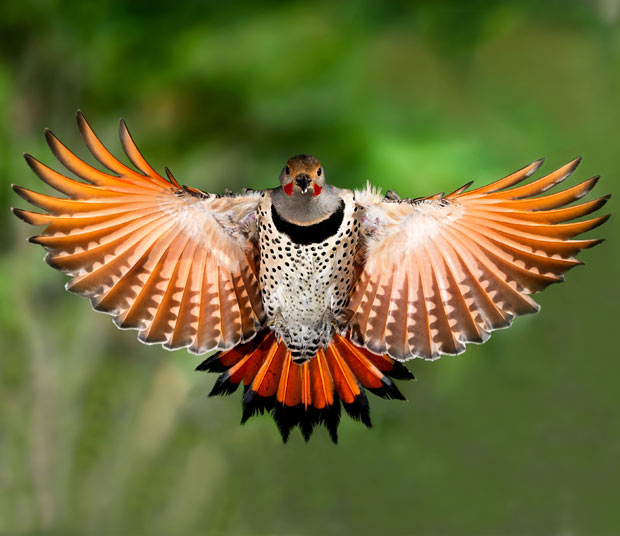
NORTHERN FLICKER (red-shafted form) photo credit: Evergreen State College
“Out of the ground the LORD God formed every beast of the field and every bird of the air, and brought them to Adam to see what he would call them. And whatever Adam called each living creature, that was its name.” (Genesis 2:19 NKJV)
During our devotions this morning, Dan and I were reading John chapter 9. It tells about the Lord healing the blind man. Also, how the religious rulers doubted his story, and wanted to know if he had really been blind. They called the parents in, and questioned them. The temple rulers were especially upset because Jesus had healed the man on the Sabbath. Many of you know this story.
“Now as Jesus passed by, He saw a man who was blind from birth. And His disciples asked Him, saying, “Rabbi, who sinned, this man or his parents, that he was born blind?” Jesus answered, “Neither this man nor his parents sinned, but that the works of God should be revealed in him. I must work the works of Him who sent Me while it is day; the night is coming when no one can work. As long as I am in the world, I am the light of the world.” When He had said these things, He spat on the ground and made clay with the saliva; and He anointed the eyes of the blind man with the clay. And He said to him, “Go, wash in the pool of Siloam” (which is translated, Sent). So he went and washed, and came back seeing.”
(John 9:1-7 NKJV) [Bolding mine]
Here is a comment from my Chronological Life Application Study Bible (KJV, p 1350)
“John 9:6 When Jesus spit on the ground and made mud in order to repair the man’s eyes, he was working with original materials. Gen2:7 states that God formed Adams body from the dust of the Ground. Jesus was demonstrating a creator’s awareness of the materials he first used to shape the human body”
I had never made that connected in that story before, but it is another view of the fact that our Creator WAS here on earth in the person of the Lord Jesus Christ. Praise the Lord for all His creation, and especially the birds, which we enjoy so much. Along with all the other parts of His Creation.
“The flowers appear on the earth; the time of the singing of birds is come,…” (Song of Solomon 2:12 KJV)
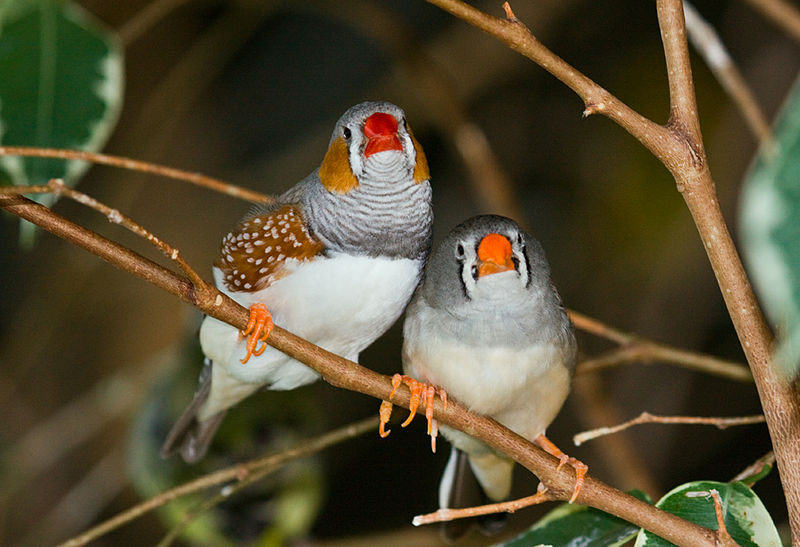
What an interesting and informative article about the creation of Zebra Finches and their singing duets. Bryian Thomas, PH.D. from the Institute For Creation Research wrote “Finch Duets Open Surprising Window on Bird Origins”
The Zebra Finches appears to have a pattern of singing that goes against what evolutionists suppose is to be the normal behavior of Finches.
“A male finch sings to females while courting, but then quiets down after finding his mate. According to evolution, finches have no reason to continue to communicate at that point, since they’ve already ensured that their genes will be passed on to a new generation. Thus, researchers were surprised to find that wild zebra finches sing to each other only after becoming a couple.”
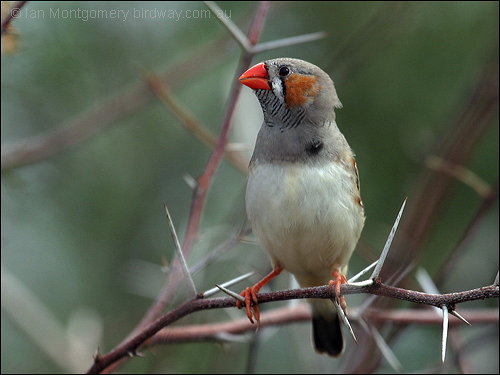
Zebra Finch (Taeniopygia guttata) by Ian
He also discusses how these songs are thought to have happened through natural selection, but….
“For male finches to sing their songs, they have to have a fully-formed system of pulmonary tubing, valves, musculature, and integrated skeletal structures. Then, the larynx (many birds have two) has to be located near the mouth and properly “wired” to the correct areas of the brain. All of that would still be useless, however, without the instinctive knowledge required to compose a song, or without the females’ ears being tuned to their specific tones. To consider this seamless array of parts as a product of just nature is imaginative–not scientific.”
“Zebra finches are active and colorful birds from Australia, and they choose a mate for life.” Thankfully, Ian has provided us with great photos of the unique Avian Wonders.
Let them give glory unto the LORD, and declare [yaggîdû = hiphîl imperfect 3rd person masculine plural of nâgad, “to appear”, “to be clear”] his praise in the islands.
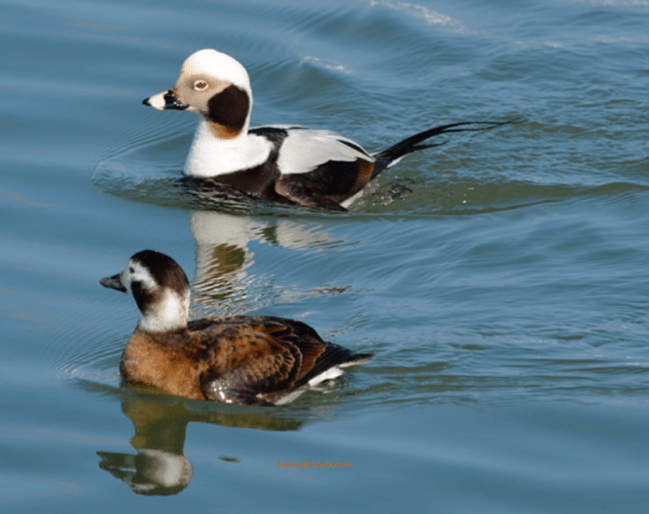
Recently, when reviewing a bird-book that presented seabirds of the Hebrides, I noticed a duck’s name that I was unfamiliar with, the “Long-tailed Duck” [see Peter Holden & Stuart Housden, RSPB Handbook of Scottish Birds, 2nd edition (Bedfordshire, UK: Bloomsbury Publishing / Royal Society for the Protection of Birds, 2016), page 39]. However, I recalled that I’d seen similar-looking ducks, in near-freezing wetland pond-water, from a train-car of the White Pass and Yukon Railway, traveling from Skagway (Alaska) into British Columbia, about 20 years ago, probably during early September, when these ducks visit migratory stopover sites.
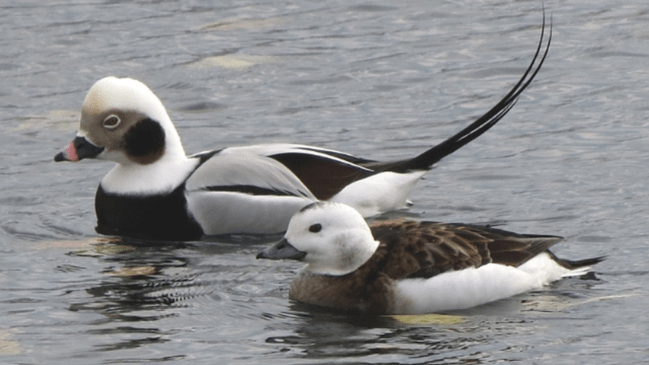
So, what does a Long-tailed Duck look like? For starters, the male (a/k/a drake) has a conspicuously long tail—that makes sense.
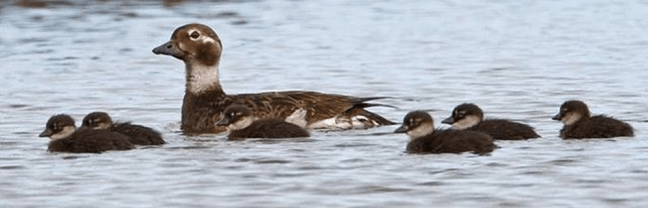
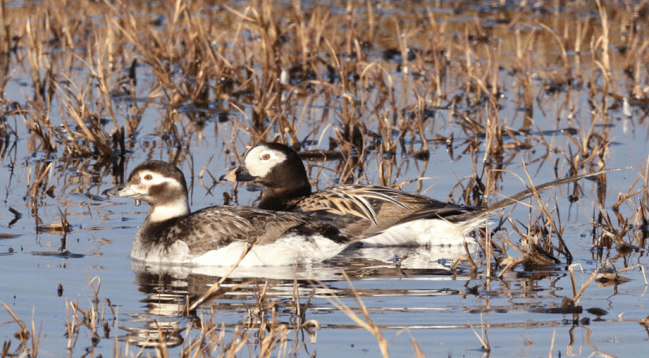
Smaller than Mallard, but tail of male may add 13 cm [about 5 inches]. Small, neat sea duck with a small, round head, steep forehead, all-dark wings in flight and white belly. In winter, male is mainly white with a dark brown “Y” mark on its back, brown breast-band and a large, dark cheek patch. In summer, it has a streaked brown back, dark head and neck, and pale greyish-white face patch. Adult male has greatly elongated central tail feathers. Female in winter shows a white collar, white face with dark lower cheeks and dark crown. … In summer, female has a darker face than in winter. Females have short tails. Juvenile is like female in summer, but with a less contrasting face pattern. Flight feathers are moulted between July and September; during part of this time birds are flightless for a few weeks. Has a unique moult, as some back feathers are moulted four times a year and some head and neck feathers three times a year.
[Peter Holden & Stuart Housden,”Long-tailed Duck”, RSPB Handbook of Scottish Birds, 2nd ed. (Bloomsbury / Royal Society for Protection of Birds, 2016), page 39.]
Does that physical description sound familiar? Do the photographs look familiar?
After some research I realized that certain cold-weather diving ducks, called “Oldsquaw” ducks in older guidebooks [e.g., James Kavanagh, The Nature of Alaska (Blaine, WA: Waterford Press, 1997), page 56], are now called “Long-tailed Duck” in newer guidebooks [e.g., Robert H. Armstrong, Guide to the Birds of Alaska, 6th edition (Portland, OR: Alaska Northwest Books, 2019), page 54]. But why?
Surely this is an odd duck. In fact, its typical call is an odd quacking-warbling-hooting honk, sounding like a duck trying to yodel through a semi-muted horn.
The duck’s fancy scientific name, Clangula hyemalis, has not changed lately.
But political pressure intrudes into the mostly-apolitical ornithology neighborhood. It seems that the earlier common name for this duck, “Oldsquaw”, is now deemed unacceptable, because it might offend someone who stumbles on the terms “old” and “squaw”, as imagining disrespectful stereotypes of elderly tribeswomen. Although “P.C.” (i.e., political coërcion) pressures should not dictate taxonomy for ornithologists, there you have it—since the International Ornithologists’ Union has acted, so now all Oldsquaws are re-named “Long-tailed Ducks”! What a world!
Long-tailed Duck mother with young (Wikipedia photo credit)
Ironically, to eschew the prior common name (“Oldsquaw”) implies that folks often disrespect old squaws, i.e., elderly womenfolk of the Native American tribes. But why should someone be ashamed of being “old”? It is a blessing to be given many years of earthly life (Leviticus 19:32; Proverbs 16:31 & 20:29b; Job 12:12). Likewise, why should an Indian woman—or any woman—be ashamed of being a “squaw” (i.e., a woman)? It is a blessing and a privilege to be whomever God creates someone to be. After all, God did not need to create anyone who would live long enough to become an old “squaw”, or an old “brave”, for that matter. It is God’s generous and providential grace that we are whomever we are—because God could have made us all Long-tailed Ducks, or Coots, or Gooney Birds, or Grackles!
While God appreciates the “simple”, yet unique, snowflakes that are ignored by busy humans, God treasures our personal lives (created in His image) infinitely more, as though we were His precious jewels (Malachi 3:17). In fact, God providentially planned our lives to be exactly what they are, and if we belong to Him, God artistically “works together for good” the component details of our lives (Romans 8:28). Surely, we should thank our Lord Jesus Christ for being our very personal Creator. So, the next time you see a grackle, think thankfully for a moment, “That could have been me!” And be grateful to your Creator, Who made you a unique, one-of-a-kind creation.
[Quoting JJSJ, “Of Grackles and Gratitude”, ACTS & FACTS, 41(7):8-10 (July 2012), posted at www.icr.org/article/6900/ .]
Meanwhile, back to the Oldsquaw’s cold-weather life in and near northern ocean seawaters. The Long-tailed Duck is a sea-duck, spending most of its winter days at sea (not very close to shoreland), diving for food, though using arctic tundra, taiga (i.e., boreal forest), and subarctic coastlands for breeding, and for latter-month molting and migratory stopovers. It’s a diving duck, sometimes diving to depths of 200 feet, using their feet to propel themselves downward, staying underwater moreso (i.e., longer) than other diving ducks. And oxygen-rich coldwaters contain lots of nutritious food for the Long-tailed Duck.
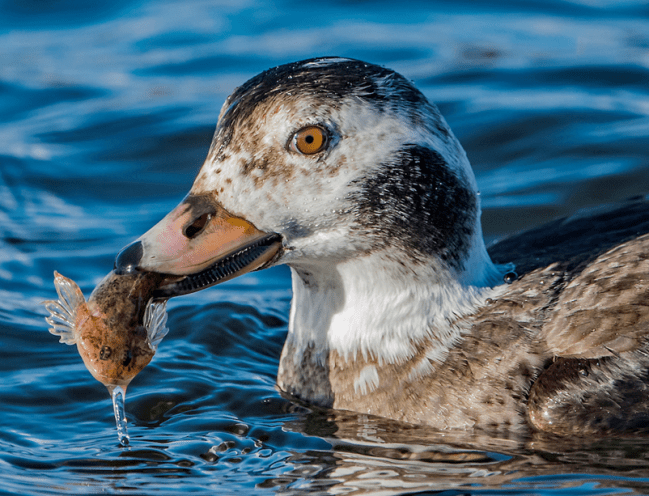
Dives to search mainly for crustaceans and molluscs, especially Blue Mussels, cockles, clams and crabs. Also eats sandpipers, small fish such as gobies and some plant material.
[Peter Holden & Stuart Housden,”Long-tailed Duck”, RSPB Handbook of Scottish Birds, 2nd ed. (Bloomsbury / Royal Society for Protection of Birds, 2016), page 39.]
Long-tailed Duck with fish (BirdGuides / Martyn Jones photo credit)
Wonderful birds are there to be seen, in the Outer Hebrides (“Western Isles”). If you get the opportunity, go see them! Meanwhile, appreciate that they are there, living their daily lives—filling their part of the earth—and glorifying their Creator.
Let them give glory unto the LORD, and declare [lit., “cause to be clarified”] His praise in the islands.
(Isaiah 42:12)
HOODED CROW (Corvus cornix) over water, Wikipedia photo credit
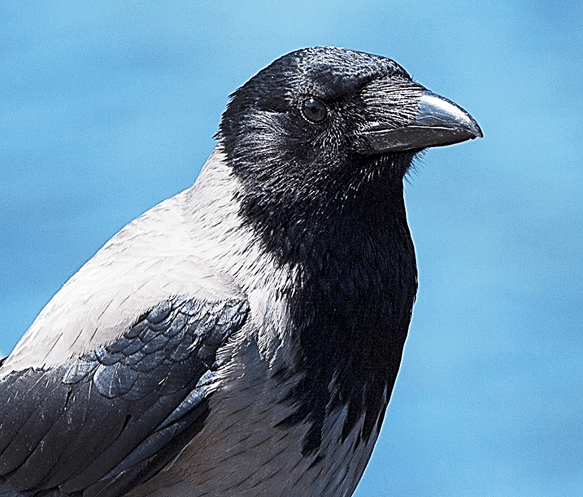
What could be more Scottish than “Scotch Crow” (Corvus cornix)? The Scotch Crow is better known, especially on the Eurasian landmass, as the Hooded Crow (a/k/a “Hoodie Crow” by some Britons, and “Grey Crow” by some Scandinavians and Irish). As the following paragraphs will document, the opportunity-grabbing Scotch Crow (a/k/a Hooded Crow) is as resourceful as a Scotsman (or Scotswoman).
Yet we need not be surprised at the wisdom of crows, because Proverbs 30:24-28 teaches us that God has caringly chosen to give wisdom to many of His creatures. For more explanation on this, with more corvid illustrations, see “Clever Creatures: ‘Wise from Receiving Wisdom’”, Acts & Facts, 46(3):21 (March 2017), posted at www.icr.org/article/clever-creatures-wise-from-receiving — as well as “Jackdaws Identify ‘Dangerous’ from ‘Safe’ Humans”, Creation Science Update (May 4, 2020), posted at www.icr.org/article/jackdaws-identify-dangerous-from-safe-humans .
Hooded Crow, Isle of Lewis (Outer Hebrides) A.D.2019 photo by Marnix Roels, “Hooded Crows from Scotland” MarnixBirdGallery.WordPress.com
The black-and-grey Hooded Crow, like other corvids (i.e., members of the raven/crow superfamily), is a generalist—like the scavenging Carrion Crow (Corvus corone, its “southern cousin”, with which Hoodies sometimes hybridize), it eats almost anything available, dead or alive—carrion (which includes a huge variety of remains form other predators’ hunting successes, as well as roadkill), seeds, nuts, food scraps discarded by humans (esp. junk food), insects gathered on pieces of meat, grains (including corn), other plant materials (including fruits), small birds, bird eggs (such as eggs of seagulls or cormorants), crustaceans (such as Green Crabs, gooseneck barnacles), gastropod mollusks (such as European limpet, Blue-rayed Limpet, European periwinkle, rough periwinkle, Atlantic dogwinkle rock snail, thick-lipped dogwhelk mudsnail, European mudsnail, top snail), bivalve mollusks (such as Blue Mussel, Warty Venus hard-shell clam, Palourde clam, cockles), purple sea urchins, small mammals (such as Norwegian rat, mice, frogs, Eurasian pygmy shrew, juvenile rabbit), spiders, insects (e.g., fly larvae and adults), fish, snakes, etc.
In sum, Hooded Crows—such as those who make a living on coasts of the British Isles—are resourceful generalists. These coast-living crows are not picky eaters!
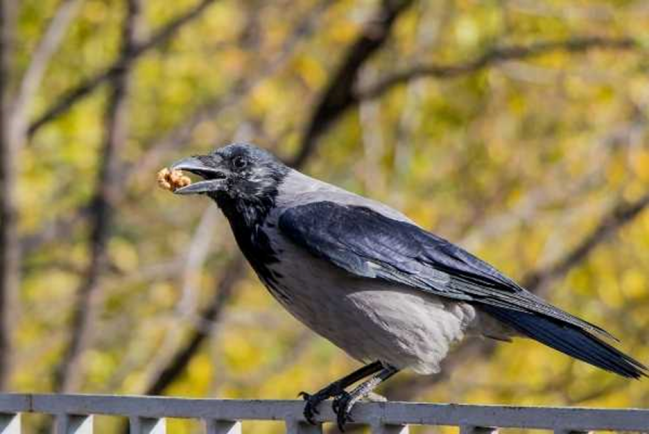
Hooded Crow perching with food (BirdsAcademy.com photo credit)
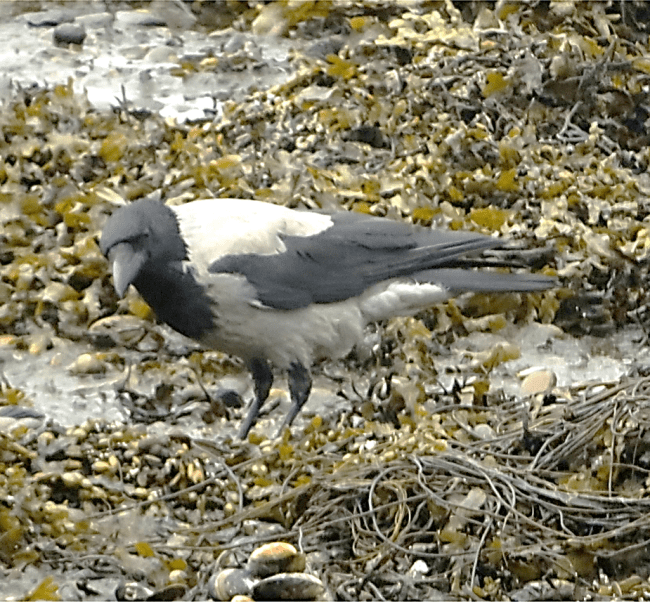
In fact, Hooded Crows who habituate coastal territories, such as beaches of the British Isles, have been studied to see what their diet looks like.
In one such research investigation, the diet of Hooded Crows was scrutinized (and quantified) near Lough Hyne Marine Reserve, a saltwater-fed coastal lake of West Cork (County Cork, Ireland). With informative details and quantified data, these corvid diet research results were reported in a Copenhagen-based science journal (“The Diet of Coastal Breeding Hooded Crows Corvus cornix cornix”, ECOGRAPHY, 15:337-346 (Oct.-Dec. 1992), by Simon D. Berrow, Tom C. Kelly, & Alan A. Myers).
The regular collection of prey items from these [coastal food-acquisition] sites … was integrated with pellet and stomach analysis to determine diet. Intertidal organisms [e.g., beach shellfish] occurred in over 80% of pellets and 43% of stomachs and occupied over 77% of the total weight of foods identified in pellets. All prey items recovered from drop sites originated from the intertidal habitat, involved either large-sized species or larger individuals of smaller-sized species, and were only dropped during October to February. Twenty-five intertidal species were identified but only a few of these species contributed to the bulk of the diet. Hooded crows were shown to consume a wide range of intertidal species throughout the year, though the species composition in the diet was seasonally influenced. Depletion and weight loss of intertidal molluscs through the winter was shown to have a minimal effect on selection suggesting that prey switching was driven by the bird’s nutritional requirements.
[Quoting Simon Berrow, Tom Kelly, & Alan Myers, at page 337]
Hooded Crow eating a beached fish (OutOfSamsara photo credit)
Interestingly, the Hooded Crows somehow know that they need protein rich foods for their nestling young, plus they need calcium-rich food when their bodies are preparing for the breeding season. These reproductive-linked-to-phenological requirements of corvids is alluded to by Dr. Simon Berrow’s research team.
Vertebrate remains and insects were the most frequently occurring prey items in six food boluses fed by crows to their nestling [young] and together accounted for 90% by volume. Dipteran [i.e., fly] larvae and adults occurred in half of the boluses with Lepidopteran [i.e., moth/butterfly] larvae and Araneae [spiders] also present.
[Quoting Berrow, Kelly, & Myers, at page 340]
. . .
The nutritional requirements of a predator [such as Hooded Crow] have been shown to influence prey selection. Ravens in Scotland tended to feed only on prey items obtained from the seashore during the breeding season which was attributed to their requirement for calcium. …. In the winter, crows tend to have an energy rich diet, but during the breeding season more protein is requiredfor provisioning the nestlings. Insects are considered a good source of protein for crows with dependent young and calcium for bone development may be obtained from crabs. Although small gastropod molluscs are abundant at Lough Hyne they are only consumed by crows during the spring and summer, which may also be a reflection of the birds’ calcium requirement.
[Quoting Berrow, Kelly, & Myers, at page 345]
Now that’s something to crow about!
Hooded Crow at the beach (Freepik.com photo credit)
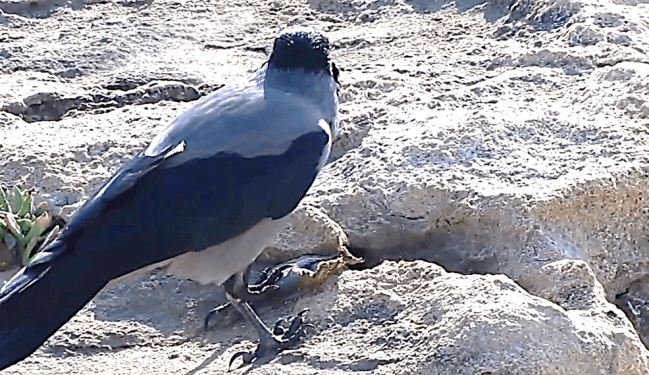
Like all corvids, the crow is also extremely intelligent. Specimens of Corvus cornix [hooded crow] living on European coasts have developed a simple yet surprising nutrition strategy. To feed on molluscs, they drop the shells from heights … [so] that they shatter on the first attempt, so that they can feed on the animal hidden inside. Furthermore, they deliberately ignore smaller shells and focus on those that guarantee a larger meal.
[Quoting Federico Fiorillo, “The Hooded Crow—Not So Pretty, But Very Smart”, AviBirds.com (accessed AD2021-12-29)]
In other words, Scotch Crows—like the Scotch people—are opportunistic, versatile, adaptable, flexible, resourceful. Whatever is available will be used to achieve whatever is needed. Very Scottish! And the Scotch Crows (a/k/a Hooded Crows) of the Western Isles are no exception—they will find and eat what they need! 😊
So, what could be more Scottish than a “Scotch Crow”? Wonderful birds are there to be seen, in the Outer Hebrides (“Western Isles”). If you get the opportunity, go see them! Meanwhile, appreciate that they are there, living their daily lives—filling their part of the earth—glorifying their Creator. As Isaiah (42:12) said, these birds cause God’s glory, especially in the islands, to be clearly seen (Romans 1:20).
Top 100 Bird Blogs and Websites For Ornithologists and Bird Lovers
This blog has been selected “by our panelist as one of the Top 100 Bird Blogs on the web.” Wow! What an honor and totally unexpected.
I received an email from the Founder of this list, Anuj Agarwal.
“I personally give you a high-five and want to thank you for your contribution to this world. This is the most comprehensive list of Top 100 Bird Blogs on the internet, and I’m honored to have you as part of this!”
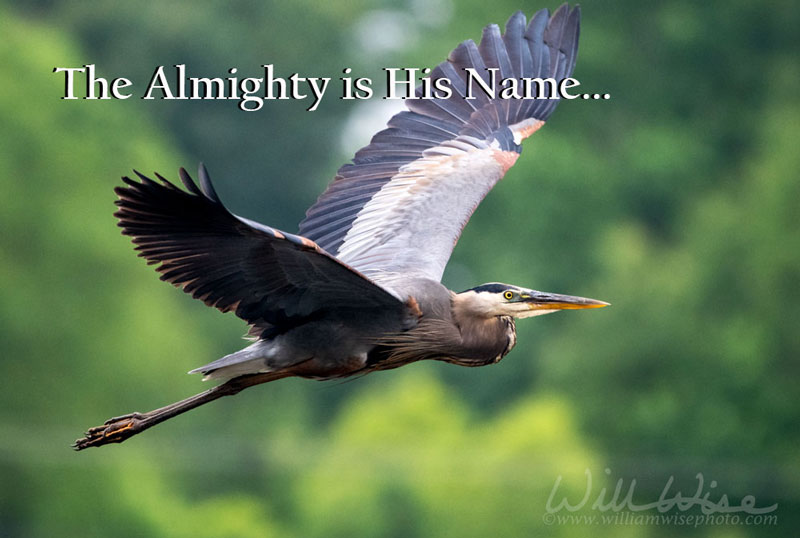
Great Blue Heron; Walton County, Georgia birding photogaphy blog by williamwisephoto.com
Plus, Thank you to our many previous writers like a j mithra, Dottie Malcolm, and others. Also, all the fantastic photographers who have given us permission to use their photos over the years. Especially, my husband, Dan.
The biggest Thanks and Praise goes to the Lord for giving me the idea and inspiration to begin this journey of writing about His Fantastic Avian Creations!
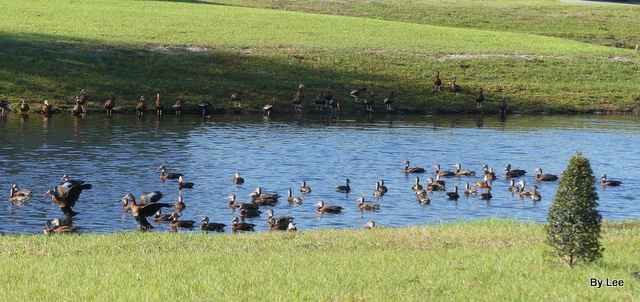
I was excited several weeks ago when the Black-Bellied Whistling Ducks started showing back up from their summer haunts. Then the Alligator showed up, and they flew off to safer waters.
This last week, one of the alligators came up on our back yard. Dan called me, but by the time I got to the window, it had returned to the water. I was able to take this video:
So now, it is really quiet out back. Just found out yesterday that there are actually three of them back there. Yep, it’s quiet around here for birdwatching!!!
“And that ye study to be quiet, and to do your own business, and to work with your own hands, as we commanded you;” (1 Thessalonians 4:11 KJV)
Along with this excitement, and boring birdwatching, my computer has still been giving me problems. So, I have been sort of “quiet” on posting here. Yet, I have been busy doing things around the house. With Covid still hanging around, even though we are vaccinated, we are older and are just staying home much more than normal.
Hopefully, things will pick up soon, and the computer will behave. Stay tuned! Just checking in.
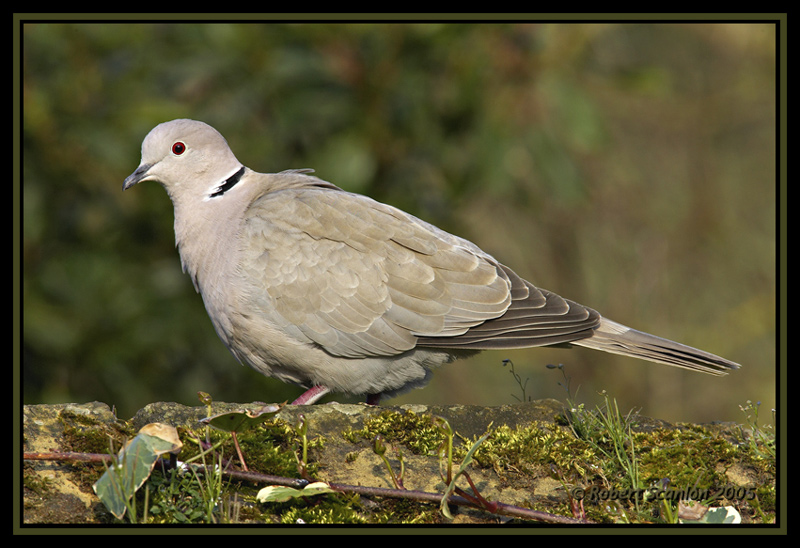
Collared Dove (Streptopelia decaocto) by Robert Scanlon. Now there’s a Burmese Collard Dove (Streptopelia xanthocycla) split off from it.
Wow! Since I last updated the World Bird List here on this site, 154 new Species have been added, 4 Ordershave been added, 2 Families have been added, and 52 Genera have been added in the last two years.
The IOC World Bird List 9.2 contains 10,758 extant species (and 158 extinct species) classified in 40Orders, 250Families and 2,320 Genera. The list also includes 20,034 subspecies, their ranges and authors.
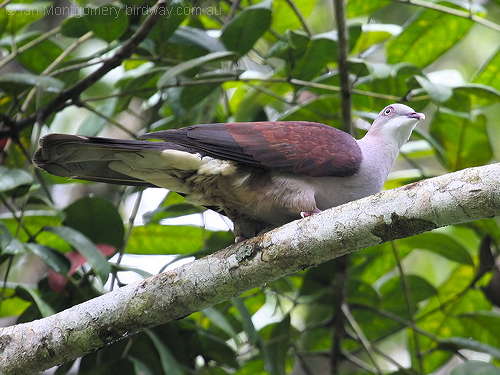
Mountain Imperial-Pigeon (Ducula badia) by Ian. Now there’s a Malabar Imperial Pigeon Ducula cuprea is split from Mountain Imperial Pigeon Ducula badia.
This is the new count:
Version 11.2 (July 15, 2021)
The IOC World Bird List 11.2 contains 10,912 extant species (and 160 extinct species) classified in 44 Orders, 252 Families and 2,372 Genera. The list also includes 19,889 subspecies, their ranges and authors.
Over the next few days, (or weeks) I hope to update our pages to the current list. Because of Covid concerns (no birding), and some health issues, I have neglected to update these. I am curious as to what they have added and deleted in the last few years. Stay tuned!
“For I am the LORD, I change not;” (Malachi 3:6 KJV)
Thankfully, Our Lord does not change!!
I did list some of the changes to the 10.1 version, but didn’t update the site. See:
I just discovered these Name Changes to 10.1 as I was finishing this article up. I just may do the same for 10.2 and 11.1 versions so you can see the changes in smaller batches. Stay tuned some more!
So, expect the links to the list to be changing as this process is on going:
I stated that, “A good friend of mine, Rhonda Sawtelle, (Create a Positive Day), has been posting every day on her Facebook a different attribute of our Lord God. She has been going through them alphabetically. What if each day, we had a different attribute and a bird that starts with that same letter. My challenge is to try to at least get through the alphabet at least once. Maybe several rounds. Stay tuned!” [By the way, she still has her blog.] I did manage to come up with at least an attribute and a bird for each letter of the alphabet, though I pushed it a few times, like with “X”.
If you would like to review them, or see them for the first time, see below. You can also find this list in the left menu as Avian and Attributes.
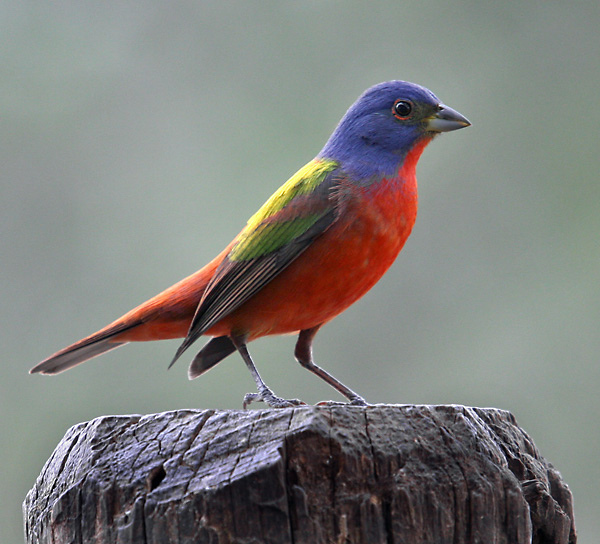
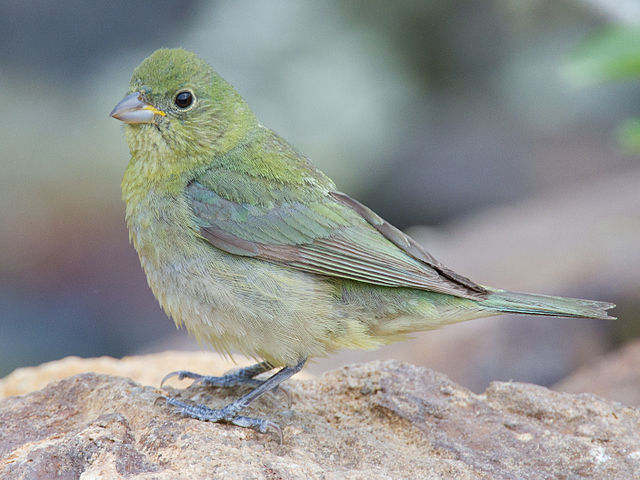
Every since my first encounter with a Painted Bunting, they have been one of top favorites. [notice I have lots of favorites :)] When we lived in south Florida, I turned to look out my window and saw one of the Avian Wonders on my feeder hanging under the awning. Wow!!! I am sure my eyes were about ready to pop out!! What a beauty! This definitely qualifies for a Paintbrush Bird. In fact, it looks like the Creator had several bushes with a dab of color on each and painted these gorgeous birds.
The male painted bunting is often described as the most beautiful bird in North America and as such has been nicknamed nonpareil, or “without equal”. Its colors, dark blue head, green back, red rump, and underparts, make it extremely easy to identify, but it can still be difficult to spot since it often skulks in foliage even when it is singing. The plumage of female and juvenile painted buntings is green and yellow-green, serving as camouflage. Once seen, the adult female is still distinctive, since it is a brighter, truer green than other similar songbirds.
The juveniles have two inserted molts in their first autumn, each yielding plumage like an adult female.
The painted bunting occupies typical habitat for a member of its family. It is found in thickets, woodland edges with riparian thickets, shrubbery and brushy areas. In the east, the species breeds in maritime hammocks and scrub communities. Today, it is often found along roadsides and in suburban areas, and in gardens with dense, shrubby vegetation. The wintering habitat is typically the shrubby edges along the border of tropical forests or densely vegetated savanna. The breeding range is divided into two geographically separate areas. These include southern Arizona, southern New Mexico, southern and eastern Texas, Oklahoma, Arkansas, Louisiana, northern Florida, coastal Georgia, the southern coast and inland waterways such as the Santee River of South Carolina and northern Mexico. They winter in South Florida, Cuba, the Bahamas, along both coasts of Mexico and through much of Central America. Occasionally, they may be vagrants further north, including to New York, Pennsylvania, and New Jersey. The bird is also found every few years as far north as New Brunswick, Canada. (Wikipedia, with editing)
Great Verses:
“Now Israel loved Joseph more than all his children, because he was the son of his old age. Also he made him a tunic of many colors.” (Genesis 37:3 NKJV)
“The rainbowshall be in the cloud, and I will look on it to remember the everlasting covenant between God and every living creature of all flesh that is on the earth.” (Genesis 9:16 NKJV) [Maybe the Lord gave us a “small reminder” of His rainbow for bright sunny days when our Painted Bunting is flitting about.]