Top 100 Bird Blogs and Websites For Ornithologists and Bird Lovers
This blog has been selected “by our panelist as one of the Top 100 Bird Blogs on the web.” Wow! What an honor and totally unexpected.
I received an email from the Founder of this list, Anuj Agarwal.
“I personally give you a high-five and want to thank you for your contribution to this world. This is the most comprehensive list of Top 100 Bird Blogs on the internet, and I’m honored to have you as part of this!”
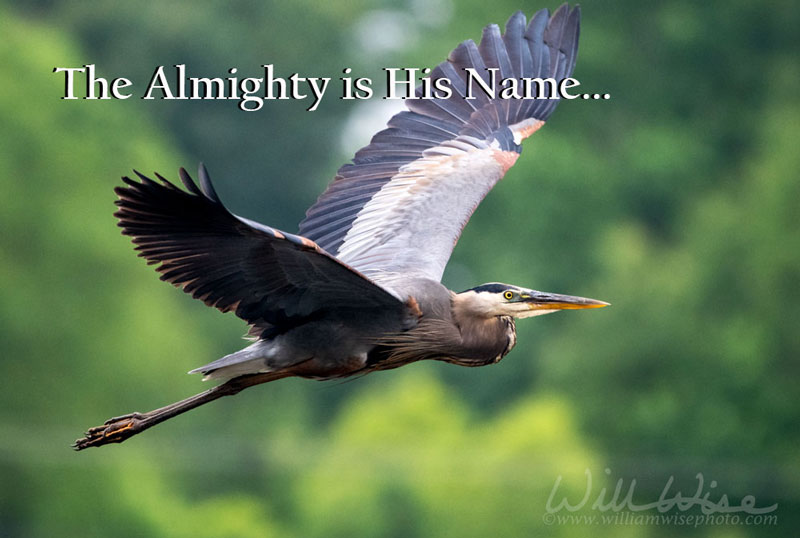
Great Blue Heron; Walton County, Georgia birding photogaphy blog by williamwisephoto.com
Plus, Thank you to our many previous writers like a j mithra, Dottie Malcolm, and others. Also, all the fantastic photographers who have given us permission to use their photos over the years. Especially, my husband, Dan.
The biggest Thanks and Praise goes to the Lord for giving me the idea and inspiration to begin this journey of writing about His Fantastic Avian Creations!
Reginald, Oliver, and the rest of the turkeys spent all winter down south near the Oliver’s Ocean, which the turkeys had decided to call the lake they had visited. By early spring, however, the weather grew much warmer. The turkeys came together and decided to start for home. After saying goodbye to the turkey friends they had made at the orchard, Reginald slowly led his group back to the north.
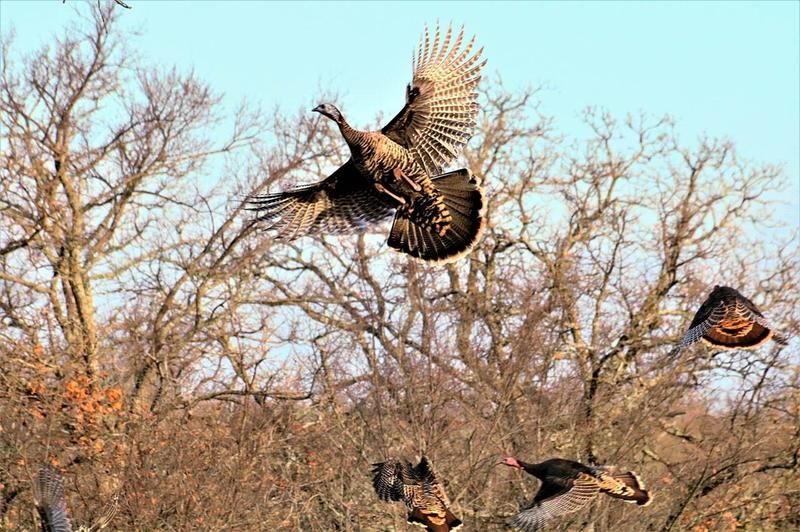
Turkeys Taking Flight (PD)
The turkeys enjoyed the weather up north now that winter had gone. To them, it was cold but not too cold, and most of the snow was quickly melting. But Reginald still had to guide the turkeys through different paths that he and a few others would have to create. Sometimes, the snow was soft enough to crush under their feet and walk through, but other times they had to climb over a large pile in their way. Oliver enjoyed stomping through the puddles, though once he fell into a hole he believed was a puddle, and Reginald had to help drag him out as Oliver flailed. The turkeys eventually made it back to their fortress, which was mostly clear of snow.
Inside the tunnels they had built, the turkeys worked to clear the remaining snow so they could easily walk through all the tunnels. They all hoped that, now that it was Spring, they wouldn’t have to worry about the cold, and they looked forward to heading back to their turkey friends in the South next winter.
But one day, Reginald woke up and realized that the weather was incredibly cold. He tried to look outside, but the entrance to the front of the fortress was covered with a dark wall of snow that he couldn’t get through. The rest of the turkeys sleeping on that side woke up and tried to help Reginald push the snow away, but it was too thick. Some of them tried gobbling for help, but the rest of the turkeys couldn’t hear them.
Inside another set of tunnels, Oliver woke up and noticed the snow as well. Luckily, he and a few other turkeys were able to scramble out of an opening and examine the woods around the fortress. Several inches of snow lay around and on top of the fortress the turkeys had made, with some of the tunnels clogged with slush. Oliver suddenly realized that Reginald and the others must be stuck inside since they hadn’t come out.
Oliver sat in the snow and started thinking. The few other turkeys waited, unsure of what to do. Oliver knew he needed to come up with a good idea to clear the snow away so that the others could get out. After thinking long and hard, however, Oliver still couldn’t come up with anything.
Broken Limb/Branch off of Tree
Just then, a branch from one of the trees above him dropped onto his head, knocking Oliver over. One of the other turkeys with him had to pull it off. When Oliver got up, he noticed how the branch made marks in the snow, and suddenly he came up with an idea.
Oliver told the turkeys that he needed their help taking the branch to the tunnel entrance. One of the turkeys went ahead to locate where Reginald was trapped. As Oliver carried the branch ahead, the other turkey found the entrance to the tunnel where Reginald and the other turkeys were. Immediately, Oliver placed the branch in the snow and used its limbs to drag the snow away. The branch caught large chunks of snow and helped Oliver clear it away. The other turkeys helped by using their feathers, until most of the snow was cleared. Reginald pushed the rest aside and was surprised to discover Oliver with the branch, along with the other turkeys.
Collecting Branches
Reginald, impressed at Oliver’s idea and leadership, allowed Oliver to use the branch to clear the rest of the snow so that all the turkeys could get out. They all agreed to find more branches similar to the one Oliver discovered so they could keep clearing the snow once it snowed again.
Fortunately, no more snow fell, and the air started to get warmer again. In a couple more days, most of the new snow had melted, so the turkeys didn’t have to worry about being trapped again. They were now free to enjoy the spring without the snow, though Reginald asked Oliver to continue finding branches so that they would be prepared.
“Two are better than one because they have a good return for their labor. For if either of them falls, the one will lift up his companion. But woe to the one who falls when there is not another to lift him up.” (Ecclesiastes 4:9-10 NASB)
Lee’s Addition:
It is nice to receive another story from Emma. She has been busy growing up and finishing College and adventures beyond.
We have enjoyed all her stories, and you can read or re-read them here at:
Just as monkeys can’t accidently type Shakespeare texts, birds can’t migrate by evolutionary luck, despite imagined eons of time for “lucky” accidents.1 Why? Because the challenging mix of birds’ metabolic needs for long-distance travel, synchronized to seasonal and diurnal weather conditions, are exacerbated by unyielding entropy. This all-or-nothing complexity prohibits “lucky” bird migrations. In short, to seasonally migrate, birds need the Lord Jesus Christ’s providential bioengineering care.2,3
Flight failures are tragic when malfunctioning airplanes or spacecraft fall out of the sky.3 Likewise, if bird traits malfunctioned while trying to evolve migratory flight features, there would be no second chances.1 So, either birds are aptly fitted by their Creator with migration traits or they can’t migrate.4,5
Consider the air speeds that birds need to maintain over long distances before their flying fuel (i.e., metabolic assets dedicated to long-distance flight needs) is depleted.
The birds’ flight speed in relation to the air varies in general between approximately 30 km per hour, for the smallest birds, and 80 km per hour, for larger birds.…When the bird’s mass increases 100 times, then 200 times as much flight power is required.4
The muscle power cannot, however, increase much more than the weight. Provided that the proportions are the same, the wing area is only 20 times as great in a bird that weighs 100 times more than another. The limited muscle power and wing area of heavy birds, in combination with the very high flight power that is required [for long-distance migrations], sets a size limit above which flying is no longer possible. This limit is estimated to be around 15 kg. This corresponds well with the weight of the largest animals in the world that can actively fly—swans, bustards, albatrosses and condors.4
Thus, interplay between flight speed and muscle power balances the complicated physics required for non-fixed-wing flying against long-distance migration.2-5
Moreover, the unforgiving biochemistry and physiology of each migratory bird’s metabolism (food acquisition, fuel utilization, respiration, etc.) must aptly fit the ongoing needs of seasonal migrations or else avian biochemical logistics fail.4,5 Thankfully, for all migratory birds—and all birdwatchers—the phenological phenomena of bird migrations is not dependent upon “luck,” as imagined by evolutionists.3,5 Rather, none less than the Lord Jesus Christ deserves all credit and acclaim for these winged wonders of biogeographic beauty.
“But now ask…the birds of the air, and they will tell [literally “explain to,” or “clarify to”] you…that the hand of the LORD has done this, in Whose hand is the life of every living thing.” (Job 12:7-10)
References
“Thus, eons of time guarantee that the simian keypunchers can never type out Hamlet—the imagined luck is ‘not to be.’ Time plus entropy prevents the spontaneous generation of life and any hope of evolution.” Johnson, J. J. S. 2018. Infinite Time Won’t Rescue Evolution. Acts & Facts. 47 (6): 21. Complex bird anatomies cannot spontaneously self-assemble, apart from Christ’s bioengineering providence, because ubiquitous entropy (i.e., the 2nd Law of Thermodynamics) absolutely prevents any mix of biochemicals from magically combining into purpose-working “all-or-nothing-unity” systems, regardless of how much time is allowed, because infinite time guarantees that (our fallen universe’s) entropy bars any such luck.
“The rule of thumb is that the speed roughly doubles when the mass of the bird increases 100 times. If a 10-g Willow Warbler flies at 30 km per hour, then a Raven of 1 kg [1,000 grams] flies, in round figures, at 60 km per hour. …The capacity of the flight muscles sets a ‘ceiling’ to how much flight power a bird can cope with—a lower ceiling for continuous power outtake and a somewhat higher ceiling for temporary all-out bursts. After this sort of brief ‘muscle spurt’ the muscles have to wind down while the lactic acid which is formed in the muscle tissue when energy is produced without sufficient oxygen supply is carried away.” Alerstam, T. 1993. Bird Migration. New York: Cambridge University Press, 252.
“Even the youths shall faint and be weary, and the young men shall utterly fall: but they that wait upon the LORD shall renew their strength; they shall mount up with wings as eagles; they shall run, and not be weary; and they shall walk, and not faint.”
As I sit in my backyard, enjoying some springtime sunshine while writing this script, my eyes are drawn to a pair of shapes, silhouetted against a bright sky, circling over the Cowlitz River. They look dark from where I am sitting, but I know that if they landed, they would not be so dark, and they would have white heads. They are eagles. A pair of them have been around this area since we moved here about three years ago.
I love the way that eagles seem to fly as if they are not flying. They catch the air currents, and their large outstretched wings enjoy a lift force which is not from their own muscles, but from those air currents. To maintain that height for so long by their own muscle power would be too tiring for such large, flying birds.
The way that these eagles soar is used in the Bible as a beautiful illustration of God’s grace. In Isaiah 40:31 we read:
“They who wait for the LORD shall renew their strength; they shall mount up with wings like eagles; they shall run and not be weary; they shall walk and not faint.”
One can imagine that getting into the air, and flying high would cause the eagle to lose energy. But then it can rest and renew its strength. The Lord reminds us, through the things that He has created, that we should wait upon Him and rely on His strength.
Prayer: Help us, Father God, to wait for You, and to renew our strength through the grace that You give us. Amen.
Author: Paul F. Taylor
Ref: With Wings Like Eagles , accessed 4/24/2020. Image: David R. Tribble, CC BY-SA 4.0 International.
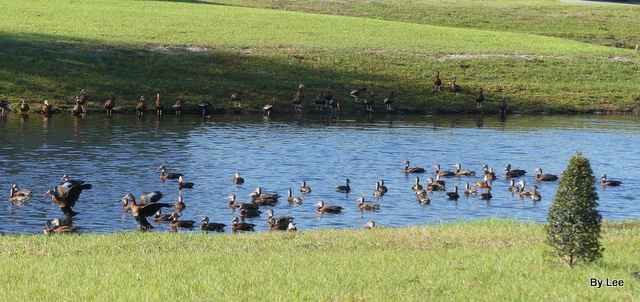
I was excited several weeks ago when the Black-Bellied Whistling Ducks started showing back up from their summer haunts. Then the Alligator showed up, and they flew off to safer waters.
This last week, one of the alligators came up on our back yard. Dan called me, but by the time I got to the window, it had returned to the water. I was able to take this video:
So now, it is really quiet out back. Just found out yesterday that there are actually three of them back there. Yep, it’s quiet around here for birdwatching!!!
“And that ye study to be quiet, and to do your own business, and to work with your own hands, as we commanded you;” (1 Thessalonians 4:11 KJV)
Along with this excitement, and boring birdwatching, my computer has still been giving me problems. So, I have been sort of “quiet” on posting here. Yet, I have been busy doing things around the house. With Covid still hanging around, even though we are vaccinated, we are older and are just staying home much more than normal.
Hopefully, things will pick up soon, and the computer will behave. Stay tuned! Just checking in.
“But those who wait upon the LORD shall renew their strength; they shall mount up with wings as eagles; they shall run, and not be weary; and they shall walk, and not faint.” (Isaiah 40:31)
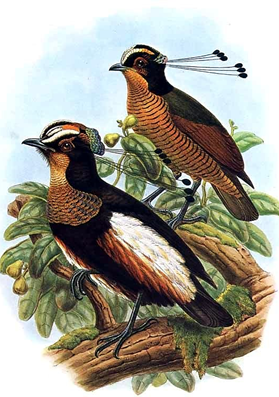
QUEEN CAROLA’S PAROTIA [Wikipedia image]
Learning to wait is a virtue, called patience (Romans 8:25; Galatians 6:9; 1st Corinthians 13:4), and waiting in line is often called “queueing up”. So here are 3 birds to “Q up” our appreciation for avian variety.
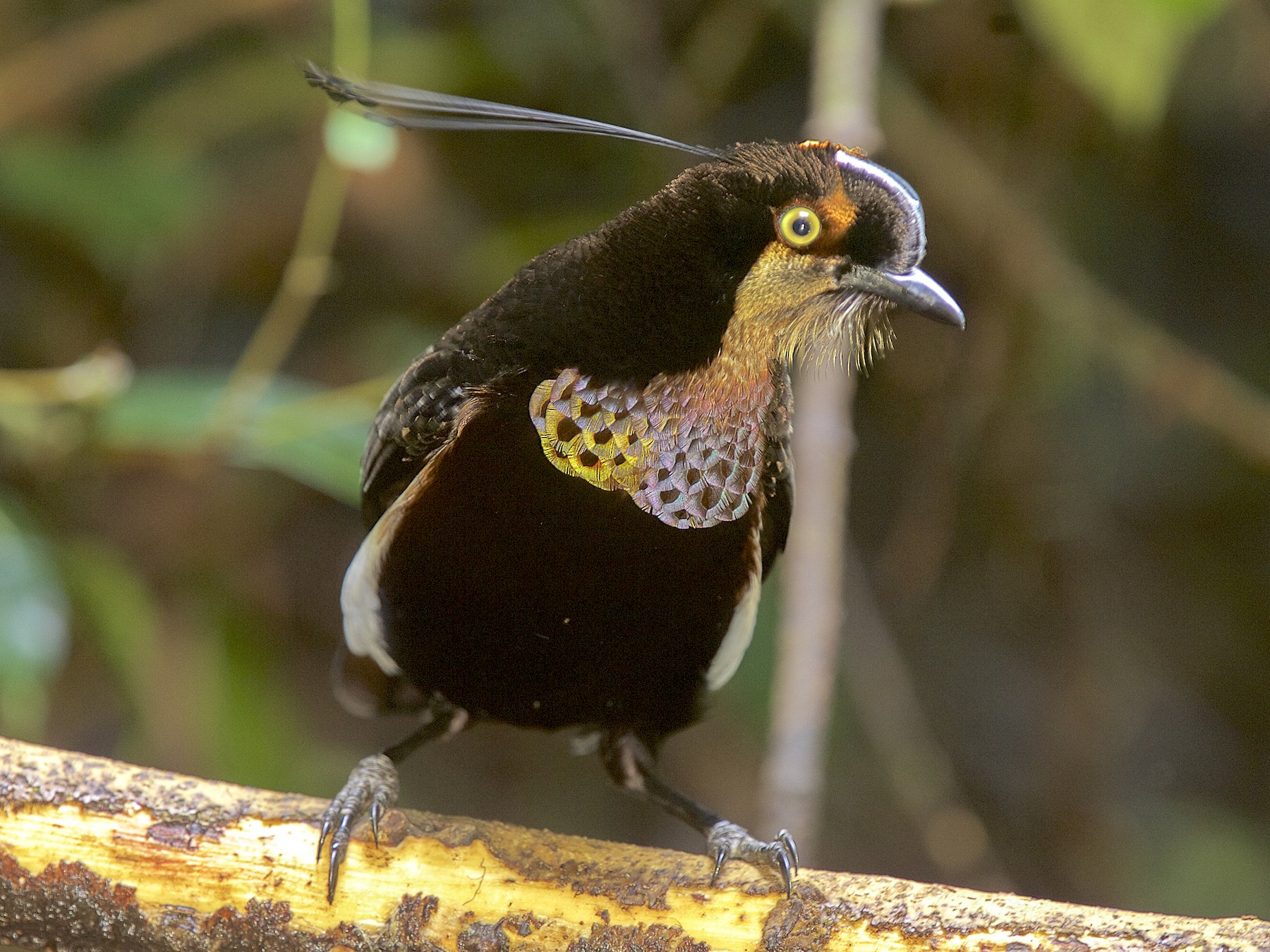
QUEEN CAROLA’S PAROTIA [ eBird.org photo credit ]
QUEEN CAROLA’S PAROTIA, also called “Queen Carola’s 6-wired Bird-of-Paradise”, are endemic (natively populated) only to New Guinea, the largest island in the Indonesian archipelago. Parotias are part of the bird-of-paradise family, and like their cousins, they perform histrionic ballet-like dances (called “leks”) upon forest dance-floors (flat areas of forest floor swept clean of loose vegetation and debris). In such dances the male hops around and bobs his crest-feathered head, like a bobble-head toy, puffing his chest plumage, fluttering his wings, fanning his kilt-like feathers, and other enthusiastic displays of “showing off for the girls”.
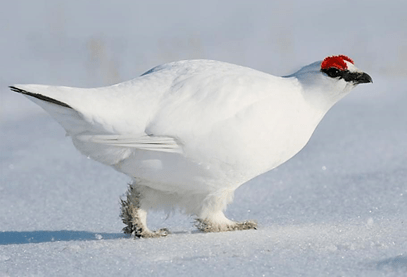
ROCK PTARMIGAN [Cornell Lab of Ornithology photo credit ]
QUAIL are various “galliform” ground-fowl (chicken-like birds), such as bobwhite quail, California quail, partridges, ptarmigans, and red grouse. Willow ptarmigans and rock ptarmigans have feather-covered feet and toes, resembling snowshoe rabbits. Like snowshoe rabbits (with winter “snow” coats and brown summer coats), the Rock Ptarmigan’s white winter plumage camouflages with snow, and its brown summer plumage with wooded areas.
QUETZAL [Mexico Daily News photo]
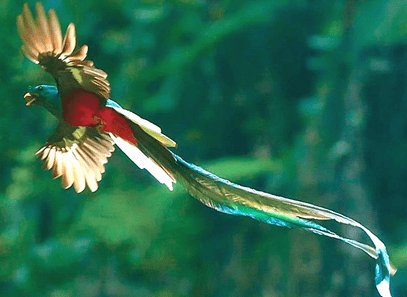
QUETZALS are fancy trogon-birds, sporting flamboyant colors and long streamer-tails. Latin American jungles and subtropical wet forests are habitats of Pavonine Quetzals, Crested Quetzals, Resplendent Quetzals, Golden-headed Quetzals, and White-tipped Quetzals. Eared Quetzals live near streams in Mexico’s pine-oak forests and canyons.
“He that dwelleth in the secret place of the most High shall abide under the shadow of the Almighty. I will say of the LORD, He is my refuge and my fortress: my God; in him will I trust.” (Psalms 91:1-2 KJV)
We had a fantastic message yesterday from our Pastor, Dave Totman. It was based on Psalm 91, “Shadow of the Almighty.”
Needless to say, there were many references to our Creator’s Avian Wonders. Just thought you would enjoy watching this.
Praise the Lord for His watch care and protection of us!
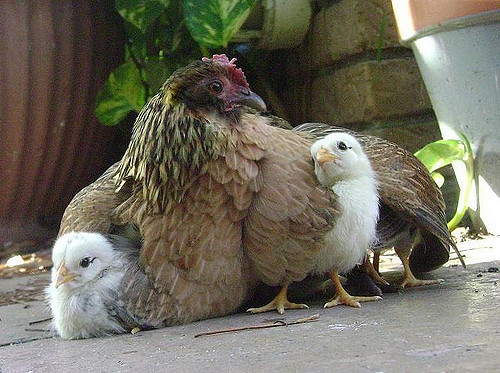
Gathering Her Chicks Under Her Wings
“He shall cover thee with his feathers, and under his wings shalt thou trust: his truth shall be thy shield and buckler. Thou shalt not be afraid for the terror by night; nor for the arrow that flieth by day;” (Psalms 91:4-5 KJV)
Here is a Killdeer protecting her eggs from a farm tractor. Almost hard to watch. [But it turns out okay!]
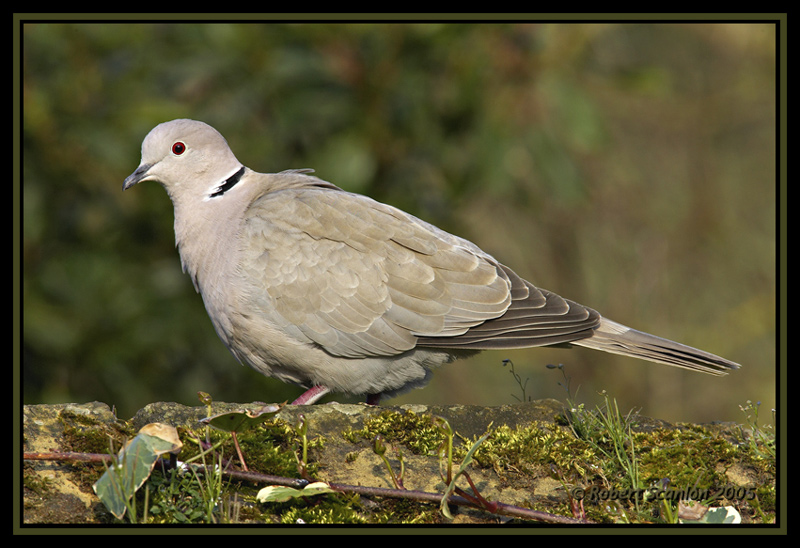
Collared Dove (Streptopelia decaocto) by Robert Scanlon. Now there’s a Burmese Collard Dove (Streptopelia xanthocycla) split off from it.
Wow! Since I last updated the World Bird List here on this site, 154 new Species have been added, 4 Ordershave been added, 2 Families have been added, and 52 Genera have been added in the last two years.
The IOC World Bird List 9.2 contains 10,758 extant species (and 158 extinct species) classified in 40Orders, 250Families and 2,320 Genera. The list also includes 20,034 subspecies, their ranges and authors.
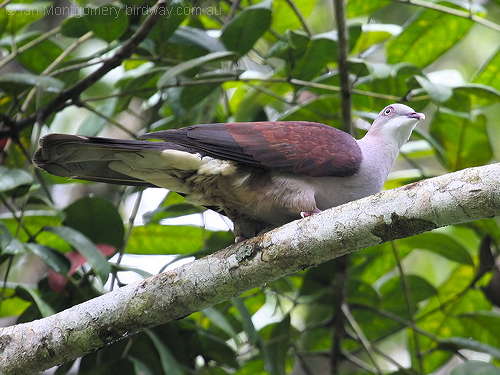
Mountain Imperial-Pigeon (Ducula badia) by Ian. Now there’s a Malabar Imperial Pigeon Ducula cuprea is split from Mountain Imperial Pigeon Ducula badia.
This is the new count:
Version 11.2 (July 15, 2021)
The IOC World Bird List 11.2 contains 10,912 extant species (and 160 extinct species) classified in 44 Orders, 252 Families and 2,372 Genera. The list also includes 19,889 subspecies, their ranges and authors.
Over the next few days, (or weeks) I hope to update our pages to the current list. Because of Covid concerns (no birding), and some health issues, I have neglected to update these. I am curious as to what they have added and deleted in the last few years. Stay tuned!
“For I am the LORD, I change not;” (Malachi 3:6 KJV)
Thankfully, Our Lord does not change!!
I did list some of the changes to the 10.1 version, but didn’t update the site. See:
I just discovered these Name Changes to 10.1 as I was finishing this article up. I just may do the same for 10.2 and 11.1 versions so you can see the changes in smaller batches. Stay tuned some more!
So, expect the links to the list to be changing as this process is on going:
Q: Are today’s birds genealogical ‘cousins’ to today’s reptiles, due to a shared (evolutionary) ancestry?
A: No. However, birds and reptiles share the same Creator, the Lord Jesus Christ, Who created them to share the same earth.
All flesh is not the same flesh: but there is one kind of flesh of men, another flesh of beasts, another of fishes, and another of birds.
1st Corinthians 15:39
According to the evolutionary sequence of [imagined] events, birds are supposed to have evolved from reptiles.3
If that had occurred in the past, which it did not, it would mean that today’s birds—such as robins and roadrunners—would be distant ‘cousins’ of reptiles—such as cobras and crocodiles.
The Darwinian tale portrays today’s birds as winged dinosaurs who supposedly survived a global ‘extinction event’ that supposedly occurred about 66,000,000 years ago.1,2
Is there any eyewitness report supporting this magical scenario, or even evidence of any such timeframe? No and no.4,5
Although there are myriads of errors in this sensational speculation, only a few of which are mentioned here.
In particular, this pseudoscience scenario requires swallowing at least three invalid and drastic premises:
(1) the assumption that reptiles are not fundamentally different from birds;3 and
(2) the assumption that a secret agent (oxymoronically named “Natural Selection”, as if “its” naturalistic outcomes were intended) can accidently invent—and then successfully secure(i.e., genetically “lock down”)—such traumatic transitional transmogrifications;5 and
(3) the assumption that any such transitions’ biochemical and genetic details, in defiance of entropy’s universal destructiveness, repeatedly escaped thermodynamic reality.5
For starters, just imagine the first-listed problem, i.e., the complicated anatomical and physiological differences between birds and reptiles:
birds have hollow bones; reptiles, except for marrow cavities, have solid bones.
birds use air sacs for non-stop unidirectional (one-way) airflow through their lungs; most reptiles have two-way breathing systems.
birds are endothermic (warm-blooded), actively controlling their body “thermostats”; reptiles are mostly ectothermic (cold-blooded).
birds have muscle-controlled feathers; reptiles have dry skins or scales.
birds have four-chambered hearts; reptiles usually have three-chambered hearts.
So don’t expect reptiles to accidentally change their genes to produce birds as descendants!
As Australian creation scientist Fiona Smith once said:
In other words, you don’t just put feathers on a reptile and then it can fly. There are a multitude of [essential] attributes, all working together, that make a bird fly.2
There is much more proof—to borrow Dr. Frank Sherwin’s observations—that birds have always (and only) been birds, and that reptiles have always (and only) been reptiles.
References
1 For centuries evolutionists have proposed the notion that birds somehow evolved from reptiles, imagining “feathered dinosaurs” or dinosaur-like flying reptiles (like pterodactyls) as speculative ‘transitional’ animals. Burnett, R. W., H. I, Fisher, and H. S. Zim. 1958. Zoology: An Introduction to the Animal Kingdom. New York, NY: Simon and Schuster, 5-7, 13-17, 72-75; Zim, H. S., and I N. Gabrielson. 1964. Birds: A Guide to the Most Familiar American Birds. New York, NY: Golden Press, 12-13.
2 “Birds are incredible flying (and occasionally non-flying) machines. The Creator has designed these creatures with specialized flight apparatus, an amazing respiratory system, not to mention unbelievable migration and navigation abilities.” Sherwin, F. 2006. A ‘One-Hundred-Million-Year-Old Bird’ Is Still a Bird. Creation Science Update (June 20, 2006). See also Johnson, J. J. S. 2020. Wandering Albatross: Wide Wings on the Winds. Creation Science Update (July 2, 2020), citing Job 39:26-27 as illustrating God’s bioengineering that enables heavy birds to efficiently use wind current for launching their heavier-than-air bodies into the sky.
3 Smith, F. 2015. Evidence for Creation: A Tour through Some East-Australian Zoos. Fremantle, Western Australia: Vivid Publishing, 164-165 (quotation), 251. Fiona Smith, an Australian professional geoscientist and science educator, graduated ICR’s School of Biblical Apologetics, during 2015 with a Master of Christian Education degree (joint major in Biblical Education & Apologetics).
4 Regarding the need for reliable eyewitnesses, to learn the truth about unique events of the no-longer-observable past, see Johnson, J. J. S. 2016. There’s Nothing Like an Eyewitness. Acts & Facts. 45(12):20.
5 Regarding the ubiquitous and inescapable destructiveness of biochemical entropy, see Johnson, J. J. S. 2018. Infinite Time Won’t Rescue Evolution. Acts & Facts. 47(6):21. Regarding the animistic role that selectionists imagine “nature” as playing, in order to “favor” or “select” a series of genetic mutations for producing phenotypically survivability-“fit” outcomes, see Guliuzza, R. 2011. Darwin’s Sacred Imposter: The Illusion that Natural Selection Operates on Organisms. Acts & Facts. 50 (12).
I stated that, “A good friend of mine, Rhonda Sawtelle, (Create a Positive Day), has been posting every day on her Facebook a different attribute of our Lord God. She has been going through them alphabetically. What if each day, we had a different attribute and a bird that starts with that same letter. My challenge is to try to at least get through the alphabet at least once. Maybe several rounds. Stay tuned!” [By the way, she still has her blog.] I did manage to come up with at least an attribute and a bird for each letter of the alphabet, though I pushed it a few times, like with “X”.
If you would like to review them, or see them for the first time, see below. You can also find this list in the left menu as Avian and Attributes.
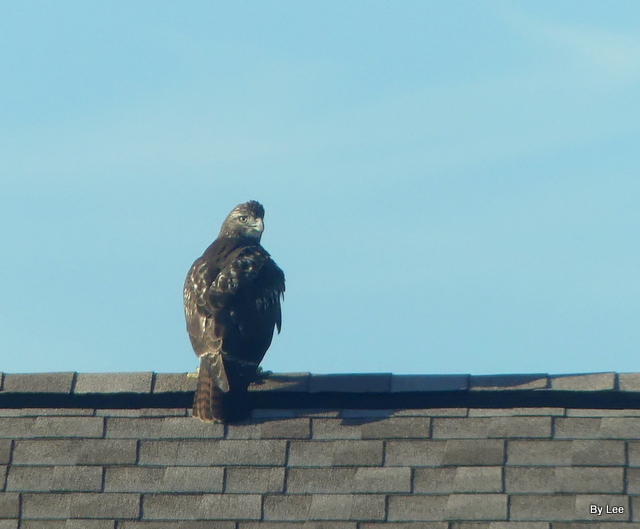
This morning we finally had a new visitor to the neighborhood. It has been rather quiet lately, plus my computer has been a having major problems. I think it is back up and running properly, I hope.
Any way, this morning while enjoying breakfast, we spotted our bird across the way on the neighbor’s roof. Checking our list of “backyard” birds, this is a new one for here. Zooming as best as can be, I believe this is juvenile or immature Red-tailed Hawk.
“Red-tailed Hawks are large, sharp-taloned birds that can be aggressive when defending nests or territories. They frequently chase off other hawks, eagles, and Great Horned Owls. Courting birds fly with legs hanging beneath them, or chase and swoop after each other, sometimes locking talons (see Cool Facts). Mated pairs typically stay together until one of the pair dies.” [All About Birds]
Church Signs:
People who fly into a rage always make a bad landing.
Christianity doesn’t guarantee a smooth flight, but it does provide a safe landing.
You can’t see where you’re going if you’re always looking backward..
Truths To Consider:
“Does the hawk fly by your wisdom, And spread its wings toward the south?” (Job 39:26 NKJV) “Blessed are those servants whom the master, when he comes, will find watching.” (Luke 12:37a NKJV)
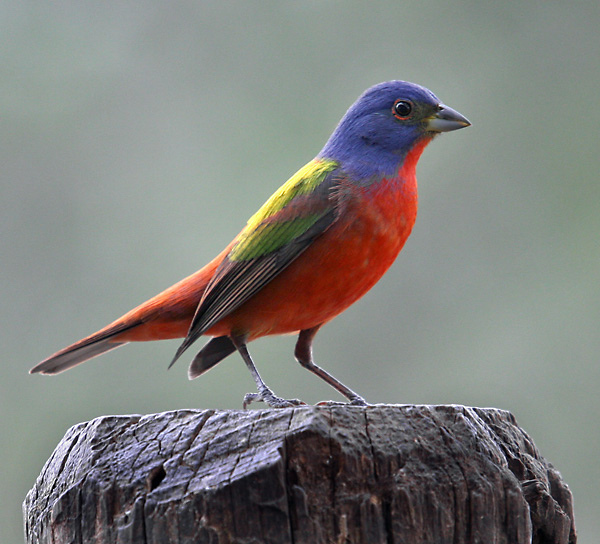
Every since my first encounter with a Painted Bunting, they have been one of top favorites. [notice I have lots of favorites :)] When we lived in south Florida, I turned to look out my window and saw one of the Avian Wonders on my feeder hanging under the awning. Wow!!! I am sure my eyes were about ready to pop out!! What a beauty! This definitely qualifies for a Paintbrush Bird. In fact, it looks like the Creator had several bushes with a dab of color on each and painted these gorgeous birds.
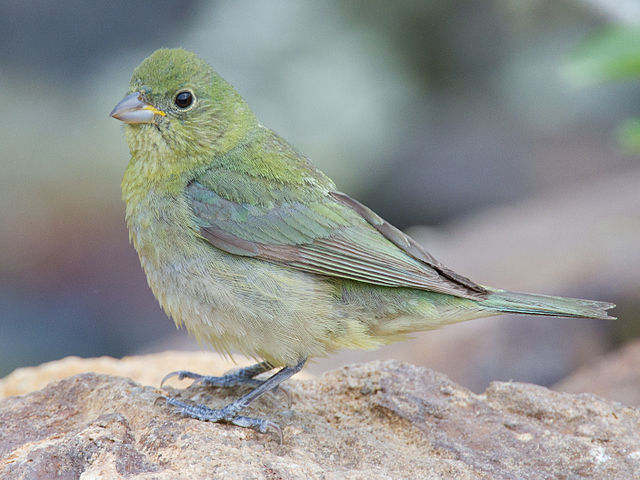
The male painted bunting is often described as the most beautiful bird in North America and as such has been nicknamed nonpareil, or “without equal”. Its colors, dark blue head, green back, red rump, and underparts, make it extremely easy to identify, but it can still be difficult to spot since it often skulks in foliage even when it is singing. The plumage of female and juvenile painted buntings is green and yellow-green, serving as camouflage. Once seen, the adult female is still distinctive, since it is a brighter, truer green than other similar songbirds.
The juveniles have two inserted molts in their first autumn, each yielding plumage like an adult female.
The painted bunting occupies typical habitat for a member of its family. It is found in thickets, woodland edges with riparian thickets, shrubbery and brushy areas. In the east, the species breeds in maritime hammocks and scrub communities. Today, it is often found along roadsides and in suburban areas, and in gardens with dense, shrubby vegetation. The wintering habitat is typically the shrubby edges along the border of tropical forests or densely vegetated savanna. The breeding range is divided into two geographically separate areas. These include southern Arizona, southern New Mexico, southern and eastern Texas, Oklahoma, Arkansas, Louisiana, northern Florida, coastal Georgia, the southern coast and inland waterways such as the Santee River of South Carolina and northern Mexico. They winter in South Florida, Cuba, the Bahamas, along both coasts of Mexico and through much of Central America. Occasionally, they may be vagrants further north, including to New York, Pennsylvania, and New Jersey. The bird is also found every few years as far north as New Brunswick, Canada. (Wikipedia, with editing)
Great Verses:
“Now Israel loved Joseph more than all his children, because he was the son of his old age. Also he made him a tunic of many colors.” (Genesis 37:3 NKJV)
“The rainbowshall be in the cloud, and I will look on it to remember the everlasting covenant between God and every living creature of all flesh that is on the earth.” (Genesis 9:16 NKJV) [Maybe the Lord gave us a “small reminder” of His rainbow for bright sunny days when our Painted Bunting is flitting about.]



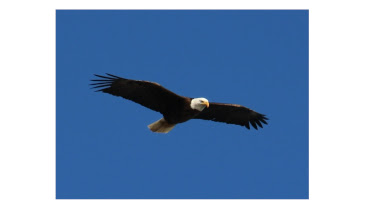 As I sit in my backyard, enjoying some springtime sunshine while writing this script, my eyes are drawn to a pair of shapes, silhouetted against a bright sky, circling over the Cowlitz River. They look dark from where I am sitting, but I know that if they landed, they would not be so dark, and they would have white heads. They are eagles. A pair of them have been around this area since we moved here about three years ago.