Bird Tales – The Woodpeckers Bird Band

Hairy Woodpecker (Picoides villosus) by Daves BirdingPix

Hairy Woodpecker (Picoides villosus) by Daves BirdingPix


The Woodpeckers Bird Band

The Woodpecker family were around on various trees drumming, drumming on the bark. Mr. Hairy Woodpecker, Mr. Downy Woodpecker, and Mr. Red-Headed Woodpecker were hard at work.

Downy Woodpecker (Picoides pubescens) by Raymond Barlow

Downy Woodpecker (Picoides pubescens) by Raymond Barlow

“Let’s start a band,” suggested Mr. Hairy Woodpecker.

Red-headed Woodpecker (Melanerpes erythrocephalus) ©USFWS

Red-headed Woodpecker (Melanerpes erythrocephalus) ©USFWS

“What’s that you say?” asked Mr. Red-Headed Woodpecker, who had been so busy at work that he had not heard what Mr. Hairy Woodpecker had been suggesting. “A band,” repeated Mr. Hairy Woodpecker. “What sort of a band?” asked Mr. Red-Headed Woodpecker. “In the first place,” continued Mr. Hairy Woodpecker, “our bills are not only fine tools for the work we have to do getting the insects from the trees, and burrowing for our nests, but they would be splendid to use in beating the drums in a band.” “Where would we get the drums?” asked Mr. Red-Headed Woodpecker. “The trees, of course, you silly!” said Mr. Hairy Woodpecker. “Oh yes, yes,” agreed Mr. Red-Headed Woodpecker. And Mr. Downy Woodpecker said, “Of course, of course. The trees will be our drums.”

American Goldfinch (Carduelis tristis) on Thistle by Fenton

American Goldfinch (Carduelis tristis) on Thistle by Fenton

“We’ll get the other birds,” said Mr. Hairy Woodpecker, “to help us. We need something in a band besides the drums. We will ask the goldfinches, the mocking-birds, the bobolinks, the phœbe and chickadee families, all of the warbler and vireo families, and the robins of course. Then I think we’ll ask the orioles, the whippoorwills, the thrush family, and the song sparrows.”

Carolina Chickadee (Poecile carolinensis) by Daves BirdingPix

Carolina Chickadee (Poecile carolinensis) by Daves BirdingPix

“Oh,” said Mr. Downy Woodpecker, “that will make a perfect band. We’d better get started right away.” And the woodpeckers began to practise. They made such a noise that the birds came from far and near to see what they were doing. Mr. Sapsucker, Mr. Crested Woodpecker, and Mr. Flicker Woodpecker had all joined in beating the drums too!

Yellow-bellied Sapsucker (Sphyrapicus varius) by Raymond Barlow

Yellow-bellied Sapsucker (Sphyrapicus varius) by Raymond Barlow

“Why are you making so much noise?” asked the birds as they flew around to the nearby trees to talk to the woodpeckers. “Oh,” said Mr. Hairy Woodpecker, “we were just going to ask you all to join our band. We will beat the drums.”

American Robin (Turdus migratorius) by Daves BirdingPix

American Robin (Turdus migratorius) by Daves BirdingPix

“And just what do you want us to do?” asked Mr. Robin Redbreast, who was always eager to help. “You must all sing.”

Song Sparrow (Melospiza melodia) by J Fenton

Song Sparrow (Melospiza melodia) by J Fenton

“But we all sing differently,” chirped a song sparrow. “We know different tunes and different songs.” “Oh,” said Mr. Hairy Woodpecker, “I never thought about that. But never mind, you can have little parts to sing alone, and other choruses where you will all sing together. I’m sure it will be a very fine band after we have practised.” And they began pounding the drums again. “Well,” said Mr. Robin Redbreast, “if the bird band isn’t to be the finest in the land, at least we’ll make a cheerful noise!”

Bobolink (Dolichonyx oryzivorus) by J Fenton

Bobolink (Dolichonyx oryzivorus) by J Fenton

* Another Bird Tale From

Daddy’s Bedtime Bird Stories – Gutenberg ebooks

By

Mary Graham Bonner

With four illustrations in color by Florence Choate and Elizabeth Curtis
Daddys Bedtime Story Images

These stories first appeared in the American Press Association Service and the Western Newspaper Union.


Many of the sketches in this volume are the work of Rebecca McCann, creator of the “Cheerful Cherub,” etc.

Daddy's Bedtime Bird Stories by Mary Graham Bonner - 1917

Daddy’s Bedtime Bird Stories by Mary Graham Bonner – 1917


Lee’s Addition:

Psalms 98:4-8 KJV (4) Make a joyful noise unto the LORD, all the earth: make a loud noise, and rejoice, and sing praise. (5) Sing unto the LORD with the harp; with the harp, and the voice of a psalm. (6) With trumpets and sound of cornet make a joyful noise before the LORD, the King. (7) Let the sea roar, and the fulness thereof; the world, and they that dwell therein. (8) Let the floods clap their hands: let the hills be joyful together

Meet the whole band: (a few missed the photo session)

This slideshow requires JavaScript.


*

*
Ian’s Bird of the Week – Rufous Whistler

Rufous Whistler (Pachycephala rufiventris) by Ian

Bird of the Week #493: Rufous Whistler ~ by Ian Montgomery

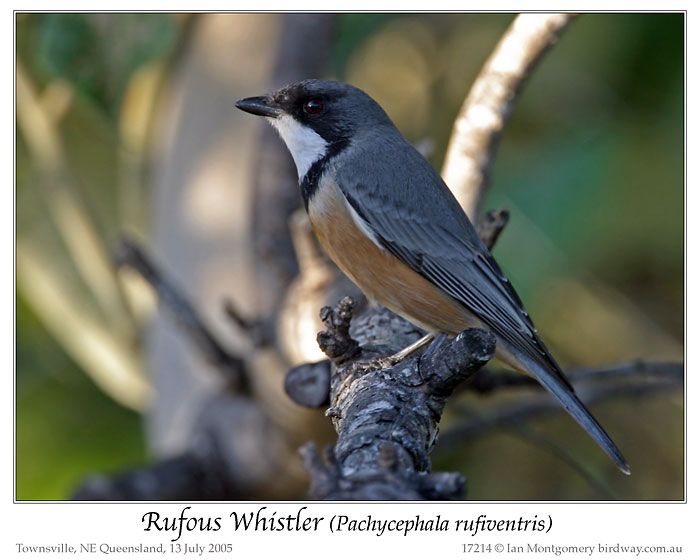
Here’s another good candidate for bird of the week that has slipped through the cracks. It’s a good candidate because it’s an attractive bird that sounds beautiful as well. Males are grey and black with a rufous belly, white throat and black breast band and look very dapper. The bird in the first two photos belongs to the nominate race rufiventris, widespread through most of mainland Australia but absent from Tasmania. Males of the nominate race have black eyebrows and lores (the area between the eye and the bill), more obvious in the first photo.

Rufous Whistler (Pachycephala rufiventris) by Ian

Rufous Whistlers are very vocal with a rich vocabulary which includes loud calls with a Whipbird-like finish – probably territorial between males – repeated ‘joey-joey-joey’ song and trills. The ‘joey’ song note, repeated up to 30 times, is sung by both sexes alternating and accompanied by a seesawing dancing motion of the body. This is wonderful to watch, and the male in the second photo is in mid-performance. The trills are apparently only made by the male.

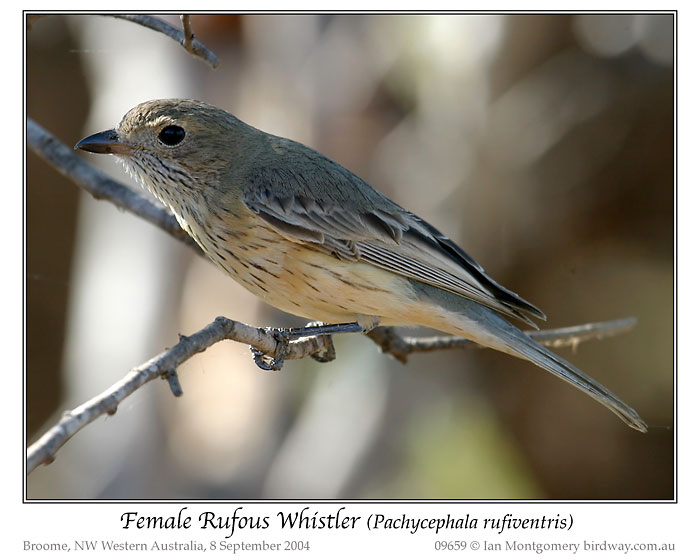
The third photo shows a female with grey back and rufous belly and streaked throat and breast.

Rufous Whistler (Pachycephala rufiventris) Female by Ian

Rufous Whistler (Pachycephala rufiventris) Female by Ian

Juveniles are similar to females, but with browner upper-parts, heavier streaks, bills with a pale base, and rufous edges to the flight feathers (as do immatures of other species such as the Golden Whistler), fourth photo.

Rufous Whistler (Pachycephala rufiventris) Juvenile by Ian

Rufous Whistler (Pachycephala rufiventris) Juvenile by Ian

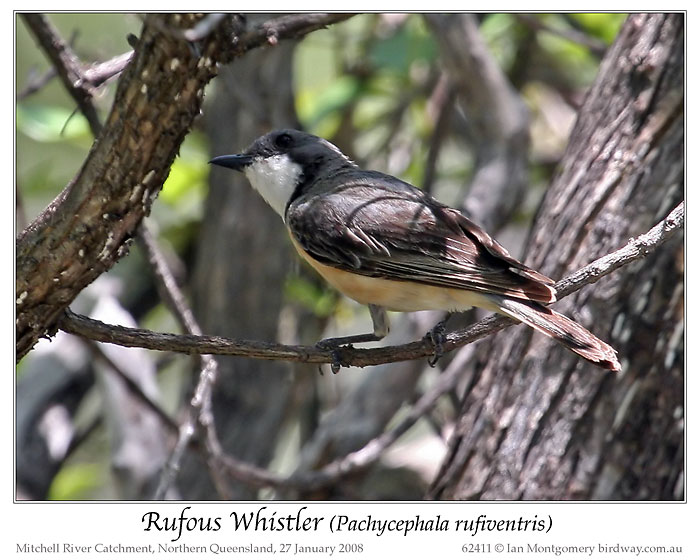
Several other races have been described in Northern Australia, and the males of these generally lack the black eyebrow, see the fifth photo. This bird belongs to perhaps the most distinctive race pallida which has a much paler belly, and this race is found in Cape York, e.g. the Mitchell River Catchment, and Northwestern Queensland.

Rufous Whistler (Pachycephala rufiventris pallida) by Ian

Rufous Whistler (Pachycephala rufiventris pallida) by Ian

The large heads of the Whistlers gives the genus the unflattering name Pachycephala (‘thick-head’) and the family the name Pachycephalidae – http://www.birdway.com.au/pachycephalidae/index.htm.

Best wishes
Ian

**************************************************
Ian Montgomery, Birdway Pty Ltd,
454 Forestry Road, Bluewater, Qld 4818
Tel 0411 602 737 ian@birdway.com.au
Bird Photos http://www.birdway.com.au/
Recorder Society http://www.nqrs.org.au


Lee’s Addition:

He will raise a signal for nations far away, and whistle for them from the ends of the earth; and behold, quickly, speedily they come! (Isaiah 5:26 ESV)

Xeno-canto Rufous Whistlers

What a beautiful sound that Whistler is making. Must be nice to hear them in person. The bird is also an attractive bird. They belong to the Pachycephalidae – Whistlers and Allies Family which has 52 species in it. Predominantly a reddish-brown and grey bird, it makes up for its subdued plumage with its song-making ability. Like many other members of the Pachycephalidae, it has a variety of musical calls.

The family Pachycephalidae, collectively the whistlers, includes the whistlers, shrike-thrushes, shrike-tits, pitohuis and Crested Bellbird, and is part of the ancient Australo-Papuan radiation of songbirds. Its members range from small to medium in size, and occupy most of Australasia.

The whistlers are stout birds with strong bills, and the group was once known as the thickheads due to the large rounded heads of many species. Their plumage is rufous, brown, or grey in the majority of species. Nevertheless a few species, particularly the Golden Whistler and its close relatives, have bright plumage. One of the more unusual traits of this family is found in the feathers of some of the pitohuis, which have toxins. These toxins are probably a deterrent to parasites and may also serve to dissuade predators from taking the birds. (Wikipedia)

See:

Ian’s Pachycephalidae Family

Pachycephalidae – Whistlers and Allies Family – Here

Ian’s Bird of the Week

*

Begging Pied-billed Grebe by MJSpringett

What an adorable photo that MJSpringett Wildlife Photography captured. Just had to share it, with permission.

Begging Pied-billed Grebe by MJSpringett Wildlife Photography

Begging Pied-billed Grebe by MJSpringett

Look at the birds of the air: they neither sow nor reap nor gather into barns, and yet your heavenly Father feeds them. Are you not of more value than they? (Matthew 6:26 ESV)

I alway enjoy seeing the Grebes swimming around and diving. Waiting for them to come up is always an adventure. You never know where to look. You watch an area and next thing you know, up they pop nowhere near where they dove.

As for a young one, like the photo, that is an site that has evaded us. It is “cute.”

The Pied-billed Grebe (Podilymbus podiceps) is a species of the grebe family of water birds. That is the Podicipedidae – Grebes FamilyThe Pied-billed Grebe is primarily found in ponds throughout the Americas. Other names of this grebe include American dabchick, dabchick, Carolina grebe, devil-diver, dive-dapper, dipper, pied-billed dabchick, thick-billed grebe, and other names.

Pied-billed Grebes are small, stocky, and short-necked. They are 12–15 in (31–38 centimeters) in length, with a wingspan of 18–24 in (45–62 cm) and weigh 8.9–20.0 oz (253–568 grams). They are mainly brown, with a darker crown and back. Their brown color serves as camouflage in the marshes they live in. They do not have white under their wings when flying, like other grebes. Their undertail is white and they have a short, blunt chicken-like bill that is a light grey color, which in summer is encircled by a broad black band (hence the name). In the summer, its throat is black. Juveniles have black and white stripes and look more like winter adults. This grebe does not have webbed feet. Its toes have lobes that come out of the side of each toe. These lobes allow for easy paddling. When flying, the feet appear behind the body due to the feet’s placement in the far back of the body.

Its call is unique, loud and sounds like a “whooping kuk-kuk-cow-cow-cow-cowp-cowp.” Its call is similar to the Yellow-billed Cuckoo.

Pied-billed Grebes rarely fly. They make a slow dive frequently, especially when in danger, diving to about 20 feet or less. They dive for about 30 seconds and may move to a more secluded area of the water, allowing only the head to be visible to watch the danger dissipate.

Pied-billed Grebes feed mainly on aquatic invertebrates, and also on small fish and amphibians (frogs, tadpoles). They dive to obtain food. Their bills allow them to crush crustaceans, like crawfish. They may also eat plants. They have been shown to eat their own feathers, like other grebes, to aid in digestion (prevent injury from small bones). They will also feed their feathers to their young. (Wikipedia with editing)

I have been young, and now am old, yet I have not seen the righteous forsaken or his children begging for bread. (Psalms 37:25 ESV)

This photo, even though the young one is not really begging, and the parent is only doing what it is supposed to do, reminds me of that promise.

See:

*

Ian’s Bird of the Week – Spotted Pardalote

Spotted Pardalote (Pardalotus punctatus) by Ian

Ian’s Bird of the Week – Spotted Pardalote ~ by Ian Montgomery

Newsletter ~ 10/30/13

I mentioned a while ago that while preparing photos for the electronic version of the book Where to Find Birds in North-East Queensland by Jo Wieneke (http://www.nqbirds.com), I found that many bird species hadn’t yet had their moment of fame as bird of the week. Spotted Pardalote is one and a surprising omission as pardalotes – http://www.birdway.com.au/pardalotidae/index.htm – are among the most of beautiful small Australian birds. The first photo shows a male of the nominate red-rumped race.

At 8-10cm/3.2-4in in length, the Spotted Pardalote is one of the smallest and only the Weebill (8-9cm) is consistently smaller. Because of the square spots on the wing, it is also called the Diamondbird, risking dreadful puns about ‘gems’. The female is similar, but not so strongly marked and lacks the yellow throat, second photo. Both these birds were close to the ground, but they spend a lot of time in the upper foliage of tall trees, where they’re very hard to see well. All the pardalotes, however, have distinctive calls, very loud for such small birds, and this usually reveals their presence.

Spotted Pardalote (Pardalotus punctatus) by Ian

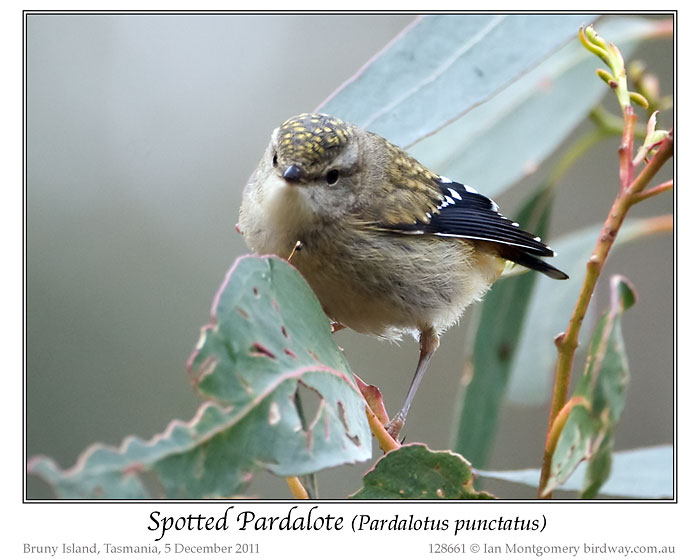
The third photo shows a slightly uncertain-looking juvenile. These are similar to females, but the markings are less obvious: in particular the background colour of the crown is grey rather blackish.

Spotted Pardalote (Pardalotus punctatus) by Ian Juvenile

Spotted Pardalotes usually nest in burrows in sand banks or road cuttings. If you surprise one near the ground, there’s a good chance that there is a nest nearby. The range of the Spotted Pardalote includes eastern and southern mainland Australia from Northeastern Queensland to SW Western Australia and Tasmania.

I’ve been continuing to add reptiles to the website. The latest lot are lizards, mainly dragons http://www.birdway.com.au/lacertilia/index.htm. Here is one of the more spectacular, the gorgeous Boyd’ Forest Dragon, endemic to Northeastern Queensland.

Boyd's Forest Dragon by Ian Montgomery

Progress with Jo’s book has been steady. I’ve added all the bird photos (over 400) and have just finished adding website-like internal links from all the places to all the birds and back again to make navigation easier. The next thing is to visit as many places as possible to check that the information is still up-to-date and get lots of location photos. That stage will start get underway seriously towards the end of November when a birding pal Madeleine joins me from Sydney for the travelling.

Best wishes
Ian

**************************************************
Ian Montgomery, Birdway Pty Ltd,
454 Forestry Road, Bluewater, Qld 4818
Tel 0411 602 737 ian@birdway.com.au
Bird Photos http://www.birdway.com.au/
Recorder Society 


Lee’s Addition:

The beast of the field shall honour me, the dragons and the owls: because I give waters in the wilderness, and rivers in the desert, to give drink to my people, my chosen. (Isaiah 43:20 KJV)

Wow! I really like those Pardalotes and that Dragon is really neat also.

The Pardalotes belong to the Pardalotidae Family and only has the Spotted, Forty-spotted, Red-browed, and the Striated Pardalotes.

Pardalotes or peep-wrens are a family, Pardalotidae, of very small, brightly coloured birds native to Australia, with short tails, strong legs, and stubby blunt beaks. This family is composed of four species in one genus, Pardalotus, and several subspecies. The name derives from a Greek word meaning “spotted”. The family once contained several other species now split into the family Acanthizidae.

Pardalotes spend most of their time high in the outer foliage of trees, feeding on insects, spiders, and above all lerps (a type of sap sucking insect). Their role in controlling lerp infestations in the eucalyptus forests of Australia may be significant. They generally live in pairs or small family groups but sometimes come together into flocks after breeding.

Pardalotes are seasonal breeders in temperate areas of Australia but may breed year round in warmer areas. They are monogamous breeders, and both partners share nest construction, incubation and chick rearing duties. All four species nest in deep horizontal tunnels drilled into banks of earth. Externally about the size of a mouse-hole, they can be very deep, at a metre or more. Some species also nest in tree hollows.

See:

*

Birdwatching at Circle B Bar Reserve – 10/26/13

Little Blue Heron (Egretta caerulea) by Lee at Circle B

Little Blue Heron (Egretta caerulea)

Be thou exalted, LORD, in thine own strength: so will we sing and praise thy power. (Psalms 21:13 KJV)

Had a very productive hour and 40 minute trip to Circle B Bar Reserve Saturday afternoon enjoying the Lord’s creation. The birds are definitely heading back down. After a sparse summer, things are starting to get interesting once more.

Limpkin (Aramus guarauna) by Lee at Circle B

Limpkin (Aramus guarauna) by Lee at Circle B

We haven’t been out there for a while and was a little disappointed in the viewing. It rained considerably this summer and the plants have really grown up making it hard to see the water birds. Even with that, to see 34 species in just under 2 hours is not bad.

Alligator about 8 ft by Lee at Circle B

Alligator about 8 ft by Lee at Circle B

We were greeted with the sounds of the Blue Jays, Carolina Wrens and an Eastern Phoebe. Also, an Armadillo was walking right along the path to the marsh. Later, I spotted about an 8 foot alligator. Those and the normal squirrels were the only, non-birds I saw.

One of the highlights was seeing five Bald Eagles flying over. Two in one group and three in the other. We had just seen an Eagle on Friday down in Lake Wales. I love seeing Eagles.

American White Ibis (Eudocimus albus) by Lee at Circle B

American White Ibis (Eudocimus albus) by Lee at Circle B

In God we boast all the day long, and praise thy name for ever. Selah. (Psalms 44:8 KJV)

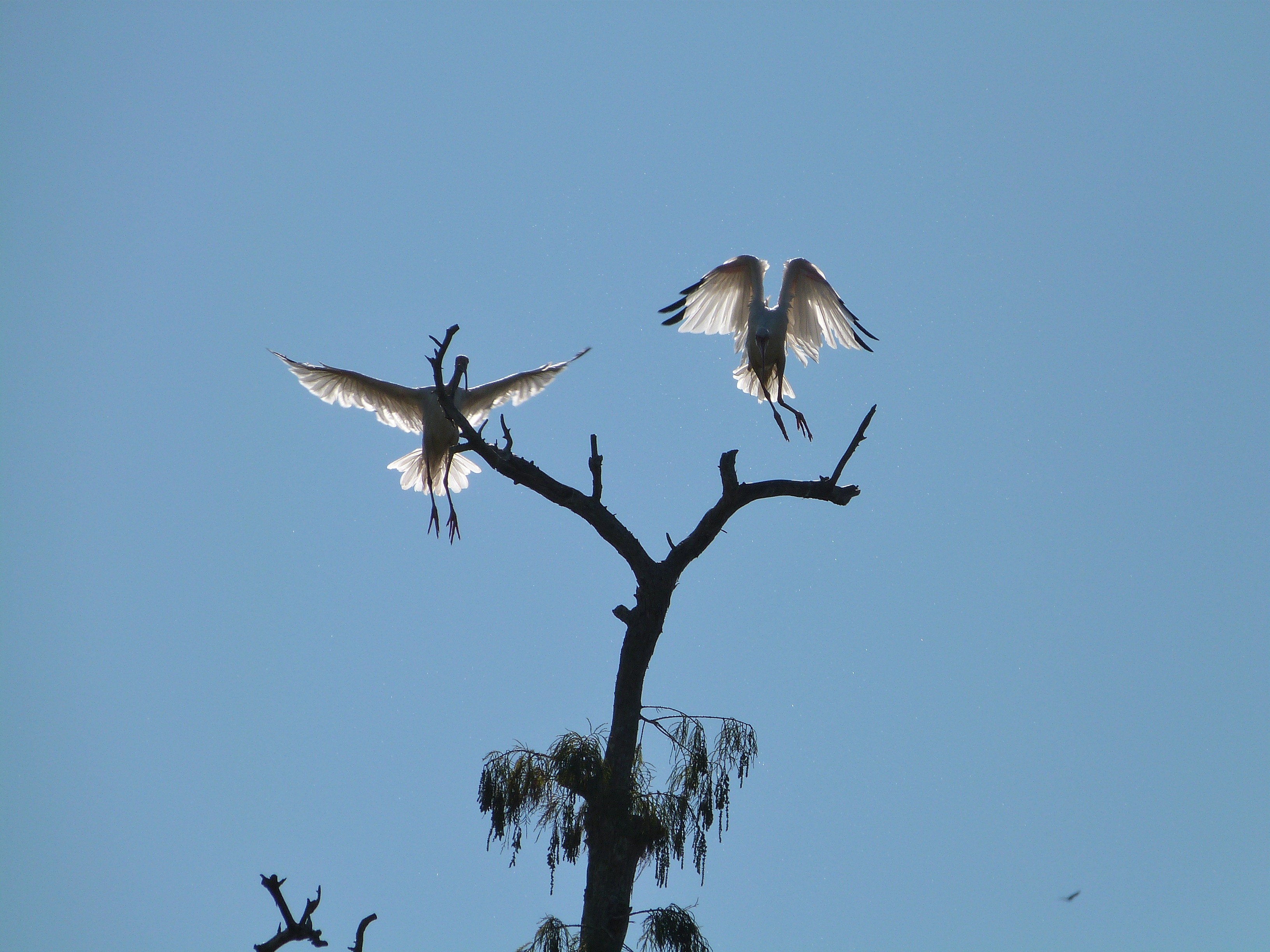
Two White Ibises landed in one of the trees when we first arrived. With the sun behind them, they remind you of Angel’s Wings. As you can see by the second photo the tree was being loaded up for the night when we passed it on the way out. That is one of the favorite “roosting” places at Circle B.

American White Ibis (Eudocimus albus) by Lee at Circle B

American White Ibis (Eudocimus albus) and friends

I am including a slideshow to give you an idea of how it was out there. The photography is not the best, but you can tell what the birds are at least. Dan doesn’t have his photos ready.

This slideshow requires JavaScript.

Here is a list of what I reported to e-Bird:

Circle B Bar Reserve, Polk, US-FL
Oct 26, 2013 3:45 PM – 5:25 PM
Traveling – 2.5 mile(s)
Clear 79 degrees
34 species
Black-bellied Whistling-Duck  15
Pied-billed Grebe  2
Wood Stork  17
Anhinga  5
Great Blue Heron  7
Great Egret  6
Snowy Egret  2
Little Blue Heron  1
Tricolored Heron  1
Cattle Egret  5
White Ibis  88
Glossy Ibis  2
Black Vulture  40
Turkey Vulture  37
Osprey  2
Bald Eagle  5
Purple Gallinule  4
Common Gallinule  6
Limpkin  4
Sandhill Crane  1
Belted Kingfisher  1
Red-bellied Woodpecker  1
Eastern Phoebe  2
Blue Jay  2
Fish Crow  5
House Wren  1
Carolina Wren  2
Blue-gray Gnatcatcher  1
Gray Catbird  1
Palm Warbler  3
Yellow-rumped Warbler  1
Northern Cardinal  1
Red-winged Blackbird  1
Boat-tailed Grackle  10
See:
*

Birdwatching Adventure – Scrub Jays II

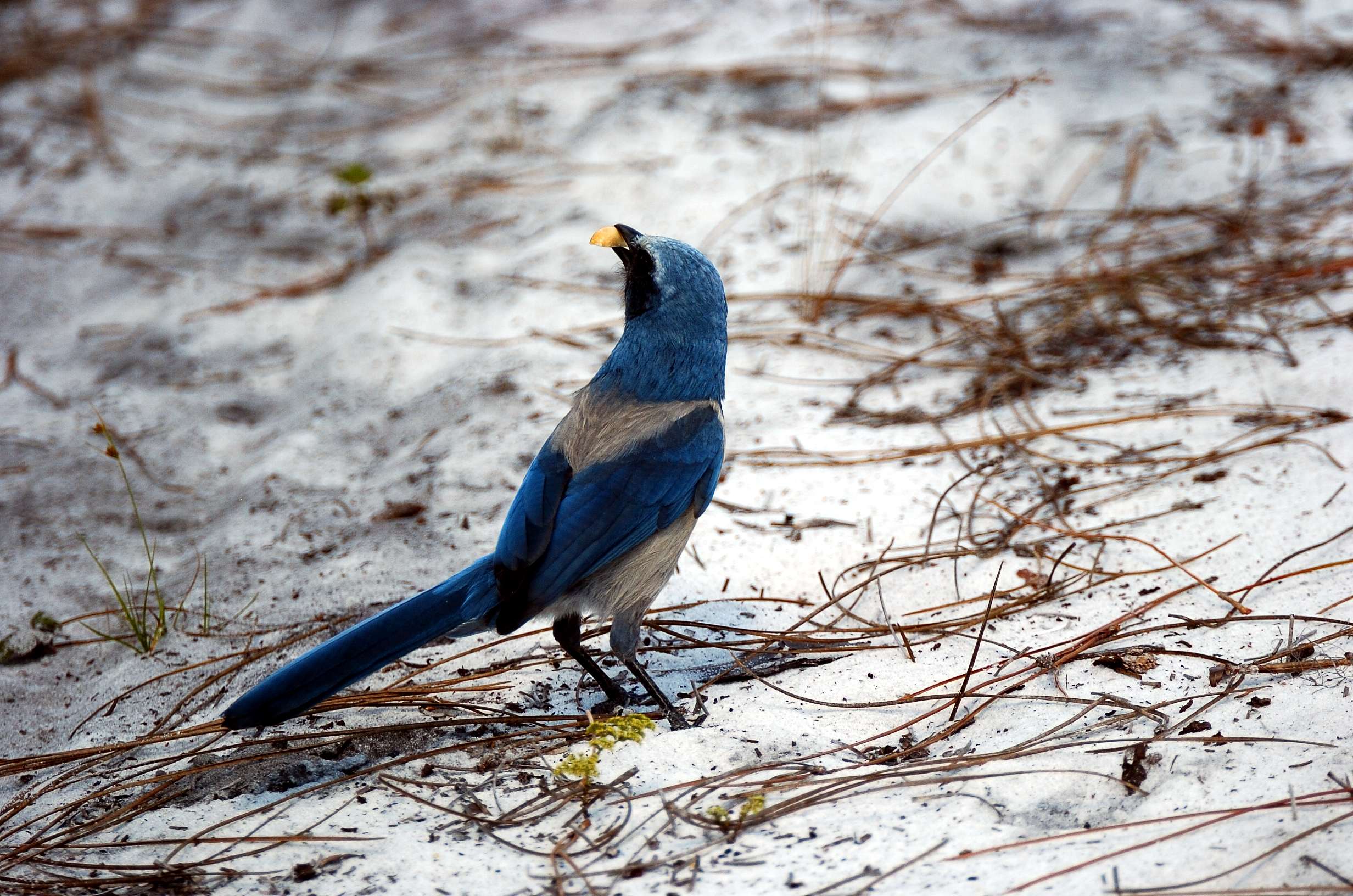
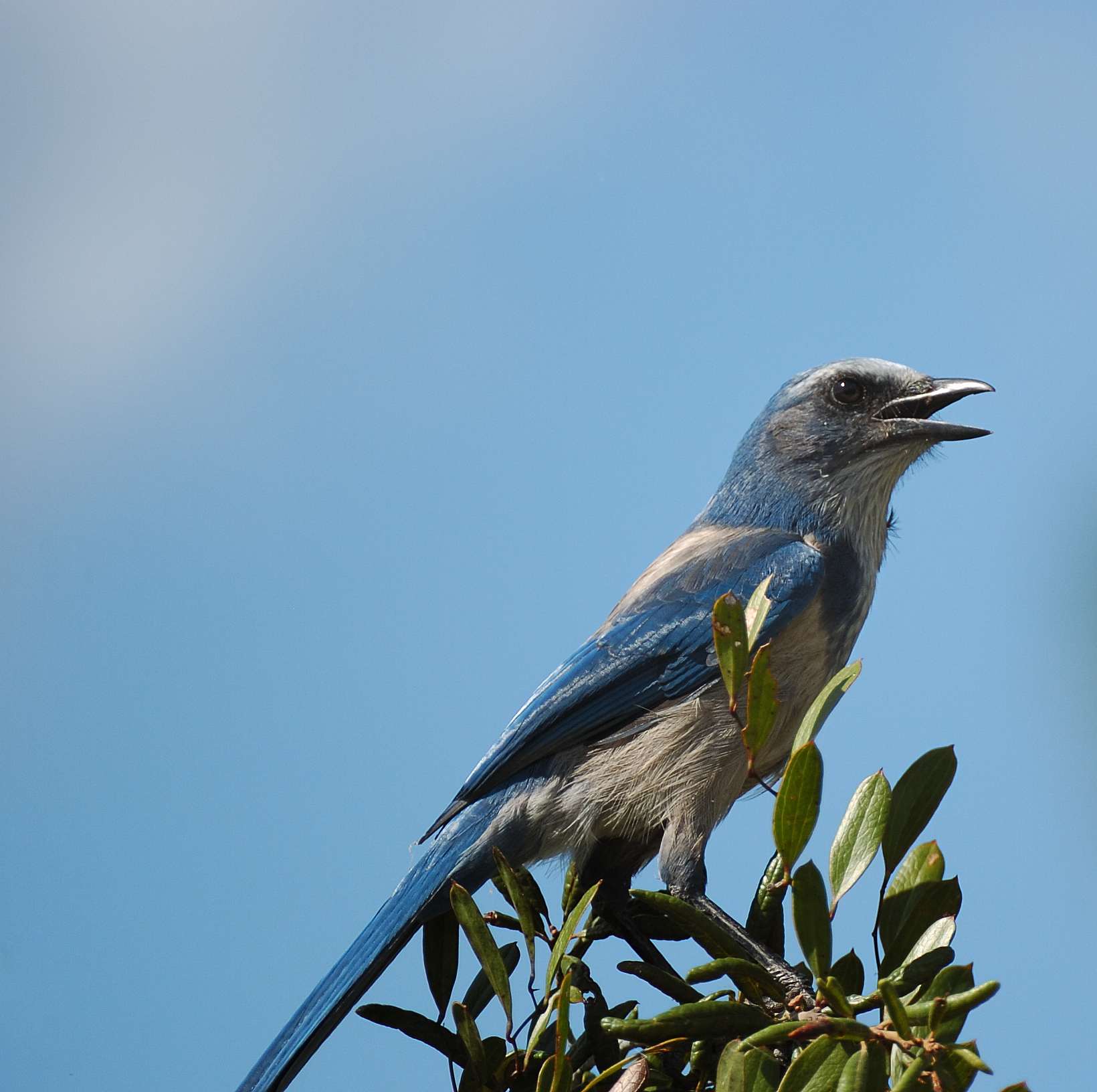
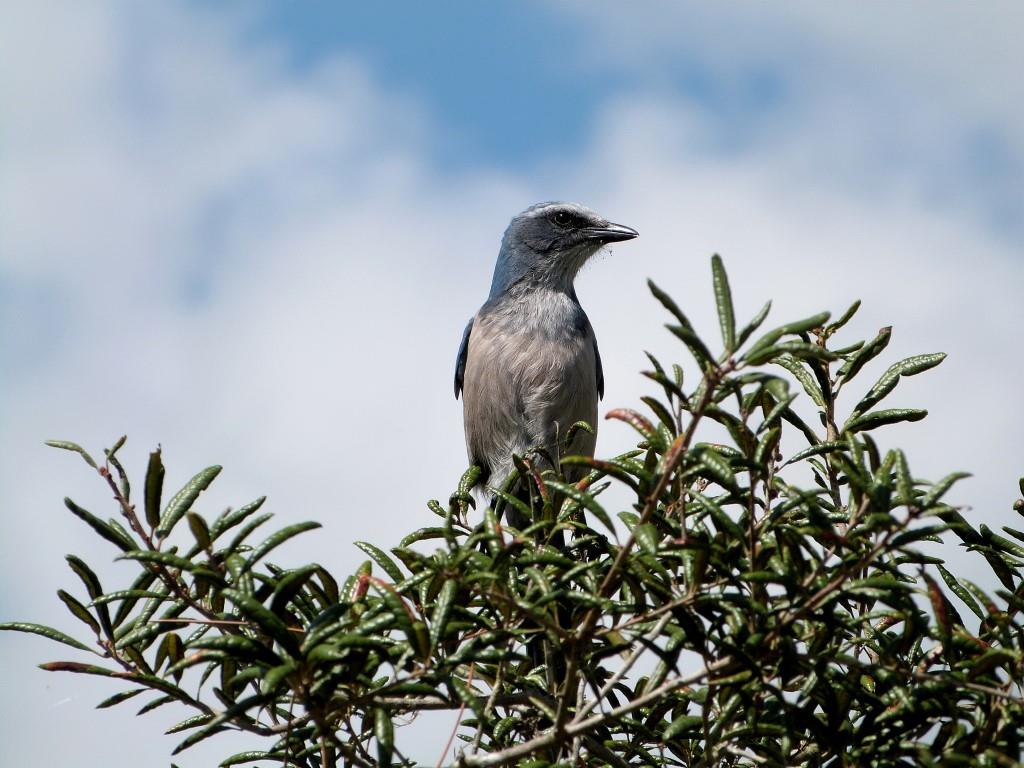
Florida Scrub Jay (Aphelocoma coerulescens)  by Dan

Florida Scrub Jay (Aphelocoma coerulescens) by Dan

Then God said, “Let the waters abound with an abundance of living creatures, and let birds fly above the earth across the face of the firmament of the heavens.” (Genesis 1:20 NKJV)

Now for the good photos from our visit to see the Florida Scrub Jays. Dan shared these that he took.

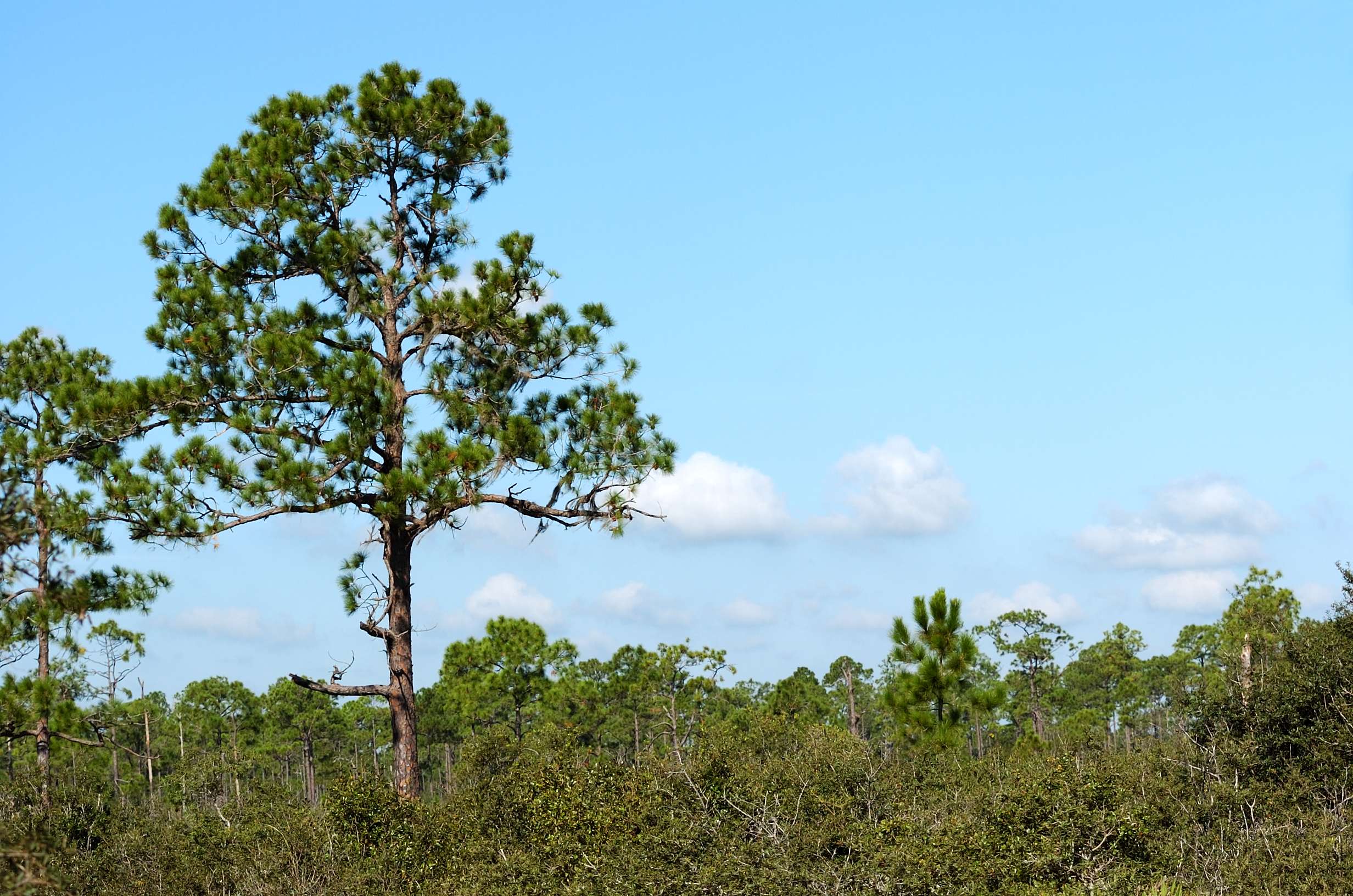
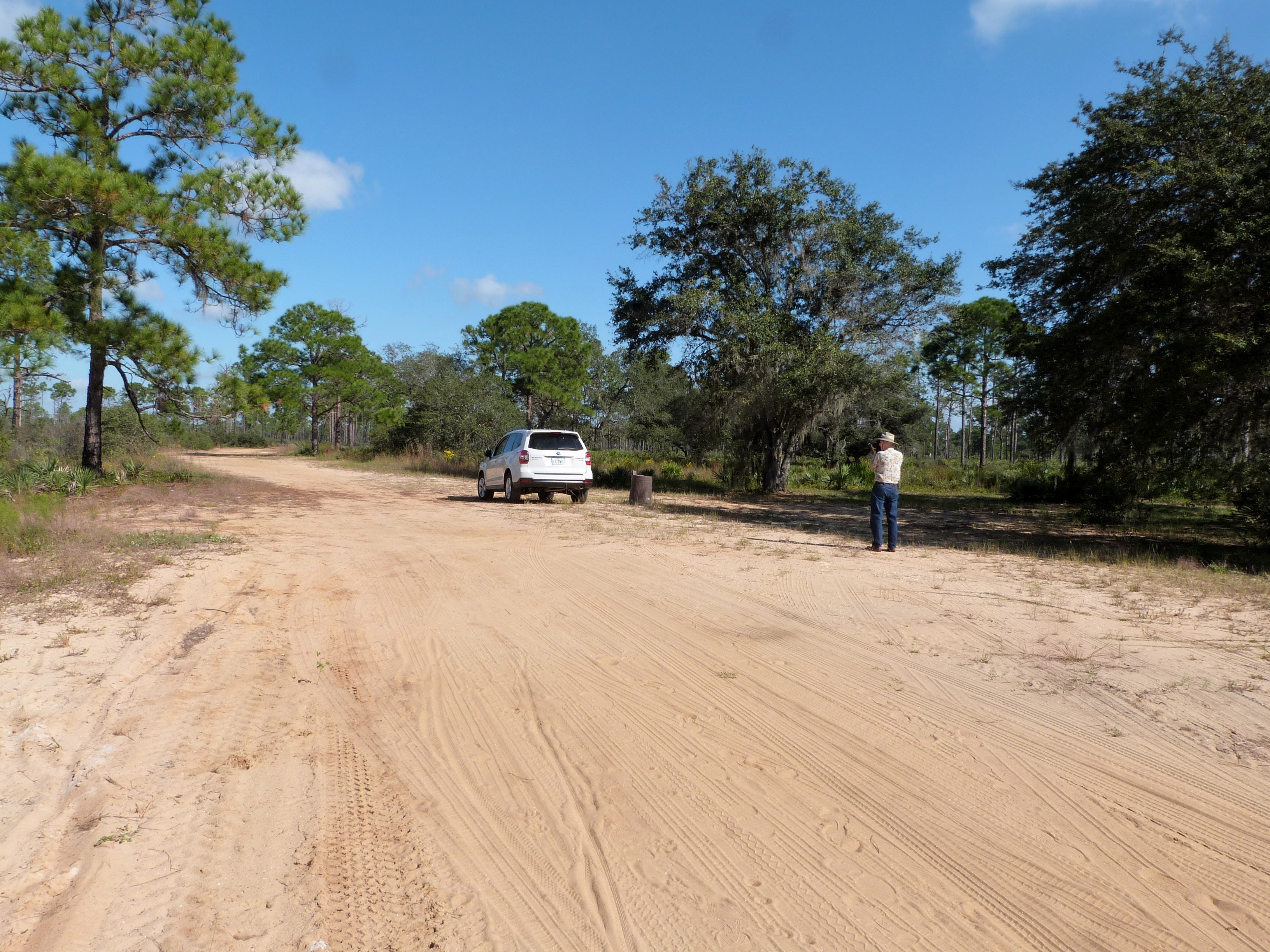
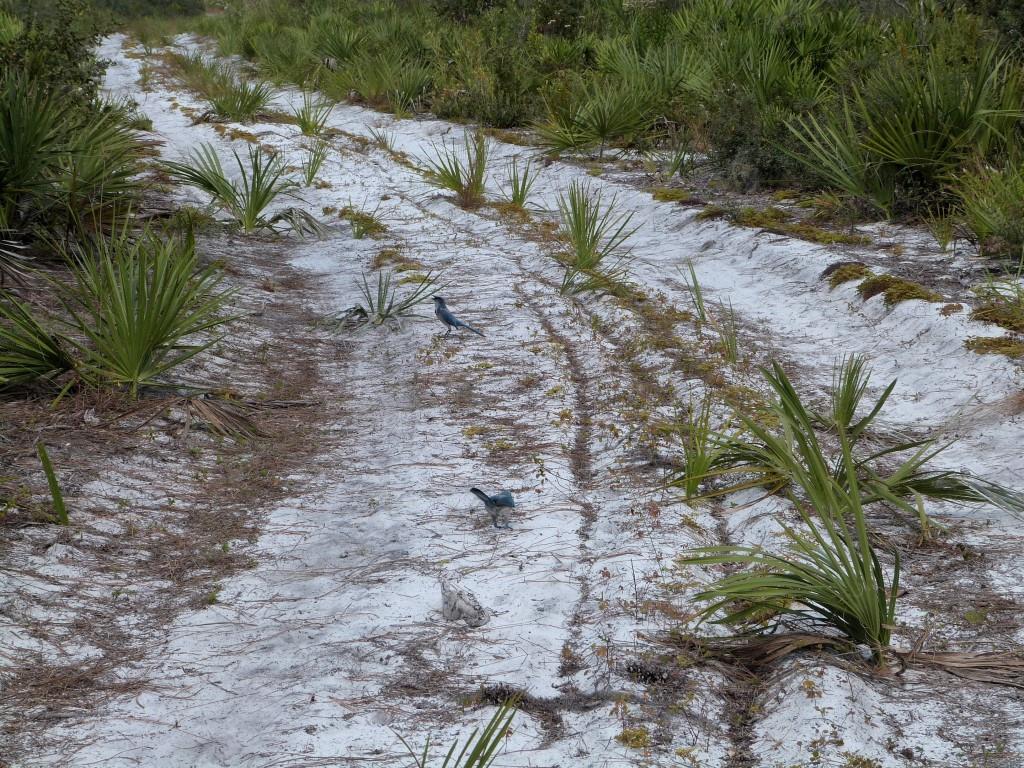
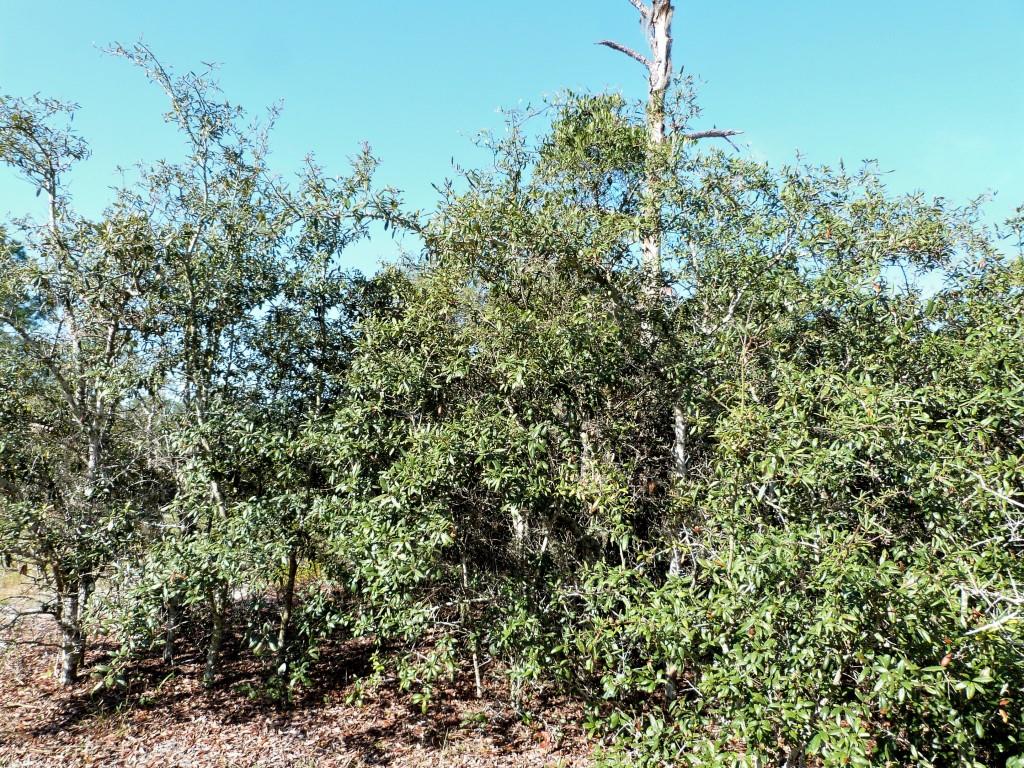
Here is an idea of the “scrub” habitat that the Florida Scrub Jays prefer. They do not like too many trees where Hawks, Eagles or other Birds of Prey can attack them.

Habitat at Lake June-in-Winter SP by Dan

Scrub Habitat at Lake June-in-Winter SP by Dan

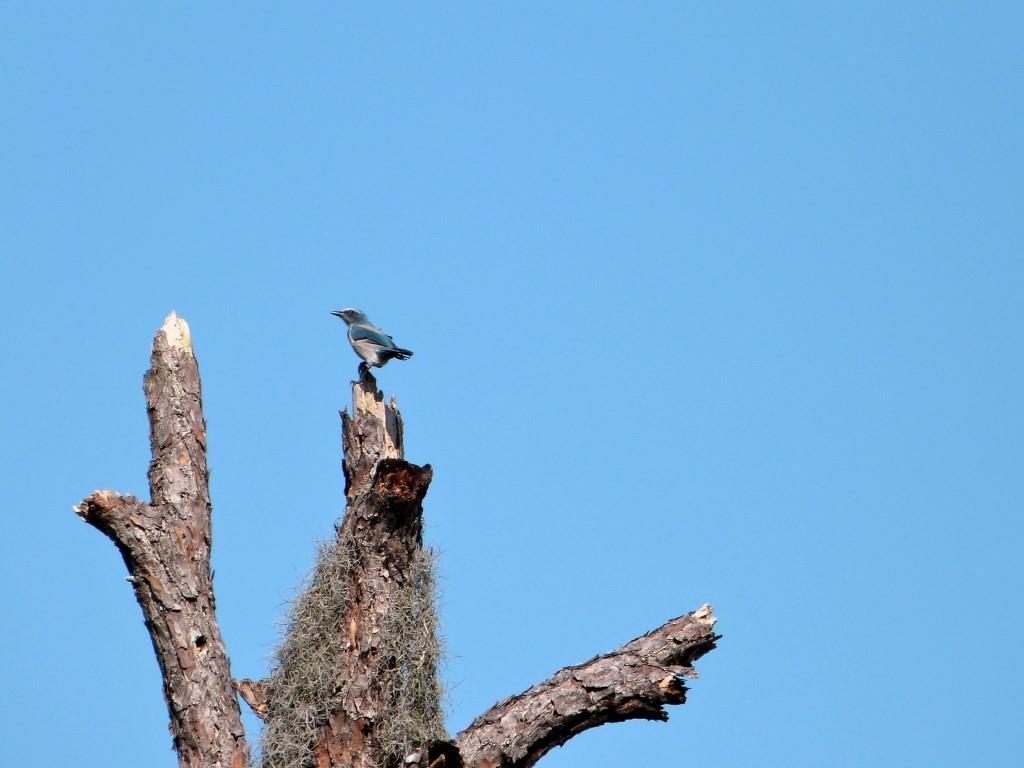
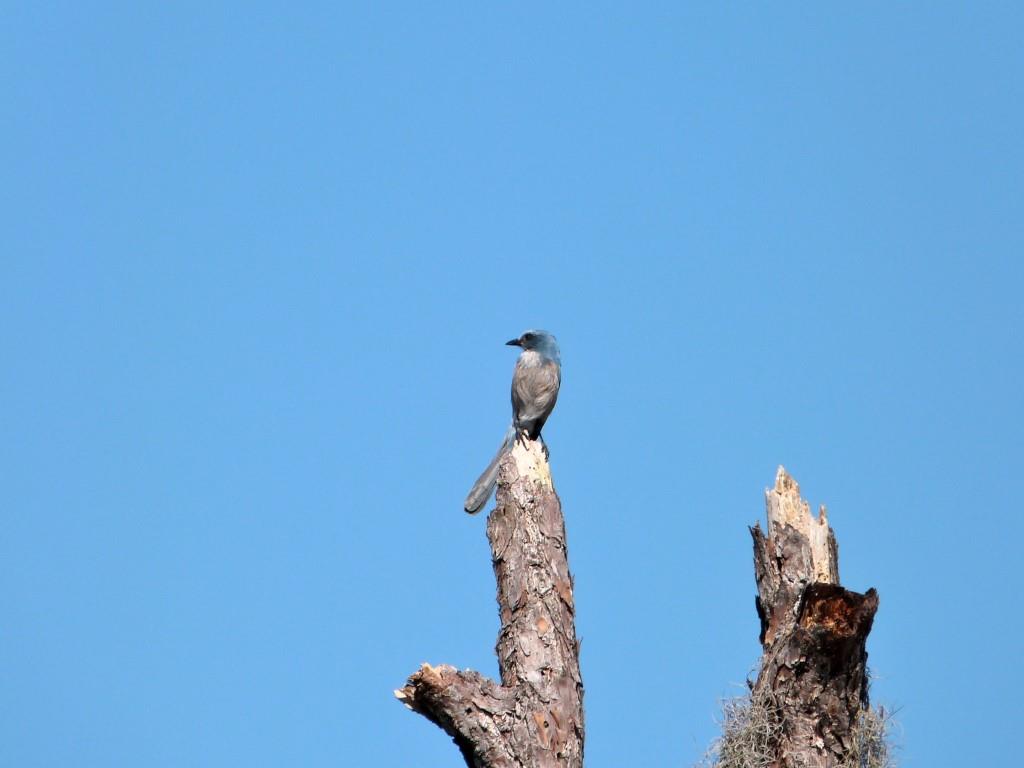
They greeted us from a distance at first.

Florida Scrub Jay (Aphelocoma coerulescens) by Dan

Florida Scrub Jay (Aphelocoma coerulescens) by Dan

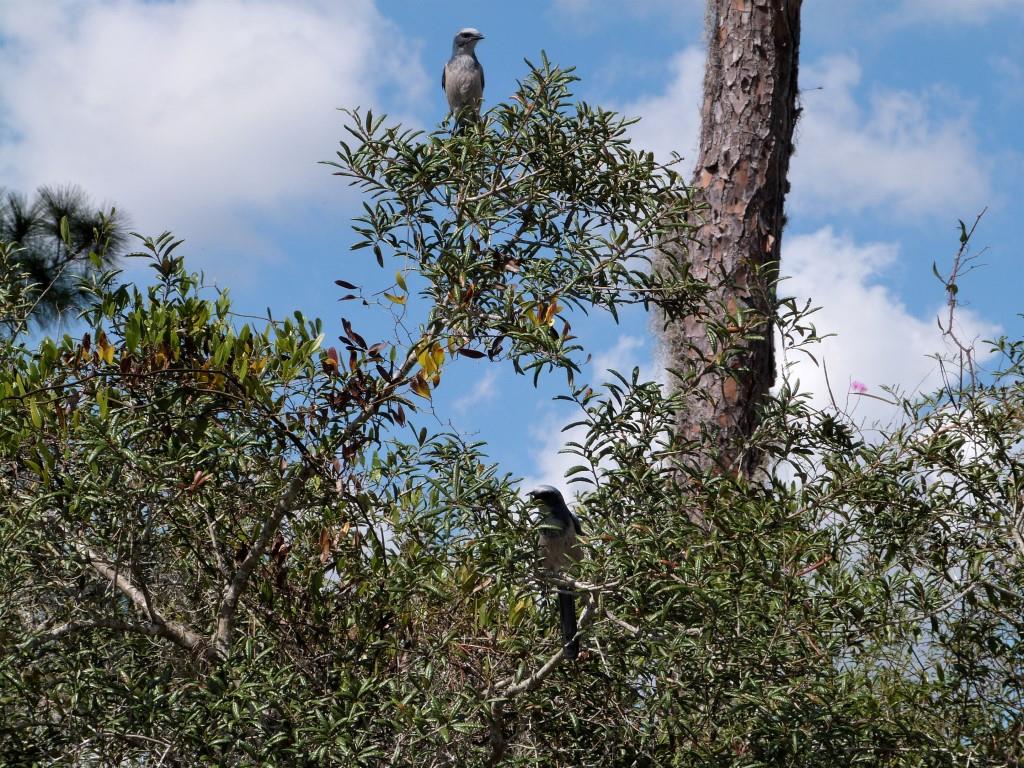
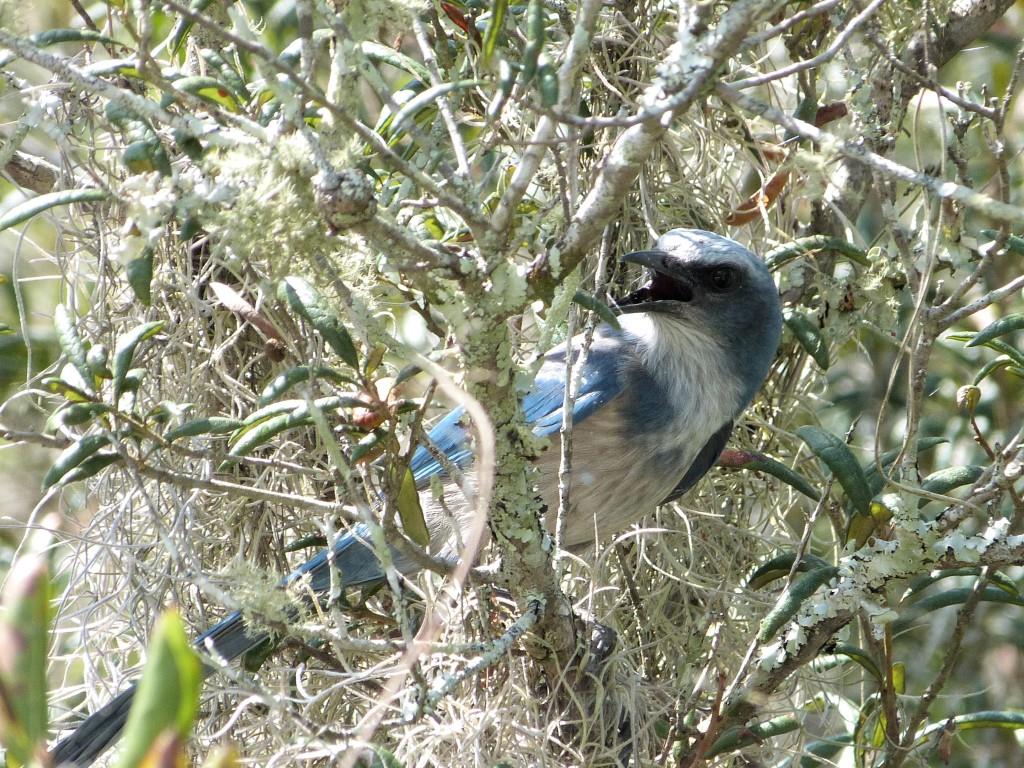
Then they were more friendly when enticed.

Florida Scrub Jay (Aphelocoma coerulescens) by Dan

Florida Scrub Jay (Aphelocoma coerulescens) by Dan

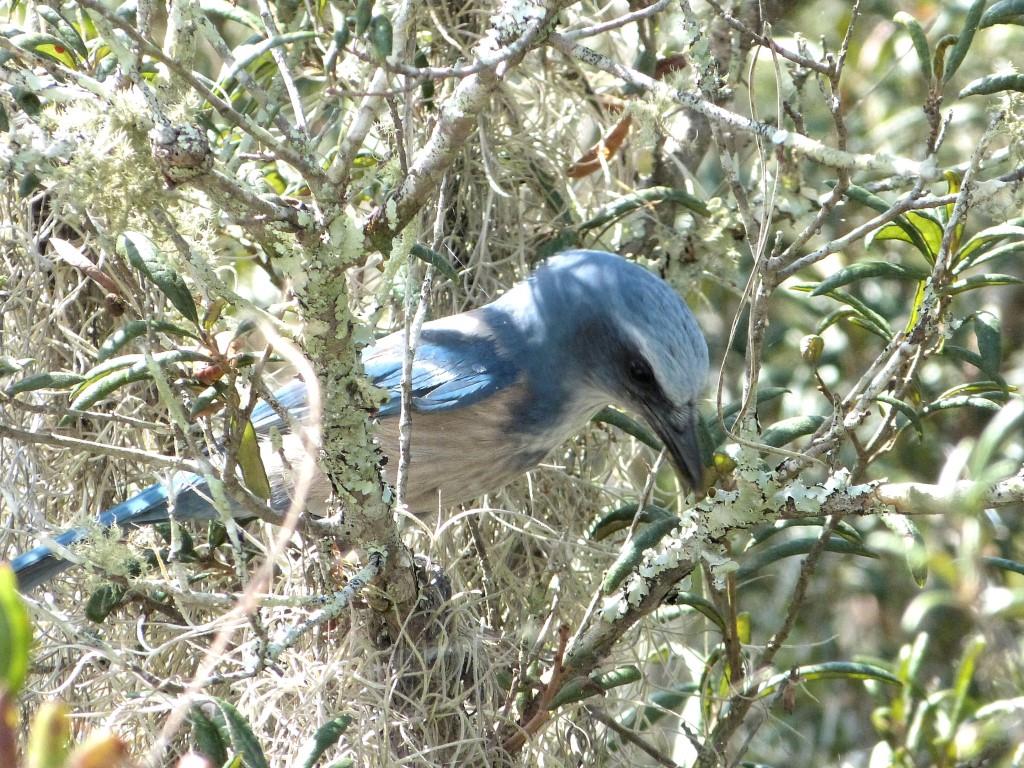
They are such pretty birds. I sure am glad the Lord has given us so many varieties of avian friends to enjoy.

Florida Scrub Jay (Aphelocoma coerulescens) by Dan

Florida Scrub Jay (Aphelocoma coerulescens) by Dan

Here is another photo from the state parks habitat:

Habitat at State Park by Dan

Habitat at State Park by Dan

These two last photos were his that he photographed through the open window of the Red-Shouldered Hawk at Highlands Hammock State Park. Remember, mine was through plastic.

Red-shouldered Hawk (Buteo lineatus) Highlands Hammock SPk by Dan

Red-shouldered Hawk (Buteo lineatus) Highlands Hammock SPk by Dan

“Does the hawk fly by your wisdom, And spread its wings toward the south? (Job 39:26 NKJV)

Red-shouldered Hawk (Buteo lineatus) Highlands Hammock SPk by Dan

Red-shouldered Hawk (Buteo lineatus) Highlands Hammock SPk by Dan

Trust you have enjoyed seeing these fantastic birds.

*

*
Birdwatching Adventure – Florida Scrub Jay

Florida Scrub Jay (Aphelocoma coerulescens) Highlands Hammock S Pk by Lee

Florida Scrub Jay (Aphelocoma coerulescens) Highlands Hammock S Pk

Look at the birds of the air, for they neither sow nor reap nor gather into barns; yet your heavenly Father feeds them. Are you not of more value than they? (Matthew 6:26 NKJV)

The main reason we went to Highlands Hammock State Park yesterday was to find some Florida Scrub Jays. The ranger told us where to find theirs and also where more could be found in another park.

Florida Scrub Jay (Aphelocoma coerulescens) Highlands Hammock S Pk by Lee

Florida Scrub Jay (Aphelocoma coerulescens) Highlands Hammock SPk 10-14-13

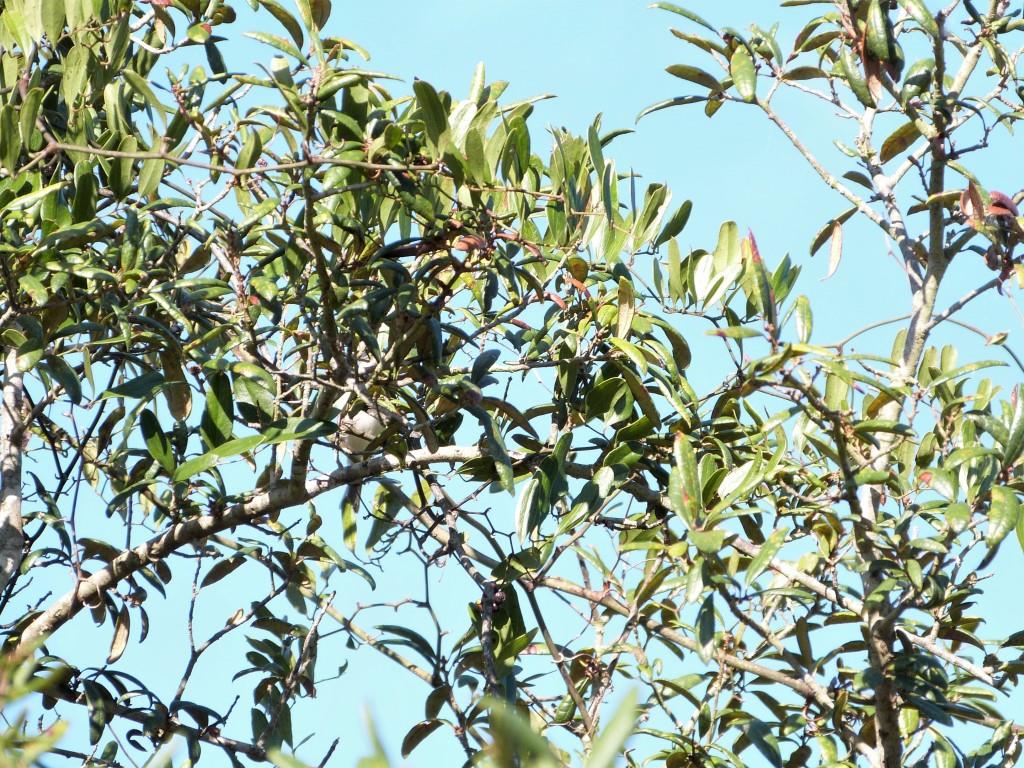
Went on the drive where the Wilderness Camping Area is located. Florida Scrub Jays prefer the scrub areas. The ranger told us that they had recently had a controlled burn and this family moved in right after that. From the pictures, you will see the kind of habitat they like.

Our new "Birding Mobile"

This is the area where we found the Scrub Jays at Highlands Hammock S P.

We found the Florida Scrub Jays, but they never got very close. We were also initiating our new “birding mobile”, as I have named it. Off the subject, but here is a photo of a Red-shouldered Hawk I shot through the “moonroof.” My first attempt at that. Next time, when we are not right under a hawk, it will be opened.

Red-shouldered Hawk (Buteo lineatus) Highlands Hammock SPk 10-14-13 Thru moonroof

Red-shouldered Hawk (Buteo lineatus) Highlands Hammock SPk 10-14-13

After driving through the rest of that park, we headed for the Lake June-in-Winter State Park. Never heard of it before. It is very tiny and we were the only ones there. Well, the birds of course were there, especially the Scrub Jays. We were able to get quite a few photos of them and they were quite friendly. There were also three Sandhill Cranes plus sounds of birds I do not recognize. The photos will be intermingled with some information about the jays from Wikipedia.

Florida Scrub Jay (Aphelocoma coerulescens) Lake June-in-Winter SPk

Florida Scrub Jay (Aphelocoma coerulescens) Lake June-in-Winter SPk

The Florida Scrub Jay (Aphelocoma coerulescens) is one of the species of scrub jay native to North America. It is the only species of bird endemic to the U.S. state of Florida and one of only 15 species endemic to the United States. Because of this, it is heavily sought by birders who travel from across the country to observe this unique species. It is possibly derived from the ancestors of Woodhouse’s Scrub Jay, the inland forms of the Western Scrub-jay. They belong to the Corvidae – Crows, Jays, Ravens Family.

Florida Scrub Jay (Aphelocoma coerulescens) Lake June-in-Winter SPk

Florida Scrub Jay (Aphelocoma coerulescens) Lake June-in-Winter SPk

It measures 9.1 to 11 in (23 to 28 cm) in length, and weighs from 2.3 to 3.2 oz (66 to 92 g), with an average 2.83 oz (80.2 g). The wingspan of the jay is 13–14 in (33–36 cm). It has a strong black bill, blue head and nape without a crest, a whitish forehead and supercilium, blue bib, blue wings, grayish underparts, gray back, long blue tail, black legs and feet.

Florida Scrub Jay (Aphelocoma coerulescens) Lake June-in-Winter SPk

Florida Scrub Jay (Aphelocoma coerulescens) Lake June-in-Winter SPk

The Florida Scrub Jay is found only in Florida scrub habitat, an ecosystem that exists only in central Florida and is characterized by nutrient-poor soil, occasional drought, and frequent wildfires. Because of its somewhat harsh weather pattern, this habitat is host to a small assortment of very specific plants, including Sand Pine, Sand Live Oak, Myrtle Oak, Chapman’s Oak, Sandhill Oak, Florida Rosemary[11] and various other hardy plants such as Eastern prickly pear.

Florida Scrub Jay (Aphelocoma coerulescens) Lake June-in-Winter SPk

Florida Scrub Jay (Aphelocoma coerulescens) Lake June-in-Winter SPk

Florida Scrub Jays are omnivorous and eat a wide variety of acorns, seeds, peanuts, insects, tree frogs, turtles, snakes, lizards, and young mice. Florida Scrub Jays have also been occasionally observed to eat other birds’ eggs or nestlings, but this occurs rarely. They routinely cache thousands of acorns a year, burying them just beneath the surface. The acorns are typically buried in the fall and consumed during the winter and spring. Acorns that are forgotten or missed may germinate, making the Florida Scrub-Jay an effective agent for the dispersal of a variety of oak trees.

Florida Scrub Jay (Aphelocoma coerulescens) Lake June-in-Winter SPk

Florida Scrub Jay (Aphelocoma coerulescens) Lake June-in-Winter SPk

Scrub jays may also take silverware and other shiny objects in a manner similar to the American Crow.

Sandhill Crane (Grus canadensis) Lake June-in-Winter SPk

Sandhill Crane (Grus canadensis) Lake June-in-Winter SPk

Here are some more of the photos from this “birdwatching adventure.”

This slideshow requires JavaScript.

See also:

Highlands Hammock State Park

Lake June-in-Winter State Park

Corvidae – Crows, Jays, Ravens Family

*

Birdwatching Adventure – Kingbird and Vireo

Western Kingbird (Tyrannus verticalis) Highlands Hammock SPk by Lee

Western Kingbird (Tyrannus verticalis) Highlands Hammock S Pk by Lee

I know all the birds of the mountains, And the wild beasts of the field are Mine. (Psalms 50:11 NKJV)

We have been off on several birdwatching adventures the last few days. We were out enjoying the Lord’s creation, especially His birds. Still sorting through the photos, but wanted to share two birds we saw today. They were at Highlands Hammock State Park in Sebring, FL. Both are birds that I have seen, but only when another birder pointed them out. That always gives a joy when you find and can figure out what a bird is.

The first one, I was only able to get one decent photo because it moved on quickly. Here is the bird cropped. (I trust this is the correct ID)

Western Kingbird (Tyrannus verticalis) Highlands Hammock SP by Lee (Cropped)

Western Kingbird (Tyrannus verticalis) Highlands Hammock SP by Lee

Kingbirds are members of the Tyrannidae – Tyrant Flycatchers Family. Adults are grey-olive on the upperparts with a grey head and a dark line through the eyes; the underparts are light becoming light orange-yellow on the lower breast and belly. They have a long black tail with white outer feathers. Western kingbirds also have a reddish crown that they only display during courtship and confrontations with other species.

These birds migrate in flocks to Florida and the Pacific coast of southern Mexico and Central America. (Lucky for us.)

They wait on an open perch and fly out to catch insects in flight, sometimes hovering and then dropping to catch food on the ground. They also eat berries.

The song is a squeaky chatter, sometimes compared to a dog’s squeaky toy. The call is a sharp loud whit. Occasionally sings before sunrise.

I have only seen this bird maybe three or four times before, so it was a nice find.

Highlands Hammock State Park

Highlands Hammock State Park

My next challenge started out in the trees and bushes above. This bird was all over the place and wouldn’t stay still as I tried to catch a photo of it. (Which is typical for those small birds.)

White-eyed Vireo (Vireo griseus) Highlands Hammock

White-eyed Vireo (Vireo griseus) Highlands Hammock

Here are some of my attempts to catch this bird. I do not use the “rule of thirds” because when I get home, finding the bird is easier if it’s centered. I figured out that it had a white breast by this photo. Let me zoom in.

White-eyed Vireo (Vireo griseus) Highlands Hammock SP cropped

White-eyed Vireo (Vireo griseus) Highlands Hammock SP cropped

Now the wings and its eye became more visible.

White-eyed Vireo (Vireo griseus) Highlands Hammock SPk 10-14-13

White-eyed Vireo (Vireo griseus) Highlands Hammock SPk 10-14-13

Then the bird finally popped out where I could get these next two photos.

White-eyed Vireo (Vireo griseus) Highlands Hammock SPk by Lee

White-eyed Vireo (Vireo griseus) Highlands Hammock SPk

That white eye is what nailed the ID on this bird. This is the first time that I’ve photographed one. When trying to figure these birds out, a good field guide and the internet sure come in handy.

My first ID in the field was wrong on both of these birds. I thought the Kingbird was some sort of Flycatcher and that this Vireo was a Warbler. Even though I only shoot in Program mode, and I do not claim to be a photographer, it does help to take proof or ID photos to help figure out what you really are seeing. It is more fun to just enjoy the birds while you are watching them and figure what it was later.

White-eyed Vireo (Vireo griseus) Highlands Hammock  SP by Lee

White-eyed Vireo (Vireo griseus) Highlands Hammock SP by Lee

They belong to the  Vireonidae – Vireos, Greenlets Family. The White-eyed Vireo (Vireo griseus) is a small songbird. It breeds in the southeastern USA from New Jersey west to northern Missouri and south to Texas and Florida, and also in eastern Mexico, northern Central America, Cuba and the Bahamas.

Populations on the US Gulf coast and further south are resident, but most North American birds migrate south in winter.The White-eyed Vireo (Vireo griseus) is a small songbird. It breeds in the southeastern USA from New Jersey west to northern Missouri and south to Texas and Florida, and also in eastern Mexico, northern Central America, Cuba and the Bahamas.

Populations on the US Gulf coast and further south are resident, but most North American birds migrate south in winter.

More of these trips will be shared. Saw lots of Wood Ducks and Florida Scrub Jays that I will “Show and Tell” later.

Thank all of you up North who have finally been sending your birds down for the coming winter. The birdwatching was getting a little boring.

See:

Tyrannidae – Tyrant Flycatchers Family

Vireonidae – Vireos, Greenlets Family

Some of our Birdwatching Trips

Highlands Hammock State Park

*


Ian’s Bird of the Week – Tooth-billed Bowerbird II

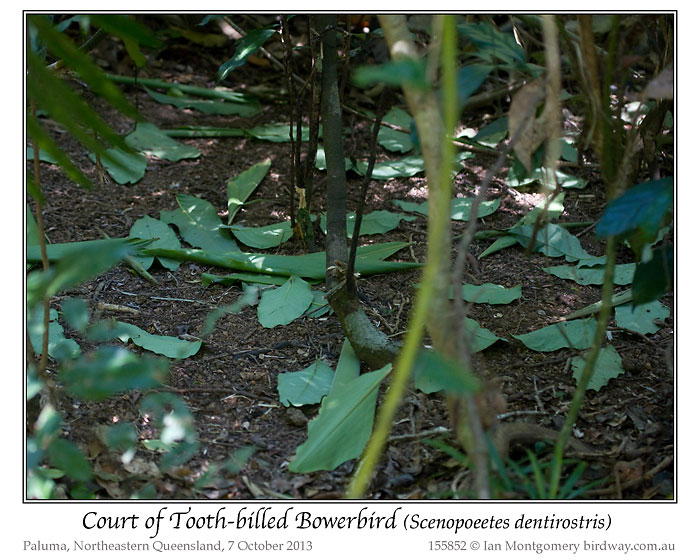
Tooth-billed Bowerbird (Scenopoeetes dentirostris) Court by Ian

Tooth-billed Bowerbird (Scenopoeetes dentirostris) Court by Ian

Ian’s Bird of the Week – Tooth-billed Bowerbird ~ by Ian Montgomery

Newsletter ~ 10/9/13

At the weekend, I followed some friends for an overnight stay at Paluma, the small village in highland rainforest about 60km north of Townsville. and they took me to view 4 display courts of the Tooth-billed Bowerbird near the village that they had already checked out. This species featured as bird of the week three years ago, but it’s an interesting subject and I got better photos this time. In contrast to some of the bowerbirds, it is sombre in plumage and cryptic in pattern but makes up for this with unique behaviour.

Alone among the promiscuous bowerbirds (the catbirds are monogamous), the male doesn’t build a bower to attract females but has a display platform or court, a cleared space on the forest floor with a central tree trunk or stem and it decorates the court with the leaves of rainforest trees, carefully placed lower side up. The central tree in the first photo is smaller than usual, but I’ve chosen this one as there are signs of the bird having chewed through some offending shoot near to it to keep the space clear. The same court is used from one year to another and the courts of different males may be relatively close proximity (50-100m/yards) to each other in what is called an extended lek. and there were four courts along the path where we were.

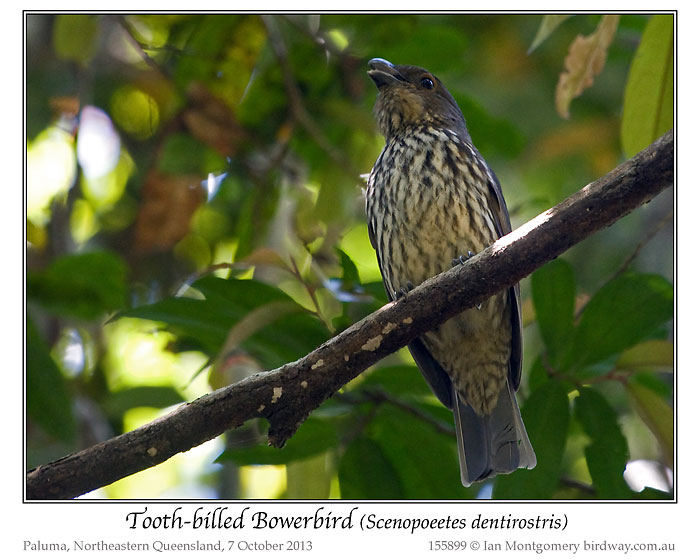
Tooth-billed Bowerbird (Scenopoeetes dentirostris) by Ian

The males sing a strange, loud and varied song with lots of mimicry from perches above the court. So during the breeding season – September to January – they are quite easy to find. The vegetation in their preferred habitat is dense so hearing them is easier than seeing them and seeing them is easier than photographing them: the second photo is a fairly typical view of one through the foliage.

 Tooth-billed Bowerbird (Scenopoeetes dentirostris) by Ian

When they’re singing, they are fairly approachable and I got quite close to this one before it flew up onto an unencumbered branch above the court and continued singing in full view (third photo). The fourth photo is cropped to show both the toothed edge to the lower mandible and the ridged inside of the upper one, a clever designed mechanism of chewing off leaves. Some while later, at another court we saw a male pick and drop a leaf, which it let fall. It then picked another on and flew off with it in the direction of its court. Apparently, it is not unusual for the birds to steal the leaves of other males, so there is the same competition for accumulating decorations as in other bowerbirds.

Tooth-billed Bowerbird (Scenopoeetes dentirostris) by Ian

I recorded the calls of three males on my phone and included one of the files below.

Last week, I mentioned a pending Snake of the Week and this aroused some interest, so here it is. I photographed this small whip snake seven years ago in a dry area in far Northwestern Queensland near the border with the Northern Territory. We tried to identify it by consulting a weighty tome on the Reptiles of Australia, but failed to find anything that quite matched it and gave up.

Sombre Whip Snake by Ian

Sombre Whip Snake by Ian

Some years later, I bought the 2008 edition of A Complete Guide to the Reptiles of Australia by Steve Wilson and Gerry Swan. It contains an Appendix which starts: “Late in the preparation of this 2008 revised second edition, a timely study of small tropical whip snakes (Demansia) was published. The work formally recognises additional species of these swift diurnal snakes, some of which have been familiar to herpetologists for many years.” So, there you are: the first time I’ve photographed a yet to be described species of vertebrate; it doesn’t often happen with birds.

I’ve been adding Primates http://www.birdway.com.au/primates/index.htm, Lizards http://www.birdway.com.au/lacertilia/index.htm and Snakes http://www.birdway.com.au/ophidia/index.htm to the Other Wildlife section of the website, hence the interest in snakes.

Best wishes
Ian

**************************************************
Ian Montgomery, Birdway Pty Ltd,
454 Forestry Road, Bluewater, Qld 4818
Tel 0411 602 737 ian@birdway.com.au
Bird Photos http://www.birdway.com.au/
Recorder Society http://www.nqrs.org.au


Lee’s Addition:

What a neat bird and description of them. Now we not only get to see them, but hear them also. Thanks again, Ian, for allowing me to share these newsletters.

The snake, is interesting also, though I am not a big snake fan. I know most are beneficial and I don’t go out of my way to kill them, I just keep my distance.

White-eared Catbird (Ailuroedus buccoides) at National Aviary

White-eared Catbird (Ailuroedus buccoides) at National Aviary

Bowerbirds are an interesting group of birds. They belong to the Ptilonorhynchidae – Bowerbirds Family, which has twenty members currently. Looking at the Family page, I realized this is the second time Ian has written about the Tooth-billed Bowerbird. That was in August of 2010.

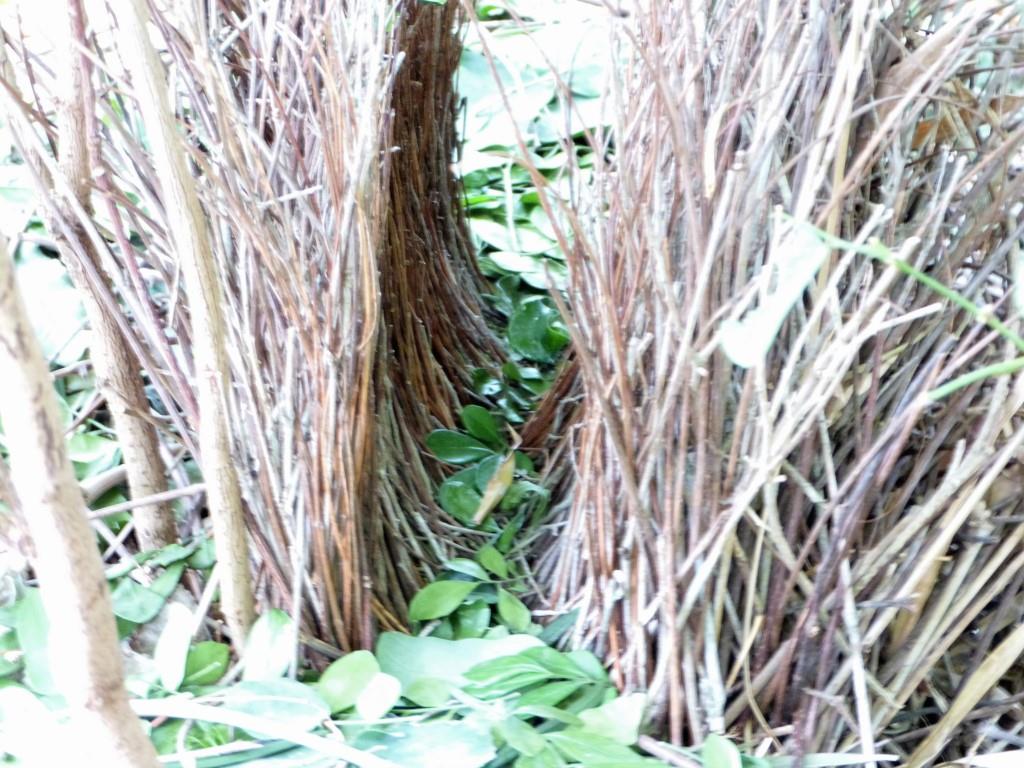
Fawn-breasted Bowerbird (Chlamydera cerviniventris) Bower at Zoo Miami

Fawn-breasted Bowerbird (Chlamydera cerviniventris) Bower at Zoo Miami

We were able to see the White-eared Catbird at Zoo Miami and at the National Aviary. At Zoo Miami, the keeper showed me the bower of the Fawn-breasted Bowerbird. You can see how he lined his bower with leaves. Unfortunately the birds were off display at the time.

White-eared Catbird (Ailuroedus buccoides) – Photo by Lee at Zoo Miami

White-eared Catbird (Ailuroedus buccoides) – Photo by Lee at Zoo Miami

Bowerbirds by Ian – Photos

Ian’s Bird of the Week

Tooth-billed Bowerbird – Wikipedia

*

Birdwatching Reviews – Miscellaneous

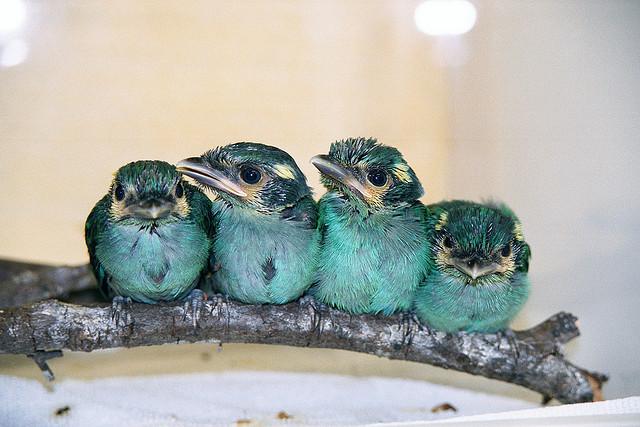
Long-tailed Broadbill (Psarisomus dalhousiae) babies ©WikiC coracii

Long-tailed Broadbill (Psarisomus dalhousiae) babies ©WikiC coracii

He hath made his wonderful works to be remembered: the LORD is gracious and full of compassion. (Psalms 111:4 KJV)

Thank all of you who have been checking out the reviews the last few days. Today will be the last of my “coasting mode” as the stitches are supposed to be removed later today. Also, thank you for your prayers. It appears the infection is decreasing and the healing is finally taking hold.

House Sparrow (Passer domesticus) by Nikhil Devasar

“His Eye Is On The Sparrow” – House Sparrow (Passer domesticus) by Nikhil Devasar

So, what is left to review? One of my enjoyable series has been the Birds in Hymns. That came about because so many hymns and songs mention birds. Listen to the words as you sing and you will be amazed how much “birdwatching” you can do while singing. Most of the material is in the Hymns section.

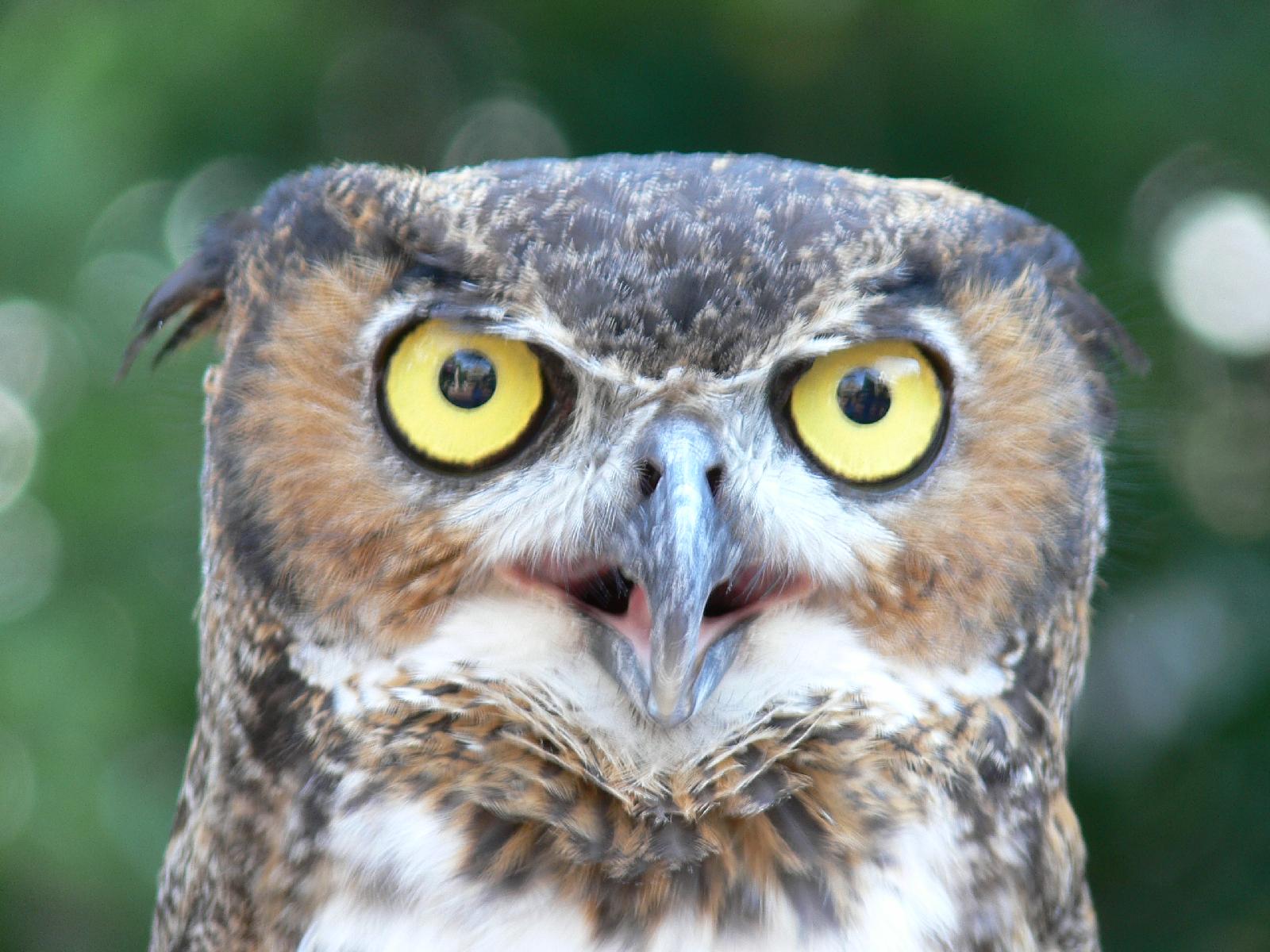
Great Horned Owl - Lowry Pk Zoo by Lee

Great Horned Owl – Lowry Pk Zoo by Lee

A fairly new section are our (mine and Dan’s) Photos from various birdwatching trips. This is still in the “rounding up stage.” The are being presented by families, but the photos are filed by our trips. Stay tuned as the photos and videos are sorted into the correct families.

Platypus From Creation Wiki

Platypus From Creation Wiki

Most readers know that I believe the Lord created the birds and all the rest of the animals, plants, world, universe and all the rest, The Formed By Him blogs are about birds, where as the When I Consider! is not limited to only our avian friends.

The fear of the LORD is the beginning of wisdom: a good understanding have all they that do his commandments: his praise endureth for ever. (Psalms 111:10 KJV)

I am sure by now, you have noticed that this website is titled “Lee’s Birdwatching Adventures PLUS.” The PLUS was added so that other interesting topics could be shared, especially Creation type articles.

The works of the LORD are great, sought out of all them that have pleasure therein. (Psalms 111:2 KJV)

Without the permission of these fantastic photographers to use their photos, where would this blog be? Please check out their sites for spectacular birds and other topics. Each have different areas of the world and interest that keep them “snapping away.”

Photography

There are other articles scattered around, but most of the main topics have been shared in these four Reviews. Thank you for visiting and looking around. You may not have noticed the

  • Our Visitors

    • 992,129 visits

tally down the sidebar, but the 1 Million mark is coming up soon. Not sure how it will be celebrated, but it will mostly be thanking you for your visits and the Lord for giving me the ideas for these many blogs and the other writers like A J, Ian and the other guest writers.

…I will praise thee, O LORD, with my whole heart; I will shew forth all thy marvellous works. (Psalms 9:1 KJV)

*

Birdwatching Reviews – Guest Writers


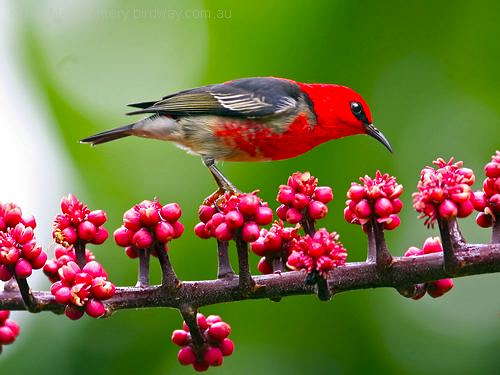
Scarlet Myzomela (Myzomela sanguinolenta) by Ian at Birdway

Scarlet Myzomela (Myzomela sanguinolenta) by Ian at Birdway

He has made His wonderful works to be remembered; the Lord is gracious, merciful, and full of loving compassion. (Psalms 111:4 AMP)

While we are reviewing while I am still in the “coasting mode“, today let’s review the various Regular and Guest Writers. I am so thankful for all of them and especially two who are regulars and have their own pages (menu).

Ian Montgomery, an Australian, was one of first photographers who gave permission to use his photos. From there, he gave permission to reproduce his newsletters in our Ian’s Bird of the Week series. I have enjoyed them and trust you have also. He has introduced us to many birds we would never have seen or heard about.

Bird and Newsletter Date

Golden Bowerbird (Prionodura newtoniana) by Ian

Golden Bowerbird (Prionodura newtoniana) by Ian

A J or a j mithra as he prefers, is from India and has been providing articles about birds and challenging us to better serve the Lord. He always seem to make great spiritual comparisons between the avian behavior and the lessons to be learned from them. You can find these at the tab,  a j mithra and he writes most of the Nuggets Plus.

a j mithra:

Nuggets Plus:

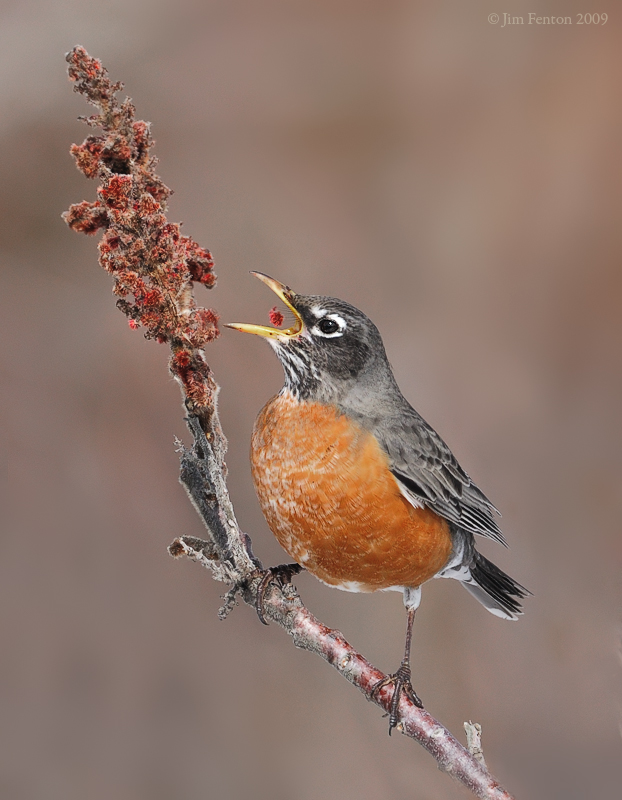
Robin Eating by Jim Fenton

Robin Eating by Jim Fenton

We also have various writers, like Dottie Malcolm and her grand-daughter, Emma, who write now and then. They are members of our church. Stephen is also from our church.

Dorothy (Dottie) Belle Malcolm’s:

Emma Foster:

Stephen Simpson’s:

Guest Writers From the Past:

And others:

The Lord has been gracious to allow the blog to have these add their additions. So, check these out. Must be one or two you haven’t read before. And thank you for visiting here as often as you do. Pressing the “Like” now and then helps us know which type articles you enjoy the best.

*

Birdwatching Reviews

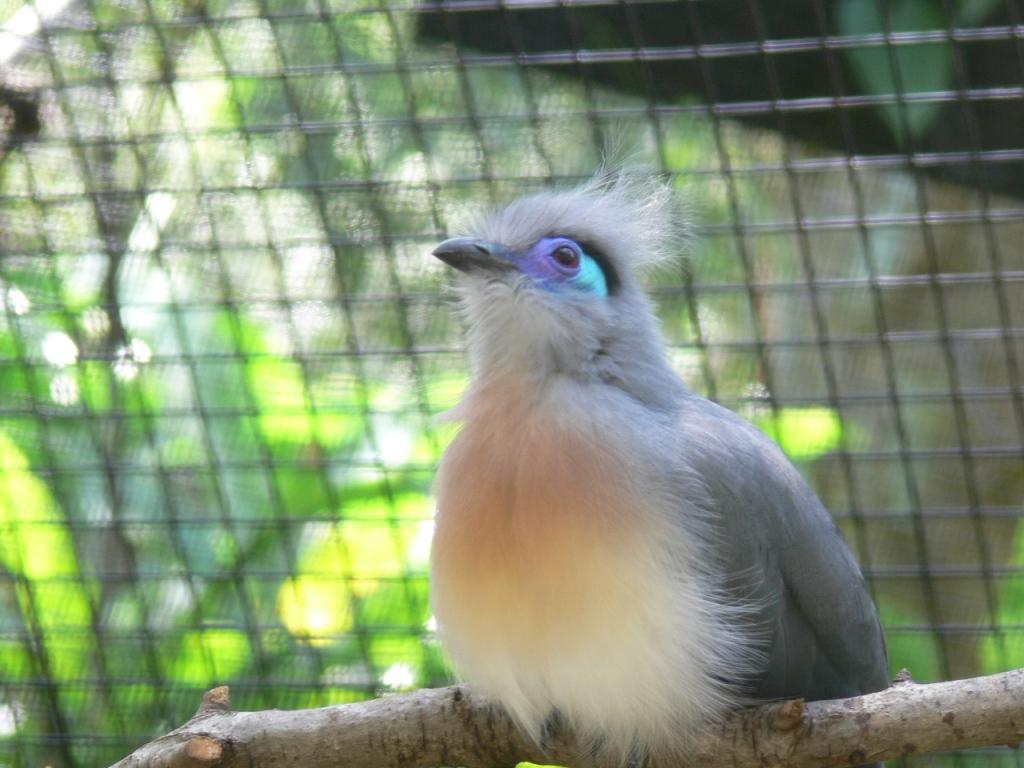
Crested Coua (Coua cristata) by Lee at LPZoo

Crested Coua (Coua cristata) by Lee at LPZoo

I remember the days of old; I meditate on all Your doings; I ponder the work of Your hands. (Psalms 143:5 AMP)

If you read yesterday’s post, Birds of the Bible Review II, you know I am in a “coasting mode” due to surgery on my neck. Today, I am encouraging you to look around the blog at some of the many Birdwatching articles that have been written over the last five years. Also, continue to pray that my cut heals and the infection clears up. It is better today.

Here are some of those many articles:

Joe Cool

(Black and White) Sumatran Laughingthrush (Garrulax bicolor) by Lee

Birdwatching

Beside them the birds of the heavens have their nests; they sing among the branches. [Matt. 13:32.] (Psalms 104:12 AMP)

Our Birdwatching Trips and other comments about birds and birding.

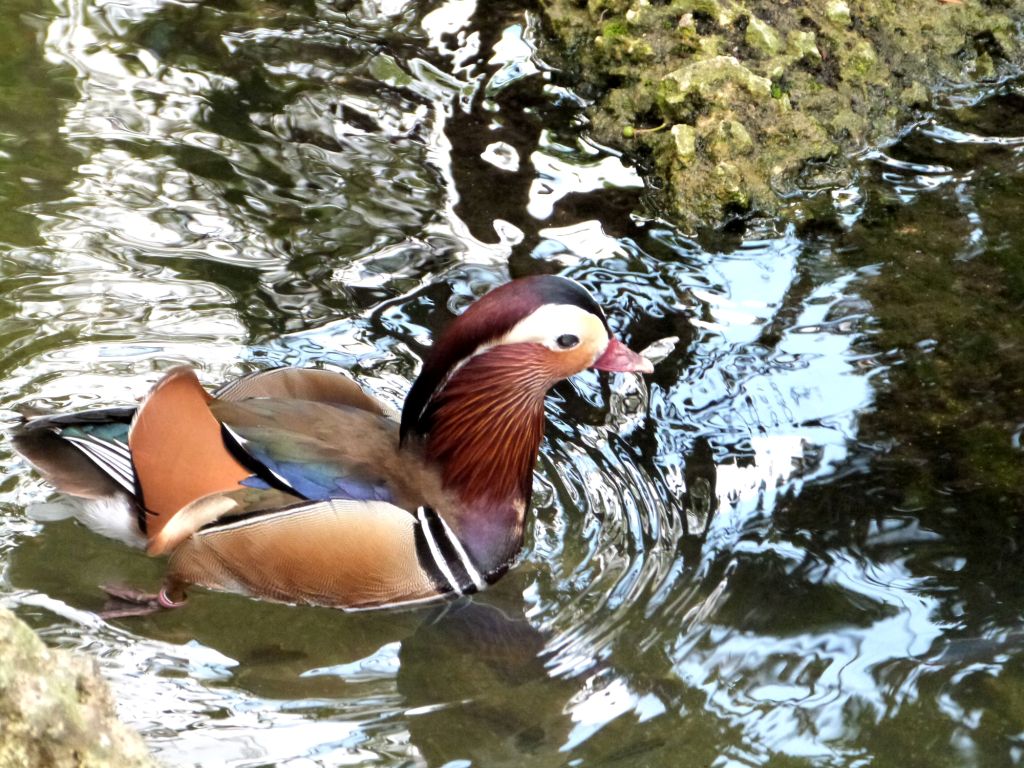
Mandarin Duck (Aix galericulata) Zoo Miami by Lee

Mandarin Duck (Aix galericulata) Zoo Miami by Lee

Formed By Him

Thou art worthy, O Lord, to receive glory and honour and power: for thou hast created all things, and for thy pleasure they are and were created (Revelation 4:11 KJV)

List of Articles:

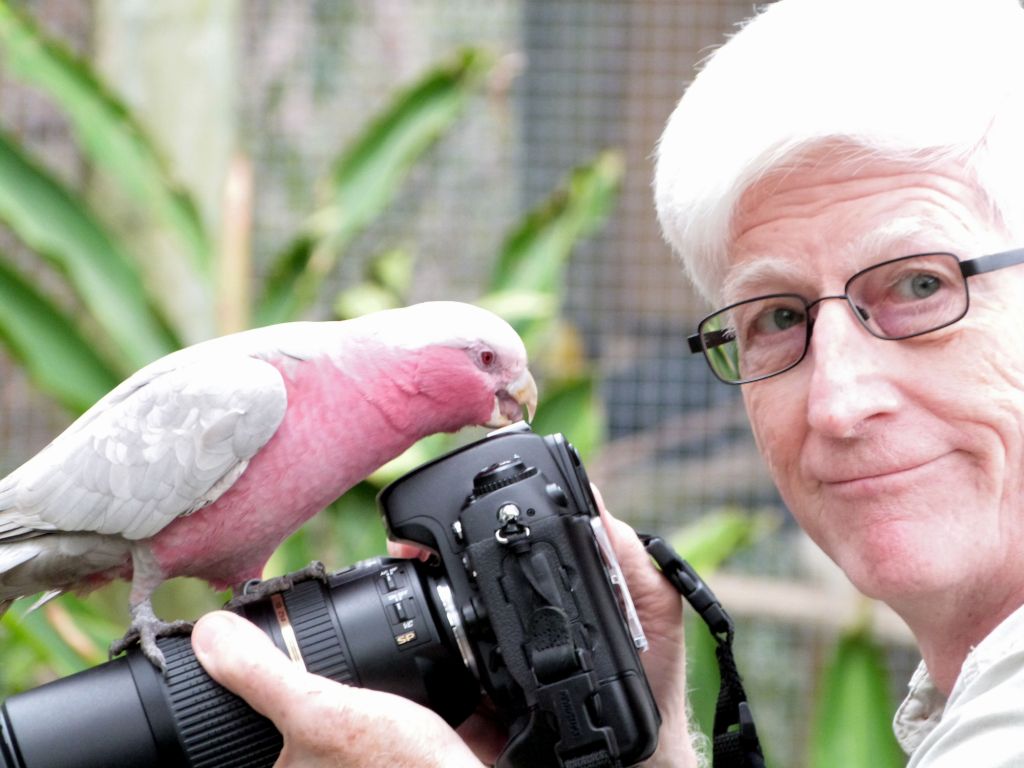
Galah (Eolophus roseicapilla) and Dan at Brevard Zoo

Galah (Eolophus roseicapilla) and Dan

Birds of the World

Are not five sparrows sold for two pennies? And [yet] not one of them is forgotten or uncared for in the presence of God. (Luke 12:6 AMP)

Birds of the World

*